
NONSENSE BOOKSBy Edward Lear.
|
| ||
—JOHN RUSKIN,
|
|


The following lines by Mr. Lear were written for a
young lady of his acquaintance, who had quoted to
him the words of a young lady not of his acquaintance,
“HOW PLEASANT TO KNOW MR. LEAR!”
“How pleasant to know Mr. Lear!”
His mind is concrete and fastidious,
He has ears, and two eyes, and ten fingers,
He sits in a beautiful parlor, |
 |
He has many friends, lay men and clerical,
When he walks in waterproof white,
He weeps by the side of the ocean,
He reads, but he cannot speak, Spanish, |
INTRODUCTION.
Edward Lear, the artist, Author of “Journals
of a Landscape Painter” in various out-of-the-way
countries, and of the delightful “Books of Nonsense,”
which have amused successive generations of children,
died on Sunday, January 29, 1888, at San Remo, Italy,
where he had lived for twenty years. Few names
could evoke a wider expression of passing regret at
their appearance in the obituary column; for until his
health began to fail he was known to an immense and
almost a cosmopolitan circle of acquaintance, and popular
wherever he was known. Fewer still could call
up in the minds of intimate friends a deeper and more
enduring feeling of sorrow for personal loss, mingled
with the pleasantest of memories; for it was impossible
to know him thoroughly and not to love him. London,
Rome, the Mediterranean countries generally, Ceylon
and India, are still all dotted with survivors among
his generation who will mourn for him affectionately,
although his latter years were spent in comparatively
close retirement. He was a man of striking
nobility of nature, fearless, independent, energetic,
given to forming for himself strong opinions, often hastily,
sometimes bitterly; not always strong or sound in
judgment, but always seeking after truth in every matter,
and following it as he understood it in scorn of
consequence; utterly unselfish, devoted to his friends,
generous even to extravagance towards any one who
had ever been connected with his fortunes or his
travels; playful, light-hearted, witty, and humorous,
but not without those occasional fits of black depression
and nervous irritability to which such temperaments
are liable.
Great and varied as the merits of his pictures are,
Lear hardly succeeded in achieving any great popularity
as a landscape-painter. His work was frequently
done on private commission, and he rarely sent in pictures
for the Academy or other exhibitions. His larger
and more highly finished landscapes were unequal in
technical perfection,—sometimes harsh or cold in
color, or stiff in composition; sometimes full of imagination,
at others literal and prosaic,—but always
impressive reproductions of interesting or peculiar scenery.
In later years he used in conversation to qualify
himself as a “topographical artist;” and the definition
was true, though not exhaustive. He had an intuitive
and a perfectly trained eye for the character and
beauty of distant mountain lines, the solemnity of rocky
gorges, the majesty of a single mountain rising from
a base of plain or sea; and he was equally exact in
rendering the true forms of the middle distances and
the specialties of foreground detail belonging to the
various lands through which he had wandered as a
sketcher. Some of his pictures show a mastery which
has rarely been equalled over the difficulties of painting
an immense plain as seen from a height, reaching
straight away from the eye of the spectator until it is
lost in a dim horizon. Sir Roderick Murchison used
to say that he always understood the geological peculiarities
of a country he had only studied in Lear’s
sketches. The compliment was thoroughly justified;
and it is not every landscape-painter to whom it could
honestly be paid.
The history of Lear’s choice of a career was a curious
one. He was the youngest of twenty-one children,
and, through a family mischance, was thrown entirely
on the limited resources of an elderly sister at a very
early age. As a boy he had always dabbled in colors
for his own amusement, and had been given to poring
over the ordinary boys’ books upon natural history.
It occurred to him to try to turn his infant talents to
account; and he painted upon cardboard a couple of
birds in the style which the older among us remember
as having been called Oriental tinting, took them to a
small shop, and sold them for fourpence. The kindness
of friends, to whom he was ever grateful, gave
him the opportunity of more serious and more remunerative
study, and he became a patient and accurate
zoölogical draughtsman. Many of the birds in the
earlier volumes of Gould’s magnificent folios were
drawn for him by Lear. A few years back there were
eagles alive in the Zoölogical Gardens in Regent’s
Park to which Lear could point as old familiar friends
that he had drawn laboriously from claw to beak fifty
years before. He united with this kind of work the
more unpleasant occupation of drawing the curiosities
of disease or deformity in hospitals. One day, as he
was busily intent on the portrait of a bird in the Zoölogical
Gardens, an old gentleman came and looked
over his shoulder, entered into conversation, and finally
said to him, “You must come and draw my birds at
Knowsley.” Lear did not know where Knowsley was,
or what it meant; but the old gentleman was the
thirteenth Earl of Derby. The successive Earls of
Derby have been among Lear’s kindest and most generous
patrons. He went to Knowsley, and the drawings
in the “Knowsley Menagerie” (now a rare and highly-prized
work among book collectors) are by Lear’s
hand. At Knowsley he became a permanent favorite;
and it was there that he composed in prolific succession
his charming and wonderful series of utterly nonsensical
rhymes and drawings. Lear had already begun seriously
to study landscape. When English winters began
to threaten his health, Lord Derby started a
subscription which enabled him to go to Rome as a
student and artist, and no doubt gave him recommendations
among Anglo-Roman society which laid the
foundations of a numerous clientèle. It was in the
Roman summers that Lear first began to exercise
the taste for pictorial wandering which grew into a
habit and a passion, to fill vivid and copious note-books
as he went, and to illustrate them by spirited and accurate
drawings; and his first volume of “Illustrated
Excursions in Italy,” published in 1846, is gratefully
dedicated to his Knowsley patron.
Only those who have travelled with him could know
what a delightful comrade he was to men whose tastes
ran more or less parallel to his own. It was not everybody
who could travel with him; for he was so irrepressibly
anxious not to lose a moment of the time at
his disposal for gathering into his garners the beauty
and interest of the lands over which he journeyed, that
he was careless of comfort and health. Calabria, Sicily,
the Desert of Sinai, Egypt and Nubia, Greece and
Albania, Palestine, Syria, Athos, Candia, Montenegro,
Zagóri (who knows now where Zagóri is, or was?),
were as thoroughly explored and sketched by him as
the more civilized localities of Malta, Corsica, and
Corfu. He read insatiably before starting all the recognized
guide-books and histories of the country he
intended to draw; and his published itineraries are
marked by great strength and literary interest quite
irrespectively of the illustrations. And he had
his reward. It is not any ordinary journalist and
sketcher who could have compelled from Tennyson
such a tribute as lines “To E.L. on his Travels in
Greece”:—
“Illyrian woodlands, echoing falls
Of water, sheets of summer glass,
The long divine Peneïan pass,
The vast Akrokeraunian walls,“Tomohrit, Athos, all things fair,
With such a pencil, such a pen,
You shadow forth to distant men,
I read and felt that I was there.”
Lear was a man to whom, as to Tennyson’s Ulysses,
“All experience is an arch wherethrough
Gleams that untravelled world.”
After settling at San Remo, and when he was nearly
sixty years old, he determined to visit India and Ceylon.
He started once and failed, being taken so ill at Suez
that he was obliged to return. The next year he succeeded,
and brought away some thousands of drawings
of the most striking views from all three Presidencies
and from the tropical island. His appetite for travel
continued to grow with what it fed upon; and although
he hated a long sea-voyage, he used seriously
to contemplate as possible a visit to relations in New
Zealand. It may safely, however, be averred that no
considerations would have tempted him to visit the
Arctic regions.
A hard-working life, checkered by the odd adventures
which happen to the odd and the adventurous
and pass over the commonplace; a career brightened
by the high appreciation of unimpeachable critics;
lightened, till of late, by the pleasant society and good
wishes of innumerable friends; saddened by the growing
pressure of ill health and solitude; cheered by his
constant trust in the love and sympathy of those who
knew him best, however far away,—such was the life
of Edward Lear.
—The London Saturday Review,
Feb. 4, 1888.
Among the writers who have striven with varying
success during the last thirty or forty years to awaken
the merriment of the “rising generation” of the time
being, Mr. Edward Lear occupies the first place in
seniority, if not in merit. The parent of modern nonsense-writers,
he is distinguished from all his followers
and imitators by the superior consistency with which
he has adhered to his aim,—that of amusing his readers
by fantastic absurdities, as void of vulgarity or
cynicism as they are incapable of being made to harbor
any symbolical meaning. He “never deviates into
sense;” but those who appreciate him never feel the
need of such deviation. He has a genius for coining
absurd names and words, which, even when they are
suggested by the exigencies of his metre, have a ludicrous
appropriateness to the matter in hand. His
verse is, with the exception of a certain number
of cockney rhymes, wonderfully flowing and even
melodious—or, as he would say, meloobious— while
to all these qualifications for his task must finally
be added the happy gift of pictorial expression, enabling
him to double, nay, often to quadruple, the
laughable effect of his text by an inexhaustible profusion
of the quaintest designs. Generally speaking,
these designs are, as it were, an idealization of the
efforts of a clever child; but now and then—as in the
case of the nonsense-botany—Mr. Lear reminds us
what a genuine and graceful artist he really is. The
advantage to a humorist of being able to illustrate his
own text has been shown in the case of Thackeray and
Mr. W. S. Gilbert, to mention two familiar examples;
but in no other instance of such a combination have we
discovered such geniality as is to be found in the nonsense-pictures
of Mr. Lear. We have spoken above of
the melodiousness of Mr. Lear’s verses, a quality which
renders them excellently suitable for musical setting,
and which has not escaped the notice of the author
himself. We have also heard effective arrangements,
presumably by other composers, of the adventures of
the Table and the Chair, and of the cruise of the Owl
and the Pussy-cat,—the latter introduced into the
“drawing-room entertainment” of one of the followers
of John Parry. Indeed, in these days of adaptations,
it is to be wondered at that no enterprising librettist
has attempted to build a children’s comic opera out of
the materials supplied in the four books with which
we are now concerned. The first of these, originally
published in 1846, and brought out in an enlarged form
in 1863, is exclusively devoted to nonsense-verses of one
type. Mr. Lear is careful to disclaim the credit of
having created this type, for he tells us in the preface
to his third book that “the lines beginning, ‘There was
an old man of Tobago,’ were suggested to me by a
valued friend, as a form of verse leading itself to limitless
variety for Rhymes and Pictures.” Dismissing the
further question of the authorship of “There was an
old man of Tobago,” we propose to give a few specimens
of Mr. Lear’s Protean powers as exhibited in the
variation of this simple type. Here, to begin with, is
a favorite verse, which we are very glad to have an
opportunity of giving, as it is often incorrectly quoted,
“cocks” being substituted for “owls” in the third line:
There was an Old Man with a beard,
Who said, ‘It is just as I feared!
Two Owls and a Hen, four Larks and a Wren,
Have all built their nests in my beard!'”
With the kindly fatalism which is the distinctive note
of the foregoing stanza, the sentiment of our next extract
is in vivid contrast:—
“There was an Old Man in a tree,
Who was terribly bored by a bee;
When they said, ‘Does it buzz?’ he replied, ‘Yes, it does!
It’s a regular brute of a Bee.'”
To the foregoing verse an historic interest attaches,
if, that is, we are right in supposing it to have inspired
Mr. Gilbert with his famous “Nonsense-Rhyme in
Blank Verse.” We quote from memory:—
“There was an Old Man of St. Bees,
Who was stung in the arm by a wasp.
When they asked, ‘Does it hurt?’ he replied, ‘No, it doesn’t,
But I thought all the while ’twas a Hornet!'”
Passing over the lines referring to the “Young Person”
of Crete to whom the epithet “ombliferous” is applied,
we may be pardoned—on the ground of the geographical
proximity of the two countries named—for quoting
together two stanzas which in reality are separated
by a good many pages:—
“There was a Young Lady of Norway,
Who casually sat in a doorway;
When the doors queezed her flat, she exclaimed, ‘What of that?’
This courageous young person of Norway.”
“There was a Young Lady of Sweden,
Who went by the slow train to Weedon;
When they cried, ‘Weedon Station!’ she made no observation,
But thought she should go back to Sweden.”
A noticeable feature about this first book, and one
which we think is peculiar to it, is the harsh treatment
which the eccentricities of the inhabitants of certain
towns appear to have met with at the hands of
their fellow-residents. No less than three people are
“smashed,”—the Old Man of Whitehaven “who
danced a quadrille with a Raven;” the Old Person of
Buda; and the Old Man with a gong “who bumped at
it all the day long,” though in the last-named case we
admit that there was considerable provocation. Before
quitting the first “Nonsense-Book,” we would point
out that it contains one or two forms that are interesting;
for instance, “scroobious,” which we take
to be a Portmanteau word, and “spickle-speckled,”
a favorite form of reduplication with Mr. Lear, and
of which the best specimen occurs in his last book,
“He tinkledy-binkledy-winkled the bell.” The second
book, published in 1871, shows Mr. Lear in the
maturity of sweet desipience, and will perhaps remain
the favorite volume of the four to grown-up readers.
The nonsense-songs are all good, and “The Story of
the Four little Children who went Round the World”
is the most exquisite piece of imaginative absurdity
that the present writer is acquainted with. But before
coming to that, let us quote a few lines from “The
Jumblies,” who, as all the world knows, went to sea in
a sieve:—
“They sailed to the Western Sea, they did,
To a land all covered with trees.
And they bought an Owl, and a useful Cart,
And a pound of Rice, and a Cranberry Tart,
And a hive of silvery Bees.
And they bought a Pig, and some green Jack-Daws,
And a lovely Monkey with lollipop paws,
And forty bottles of Ring-Bo-Ree,
And no end of Stilton Cheese.
Far and few, far and few,
Are the lands where the Jumblies live.
Their heads are green, and their hands are blue,
And they went to sea in a sieve.And in twenty years they all came back,
In twenty years or more,
And every one said, ‘How tall they’ve grown!
For they’ve been to the Lakes, and the Torrible Zone,
And the hills of the Chankly Bore.'”
From the pedestrian excursion of the Table and the
Chair, we cannot resist making a brief quotation,
though in this, as in every case, the inability to quote
the drawings also is a sad drawback:—
“So they both went slowly down,
And walked about the town,
With a cheerful bumpy sound,
As they toddled round and round.
And everybody cried,
As they hastened to their side,
‘See, the Table and the Chair
Have come out to take the air!’“But in going down an alley
To a castle in a valley,
They completely lost their way,
And wandered all the day,
Till, to see them safely back,
They paid a Ducky-Quack,
And a Beetle and a Mouse,
Who took them to their house.“Then they whispered to each other,
‘O delightful little brother,
What a lovely walk we’ve taken!
Let us dine on Beans and Bacon!’
So the Ducky and the leetle
Browny-Mousy, and the Beetle
Dined, and danced upon their heads,
Till they toddled to their beds.”
“The Story of the Four little Children who went
Round the World” follows next, and the account of
the manner in which they occupied themselves while
on shipboard may be transcribed for the benefit of
those unfortunate persons who have not perused the
original: “During the day-time Violet chiefly occupied
herself in putting salt-water into a churn, while
her three brothers churned it violently in the hope
it would turn into butter, which it seldom if ever
did.” After journeying for a time, they saw some
land at a distance, “and when they came to it they
found it was an island made of water quite surrounded
by earth. Besides that it was bordered by
evanescent isthmuses with a great Gulf-Stream running
about all over it, so that it was perfectly beautiful,
and contained only a single tree, five hundred
and three feet high.” In a later passage, we read
how “by-and-by the children came to a country
where there were no houses, but only an incredibly
innumerable number of large bottles without corks,
and of a dazzling and sweetly susceptible blue color.
Each of these blue bottles contained a bluebottlefly,
and all these interesting animals live continually
together in the most copious and rural harmony,
nor perhaps in many parts of the world is such
perfect and abject happiness to be found.” Our last
quotation from this inimitable recital shall be from
the description of their adventure on a great plain
where they espied an object which “on a nearer
approach and on an accurately cutaneous inspection,
seemed to be somebody in a large white wig sitting on
an arm-chair made of sponge-cake and oyster-shells.”
This turned out to be the “Co-operative Cauliflower,”
who, “while the whole party from the boat was gazing
at him with mingled affection and disgust … suddenly
arose, and in a somewhat plumdomphious manner
hurried off towards the setting sun, his steps supported
by two superincumbent confidential cucumbers
… till he finally disappeared on the brink of the western
sky in a crystal cloud of sudorific sand. So remarkable
a sight of course impressed the four children very
deeply; and they returned immediately to their boat
with a strong sense of undeveloped asthma and a great
appetite.”
In his third book, Mr. Lear takes occasion in an
entertaining preface to repudiate the charge of harboring
any ulterior motive beyond that of “Nonsense
pure and absolute” in any of his verses or pictures,
and tells a delightful anecdote illustrative of the “persistently
absurd report” that the Earl of Derby was the
author of the first book of “Nonsense.” In this volume
he reverts once more to the familiar form adopted in
his original efforts, and with little falling off. It is to
be remarked that the third division is styled “Twenty-Six
Nonsense Rhymes and Pictures,” although there is
no more rhyme than reason in any of the set. Our
favorite illustrations are those of the “Scroobious
Snake who always wore a Hat on his Head, for fear he
should bite anybody,” and the “Visibly Vicious Vulture
who wrote some Verses to a Veal-cutlet in a
Volume bound in Vellum.” In the fourth and last of
Mr. Lear’s books, we meet not only with familiar words,
but personages and places,—old friends like the Jumblies,
the Yonghy-Bonghy-Bo, the Quangle Wangle,
the hills of the Chankly Bore, and the great Gromboolian
plain, as well as new creations, such as the Dong
with a luminous Nose, whose story is a sort of nonsense
version of the love of Nausicaa for Ulysses, only
that the sexes are inverted. In these verses, graceful
fancy is so subtly interwoven with nonsense as almost
to beguile us into feeling a real interest in Mr. Lear’s
absurd creations. So again in the Pelican chorus there
are some charming lines:—
“By day we fish, and at eve we stand
On long bare islands of yellow sand.
And when the sun sinks slowly down,
And the great rock-walls grow dark and brown,
When the purple river rolls fast and dim,
And the ivory Ibis starlike skim,
Wing to wing we dance around,” etc.
The other nonsense-poems are all good, but we have
no space for further quotation, and will take leave of
our subject by propounding the following set of examination
questions which a friend who is deeply versed
in Mr. Lear’s books has drawn up for us:—
1. What do you gather from a study of Mr. Lear’s works to
have been the prevalent characteristics of the inhabitants of
Gretna, Prague, Thermopylae, Wick, and Hong Kong?2. State briefly what historical events are connected with
Ischia, Chertsey, Whitehaven, Boulak, and Jellibolee.3. Comment, with illustrations, upon Mr. Lear’s use of the
following words: Runcible, propitious, dolomphious, borascible,
fizzgiggious, himmeltanious, tumble-dum-down, spongetaneous.4. Enumerate accurately all the animals who lived on the
Quangle Wangle’s Hat, and explain how the Quangle Wangle
was enabled at once to enlighten his five travelling companions
as to the true nature of the Co-operative Cauliflower.5. What were the names of the five daughters of the Old
Person of China, and what was the purpose for which the
Old Man of the Dargle purchased six barrels of Gargle?6. Collect notices of King Xerxes in Mr. Lear’s works, and
state your theory, if you have any, as to the character and
appearance of Nupiter Piffkin.7. Draw pictures of the Plum-pudding flea, and the Moppsikon
Floppsikon Bear, and state by whom waterproof tubs
were first used.8. “There was an old man at a station
Who made a promiscuous oration.”What bearing may we assume the foregoing couplet to have
upon Mr. Lear’s political views?—The London Spectator.
A Book of Nonsenseby Edward Lear.With All the Original Pictures and Verses.
|
1894 Cover |


NONSENSE RHYMES AND PICTURES


Nonsense Songs, |
|
NONSENSE SONGS.

THE OWL AND THE PUSSY-CAT.
I.
The Owl and the Pussy-Cat went to sea
In a beautiful pea-green boat:
They took some honey, and plenty of money
Wrapped up in a five-pound note.
The Owl looked up to the stars above,
And sang to a small guitar,
“O lovely Pussy, O Pussy, my love,
What a beautiful Pussy you are,
You are,
You are!
What a beautiful Pussy you are!”
II.
Pussy said to the Owl, “You elegant fowl,
How charmingly sweet you sing!
Oh! let us be married; too long we have tarried:
But what shall we do for a ring?”
They sailed away, for a year and a day,
To the land where the bong-tree grows;
And there in a wood a Piggy-wig stood,
With a ring at the end of his nose,
His nose,
His nose,
With a ring at the end of his nose.

III.
“Dear Pig, are you willing to sell for one shilling
Your ring?” Said the Piggy, “I will.”
So they took it away, and were married next day
By the Turkey who lives on the hill.
They dined on mince and slices of quince,
Which they ate with a runcible spoon;
And hand in hand, on the edge of the sand,
They danced by the light of the moon,
The moon,
The moon,
They danced by the light of the moon.


THE DUCK AND THE KANGAROO.
I.
Said the Duck to the Kangaroo,
“Good gracious! how you hop
Over the fields, and the water too,
As if you never would stop!
My life is a bore in this nasty pond;
And I long to go out in the world beyond:
I wish I could hop like you,”
Said the Duck to the Kangaroo.
II.
“Please give me a ride on your back,”
Said the Duck to the Kangaroo:
“I would sit quite still, and say nothing but ‘Quack’
The whole of the long day through;
And we ‘d go the Dee, and the Jelly Bo Lee,
Over the land, and over the sea:
Please take me a ride! oh, do!”
Said the Duck to the Kangaroo.

III.
Said the Kangaroo to the Duck,
“This requires some little reflection.
Perhaps, on the whole, it might bring me luck;
And there seems but one objection;
Which is, if you’ll let me speak so bold,
Your feet are unpleasantly wet and cold,
And would probably give me the roo-
Matiz,” said the Kangaroo.
IV.
Said the Duck, “As I sate on the rocks,
I have thought over that completely;
And I bought four pairs of worsted socks,
Which fit my web-feet neatly;
And, to keep out the cold, I’ve bought a cloak;
And every day a cigar I’ll smoke;
All to follow my own dear true
Love of a Kangaroo.”
V.
Said the Kangaroo, “I’m ready,
All in the moonlight pale;
But to balance me well, dear Duck, sit steady,
And quite at the end of my tail.”

So away they went with a hop and a bound;
And they hopped the whole world three times round.
And who so happy, oh! who,
As the Duck and the Kangaroo?


THE DADDY LONG-LEGS AND THE FLY.
I.
Once Mr. Daddy Long-legs,
Dressed in brown and gray,
Walked about upon the sands
Upon a summer’s day:
And there among the pebbles,
When the wind was rather cold,
He met with Mr. Floppy Fly,
All dressed in blue and gold;
And, as it was too soon to dine,
They drank some periwinkle-wine,
And played an hour or two, or more,
At battlecock and shuttledore.
II.
Said Mr. Daddy Long-legs
To Mr. Floppy Fly,
“Why do you never come to court?
I wish you ‘d tell me why.
All gold and shine, in dress so fine,
You’d quite delight the court.
Why do you never go at all?
I really think you ought.
And, if you went, you’d see such sights!
Such rugs and jugs and candle-lights!
And, more than all, the king and queen,—
One in red, and one in green.”
III.
“O Mr. Daddy Long-legs!”
Said Mr. Floppy Fly,
“It’s true I never go to court;
And I will tell you why.
If I had six long legs like yours,
At once I’d go to court;
But, oh! I can’t, because my legs
Are so extremely short.
And I’m afraid the king and queen
(One in red, and one in green)
Would say aloud, ‘You are not fit,
You Fly, to come to court a bit!'”
IV.
“Oh, Mr. Daddy Long-legs!”
Said Mr. Floppy Fly,
“I wish you ‘d sing one little song,
One mumbian melody.
You used to sing so awful well
In former days gone by;
But now you never sing at all:
I wish you’d tell me why:
For, if you would, the silvery sound
Would please the shrimps and cockles round,
And all the crabs would gladly come
To hear you sing, ‘Ah, Hum di Hum!'”
V.
Said Mr. Daddy Long-legs,
“I can never sing again;
And, if you wish, I’ll tell you why,
Although it gives me pain.
For years I cannot hum a bit,
Or sing the smallest song;
And this the dreadful reason is,—
My legs are grown too long!
My six long legs, all here and there,
Oppress my bosom with despair;
And, if I stand or lie or sit,
I cannot sing one single bit!”
VI.
So Mr. Daddy Long-legs
And Mr. Floppy Fly
Sat down in silence by the sea,
And gazed upon the sky.
They said, “This is a dreadful thing!
The world has all gone wrong,
Since one has legs too short by half,
The other much too long.
One never more can go to court,
Because his legs have grown too short;
The other cannot sing a song,
Because his legs have grown too long!”
VII.
Then Mr. Daddy Long-legs
And Mr. Floppy Fly
Rushed downward to the foamy sea
With one sponge-taneous cry:
And there they found a little boat,
Whose sails were pink and gray;
And off they sailed among the waves,
Far and far away:
They sailed across the silent main,
And reached the great Gromboolian Plain;
And there they play forevermore
At battlecock and shuttledore.


THE JUMBLIES.
I.
They went to sea in a sieve, they did;
In a sieve they went to sea:
In spite of all their friends could say,
On a winter’s morn, on a stormy day,
In a sieve they went to sea.
And when the sieve turned round and round,
And every one cried, “You’ll all be drowned!”
They called aloud, “Our sieve ain’t big;
But we don’t care a button, we don’t care a fig:
In a sieve we’ll go to sea!”
Far and few, far and few,
Are the lands where the Jumblies live:
Their heads are green, and their hands are blue
And they went to sea in a sieve.
II.
They sailed away in a sieve, they did,
In a sieve they sailed so fast,
With only a beautiful pea-green veil
Tied with a ribbon, by way of a sail,
To a small tobacco-pipe mast.
And every one said who saw them go,
“Oh! won’t they be soon upset, you know?
For the sky is dark, and the voyage is long;
And, happen what may, it’s extremely wrong
In a sieve to sail so fast.”
Far and few, far and few,
Are the lands where the Jumblies live:
Their heads are green, and their hands are blue;
And they went to sea in a sieve.
III.
The water it soon came in, it did;
The water it soon came in:
So, to keep them dry, they wrapped their feet
In a pinky paper all folded neat;
And they fastened it down with a pin.
And they passed the night in a crockery-jar;
And each of them said, “How wise we are!
Though the sky be dark, and the voyage be long,
Yet we never can think we were rash or wrong,
While round in our sieve we spin.”
Far and few, far and few,
Are the lands where the Jumblies live:
Their heads are green, and their hands are blue;
And they went to sea in a sieve.
IV.
And all night long they sailed away;
And when the sun went down,
They whistled and warbled a moony song
To the echoing sound of a coppery gong,
In the shade of the mountains brown.
“O Timballoo! How happy we are
When we live in a sieve and a crockery-jar!
And all night long, in the moonlight pale,
We sail away with a pea-green sail
In the shade of the mountains brown.”
Far and few, far and few,
Are the lands where the Jumblies live:
Their heads are green, and their hands are blue;
And they went to sea in a sieve.
V.
They sailed to the Western Sea, they did,—
To a land all covered with trees:
And they bought an owl, and a useful cart,
And a pound of rice, and a cranberry-tart,
And a hive of silvery bees;
And they bought a pig, and some green jackdaws,
And a lovely monkey with lollipop paws,
And forty bottles of ring-bo-ree,
And no end of Stilton cheese.
Far and few, far and few,
Are the lands where the Jumblies live:
Their heads are green, and their hands are blue;
And they went to sea in a sieve.
VI.
And in twenty years they all came back,—
In twenty years or more;
And every one said, “How tall they’ve grown!
For they’ve been to the Lakes, and the Torrible Zone,
And the hills of the Chankly Bore.”
And they drank their health, and gave them a feast
Of dumplings made of beautiful yeast;
And every one said, “If we only live,
We, too, will go to sea in a sieve,
To the hills of the Chankly Bore.”
Far and few, far and few,
Are the lands where the Jumblies live:
Their heads are green, and their hands are blue;
And they went to sea in a sieve.

THE NUTCRACKERS AND THE SUGAR-TONGS.
I.
The Nutcrackers sate by a plate on the table;
The Sugar-tongs sate by a plate at his side;
And the Nutcrackers said, “Don’t you wish we were able
Along the blue hills and green meadows to ride?
Must we drag on this stupid existence forever,
So idle and weary, so full of remorse,
While every one else takes his pleasure, and never
Seems happy unless he is riding a horse?
II.
“Don’t you think we could ride without being instructed,
Without any saddle or bridle or spur?
Our legs are so long, and so aptly constructed,
I’m sure that an accident could not occur.
Let us all of a sudden hop down from the table,
And hustle downstairs, and each jump on a horse!
Shall we try? Shall we go? Do you think we are able?”
The Sugar-tongs answered distinctly, “Of course!”
III.
So down the long staircase they hopped in a minute;
The Sugar-tongs snapped, and the Crackers said “Crack!”
The stable was open; the horses were in it:
Each took out a pony, and jumped on his back.
The Cat in a fright scrambled out of the doorway;
The Mice tumbled out of a bundle of hay;
The brown and white Rats, and the black ones from Norway,
Screamed out, “They are taking the horses away!”
IV.
The whole of the household was filled with amazement:
The Cups and the Saucers danced madly about;
The Plates and the Dishes looked out of the casement;
The Salt-cellar stood on his head with a shout;
The Spoons, with a clatter, looked out of the lattice;
The Mustard-pot climbed up the gooseberry-pies;
The Soup-ladle peeped through a heap of veal-patties,
And squeaked with a ladle-like scream of surprise.
V.
The Frying-pan said, “It’s an awful delusion!”
The Tea-kettle hissed, and grew black in the face;
And they all rushed downstairs in the wildest confusion
To see the great Nutcracker-Sugar-tong race.
And out of the stable, with screamings and laughter
(Their ponies were cream-colored, speckled with brown),
The Nutcrackers first, and the Sugar-tongs after;
Rode all round the yard, and then all round the town.
VI.
They rode through the street, and they rode by the station;
They galloped away to the beautiful shore;
In silence they rode, and “made no observation,”
Save this: “We will never go back any more!”
And still you might hear, till they rode out of hearing,
The Sugar-tongs snap, and the Crackers say “Crack!”
Till, far in the distance their forms disappearing,
They faded away; and they never came back!
CALICO PIE.

I.
Calico pie,
The little birds fly
Down to the calico-tree:
Their wings were blue,
And they sang “Tilly-loo!”
Till away they flew;
And they never came back to me!
They never came back,
They never came back,
They never came back to me!
II.
Calico jam,
The little Fish swam
Over the Syllabub Sea.
He took off his hat
To the Sole and the Sprat,
And the Willeby-wat:

But he never came back to me;
He never came back,
He never came back,
He never came back to me.
III.
Calico ban,
The little Mice ran
To be ready in time for tea;
Flippity flup,
They drank it all up,
And danced in the cup:
But they never came back to me;
They never came back,
They never came back,
They never came back to me

IV.
Calico drum,
The Grasshoppers come,
The Butterfly, Beetle, and Bee,
Over the ground,
Around and round,
With a hop and a bound;

But they never came back,
They never came back,
They never came back.
They never came back to me.

MR. AND MRS. SPIKKY SPARROW.
I.
On a little piece of wood
Mr. Spikky Sparrow stood:
Mrs. Sparrow sate close by,
A-making of an insect-pie
For her little children five,
In the nest and all alive;
Singing with a cheerful smile,
To amuse them all the while,
“Twikky wikky wikky wee,
Wikky bikky twikky tee,
Spikky bikky bee!”
II.
Mrs. Spikky Sparrow said,
“Spikky, darling! in my head
Many thoughts of trouble come,
Like to flies upon a plum.
All last night, among the trees,
I heard you cough, I heard you sneeze;
And thought I, ‘It’s come to that
Because he does not wear a hat!’
Chippy wippy sikky tee,
Bikky wikky tikky mee,
Spikky chippy wee!
III.
“Not that you are growing old;
But the nights are growing cold.
No one stays out all night long
Without a hat: I’m sure it’s wrong!”
Mr. Spikky said, “How kind,
Dear, you are, to speak your mind!
All your life I wish you luck!
You are, you are, a lovely duck!
Witchy witchy witchy wee,
Twitchy witchy witchy bee,
Tikky tikky tee!
IV.
“I was also sad, and thinking,
When one day I saw you winking,
And I heard you sniffle-snuffle,
And I saw your feathers ruffle:
To myself I sadly said,
‘She’s neuralgia in her head!
That dear head has nothing on it!
Ought she not to wear a bonnet?’
Witchy kitchy kitchy wee,
Spikky wikky mikky bee,
Chippy wippy chee!
V.
“Let us both fly up to town:
There I’ll buy you such a gown!
Which, completely in the fashion,
You shall tie a sky-blue sash on;
And a pair of slippers neat
To fit your darling little feet,
So that you will look and feel
Quite galloobious and genteel.
Jikky wikky bikky see,
Chicky bikky wikky bee,
Twicky witchy wee!”
VI.
So they both to London went,
Alighting on the Monument;
Whence they flew down swiftly—pop!
Into Moses’ wholesale shop:
There they bought a hat and bonnet,
And a gown with spots upon it,
A satin sash of Cloxam blue,
And a pair of slippers too.
Zikky wikky mikky bee,
Witchy witchy mitchy kee,
Sikky tikky wee!
VII.
Then, when so completely dressed,
Back they flew, and reached their nest.
Their children cried, “O ma and pa!
How truly beautiful you are!”
Said they, “We trust that cold or pain
We shall never feel again;
While, perched on tree or house or steeple,
We now shall look like other people.
Witchy witchy witchy wee,
Twikky mikky bikky bee,
Zikky sikky tee!”


THE BROOM, THE SHOVEL, THE POKER, AND THE TONGS.
I.
The Broom and the Shovel, the Poker and Tongs,
They all took a drive in the Park;
And they each sang a song, ding-a-dong, ding-a-dong!
Before they went back in the dark.
Mr. Poker he sate quite upright in the coach;
Mr. Tongs made a clatter and clash;
Miss Shovel was dressed all in black (with a brooch);
Mrs. Broom was in blue (with a sash).
Ding-a-dong, ding-a-dong!
And they all sang a song.
II.
“O Shovely so lovely!” the Poker he sang,
“You have perfectly conquered my heart.
Ding-a-dong, ding-a-dong! If you’re pleased with my song,
I will feed you with cold apple-tart.
When you scrape up the coals with a delicate sound,
You enrapture my life with delight,
Your nose is so shiny, your head is so round,
And your shape is so slender and bright!
Ding-a-dong, ding-a-dong!
Ain’t you pleased with my song?”
III.
“Alas! Mrs. Broom,” sighed the Tongs in his song,
“Oh! is it because I’m so thin,
And my legs are so long,—ding-a-dong, ding-a-dong!—
That you don’t care about me a pin?
Ah! fairest of creatures, when sweeping the room,
Ah! why don’t you heed my complaint?
Must you needs be so cruel, you beautiful Broom,
Because you are covered with paint?
Ding-a-dong, ding-a-dong!
You are certainly wrong.”
IV.
Mrs. Broom and Miss Shovel together they sang,
“What nonsense you’re singing to-day!”
Said the Shovel, “I’ll certainly hit you a bang!”
Said the Broom, “And I’ll sweep you away!”
So the coachman drove homeward as fast as he could,
Perceiving their anger with pain;
But they put on the kettle, and little by little
They all became happy again.
Ding-a-dong, ding-a-dong!
There’s an end of my song.


THE TABLE AND THE CHAIR.
I.
Said the Table to the Chair,
“You can hardly be aware
How I suffer from the heat
And from chilblains on my feet.
If we took a little walk,
We might have a little talk;
Pray let us take the air,”
Said the Table to the Chair.
II.
Said the Chair unto the Table,
“Now, you know we are not able:
How foolishly you talk,
When you know we cannot walk!”
Said the Table with a sigh,
“It can do no harm to try.
I’ve as many legs as you:
Why can’t we walk on two?”
III.
So they both went slowly down,
And walked about the town
With a cheerful bumpy sound
As they toddled round and round;
And everybody cried,
As they hastened to their side,
“See! the Table and the Chair
Have come out to take the air!”
IV.
But in going down an alley,
To a castle in a valley,
They completely lost their way,
And wandered all the day;
Till, to see them safely back,
They paid a Ducky-quack,
And a Beetle, and a Mouse,
Who took them to their house.

V.
Then they whispered to each other,
“O delightful little brother,
What a lovely walk we’ve taken!
Let us dine on beans and bacon.”
So the Ducky and the leetle
Browny-Mousy and the Beetle
Dined, and danced upon their heads
Till they toddled to their beds.

NONSENSE STORIES.
THE STORY OF THE FOUR LITTLE CHILDREN WHO WENT ROUND THE WORLD.
Once upon a time, a long while ago, there were four little
people whose names were

and they all thought they should like to see the world. So they
bought a large boat to sail quite round the world by sea, and then
they were to come back on the other side by land. The boat was
painted blue with green spots, and the sail was yellow with red
stripes: and, when they set off, they only took a small Cat to steer
and look after the boat, besides an elderly Quangle-Wangle, who
had to cook the dinner and make the tea; for which purposes they
took a large kettle.

For the first ten days they sailed on beautifully, and found plenty
to eat, as there were lots of fish; and they had only to take them
out of the sea with a long spoon, when the Quangle-Wangle instantly
cooked them; and the Pussy-Cat was fed with the bones,
with which she expressed herself pleased, on the whole: so that all
the party were very happy.

During the daytime, Violet chiefly occupied herself in putting
salt water into a churn; while her three brothers churned it violently,
in the hope that it would turn into butter, which it seldom
if ever did; and in the evening they all retired into the tea-kettle,
where they all managed to sleep very comfortably, while Pussy and
the Quangle-Wangle managed the boat.

After a time, they saw some land at a distance; and, when they
came to it, they found it was an island made of water quite surrounded
by earth. Besides that, it was bordered by evanescent
isthmuses, with a great gulf-stream running about all over it; so
that it was perfectly beautiful, and contained only a single tree,
503 feet high.
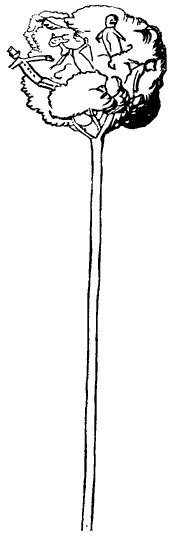
When they had landed, they walked about, but found, to their
great surprise, that the island was quite full of veal-cutlets and
chocolate-drops, and nothing else. So they all climbed up the
single high tree to discover, if possible, if there were any people;
but having remained on the top of the tree for a week, and not
seeing anybody, they naturally concluded that there were no inhabitants;
and accordingly, when they came down, they loaded
the boat with two thousand veal-cutlets
and a million of chocolate-drops;
and these afforded
them sustenance for more than
a month, during which time
they pursued their voyage with
the utmost delight and apathy.
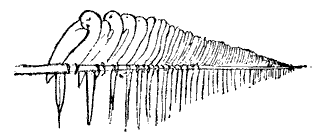
After this they came to a
shore where there were no less than sixty-five
great red parrots with blue tails, sitting
on a rail all of a row, and all fast asleep.
And I am sorry to say that the Pussy-Cat
and the Quangle-Wangle crept softly, and
bit off the tail-feathers of all the sixty-five
parrots; for which Violet reproved them
both severely.
Notwithstanding which, she proceeded
to insert all the feathers—two hundred
and sixty in number—in her bonnet;
thereby causing it to have a lovely and
glittering appearance, highly prepossessing
and efficacious.

The next thing that happened to them
was in a narrow part of the sea, which was
so entirely full of fishes that the boat could
go on no farther: so they remained there
about six weeks, till they had eaten nearly
all the fishes, which were soles, and all
ready-cooked, and covered with shrimp-sauce,
so that there was no trouble whatever.
And as the few fishes who remained uneaten complained of
the cold, as well as of the difficulty they had in getting any sleep on
account of the extreme noise made by the arctic bears and the tropical
turnspits, which frequented the neighborhood in great numbers,
Violet most amiably knitted a small woollen frock for several of
the fishes, and Slingsby administered some opium-drops to them;
through which kindness they became quite warm, and slept soundly.

Then they came to a country which was wholly covered with
immense orange-trees of a vast size, and quite full of fruit. So they
all landed, taking with them the tea-kettle, intending to gather some
of the oranges, and place them in it. But, while they were busy
about this, a most dreadfully high wind rose, and blew out most of
the parrot-tail feathers from Violet’s bonnet. That, however, was
nothing compared with the calamity of the oranges falling down on
their heads by millions and millions, which thumped and bumped
and bumped and thumped them all so seriously, that they were
obliged to run as hard as they could for their lives; besides that
the sound of the oranges rattling on the tea-kettle was of the most
fearful and amazing nature.

Nevertheless, they got safely to the boat, although considerably
vexed and hurt; and the Quangle-Wangle’s right foot was so
knocked about, that he had to sit with his head in his slipper for
at least a week.

This event made them all for a time rather melancholy: and perhaps
they might never have become less so, had not Lionel, with a
most praiseworthy devotion and perseverance, continued to stand
on one leg,
and whistle to them in a loud and lively manner; which
diverted the whole party so extremely
that they gradually recovered
their spirits, and agreed
that whenever they should reach
home, they would subscribe towards
a testimonial to Lionel, entirely
made of gingerbread and
raspberries, as an earnest token of
their sincere and grateful infection.

After sailing on calmly for
several more days, they came to another country, where they were
much pleased and surprised to see a countless multitude of white
Mice with red eyes, all sitting in a great circle, slowly eating
custard-pudding with the most satisfactory and polite demeanor.

And as the four travellers were rather hungry, being tired of eating
nothing but soles and oranges for so long a period, they held
a council as to the propriety of asking the Mice for some of their
pudding in a humble and affecting manner, by which they could
hardly be otherwise than gratified. It was agreed, therefore, that
Guy should go and ask the Mice, which he immediately did; and
the result was, that they gave a walnut-shell only half full of custard
diluted with water. Now, this displeased Guy, who said, “Out of
such a lot of pudding as you have got, I must say, you might have
spared a somewhat larger quantity.” But no sooner had he finished
speaking than the Mice turned round at once, and sneezed at him
in an appalling and vindictive manner (and it is impossible to
imagine a more scroobious and unpleasant sound than that caused by
the simultaneous sneezing of many millions of angry Mice); so that
Guy rushed back to the boat, having first shied his cap into the
middle of the custard-pudding, by which means he completely
spoiled the Mice’s dinner.

By and by the four children came to a country where there were
no houses, but only an incredibly innumerable number of large
bottles without corks, and of a dazzling and sweetly susceptible blue
color. Each of these blue bottles contained a Blue-Bottle-Fly; and
all these interesting animals live continually together in the most
copious and rural harmony: nor perhaps in many parts of the world
is such perfect and abject happiness to be found. Violet and
Slingsby and Guy and Lionel were greatly struck with this singular
and instructive settlement; and, having previously asked permission
of the Blue-Bottle-Flies (which was most courteously granted), the
boat was drawn up to the shore, and they proceeded to make tea in
front of the bottles: but as they had no tea-leaves, they merely
placed some pebbles in the hot water; and the Quangle-Wangle
played some tunes over it on an accordion, by which, of course, tea
was made directly, and of the very best quality.

The four children then entered into conversation with the Blue-Bottle-Flies,
who discoursed in a placid and genteel manner, though
with a slightly buzzing accent, chiefly owing to the fact that they
each held a small clothes-brush between their teeth, which naturally
occasioned a fizzy, extraneous utterance.
“Why,” said Violet, “would you kindly inform us, do you reside
in bottles; and, if in bottles at all, why not, rather, in green or purple,
or, indeed, in yellow bottles?”
To which questions a very aged Blue-Bottle-Fly answered, “We
found the bottles here all ready to live in; that is to say, our
great-great-great-great-great-grandfathers did: so we occupied them at
once. And, when the winter comes on, we turn the bottles upside
down, and consequently rarely feel the cold at all; and you know
very well that this could not be the case with bottles of any other
color than blue.”
“Of course it could not,” said Slingsby. “But, if we may take
the liberty of inquiring, on what do you chiefly subsist?”
“Mainly on oyster-patties,” said the Blue-Bottle-Fly; “and,
when these are scarce, on raspberry vinegar and Russian leather
boiled down to a jelly.”
“How delicious!” said Guy.
To which Lionel added, “Huzz!” And all the Blue-Bottle-Flies
said, “Buzz!”
At this time, an elderly Fly said it was the hour for the evening-song
to be sung; and, on a signal being given, all the Blue-Bottle-Flies
began to buzz at once in a sumptuous and sonorous manner,
the melodious and mucilaginous sounds echoing all over the waters,
and resounding across the tumultuous tops of the transitory titmice
upon the intervening and verdant mountains with a serene and
sickly suavity only known to the truly virtuous. The Moon was
shining slobaciously from the star-bespangled sky, while her light
irrigated the smooth and shiny sides and wings and backs of the
Blue-Bottle-Flies with a peculiar and trivial splendor, while all
Nature cheerfully responded to the cerulean and conspicuous
circumstances.
In many long-after years, the four little travellers looked back to
that evening as one of the happiest in all their lives; and it was
already past midnight when—the sail of the boat having been set
up by the Quangle-Wangle, the tea-kettle and churn placed in their
respective positions, and the Pussy-Cat stationed at the helm—the
children each took a last and affectionate farewell of the Blue-Bottle-Flies,
who walked down in a body to the water’s edge to see the
travellers embark.

As a token of parting respect and esteem, Violet made a courtesy
quite down to the ground, and stuck one of her few remaining
parrot-tail feathers into the back hair of the most pleasing of the
Blue-Bottle-Flies; while Slingsby, Guy, and Lionel offered them
three small boxes, containing, respectively, black pins, dried figs,
and Epsom salts; and thus they left that happy shore forever.
Overcome by their feelings, the four little travellers instantly
jumped into the tea-kettle, and fell fast asleep. But all along
the shore, for many hours, there was distinctly heard a sound of
severely-suppressed sobs, and of a vague multitude of living creatures
using their pocket-handkerchiefs in a subdued simultaneous
snuffle, lingering sadly along the walloping waves as the boat sailed
farther and farther away from the Land of the Happy Blue-Bottle-Flies.
Nothing particular occurred for some days after these events,
except that, as the travellers were passing a low tract of sand, they
perceived an unusual and gratifying spectacle; namely, a large
number of Crabs and Crawfish—perhaps six or seven hundred—sitting
by the water-side, and endeavoring to disentangle a vast
heap of pale pink worsted, which they moistened at intervals with
a fluid composed of lavender-water and white-wine negus.
“Can we be of any service to you, O crusty Crabbies?” said the
four children.
“Thank you kindly,” said the Crabs consecutively. “We are
trying to make some worsted mittens, but do not know how.”
On which Violet, who was perfectly acquainted with the art of
mitten-making, said to the Crabs, “Do your claws unscrew, or are
they fixtures?”
“They are all made to unscrew,” said the Crabs; and forthwith
they deposited a great pile of claws close to the boat, with which
Violet uncombed all the pale pink worsted, and then made the loveliest
mittens with it you can imagine. These the Crabs, having
resumed and screwed on their claws, placed cheerfully upon their
wrists, and walked away rapidly on their hind-legs, warbling songs
with a silvery voice and in a minor key.
After this, the four little people sailed on again till they came to
a vast and wide plain of astonishing dimensions, on which nothing
whatever could be discovered at first; but, as the travellers walked
onward, there appeared in the extreme and dim distance a single
object, which on a nearer approach, and on an accurately cutaneous
inspection, seemed to be somebody in a large white wig, sitting on
an arm-chair made of sponge-cakes and oyster-shells. “It does not
quite look like a human being,” said Violet doubtfully; nor could
they make out what it really was, till the Quangle-Wangle (who had
previously been round the world) exclaimed softly in a loud voice,
“It is the co-operative Cauliflower!”

And so, in truth, it was: and they soon found that what they had
taken for an immense wig was in reality the top of the Cauliflower;
and that he had no feet at all, being able to walk tolerably well with
a fluctuating and graceful movement on a single cabbage-stalk,—an
accomplishment which naturally saved him the expense of stockings
and shoes.
Presently, while the whole party from the boat was gazing at
him with mingled affection and disgust, he suddenly arose, and,
in a somewhat plumdomphious manner, hurried off towards the
setting sun,—his steps supported by two superincumbent confidential
Cucumbers, and a large number of Waterwagtails proceeding
in advance of him by three and three in a row,—till he finally
disappeared on the brink of the western sky in a crystal cloud of
sudorific sand.

So remarkable a sight, of course, impressed the four children very
deeply; and they returned immediately to their boat with a strong
sense of undeveloped asthma and a great appetite.
Shortly after this, the travellers were obliged to sail directly below
some high overhanging rocks, from the top of one of which a particularly
odious little boy, dressed in rose-colored knickerbockers,
and with a pewter plate upon his head, threw an enormous pumpkin
at the boat, by which it was instantly upset.

But this upsetting was of no consequence, because all the party
knew how to swim very well: and, in fact, they preferred swimming
about till after the moon rose; when, the water growing chilly, they
sponge-taneously entered the boat. Meanwhile the Quangle-Wangle
threw back the pumpkin with immense force, so that it hit the rocks
where the malicious little boy in rose-colored knickerbockers was
sitting; when, being quite full of lucifer-matches, the pumpkin
exploded surreptitiously into a thousand bits; whereon the rocks
instantly took fire, and the odious little boy became unpleasantly
hotter and hotter and hotter, till his knickerbockers were turned
quite green, and his nose was burnt off.
Two or three days after this had happened, they came to another
place, where they found nothing at all except some wide and deep
pits full of mulberry-jam. This is the property of the tiny, yellow-nosed
Apes who abound in these districts, and who store up the
mulberry-jam for their food in winter, when they mix it with pellucid
pale periwinkle-soup, and serve it out in wedgewood china-bowls,
which grow freely all over that part of the country. Only
one of the yellow-nosed Apes was on the spot, and he was fast
asleep; yet the four travellers and the Quangle-Wangle and Pussy
were so terrified by the violence and sanguinary sound of his snoring,
that they merely took a small cupful of the jam, and returned
to re-embark in their boat without delay.
What was their horror on seeing the boat (including the churn
and the tea-kettle) in the mouth of an enormous Seeze Pyder, an
aquatic and ferocious creature truly dreadful to behold, and,
happily, only met with in those excessive longitudes! In a moment,
the beautiful boat was bitten into fifty-five thousand million hundred
billion bits; and it instantly became quite clear that Violet, Slingsby,
Guy, and Lionel could no longer preliminate their voyage by sea.

The four travellers were therefore obliged to resolve on pursuing
their wanderings by land: and, very fortunately, there happened
to pass by at that moment an elderly Rhinoceros, on which they
seized; and, all four mounting on his back,—the Quangle-Wangle
sitting on his horn, and holding on by his ears, and the Pussy-Cat
swinging at the end of his tail,—they set off, having only four small
beans and three pounds of mashed potatoes to last through their
whole journey.

They were, however, able to catch numbers of the chickens and
turkeys and other birds who incessantly alighted on the head of the
Rhinoceros for the purpose of gathering the seeds of the rhododendron-plants which grew there; and these creatures they cooked in
the most translucent and satisfactory manner by means of a fire
lighted on the end of the Rhinoceros’s back. A crowd of Kangaroos
and gigantic Cranes accompanied them, from feelings of curiosity
and complacency; so that they were never at a loss for company,
and went onward, as it were, in a sort of profuse and triumphant
procession.
Thus in less than eighteen weeks they all arrived safely at
home, where they were received by their admiring relatives with
joy tempered with contempt, and where they finally resolved to
carry out the rest of their travelling-plans at some more favorable
opportunity.
As for the Rhinoceros, in token of their grateful adherence, they
had him killed and stuffed directly, and then set him up outside
the door of their father’s house as a diaphanous doorscraper.

THE HISTORY OF THE SEVEN FAMILIES OF THE LAKE PIPPLE-POPPLE.
CHAPTER I.
INTRODUCTORY.
In former days,—that is to say, once upon a time,—there lived
in the Land of Gramble-Blamble seven families. They lived
by the side of the great Lake Pipple-Popple (one of the seven
families, indeed, lived in the lake), and on the outskirts of the city
of Tosh, which, excepting when it was quite dark, they could see
plainly. The names of all these places you have probably heard
of; and you have only not to look in your geography-books to
find out all about them.
Now, the seven families who lived on the borders of the great
Lake Pipple-Popple were as follows in the next chapter.
CHAPTER II.
THE SEVEN FAMILIES.
There was a family of two old Parrots and seven young
Parrots.

There was a family of two old Storks and seven young Storks.

There was a family of two old Geese and seven young Geese.

There was a family of two old Owls and seven young Owls.

There was a family of two old Guinea Pigs and seven young
Guinea Pigs.

There was a family of two old Cats and seven young Cats.

And there was a family of two old Fishes and seven young
Fishes.

CHAPTER III.
THE HABITS OF THE SEVEN FAMILIES.
The Parrots lived upon the Soffsky-Poffsky trees, which were
beautiful to behold, and covered with blue leaves; and they
fed upon fruit, artichokes, and striped beetles.
The Storks walked in and out of the Lake Pipple-Popple, and
ate frogs for breakfast, and buttered toast for tea; but on account
of the extreme length of their legs they could not sit down, and so
they walked about continually.
The Geese, having webs to their feet, caught quantities of flies,
which they ate for dinner.
The Owls anxiously looked after mice, which they caught, and
made into sago-puddings.
The Guinea Pigs toddled about the gardens, and ate lettuces
and Cheshire cheese.
The Cats sate still in the sunshine, and fed upon sponge biscuits.
The Fishes lived in the lake, and fed chiefly on boiled periwinkles.
And all these seven families lived together in the utmost fun and
felicity.
CHAPTER IV.
THE CHILDREN OF THE SEVEN FAMILIES ARE SENT AWAY.
One day all the seven fathers and the seven mothers of the
seven families agreed that they would send their children
out to see the world.
So they called them all together, and gave them each eight
shillings and some good advice, some chocolate-drops, and a small
green morocco pocket-book to set down their expenses in.
They then particularly entreated them not to quarrel; and all
the parents sent off their children with a parting injunction.
“If,” said the old Parrots, “you find a cherry, do not fight
about who should have it.”
“And,” said the old Storks, “if you find a frog, divide it carefully
into seven bits, but on no account quarrel about it.”
And the old Geese said to the seven young Geese, “Whatever
you do, be sure you do not touch a plum-pudding flea.”
And the old Owls said, “If you find a mouse, tear him up into
seven slices, and eat him cheerfully, but without quarrelling.”
And the old Guinea Pigs said, “Have a care that you eat your
lettuces, should you find any, not greedily, but calmly.”
And the old Cats said, “Be particularly careful not to meddle
with a clangle-wangle if you should see one.”
And the old Fishes said, “Above all things, avoid eating a blue
boss-woss; for they do not agree with fishes, and give them a pain
in their toes.”
So all the children of each family thanked their parents; and,
making in all forty-nine polite bows, they went into the wide
world.
CHAPTER V.
THE HISTORY OF THE SEVEN YOUNG PARROTS.
The seven young Parrots had not gone far, when they saw
a tree with a single cherry on it, which the oldest Parrot
picked instantly; but the other six, being extremely hungry, tried
to get it also. On which all the seven began to fight; and they
scuffled,
and huffled,
and ruffled,
and shuffled,
and puffled,
and muffled,
and buffled,
and duffled,
and fluffled,
and guffled,
and bruffled, and
screamed, and shrieked, and squealed,
and squeaked, and clawed, and snapped, and bit, and bumped,
and thumped, and dumped, and flumped each other, till they were
all torn into little bits; and at last there was nothing left to record
this painful incident except the cherry and seven small green
feathers.
And that was the vicious and voluble end of the seven young
Parrots.

CHAPTER VI.
THE HISTORY OF THE SEVEN YOUNG STORKS.
When the seven young Storks set out, they walked or flew for
fourteen weeks in a straight line, and for six weeks more in
a crooked one; and after that they ran as hard as they could for
one hundred and eight miles; and after that they stood still, and
made a himmeltanious chatter-clatter-blattery noise with their bills.
About the same time they perceived a large frog, spotted with
green, and with a sky-blue stripe under each ear.
So, being hungry, they immediately flew at him, and were going
to divide him into seven pieces, when they began to quarrel as to
which of his legs should be taken off first. One said this, and
another said that; and while they were all quarrelling, the frog
hopped away. And when they saw that he was gone, they began
to chatter-clatter,
blatter-platter,
patter-blatter,
matter-clatter,
flatter-quatter,
more violently than ever; and after they
had fought for a week, they pecked each other all to little pieces,
so that at last nothing was left of any of them except their bills.
And that was the end of the seven young Storks.

CHAPTER VII.
THE HISTORY OF THE SEVEN YOUNG GEESE.
When the seven young Geese began to travel, they went over
a large plain, on which there was but one tree, and that was,
a very bad one.
So four of them went up to the top of it, and looked about
them; while the other three waddled up and down, and repeated
poetry, and their last six lessons in arithmetic, geography, and
cookery.
Presently they perceived, a long way off, an object of the most
interesting and obese appearance, having a perfectly round body
exactly resembling a boiled plum-pudding, with two little wings, and
a beak, and three feathers growing out of his head, and only one
leg.
So, after a time, all the seven young Geese said to each
other, “Beyond all doubt this beast must be a Plum-pudding
Flea!”
On which they incautiously began to sing aloud,
“Plum-pudding Flea,
Plum-pudding Flea,
Wherever you be,
Oh! come to our tree,
And listen, oh! listen, oh! listen to me!”
And no sooner had they sung this verse than the Plum-pudding
Flea began to hop and skip on his one leg with the
most dreadful velocity, and came straight to the tree, where he
stopped, and looked about him in a vacant and voluminous
manner.
On which the seven young Geese were greatly alarmed, and all
of a tremble-bemble: so one of them put out his long neck, and
just touched him with the tip of his bill; but no sooner had he
done this than the Plum-pudding Flea skipped and hopped about
more and more, and higher and higher; after which he opened
his mouth, and, to the great surprise and indignation of the seven
Geese, began to bark so loudly and furiously and terribly, that
they were totally unable to bear the noise; and by degrees every
one of them suddenly tumbled down quite dead.
So that was the end of the seven young Geese.

CHAPTER VIII.
THE HISTORY OF THE SEVEN YOUNG OWLS.
When the seven young Owls set out, they sate every now and
then on the branches of old trees, and never went far at
one time.
And one night, when it was quite dark, they thought they heard
a mouse; but, as the gas-lamps were not lighted, they could not
see him.
So they called out, “Is that a mouse?”
On which a mouse answered, “Squeaky-peeky-weeky! yes, it is!”
And immediately all the young Owls threw themselves off the
tree, meaning to alight on the ground; but they did not perceive
that there was a large well below them, into which they all fell superficially,
and were every one of them drowned in less than half a
minute.
So that was the end of the seven young Owls.

CHAPTER IX.
THE HISTORY OF THE SEVEN YOUNG GUINEA PIGS.
The seven young Guinea Pigs went into a garden full of goose-berry-bushes
and tiggory-trees, under one of which they fell
asleep. When they awoke, they saw a large lettuce, which had
grown out of the ground while they had been sleeping, and which
had an immense number of green leaves. At which they all
exclaimed,—
“Lettuce! O lettuce
Let us, O let us,
O lettuce-leaves,
O let us leave this tree, and eat
Lettuce, O let us, lettuce-leaves!”
And instantly the seven young Guinea Pigs rushed with such extreme
force against the lettuce-plant, and hit their heads so vividly
against its stalk, that the concussion brought on directly an incipient
transitional inflammation of their noses, which grew worse and worse
and worse and worse, till it incidentally killed them all seven.
And that was the end of the seven young Guinea Pigs.

CHAPTER X.
THE HISTORY OF THE SEVEN YOUNG CATS.
The seven young Cats set off on their travels with great delight
and rapacity. But, on coming to the top of a high hill, they
perceived at a long distance off a Clangle-Wangle (or, as it is more
properly written, Clangel-Wangel); and, in spite of the warning
they had had, they ran straight up to it.
(Now, the Clangle-Wangle is a most dangerous and delusive
beast, and by no means commonly to be met with. They live in
the water as well as on land, using their long tail as a sail when in
the former element. Their speed is extreme; but their habits of
life are domestic and superfluous, and their general demeanor pensive
and pellucid. On summer evenings, they may sometimes be
observed near the Lake Pipple-Popple, standing on their heads, and
humming their national melodies. They subsist entirely on vegetables,
excepting when they eat veal or mutton or pork or beef or
fish or saltpetre.)
The moment the Clangle-Wangle saw the seven young Cats approach,
he ran away; and as he ran straight on for four months,
and the Cats, though they continued to run, could never overtake
him, they all gradually died of fatigue and exhaustion, and never
afterwards recovered.
And this was the end of the seven young Cats.

CHAPTER XI.
THE HISTORY OF THE SEVEN YOUNG FISHES.
The seven young Fishes swam across the Lake Pipple-Popple,
and into the river, and into the ocean; where, most unhappily
for them, they saw, on the fifteenth day of their travels, a
bright-blue Boss-Woss, and instantly swam after him. But the Blue
Boss-Woss plunged into a perpendicular,
spicular,
orbicular,
quadrangular,
circular depth of soft mud;
where, in fact, his house was.
And the seven young Fishes, swimming with great and uncomfortable
velocity, plunged also into the mud quite against their will,
and, not being accustomed to it, were all suffocated in a very short
period.
And that was the end of the seven young Fishes.

CHAPTER XII.
CHAPTER XII.
OF WHAT OCCURRED SUBSEQUENTLY.
After it was known that the
seven young Parrots,
and the seven young Storks,
and the seven young Geese,
and the seven young Owls,
and the seven young Guinea Pigs,
and the seven young Cats,
and the seven young Fishes,
were all dead, then the Frog, and the Plum-pudding Flea, and the
Mouse, and the Clangle-Wangle, and the Blue Boss-Woss, all met
together to rejoice over their good fortune. And they collected
the seven feathers of the seven young Parrots, and the seven bills of
the seven young Storks, and the lettuce, and the cherry; and
having placed the latter on the lettuce, and the other objects in a
circular arrangement at their base, they danced a hornpipe round
all these memorials until they were quite tired; after which they
gave a tea-party, and a garden-party, and a ball, and a concert, and
then returned to their respective homes full of joy and respect,
sympathy, satisfaction, and disgust.

CHAPTER XIII.
OF WHAT BECAME OF THE PARENTS OF THE FORTY-NINE CHILDREN.
BUT when the two old Parrots,
and the two old Storks,
and the two old Geese,
and the two old Owls,
and the two old Guinea Pigs,
and the two old Cats,
and the two old Fishes,
became aware, by reading in the newspapers, of the calamitous extinction
of the whole of their families, they refused all further sustenance;
and, sending out to various shops, they purchased great
quantities of Cayenne pepper and brandy and vinegar and blue
sealing-wax, besides seven immense glass bottles with air-tight
stoppers. And, having done this, they ate a light supper of brown-bread
and Jerusalem artichokes, and took an affecting and formal
leave of the whole of their acquaintance, which was very numerous
and distinguished and select and responsible and ridiculous.
CHAPTER XIV.
CONCLUSION.
And after this they filled the bottles with the ingredients for
pickling, and each couple jumped into a separate bottle; by
which effort, of course, they all died immediately, and became
thoroughly pickled in a few minutes; having previously made
their wills (by the assistance of the most eminent lawyers of the
district), in which they left strict orders that the stoppers of the
seven bottles should be carefully sealed up with the blue sealing-wax
they had purchased; and that they themselves, in the bottles,
should be presented to the principal museum of the city of Tosh,
to be labelled with parchment or any other anti-congenial succedaneum,
and to be placed on a marble table with silver-gilt legs, for
the daily inspection and contemplation, and for the perpetual
benefit, of the pusillanimous public.
And if you ever happen to go to Gramble-Blamble, and visit
that museum in the city of Tosh, look for them on the ninety-eighth
table in the four hundred and twenty-seventh room of the
right-hand corridor of the left wing of the central quadrangle of
that magnificent building; for, if you do not, you certainly will
not see them.

NONSENSE COOKERY.
Extract from the Nonsense Gazette, for August, 1870.
“Our readers will be interested in the following communications
from our valued and learned contributor, Prof. Bosh,
whose labors in the fields of culinary and botanical science are so
well known to all the world. The first three articles richly merit
to be added to the domestic cookery of every family: those which
follow claim the attention of all botanists; and we are happy to
be able, through Dr. Bosh’s kindness, to present our readers with
illustrations of his discoveries. All the new flowers are found in
the Valley of Verrikwier, near the Lake of Oddgrow, and on the
summit of the Hill Orfeltugg.”
THREE RECEIPTS FOR DOMESTIC COOKERY.
TO MAKE AN AMBLONGUS PIE.
Take 4 pounds (say 4½ pounds) of fresh Amblongusses, and
put them in a small pipkin.
Cover them with water, and boil them for 8 hours incessantly;
after which add 2 pints of new milk, and proceed to boil for 4
hours more.
When you have ascertained that the Amblongusses are quite
soft, take them out, and place them in a wide pan, taking care to
shake them well previously.
Grate some nutmeg over the surface, and cover them carefully
with powdered gingerbread, curry-powder, and a sufficient quantity
of Cayenne pepper.
Remove the pan into the next room, and place it on the floor.
Bring it back again, and let it simmer for three-quarters of an hour.
Shake the pan violently till all the Amblongusses have become of a
pale purple color.
Then, having prepared the paste, insert the whole carefully;
adding at the same time a small pigeon, 2 slices of beef, 4 cauliflowers,
and any number of oysters.
Watch patiently till the crust begins to rise, and add a pinch of
salt from time to time.
Serve up in a clean dish, and throw the whole out of window
as fast as possible.
TO MAKE CRUMBOBBLIOUS CUTLETS.
Procure some strips of beef, and, having cut them into the
smallest possible slices, proceed to cut them still smaller,—
eight, or perhaps nine times.
When the whole is thus minced, brush it up hastily with a new
clothes-brush, and stir round rapidly and capriciously with a salt-spoon
or a soup-ladle.
Place the whole in a saucepan, and remove it to a sunny place,
—say the roof of the house, if free from sparrows or other birds,—
and leave it there for about a week.
At the end of that time add a little lavender, some oil of almonds,
and a few herring-bones; and then cover the whole with
4 gallons of clarified Crumbobblious sauce, when it will be ready
for use.
Cut it into the shape of ordinary cutlets, and serve up in a clean
table-cloth or dinner-napkin.
TO MAKE GOSKY PATTIES.
Take a pig three or four years of age, and tie him by the off
hind-leg to a post. Place 5 pounds of currants, 3 of sugar, 2
pecks of peas, 18 roast chestnuts, a candle, and 6 bushels of turnips,
within his reach: if he eats these, constantly provide him
with more.
Then procure some cream, some slices of Cheshire cheese, 4
quires of foolscap paper, and a packet of black pins. Work the
whole into a paste, and spread it out to dry on a sheet of clean
brown waterproof linen.
When the paste is perfectly dry, but not before, proceed to beat
the pig violently with the handle of a large broom. If he squeals,
beat him again.
Visit the paste and beat the pig alternately for some days, and
ascertain if, at the end of that period, the whole is about to turn
into Gosky Patties.
If it does not then, it never will; and in that case the pig
may be let loose, and the whole process may be considered as
finished.
NONSENSE BOTANY.
 Baccopipia Gracilis. |
 Bottlephorkia Spoonifolia. |
 Cockatooca Superba. |
 Fishia Marina. |
 Guittara Pensilis. |
 Manypeeplia Upsidownia. |
 Phattfacia Stupenda. |
 Piggiwiggia Pyramidalis. |
 Plumbunnia Nutritiosa. |
 Pollybirdia Singularis. |
NONSENSE ALPHABETS.
|
a b c d e f g h i j k l m n o p q r s t u v w x y z | |||
A
a Nice little ant! | B
b Nice little book! | ||
C
c Crafty old cat! | D
d Dear little duck! | ||
E
e Oh, what funny small eyes! | F
f Lively young fish! | ||
G
g Good little goat! | H
h Oh, what a hat! | ||
I
i All that good ice! | J
j All through the town! | ||
K
k Fly away, kite! | L
l Useful nice light! | ||
M
m Useful old mill! | N
n Nice little net! | ||
O
o Down to the ground! | P
p Cross little pig! | ||
Q
q Quaint little quail! | R
r Naughty fat rabbit! | ||
S
s Nippity-nee! | T
t Torty never came back! | ||
U
u Useful old urn! | V
v Nice little villa! | ||
W
w Monstrous old whale! | X
x Angry old Xerxes! | ||
Y
y Dark little yew! | Z
z Beautiful zinc! | ||


a b c d e f g h i j k l m n o p q r s t u v w x y z | |||
A
a
| B
b
| ||
C
c
| D
d
| ||
E
e
| F
f
| ||
G
g
| H
h
| ||
I
i
| J
j
| ||
K
k
| L
l
| ||
M
m
| N
n
| ||
O
o
| P
p
| ||
Q
q
| R
r
| ||
S
s
| T
t
| ||
U
u
| V
v
| ||
W
w
| X
x
| ||
Y
y
| Z
z
| ||


a b c d e f g h i j k l m n o p q r s t u v w x y z | |||
A
a! Funny old Ape! | B
b! Brown little bat! | ||
C
c! What a high camel! | D
d! Dear little Dove! | ||
E
e! Beautiful eagle! | F
f! Nice little fan. | ||
G
g! Gooseberry red! | H
h! Long-legged Heron! | ||
I
i! Neat little inkstand! | J
j! Nice little jug! | ||
K
k! Kingfisher, blue! | L
l! Beautiful Lily! | ||
M
m! Funny old Man! | N
n! Nice little Nut! | ||
O
o! Open-mouthed oyster! | P
p! Poor little Polly! | ||
Q
q! Nice little Quill! | R
r! Rattlesnake bite! | ||
S
s! Valuable screw! | T
t! Nice little thimble! | ||
U
u! What a nice upper-coat! | V
v! Pretty green Veil! | ||
W
w! Beautiful watch! | X
x! Look at King Xerxes! | ||
Y
y! Look at the Yak! | Z
z! Pretty striped Zebra! | ||


More Nonsense |
1894 Cover |

INTRODUCTION.

In offering this little book—the third of its kind—to
the public, I am glad to take the opportunity
of recording the pleasure I have received at the appreciation
its predecessors have met with, as attested
by their wide circulation, and by the universally kind
notices of them from the Press. To have been the
means of administering innocent mirth to thousands,
may surely be a just motive for satisfaction, and an
excuse for grateful expression.
At the same time, I am desirous of adding a few
words as to the history of the two previously published
volumes, and more particularly of the first or
original “Book of Nonsense,” relating to which many
absurd reports have crept into circulation, such as that
it was the composition of the late Lord Brougham, the
late Earl of Derby, etc.; that the rhymes and pictures
are by different persons; or that the whole have a
symbolical meaning, etc.; whereas, every one of the
Rhymes was composed by myself, and every one of
the Illustrations drawn by my own hand at the time
the verses were made. Moreover, in no portion of
these Nonsense drawings have I ever allowed any caricature
of private or public persons to appear, and
throughout, more care than might be supposed has
been given to make the subjects incapable of misinterpretation:
“Nonsense,” pure and absolute, having
been my aim throughout.
As for the persistently absurd report of the late Earl
of Derby being the author of the “First Book of Nonsense,”
I may relate an incident which occurred to me
four summers ago, the first that gave me any insight
into the origin of the rumor.
I was on my way from London to Guildford, in a
railway carriage, containing, besides myself, one passenger,
an elderly gentleman: presently, however, two
ladies entered, accompanied by two little boys. These,
who had just had a copy of the “Book of Nonsense”
given them, were loud in their delight, and by degrees
infected the whole party with their mirth.
“How grateful,” said the old gentleman to the two
ladies, “all children, and parents too, ought to be to
the statesman who has given his time to composing
that charming book!”
(The ladies looked puzzled, as indeed was I, the
author.)
“Do you not know who is the writer of it?” asked
the gentleman.
“The name is ‘Edward Lear,'” said one of the
ladies.
“Ah!” said the first speaker, “so it is printed; but
that is only a whim of the real author, the Earl of
Derby. ‘Edward’ is his Christian name, and, as you
may see, LEAR is only EARL transposed.”
“But,” said the lady, doubtingly, “here is a dedication
to the great-grandchildren, grand-nephews, and
grand-nieces of Edward, thirteenth Earl of Derby, by
the author, Edward Lear.”
“That,” replied the other, “is simply a piece of
mystification; I am in a position to know that the
whole book was composed and illustrated by Lord
Derby himself. In fact, there is no such a person at
all as Edward Lear.”
“Yet,” said the other lady, “some friends of mine
tell me they know Mr. Lear.”
“Quite a mistake! completely a mistake!” said the
old gentleman, becoming rather angry at the contradiction;
“I am well aware of what I am saying: I
can inform you, no such a person as ‘Edward Lear’
exists!”
Hitherto I had kept silence; but as my hat was, as
well as my handkerchief and stick, largely marked inside
with my name, and as I happened to have in my
pocket several letters addressed to me, the temptation
was too great to resist; so, flashing all these articles at
once on my would-be extinguisher’s attention, I speedily
reduced him to silence.
The second volume of Nonsense, commencing with
the verses, “The Owl and the Pussy-Cat,” was written
at different times, and for different sets of children:
the whole being collected in the course of last year,
were then illustrated, and published in a single volume,
by Mr. R.J. Bush, of 32 Charing Cross.
The contents of the third or present volume were
made also at different intervals in the last two years.
Long years ago, in days when much of my time
was passed in a country house, where children and
mirth abounded, the lines beginning, “There was an
old man of Tobago,” were suggested to me by a valued
friend, as a form of verse lending itself to limitless
variety for rhymes and pictures; and thenceforth the
greater part of the original drawings and verses for
the first “Book of Nonsense” were struck off with
a pen, no assistance ever having been given me in any
way but that of uproarious delight and welcome at the
appearance of every new absurdity.
Most of these Drawings and Rhymes were transferred
to lithographic stones in the year 1846, and
were then first published by Mr. Thomas McLean, of
the Haymarket. But that edition having been soon
exhausted, and the call for the “Book of Nonsense”
continuing, I added a considerable number of subjects
to those previously-published, and having caused the
whole to be carefully reproduced in woodcuts by
Messrs. Dalzell, I disposed of the copyright to Messrs.
Routledge and Warne, by whom the volume was
published in 1843.
EDWARD LEAR.
VILLA EMILY, SAN REMO,
August, 1871.
NONSENSE BOTANY.
 Barkia Howlaloudia. |
 Enkoopia Chickabiddia. |
 Jinglia Tinkettlia. |
 Nasticreechia Krorluppia. |
 Arthbroomia Rigida. |
 Sophtsluggia Glutinosa. |
 Minspysia Deliciosa. |
 Shoebootia Utilis. |
 Stunnia Dinnerbellia. |
 Tickia Orologica. |
 Washtubbia Circularis. |
 Tigerlillia Terribilis. |
ONE HUNDRED NONSENSE PICTURES AND RHYMES.
|
|


TWENTY-SIX NONSENSE RHYMES
AND PICTURES.
a b c d e f g h i j k l m n o p q r s t u v w x y z | |

The Absolutely Abstemious Ass, |

The Bountiful Beetle, |

The Comfortable Confidential Cow, |

The Dolomphious Duck, |

The Enthusiastic Elephant, |

The Fizzgiggious Fish, |

The Good-natured Grey Gull, |

The Hasty Higgeldipiggledy Hen, |

The Inventive Indian, |

The Judicious Jubilant Jay, |

The Kicking Kangaroo, |

The Lively Learned Lobster, |

The Melodious Meritorious Mouse, |

The Nutritious Newt, |

The Obsequious Ornamental Ostrich, |

The Perpendicular Purple Polly, |

The Queer Querulous Quail, |

The Rural Runcible Raven, |

The Scroobious Snake, |

The Tumultuous Tom-tommy Tortoise, |

The Umbrageous Umbrella-maker, |

The Visibly Vicious Vulture, |

The Worrying Whizzing Wasp, |

The Excellent Double-extra XX |

The Yonghy-Bonghy-Bo, |

The Zigzag Zealous Zebra, |
Laughable Lyrics: |
1894 Cover
|

LAUGHABLE LYRICS.

THE DONG WITH A LUMINOUS NOSE.
When awful darkness and silence reign
Over the great Gromboolian plain,
Through the long, long wintry nights;
When the angry breakers roar
As they beat on the rocky shore;
When Storm-clouds brood on the towering heights
Of the Hills of the Chankly Bore,—
Then, through the vast and gloomy dark
There moves what seems a fiery spark,—
A lonely spark with silvery rays
Piercing the coal-black night,—
A Meteor strange and bright:
Hither and thither the vision strays,
A single lurid light.
Slowly it wanders, pauses, creeps,—
Anon it sparkles, flashes, and leaps;
And ever as onward it gleaming goes
A light on the Bong-tree stems it throws.
And those who watch at that midnight hour
From Hall or Terrace or lofty Tower,
Cry, as the wild light passes along,—
“The Dong! the Dong!
The wandering Dong through the forest goes!
The Dong! the Dong!
The Dong with a luminous Nose!”
Long years ago
The Dong was happy and gay,
Till he fell in love with a Jumbly Girl
Who came to those shores one day.
For the Jumblies came in a sieve, they did,—
Landing at eve near the Zemmery Fidd
Where the Oblong Oysters grow,
And the rocks are smooth and gray.
And all the woods and the valleys rang
With the Chorus they daily and nightly sang,—
“Far and few, far and few,
Are the lands where the Jumblies live;
Their heads are green, and their hands are blue,
And they went to sea in a sieve.”
Happily, happily passed those days!
While the cheerful Jumblies staid;
They danced in circlets all night long,
To the plaintive pipe of the lively Dong,
In moonlight, shine, or shade.
For day and night he was always there
By the side of the Jumbly Girl so fair,
With her sky-blue hands and her sea-green hair;
Till the morning came of that hateful day
When the Jumblies sailed in their sieve away,
And the Dong was left on the cruel shore
Gazing, gazing for evermore,—
Ever keeping his weary eyes on
That pea-green sail on the far horizon,—
Singing the Jumbly Chorus still
As he sate all day on the grassy hill,—
“Far and few, far and few,
Are the lands where the Jumblies live;
Their heads are green, and their hands are blue,
And they went to sea in a sieve.”
But when the sun was low in the West,
The Dong arose and said,—
—”What little sense I once possessed
Has quite gone out of my head!”
And since that day he wanders still
By lake and forest, marsh and hill,
Singing, “O somewhere, in valley or plain,
Might I find my Jumbly Girl again!
For ever I’ll seek by lake and shore
Till I find my Jumbly Girl once more!”
Playing a pipe with silvery squeaks,
Since then his Jumbly Girl he seeks;
And because by night he could not see,
He gathered the bark of the Twangum Tree
On the flowery plain that grows.
And he wove him a wondrous Nose,—
A Nose as strange as a Nose could be!
Of vast proportions and painted red,
And tied with cords to the back of his head.
—In a hollow rounded space it ended
With a luminous Lamp within suspended,
All fenced about
With a bandage stout
To prevent the wind from blowing it out;
And with holes all round to send the light
In gleaming rays on the dismal night
And now each night, and all night long,
Over those plains still roams the Dong;
And above the wail of the Chimp and Snipe
You may hear the squeak of his plaintive pipe,
While ever he seeks, but seeks in vain,
To meet with his Jumbly Girl again;
Lonely and wild, all night he goes,—
The Dong with a luminous Nose!
And all who watch at the midnight hour,
From Hall or Terrace or lofty Tower,
Cry, as they trace the Meteor bright,
Moving along through the dreary night,—
“This is the hour when forth he goes,
The Dong with a luminous Nose!
Yonder, over the plain he goes,—
He goes!
He goes,—
The Dong with a luminous Nose!”

THE TWO OLD BACHELORS.
Two old Bachelors were living in one house;
One caught a Muffin, the other caught a Mouse.
Said he who caught the Muffin to him who caught the Mouse,—
“This happens just in time! For we’ve nothing in the house,
Save a tiny slice of lemon and a teaspoonful of honey,
And what to do for dinner—since we haven’t any money?
And what can we expect if we haven’t any dinner,
But to lose our teeth and eyelashes and keep on growing thinner?”
Said he who caught the Mouse to him who caught the Muffin,—
“We might cook this little Mouse, if we only had some Stuffin’!
If we had but Sage and Onion we could do extremely well;
But how to get that Stuffin’ it is difficult to tell!”
Those two old Bachelors ran quickly to the town
And asked for Sage and Onion as they wandered up and down;
They borrowed two large Onions, but no Sage was to be found
In the Shops, or in the Market, or in all the Gardens round.
But some one said, “A hill there is, a little to the north,
And to its purpledicular top a narrow way leads forth;
And there among the rugged rocks abides an ancient Sage,—
An earnest Man, who reads all day a most perplexing page.
Climb up, and seize him by the toes,—all studious as he sits,—
And pull him down, and chop him into endless little bits!
Then mix him with your Onion (cut up likewise into Scraps),—
When your Stuffin’ will be ready, and very good—perhaps.”
Those two old Bachelors without loss of time
The nearly purpledicular crags at once began to climb;
And at the top, among the rocks, all seated in a nook,
They saw that Sage a-reading of a most enormous book.
“You earnest Sage!” aloud they cried, “your book you’ve read enough in!
We wish to chop you into bits to mix you into Stuffin’!”
But that old Sage looked calmly up, and with his awful book,
At those two Bachelors’ bald heads a certain aim he took;
And over Crag and precipice they rolled promiscuous down,—
At once they rolled, and never stopped in lane or field or town;
And when they reached their house, they found (besides their want of Stuffin’),
The Mouse had fled—and, previously, had eaten up the Muffin.
They left their home in silence by the once convivial door;
And from that hour those Bachelors were never heard of more.
THE PELICAN CHORUS.

King and Queen of the Pelicans we;
No other Birds so grand we see!
None but we have feet like fins!
With lovely leathery throats and chins!
Ploffskin, Pluffskin, Pelican jee!
We think no Birds so happy as we!
Plumpskin, Ploshkin, Pelican Jill!
We think so then, and we thought so still
We live on the Nile. The Nile we love.
By night we sleep on the cliffs above;
By day we fish, and at eve we stand
On long bare islands of yellow sand.
And when the sun sinks slowly down,
And the great rock walls grow dark and brown,
Where the purple river rolls fast and dim
And the Ivory Ibis starlike skim,
Wing to wing we dance around,
Stamping our feet with a flumpy sound,
Opening our mouths as Pelicans ought;
And this is the song we nightly snort,—
Ploffskin, Pluffskin, Pelican jee!
We think no Birds so happy as we!
Plumpskin, Ploshkin, Pelican jill!
We think so then, and we thought so still!
Last year came out our Daughter Dell,
And all the Birds received her well.
To do her honor a feast we made
For every bird that can swim or wade,—
Herons and Gulls, and Cormorants black,
Cranes, and Flamingoes with scarlet back,
Plovers and Storks, and Geese in clouds,
Swans and Dilberry Ducks in crowds:
Thousands of Birds in wondrous flight!
They ate and drank and danced all night,
And echoing back from the rocks you heard
Multitude-echoes from Bird and Bird,—
Ploffskin, Pluffskin, Pelican jee!
We think no Birds so happy as we!
Plumpskin, Ploshkin, Pelican jill!
We think so then, and we thought so still!
Yes, they came; and among the rest
The King of the Cranes all grandly dressed.
Such a lovely tail! Its feathers float
Between the ends of his blue dress-coat;
With pea-green trowsers all so neat,
And a delicate frill to hide his feet
(For though no one speaks of it, every one knows
He has got no webs between his toes).
As soon as he saw our Daughter Dell,
In violent love that Crane King fell,—
On seeing her waddling form so fair,
With a wreath of shrimps in her short white hair.
And before the end of the next long day
Our Dell had given her heart away;
For the King of the Cranes had won that heart
With a Crocodile’s egg and a large fish-tart.
She vowed to marry the King of the Cranes,
Leaving the Nile for stranger plains;
And away they flew in a gathering crowd
Of endless birds in a lengthening cloud.
Ploffskin, Pluffskin, Pelican jee!
We think no Birds so happy as we!
Plumpskin, Ploshkin, Pelican jill!
We think so then, and we thought so still!
And far away in the twilight sky
We heard them singing a lessening cry,—
Farther and farther, till out of sight,
And we stood alone in the silent night!
Often since, in the nights of June,
We sit on the sand and watch the moon,—
She has gone to the great Gromboolian Plain,
And we probably never shall meet again!
Oft, in the long still nights of June,
We sit on the rocks and watch the moon,—
She dwells by the streams of the Chankly Bore.
And we probably never shall see her more.
Ploffskin, Pluffskin, Pelican jee!
We think no Birds so happy as we!
Plumpskin, Ploshkin, Pelican jill!
We think so then, and we thought so still!

2004: also available as .pdf, .midi, or Lilypond markup
NOTE.—The Air of this and the following Song by Edward Lear; the
Arrangement for the Piano by Professor Pomè, of San Remo, Italy.

THE COURTSHIP OF THE YONGHY-BONGHY-BÒ.
I.
On the Coast of Coromandel
Where the early pumpkins blow,
In the middle of the woods
Lived the Yonghy-Bonghy-Bò.
Two old chairs, and half a candle,
One old jug without a handle,—
These were all his worldly goods:
In the middle of the woods,
These were all the worldly goods
Of the Yonghy-Bonghy-Bò,
Of the Yonghy-Bonghy Bò.
II.
Once, among the Bong-trees walking
Where the early pumpkins blow,
To a little heap of stones
Came the Yonghy-Bonghy-Bò.
There he heard a Lady talking,
To some milk-white Hens of Dorking,—
“‘Tis the Lady Jingly Jones!
On that little heap of stones
Sits the Lady Jingly Jones!”
Said the Yonghy-Bonghy-Bò,
Said the Yonghy-Bonghy-Bò.
III.
“Lady Jingly! Lady Jingly!
Sitting where the pumpkins blow,
Will you come and be my wife?”
Said the Yonghy-Bonghy-Bò.
“I am tired of living singly”—
On this coast so wild and shingly,—
I’m a-weary of my life;
If you’ll come and be my wife,
Quite serene would be my life!”
Said the Yonghy-Bonghy-Bò,
Said the Yonghy-Bonghy-Bò.
IV.
“On this Coast of Coromandel
Shrimps and watercresses grow,
Prawns are plentiful and cheap,”
Said the Yonghy-Bonghy-Bò.
“You shall have my chairs and candle,
And my jug without a handle!
Gaze upon the rolling deep
(Fish is plentiful and cheap);
As the sea, my love is deep!”
Said the Yonghy-Bonghy-Bò,
Said the Yonghy-Bonghy-Bò.
V.
Lady Jingly answered sadly,
And her tears began to flow,—
“Your proposal comes too late,
Mr. Yonghy-Bonghy-Bò!
I would be your wife most gladly!”
(Here she twirled her fingers madly,)
“But in England I’ve a mate!
Yes! you’ve asked me far too late,
For in England I’ve a mate,
Mr. Yonghy-Bonghy-Bò!
Mr. Yonghy-Bonghy-Bò!
VI.
“Mr. Jones (his name is Handel,—
Handel Jones, Esquire, & Co.)
Dorking fowls delights to send,
Mr. Yonghy-Bonghy-Bò!
Keep, oh, keep your chairs and candle,
And your jug without a handle,—
I can merely be your friend!
Should my Jones more Dorkings send,
I will give you three, my friend!
Mr. Yonghy-Bongy-Bò!
Mr. Yonghy-Bonghy-Bò!
VII.
“Though you’ve such a tiny body,
And your head so large doth grow,—
Though your hat may blow away,
Mr. Yonghy-Bonghy-Bò!
Though you’re such a Hoddy Doddy,
Yet I wish that I could modi-
fy the words I needs must say!
Will you please to go away?
That is all I have to say,
Mr. Yongby-Bonghy-Bò!
Mr. Yonghy-Bonghy-Bò!”
VIII.
Down the slippery slopes of Myrtle,
Where the early pumpkins blow,
To the calm and silent sea
Fled the Yonghy-Bonghy-Bò.
There, beyond the Bay of Gurtle,
Lay a large and lively Turtle.
“You’re the Cove,” he said, “for me;
On your back beyond the sea,
Turtle, you shall carry me!”
Said the Yonghy-Bonghy-Bò,
Said the Yonghy-Bonghy-Bò.
IX.
Through the silent-roaring ocean
Did the Turtle swiftly go;
Holding fast upon his shell
Rode the Yonghy-Bonghy-Bò.
With a sad primaeval motion
Towards the sunset isles of Boshen
Still the Turtle bore him well.
Holding fast upon his shell,
“Lady Jingly Jones, farewell!”
Sang the Yonghy-Bonghy-Bò,
Sang the Yonghy-Bonghy-Bò.
X.
From the Coast of Coromandel
Did that Lady never go;
On that heap of stones she mourns
For the Yonghy-Bonghy-Bò.
On that Coast of Coromandel,
In his jug without a handle
Still she weeps, and daily moans;
On that little heap of stones
To her Dorking Hens she moans,
For the Yonghy-Bonghy-Bò,
For the Yonghy-Bonghy-Bò.

Also available as .pdf, .midi, or Lilypond markup. (added 2004)

THE POBBLE WHO HAS NO TOES.
I.
The Pobble who has no toes
Had once as many as we;
When they said, “Some day you may lose them all;”
He replied, “Fish fiddle de-dee!”
And his Aunt Jobiska made him drink
Lavender water tinged with pink;
For she said, “The World in general knows
There’s nothing so good for a Pobble’s toes!”
II.
The Pobble who has no toes,
Swam across the Bristol Channel;
But before he set out he wrapped his nose
In a piece of scarlet flannel.
For his Aunt Jobiska said, “No harm
Can come to his toes if his nose is warm;
And it’s perfectly known that a Pobble’s toes
Are safe—provided he minds his nose.”
III.
The Pobble swam fast and well,
And when boats or ships came near him,
He tinkledy-binkledy-winkled a bell
So that all the world could hear him.
And all the Sailors and Admirals cried,
When they saw him nearing the further side,—
“He has gone to fish, for his Aunt Jobiska’s
Runcible Cat with crimson whiskers!”
IV.
But before he touched the shore,—
The shore of the Bristol Channel,
A sea-green Porpoise carried away
His wrapper of scarlet flannel.
And when he came to observe his feet,
Formerly garnished with toes so neat,
His face at once became forlorn
On perceiving that all his toes were gone!
V.
And nobody ever knew,
From that dark day to the present,
Whoso had taken the Pobble’s toes,
In a manner so far from pleasant.
Whether the shrimps or crawfish gray,
Or crafty Mermaids stole them away,
Nobody knew; and nobody knows
How the Pobble was robbed of his twice five toes!
VI.
The Pobble who has no toes
Was placed in a friendly Bark,
And they rowed him back, and carried him up
To his Aunt Jobiska’s Park.
And she made him a feast, at his earnest wish,
Of eggs and buttercups fried with fish;
And she said, “It’s a fact the whole world knows,
That Pobbles are happier without their toes.”
THE NEW VESTMENTS.
There lived an old man in the Kingdom of Tess,
Who invented a purely original dress;
And when it was perfectly made and complete,
He opened the door and walked into the street.
By way of a hat he’d a loaf of Brown Bread,
In the middle of which he inserted his head;
His Shirt was made up of no end of dead Mice,
The warmth of whose skins was quite fluffy and nice;
His Drawers were of Rabbit-skins, so were his Shoes;
His Stockings were skins, but it is not known whose;
His Waistcoat and Trowsers were made of Pork Chops;
His Buttons were Jujubes and Chocolate Drops;
His Coat was all Pancakes, with Jam for a border,
And a girdle of Biscuits to keep it in order;
And he wore over all, as a screen from bad weather,
A Cloak of green Cabbage-leaves stitched all together.
He had walked a short way, when he heard a great noise,
Of all sorts of Beasticles, Birdlings, and Boys;
And from every long street and dark lane in the town
Beasts, Birdies, and Boys in a tumult rushed down.
Two Cows and a Calf ate his Cabbage-leaf Cloak;
Four Apes seized his Girdle, which vanished like smoke;
Three Kids ate up half of his Pancaky Coat,
And the tails were devour’d by an ancient He Goat;
An army of Dogs in a twinkling tore up his
Pork Waistcoat and Trowsers to give to their Puppies;
And while they were growling, and mumbling the Chops,
Ten Boys prigged the Jujubes and Chocolate Drops.
He tried to run back to his house, but in vain,
For scores of fat Pigs came again and again:
They rushed out of stables and hovels and doors;
They tore off his stockings, his shoes, and his drawers;
And now from the housetops with screechings descend
Striped, spotted, white, black, and gray Cats without end:
They jumped on his shoulders and knocked off his hat,
When Crows, Ducks, and Hens made a mincemeat of that;
They speedily flew at his sleeves in a trice,
And utterly tore up his Shirt of dead Mice;
They swallowed the last of his Shirt with a squall,—
Whereon he ran home with no clothes on at all.
And he said to himself, as he bolted the door,
“I will not wear a similar dress any more,
Any more, any more, any more, never more!”
MR. AND MRS. DISCOBBOLOS.
I.
Mr. and Mrs. Discobbolos
Climbed to the top of a wall.
And they sate to watch the sunset sky,
And to hear the Nupiter Piffkin cry,
And the Biscuit Buffalo call.
They took up a roll and some Camomile tea,
And both were as happy as happy could be,
Till Mrs. Discobbolos said,—
“Oh! W! X! Y! Z!
It has just come into my head,
Suppose we should happen to fall!!!!!
Darling Mr. Discobbolos!
II.
“Suppose we should fall down flumpetty,
Just like pieces of stone,
On to the thorns, or into the moat,
What would become of your new green coat?
And might you not break a bone?
It never occurred to me before,
That perhaps we shall never go down any more!”
And Mrs. Discobbolos said,
“Oh! W! X! Y! Z!
What put it into your head
To climb up this wall, my own
Darling Mr. Discobbolos?”
III.
Mr. Discobbolos answered,
“At first it gave me pain,
And I felt my ears turn perfectly pink
When your exclamation made me think
We might never get down again!
But now I believe it is wiser far
To remain for ever just where we are.”
And Mr. Discobbolos said,
“Oh! W! X! Y! Z!
It has just come into my head
We shall never go down again,
Dearest Mrs. Discobbolos!”
IV.
So Mr. and Mrs. Discobbolos
Stood up and began to sing,—
“Far away from hurry and strife
Here we will pass the rest of life,
Ding a dong, ding dong, ding!
We want no knives nor forks nor chairs,
No tables nor carpets nor household cares;
From worry of life we’ve fled;
Oh! W! X! Y! Z!
There is no more trouble ahead,
Sorrow or any such thing,
For Mr. and Mrs. Discobbolos!”

THE QUANGLE WANGLE’S HAT.
I.
On the top of the Crumpetty Tree
The Quangle Wangle sat,
But his face you could not see,
On account of his Beaver Hat.
For his Hat was a hundred and two feet wide,
With ribbons and bibbons on every side,
And bells, and buttons, and loops, and lace,
So that nobody ever could see the face
Of the Quangle Wangle Quee.
II.
The Quangle Wangle said
To himself on the Crumpetty Tree,
“Jam, and jelly, and bread
Are the best of food for me!
But the longer I live on this Crumpetty Tree
The plainer than ever it seems to me
That very few people come this way
And that life on the whole is far from gay!”
Said the Quangle Wangle Quee.
III.
But there came to the Crumpetty Tree
Mr. and Mrs. Canary;
And they said, “Did ever you see
Any spot so charmingly airy?
May we build a nest on your lovely Hat?
Mr. Quangle Wangle, grant us that!
O please let us come and build a nest
Of whatever material suits you best,
Mr. Quangle Wangle Quee!”
IV.
And besides, to the Crumpetty Tree
Came the Stork, the Duck, and the Owl;
The Snail and the Bumble-Bee,
The Frog and the Fimble Fowl
(The Fimble Fowl, with a Corkscrew leg);
And all of them said, “We humbly beg
We may build our homes on your lovely Hat,—
Mr. Quangle Wangle, grant us that!
Mr. Quangle Wangle Quee!”
V.
And the Golden Grouse came there,
And the Pobble who has no toes,
And the small Olympian bear,
And the Dong with a luminous nose.
And the Blue Baboon who played the flute,
And the Orient Calf from the Land of Tute,
And the Attery Squash, and the Bisky Bat,—
All came and built on the lovely Hat
Of the Quangle Wangle Quee.
VI.
And the Quangle Wangle said
To himself on the Crumpetty Tree,
“When all these creatures move
What a wonderful noise there’ll be!”
And at night by the light of the Mulberry moon
They danced to the Flute of the Blue Baboon,
On the broad green leaves of the Crumpetty Tree,
And all were as happy as happy could be,
With the Quangle Wangle Quee.
THE CUMMERBUND.
An Indian Poem.
I.
She sate upon her Dobie,
To watch the Evening Star,
And all the Punkahs, as they passed,
Cried, “My! how fair you are!”
Around her bower, with quivering leaves,
The tall Kamsamahs grew,
And Kitmutgars in wild festoons
Hung down from Tchokis blue.
II.
Below her home the river rolled
With soft meloobious sound,
Where golden-finned Chuprassies swam,
In myriads circling round.
Above, on tallest trees remote
Green Ayahs perched alone,
And all night long the Mussak moan’d
Its melancholy tone.
III.
And where the purple Nullahs threw
Their branches far and wide,
And silvery Goreewallahs flew
In silence, side by side,
The little Bheesties’ twittering cry
Rose on the flagrant air,
And oft the angry Jampan howled
Deep in his hateful lair.
IV.
She sate upon her Dobie,
She heard the Nimmak hum,
When all at once a cry arose,
“The Cummerbund is come!”
In vain she fled: with open jaws
The angry monster followed,
And so (before assistance came)
That Lady Fair was swollowed.
V.
They sought in vain for even a bone
Respectfully to bury;
They said, “Hers was a dreadful fate!”
(And Echo answered, “Very.”)
They nailed her Dobie to the wall,
Where last her form was seen,
And underneath they wrote these words,
In yellow, blue, and green:
“Beware, ye Fair! Ye Fair, beware!
Nor sit out late at night,
Lest horrid Cummerbunds should come,
And swollow you outright.”
NOTE.—First published in Times of India, Bombay, July, 1874.
THE AKOND OF SWAT.
Who, or why, or which, or what, |
or SQUAT? |
Is he wise or foolish, young or old? |
or HOT, |
Does he sing or whistle, jabber or talk, |
or TROT, |
Does he wear a turban, a fez, or a hat? |
or a COT, |
When he writes a copy in round-hand size, |
with a DOT, |
Can he write a letter concisely clear |
or BLOT, |
Do his people like him extremely well? |
or PLOT, |
If he catches them then, either old or young, |
or shot, |
Do his people prig in the lanes or park? |
GAROTTE? |
Does he study the wants of his own dominion? |
a JOT, |
To amuse his mind do his people show him |
or WHAT, |
At night if he suddenly screams and wakes, |
or a LOT, |
Does he live on turnips, tea, or tripe? |
or a DOT, |
Does he like to lie on his back in a boat |
SHALLOTT, |
Is he quiet, or always making a fuss? |
or a SCOT, |
Does he like to sit by the calm blue wave? |
or a GROTT, |
Does he drink small beer from a silver jug? |
or a POT, |
|
or ROT, |
Does he wear a white tie when he dines with friends, |
or a KNOT, |
Does he like new cream, and hate mince-pies? |
or NOT, |
Does he teach his subjects to roast and bake? |
in a YACHT, |
Some one, or nobody, knows I wot | Is the Akond of Swat! |
NOTE.—For the existence of this potentate see Indian newspapers, passim.
The proper way to read the verses is to make an immense emphasis on the
monosyllabic rhymes, which indeed ought to be shouted out by a chorus.
NONSENSE BOTANY.
 Armchairia Comfortabilis. |
 Bassia Palealensis. |
 Bubblia Blowpipia. |
 Bluebottlia Buzztilentia. |
 Crabbia Horrida. |
 Smalltoothcombia Domestica. |
 Knutmigrata Simplice. |
 Tureenia Ladlecum. |
 Puffia Leatherbellowsa. |
 Queeriflora Babyöides. |
NONSENSE ALPHABETS.
a b c d e f g h i j k l m n o p q r s t u v w x y z | |||
A
| B
| ||
C
| D
| ||
E
| F
| ||
G
| H
| ||
I
| J
| ||
K
| L
| ||
M
| N
| ||
O
| P
| ||
Q
| R
| ||
S
| T
| ||
U
| V
| ||
W
| X
| ||
Y
| Z
| ||


a b c d e f g h i j k l m n o p q r s t u v w x y z | |
| |
| |
| |
| |
| |
| |
| |
| |
| |
| |
| |
| |
| |
| |
| |
| |
| |
| |
| |
| |
| |
| |
| |
| |
| |
| |
 tumbled down, and hurt his Arm, against a bit of wood,
 said. “My Boy, oh, do not cry; it cannot do you good!”
 said, “A Cup of Coffee hot can’t do you any harm.”
 said, “A Doctor should be fetched, and he would cure the arm.”
 said, “An Egg beat up with milk would quickly make him well.”
 said, “A Fish, if broiled, might cure, if only by the smell.”
 said, “Green Gooseberry fool, the best of cures I hold.”
 said, “His Hat should be kept on, to keep him from the cold.”
 said, “Some Ice upon his head will make him better soon.”
 said, “Some Jam, if spread on bread, or given in a spoon!”
 said, “A Kangaroo is here,—this picture let him see.”
 said, “A Lamp pray keep alight, to make some barley tea.”
 said, “A Mulberry or two might give him satisfaction.”
 said, “Some Nuts, if rolled about, might be a slight attraction.”
 said, “An Owl might make him laugh, if only it would wink.”
 said, “A Quince I recommend,—a Quince, or else a Quail.”
 said, “Some Rats might make him move, if fastened by their tail.”
 said, “A Song should now be sung, in hopes to make him laugh!”
 said, “A Turnip might avail, if sliced or cut in half!”
 said, “An Urn, with water hot, place underneath his chin!”
 said, “I’ll stand upon a chair, and play a Violin!”
 said, “Some Whisky-Whizzgigs fetch, some marbles and a ball!”
 said, “Some double XX ale would be the best of all!”
 said, “Some Yeast mixed up with salt would make a perfect plaster!”
 said, “Here is a box of Zinc! Get in, my little master!
Index
An Index of First Lines
- A tumbled down,
- A was an Area Arch
- A was an ant
- A was an ape,
- A was once an apple-pie,
- The Absolutely Abstemious Ass,
- B said. “My Boy, oh, do not cry;
- B was a Bottle blue,
- B was a bat,
- B was a book
- B was once a little bear,
- The Bountiful Beetle,
- The Broom and the Shovel, the Poker and Tongs,
- C said, “A Cup of Coffee hot
- C was Papa’s gray Cat,
- C was a camel:
- C was a cat
- C was once a little cake,
- Calico pie, the little birds fly
- The Comfortable Confidential Cow,
- D said, “A Doctor should be fetched,
- D was Papa’s white Duck,
- D was a dove,
- D was a duck
- D was once a little doll,
- The Dolomphious Duck,
- E said, “An Egg beat up with milk
- E was a little Egg,
- E was an eagle,
- E was an elephant,
- E was once a little eel,
- The Enthusiastic Elephant,
- The Excellent Double-extra XX
- F said, “A Fish, if broiled, might cure,
- F was a fan
- F was a fish
- F was a little Fish.
- F was once a little fish,
- The Fizzgiggious Fish,
- G said, “Green Gooseberry fool,
- G was Papa’s new Gun;
- G was a goat
- G was a gooseberry,
- G was once a little goose,
- The Good-natured Grey Gull,
- H said, “His Hat should be kept on,
- H was Papa’s new Hat;
- H was a hat
- H was a heron,
- H was once a little hen,
- The Hasty Higgeldipiggledy Hen,
- “How pleasant to know Mr. Lear!”
- I said, “Some Ice upon his head
- I was an Inkstand new,
- I was an inkstand,
- I was once a bottle of ink
- I was some ice
- In former days,that is to say, once upon a time,there lived in the Land of Gramble-Blamble seven families.
- The Inventive Indian,
- J said, “Some Jam, if spread on bread,
- J was a jackdaw
- J was a jug,
- J was once a jar of jam,
- J was some Apple Jam,
- The Judicious Jubilant Jay,
- K said, “A Kangaroo is here,—
- K was a great new Kite;
- K was a kingfisher:
- K was a kite
- K was once a little kite,
- The Kicking Kangaroo,
- King and Queen of the Pelicans we;
- L said, “A Lamp pray keep alight,
- L was a fine new Lamp;
- L was a light
- L was a lily,
- L was once a little lark,
- The Lively Learned Lobster,
- M said, “A Mulberry or two
- M was a dish of mince;
- M was a man,
- M was a mill
- M was once a little mouse,
- The Melodious Meritorious Mouse,
- Mr. and Mrs. Discobbolos
- N said, “Some Nuts, if rolled about,
- N was a net
- N was a Nut that grew
- N was a nut
- N was once a little needle,
- The Nutcrackers sate by a plate on the table;
- The Nutritious Newt,
- O said, “An Owl might make him laugh,
- O was an orange
- O was an oyster,
- O was an Owl who flew
- O was once a little owl,
- The Obsequious Ornamental Ostrich,
- On a little piece of wood,
- On the Coast of Coromandel
- On the top of the Crumpetty Tree
- Once Mr. Daddy Long-legs,
- Once upon a time, a long while ago, there were four little people whose names were Violet, Slingsby, Guy, and Lionel;
- The Owl and the Pussy-Cat went to sea
- P said, “Some Poetry might be read aloud,
- P was a little Pig,
- P was a pig,
- P was a polly,
- P was once a little pump,
- The Perpendicular Purple Polly,
- The Pobble who has no toes
- Q said, “A Quince I recommend,—
- Q was a Quince that hung
- Q was a quail
- Q was a quill
- Q was once a little quail,
- The Queer Querulous Quail,
- R said, “Some Rats might make him move,
- R was a Railway Rug
- R was a rabbit,
- R was a rattlesnake,
- R was once a little rose,
- The Rural Runcible Raven,
- S said, “A Song should now be sung,
- S was Papa’s new Stick,
- S was once a little shrimp,
- S was a screw
- S was the sugar-tongs,
- Said the Duck to the Kangaroo,
- Said the Table to the Chair,
- The Scroobious Snake,
- She sate upon her Dobie,
- T said, “A Turnip might avail,
- T was a thimble,
- T was a tortoise,
- T was a tumbler full
- T was once a little thrush,
- There is a young lady, whose nose,
- There lived an old man in the Kingdom of Tess,
- There was a Young Girl of Majorca,
- There was a Young Lady of Bute,
- There was a Young Lady of Clare,
- There was a Young Lady of Dorking,
- There was a Young Lady of Hull,
- There was a Young Lady of Lucca,
- There was a Young Lady of Norway,
- There was a Young Lady of Parma,
- There was a Young Lady of Poole,
- There was a Young Lady of Portugal,
- There was a Young Lady of Russia,
- There was a Young Lady of Ryde,
- There was a Young Lady of Sweden,
- There was a Young Lady of Troy,
- There was a Young Lady of Turkey,
- There was a Young Lady of Tyre,
- There was a Young Lady of Wales,
- There was a Young Lady of Welling,
- There was a Young Lady whose bonnet
- There was a Young Lady whose chin
- There was a Young Lady whose eyes
- There was a Young Lady whose nose
- There was a Young Person of Crete,
- There was a Young Person of Smyrna,
- There was a young lady in blue,
- There was a young lady in white,
- There was a young lady of Corsica,
- There was a young lady of Firle,
- There was a young lady of Greenwich,
- There was a young person in green,
- There was a young person in pink,
- There was a young person in red,
- There was a young person of Ayr,
- There was a young person of Bantry,
- There was a young person of Janina,
- There was a young person of Kew,
- There was a young person whose history
- There was an Old Derry down Derry,
- There was an Old Lady of Chertsey,
- There was an Old Lady of Prague,
- There was an Old Lady whose folly
- There was an Old Man at a Junction,
- There was an Old Man in a boat,
- There was an Old Man in a casement,
- There was an Old Man in a pew,
- There was an Old Man in a tree,
- There was an Old Man of Aôsta
- There was an Old Man of Apulia,
- There was an Old Man of Berlin,
- There was an Old Man of Bohemia,
- There was an Old Man of Calcutta,
- There was an Old Man of Cape Horn,
- There was an Old Man of Coblenz,
- There was an Old Man of Columbia,
- There was an Old Man of Corfu,
- There was an Old Man of Dundee,
- There was an Old Man of Jamaica,
- There was an Old Man of Kamschatka,
- There was an Old Man of Kilkenny,
- There was an Old Man of Leghorn,
- There was an Old Man of Madras,
- There was an Old Man of Marseilles,
- There was an Old Man of Melrose,
- There was an Old Man of Moldavia,
- There was an Old Man of Nepaul,
- There was an Old Man of Peru,
- There was an Old Man of Peru.
- There was an Old Man of Quebec,—
- There was an Old Man of Vesuvius,
- There was an Old Man of Vienna,
- There was an Old Man of Whitehaven,
- There was an Old Man of th’ Abruzzi,
- There was an Old Man of the Cape,
- There was an Old Man of the Coast,
- There was an Old Man of the Dee,
- There was an Old Man of the East,
- There was an Old Man of the Hague,
- There was an Old Man of the Isles,
- There was an Old Man of the Nile,
- There was an Old Man of the North,
- There was an Old Man of the South,
- There was an Old Man of the West,
- There was an Old Man of the West,
- There was an Old Man of the Wrekin,
- There was an Old Man on a hill,
- There was an Old Man on some rocks,
- There was an Old Man on whose nose
- There was an Old Man who said, “How
- There was an Old Man who said, “Hush!
- There was an Old Man who said, “Well!
- There was an Old Man who supposed
- There was an Old Man with a beard,
- There was an Old Man with a beard,
- There was an Old Man with a flute,—
- There was an Old Man with a gong,
- There was an Old Man with a nose,
- There was an Old Man with a poker,
- There was an Old Man with an Owl,
- There was an Old Person of Anerley,
- There was an Old Person of Bangor,
- There was an Old Person of Basing,
- There was an Old Person of Buda,
- There was an Old Person of Burton,
- There was an Old Person of Cadiz,
- There was an Old Person of Cheadle
- There was an Old Person of Chester,
- There was an Old Person of Chili,
- There was an Old Person of Dover,
- There was an Old Person of Dutton,
- There was an Old Person of Ems
- There was an Old Person of Ewell,
- There was an Old Person of Gretna,
- There was an Old Person of Hurst,
- There was an Old Person of Ischia,
- There was an Old Person of Leeds,
- There was an Old Person of Mold,
- There was an Old Person of Philœ,
- There was an Old Person of Prague,
- There was an Old Person of Rheims,
- There was an Old Person of Rhodes,
- There was an Old Person of Spain,
- There was an Old Person of Sparta,
- There was an Old Person of Tartary,
- There was an Old Person of Tring,
- There was an Old Person of Troy,
- There was an Old Person whose habits
- There was an old Lady of Winchelsea,
- There was an old Man in a Garden,
- There was an old Person of Cromer,
- There was an old lady of France,
- There was an old man at a Station,
- There was an old man in a Marsh,
- There was an old man in a barge,
- There was an old man in a tree,
- There was an old man of Ancona,
- There was an old man of Blackheath,
- There was an old man of Boulak,
- There was an old man of Cashmere,
- There was an old man of Dee-side
- There was an old man of Dumblane,
- There was an old man of Dumbree,
- There was an old man of Dunluce,
- There was an old man of Dunrose;
- There was an old man of El Hums,
- There was an old man of Hong Kong,
- There was an old man of Ibreem,
- There was an old man of Messina,
- There was an old man of Port Grigor,
- There was an old man of Spithead,
- There was an old man of Thames Ditton,
- There was an old man of Thermopylae,
- There was an old man of Three Bridges,
- There was an old man of Toulouse
- There was an old man of West Dumpet,
- There was an old man of the Dargle
- There was an old man on the Border,
- There was an old man on the Humber,
- There was an old man who screamed out
- There was an old man whose despair
- There was an old man whose remorse
- There was an old man, who when little
- There was an old person in black,
- There was an old person in gray,
- There was an old person of Bar,
- There was an old person of Barnes,
- There was an old person of Blythe,
- There was an old person of Bow,
- There was an old person of Bray,
- There was an old person of Bree,
- There was an old person of Brigg,
- There was an old person of Brill,
- There was an old person of Bromley,
- There was an old person of Bude,
- There was an old person of Cannes,
- There was an old person of Cassel,
- There was an old person of China,
- There was an old person of Crowle,
- There was an old person of Deal,
- There was an old person of Dean
- There was an old person of Down,
- There was an old person of Dundalk,
- There was an old person of Ealing,
- There was an old person of Fife,
- There was an old person of Filey,
- There was an old person of Florence,
- There was an old person of Grange,
- There was an old person of Hove,
- There was an old person of Hyde,
- There was an old person of Ickley,
- There was an old person of Jodd,
- There was an old person of Loo,
- There was an old person of Minety,
- There was an old person of Newry,
- There was an old person of Nice,
- There was an old person of Pett,
- There was an old person of Pinner,
- There was an old person of Pisa,
- There was an old person of Putney,
- There was an old person of Rimini,
- There was an old person of Rye,
- There was an old person of Sark,
- There was an old person of Sestri,
- There was an old person of Sheen,
- There was an old person of Shields,
- There was an old person of Shoreham,
- There was an old person of Skye,
- There was an old person of Slough,
- There was an old person of Stroud,
- There was an old person of Ware,
- There was an old person of Wick,
- There was an old person of Wilts,
- There was an old person of Woking,
- They went to sea in a sieve, they did;
- The Tumultuous Tom-tommy Tortoise,
- Two old Bachelors were living in one house;
- U said, “An Urn, with water hot
- U was a silver urn,
- U was an upper-coat,
- U was an urn
- U was once a little urn,
- The Umbrageous Umbrella-maker,
- V said, “I’ll stand upon a chair,
- V was a veil
- V was a Villain; once
- V was a villa
- V was once a little vine,
- The Visibly Vicious Vulture,
- W said, “Some Whisky-Whizzgigs fetch,
- W was a Watch of Gold:
- W was a watch,
- W was a whale
- W was once a whale,
- When awful darkness and silence reign
- Who, or why, or which, or what
- The Worrying Whizzing Wasp,
- X said, “Some double XX ale
- X was King Xerxes, whom
- X was King Xerxes,
- X was King Xerxes,
- X was once a great king Xerxes,
- Y said, “Some Yeast mixed up with salt
- Y was a yak,
- Y was a yew,
- Y was a Youth, who kicked
- Y was once a little yew,
- The Yonghy-Bonghy-Bo,
- Z said, “Here is a box of Zinc!
- Z was a Zebra striped
- Z was a zebra,
- Z was once a piece of zinc,
- Z was some zinc,
- The Zigzag Zealous Zebra,
An Index of Nonsense Alphabets by Edward Lear.
- Alphabets
- By Letter
-
ant
ape
apple-pie
arch
arm
ass -
bat
bear
beetle
book
bottle
boy -
cake
camel
cat
cat
coffee
cow -
doctor
doll
dove
duck
duck
duck -
eagle
eel
egg
egg
elephant
elephant -
fan
fish
fish
fish
fish
fish -
goat
goose
gooseberry
gooseberry
gull
gun -
hat
hat
hat
hen
hen
heron -
ice
ice
indian
ink
inkstand
inkstand -
jackdaw
jam
jam
jam
jay
jug -
kangaroo
kangaroo
kingfisher
kite
kite
kite -
lamp
lamp
lark
light
lily
lobster -
man
mill
mince
mouse
mouse
mulberry -
needle
net
newt
nut
nut
nuts -
orange
ostrich
owl
owl
owl
oyster -
pig
pig
poetry
polly
polly
pump -
quail
quail
quail
quill
quince
quince -
rabbit
rats
rattlesnake
raven
rose
rug -
screw
shrimp
snake
song
stick
sugar-tongs -
thimble
thrush
tortoise
tortoise
tumbler
turnip -
umbrella-maker
upper-coat
urn
urn
urn
urn -
veil
villa
villain
vine
violin
vulture -
wasp
watch
watch
whale
whale
whisky-whizzigigs -
Xerxes
Xerxes
Xerxes
Xerxes
Xerxes
XX ale -
yak
yeast
yew
yew
Yonghy-Bonghy-Bo
youth -
zebra
zebra
zebra
zinc
zinc
zinc
-
ant
An Index of Nonsense Botanies by Edward Lear.
- Botanies
- Species
- Armchairia Comfortabilis
- Arthbroomia Rigida
- Baccopipia Gracilis
- Barkia Howlaloudia
- Bassia Palealensis
- Bluebottlia Buzztilentia
- Bottlephorkia Spoonifolia
- Bubblia Blowpipia
- Cockatooca Superba
- Crabbia Horrida
- Enkoopia Chickabiddia
- Fishia Marina
- Guittara Pensilis
- Jinglia Tinkettlia
- Knutmigrata Simplice
- Manypeeplia Upsidownia
- Minspysia Deliciosa
- Nasticreechia Krorluppia
- Phattfacia Stupenda
- Piggiwiggia Pyramidalis
- Plumbunnia Nutritiosa
- Pollybirdia Singularis
- Puffia Leatherbellowsa
- Queeriflora Babyöides
- Shoebootia Utilis
- Smalltoothcombia Domestica
- Sophtsluggia Glutinosa
- Stunnia Dinnerbellia
- Tickia Orologica
- Tigerlillia Terribilis
- Tureenia Ladlecum
- Washtubbia Circularis
An Index of Nonsense Songs and Stories by Edward Lear.
- Songs
- The Akond of Swat
- The Broom, the Shovel, the Poker, and the Tongs
- Calico Pie
- The Cummerbund
- The Daddy Long-Legs and the Fly
- The Dong with a Luminous Nose
- The Duck and the Kangaroo
- The Jumblies
- Mr. And Mrs. Discobbolos
- Mr. and Mrs. Spikky Sparrow
- The New Vestments
- The Nutcrackers and the Sugar-Tongs
- The Owl and the Pussy-Cat
- The Pelican Chorus
- The Pobble who has no Toes
- The Quangle Wangle’s Hat
- The Table And The Chair
- The Two Old Bachelors
- The Yonghy-Bonghy-Bò
- Stories