
HYMNS,
SONGS, AND FABLES,
FOR
YOUNG PEOPLE.
BY
ELIZA LEE FOLLEN.
REVISED AND ENLARGED FROM THE LAST EDITION.
BOSTON:
WM. CROSBY AND H.P. NICHOLS,
118 WASHINGTON STREET.
1851.
Entered according to Act of Congress, in the year 1846, by Wm.
Crosby and H.P. Nichols, in the Clerk’s Office of the District
Court of the District of Massachusetts.
CAMBRIDGE:
STEREOTYPED AND PRINTED BY
METCALF AND COMPANY,
PRINTERS TO THE UNIVERSITY.
CONTENTS.
PREFACE TO THE FIRST EDITION
PREFACE TO THE PRESENT EDITION
HYMNS.
“Suffer little children to come unto me”
The Good Boy’s Hymn on going to Bed
“I will arise and go to my Father”
Charley and his Father. A Ballad
On the Death of a Young Companion
The Child at her Mother’s Grave
PREFACE TO THE FIRST EDITION.
BY CHARLES FOLLEN.
This little book is dedicated to parents and children. Most of the
poems were written with no other hope, than that they would instruct
or please some child. The pleasure they have given in a limited circle
has tempted the writer to print them. Some have never before appeared
in public, but most of them have been already published in different
works; some few, without the author’s knowledge.
It will be found that these poems are intended for children of
different ages and characters. It may be objected to the book, that
gay and serious pieces are bound up together; but so it is in human
life and human nature, and it is essential to the healthful action of
a child’s mind that it should be so. The smile that overtakes its
tears is as necessary to the child as the sun after a spring shower
is to the young plant; and without it a blight will fall upon the
opening blossom.
The natural love that all have for their literary offspring, perhaps,
first induced the author to bring the stray little family together.
This motive was strengthened by the hope that children might love the
book, and that she might have the pleasure of seeing it among their
treasures, with the corners of the leaves well worn by their little
fingers, and perhaps sometimes placed upon the pillow where “angels
hover round.”
This success, which must secure to her also the approbation of
parents, she does aspire after, and most earnestly desire; this, and
this alone, will satisfy her; without this, she would be the first to
pronounce it an unworthy offering.
Cambridge, May 19, 1831.
PREFACE
TO THE PRESENT EDITION.
The present edition of Hymns, Songs, and Fables, has been greatly
enlarged, by poems either not before printed, or that have had a very
limited circulation, and also by a number of translations from the
German. If they should have the good fortune to add to the innocent
pleasure of the young, and deserve to become associated in their minds
with the pure and hallowed recollections of home, and happy early
days, my highest ambition with regard to them be entirely gratified.
Eliza Lee Follen.
Cambridge, November 19, 1846.
HYMNS.
“SUFFER LITTLE CHILDREN TO COME UNTO ME.”
This is what the Saviour said;
Little children, come and see
Where these gracious words are read.
Of the love of God they tell;
‘Tis indeed a holy book,—
Learn to read and love it well.
“Come ye all and learn of me”;
He was gentle, lowly, meek,—
So should all his followers be.
From his Father did descend,
He took them in his arms of love,
And children knew him for their friend.
Blessed in innocence they are;
Little children he caressed;
Praise him in your infant prayer.
HYMN.
From our hearts a song of praise!
Of that goodness let us sing
Whence our lives and blessings spring.
Praise to him who gave us sight,
Praise to him who formed the ear;
Will he not his children hear?
Praise him for our varied powers,
For these thoughts that rise above,
For these hearts he made for love,
Bearing witness when we sin;
Praise to him whose tender care
Keeps this watchful guardian there.
Jesus for our guide and friend;
Praise him, every heart and voice,
Him who makes all worlds rejoice.
HYMN FOR A LITTLE BOY.
When I am all alone,
As if some one could hear and see,
And all my thoughts were known?
And dance and sing with joy;
Sometimes it makes me very sad,
And frights your little boy.
For I have never known
Why ’tis I laugh, or why I cry,
When I am all alone.”
There is a watchful eye
To which your very thoughts are known;
‘Tis God is ever nigh.
He tunes your happy song;
O, then, my little timid boy,
Fear only doing wrong.
Who bids the good be gay,
With the same love will make it sad,
Whene’er you disobey.
Your weakest, faintest prayer;
He wipes away an infant’s tears,
And children are his care.”
“THE LORD IS MY STRENGTH.”
But thou wilt strengthen me,
If from my heart I humbly seek
For help and light from thee.
Then, Father, pity me,
And make my failing virtue strong;
Help me to think of thee!
That courage give to me
Which ever speaks and acts the truth,
And puts its trust in thee.
HYMN.
The night, and shining day,
Regard a little child like me,
And listen when I pray?
Then will he hear my cry?
And when I shall be sick and old,
O, then will God be nigh?
Of his unfailing love;
And when his mercy most we need,
His mercy he will prove.
He looks upon the heart,
And from the humble and sincere
He never will depart.
He hears our faintest prayer;
Where’er the faithful Christian goes,
He finds his Father there.
God is a faithful friend,
And when no other help is near,
He will deliverance send.
But fear to disobey
That power which does your life sustain,
And guards you every day.
“THY WILL BE DONE.”
To God, the Holy One,
With filial love and trust to say,—
“Father, thy will be done!”
A cure for every ill;
They calm and soothe the troubled mind,
And bid all care be still.
And an immortal soul,
In joy or grief, in life or death,
My every wish control!
Thus imitate thy Son!
Teach me, O God, with truth to say,—
“Thy will, not mine, be done!”
SABBATH DAY.
The best of all the seven,
To cast our earthly thoughts away,
And think of God and heaven!
Our sins may be forgiven;
With filial confidence to say,
“Father, who art in heaven”!
And, free from folly’s leaven,
Confess that we have strayed from thee,
Thou righteous Judge in heaven!
In vain the will has striven,
He who regards the inmost heart
Will send his grace from heaven.
By cold unkindness driven,
The heart that knows no refuge here
Shall find a friend in heaven.
The best of all the seven,
When hearts unite their vows to pay
Of gratitude to Heaven.
THE GOOD BOY’S HYMN ON GOING TO BED.
Upon my quiet little bed,
And feel assured, that all day long
I have not knowingly done wrong!
“You have been very good to-day!”
How sweet to see my father’s joy
When he can say, “My dear, good boy!”
To many a dear-loved distant friend,
And feel, if they my heart could see,
How very happy they would be!
Made all these shining worlds above
My pure and happy heart can see,
And loves a little boy like me.
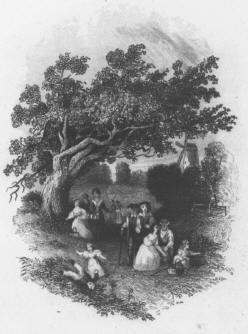
GOD IS GOOD.
Waving fields, the dark green wood,
The insect fluttering for an hour,—
All things proclaim that God is good.
The hills that have for ages stood,
And clouds with gold and silver lined,
All still repeat that God is good.
Has the same verdant path pursued,
And every bird, in accents clear,
Joins in the song that God is good.
Calms each wild wave and billow rude,
Retreats submissive from the shore,
And swells the chorus, “God is good.”
That sing his praise with light renewed;
The rising sun each day declares,
In rays of glory, God is good.
That God is good! and man, endued
With power to speak his Maker’s praise,
Should still repeat that God is good.
EVENING.
The clouds how bright and gay!
The stars, appearing one by one,
How beautiful are they!
And sheds her gentle light,
And hangs her crystal lamp on high,
How beautiful is night!
Of something brighter far?
Glows there a light within this breast
Outshining every star?
The mountains melt away,
This flame within shall never fail,
But live in endless day.
Sin may its lustre dim;
While goodness bears it up to heaven,
And leads it back to him.
ROBINSON CRUSOE’S HYMN.
Around me and above,
Sends forth a hymn of praise to thee,
And speaks thy boundless love.
The woods so dark and lone;
The soft south-wind, the sounding sea,
Worship the Holy One.
The prattling, sparkling rill,
The birds, with their melodious song,
Repeat thy praises still.
Father, thou hearest me;
I know that I am not alone,
When I but think of thee.
HYMN.
Brought every being forth;
He made the shining worlds above,
And every thing on earth.
The sea, the waterfall,
The bright green fields, the clear blue sky,—
‘Tis God that made them all.
My heart to love them well,
And he bestowed the power of thought,
And speech my thoughts to tell.
He is their father too;
He bids me all their precepts hear,
And all they teach me, do.
And ‘mid the darkest night;
He views me when I disobey,
And when I act aright.
When I am all alone;
My hymn of praise, my humble prayer,
He hears them every one.
O, what a wondrous thought!
My Heavenly Father, teach me how
To love thee as I ought.
ON PRAYER.
Wandered forth the timid dove,
So the heart, in humble prayer,
Essays to reach the throne of love.
Like her again may soar,
And still return and find no rest,
No peaceful, happy shore.
And takes a bolder flight,
And see! the olive-branch she brings,
To bless her master’s sight.
Though spent and tempest-driven,
And higher soars, and brings at length
A pledge of peace with Heaven.
“THE SPIRIT GIVETH LIFE.”
Wild rushing through the oak,
Seemed to my listening, dreaming mind
As though a spirit spoke?
Doth give so sweet a song,
That on its tide my thoughts do seem
To pour themselves along?
What in each glowing star,
That speaks of things beyond the sight,
And questions what they are?
What in the ocean’s roar,
Hears the grand chorus, “O, rejoice!”
Echo from shore to shore?
Pure thoughts and tender love,
And hears delicious melody
Around, below, above?
Of terror and dismay,
And wakes the agonizing shriek
Of guilt that fears to pray?
This little throb of life
Hears its own echoes in the wind,
And in the tempest’s strife;
Its own affections gives;
Sees its own image everywhere,
Through all creation lives.
Give back the solemn tone;
This boundless arch of azure fills
With accents all its own.
This omnipresent thought?
How shall it ever utterance find
For all itself hath taught?
Its mysteries are known;
It seeks the source from whence it came,
And rests in God alone.
WE NEVER PART FROM THEE.
God, who makest all thy care,
God, who hearest every prayer,
Thou who see’st the heart;
Father, help our souls to rise,
And, beyond these narrow skies,
See thee as thou art!
Holy trust adore thy will,
Holy love our bosoms fill,
Let our songs ascend!
Dearest friends may parted be,
All our earthly treasures flee,
Yet we never part from thee,
Our eternal Friend.
“I WILL ARISE AND GO TO MY FATHER.”
Thou high and holy One!
And may my troubled spirit flee
For rest to thee alone.
Secure and sweet repose;
And thou canst bid the desert mind
To blossom as the rose.
Where angels claim their birth,
Forsake its home beyond the skies,
And cling to barren earth.
That warns him to depart;
Shall I not heed the voice divine,
That whispers in my heart,—
No longer idly roam!
Fly to the realms of endless day;
For this is not thy home.”
Ere clouds and darkness come,
And thunders in my startled ear
Proclaim my final doom.
Thy wandering child reclaim.
Speak! and my dying faith shall rise,
And wake a deathless flame.
EVENING HYMN.
Thou, whose love is everywhere,
Thou who seest every heart,
Listen to our evening prayer.
Love unfailing, full, and free,
Love no injury can move,
Love that ever rests on thee.
Keep us safe from every ill;
Cheerful as the morning light,
May we wake to do thy will.
AUTUMN.
I hear her parting knell;
I hear the moaning, fitful blast,
Sighing a sad farewell.
In rainbow hues she glows;
Like the last smile of parting day,
Still brightening as she goes.
Sad is the cricket’s song;
The wind, wild rushing o’er the hill,
Bears the dead leaf along.
This twilight of the year;
To me, sweet Spring, in all her prime,
Was never half so dear.
On all that meets the eye,
‘Tis rapture, then, within to feel
The soul that cannot die;—
To Him who changes never.
This earth, these heavens, shall change and die;
God is the same for ever.
THE LORD’S DAY.
From the deep slumbers of the tomb;
This is the day the Saviour broke
The bonds of fear and hopeless gloom.
No longer may we dread to die.
Let every fear be cast away,
And tears be wiped from every eye.
A dark and thorny path he trod;
But heaven was ever in his view,—
That toilsome path led up to God.
Let every sin and sorrow cease;
Let children come this day and bring
Their offering of love and peace.
THE MINISTRY OF PAIN.
Know ’tis a Father’s hand you feel;
It leads you to the realms of peace;
It kindly only wounds to heal.
Bursts on the sad, desponding mind,
To say, when fiercest ills annoy,—
“I know my Father still is kind!”
Checks every murmur, every sigh;
Patience then waits his sovereign will,
Rejoiced to live,—resigned to die.
To teach the soul its real worth;
To lead it to that source again,
From whence it first derived its birth.
“BY FAITH YE ARE SAVED.”
Thou prayest for the help that thou dost need,
As shipwrecked mariner for life will plead,
O, then for faith pour forth the fervent prayer!
‘Tis faith alone life’s heavy ills can bear.
O, mark her calm, far-seeing, quickening eye,
Full of the light of immortality!
It tells of worlds unseen, and calls us there;
That look of hers can save thee from despair.
And all life’s flowers are fading in the dust,
Faith lifts our drooping vision from the ground,—
Says, that the hand that smites us yet is just;
That human agony hath ever found
The mighty God a never-failing trust.
EVENING PRAYER.
Father all-seeing!
We bow before thee;
Our souls adore thee;
Help us obey thee;
Guide us aright;
Keep us, we pray thee,
Through the long night.
God of all living,
Thy power defend us,
Thy peace attend us,
While we are closing
This day in prayer,
Ever reposing
Under thy care.
EVENING HYMN.
Let me myself these questions ask:—
Have I endeavoured to do right,
Nor thought my duty was a task?
And the small voice of conscience heard?
When passion tempted me to speak,
Have I repressed the angry word?
What my kind parents bid me do,
And not by word or action said
The thing that was not strictly true?
Then have I stopped to think and pray,
That God would give my soul the power
To chase the sinful thought away?
Wilt thou forgive and love me still!
Wilt thou to me new strength impart,
And make me love to do thy will!
LINES WRITTEN AT MIDNIGHT.
TRANSLATED FROM THE GERMAN OF A.G. EBERHARD.
As evening comes to take his place;
So looks the parting loved-one, when
He means to quickly come again.
Advances now the silent night;
And with the calm and gentle moon,
Sweet peace doth quietly come on.
Without a gush of love and praise?
And now it is the midnight hour,
And sleep asserts her soothing power.
That from my neighbour’s window shone;
His simple household prayer is said,
He rests from toil, on his hard bed.
Faithful till morning watch he will;
But vain, O watchman! is thy care,
If God, the Guardian, be not there.
In my small room I sit alone,
And, thinking o’er past joys and pain,
A sweet contentment doth remain.
Will forsake his sheep,—he watcheth ever;
The mother may forget her child, but yet
Thus saith the Lord,—”Thee I will not forget.”
Thy faithful eye still watcheth me;
For He who ever wakes and lives
To loving hearts no night e’er gives.
“HOPE IN GOD.”
TRANSLATED FROM THE GERMAN OF S.A. MAHLMAN.
Thou at last thy flowers shalt gather;
God is full of tender love,—
Childlike speak thou to thy Father.
From believing, trusting hearts,
The God of mercy ne’er departs.
Rest upon his goodness always;
To those joyful, sunny heights
Lead these rough and gloomy pathways;
Wakes for aye his Eye of Light,—
Tremble not in storm and night.
To the heart of God fast clinging,
Tell him all thy deepest woes,
Before him all thy sorrows bringing;
He is kind, and comfort gives
To every sorrowing heart that lives.
Strength the Helper now is sending;
Soon thou’lt understand His ways,
Soon thou’lt find thy sorrows ending.
God! who life and goodness art!
In patience hope in Him, my heart.
FAILURE AND SUCCESS.
When, reft of all, it stands alone,
And not in what men call success,
The noble, valiant soul is known.
Shoots at a mark he may not reach;
The world may laugh, the world may blame.
And what it calls discretion preach.
Which low ambition makes its own;
But, far beyond, his earnest soul
Stands in the light, though all alone.
That Jesus won immortal power;
Thus the great failure of the cross
Was his triumphant, glorious hour.
He fails who has a low desire.
Up to the highest ever press,
Still onward, upward, higher! higher!
That they who watch thy spirit’s flight
Shall look to heaven from whence it came,
And loose thee in celestial light.
SONGS.
THE LITTLE SPRING.
There flows a clear and fairy stream;
There the pert squirrel oft has drank,
And thought, perhaps, ’twas made for him.
As drop by drop the crystals flow,
Singing their silvery welcome still
To all who to the fountain go.
Its tributary drop to bear,
Its modest head a moment hides,
Then rises up and sparkles there.
Falls like the gentle dews of heaven,
Bids me with humble love impart
The little treasure God has given.
Full many a cup of joy may flow,
And on the stream of human bliss
Its little ray of gladness throw.
THE LITTLE BOY’S MAY-DAY SONG.
On every hill and dell,
And O, how beautiful they are!
How sweetly, too, they smell!
And look so glad and gay;
I love to hear their pleasant song,
I feel as glad as they.
The bees hum round their hive,
The butterflies are coming out,—
‘Tis good to be alive.
With green wreaths now are hung;
O mother! let me laugh and play,
I cannot hold my tongue.
And mount the clear blue skies;
And hark! how merrily he sings,
As far away he flies.”
And let your cheerful voice,
With birds, and brooks, and merry May,
Cry loud, Rejoice! rejoice!
My little happy boy,
For He who made this blooming earth
Smiles on an infant’s joy.”
GUESS WHAT I HAVE HEARD.
O, it will soon be spring!
I’m sure it was a little bird,—
Mother, I heard him sing.
That peeps out from the snow,
As if it wanted to be seen,—
‘Twill soon be spring, I know.
How fast it runs along!—
Here is a cunning little brook;
O, hear its pretty song!
That kept it all so still,
For now it merrily runs on,
And goes just where it will.
It says, it seems to me,—
“Good by, cold weather, ice, and snow;
Now girls and brooks are free.”
Mother, to me last night,
Of this great world that God has made,
So beautiful and bright.
No naughty thing I’ll do;
I would not be the only thing
That is not happy, too.
SPRING.
Winter’s gone and summer’s near;
See, the tender grass is springing,
And the flowers will soon be here.
Who painted all the flowers?
Who taught the little birds to sing,
And made these hearts of ours?
He does every blessing give;
All this happy world is his,—
Let us love him while we live.
THE LITTLE BOY’S GOOD-NIGHT.
The birds are sleeping sound;
‘Tis time to say to all, “Good night!”
And give a kiss all round.
Now kiss your little son;
Good night! my friends, both far and near,
Good night to every one.
Sleep well till morning light;
Perhaps if you could sing in words,
You would have said, “Good night!”
You blossom while I sleep;
And all the stars, that shine so bright,
With you their watches keep.
The stars are sparkling there;
‘Tis time to shut our weary eyes,
And say our evening prayer.
THE SHEPHERD’S SABBATH-SONG.
TRANSLATED FROM THE GERMAN OF UHLAND.
In the wide field I am alone.
Hark! now one morning bell’s sweet tone,—
Now it has died away.
Sweet dread doth o’er my spirit steal,
From whispering sounds of those who kneel,
Unseen, to pray with me.
So clear and solemn is the sky,
It seems all opening to my eye;
This is the Sabbath day!
TO SPRING.
Smiling through thy veil of showers;
Birds and brooks thy welcome sing,—
Haste, and waken all thy flowers.
From the breathing, moving earth
Life is starting all around,
Sending joy and fragrance forth.
Blossoms hang their drapery;
Branches that defied the storm
Now are full of melody.
In this joyous company;
Woods, and hills, and valleys ring
With a shout of jubilee.
Senseless things have found a voice;
Shall this throbbing heart be still,
When all nature cries, “Rejoice”?
Join the universal glee,
Yield to nature’s kind control,
Catch her heavenly harmony.
Cast each selfish care away;
Birds and brooks shall tune your song;
This is nature’s holiday.
HER VOYAGE IS AT AN END.
Still as an infant’s joy;
There sat upon the rocky shore
A father and his boy.
It came from foreign lands;
The boy began to dance and skip,
And clap his little hands.
The ship is hastening on;
They hear the birds sing on the land;
Her voyage is nearly done.
The rocks with music fill;
But now he cries,—”See, father, see!
The ship is standing still.”
Her white sails all descend;
The ship has struck upon a rock,—
Her voyage is at an end.
All crowded is the deck;
She struggles hard,—she’s free;—O, no!
She is indeed a wreck.
“Father! what will she do?
Let’s take the boat to her relief,
O, quickly let us go!”
Its ready succour gave;
They brought the crew all safe to land,
And the cargo tried to save.
More dark the billows seem;
They break against the ship, and hark!
The seamew’s mournful scream.
In sweet repose he sinks;
And, as he shuts his weary eyes,
On the poor ship he thinks.
As it did the day before;
The father and his son again
Are seated on the shore.
Their white sails gayly fill,
They lightly o’er the blue waves float,—
But the gallant ship is still.
Of masts and rigging strip;
The waves are playing o’er the deck
Of the sad and ruined ship.
Of a lone and blasted tree;
He seemed to look upon the flood
With a gloomy sympathy.
At the sinking vessel now;
He does not speak a single word.
But a shade is on his brow.
And sweeps with triumph on;
It bears her to her watery grave,—
The gallant ship is gone.
Still as an infant’s joy;
The father sits upon the shore
In silence with his boy.
Cohasset Shore, July, 1831.
CHARLEY AND HIS FATHER.
A BALLAD.
The flowers are dead and gone,
The clouds look cold and gray
Around the setting sun.
Their naked branches swing;
The winter winds arise,
And mournfully they sing.
Was Charley’s happy place,
And very thoughtfully
He looked up in his face;
“Father, how cold it blows!
What ‘comes of all the birds
Amidst the storms and snows?”
From storms, and snows, and rain;
But, Charley dear, next May
They’ll all come back again.”
The little fellow said,
“And all be bright and new,
That now looks cold and dead?”
The flowers will all revive,
The birds return and sing,
And all be made alive.”
Father, that they must go?
And brings them back in May,
When there is no more snow?
Upon the hill and plain,
Who’ll make it all so green,
And bring the flowers again?”
That none of us can see
Takes care of every flower,
Gives life to every tree.
Shows little birds their way;
And we, too, are his care,—
He guards us day by day.”
Will they come back in May?”
Tears were in Charley’s eye,—
“Will they, dear father, say?”
We go to them, my boy,
There, in our heavenly home,
To meet in endless joy.”
Still Charley kept his place,
And very thoughtfully
He looked up in his face.
REMEMBER THE SLAVE.
You clasp your arms in love,
And when, with grateful joy, you raise
Your eyes to God above,
Her child is torn away,
Sold for a little slave,—O, then
For that poor mother pray!
You look upon with pride,
And pray to see them when you’re old,
All blooming by your side,
The father of a slave,
Who asks a pitying God to give
His little son a grave.
Meet round the social hearth,
And talk of home and happy days,
And laugh in careless mirth,
Who never felt your joy,
Who, early old, has never known
The bliss to be a boy.
Who came to make men free,
When, at the Almighty Maker’s throne,
You bend the suppliant knee,
Then let your prayers ascend
For the poor slave, who hardly knows
That God is still his friend.
That Jesus came to save,
Unite in the most holy cause
Of the forsaken slave.
HOME-SICKNESS.
TRANSLATED FROM THE GERMAN.
I’d soar away on high,
And seek my father’s dwelling,
Beyond the far blue sky.
I’d flap my wings with joy;
My mother from the window
Sees and admits her boy.
How often has my heart
Longed sadly to embrace thee;
Now here behold thou art!”
Of what can never be.
My long-lost home,—the loved ones,—
These eyes may never see.
HAPPINESS.
What gilds the evening hours?
What makes our hearts seem gay and light,
As if we trod on flowers?
Bids flowers grow everywhere;
Makes it bright sunshine every day.
And every evening fair.
See smiling angels there,
And think they look on us in love,
As if we were their care?
‘Tis that the soul, all free from sin,
Glows like an inward sun;
And heaven above and heaven within
Do meet and join in one.
CHILDREN IN SLAVERY.
Like birds and butterflies,
As free and gay sport life away,
And know not care nor sighs;
All peace below, above;
Life’s flowers are there, and everywhere
Is innocence and love.
A blight must be at hand;
Then joys decay, and birds of prey
Are hovering o’er the land.
When young hearts weep as they go to sleep,
Then all the world seems sad;
The flesh must creep, and woes are deep,
When children are not glad.
TO GOOD RESOLUTIONS.
Which lifts its diamond head,
Exulting in the mead;
But the rude wind shall steal its gem,
Shall break its tender stem,
And leave it dead.
Wherefore so soon decay?
O, yet prolong your stay!
Until my soul shall boldly rise,
And claim its native skies,
Haste not away.
THANKS FOR A PLEASANT DAY.
To God our Father sing and pray;
In his unceasing love rejoice,
And thank him for this pleasant day.
Let all our selfish passions cease!
O, let us lift our thoughts above,
Where all is brightness, goodness, peace.
O, let us seek to be forgiven;
Nor let one discord spoil the song
Our hearts would raise this day to heaven.
Is full of sweetness, full of joy,—
When all around is calm and fair,—
Shall we the harmony destroy?
To free our souls from every sin;
Then will each day be bright and fair,
For God’s pure sunshine dwells within.
TO A BUTTERFLY.
[Those who are acquainted with this little poem, translated
from Herder, will perceive that a slight liberty has been
taken with the last two lines.]
Butterfly with quivering wing!
Hovering in thy transient hour
Over every bush and flower,
Feasting upon flowers and dew,
Thyself a brilliant blossom, too!
Purpled o’er those wings of thine?
Was it some sylph whose tender care
Spangled thy robes so fine and fair,
And wove them of the morning air?
I feel thy little throbbing heart;
Thou fear’st e’en now death’s bitter smart.
Be free and joyful thy short day!
Image thou dost seem to me
Of that which I may one day be,
When I shall drop this robe of earth,
And wake into a spirit’s birth.
TO NATURE.
FROM THE GERMAN OF FREDERICK LEOPOLD, COUNT OF STALBERG.
Let me ever follow thee;
By the hand, O, lead me still,
Like a child, at thy sweet will.
I will on thy bosom rest,
Breathe in pleasure from above,
In thy mother-arms of love.
Thee to love, with thee to be!
Holy nature! sweet and free,
Let me ever follow thee.
ON THE DEATH OF A YOUNG COMPANION.
Thou hast gone to that clime
Where sickness and sorrow are o’er.
We loved thee when here,
We shed the sad tear
To think we shall see thee no more.
We remember that He
Who made little children his care
In his own fatherland
Will reach you his hand,
And comfort and welcome you there.
But do we not know
That thou art released from all pain?
Then weep not; for He
Who walked on the sea
Has said we shall all live again.
THE SABBATH IS HERE.
FROM KRUMACHER.
Rest, rest, toilsome life,
Be silent all strife,
Let us stop on our way,
And give thanks and pray
To Him who all things has given.
How fresh and how fair!
In the still morning air,
The bright golden grain
Waves over the plain;
It is God who doth all this bestow.
No tired ox moans,
No creaking wheel groans,
At rest is the plough;
No noise is heard now,
Save the sound of the rustling corn.
In hope and in faith;
The Father he saith
Amen! Be it so!
Behold the corn grow!
Rejoicing his goodness we’ll own.
Who sendeth the rain
Upon the young grain.
And soon all around
The sickle will sound.
And home the bright sheaves we will bring.
We sow in the dust,
While humbly we trust
Up yonder shall grow
The seed which we sow,
And bloom a bright garland above.
THE CHILD AT HER MOTHER’S GRAVE.
TRANSLATED FROM THE GERMAN.
Sweet sleep has come to thee;
Ah, mother! dearest mother mine!
O, call me to that room of thine!
O, shut it not from me!
And be thy child again;
‘Tis cold and stormy here with me,
‘Tis warm, and, O, so still with thee!
Ah! let me, let me in!
So gladly held my hand;
O, see, thou hast forsaken me!
Take me this time again with thee
Into the heavenly land.
CHILD’S SONG.
TRANSLATED FROM THE GERMAN.
Fourteen angels are at hand;—
Two on my right their watches keep;
Two on my left to bless me stand;
Two hover gently o’er my head;
Two guard the foot of my small bed;
Two wake me with the sun’s first ray;
Two dress me nicely every day;
Two guide me on the heavenly road,
That leads to paradise and God.
TO A FOUNTAIN.
FROM THE GERMAN OF RAMLER.
But the fountain prattles never.
Traveller! at this fountain stay;
Learn of it, with pure endeavour,
Good to do, and nothing say.
SONG FOR AN INFANT SCHOOL.
To and fro,
In a merry, pretty row,
Footsteps light,
Faces bright;
‘Tis a happy sight.
Swiftly turning round and round,
Do not look upon the ground.
Follow me,
Full of glee,
Singing merrily.
So are we;
And we live as happily.
Work we do,
Study too,
For we learn “twice two”;
Then we laugh, and dance, and sing,
Gay as birds or any thing.
Follow me,
Full of glee,
Singing merrily.
Play’s begun;
Now we have our laugh and fun.
Happy days,
Pretty plays,
And no naughty ways.
Holding fast each other’s hand,
We’re a little happy band;
Follow me,
Full of glee,
Singing merrily.
THE SUMMER.
A FREE TRANSLATION OF A GERMAN POPULAR SONG.
Of such a summer day as this,
Bestowed on all by Heaven;
The beauties of the garden see,
Behold! it is for thee and me
Its glories all are given.
The earth upon her dusky breast
Her robe of green is wearing;
The flowers are blooming far and wide,—
Not Solomon in all his pride
With them would bear comparing.
Far upward in the clear blue sky
The lark her way is winging;
Hark to the lovely nightingale!
With her sweet song each hill and dale,
And woods and rocks, are ringing.
The swallow finds her young ones food,
The stork her house is keeping.
The bounding stag, the timid roe,
Are full of joy, and to and fro,
Through the high grass, are leaping.
And with the myrtle and the rose
Its shady banks adorning;
While, from the flowery mead near by,
The sheep and shepherd’s joyful cry
Salutes the early morning.
Fly here and there, and where they please
Their honey food are quaffing;
The sap is running up the vine,
Round the old elm its tendrils twine,
And in the sun are laughing.
When all God’s glorious works I see
My soul desires to know him.
When all are singing I must sing,
And to the Highest I must bring
The tribute which I owe him.
And has he with a loving care
My happy being given?
What, in the glorious world above,
Where all is beauty, all is love,—
What shall I be in heaven?
In that great Presence! there to bow
In grateful love before him,
Then would I with the angels raise
One never-ending song of praise,
And worship and adore him!
TO A BEAUTIFUL GIRL.
Bright pleasure sparkling in thine eye,
Alas! e’en thee time will not spare,
And thou must die.
That scarcely ever breathed a sigh,
Must weep o’er pleasures fled away,
For all must die.
The virtuous wish, the purpose high,
The bloom with which the soul’s arrayed,
Shall never die.
THE LITTLE SLAVE’S WISH.
Up in the bright blue sky,
That sings and flies just where he will,
And no one asks him why.
That runs so swift along,
Through pretty flowers, and shining stones,
Singing a merry song.
Without a fear or care,
Spreading my many-colored wings,
Like a flower in the air.
That I saw the other day,
Who through the dark green forest flew,
Like an arrow far away.
By the gentle south-wind driven,
Floating along so calm and bright
Up to the gates of heaven.
And dwell in a gloomy cave,
And shake the forest when I roared,
Than what I am,—a slave.
My father calls me brave;
What wicked action have I done
That I should be a slave?
That his right arm can save;
O, is it, can it, be his will
That I should be a slave?
And lie down in the grave,
Than ’tis to be what I am now,—
A little negro slave!
FABLES.
THE HONEST BIRD.
Within a wicker cage was heard,
In mournful tones, these words to sing:—
“In vain I stretch my useless wing;
Still round and round I vainly fly,
And strive in vain for liberty.
Dear liberty, how sweet thou art!”
The prisoner sings, with breaking heart:—
“All other things I’d give for thee,
Nor ask one joy but liberty.”
Who often ran about the house,
Came to his cage; her cunning ear
She turned, the mournful bird to hear.
Soon as he ceased,—”Suppose,” said she,
“I could contrive to set you free;
Would you those pretty wings give me?”
The sky was blue, the air was sweet.
The bird with eagerness replied,—
“O, yes! my wings, and see, beside,
These seeds and apples, sugar, too,
All, pretty mouse, I’ll give to you,
If you will only set me free;
For, O, I pant for liberty!”
In ecstasy, forgot his word;
Swift as an arrow, see, he flies,
Far up, far up, towards the skies;
But see, he stops, now he descends,
Towards the cage his course he bends.
“Kind mouse,” said he, “behold me now
Returned to keep my foolish vow;
I only longed for freedom then,
Nor thought to want my wings again.
Better with life itself to part,
Than, living, have a faithless heart;
Do with me, therefore, as you will,
An honest bird I will be still.”
He drooped his wings and hung his head.
The mouse, though very pert and smart,
Had yet a very tender heart;
She minced a little, twirled about,
Then thus her sentiments threw out:—
“I don’t care much about your wings,—
Apples and cakes are better things;
You love the clouds, I choose the house;
Wings would look queer upon a mouse.
My nice long tail is better far,
So keep your wings just where they are.”
And ran into her little crack.
The bird spread out his wings and flew,
And vanished in the sky’s deep blue;
Far up his joyful song he poured,
And sang of freedom as he soared.
SOLILOQUY
OF ELLEN’S SQUIRREL, ON RECEIVING HIS LIBERTY;—OVERHEARD BY A LOVER
OF NATURE AND A FRIEND OF ELLEN.
That whispered in my trembling ear?
And can I, free and unconfined,
Taste of the joys that still are dear?
And fly along the flowery plain,
Light as the wind, as fleet, as free,
And make my winter’s nest again?
The song you heard from yonder tree,
Which made awakening memory start,
Was the sweet sound of Liberty!
For tenderest care bestowed on me;
But most my gratitude will flow
For your best gift,—sweet Liberty!
When all your youthful heart beats high,
And, hastening on from flower to flower,
You taste the sweets of Liberty,
That I can skip and dance like you,
To your kind, tender heart shall be
As pure a joy as e’er you knew.
The sounds I hear, the sights I see;
Dear Ellen, once again receive
Your Squirrel’s thanks for Liberty.
THE PIN, NEEDLE, AND SCISSORS.
Disputes are rising every day.
You’d think, if no one did deny it,
A little work-box might be quiet;
But ’tis not so, for I did hear,
Or else I dreamed it, ’tis so queer,
A Pin and Needle in the cushion
Maintain the following discussion.
Was very sharp and full of pride,
And thus, methought, she did begin:—
You clumsy, thick, short, ugly Pin,
I wish you were not quite so near;
How could my mistress stick me here?
She should have put me in my place,
With my bright sisters in the case.”
“I do not want you by my side.
I’m rather short and thick, ’tis true;
Who’d be so long and thin as you?
I’ve got a head, though, of my own,
That you had better let alone.”
“That you’ve a head can’t be denied;
For you a very proper head,
Without an eye, and full of lead.”
Replied the poor insulted Pin,
“I hardly dare a word to say,
And wish indeed you were away;
That golden eye in your poor head
Was only made to hold a thread;
All your fine airs are foolish fudge,
For you are nothing but a drudge;
But I, in spite of your abuse,
Am made for pleasure and for use.
I fasten the bouquet and sash,
And help the ladies make a dash;
I go abroad and gayly roam,
While you are rusting here at home.”
You’ve brass enough to beat the Dutch;
Do I not make the ladies’ clothes,
Ere I retire to my repose?
Then who, forsooth, the glory wins?
Alas! ’tis finery and pins.
This is the world’s unjust decree,
But what is this vain world to me?
I’d rather live with my own kin,
Than dance about like you, vain Pin.
I’m taken care of every day;
You’re used awhile, then thrown away,
Or else you get all bent up double,
And a snug crack for all your trouble.”
And sometimes very roughly used;
I often get an ugly crook,
Or fall into a dirty nook;
But there I lie, and never mind it;
Who wants a pin is sure to find it;
In time I am picked up, and then
I lead a merry life again.
You fuss so at a fall or hurt,
And, if you get a little dirt,
You keep up such an odious creaking,
That where you are there is no speaking;
And then your lackey Emery’s called,
And he, poor thing, is pricked and mauled,
Until your daintiness—O, shocking!—
Is fit for what? to mend a stocking!”
They might have quarrelled for a week,—
But here the Scissors interposed.
And thus the warm debate was closed:—
“You angry Needle! foolish Pin!
How did this nonsense first begin?
You should have both been better taught;
But I will cut the matter short.
You both are wrong, and both are right,
And both are very impolite.
E’en in a work-box ’twill not do
To talk of every thing that’s true.
All personal remarks avoid,
For every one will be annoyed
At hearing disagreeable truth;
Besides, it shows you quite uncouth,
And sadly wanting in good taste.
But what advantages you waste!
Think, Pins and Needles, while you may,
How much you hear in one short day;
No servants wait on lordly man
Can hear one half of what you can.
‘Tis not worth while to mince the matter;
Nor men nor boys like girls can chatter;
All now are learning, forward moving,
E’en Pins and Needles are improving;
And in this glorious, busy day
All have some useful part to play.
Go forth, ye Pins, and bring home news!
Ye Needles in your cases muse!
And take me for your kind adviser,
And only think of growing wiser;
Then, when you meet again, no doubt,
Something you’ll have to talk about,
And need not get into a passion,
And quarrel in this vulgar fashion.
Less of yourselves you’ll think, and more
Of others, than you did before.
You’ll learn, that in their own right sphere
All things with dignity appear.
And have, when in their proper place,
Peculiar use and native grace.”
To have said so much, and all was hushed.
LEARNED FRED.
FROM THE GERMAN.
When, full of all he’d learned,
Young Frederick, that hopeful son,
From college home returned.
It was not long before
The learned man at table poured
The treasures of his lore.
You doubtless think you see
Two roasted fowls before us here;
But I say there are three.
And one in two must be;
Ergo,—or logic is not true,—
These roasted fowls are three.”
“‘Tis just as you have said;
This is for me, that for mamma,
The third for learned Fred.”
LITTLE ROLAND.
TRANSLATED FROM THE GERMAN OF UHLAND.
Her bitter woes to weep;
Little Roland played in the free fresh air;
His sorrows were not deep.
Why did I fly from thee?
Splendor and rank I left for love;
Now thou art wroth with me.
Beneath the waves art thou;
For love I have forsaken all,
Yet love forsakes me now.
Now fame and love to me;
Come quickly, little Roland, come!
My hope rests all on thee.
To beg us meat and bread;
And whoso gives the smallest gift,
Ask blessings on his head.”
In the golden hall of state;
With dish and cup the servants ran,
On the noble guests to wait.
All hearts to joyful mood;
The cheerful music does not reach
To Bertha’s solitude.
Of beggars a motley throng;
The meat and drink was more to them
Than flute, and harp, and song.
Upon the beggar throng;
Through the crowd he saw a noble boy,
Pushing his way along.
Of divers colors all;
But with the beggars he would not stay,—
He looked up at the hall.
As though it were his own;
He takes a dish from the royal board
In silence, and is gone.
This is a curious way”;
But, as he quietly submits,
The rest do nothing say.
To the king he marches up,
And little Roland boldly takes
The royal golden cup.
King Charles’s voice did ring;
Little Roland kept the golden cup,
And looked up at the king.
But very soon he smiled:—
“You tread here in our golden hall,
As in the green woods wild.
As they take an apple from a tree;
As with the waters of the brook,
With my red wine you make free.”
On apples she may dine;
My mother must have fish and game,
For her is the foaming wine.”
As thou, my boy, dost boast,
Then surely has she a castle fair,
And of vassals a stately host.
And who cupbearer, too?”
“My own right hand her sewer is;
My left, cupbearer true.”
“My two blue eyes alway.”
“Tell on; who is her minstrel free?”
“My rosy mouth, I say.”
But does strange livery choose,—
Made up of colors manifold,
Shining with rainbow hues.”
With eight boys I have fought;
Four sorts of cloth to the conqueror,
As tribute, they have brought.”
The dame’s must surely be;
She is, I wot, the beggar’s queen,
Who keeps a table free.
From my royal palace be;
Arise, three ladies, and three lords,
And bring her in to me.”
From the splendid hall he hies;
To follow him, at the king’s command,
Three lords, three ladies, rise.
The king sees, far away,
The noble ladies and the knights
Return without delay.
“Help, Heaven! see I aright?
‘Tis my own blood, in open hall,
I have treated with cruel slight.
My sister Bertha stand;
So pale in my gay palace here,
A beggar’s staff in her hand!”
Pale image of despair;
His wrath returns, and he looks on her
With a stern and angry air.
No word to speak she tried;
Little Roland raised his clear blue eyes,—
“My uncle!” loud he cried.
The king said tenderly;
“For the sake of this dear son of thine,
Thou shalt forgiven be.”
“Dear brother! thanks to thee;
Little Roland shall requite the boon
Thou hast bestowed on me.
Shall be an image fair;
The colors of many a foreign realm
His banner and shield shall bear.
He shall seize with his free right hand,
And safety and fresh glory bring
To his sighing mother-land.”
BILLY RABBIT TO MARY.
[Billy Rabbit was a little rabbit which a boy caught in the
woods, and gave to a little girl of the name of Mary. She
was very attentive to the little prisoner, gave him an
abundance of good things to eat, and tried her best to make
him happy; but all in vain. After many attempts, he at last
succeeded in making his escape, and instantly disappeared in
the woods. In the course of the day, the following letter,
sealed with a sharp thorn, was received by his friend Mary.]
But I tried very hard, and escaped you at last;
The chance was so tempting, I thought I would nab it,—
It was not very naughty, I’m sure, in a rabbit.
O, let not your kind heart be angry with me;
But think what a joy it is to be free,
To see the green woods, to feel the fresh air,
To skip, and to play, and to run everywhere.
The food that you gave me was pleasant and sweet,
But I’d rather be free, though with nothing to eat.
And every one wanted to give me a smack.
Dick knocked over Brownie, and jumped over Bun,
And the neighbours came in to witness the fun.
My father said something, but could not be heard;
My mother looked at me, but spoke not a word;
And while she was looking, her eyes became pink,
And she shed a few tears, I verily think.
To all sorts of beings, to men, and to rabbits,
Ah! dear to us all is sweet Liberty,
Especially, Mary, to you and to me.
So I hope you’ll forgive me for sending this letter,
To tell you I’m safe, and feel so much better,
Cut all sorts of capers, and act very silly,
And am your devoted, affectionate
Billy.
THE OLD AND NEW SHOES.
Said a little boy once to his shoes;
“All stubbed are your toes, all twisted your strings,
You’re wrinkled, one-sided, and loose.
They are almost as smooth as my skin;
How stiff they are, too! how straight and upright!
How snug my feet feel now they’re in!”
And strutted with pride to the door;
His unkindness had cut the old shoes to the quick,
For nothing contempt can endure.
(‘Twas one of the shoes he heard call);
“Our soles cannot bear such insults as these,
And your pride, Sir, will soon have a fall.”
But could not see into the matter;
At last he exclaimed,—”As they’ve nothing to do,
I suppose, like Poll Parrot, they chatter.”
His shoes were too stiff to go fast;
But let us observe him, and see how he fares,
How repentant poor Frank was at last.
So tight, that they pinched in his toes;
He could only sit still, and try to look grand,
And remember he had on new shoes.
And the shoes were remembered no more;
They began to cut capers, but at the first prank
Down tumbled poor Frank on the floor.
He said, “Never mind,” though in pain;
He whistled to Fido, but there is no denying
He fell down again and again.
He said to the nurse,—”I should choose,
If you please, when I’m dressed, my good Betsey, to-morrow,
To put on my easy old shoes.
I don’t like my new shoes at all.”
“Ah! you see,” answered Betsey, “what I told you was true;
Your shoes, Master Frank, are too small.”
And, forgetting his trouble and pain,
“How happy,” said he, “my poor toes will be
To get into the old shoes again.”
“Master Frank, will you please to attend?
I wish, with your leave, to say just a word,—
‘Tis a word of advice from a friend.
Let your new ones be always well tried;
Old shoes and old friends are far better than new,
And, trust me, more worthy of pride.
But they can be easily mended.
I have done,” said the shoe, in a kind, easy tone,
And it gaped as the lecture was ended.
New strings, too, their beauty renew;
Frank wears them in peace, and has never forgot
The words of the friendly old shoe.
THE MONKEYS AND THE BEARS.
TRANSLATED FROM THE GERMAN OF GELLART.
How it was that their nation so much surpassed theirs,
And begged that the means they would graciously tell
By which the young bears were kept hearty and well.
“Perhaps it may be,” said one of the mothers,
Who seemed more considerate and wise than the others,
“Perhaps,” said she, trembling at even the thought,
“We give our dear young ones less food than we ought;
We may be impatient; I have really some fears
That we rock them too little, the poor little dears;
Our milk may cause fever, and their stomachs not suit,
Or perhaps they are weakened and injured by fruit.
Perhaps the whole mischief is caused by the air,
And who ‘gainst this evil can ever prepare?
In their earliest years, it may poison instil,
And through their whole lifetime produce every ill.
Perhaps it may be, before we are aware,
They breathe in a pestilence, borne on the air.
Perhaps, for the nerves of us monkeys are weak,
In jumping, or leaping, some bone they may break
In their breasts.” Here, for weeping, she scarcely could speak,
And she snatched up her little one long to her breast;
With such vehement love the poor victim she pressed,
That all its complainings and troubles were stilled;
Alas the poor mother! her pet she had killed.
For the cause why your young ones are sickly and weak;
It is not the milk, nor the fruit, nor the air,
Nor fault of the stomach, and ’tis no lack of care.
Your blind fondness it is that cuts short their days.
How is it that we such multitudes raise?
As soon as our young ones are able to run,
We take them out with us to play in the sun.
We take them through floods, through heat, and through cold,
And so they are healthy, and live to be old.”
THE END.
A CATALOGUE OF BOOKS
PUBLISHED BY
CROSBY & NICHOLS,
111 WASHINGTON STREET,
BOSTON.
Crosby & Nichols have for sale a general assortment of Books
in all the various departments of literature, comprising Theological,
School, Juvenile, and Miscellaneous Books of all kinds.All Periodicals, both American and Foreign, supplied promptly. A
liberal discount to clubs, societies, or individuals, where several
are taken.
Foreign Books imported to order by every steamer.
BOSTON:
W.M. CROSBY AND H.P. NICHOLS,
111 Washington Street.
A LIST OF BOOKS
RECENTLY PUBLISHED BY
WM. CROSBY & H.P. NICHOLS,
111 WASHINGTON STREET, BOSTON.
A MEMOIR OF WILLIAM ELLERY CHANNING, with Extracts from his
Correspondence and Manuscripts. Edited by his nephew, Wm. Henry
Channing. Comprised in three volumes, of from 450 to 500 pages
each, uniform with the best edition of the Works. Two very superior
portraits of Dr. Channing appear in the volumes; one from a painting
by Allston, the other by Gambadella. Price $3.00.
Contents.—Part First,—Parentage and Birth; Boyhood;
College Life; Richmond; Studies and Settlement. Part Second,—Early
Ministry; Spiritual Growth; The Unitarian Controversy; Middle-age
Ministry; European Journey. Part Third,—The Ministry and
Literature; Religion and Philosophy; Social Reforms; The Antislavery
Movement; Politics; Friends; Home Life; Notes.
NOTICES OF THE PRESS.
“A more interesting and instructive biographical work we have never
read. High as was our opinion of Channing,—of his intellectual and
moral worth,—the perusal of this work has convinced us that we never
duly estimated him…. His letters reveal his character more fully
than his sermons and essays. In his letters he lays his heart entirely
open; and no man, no matter what his opinions or prejudices, can read
them without saying,—’Channing was, indeed, a great and good
man,—one who lived for the world!'”—Christian Messenger.
“Only one who was similar in purpose and temper,—who felt like
aspirations, hopes, and faith,—could at all do justice to the
distinguished subject. The present book must, therefore, we are sure,
give us Channing’s character in its completeness, and true harmony and
proportions of parts.”—Salem Observer.
“These memoirs of a great and good man will, we apprehend, obtain an
uncommonly extensive circulation, not only among the denomination of
Christians in which he ranked himself, but with all who reverence
purity of character, an enlarged philanthropy, and eminent talents,
guided by virtue and piety.”—Salem Register.
“If we mistake not, now is the very time in God’s providence when the
biography of William Ellery Channing could best make its appearance.
We have heard that a distinguished divine, of different speculative
religious views from Dr. Channing, has recently said,—’Channing is
greatly needed among us at this present moment.’ Behold him here! We
doubt not that the biography thus prepared is to make a great
impression on the age that is passing, and that is yet to
come.”—Christian Register.
SERMONS ON CHRISTIAN COMMUNION. Designed to promote the Culture of the
Religious Affections. Edited by Rev. T.R. Sullivan. 12mo. pp.
403. Price, $1.00.
This work is not confined to the subject of the Lord’s Supper, but
“forms a series of practical discourses of the persuasive kind,
relating to repentance, or the duty of commencing the Christian
course,—to edification, or the encouragements to progressive
Christian improvement,—and to the eucharistic service, as affording
exercise for all the grateful and devout affections of the heart in
every stage of its subjection to Christian discipline.”—Preface.
The following is a list of the writers:—
Rev. H.A. Miles, Lowell.
” F. Parkman, D.D., Boston.
” S. Judd, Augusta.
” F.D. Huntington, Boston.
” C.T. Brooks, Newport.
” N. Hall, Dorchester.
” J.I.T. Coolidge, Boston.
” G.W. Briggs, Plymouth.
” A.A. Livermore, Keene.
” J. Whitman, Lexington.
” J.W. Thompson, Salem.
” H.W. Bellows, New York.
” E.S. Gannett, D.D., Boston.
” A.P. Peabody, Portsmouth.
” J. Walker, D.D., Cambridge.
” C. Robbins, Boston.
” G.E. Ellis, Charlestown.
” G. Putnam, D.D., Roxbury.
” J.H. Morison, Milton.
” A. Young, D.D., Boston.
” E.B. Hall, D.D., Providence.
” S.G. Bulfinch, Nashua.
” O. Dewey, D.D., New York.
” S. Osgood, Providence.
” A. Hill, Worcester.
” W.H. Furness, D.D., Philadelphia.
” N.L. Frothingham, D.D., Boston.
” E. Peabody, Boston.
” S.K. Lothrop, “
” C.A. Bartol, “
” A.B. Muzzey, Cambridge.
“The design of the work is admirable, and we doubt not it is admirably
executed, and will promote the best interests of our churches. We
chanced to open at Sermon XVIII., on Christian Education, and were
pleased to see the idea of Dr. Bushnell’s celebrated book on
‘Christian Nurture’ illustrated and urged in a sermon by Dr. Putnam,
preached two years before Dr. Bushnell’s book made its
appearance.”—Christian Register.
“The tone of these sermons, their living interest, their
unpremeditated variety in unity, fit them well for this
purpose,—close personal influence on minds of widely differing views,
united in the one great aim of a Christian life. We shall probably
take an early opportunity of making some selections.”—Christian
Inquirer.
“We think the volume is upon the whole one of the best volumes of
discourses ever issued from the American press.”—Boston Daily
Atlas.
THE GOSPEL NARRATIVES, their Origin, Peculiarities, and Transmission.
By Rev. Henry A. Miles. 16mo. pp. 174. Price, 50 cents.
This work is designed for families and Sunday Schools, and contains a
comparison of each Gospel with the education, life, and character of
its author, and with the purpose which he had in view in its
composition; as also an account of the transmission of the Gospels
down to our time, and the evidence of their uncorrupted preservation.
“This volume by Mr. Miles has substantial value. It is by the
circulation and use of such books that Christian knowledge is to be
extended, and Christian faith confirmed. By a thorough study even of
this small work in childhood, many persons might have the satisfaction
of carrying through life a clear and connected idea of the biographies
of Jesus, and of the nature of the external evidence in their favor,
instead of remaining in vague uncertainty on the whole subject.
Bringing into a simple and popular form, and small compass,
information not hitherto accessible, except to a limited number of
persons, the ‘Gospel Narratives’ will be interesting to the general
reader, whether youthful or adult. It must, without doubt, be
introduced in all our Sunday Schools, and will rank among the most
important manuals.”
NAOMI; or Boston Two Hundred Years Ago. A Tale of the Quaker
Persecution in New England. By Eliza Buckminster Lee, Author
of “The Life of Jean Paul.” Second Edition. 12mo. pp. 324. Price, 75
cents.
The first edition of this popular book was exhausted within a month
after its publication.
“Mrs. Lee has given the public a most agreeable book. Her style is
elevated and earnest. Her sentiments, of the pure and the true. The
characters are well conceived, and are presented each in strong
individuality, and with such apparent truthfulness as almost to leave
us in doubt whether they are ‘beings of the mind,’ or were real men
and women who bore the parts she assigns them in those dark tragedies
that stained this ‘fair heritage of freedom’ in the early days of
Massachusetts.”—Worcester Palladium.
“We have been exceedingly interested in this book, and recommend it as
a beautiful picture of female piety and quiet heroism, set in a frame
of history and tradition, that cannot fail to please every one
connected, however remotely, with the land of the Puritans. The
accomplished author of ‘The Life of Jean Paul’ has produced an
American novel which we should like to see followed by others
illustrative of the facts and manners of the olden time.”—Christian
Inquirer.
THE MARRIAGE OFFERING. Designed as a Gift to the Newly-married. Edited
by Rev. A.A. Livermore. 16mo. pp. 215. Price, 50 cents.
“It was a happy thought that suggested such a volume. We were not
aware before that there was so much and so various Christian
literature on the subject.”—Christian Register.
MARTYRIA; a Legend, wherein are contained Homilies, Conversations, and
Incidents of the Reign of Edward the Sixth. Written by William
Mountford, Clerk. With an Introduction to the American Edition,
by Rev. F.D. Huntington. 16mo. pp. 348. Price, 75 cents.
“The charm of the book lies in the elevated tone of thought and moral
sentiment which pervades it. You feel, on closing the volume, as if
leaving some ancient cathedral, where your soul had been mingling with
ascending anthems and prayers. There is scarcely a page which does not
contain some fine strain of thought or sentiment, over which you shut
the book that you may pause and meditate.
“We recommend the volume to our readers, with the assurance that they
will find few works in the current literature of the day so well worth
perusal.”—Christian Register.
“This is really an original book. We have seen nothing for a long time
more fresh or true. The writer has succeeded wonderfully, in taking
himself and his readers into the heart of the age he describes. What
is more, he has uttered words and thoughts which stir up the deep
places of the soul. Let those read who wish to commune with the true
and unpretending martyr-spirit, the spread of faith and endurance,
courage, self denial, forgiveness, prayer.
“Of all the treatises we have ever read on marriage, we have seen none
so good as one here called a ‘Marriage Sermon’; not that we would ask
any couple to hear it all on their marriage day, but we commend it to
all who are married, or intend to be. The whole book is
precious.”—Providence Journal.
“There are few religious books which breathe a finer spirit than this
singular volume. The author’s mind seems to have meditated deeply on
the awful realities of life. In the thoughtful flow of his periods,
and the grave, earnest eloquence of particular passages, we are
sometimes reminded of the Old English prose writers. The work is a
‘curiosity’ of literature, well worth an attentive
perusal.”—Graham’s Magazine.
A TRANSLATION OF PAUL’S EPISTLE TO THE ROMANS, with an Introduction
and Notes. By William A. Whitwell, Minister of the
Congregational Society in Wilton, N.H. 16mo. pp. 116. Price, 50 cents.
“We would express a high opinion of the book, and can assure the
Christian reader who will compare it carefully with our common
version, that he will rise up from the joint perusal of the two with a
better understanding of Paul than he had before.”—Christian
Register.
CHRISTIANITY THE DELIVERANCE OF THE SOUL AND ITS LIFE. By William
Mountford. With an Introduction by Rev. F.D. Huntington.
16mo. pp. 118. Price, 37-1/2 cents.
“Mr. Mountford is full of warm religious feeling. He brings religion
home to the heart, and applies it as the guide of the life.”—London
Inquirer.
SELF-FORMATION; or the History of an Individual Mind: Intended as a
Guide for the Intellect through Difficulties to Success. By a Fellow
of a College. 12mo. pp. 504. Price, $1.00.
“The publishers have done good service by bringing forward an American
edition of this work. It may be most unreservedly recommended,
especially to the young.”—Daily Advertiser.
“Your gift of ‘Self-Formation’ is truly a welcome one, and I am
greatly obliged to you for it. It is a work of quite original
character, and I esteem it (in common with all I know of, who have
read it) as possessed of very rare merit. I am glad, for the cause of
good education and sound principle, that you have republished it, and
I wish every young man and woman in the community might be induced to
read it carefully. It is several years since I looked into it in the
English edition,—but I yet retain a vivid impression of the great
delight it afforded me, and I shall gladly avail of the opportunity of
renewing it.”—Extract from a Letter.
“This is emphatically a good book, which may be read with profit by
all classes, but more especially by young men, to whose wants it is
admirably adapted. The American editor is no doubt right in saying,
that it is almost without a question the most valuable and useful work
on self education that has appeared in our own, if not in any other
language.”—New York Tribune.
THOUGHTS ON MORAL AND SPIRITUAL CULTURE. By Rev. Robert C.
Waterston. Second Edition, revised. 16mo. pp. 302. Price, 62-1/2
cents.
This book has met with a ready sale in this country, and has been
republished in England. A London periodical, in reviewing it,
says:—”We will venture to predict that it will soon take its place on
the shelves of our religious libraries, beside Ware ‘On the Christian
Character,’ Greenwood’s ‘Lives of the Apostles,’ and other works to
which we might refer as standard publications, the value of which is
not likely to be diminished by the lapse of time or the caprices of
fashion.”
“The sense of duty in parents and teachers may be strengthened and
elevated by contemplating the high standard which is here held up to
them. The style has the great merit of being an earnest one, and there
are many passages which rise into genuine eloquence and the glow of
poetry.”—N.A. Review.
“The Lecture ‘On the Best Means of exerting a Moral and Spiritual
Influence in Schools,’ no teacher, male or female, possessed of any of
the germs of improvement, can read without benefit.”—Hon. Horace
Mann, Secretary of the Board of Education.
DOMESTIC WORSHIP. By William H. Furness, Pastor of the First
Congregational Unitarian Church in Philadelphia. Third Edition. 12mo.
pp. 272. Price, 75 cents.
“We are glad to see this book. It is a work of great and peculiar
excellence. It is not a compilation from other books of devotion; nor
is it made up of conventional phrases and Scripture quotations, which
have been so long employed as the language of prayer, that they are
repeated without thought and without feeling. It is admirably adapted
to the purpose for which it was written; and it may be read again and
again with great interest and profit by any one, who desires to enrich
his mind with the purest sentiments of devotion, and with the language
in which it finds its best expression. Here we have the genuine
utterances of religious sensibility,—fresh, natural, and original, as
they come from a mind of singular fertility and beauty, and a heart
overflowing with love to God and love to man. They seem not like
prayers made with hands, to be printed in a book, but real praying,
full of spirit and life…. So remarkable is their tone of reality and
genuineness, that we cannot bring ourselves to regard them as
compositions written for a purpose, but rather as the actual
utterances of a pure and elevated soul in reverent and immediate
communion with the Infinite Father.”—Christian Examiner.
LAYS FOR THE SABBATH. A Collection of Religious Poetry. Compiled by
Emily Taylor. Revised, with Additions, by John
Pierpont. 16mo. pp. 288. Price, 75 cents.
“It is simple and unpretending: and though some of the pieces are
probably familiar to most readers, they all breathe a pure and
elevated spirit, and here and there is an exquisite effusion of
genius, which answers to the holiest wants of the soul.
“Not only great pleasure may be derived from such a volume, but
lasting and useful impressions. Many are keenly alive to the harmony
of verse and the fresh outbursts of poetic feeling, who would pore
with delight over such a volume, and many might thus be won to high
thought and serious reflection.”—Christian Examiner.
THE YOUNG MAIDEN. Seventh Edition. By Rev. A.B. Muzzey,
Author of “The Young Man’s Friend,” “Sunday School Guide,” etc., etc.
16mo. pp. 264. Price, 62-1/2 cents.
Contents.—The Capacities of Woman; Female Influence; Female
Education; Home; Society; Love; Single Life; Reasons for Marriage;
Conditions of True Marriage; Society of Young Men; First Love; Conduct
during Engagement; Trials of Woman and her Solace; Encouragements.
“The sentiments and principles enforced in this book may be safely
commended to the attention of women of all ranks. Its purpose is
excellent throughout; and as it is everywhere governed by a just and
amiable spirit, we believe it is calculated to do much good.”—London
Atlas.
“A little work, well worthy, from its good sense and good feeling, to
be a permanent and favorite monitor to our fair
countrywomen.”—Morning Herald.
A HISTORY OF SUNDAY SCHOOLS and of Religious Education, from the
Earliest Times. By Lewis G. Pray. Embellished with two
Engravings. 16mo. pp. 270. Price, 62-1/2 cents.
“The author has been for a long period engaged in the cause of which
he has now become the historian; and if ardor, perseverance, and
faithfulness in that service qualify him to write its history, we know
of no one to whom it could have been more properly
confided.”—Portsmouth Journal.
“A volume of great Interest to all who have at heart the subject
discussed.”—Literary World.
LIFE IN THE SICK-ROOM. Essays, by Harriet Martineau. With an
Introduction to the American Edition, by Mrs. Follen. Second
American Edition. 16mo. pp. 196. Price, 62-1/2 cents.
“For the principles which it inculcates, for the exalted ideal it
presents, for the renovating spirit with which it is filled, the book
cannot fail to be a blessing to humanity.”—Christian Examiner.
EUTHANASY, or Happy Talk towards the End of Life. By William
Mountford. Author of “Martyria.” 16mo. pp.
“This is a book which will prove an incalculable treasure to those who
are in sorrow and bereavement, and cannot be perused by any thoughtful
mind without pleasure and improvement.”—Christian Examiner.
THE CHRISTIAN PARENT. By Rev. A.B. Muzzey, Author of “The
Young Maiden,” &c., &c. 16mo. Price, 75 cents.
RELIGIOUS CONSOLATION. Edited by Rev. Ezra S. Gannett. 16mo.
Price, 50 cents.
Contents.—The Good of Affliction; The Mourner Comforted;
Erroneous Views of Death; The Departed; Death and Sleep; Immortality;
Trust in God under Afflictions; Filial Trust; The Future Life; Friends
in Heaven; Hope; Thanksgiving in Affliction; Trust amidst Trial; Life
and Death; The Voices of the Dead; To the Memory of a Friend; A Prayer
in Affliction; Duties of the Afflicted; The Mourner Blessed;
Consolation; The Dangers of Adversity; Trust in Divine Love; The
Promises of Jesus; The Believer’s Hope; The Uses of Affliction; Time
Passing; The Christian’s Death; The Hope of Immortality; God our
Father.
THOUGHTS; selected from the Works of William Ellery Channing,
D.D. 32mo. pp. 160. Price, 37-1/2 cents.
“This is a diamond of a volume, the purpose of which is well expressed
in the following ‘thought’ from Channing, which is put on the
title-page:—
“‘Sometimes a single word, spoken by the voice of genius, goes far
into the heart. A hint, a suggestion, an undefined delicacy of
expression, teaches more than we gather from volumes of less gifted
men.’
“Those who differ in theological views from the gifted Channing will
of course find many thoughts in this little volume not to their taste.
But those to whom any theological views have ever done much good will
nevertheless prize the book for its thoughts. Thoughts they are, not
faint reflections of thought. And those who would be wise above all
things prize to know what can be thought on all sides of every
important subject. To enrich our columns we borrow a gem or
two.”—Chronotype.
“A collection of noble thoughts, that may well take its place by the
side of the celebrated thoughts of Pascal, which have in them more of
metaphysics, but less that touches the human heart. It makes a
beautiful pocket volume.”—Christian Examiner.
“We have long desired to see a book of this kind, and now, from a
slight examination, believe that it is well done. It is a beautiful
collection of beautiful thoughts, and must be a welcome possession,
not only for all who agree with Dr. Channing in his peculiar religious
opinions, but for all who value lofty sentiments worthily expressed,
and who by the influence of such thoughts would be strengthened to
duty, or raised to a higher sphere of contemplation.”—Christian
Register.
DAVID ELLINGTON. By Rev. Henry Ware, Jr. With other Extracts
from his Writings. 18mo. pp. 192. Price, 37-1/2 cents.
“Mr. Ware has left very few things which will do so much towards
promoting the great object for which he lived and labored. The simple
story of the every-day life of a good man, told as these stories are
told, finds a response in the hearts of those most indifferent to the
great concerns of virtue and religion; it reaches and touches what
nothing else, not the eloquent preaching of an apostle, could reach
and touch.”
CHRISTIAN CONSOLATIONS. Sermons designed to furnish Comfort and
Strength to the Afflicted. By Rev. A.P. Peabody, Pastor of
the South Church, Portsmouth, N.H. 16mo. pp. 320. Price, 75 cents.
“We welcome with almost as much surprise as satisfaction the
appearance of a volume of discourses as excellent as those of Mr.
Peabody. They are rich in thought, and of a high order of literary
merit.”—N.A. Review.
THE GENERAL FEATURES OF THE MORAL GOVERNMENT OF GOD. By A.B.
Jacocks. 16mo. pp. 94. Price, 37-1/2 cents.
GENERAL PRINCIPLES OF THE PHILOSOPHY OF NATURE: with an Outline of
some of its recent Developments among the Germans, embracing the
Philosophical Systems of Schelling and Hegel, and Oken’s System of
Nature. By J.B. Stallo, A.M., lately Professor of Analytical
Mathematics, Natural Philosophy, and Chemistry in St. John’s College,
N.Y. 12mo. pp. 532. Price, $1.25.
“It grapples with the most abstruse problems, and tugs fiercely to
pluck out the heart of their mystery. No difficulty is too great for
the author to meet, and none seems able to upset his theory. In truth,
the book is one of the most profound ever published in Boston, and
whatever opinion may be given regarding its principles, none can
gainsay its vigor of understanding and reach of learning. The
pertinent question, Who reads an American book? will change somewhat
its meaning, if American literature takes the abstruse direction
indicated by Mr. Stallo’s volume. In that event, our books will remain
unread, not because they are too shallow, but because they are too
deep.”—Boston Courier.
MORNING AND EVENING MEDITATIONS, for every Day in a Month. By Miss
Carpenter (daughter of the late Dr. Lant Carpenter). 16mo. pp.
312. Price, 62-1/2 cents.
“The compiler of this work has rendered good service to all possessed
of Christian sympathies.”—Literary World.
“We like its spirit, and believe it will prove an excellent closet
companion for those who will faithfully use it.”—Christian
Register.
THE WORDS OF CHRIST; from the New Testament. 16mo. pp. 150. Price, 50
cents.
“The compiler has most happily collected the words of Christ, so that,
by the slightest reference possible to the tables, every text is
ascertained under the several heads. It will prove very beneficial to
the Biblical scholar, clergyman, and Sunday-school
teacher.”—Christian World.
DISCOURSES ON THE CHRISTIAN SPIRIT AND LIFE. By Rev. Cyrus A.
Bartol. Second Edition, Revised, with an Introduction. 12mo. pp.
408. Price, $1.00.
DISCOURSES ON THE RECTITUDE OF HUMAN NATURE. By George W. Burnap,
D.D. 12mo. pp. 409. Price, $1.00.
A HISTORY OF JESUS. By Rev. William H. Furness. 12mo. pp.
231. Price, $1.00.
COMMUNION THOUGHTS. By Rev. S.G. Bulfinch. 16mo. pp. 204.
Price, 62-1/2 cents.
INTRODUCTORY LESSONS ON CHRISTIAN EVIDENCES. By Archbishop
Whatley. 18mo. pp. 131. Price, 20 cents.
RELIGIOUS THOUGHTS AND OPINIONS OF A STATESMAN. By William Von
Humboldt. 16mo.
THE STARS AND EARTH; or THOUGHTS UPON SPACE, TIME, AND
ETERNITY. 18mo. pp. 88. Price, 31 cents.
A MEMOIR OF REV. HIRAM WITHINGTON, With Selections from his Writings.
16mo. pp. 190. Price, 50 cents.
TEN DISCOURSES ON ORTHODOXY. By Rev. Joseph H. Allen, 12mo.
pp. 227. Price, 75 cents.
POPULAR OBJECTIONS TO UNITARIAN CHRISTIANITY CONSIDERED AND ANSWERED.
In Seven Discourses. By Rev. George W. Burnap. 16mo. pp. 166.
Price, 37-1/2 cents.
Contents.—The Position of Unitarianism defined. Unitarians
not Infidels. Explaining the Bible and Explaining it away.
Unitarianism not mere Morality. Unitarianism Evangelical Christianity.
Unitarianism does not tend to Unbelief. Dr. Watts a Unitarian.
“These topics Mr. Burnap treats with a freshness of thought which will
render the volume acceptable to those who have a taste for reading of
this sort, while its general merits place it in the class of works one
would wish to see extensively circulated among those who think that
Unitarianism has nothing to stand upon, or that it is a doctrine full
of impiety.”—Christian Examiner.
THE MISCELLANEOUS WRITINGS OF F.W.P. GREENWOOD, D.D. 12mo. pp. 400.
Price, $1.00.
“It is a profitable book for any one to read,—partly because it
communicates information and offers instruction, but chiefly because
its moral tone is of the healthiest kind.”—Christian Examiner.
ECHOES OF INFANT VOICES. 16mo. pp. 144. Price, 50 cents.
MEMOIR AND WRITINGS OF REV. JAMES H. PERKINS. Edited by Rev.
William H. Channing. 2 Vols. 12mo.
A STUDY FOR YOUNG MEN; or a Sketch of Sir Thomas Fowell Buxton. By
Rev. Thomas Binney. 16mo. pp. 150. Price, 42 cents.
HYMNS FOR THE SANCTUARY. Compiled by a Committee of the West Boston
Society. 12mo.
CHRISTIAN HYMNS FOR PUBLIC AND PRIVATE WORSHIP. A Collection compiled
by a Committee of the Cheshire Pastoral Association. Twenty-eighth
Edition. 18mo. pp. 562. Price, 50 cents.
Although this book has been published but four years, it is now used
in forty societies, and this fact is considered sufficient to show
the estimation in which it is held, and the manner in which it has
stood the test of comparison with other collections.
The following are some of the peculiar merits of the Christian
Hymns:—the number of hymns is very large; the variety of subjects and
metres is very great; the hymns are better adapted for singing; the
plan of arrangement is improved; and the price is very low.
MANUALS FOR SABBATH SCHOOLS.
LESSONS ON THE PARABLES OF THE SAVIOUR, for Sunday Schools and
Families. By Rev. F.D. Huntington. 18mo. Fourth Edition.
QUESTIONS ADAPTED TO THE TEXT OF THE NEW TESTAMENT. By C. Soule
Cartee. 18mo. Parts I. and II. Fourth Thousand.
A SCRIPTURE CATECHISM OF THE CHRISTIAN RELIGION, stated in the Words
of the Bible. By Ephraim Peabody. 18mo. pp. 56. Third
Thousand.
FIRST BOOK FOR SUNDAY SCHOOLS. Fifth Edition. 18mo. pp. 36.
THE MINISTRY OF CHRIST. With Notes and Questions By Rev. Thomas B.
Fox. Third Edition, Revised and Corrected. 18mo. pp. 261.
A MANUAL ON THE BOOK OF ACTS. By Rev. Thomas B. Fox. 18mo.
THE SUNDAY SCHOOL SERVICE-BOOK. By Hon. Stephen C. Phillips,
President of the Boston Sunday School Society. 18mo.
THE SUNDAY SCHOOL SINGING-BOOK. By E.L. White. Square 16mo.
QUESTIONS ON THE GOSPEL NARRATIVES; their Origin, Peculiarities, and
Transmission. By Rev. Henry A. Miles. 18mo. pp. 18.
JUVENILE BOOKS.
THE CHILDHOOD OF MARY LEESON. By Mary Howitt. 18mo. pp. 143.
THE PLAYMATE. A Pleasant Companion for Spare Hours. Embellished with
more than a Hundred Engravings. Large 16mo. pp. 400.
HYMNS, SONGS, AND FABLES. By Mrs. Follen. 18mo. pp. 107.
THE TWO NEW SCHOLARS, and Other Stories. 18mo. pp. 92.
FIVE YEARS OF YOUTH; of Sense and Sentiment. By Harriet
Martineau. With a Preface by Mrs. Follen. 18mo. pp. 255.
ALLEGORIES AND CHRISTIAN LESSONS; for Children. By T.B. Fox.
18mo. pp. 144.
ELLA HERBERT; or Self-Denial. By a Lady. 18mo. pp. 71.
TRADITIONS OF PALESTINE. By Harriet Martineau. 18mo. pp. 142.
THE ESKDALE HERDBOY. By Lady Stoddart. 18mo. pp. 146.
THE BOY OF SPIRIT. 18mo. pp. 123.
WHEN ARE WE HAPPIEST? 18mo. pp. 149.
HURRA FOR NEW ENGLAND! 18mo. pp. 112.
HOW TO SPOIL A GOOD CITIZEN; and Other Stories. By the Author of
“Willie Rogers,” &c., &c. 18mo. pp. 180.
MRS. TUTHILL’S JUVENILES.
I WILL BE A GENTLEMAN. Twelfth Edition. 18mo. pp. 154.
I WILL BE A LADY. Twelfth Edition. 18mo. pp. 173.
ONWARD! RIGHT ONWARD! Seventh Edition. 18mo. pp. 173.
ANY THING FOR SPORT. Third Edition. 18mo. pp. 136.
THE BOARDING-SCHOOL GIRL. Second Edition. 18mo. pp. 145.
A STRIKE FOR FREEDOM, or Law and Order, 18mo.
THE BOY OF MOUNT RHIGI. By Miss Sedgwick. 16mo. pp. 252.
THE GLORIOUS STRANGER. 18mo.
COUSIN HATTY’S HYMNS AND TWILIGHT STORIES. 16mo.
ALL FOR THE BEST. By T.S. Arthur. 16mo.
BARDOUC. A Persian Tale. 18mo.
THE CHILD’S MORNING BOOK. 18mo.
THE CHRISTIAN EXAMINER AND RELIGIOUS MISCELLANY. Edited by Rev.
George Putnam, D.D., and Rev. George E. Ellis.
“This work, which combines literature with theology, has always
sustained a high reputation for learning and ability,—nearly all the
more eminent Unitarians of the day having been at different times
numbered among its contributors.”
The Examiner was first issued under the superintendence of the late
Dr. Noah Worcester. It has since been edited by Rev. John G. Palfrey,
D.D., Rev. Francis Jenks, Rev. F.W.P. Greenwood, D.D., Rev. James
Walker, D.D., Rev. William Ware, Rev. Alvan Lamson, D.D., and Rev.
Ezra S. Gannett, D.D., and through its pages the writings of
Worcester, Channing, Norton, and Ware have been given to the public.
The Christian Examiner is published on the first days of January,
March, May, July, September, and November, in numbers of one hundred
and forty-four octavo pages each, at four dollars per annum.