
![[Illustration]](http://www.gutenberg.org/cache/epub/6888/images/cover.jpg)
History of the Gatling Gun Detachment, Fifth Army Corps, at Santiago
With a Few Unvarnished Truths Concerning that Expedition.
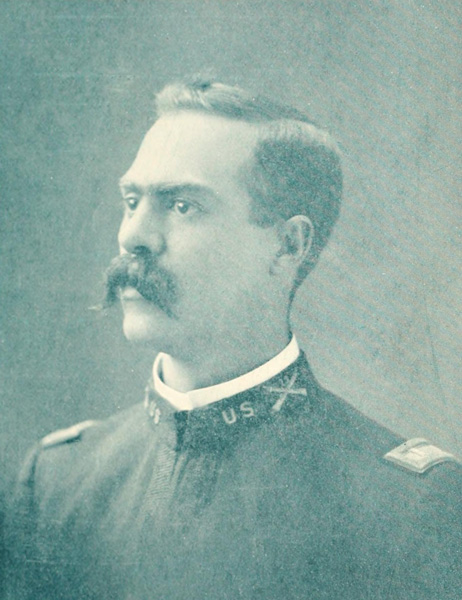
by John H. Parker
1st Lieut. 13th Inf.
(Late) Commanding Gatling Gun Detachment,
Fifth Army Corps, at Santiago.
DEDICATION.
To the Enlisted Members of the Detachment, Who, by Their Devotion,
Courage and Endurance, Made Its Success Possible, this Volume is
Dedicated as a Token of Esteem by the Author.
Contents
The photographic illustrations in this work are due to the courage and kindness
of Mr. John N. Weigle, of Gettysburg, Pa. This young man was first sergeant of
the Gatling Gun Detachment, and took with him a large supply of material. It
was his delight to photograph everything that occurred, and his pleasure to
furnish a set of photographs for the use of the author. Mr. Weigle was
recommended for a commission in the Regular Army of the United States, for his
extreme gallantry in action, and is a magnificent type of the American youth.
The thanks of the author are tendered to him for the photographic illustrations
so generously supplied.
ILLUSTRATIONS
PREFACE.
On the morning of July 1st, the dismounted cavalry, including my regiment,
stormed Kettle Hill, driving the Spaniards from their trenches. After taking
the crest, I made the men under me turn and begin volley-firing at the San Juan
Blockhouse and intrenchments against which Hawkins’ and Kent’s
Infantry were advancing. While thus firing, there suddenly smote on our ears a
peculiar drumming sound. One or two of the men cried out, “The Spanish
machine guns!” but, after listening a moment, I leaped to my feet and
called, “It’s the Gatlings, men! It’s our Gatlings!”
Immediately the troopers began to cheer lustily, for the sound was most
inspiring. Whenever the drumming stopped, it was only to open again a little
nearer the front. Our artillery, using black powder, had not been able to stand
within range of the Spanish rifles, but it was perfectly evident that the
Gatlings were troubled by no such consideration, for they were advancing all
the while.
Soon the infantry took San Juan Hill, and, after one false start, we in turn
rushed the next line of block-houses and intrenchments, and then swung to the
left and took the chain of hills immediately fronting Santiago. Here I found
myself on the extreme front, in command of the fragments of all six regiments
of the cavalry division. I received orders to halt where I was, but to hold the
hill at all hazards. The Spaniards were heavily reinforced and they opened a
tremendous fire upon us from their batteries and trenches. We laid down just
behind the gentle crest of the hill, firing as we got the chance, but, for the
most part, taking the fire without responding. As the afternoon wore on,
however, the Spaniards became bolder, and made an attack upon the position.
They did not push it home, but they did advance, their firing being redoubled.
We at once ran forward to the crest and opened on them, and, as we did so, the
unmistakable drumming of the Gatlings opened abreast of us, to our right, and
the men cheered again. As soon as the attack was definitely repulsed, I
strolled over to find out about the Gatlings, and there I found Lieut. Parker
with two of his guns right on our left, abreast of our men, who at that time
were closer to the Spaniards than any others.
From thence on, Parker’s Gatlings were our inseparable companions
throughout the siege. They were right up at the front. When we dug our
trenches, he took off the wheels of his guns and put them in the trenches. His
men and ours slept in the same bomb-proofs and shared with one another whenever
either side got a supply of beans or coffee and sugar. At no hour of the day or
night was Parker anywhere but where we wished him to be, in the event of an
attack. If a troop of my regiment was sent off to guard some road or some break
in the lines, we were almost certain to get Parker to send a Gatling along,
and, whether the change was made by day or by night, the Gatling went.
Sometimes we took the initiative and started to quell the fire of the Spanish
trenches; sometimes they opened upon us; but, at whatever hour of the
twenty-four the fighting began, the drumming of the Gatlings was soon heard
through the cracking of our own carbines.
I have had too little experience to make my judgment final; but certainly, if I
were to command either a regiment or a brigade, whether of cavalry or infantry,
I would try to get a Gatling battery—under a good man—with me. I
feel sure that the greatest possible assistance would be rendered, under almost
all circumstances, by such a Gatling battery, if well handled; for I believe
that it could be pushed fairly to the front of the firing-line. At any rate,
this is the way that Lieut. Parker used his battery when he went into action at
San Juan, and when he kept it in the trenches beside the Rough Riders before
Santiago.
Theodore Roosevelt.

CHAPTER I.
L’ENVOI.
The history of the Gatling Gun Detachment, Fifth Army Corps, is to a certain
extent the history of the Santiago campaign. The detachment was organized on
the spur of the moment, to utilize material which would otherwise have been
useless, and was with the Fifth Corps in all the campaign. It participated in
all the fighting of that campaign, except the fight at La Guasimas, and was
disbanded upon the return of the Fifth Corps to Montauk. Whatever hardships
were endured by the Fifth Corps were shared by this detachment; whatever
dangers were faced by the Fifth Corps were faced by it also; where the hottest
fighting occurred this detachment went in and stayed; and at the surrender it
was paraded, to use the words of General Shafter, “Upon that portion of
the line which it occupied so promptly and defended so well.”
But this memoir is not intended as a history of that campaign nor of the Fifth
Corps. The author has not the data available to cover so large a field, nor the
ability to do justice to the courage, fortitude, and endurance so heroically
displayed by that gallant army. That story will be written by abler pens, and
will be the wonder of the world when it is told.
This story is that of an experiment. It is told to lay before the general
public, as well as the military critic, the work of a little detachment of
thirty-seven men, armed with an untried weapon, organized in the short space of
four days preceding July 1, 1898, and which without proper equipment, adequate
instruction, or previous training, in the face of discouragements and sneers,
and in spite of obstacles enough to make the mere retrospect sickening, still
achieved for itself a warm place in the hearts of all true soldiers, and
covered itself with glory upon the hardest fought battle-field of the
Hispano-American War.
This story is to commemorate the gallantry of the enlisted men who helped to
make history and revolutionize tactics at Santiago. It will tell of the heroism
of the plain American Regular, who, without hope of preferment or possibility
of reward, boldly undertook to confute the erroneous theories of military
compilers, who, without originality or reason, have unblushingly cribbed the
labored efforts of foreign officers, and foisted these compilations of
second-hand opinions upon the American Army as military text-books of authority
and weight. These literary soldiers declared, following the lead of their
foreign guides, that “The value of machine guns on the battle-field is
doubtful,” and that “Their offensive value is probably very
small.” They also agreed, with most touching unanimity, that “A
direct assault upon a fortified position, occupied by good, unshaken infantry,
armed with the modern rifle and plentifully supplied with ammunition is sure to
fail, unless made by overwhelming numbers and prepared by strong and accurate
fire by artillery.”
These servile imitators of foreign pen soldiers were destined to see all their
pet theories exploded by the grim old mountain puma from California and his
brave Fifth Corps. They were to learn, so far as they are capable of learning,
that the American Regular makes tactics as he needs them; that the rules of war
established by pen soldiers do not form the basis of actual operations in the
field; that theories must go to the wall before the stern logic of irrefutable
facts; and that deductions based on the drill-made automatons of European
armies are not applicable to an army composed of American Volunteer Regulars,
led by our trained officers.
We shall see that an army destitute of cavalry, and hence without
“eyes”; not supported by artillery; in the most difficult country
over which soldiers ever operated, and without maps or reconnaissance—in
twenty days shut up and captured an army of twice its own effective strength,
in a strongly fortified city, with better served and more numerous artillery.
We shall find that when the “sledge” was not at hand, American
ingenuity was able to use the “mallet” instead, making light
machine guns perform all the function of artillery, and dispensing altogether,
so far as any practical results were concerned, with that expensive and much
overrated arm; that the Regular private is capable of meeting all demands upon
his intelligence, and that the American non. com. is the superior of foreign
officers.
It is also hoped to place before the intelligent American public some correct
ideas of the new arm which was tried thoroughly at Santiago for the first time
in the history of the world. The machine gun is the latest practical product of
American inventive genius applied to war. The first form of this weapon tried,
the mitrailleuse, was not very successful. It failed, not on account of faults
of construction, or imperfect mechanism, but because its proper tactical
employment had not been thought out by the French army. Since that time machine
guns have been greatly improved, but no one has succeeded in making their great
value appreciated by military authorities. The failures of the French brought
the gun into disfavor, and created a prejudice against its employment.
The Artillery of the world, which poses in every country as an élite
body of scientific fighters, and is often found on the battle-field to be an
aggregation of abstruse theorists, were jealous and contemptuous. They said,
“See how easily the artillery knocked out machine guns at
Gravelotte.” The Cavalry of the world, famous everywhere for an
esprit-du-corps which looks haughtily down on all other arms of the
service, were too deeply absorbed in the merits of saber vs. revolver, and in
the proper length of their spectacular plumes, to give a second thought to this
new, untried, and therefore worthless weapon. The world’s Infantry,
resting upon the assumption that it is the backbone of all armies, and the only
real, reliable fighting body under all conditions, left the consideration of
these vague dreams of mechanical destructiveness to lunatics, cranks, and
philanthropists.
In our own country the Ordnance Department, which is the trial court before
which all military inventions must appear, scouted the idea of usefulness of
machine guns even after war was declared, and adhered to the view that machine
guns, in the very nature of things, could never be useful except in the defense
of fortified positions; that they never could be brought up on the battlefield,
nor used if they were brought up. This view was that of a prominent young
officer of that department who wrote a report on the subject, and it seemed to
express the views of the department.
This view must have been that of our War Department, for it did not even
acknowledge the receipt of drawings and specifications for a machine gun
carriage, offered freely to the Government as a gift by the inventor six months
before the war, together with the first correct tactical outline of the proper
use of machine guns ever filed in any War Office in the world. This invention
was designed to facilitate the use of the machine gun by making its advance
with the skirmish line possible on the offensive, and was recommended by the
whole staff of the Infantry and Cavalry School as a meritorious device, worthy
of trial. The discussion filed with the invention pointed out, for the first
time, the correct tactical employment of the weapon, and staked the military
reputation and ability of the author and inventor on the correctness of his
views.
From these facts it may be gathered that there was required a certain degree of
originality and energy to get together and organize a machine gun battery for
the Santiago campaign.
The project was conceived and executed. The service rendered by this battery
has forever set at rest the question of the proper tactical use of the machine
gun arm, both on the offensive and defensive. These things are now beyond the
realm of theory. They are a demonstrated problem. The solution is universally
acknowledged to be correct.
This is the history of that detachment.
CHAPTER II.
INCEPTION.
From the 26th of April until the 6th of June, Tampa and Port Tampa were the
military centers of greatest interest in the United States. Troops were rushed
into these places on special trains and camped on available sites, pending the
organization of a proposed expedition to—somewhere. Supplies of every
description came pouring in on long trains of express and freight cars; mounted
officers and orderlies ploughed their rushing way through great heaps and dunes
of ever-shifting sand, leaving behind them stifling clouds of scintillating
particles, which filtered through every conceivable crevice and made the effort
to breathe a suffocating nightmare. Over all the tumultuous scene a torrid sun
beat down from a cloudless sky, while its scorching rays, reflected from the
fierce sand under foot, produced a heat so intolerable that even the tropical
vegetation looked withered and dying. In this climate officers and men,
gathered mostly from Northern posts, were to “acclimate” themselves
for a tropical campaign—somewhere.
![[Illustration: ]](http://www.gutenberg.org/cache/epub/6888/images/03.jpg)
They never encountered as deadly a heat, nor a more pernicious climate, in Cuba
nor in Porto Rico, than that of southern Florida. Its first effect upon men
just emerging from a bracing Northern winter was akin to prostration. Then
began to follow a decided tendency to languor; after this one was liable to
sudden attacks of bowel troubles. The deadly malaria began to insidiously
prepare the way for a hospital cot; the patient lost flesh, relish of food
became a reminiscence, and an hour’s exertion in the sun was enough to
put a man on his back for the rest of the day. Exposure to the direct action of
the sun’s rays was frequently followed by nausea, a slight chill, and
then a high fever. The doctors subsequently called this “thermal
fever,” which is suspected to be a high-sounding name calculated to cover
up a very dense ignorance of the nature of the disease, because no one ever
obtained any relief from it from them. Recurrence of the exposure brought
recurrence of the fever, and, if persisted in, finally produced a severe
illness.
One reason for this was that the troops continued to wear the winter clothing
they had worn on their arrival. The promised “khaki” did not
materialize. Some regiments drew the brown canvas fatigue uniform, but the only
use made of it was to put the white blanket-roll through the legs of the
trousers, thereby adding to the weight of the roll, without perceptible benefit
to the soldier.
Such a climate, under such surroundings, was not conducive to original thought,
prolonged exertion, or sustained study. Everybody felt “mean” and
was eager for a change. Nobody wanted to listen to any new schemes. The highest
ambition seemed to be to get out of it to somewhere with just as little delay
and exertion as possible. It was at this juncture that the plan of organizing a
Gatling gun battery was conceived, and the attempt to obtain authority began.
The Gatling gun is one of the two machine guns adopted in the land service of
the United States. Not to enter into a technical description, but merely to
convey a general idea of its working and uses, it may be described as follows:
The gun is a cluster of rifle barrels, without stocks, arranged around a rod,
and parallel to it. Each barrel has its own lock or bolt, and the whole cluster
can be made to revolve by turning a crank. The bolts are all covered in a brass
case at the breech, and the machine is loaded by means of a vertical groove in
which cartridges are placed, twenty at a time, and from which they fall into
the receivers one at a time. As the cluster of barrels revolves each one is
fired at the lowest point, and reloaded as it completes the revolution. The gun
is mounted on a wye-shaped trunnion; the lower end of the wye passes down into
a socket in the axle. The gun is pointed by a lever just as one points a garden
hose or sprinkler, with the advantage that the gun can be clamped at any
instant, and will then continue to sprinkle its drops of death over the same
row of plants until the clamps are released. The axle is hollow and will hold
about a thousand cartridges. It is horizontal, and on its ends are heavy
Archibald wheels. There is also a heavy hollow trail, in which tools and
additional ammunition can be stored. The limber resembles that used by the
Artillery, and is capable of carrying about 9600 rounds of cartridges. The
whole gun, thus mounted, can be drawn by two mules, and worked to good
advantage by from six to eight men. It is built of various calibers, and can
fire from 300 to 900 shots per minute. The guns used by the Gatling Gun
Detachment, Fifth Army Corps, were built by the Colt’s Arms Co., were the
latest improved model, long ten-barrel gun, and fired the Krag-Jorgenson
ammunition used by the Regular Army.
The attempt to obtain authority to organize a machine gun battery met with many
discouragements and repeated failures. No one seemed to have thought anything
about the subject, and Tampa was not a good place nor climate in which to
indulge in that form of exercise, apparently. Perhaps the climate was one
reason why so little thinking was done, and everything went “at sixes and
sevens.”
![[Illustration: ]](http://www.gutenberg.org/cache/epub/6888/images/04.jpg)
The officer who had conceived the scheme was a young man, too. He was only a
second lieutenant (“Second lieutenants are fit for nothing except to take
reveille”), and had never, so far as his military superiors knew, heard
the whistle of a hostile bullet. He had made no brilliant record at the
Academy, had never distinguished himself in the service, and was not
anybody’s “pet.” He was, apparently, a safe man to ignore or
snub if occasion or bad temper made it desirable to ignore or snub somebody,
and, above all, had no political friends who would be offended thereby.
“Politics” cut quite a figure in Tampa in some respects. An officer
who was known to be a personal friend of Senator Somebody, or protege of this
or that great man, was regarded with considerable awe and reverence by the
common herd. It was ludicrous to see the weight attached to the crumbs of
wisdom that fell from the friends of the friends of somebody. They shone only
by a reflected light, it is true; but nobody there at Tampa had a lamp of his
own, except the few who had won renown in the Civil War, and reflected light
was better than none at all. A very young and green second lieutenant who was
able to boast that he had declined to be a major in a certain State was at once
an oracle to other lieutenants—and to some who were not lieutenants. The
policy which governed these appointments was not so well understood at that
date in the campaign as it is now.
When the court of a reigning favorite was established at the Tampa Bay Hotel as
a brigadier, and people began to get themselves a little settled into the idea
that they knew who was in command, they were suddenly disillusioned by the
appointment of another and senior brigadier to the command. They settled down
to get acquainted with the new authority, and were just beginning to find out
who was who, when the telegraph flashed the news that the deposed potentate had
been made a major-general, and, of course, was now in command. The thing was
becoming interesting. Bets began to be made as to which would come in ahead
under the wire. The other also became a major-general. Then came a period of
uncertainty, because the question of rank hinged upon some obscure and musty
record of forgotten service some thirty-four years before. From these facts
will be apparent the difficulty under which a subordinate labored in trying to
create anything.
It is hardly worth while in any case of that sort to waste time with
subordinates. The projector of an enterprise had better go straight to the one
who has the necessary authority to order what is wanted; if access to him can
be had, and he can be brought to recognize the merits of the plan—that
settles it; if not—that also settles it. In either case the matter
becomes a settled thing, and one knows what to depend upon.
But who was the man to see there at Tampa? Nobody knew.
The first officer approached was the one in direct line of superiority, Col. A.
T. Smith, 13th Infantry. The idea was to ascertain his views and try to obtain
from him a favorable endorsement upon a written plan to be submitted through
military channels to the commanding general at Tampa. Perhaps it was the deadly
climate; for the reply to a request for a few minutes’ audience on the
subject of machine guns was very gruff and curt: “I don’t want to
hear anything about it. I don’t believe in it, and I don’t feel
like hearing it. If you want to see me about this subject, come to me in office
hours.” That settled it. Any effort to get a written plan through would
have to carry the weight of official disapproval from the start, and even a
“shavey” knows that disapproval at the start is enough to kill a
paper in the official routine.
The next officers approached were Major William Auman and Capt. H. Cavanaugh,
of the 13th Infantry, who were asked for advice. These two officers, both of
whom rendered very distinguished services on the battle-field, listened with
interest and were convinced. Their advice was: “Get your plan in tangible
shape, typewritten, showing just what you propose; then go straight to the
commanding general himself. If he listens to you, he will be the responsible
party, and will have waived the informality; if he will not receive you, no
harm is done.”
This advice was followed and the following plan prepared:
Scheme for Organization of Division Galling Gun Detachment.
“Material:
“Three guns with limbers and caissons; 28 horses and 16 saddles; 6 sets
double harness, wheel, and 6 lead; 1 escort wagon, team and driver; and 100,000
rounds, .30 cal.
“Personnel:
“One first lieutenant, 3 sergeants, 3 corporals, 1 clerk, 1 cook, and 35
enlisted men selected for their intelligence, activity, and daring; volunteers,
if possible to be obtained, as the service will be hazardous.
“Equipment:
“Officer: Revolver, saber, or machete, and field-glass.
“Enlisted men: Revolver and knife.
“Fifty rounds to be carried on person for revolver, and 50 in ordnance
train.
“Camp Equipage:
“Four conical wall-tents, 2 ‘A’ wall-tents, and the ordinary
cooking outfit for a company of 41 men.
“Organization:
“In the discretion of the detachment commander, subject to approval of
division commander; probably as follows, subject to modifications by
experience:
“Three detachments under a sergeant. A detachment to be composed of 1
gunner and 7 men. The gunner should be a corporal.
“Administration:
“The Division Gatling Gun Detachment to be subject only to the orders of
the division commander, or higher authority. Its members are carried on
‘d. s.’ in their respective organizations. Its commander exercises
over it the same authority as a company commander, and keeps the same records.
Returns, reports, and other business are transacted as in company, except that
the detachment commander reports directly to and receives orders directly from
Division Headquarters. The detachment is not subject to ordinary guard or
fatigue. When used as part of a guard, whole detachments go with their pieces.
“Instruction:
“The organization is purely experimental; hence the greatest possible
latitude must be allowed the detachment commander, and he should be held
accountable for the results. He should not be subjected to the orders or
interference of any subordinates, however able, who have made no special study
of the tactical use or instruction for machine guns, and who may not have faith
in the experiment. It will be useless to expect efficiency of the proposed
organization unless this liberty be accorded its organizer. The field is a new
one, not yet well discussed by even the text-writers. Organization and
instruction must be largely experimental, subject to change as the result of
experience; but no change from the plans of the organizer should be made except
for good and sufficient reasons.
“Tactical Employment:
“This organization is expected to develop:
“(a) The fire-action of good infantry.
“(b) The mobility of cavalry.
“Its qualities, therefore, must be rapidity and accuracy, both of fire
and movement.
“Its employment on the defensive is obvious. On the offensive it is
expected to be useful with advance guards, rear guards, outposts, raids, and in
battle. The last use, novel as it is, will be most important of all. The flanks
of the division can be secured by this organization, relieving reserves of this
duty; it will give a stiffening to the line of support, and at every opportune
occasion will be pushed into action on the firing line. The moral effect
of its presence will be very great; it will be able to render valuable
assistance by its fire (over the charging line) in many cases. Last, but very
important, the occupation of a captured line by this organization at once will
supply a powerful, concentrated, and controlled fire, either to repulse a
counter-charge or to fire on a discomfited, retiring enemy. Being a horsed
organization, it can arrive at the critical point at the vital moment when, the
defender’s first line having been thrust out, our line being
disorganized, a counter-charge by the enemy would be most effective, or
controlled fire by our own troops on him would be most useful.
“It is urged that this last use of machine guns is one of the most
important functions, and one which has been overlooked by writers and
tacticians.
“There is one vital limitation upon the proposed organization; viz., it
must not be pitted against artillery.
“It is urgently suggested that this organization can be perfected here
and now without difficulty, while it will be very difficult to perfect after
the forward movement has begun. Horses and harness can be easily procured at
Tampa; there will be no difficulty if some energetic officer be authorized to
proceed with the work, and directed to attend to the details.
“Believing earnestly in the utility of the proposed organization, which
will convert useless impedimenta into a fourth arm, and realizing the dangerous
nature of the proposed service, I respectfully offer my services to carry these
plans into effect.
“John H. Parker,
“2d Lieut. 13th Infty.”
With this plan well digested and with many a plausible argument in its favor
all thought out, Col. Arthur McArthur, assistant adjutant-general to Gen. Wade,
who was at that moment in command, was approached.
![[Illustration: ]](http://www.gutenberg.org/cache/epub/6888/images/05.jpg)
Col. McArthur was a very busy man. He was also a very business-like man, and
one of handsome appearance, easy access, and pleasant address. He sandwiched in
a fifteen-minute interview between two pressing engagements, and manifested
both interest and approval. But nothing could be done at that time. “Come
again a week from to-day,” said he, “and I will try to obtain you a
hearing before one who can do what you wish by a single word. I believe in your
scheme and will help you if I can.” The week rolled by and a change of
commanding generals occurred. Gen. Wade was ordered away, taking McArthur with
him, and no progress had been made. It was discouraging.
The next step in the plan was by lucky accident. Lieutenant (now Lieut.-Col.)
John T. Thompson, Ordnance Department, who was in charge of the Ordnance Depot
at Tampa, accidentally met the would-be machine-gun man, and was promptly
buttonholed over a dish of ice cream. Thompson was himself a young man and a
student. His department placed an insuperable obstacle in the way of himself
carrying out a plan which he, also, had conceived, and he was keen to see the
idea, which he fully believed in, demonstrated on the battle-field. He had,
moreover, as ordnance officer, just received an invoice of fifteen Gatling
guns, complete, of the latest model, and he had access to the commanding
general by virtue of being a member of his staff. By reason of the terrible
rush of overwork, he needed an assistant, and it seemed practicable to try to
kill two birds with one stone. But all he said was, “I believe in the
idea; I have long advocated it. It may be possible for me to get you your
opportunity, and it may not. If so, you will hear from the matter.”
The attempt to get the thing going had been apparently abandoned, when, utterly
without notice, the regimental commander received orders per letter, from
Headquarters Fifth Army Corps, which resulted in the following orders:
“Headquarters 13th Infantry, in the Field,
“Tampa, Fla., May 27, 1898.
“Special Orders No. 22:
“Pursuant to instructions contained in letter from Headquarters 5th
Army Corps, May 26, 1898,
2d Lieut. John H. Parker, 13th Infantry.
Sergeant Alois Weischaar, Company A,
Sergeant William Eyder, Company G,
Private Lewis Kastner, Company A.
Private Joe Seman, Company B,
Private Abram Greenberg, Company C.
Private Joseph Hoft, Company D,
Private O’Connor L. Jones, Company D,
Private Louis Misiak, Company E,
Private George C. Murray, Company F,
Private John Bremer, Company G,
Private Fred H. Chase, Company H,
Private Martin Pyne, Company H,
will report to Lieut. J. T. Thompson, ordnance officer, for duty in connection
with the Gatling Gun Battery.
“These men will be fully equipped, with the exception of rifle, bayonet,
scabbard, and blanket-bag, and will be rationed to include May 31, 1898.
“By order of Colonel Smith.
“M. McFarland,
“1st Lieut. 13th Infty., Adjutant.”
These men were selected by their company commanders. It is not known whether
the selections were made with a view to special fitness or not. They had no
notice that the detail was to be anything but a transient character; in fact,
one company commander actually detailed the cook of his private mess, and was
intensely disgusted when he found that the detail was to be permanent or
semi-permanent. The men were sent fully armed and equipped; carrying rifles,
knapsacks, etc., and marched down to the Ordnance Depot for instructions. These
instructions were to return to camp, turn in their rifles, bayonets,
cartridges, belts, and knapsacks, and return early the following morning
equipped with blanket-roll complete, haversack, and canteen. Each man, after
full explanation of the hazardous duty, was given a chance to withdraw, but all
volunteered to stay.
The instructions were obeyed, and the Gatling Gun Detachment was born—a
pigmy.
![[Illustration: ]](http://www.gutenberg.org/cache/epub/6888/images/06.jpg)
CHAPTER III.
THE ORDNANCE DÉPÔT.
The Ordnance Dépôt at Tampa was located on Lafayette Street, at the end of the
bridge over the river, next to the Tampa Bay Hotel. The river washed the sides
of the building, which was occupied by the Tampa Athletic Club, and had
formerly been used as a club-house. There were two stories and a basement. The
basement was nearly on a level with the river, the main floor on a level with
the bridge, and there was also a spacious upper floor. The main floor was used
for storage of light articles of ordnance; the basement for heavy articles and
ammunition. Hundreds of thousands of rounds of rifle and revolver ball
cartridges, thousands of rounds of Hotchkiss fixed ammunition, and many
hundreds of pounds of powder charges for field artillery and mortars were here
stored. Miscellaneous assortments were daily coming in, generally without any
mark on the box by which to learn what were the contents. The name of the
arsenal, if from an arsenal, was usually stamped on the seal; generally there
was no mark whatever to designate the origin or contents of the many boxes
which came from ordinary posts. The invoices came from a week to ten days
behind or in advance of the arrival of the boxes, and there was not the
slightest clue to be gained from them. Consequently those who had to check up
invoices and prepare for issues were at their wits’ end to keep things
straight. A requisition for so many articles would come in, duly approved;
unless the boxes containing these articles happened to have been unpacked, it
was uncertain whether they were on hand or not. No wholesale merchant of any
sense would ship out boxes of goods without some indication of their contents;
but that was exactly what was done from all over the country to the Ordnance
Dépôt at Tampa.
The upper floor consisted of one large room. A rope railing was placed around
it to preserve clear space around the desks. There were several of these for
the ordnance officer and the various clerks. A chief clerk, an assistant clerk,
a stenographer, and two ordnance sergeants looked after the red tape. An
overseer with four subordinates and a gang of negro stevedores attended to
loading and unloading boxes, storing them, counting out articles for issue or
receipt, and such other duties as they were called on to perform. There was an
old janitor named McGee, a veteran of the Civil War, whose business it was to
look after the sweeping and keep the floors clean.
Four guns in their original boxes were issued to the detachment on the 27th of
May. They were new, and apparently had never been assembled. On assembling them
it was found that the parts had been constructed with such
“scientific” accuracy that the use of a mallet was necessary. The
binder-box on the pointing lever was so tight that in attempting to depress the
muzzle of the gun it was possible to lift the trail off the ground before the
binder-box would slide on the lever. The axis-pin had to be driven in and out
with an axe, using a block of wood, of course, to prevent battering. A truly
pretty state of affairs for a gun the value of which depends on the ease with
which it can be pointed in any direction.
Inquiry after the war at the factory where the guns are made disclosed the fact
that these parts are rigidly tested by a gauge by the Government inspectors,
and that looseness is regarded as a fatal defect. Even play of half a hundredth
of an inch is enough to insure the rejection of a piece. The very first thing
done by the Gatling Gun Detachment, upon assembling these guns, was to obtain a
set of armorers’ tools and to file away these parts by hand until the aim
of the piece could be changed by the touch of a feather. The detachment was
ordered to rely upon the friction clutches for steadiness of aim, when
necessary, and not upon the tight fit of the parts. It was ordered that there
must be no doubt whatever of easy, perfectly free manipulation at any and all
times, even if the pointing lever should become rusted. This precaution proved
on July 1st to have been of great value.
![[Illustration: ]](http://www.gutenberg.org/cache/epub/6888/images/07.jpg)
The instruction of the detachment began immediately, and consisted, at first,
of unpacking, mounting, dismounting, and repacking the guns. The four guns were
mounted and a drill held each time in the loading and firing of the piece. This
system of instruction was continued until the detachment was ordered on board
ship on the 6th of June. During this instruction members of the detachment were
designated by name to fall out, and the remainder of the detachment required to
execute all the maneuvers of the piece as before. In fact, this instruction was
carried to such a point that one man alone was required to load, aim, and fire
the gun at designated objects without any assistance.
The detachment at once assumed the position of an independent command. It
reported directly to Maj.-Gen. W. R. Shafter, commanding the 5th Corps, in
everything so far as its duties with Gatling guns were concerned, was regarded
as an independent command, kept its own records in the same manner as a
company, obtained cooking utensils from the quartermaster and ran its own mess,
and furnished its own guard. This status, that of a separate command, continued
until the detachment was finally disbanded at Montauk.
On the 27th of May the detachment commander was summoned to Gen.
Wheeler’s headquarters and there requested to explain to the general in
person his plans for organizing a Gatling gun detachment. Gen. Wheeler had just
assumed command of all the Cavalry belonging to the 5th Army Corps. His
headquarters, instead of being in a suite of rooms in the palatial Tampa Bay
Hotel, where all the other general officers had their headquarters, were
located about half a mile from the hotel in a treeless pasture. The cavalry
guidon floating from a lance-head was the only indication of headquarters, and
the half-dozen “A” tents in an irregular line gave no sign that one
of the most distinguished generals in the world had here his headquarters in
the field.
The general was easily accessible. The first thing that impressed one of him
was his extraordinary quickness. His eye seemed to take in everything within
sight of him at a single glance, and to read one’s thoughts before the
tongue could give expression to them. He grasped ideas when they were only half
uttered and immediately drew deductions from mere statements of simple facts,
the result of years of careful study. These deductions, which Gen. Wheeler drew
instantly, were in every case correct, and showed a keener and more correct
appreciation of the proper tactical employment of machine guns than was shown
by any other officer of the 5th Corps. The result of the interview with the
general was that a scheme for the organization of a tactical unit to be
composed of three Gatling guns and to be employed with the cavalry division,
was drawn up on the spot, under Gen. Wheeler’s personal direction, and
was submitted by him to Gen. Shafter, with the request that authority be
granted for the organization of this command for the purpose indicated.
In the application Gen. Wheeler stated that he believed that such a battery of
machine guns, if properly handled, could go anywhere that cavalry could go,
could take the place of infantry supports, could dash up and hold any ground or
advantageous position that a body of cavalry might seize, could be thrown out
to one flank of the enemy and assist in his demoralization in preparation for
the cavalry charge, and would be of particular service in case the enemy
attempted to form infantry squares, which were at that time supposed to be the
main part of the Spanish tactics of battle. This application was disapproved.
On the 30th of May, Gen. Lee sent for the detachment commander for an interview
on the subject of Gatling guns. Gen. Lee was at this time quartered at the
Tampa Bay Hotel, and was engaged in the organization of the 7th Army Corps. It
was supposed that the 7th Corps was designed for the Havana campaign, and it
was believed that the attack upon Havana would begin at a very early date. The
result of the interview with Gen. Lee was that he directed a scheme for the
organization of a tactical unit to be composed of 9 guns, 3 batteries of 3 guns
each, to be prepared for service with the 7th Army Corps.
It was desired that this organization be a volunteer organization, and the
application was therefore made for authority from the President, under that law
of Congress authorizing the employment of special troops. Col. Guild, well and
favorably known from his connection with the Massachusetts National Guard, was
prepared to furnish a volunteer organization already in existence, well drilled
and already officered, composed of the flower of the youth of Massachusetts,
very largely of college graduates, who had already been communicated with on
the subject, and who were even at that time expecting momentarily a telegram
calling them to this duty. Nothing resulted from this effort.
Meantime the drill instruction of the little detachment continued. Its members
had acquired a considerable degree of proficiency in the mechanical handling of
their guns, and were beginning to appreciate the destructive possibilities of
their weapon. They were enjoying a degree of liberty which they had not found
in their regimental camp, because when not on duty they were free to come and
go at will, when and where they pleased. The hours for instruction were
designated in the morning and in the cool of the afternoon, leaving the middle
of the day and the evening for the men’s own recreation. The result of
this system of treatment was that esprit-du-corps began to be developed
in the detachment. They began to feel that they were a special organization,
expected to do special work, and that they were receiving very special
treatment. They began to be proud of being members of the Gatling Gun
Detachment, to take greater interest in the work, and when on the first of June
they received their monthly pay not a single member of the detachment committed
any excesses in consequence of this unusual degree of freedom. No one was
intoxicated. No one was absent without permission.
The detachment had not been at the Ordnance Depot very long before an
opportunity occurred for some of its members to exhibit those qualities which
made the success of the battery so conspicuous on the battle-field afterward.
The detachment commander had been detailed by verbal orders on the first of
June in charge of the issues of ordnance property to the Santiago expedition.
This was in addition to his duties with the Gatling guns. The work would
commence about 6 o’clock in the morning, and from that time until dark
there was a continual stream of wagons carrying away stores such as rifles,
haversacks, meat ration cans, tin cups, and all the articles needed by troops
in the field during a campaign. The ammunition which was issued to the troops
at this time was drawn at the same place.
When wagons arrived to receive issues, stevedores were directed to count out
the different articles under the direction of an overseer, and these piles of
articles were verified by the officer in charge of the issues. The stevedores
then loaded them on the wagons which were to haul them to the different camps.
Receipts in duplicate were always taken and invoices in duplicate were always
given, in the name, of course, of Lieut. John T. Thompson, who was responsible
for the stores.
On the 4th of June issues were being made of rifle-ball cartridges. These
cartridges came packed in boxes of 1000 rounds each, and each box weighed 78
pounds. A great quantity of it was stored in the basement, where there was also
a considerable quantity of fixed Hotchkiss ammunition, as well as several
thousand rounds of powder charges in boxes. The Hotchkiss ammunition, which
comes with projectile and powder both set in a brass case, is bad ammunition to
pack; for, no matter how carefully it is handled, there is almost always some
leakage of powder from the cartridge case, thus causing a certain amount of
loose powder to sift into the box in which it is packed.
About half past 11 o’clock on this morning a negro stevedore accidentally
dropped a box of rifle ammunition near a pile of Hotchkiss fixed, and the next
instant the laborers saw smoke ascending toward the ceiling of the basement.
They yelled “Fire! fire!” at the top of their voices, and everybody
in the basement at once made a rush for the two doors. It was a panic. The
danger was imminent. The smoke curled up to the ceiling and then curled down
again, and the excited, panic-stricken faces of the negroes as they rushed
through the door made an awful picture of human terror. People on the outside
of the building began to shout “Fire!”
At this juncture McGee, the old janitor, who had just reached the door, cried
out, “Lieutenant, there is a box in here on fire!” speaking to
Lieut. Parker, who was verifying issues just outside the door. The lieutenant
replied, “Let’s throw it into the river,” and dashed toward
the box through the door, pushing the excited negroes to each side in order to
assist McGee, who had instantly started for the box. When Lieut. Parker reached
the box, he found that McGee had already taken it up, and was staggering under
its weight. He placed one arm around McGee’s shoulder and with the other
assisted him to support the box, from which the smoke was still ascending, and
the two rushed for the door, throwing the whole momentum of their weight and
speed against the crowd of frightened negroes, who were falling over each other
in their panic-stricken efforts to escape. Priv. Greenberg, of the 13th
Infantry, a member of the Gatling Gun Detachment, who was the sentinel on post
at the time, saw the two men coming with the box, and with great presence of
mind added his own weight with a rapid rush to the shock they had produced,
thus enabling them to break their way through the dense throng at the door. It
was only the work of an instant to then throw the box in the river, where it
sank in the water and for a moment the blue smoke continued to bubble up from
the box, which lay clearly visible on the bed of the river, the water being
only about two feet deep at this point, which was, however, enough to entirely
cover the box and thus extinguish the fire. At the outcry of
“Fire!” Lieut. H. L. Kinnison, of the 25th Infantry, who was
waiting outside of the basement with a wagon, started in at the other door, and
Serg. Weischaar, acting first sergeant of the Gatling Gun Detachment, started
for water. Just as the two men emerged from the door carrying the box, Lieut.
Kinnison reached the spot where the fire had originated, and Serg. Weischaar
appeared with two buckets of water. He and Lieut. Kinnison at once flooded the
floor, seized a woolen cloth which happened to be near, and wetted down the
boxes of Hotchkiss ammunition as a measure of precaution.
![[Illustration: ]](http://www.gutenberg.org/cache/epub/6888/images/08.jpg)
McGee, the hero of this episode, is an old veteran of the Civil War, having
served three years in the Pennsylvania Volunteer Infantry during the war, and
five years in the Regular Army after the war. He has never drawn a pension nor
applied for one, although he suffers considerably from disease and wounds
contracted and received during the war, and certainly should be rewarded by a
grateful government for his conspicuous heroism. The explosion of this magazine
would have brought the whole expedition to a standstill, besides inflicting
tremendous destruction of property and frightful loss of life.
The same day the Artillery of the army began to draw its material for the
campaign, and for a period of thirty-nine hours there was no rest for anybody
connected with the issue of ordnance stores. It was at this time that the lack
of intelligent marking and packing of the boxes was keenly felt. The greatest
difficulty was experienced in selecting, from the mass of stores in the depot,
the stores that were required by the Artillery. It was especially difficult
during the work by night, when the only light that could possibly be allowed
was a single lantern, on account of the danger of fire.
At the close of this thirty-nine hours of arduous duty, the officer in command
of the Gatling Gun Detachment learned that orders had been issued for the
embarkation of the 5th Army Corps at Port Tampa, and that no reference had been
made to the Gatling Gun Detachment in these orders. He at once sought Lieut.
Thompson, who could offer no light on the omission, but said, “I have
orders to send at once to the Cherokee 521,000 rounds of rifle-ball
cartridges and all the revolver ammunition on hand. This is the reserve
ammunition of the 5th Army Corps. I will send you in charge of this ammunition
and you will see it to its destination. You may take an escort or not, as you
please. The ammunition is to go on the 4 o’clock train and you must make
all the arrangements in regard to it. Get box-cars, haul the ammunition over
there and put it in the cars, see that it goes on that train, and as soon as it
arrives at Port Tampa, see that it is properly put on board the
Cherokee.”
In order to fully understand the situation of the Gatling Gun Detachment at
this juncture, the following correspondence on the subject is necessary:
“Office of Ordnance Officer,
“Lafayette Street, West of Bridge,
“Tampa, Fla., June 3, 1898.
“The Assistant Adjutant-General, 5th Army Corps, Tampa, Florida:
“Sir,—Replying to your letter of June 1,1898, in reference to
Gatling Gun Detachment, I have the honor to submit the following report:
Guns, men, and equipment required for a 4-gun detachment:
The gun crews thus organized will give most effective service for the
detachment.
Ammunition: Each limber carries 9,840 rounds cal. .30. Four limbers, 27,360;
necessary reserve, 32,640; total, 60,000.
Tentage: Two conical wall-tents for enlisted men; one ‘A’ wall-tent
for officer.
Camp equipage, in addition to that on hand in Gatling Gun Detachment: one
buzzacot, small; four mess-pans, one dish-pan, one coffee-mill.
Blanket-roll complete; revolver with 50 rounds per man; waist-belts and
entrenching-knives.
“It is recommended that Priv. Butz, ‘G’ Co., 13th Infantry,
Corp. Robert S. Smith, ‘C’ Co., 13th Infantry, and Serg. Weigle,
9th Infantry, be members of the detachment; and that detachment be taken from
9th Infantry, which has some well-instructed men.
“It is further recommended that the detachment be fully horsed as soon as
practicable, and that the whole be placed under the command of Lieut. John H.
Parker, 13th Infantry, as acting captain.
“I recommend that I be authorized to issue the 4 Gatling guns and parts
to him.
“The details should carry the rations prescribed in General Orders 5th,
May 31, 1898, 5th Army Corps. Very respectfully,
(Signed) “Jno. T. Thompson,
“1st Lieut., Ord. Dept, U. S. A.”
This letter, prepared by Lieut. Parker and signed by Lieut. Thompson, was
endorsed as follows:
First Endorsement.
“Headquarters 5th Army Corps,
“Tampa, Fla., June 5, 1898.
“Respectfully returned to Lieut. J. T. Thompson, Ordnance Officer.
“If Lieut. Parker, in charge of the detachment as at present constituted,
can make the arrangements suggested within, he may take action; but, in view of
the limited time remaining, it is thought the detachment already organized will
answer.
“By command of Maj.-Gen. Shafter.
“E. J. McClernand,
“Assistant Adjutant-General.”
Second Endorsement.
“Office of the Ordnance Officer,
“Lafayette Street Bridge,
“Tampa, Fla., June 5, 1898.
“Respectfully referred to Lieut. John H. Parker for his information.
“Jno. T. Thompson,
“1st Lieut., Ordnance Dept, U. S. A.”
![[Illustration: ]](http://www.gutenberg.org/cache/epub/6888/images/09.jpg)
It will be seen from the first endorsement that a certain amount of discretion
was left to the detachment commander. He was authorized to take action if he
could make the arrangements suggested within. Lieut. Thompson had authorized an
escort for the reserve ammunition, if it was considered necessary. The
detachment commander resolved to take action by using his whole detachment as
an escort, putting it on board the Cherokee, with the reserve
ammunition, and accompanying it to its destination—in Cuba, trusting to
the future to enable him to complete the detachment according to the first
endorsement.
It was now 11 o’clock in the forenoon. Between that time and 4
o’clock it was necessary to obtain two freight cars, have them placed
upon the siding at a convenient point, have more than twenty wagon-loads of
ammunition, camp equipage, etc., placed in these cars, have the four guns with
their limbers placed on board, and, more difficult than all the rest, go
through the necessary red tape at the quartermaster’s office in order to
get the two cars moved to Port Tampa. It was all accomplished.
The general freight agent was bluffed into believing that unless the two cars
were instantly set where they were wanted his whole railroad would be tied up.
The quartermaster was hypnotized and dropped formality, putting all the clerks
to work upon papers and making out the necessary bill of lading, invoices,
etc., in time to catch the 4 o’clock train. He also issued the necessary
transportation for the officer and men of the detachment from Tampa to Port
Tampa, accepting the first endorsement above as sufficient orders for that
purpose.
One member of the detachment, Priv. Murray, had been very ill with what we
afterward learned to call the Cuban fever, and, while apparently convalescent,
was entirely too weak to accompany the detachment. He was a splendid fellow,
and the tears rolled down his emaciated face when he was told he must remain
behind. He was furnished with a descriptive list and a letter was written to
the chief surgeon of the Division Hospital, requesting him to send an ambulance
immediately for the sick man. One member of the detachment carried this letter
to Tampa Heights, and so sharp was the work of getting away that this man had
to board a moving train as it was pulling out to keep from getting left; but
Priv. Murray was taken to the hospital and cared for, and Priv. Bremer did not
get left.
The detachment reached Port Tampa about sundown, and Maj. Cushing, who had
charge of the loading of the transports, at once authorized the cars to be set
alongside the Cherokee. The ammunition, guns, camp equipage, men, and
all were promptly put aboard. The training in packing and unpacking the guns
was the only thing which enabled the work to be done in the limited time
allotted. Not so much as a ten-penny nail belonging to the detachment was left
behind.
During the night the troops that were to occupy the Cherokee came on
board, and it was found the next morning that five or six tons of regimental
baggage had been piled on top of the guns, making it practically impossible to
disembark, even if such a movement should be ordered.
![[Illustration: ]](http://www.gutenberg.org/cache/epub/6888/images/10.jpg)
CHAPTER IV.
THE VOYAGE AND DISEMBARKATION.
It seemed that the work had been accomplished none too soon, for on the morning
of June 7th orders came to the Cherokee to leave the slip and proceed
down the bay. There were on board at this time, beside the little Gatling Gun
Detachment, the 17th Infantry, under command of Col. Haskell, and a battalion
of the 12th Infantry, under command of Col. Comba, who was the senior officer
on board. The ship was frightfully crowded. The berth deck and lower deck had
been arranged for the accommodation of the men by nailing rows of two 2×4
scantlings just far enough apart to leave room for a man to lie down, and
fastening three tiers of bunks to these scantlings. The men were packed in
these bunks like sardines in a box. The ventilation was conspicuous by its
absence, the heat below deck was frightful and the misery entailed by such
accommodations was beyond description. But the men were very cheerful, and,
being allowed the privilege of the upper deck, very little in the way of
complaint was heard. Everybody was anxious to be off. The hope most frequently
expressed was for a quick passage and a sharp, swift campaign. It was easily
foreseen by the officers on board the ship that a long sojourn on shipboard
under such conditions would have a very bad effect on the men.
The ship dropped down the bay to the quarantine station, starting about noon,
and there lay to, waiting, as was supposed, for the remainder of the fleet.
Suddenly, about 8 p. m., one of the torpedo cruisers came tearing down the bay
under full steam, and we heard the message sounded through the megaphone:
“Return to port. Three Spanish cruisers within three hours’ sail of
the offing.” It was a thrilling moment. Officers and men were lounging,
taking, as they supposed, their last view of the American shores, without a
suspicion of present danger, when they were rapidly brought to a realizing
sense that “war is hell,” by a notice that the enemy was upon them.
Whether they were in danger or not, the danger was deadly real and imminent to
them at the time.
The Cherokee had been anchored pretty well inside. She immediately got
up steam and went out to warn other vessels farther out in the offing, and then
made safely for the harbor. Officers and men behaved with perfect coolness. It
was hopeless to attempt to escape by concealment, so Col. Comba ordered out the
band of the 17th Infantry and the good ship fled up the bay, in momentary
expectation of a smashing shot from the enemy, to the strains of
“There’ll be a hot time.” What little excitement there was
displayed itself in a feverish searching of the bay with field-glasses for
signs of the enemy. The older officers, upon whom the responsibility was
resting, sat upon the quarter-deck, smoking their pipes and discussing the
situation. The captains quietly moved about, assigning stations to their
companies, in case of attack, with the view of trying the effect of the modern
rifle upon the armored sides of a Spanish man-of-war, and two of the younger
officers took advantage of the catchy air which the band was playing to dance a
two-step on the quarter-deck. So the evening wore away. The moon went down. The
myriad little stars came out, twinkling in the deep blue sky, and at last both
officers and men, tired of looking for an enemy who was never to appear, turned
in for such sleep as they could get, leaving a small guard on deck to keep a
lookout. When they awoke next morning, the ship was in the deepest part of the
nearest slip, moored fast by her guy-ropes to the dock. Thus ended the first
engagement with the enemy.
From the 8th until the 13th, the Cherokee lay at anchor in the slip. She
was relieved on the 10th of about 200 men, thus slightly lightening her
overcrowded condition. In the meantime, this overcrowded condition of the ship
had led to some discussion as to who could best be moved on board some other
ship, with some prospect that the Gatling Gun Detachment might be disturbed.
The situation was not at all satisfactory. With four guns, no mules, no
harness, no authority, and only twelve men, the Gatling Gun Detachment did not
appear to be in a very fair way toward inflicting much damage upon the enemy.
So on the 11th of June the detachment commander visited Gen. Shafter at his
headquarters, determined to bring the matter to an issue, definitely, one way
or the other. This was the first time he had met the general, and, under the
circumstances, the manner of his reception appeared to be doubtful.
Gen. Shafter is a big man. This is not noticed at first glance. He is above the
average height, but his corpulent figure does not indicate that he is full five
feet nine inches in height, because his girth is of like proportion. His hands
are big; his arm is big; his head is big. The occiput is especially full, and
the width of head just over the ears is noticeable. There is plenty of room for
the organs of combativeness. One would think he is probably a lover of
children; during this interview he patted the head of an inquisitive dog, which
evidently belonged somewhere on board the flag-ship, and which strayed into the
room. His eyes are big, very full and very keen. As you enter he says curtly,
“Take a seat.” He waits, looking down, for you to state your
business, then suddenly fixes you with a piercing glance, and goes to the heart
of the subject by one incisive sentence, which leaves no more to be said. This
description is a general type of several interviews with him. On this occasion
the general inquired concerning the facts, looking keenly, searchingly, and
meditatively at the detachment commander. The machine gun man was “on
trial.” Then the general broke the silence by one short question,
“What do you want?” and the reply was in kind, “Twenty men,
general, with the privilege of selecting them.” The general suggested the
advisability of taking a complete organization; to which was replied,
“That at this late hour in the expedition it is imperative to have
selected men in order to perform the required duty; that men taken at random,
as would be the case in a complete organization such as a company, would not be
likely to have the required characteristics.” The general tersely
remarked, “You may have them. Make out your list, name any man in the
corps that you want, and hand the list to me. I will send the men to
you.” The trial was over, and the Machine Gun Detachment was a settled
fact.
Accordingly on the following day Special Orders No. 16 were issued, as follows:
Extract.
“Headquarters 5th Army Corps,
“On Board S. S. Segurança,
“Tampa Bay, Fla., June 11, 1898.
“Special Orders, No. 16:
* * * * *
“4. The following named enlisted men are detailed for duty with the
Gatling Gun Detachment, 5th Army Corps, and will report at once to 2d Lieut.
John H. Parker, 13th Infantry, commanding the detachment for duty:
“9th Infantry: Sergeant Weigle.
“12th Infantry: Privates Voelker, Company A; Anderson, Lauer, and
Timberly, Company C; Prazak, Company E.
“13th Infantry: Sergeant Green, Company H; Corporals Stiegerwald, Company
A; Doyle, Smith, and Rose, Company C; Privates Corey and Power, Company A;
Barts, Company E; and Schmadt, Company G.
“17th Infantry: Privates Merryman and Schulze, Company A; McDonald,
Company B; Elkins, Dellett, and McGoin, Company D; Click, Needle, Shiffer, and
Sine, Company E.
“Each of the soldiers will report equipped as follows: Blanket-roll
complete, haversack and contents, canteen, waist-belt of leather,
hunting-knife, and revolver, and they will be rationed with ten days’
travel rations. Descriptive lists of these men will be sent to the commanding
officer of the detachment.
* * * * *
“By command of Maj.-Gen. Shafter.
“Official. J. D. Miley, E. J. McClernand,
“Aide. Asst. Adj.-Gen.”
“Headquarters 5th Army Corps,
“On Board S. S. Segurança,
“Tampa Bay, June 11, 1898.
“Special Orders, No. 16:
Extract.
* * * * *
“5. 2d Lieut. John H. Parker, 13th Infantry, commanding the Gatling Gun
Detachment, 5th Army Corps, is authorized to make the usual requisitions for
supplies.
* * * * *
“By command of Maj.-Gen. Shafter.
“Official. J. D. Miley, E. J. McClernand,
“Aide. Asst. Adj.-Gen.”
The organization was thus perfected by a single stroke of the general’s
pen on the 11th of June, theoretically; practically it was the 14th of June
before the details from the 12th and 17th Infantry reported, and when they did,
instead of being equipped as directed, they carried rifles with 100 rounds of
ammunition.
![[Illustration: ]](http://www.gutenberg.org/cache/epub/6888/images/11.jpg)
Serg. Weigle, of the 9th Infantry, who reported at the same time, carried a
revolver. On the 14th a wigwag message was received from the 13th Infantry,
inquiring whether the detail was desired to report at once or not, to which the
reply was sent that it was desired to report at the earliest possible moment.
It did not report.
The detachment was at once organized as well as possible for the trip on board
the transport, and the guns brought up from the hold of the ship and mounted in
such a way that they would be ready for instant use. It was not known but that
the detachment might have to participate in a naval engagement, and the value
of machine guns in the navy has long been demonstrated. At any rate, it was
determined to be ready to give a warm reception to any torpedo vessel which
might attempt to attack the Cherokee. One object of getting the guns up
was to give instruction to the new men who reported on the 14th. Sergt. Weigle
was well instructed in the use of Gatling guns, but none of the other members
of the detachment had ever received any instruction, and had been selected
rather on the ground of their superior intelligence and courage than on any
special knowledge of machine guns. They were given a drill each day in loading
and firing the piece, during the time they remained on board the transport,
when the weather permitted.
The condition of the troops on board the transport was miserable. The following
extract from a letter written at that time will convey some idea of the
crowded, ill-ventilated condition of the vessel:
“We have now been on board the transport a week, and are getting into a
frame of mind suitable for desperate work. If you can imagine 1000 men crowded
into space needed for 500, and then kept there without room to stand or move or
sit for seven days, under a tropical sun, in foul holds utterly without
ventilation (just imagine it!), endured without a single murmur or complaint,
not stoically, but patiently and intelligently, while every officer on board is
kicking as hard and as often as possible for the relief of his men, then you
will have some idea of the situation. The men are very patient, but they know
someone has blundered. Talk about the heroism of the Light Brigade! It is
nothing to the heroism that goes cheerfully and uncomplainingly into the Black
Hole of Calcutta (there is nothing else that will compare with these
transports), all because it is duty. When will the people appreciate the
heroism of the Regular Army?”
This was the actual condition of affairs on board the Cherokee up to the
time of leaving port on the 14th of June, and it was modified only by the
hoisting of wind-sails, after we got under way. These were not very efficient
and there were only two of them, so very little relief was given to the
overcrowded berth-deck. Most of the men spent their time on the upper deck, and
one whole company was quartered there. At night, after 8 o’clock, Col.
Comba authorized the men to sleep on deck, and there was always a rush, when
the ship’s bell struck the hour, for good places on the quarter-deck. The
only thing that made the voyage endurable was the good weather which prevailed.
This prevented seasickness, to a certain extent.
The squadron reached Santiago de Cuba, and after tacking about for several
days, either for the purpose of deceiving the enemy, or of waiting a decision
as to the landing-place, finally approached Baiquiri, which had been selected
for the landing. The troops on the Cherokee began to land on the 23d of
June, the battalion of the 12th Infantry going first. This was followed by the
17th Infantry, and upon its departure the captain of the Cherokee put to
sea. The reason for this maneuver is not known. The orders issued by Gen.
Shafter in regard to the landing were that the Gatling Gun Detachment should
accompany Gen. Lawton’s Division. This movement of the Cherokee
completely blocked the landing of the Gatling guns. The ship’s captain
was finally induced to put back into the bay and speak to the Segurança,
and Gen. Shafter directed that the detachment should be taken off the next
morning.
An effort was made, therefore, to obtain the use of a lighter which was not at
that time in use, but the Commissary Department refused to yield the boat, and
it remained until 11 o’clock the next morning tied up to the wharf with
half a load of commissaries on board before it became available, and then was
seized by the Quartermaster’s Department. An effort was then made to
obtain the use of three pontoons, belonging to the Engineer Department, which
had been drawn up to the shore and were of no use to anybody. The young
engineer officer in charge of these boats, a premature graduate of the class of
’98, was “afraid the boats might get smashed in the surf,”
and could not consent without seeing Col. Derby. Col. Derby could not be found.
![[Illustration: ]](http://www.gutenberg.org/cache/epub/6888/images/12.jpg)
A wigwag came from Gen. Shafter, asking whether the Gatling guns had been
landed. The reply, “No; may I use pontoons?” was answered at once,
“Use pontoons, and get off immediately.” On returning to shore with
a party to work the pontoons, the party was stopped in the act of launching the
first boat by Gen. Sumner, and ordered to proceed to the Cherokee, take
her out into the offing, and order another to take her place to unload.
Protesting against this action, and informing Gen. Sumner of the urgent orders
for the Gatling guns to disembark at once, that officer inquired the opinion of
the prematurely graduated engineer as to the practicability of using the
pontoons, and this experienced young man again expressed the fear that the
boats might be injured in the surf. To the detachment commander’s
indignant exclamation, “What the h— were these boats made for, if
they are not to be used and smashed?” Gen. Sumner responded by a
peremptory order to warp the Cherokee out from the pier and send the
other vessels in. The order was obeyed, and all the circumstances reported to
Gen. Shafter the same evening, with the expression of the opinion that if the
general wanted the Gatling guns landed, he would have to attend to it
personally, because the Gatling gun commander did not have sufficient rank to
accomplish it in the face of all these obstacles. Early on the morning of June
25th, therefore, Gen. Shafter sent peremptory orders to the lighter to lay
alongside the Cherokee, take the Gatling guns and detachment on board,
and land them on the dock. The transfer began at 8 o’clock in the
morning, Gen. Shafter coming out in person in his steam launch to see that his
order was executed. By 11 o’clock the guns, carriages, 30,000 rounds of
ammunition, four sets of double harness, and the detachment were on board the
lighter. This had been accomplished a mile outside in the offing, with the
vessel rolling and pitching in the trough of the sea and on the crest of the
gigantic rollers in so violent a manner that it was almost impossible for men
to stand on their feet, much less handle such heavy material as guns and
ammunition. The lighter was warped to the pier at 11 o’clock, and the
general tied his steam launch alongside to see that it was not disturbed until
the debarkation was completed. At 1 o’clock everything was ashore, and,
in compliance with the general’s instructions, the best mules in the
corral were taken, and as they were led away from the corral-gate, a fat,
sleek, black streaked, long-eared specimen, which had been selected for a
saddle-mule, set up a cheerful “Aw! hee haw! haw!” which produced a
burst of laughter and cheering from the members of the detachment and the
soldiers in the vicinity. It was a cheerful omen. These Missouri mules were
capable of pulling anything loose at both ends, and four experienced drivers
had been selected from the detachment who were capable of riding anything that
walked on four feet, or driving anything from an Arab courser to a pair of
Shetland ponies.
Priv. J. Shiffer had been selected as corral boss of the detachment. The most
picturesque figure, the most boyish member, and as brave a soldier as ever
shouldered a musket; broad of shoulder, stout of limb, full of joke, as
cheerful as a ray of sunlight, this man was the incarnation of courage and
devotion. He loved a mule. He was proud of the job. With the instinct of a true
teamster, he had snapped up the best pair of mules in the whole corral and was
out before the detachment commander had selected a single mule. This team was
as black as Shiffer’s shoes and as strong as a pair of elephants. They
were worked harder than any other team in the 5th Army Corps, and when they
were turned in to the quartermaster in August, they were as fat, as sleek, as
strong, and as hardy as on the day they were taken from the corral in Baiquiri.
The other three teamsters were like unto the first. They were all handy men.
They were as capable of fighting or aiming a gun as of driving a team. Any one
of the four could take a team of mules up a mountain-side or down a vertical
precipice in perfect safety. They could do the impossible with a team of mules,
and they had to do it before the detachment reached the firing-line. The
success of the battery was to depend to a very large degree upon the coolness,
good judgment, and perfect bravery of these four teamsters.
![[Illustration: ]](http://www.gutenberg.org/cache/epub/6888/images/13.jpg)
It should be noted that the use of mules was an experiment. The
“scientific” branch of service has always held that the proper
animal to draw a field-piece is the horse. They expatiate with great delight
upon the almost human intelligence and sagacity of that noble animal; upon his
courage “when he snuffeth the battle afar,” and upon the undaunted
spirit with which he rushes upon the enemy, and assists his master to work the
destruction of his foes. The Artillery claims that mules are entirely too
stubborn, too cowardly, and too hard to manage for the purpose of their arm of
the service. It was also an experiment to use two mules per gun. The Engineer
Department had reported that the road to the front was impassable for wheeled
vehicles, and even the general had apparently thought that four mules per gun
would be necessary. The necessity of economizing mules, and the opinion of the
detachment commander that two mules per gun would be sufficient, had led to the
issue of that number. Those who despise the army mule for the purposes of field
artillery know very little of the capacity of this equine product of Missouri
when properly handled. It was demonstrated that two mules can pull a Gatling
gun with 10,000 rounds of ammunition, loaded down with rations and forage,
where eight horses are required to draw a field-piece; and that mules are
equally as easy to manage under fire as horses.
The landing was completed and the detachment organized at 3 p. m., having
rations, forage, and ammunition complete. There was no tentage, except the
shelter-halves which some of the men had brought with them. Capt. Henry
Marcotte, retired, the correspondent of the Army and Navy Journal,
requested permission to accompany the detachment, which was granted, and soon
all were en route for the front, entrusted with the task of opening the
way for wheeled transportation and of demonstrating the practicability of the
road for army wagons and field artillery.
For the first mile the road was excellent. It lay through one of the most
fertile parts of the most fertile island in the world. A little stream
trickling along the side of the road furnished plenty of water for both men and
animals. At the end of the mile the detachment found a steep hill to descend.
The Ordnance Department, which designed and built the carriage for the Gatling
guns, had never foreseen the necessity for a brake, and it was therefore
necessary to cut down bushes from the roadside and fasten the rear wheels by
placing a stout pole between the spokes and over the trail of the piece. This
locked the wheels, and the guns were thus enabled to slide down the steep hill
without danger of a runaway. From this point the road became a narrow defile.
The rank jungle closed in upon the trail, the long barbed leaves of the Spanish
bayonet hung across and lacerated the legs of the mules until the blood
trickled down to the hoofs; the boughs of the trees hung down over it so that
even the men on foot had to stoop to pass under them, and the tortuous path
winding in and out amid the dense tropical undergrowth made it impossible to
see in places more than twenty-five or thirty yards ahead at a time.
The advance guard, consisting of all the members of one gun crew, had been
organized at once upon starting, and this guard moved along the road about two
hundred and fifty yards in advance of the detachment, scouting every path
vigilantly to the right and left, and keeping a constant, careful lookout to
the front. Their orders were, in case of encountering the enemy, to scatter in
the underbrush, open fire with magazines, so as to produce the impression upon
the enemy that there was a large force, and then slowly fall back upon the
battery. The plan was, upon the first alarm, to bring the two leading guns into
battery upon the road, with the fourth gun ready to be opened to either flank,
while the gun crew of the third gun, which formed the advance guard, were to
act as infantry support to the battery. It was hoped that the enemy would
follow the advance guard as it retreated, and it was believed that the Gatling
gun battery could take care of two or three regiments of Spaniards without help
if necessary.
This form for the march had been adopted as the result of mature reflection.
The general had offered a cavalry escort of two troops, and Gen. Sumner had
rather urged the use of an escort, but it was desired to demonstrate that a
battery of machine guns, properly manned and equipped, is capable of
independent action, and does not need the assistance of either arm of the
service. In fact, the Gatling gun men would have been rather pleased than not
to have had a brush with the enemy without the assistance of either infantry or
cavalry. But it was not to be.
The march was continued until darkness fell over the landscape, and the battery
arrived at a beautiful camping-place about one mile east of Siboney, where a
break in the water-pipe near the railroad track gave an ample supply of
excellent water, and a ruined plantation, now overgrown with luxuriant
sugar-cane, provided ample forage for the mules. The two troops of cavalry,
which had been offered and refused as an escort, had reached this camping-place
some time before, so that the wearied members of the detachment found pleasant
camp-fires already throwing their weird lights and shadows over the drooping
branches of the royal palm.
Here, in the midst of the jungle, they pitched their first camp in Cuba. The
condition of the mules was duly looked to, their shoulders washed down with
strong salty water, their feet carefully examined, and the animals then
tethered to graze their fill on the succulent sugar-cane, after having had a
bountiful supply of oats. Meantime the camp cooks had a kettle full of coffee
simmering, and canned roast beef warming over the fire, and after a hearty meal
the tired men stretched themselves upon the ground, with no canopy except the
stars and only one sentinel over the camp, and slept more soundly than they had
on board the tossing Cherokee.
CHAPTER V.
THE MARCH.
At early dawn the battery arose, and, after a quick breakfast, resumed the
march. Some half-mile farther on they passed a battery of light artillery which
had preceded them on the road by some nine hours, and which had camped at this
point awaiting forage. At Siboney the detachment stopped to look after the
detail from the 13th Infantry, which had not yet reported. The detachment
commander sought out the regimental adjutant, who referred him to the
regimental commander, Col. Worth. This colonel was at first reluctant to allow
the men to go, but, on being informed of the necessity for them, and after
inquiring about the orders on the subject, he directed the detail to report
immediately. All the members of this detail reported at once, except Corp.
Rose, who had been left by his company commander on board ship.
The road from Siboney to the front was not known. There was no one in camp who
even knew its general direction. Application was therefore made to Gen.
Castillo, who was in command of a body of Cubans at Siboney, for a guide. After
a great deal of gesticulation, much excited talk between the general and
members of his staff, and numerous messengers had been dispatched hither and
thither upon this important and very difficult business, a Cuban officer was
sent with instructions to furnish a guide who could conduct the detachment to
Gen. Wheeler’s headquarters at the front. In the course of some twenty
minutes, a dirty slouchy, swarthy, lousy-looking vagabond was pointed out as
the desired guide, and was said to know every by-path and trail between Siboney
and Santiago. He was told to go with the detachment to Gen. Wheeler’s
headquarters and then return, and the detachment commander started for his
command followed by his sable guide. Passing through a group of these brave
Cuban heroes, he lost sight of his redoubtable guide for an instant, and has
never since found that gentleman.
It would be just as well to add a description of the patriotic Cuban as he was
found by the Gatling Gun Detachment during their campaign in behalf of Cuban
independence, in the name of humanity; and this description, it is thought,
tallies with the experience of all officers in the expedition.
The valiant Cuban! He strikes you first by his color. It ranges from chocolate
yellow through all the shades to deepest black with kinky hair; but you never
by any chance see a white Cuban, except the fat, sleek, well-groomed, superbly
mounted ones in “khaki,” who loaf around headquarters with
high-ranking shoulder-straps. These are all imported from the United States.
They comprise the few wealthy ones of Spanish descent, who are renegade to
their own nativity, and are appealing to the good people of the United States
to establish them in their status of master of peons without any overlord who
can exact his tithes for the privilege.
![[Illustration: ]](http://www.gutenberg.org/cache/epub/6888/images/14.jpg)
The next thing you notice is the furtive look of the thief. No one has ever yet
had a chance to look one of these chocolate-colored Cubans straight in the eye.
They sneak along. Their gait has in it something of that of the Apache, the
same soft moccasined tread, noiseless and always stealthy. Your impressions as
to their honesty can be instantly confirmed. Leave anything loose, from a heavy
winter overcoat, which no one could possibly use in Cuba, to—oh well,
anything—and any Cuban in sight will take great pleasure in dispelling
any false impressions that honesty is a native virtue.
Next you notice that he is dirty. His wife does sometimes make a faint attempt
at personal cleanliness; this is evident, because in one bright instance a
white dress was seen on a native woman, that had been washed sometime in her
history. But as to his lordship, the proud male citizen of Cuba libre, you
would utterly and bitterly insult him by the intimation that a man of his
dignity ought ever to bathe, put on clean clothes, or even wash his hands. He
is not merely dirty, he is filthy. He is infested with things that crawl and
creep, often visibly, over his half-naked body, and he is so accustomed to it
that he does not even scratch.
Next you observe the intense pride of this Cuban libre. It is manifested the
very first time you suggest anything like manual labor—he is incapable of
any other—even for such purposes as camp sanitation, carrying rations, or
for any other purpose. His manly chest swells with pride and he exclaims in
accents of wounded dignity, “Yo soy soldado!” Still his pride does
not by any chance get him knowingly under fire. At El Poso some of him did get
under fire from artillery, accidentally, and it took a strong provost guard to
keep him there. If he ever got under fire again there was no officer on the
firing-line who knew it.
He is a treacherous, lying cowardly, thieving, worthless, half-breed mongrel;
born of a mongrel spawn of Europe, crossed upon the fetiches of darkest Africa
and aboriginal America. He is no more capable of self-government than the
Hottentots that roam the wilds of Africa or the Bushmen of Australia. He can
not be trusted like the Indian, will not work like a negro, and will not fight
like a Spaniard; but he will lie like a Castilian with polished suavity, and he
will stab you in the dark or in the back with all the dexterity of a renegade
graduate of Carlisle.
Providence has reserved a fairer future for this noble country than to be
possessed by this horde of tatterdemalions. Under the impetus of American
energy and capital, governed by a firm military hand with even justice, it will
blossom as the rose; and, in the course of three or four generations, even the
Cuban may be brought to appreciate the virtues of cleanliness, temperance,
industry, and honesty.
Our good roads ended at Siboney, and from there on to Gen. Wheeler’s
headquarters was some of the worst road ever traveled. Part of it lay through
deep valleys, where the sun was visible scarcely more than an hour at noontime,
and the wet, fetid soil was tramped into a muck of malarial slime under foot of
the mules and men. The jungle became ranker, the Spanish bayonets longer and
their barbs sharper in these low bottom jangles. The larger undergrowth closed
in more sharply on the trail, and its boughs overhung so much in some places
that it became necessary to cut them away with axes in order to pass.
These guns were the first wheeled vehicles that had ever disturbed the solitude
of this portion of Cuba. The chocolate-colored natives of Cuba sneak; the white
native of Cuba, when he travels at all, goes on horseback. He very seldom
travels in Cuba at all, because he is not often there. Consequently the roads
in Cuba, as a rule, are merely small paths sufficient for the native to walk
along, and they carry the machete in order to open a path if necessary. These
low places in the valleys were full of miasmatic odors, yellow fever, agues,
and all the ills that usually pertain to the West Indian climate.
At other places the road ran along the tops of the foot-hills from one to two
hundred feet higher than the bottom of these valleys. Here the country was much
more open. The path was usually wide enough for the guns to move with
comparative ease. Sometimes one wagon could pass another easily. These parts of
the road were usually more or less strewn with boulders. The road was rarely
level and frequently the upland parts were washed out. Sometimes it was only
the boulder-clad bottom of a ravine; again the water would have washed out the
gully on one side so deep as to threaten overturning the guns. The portions of
the road between the valleys and the top of these foot-hills were the worst
places the detachment had to pass. These ascents and descents were nearly
always steep. While not at all difficult for the man upon horseback or for the
man on foot, they were frequently almost too steep for draft, and they were
always washed out. In places it was necessary to stop and fill up these
washouts by shoveling earth and stone into the places before the detachment
could pass.
![[Illustration: ]](http://www.gutenberg.org/cache/epub/6888/images/15.jpg)
On one of these occasions, while heaving rock to fill up a bad washout, Priv.
Jones was stung by a scorpion. Jones did not know what had bitten him, and
described it as a little black thing about as long as his finger. Fortunately
there was a small supply of whisky with the detachment, and this remedy was
applied to Jones internally. Some soldier in the detachment suggested that a
quid of tobacco externally would be beneficial, so this also was done. It was
not a dressing favorable to an aseptic condition of the wound, perhaps, nor was
there anything in the quid of tobacco calculated to withdraw the poison or
neutralize its effects, so the doctors may characterize this as a very foolish
proceeding; but country people skilled in simples and herb remedies might tell
some of these ultra scientific surgeons that the application of a quid of
tobacco or of a leaf of tobacco to the sting of a wasp or the bite of a spider,
or even the sting of a scorpion, is nearly always attended by beneficial
results. In fact, when Jones was stung there was a surgeon, a medical officer,
who turned up even before Jones was treated with the whisky cure, and, upon
receiving Jones’ explanation that he had been heaving rock and had been
bitten on the end of the finger by a little black thing, and after hearing the
remarks of the men that it was very probably a scorpion sting, this medical
officer very sagely diagnosed the accident to that effect, but was unable to
prescribe any remedy because he had not brought along his emergency case. This
medical officer, with his two attendant hospital satellites, had left both
litter and emergency case upon the transport.
The ordinary line officer or soldier who is somewhat accustomed to carrying
weights and does not require a hospital drill to teach him to carry a wounded
comrade a few yards, looks with a certain degree of envy upon the possession of
a hospital litter with its convenient straps for weight-carrying, and would
consider this a very convenient means for carrying a pack. This litter is
designed to enable two men, hospital attendants or band men, to pick up a
wounded soldier weighing some 160 or 180 pounds and carry him from fifty yards
to a mile if necessary, to a dressing-station or hospital shack. The medical
field-case No. 1 weighs about sixty pounds filled, and field-case No. 2 weighs
about forty pounds. These two cases contain all the medicines necessary to run
a division hospital; the case of emergency instruments does not weigh above ten
or twelve pounds, and would not be a burden for a child to carry. It is
therefore difficult for the small-minded officer of the line to see why the
Medical Department was unable to have these medicines up at the front. They had
the same means of locomotion provided for the other soldiers, by Nature, and
they had, moreover, no particular necessity for all rushing to the extreme
front. On the contrary, they had from the 23d of June, when the landing began,
at Baiquiri, until the 1st of July, to accomplish a distance of less than
twenty miles; and it would seem reasonable that they might have had their
medicine-cases up where they were needed by that time.
These gentlemen pose as the most learned, expert, scientific, highly trained
body of medical men in the world. They are undoubtedly as well trained, as
highly educated, and as thoroughly proficient as the medical officers of any
army in the world. A summons of an ordinary practitioner would bring with him
his saddle-bags of medicines; no physician in the city would pretend to answer
even an ambulance call without having a few simple remedies—in other
words, an emergency case; but it was an exception, and a very rare exception at
that, to find a medical officer who took the trouble to carry anything upon his
aristocratic back on that march to the front.
A conversation overheard between two medical officers on board a transport just
before landing may serve to partially explain the state of affairs. Said
surgeon No. 1 to surgeon No. 2, “We are going to land this morning; are
you going to carry your field-case?” To which surgeon No. 2 indignantly
replied, “No, I’m not a pack-mule!” Surgeon No. 1 again
inquired, “Are you going to make your hospital men carry it?” To
which surgeon No. 2 replied, “No; my men are not beasts of burden.”
Both of these medical officers went ashore; one of them had his field case
carried; the other did not. Both of them were up at the firing-line, both did
good service in rendering first aid. Both of them worked heroically, both
seemed deeply touched by the suffering they were compelled to witness, and both
contracted the climatic fever. But in the absence of medicines the role of the
surgeon can be taken by the private soldier who has been instructed in first
aid to the injured; for in the absence of medical cases and surgical
instruments the first-aid packet is the only available source of relief, and
these first-aid packets were carried by the private soldier, not by the Medical
Department.
![[Illustration: ]](http://www.gutenberg.org/cache/epub/6888/images/16.jpg)
A little less “theory,” a little less “science,” a
little less tendency to dwell on the “officer” part of the
business, with a little more devotion to the duty of relieving suffering
humanity—in short, a little less insistence upon “rank,”
would have vastly improved the medical service of the United States Army in the
field at this time.
These remarks do not apply to the heroes like Ebert, Thorpe, Brewer, Kennedy,
Warren, and a few others, who fearlessly exposed their lives upon the very
firing-line. These men are the very “salt of the earth.” The escape
of even a “frazzle” of the 5th Corps was due to their superhuman
energy and exertions. They did much to redeem the good name of their corps and
to alleviate suffering.
But Priv. Jones recovered from the sting of the scorpion. In fact, soldiers
were heard to exclaim that they would be glad to find a scorpion when they saw
the character of the remedy applied in Jones’ case.
The detachment left Siboney about 10 o’clock in the morning and tramped
steadily along the road up hill and down until 12; then, upon finding a
convenient place, it halted for dinner. The mules were unharnessed, coffee
prepared, and, just as the detachment was about to begin this noonday meal, two
of the peripatetic newspaper fraternity joined, en route to the rear.
The ubiquitous correspondent had for the first time discovered the Gatling Gun
Detachment, and they thought it was Artillery.
One of these gentlemen was a long, slim, frayed-out specimen of humanity, with
a wearied and expressive droop of the shoulders; the other was a short, stout,
florid, rotund individual, and his “too, too solid flesh” was in
the very visible act of melting. The newspaper gentlemen were invited to
participate in the noonday meal, and, with some gentle urging, consented. It
was only after the meal was over that it was learned that this was the first
square meal these men had had in over forty-eight hours. They had been with
Gen. Wheeler at La Guasimas, had rejoined Wheeler after reporting that fight,
in hopes of making another “scoop,” and were now on their way to
Siboney, hoping to buy some provisions. Poor devils! They had worked for a
“scoop” at La Guasimas; they had gone up on the firing-line and had
sent back authentic accounts of that little skirmish; but they did not make the
“scoop.” The “scoop” was made by newspaper men who had
remained on board the transports, and who took the excited account of a member
of the command who had come back delirious with excitement, crazed with fear,
trembling as though he had a congestive chill—who, in fact, had come back
faster than he had gone to the front, and in his excited condition had told the
story of an ambuscade; that Wheeler, Wood, and Roosevelt were all dead; that
the enemy was as thick as the barbs on the Spanish bayonet; and that he, only
he, had escaped to tell the tale. This was the account of the battle that got
back to the newspapers in the form of a “scoop,” and it was nothing
more nor less than the excited imagination of the only coward who at that time
or ever afterwards was a member of the famous Rough Riders. He was consequently
returned to civil life prematurely.
The newspaper correspondent in Cuba was of a distinguished type. You recognized
him immediately. He was utterly fearless; he delighted in getting up on the
firing-line—that is, a few of him did. Among these few might be mentioned
Marshall, and Davis, and Remington, and Marcotte, and King, and some half-dozen
others; but there was another type of newspaper correspondent in Cuba, who hung
around from two miles and a half to three miles in rear of the firing-line, and
never by any possibility got closer to the enemy than that. The members of this
guild of the newspaper fraternity were necessarily nearer the cable office than
their more daring comrades; in fact, there were a few who were known to have
been eight or nine miles nearer to the cable office during battles, and those
correspondents were the ones who made the great “scoop” in the New
York papers, by which a regiment that laid down and skulked in the woods, or
ran wildly to the rear, was made to do all the fighting on the first day of
July. This latter class of journalists were a menace to the army, a disgrace to
their profession, and a blot upon humanity. Even the Cubans were ashamed of
them.
The detachment resumed the march at half past 1, and encountered some very
difficult road, difficult because it needed repairs. The most difficult places
were the ascents and descents of the hills, and in nearly every case fifteen or
twenty minutes’ careful investigation was able to discover a means of
getting around the worst places in the road. When it was not practicable to go
around, J. Shiffer and his three fellow-teamsters would take a twist of their
hands in the manes of their long-eared chargers, and apparently lift them down,
or up, as the case might be, always landing on their feet and always safely. It
was merely a question of good driving and will to go through. The worst places
were repaired by the detachment before these reckless attempts at
precipice-scaling were made. At one place there was a detachment of the 24th
Infantry engaged in an alleged effort to repair the road. They did not seem to
work with much vim. Chaplain Springer, having in the morning exhorted them to
repentance and a better life and to doing good works unto their brethren, the
enemy, was engaged at this point in the afternoon, it being Sunday, in a
practical demonstration of what he considered good works. In other words, the
chaplain, whose religious enthusiasm no one doubts, was engaged in heaving
rocks with his own hands to show these colored soldiers how they ought to make
good road, and he was doing “good works.”
It is but a just tribute to Chaplains Springer and Swift, of the Regulars, to
say that they were conspicuous in the hour of danger at the point of greatest
peril. In the fearless discharge of their holy office, they faced all the
dangers of battle; nor did they neglect the care of the body while ministering
to the spiritual needs of the soldiers. Springer, for example, collected wood
and made coffee for all on the firing-line, within 400 yards of the block-house
at El Caney; and Swift was equally conspicuous in relieving suffering, binding
up wounds, and caring for the sick. There were probably others equally as
daring; but the author knows of the deeds of these men, and desires to pay a
tribute of respect to them. Chaplains of this stamp are always listened to with
respectful attention when they express their views of the true course of life
to obtain a blessed hereafter. They were in very sharp contrast to the
long-visaged clerical gentlemen who were so much in evidence at Tampa, and who
never got within 500 miles of danger.
The detachment safely passed all the bad places and obstacles in the road,
arriving at Gen. Wheeler’s headquarters about half past 4 o’clock,
and reported. It was assigned a position between the advance outposts and
directed to dispose of its guns in such a manner as to sweep the hills on which
these outposts were placed. High hills to the right at a distance of about 2000
yards were supposed to be infested by the enemy, and a blockhouse which stood
out against the sky-line was thought to contain a Spanish detachment. A high
hill to the left at a distance of about 1000 yards had not yet been explored,
and it was thought probable that some of the enemy was concealed on this hill
also. The detachment commander was directed to report, after posting his
battery, in which duty he was assisted by Col. Dorst, to Gen. Chaffee, who had
charge of the outposts. The General inquired what the battery consisted of, and
upon being informed that “It consists of four Gatling guns, posted so as
to command the neighboring hills,” remarked in a very contemptuous
manner, “You can’t command anything.” Gen. Chaffee
subsequently had reason to revise his opinion, if not to regret the expression
of it.
CHAPTER VI.
THE BATTERY IN CAMP WHEELER.
At this point in the history of the detachment, it would be well to give some
account of the reasoning which led to its formation and the personnel of the
detachment.
Since the days of ’65 the armies of the civilized world have adopted a
rifle whose effective range is more than twice as great as that used in the
Civil War. Very able discussions have been made upon the theoretical changes of
the battle-field thus brought about, but no proper conclusion had been reached.
It was acknowledged by all text-book writers that the artillery arm of the
service would find much greater difficulty in operating at short ranges, and
that assaults upon fortified positions would be much more difficult in the
future. But only Gen. Williston, of the United States Artillery, had ever taken
the advanced ground that in a machine gun arm would be found a valuable
auxiliary as a result of these changed conditions. This theory of Gen.
Williston’s was published in the Journal of the Military Service
Institute in the spring of ’86, but never went, so far as Gen.
Williston was concerned, beyond a mere theory; nor had the detachment commander
ever heard of Gen. Williston’s article until after the battle of
Santiago.
![[Illustration: ]](http://www.gutenberg.org/cache/epub/6888/images/17.jpg)
A study of the science of tactics—not merely drill regulations, but
tactics in the broader sense of maneuvering bodies of troops upon the
battle-field—had led Lieut. Parker to the conclusion that the artillery
arm of the service had been moved back upon the battle-field to ranges not less
than 1500 yards. This not because of lack of courage on the part of the
Artillery, but as an inherent defect in any arm of the service which depends
upon draft to reach an effective position. It was not believed that animals
could live at a shorter range in anything like open country. The problem of
supporting an infantry charge by some sort of fire immediately became the great
tactical problem of the battle-field. Admitting that the assault of a fortified
position has become much more difficult than formerly, the necessity of
artillery support, or its equivalent in some kind of fire, became
correspondingly more important, while under the conditions it became doubly
more difficult to bring up this support in the form of artillery fire.
The solution of this problem, then, was the principal difficulty of the modern
battle-field; and yet, strange to say, the curtailed usefulness of artillery
does not seem to have suggested itself to anybody else in the service previous
to the first day of July. This problem had been made the subject of special
study by him for several years, and had led to the conclusion that some form of
machine gun must be adopted to take the place of artillery from 1500 yards
down. This in turn led to the study of machine guns. The different forms in use
in the different armies of the world had been considered, and it was found that
there was none in any service properly mounted for the particular use desired.
All of them required the service of animals as pack-mules, or for draft, while
the very conditions of the problem required a gun to be so mounted that the use
of animals could be dispensed with.
The Maxim gun has been reduced in weight to about 60 pounds, and is furnished
with a tripod weighing about the same; but this is too heavy, and the supply of
ammunition at once becomes a critical question. The Colt’s automatic
rapid-fire gun has been reduced to 40 pounds, with a tripod of equal weight,
but here again the same difficulty presents itself. The soldier is capable of
carrying only a limited amount of weight; and with his already too heavy pack,
his three days’ rations, together with the heat, fatigue and excitement
of battle, it did not appear possible for any tripod-mounted gun to be
effectively used.
The problem therefore resolved itself into the question of carriages: A
carriage capable of carrying any form of machine gun using small-caliber
ammunition, capable of being moved anywhere by draft, capable of being
dismantled and carried on a pack-mule, and, above, all, capable of being moved
by hand; required also some device for getting the requisite amount of
ammunition up to the firing-line. A carriage and ammunition cart was invented
fulfilling all these conditions and the invention was presented to the
adjutant-general of the army for consideration, accompanied by a discussion of
the proper tactical use of the gun so mounted. This discussion, in part, was as
follows:
“It is claimed for this carriage that a machine gun mounted on it can be
carried with a firing-line of infantry on the offensive, over almost any kind
of ground, into the decisive zone of rifle fire and to the lodgment in the
enemy’s line, if one is made.
“On broken ground the piece can be moved forward by draft under cover of
sheltering features of the terrain to a position so near the enemy that, under
cover of its fire, an infantry line can effect a lodgment, after which the
piece can be rushed forward by a sudden dash.
“The machine gun, mounted on this carriage, is especially adapted for
service with the reserve of a battalion on the offensive, acting either alone
or in regiment. Its use will enable the commander to reduce the reserve,
thereby increasing the strength of the fighting-line, and yet his flanks will
be better protected than formerly, while he will still have a more powerful
reserve. If the fighting-line be driven back, the machine guns will establish a
point of resistance on which the line can rally, and from which it can not be
driven, unless the machine guns be annihilated by artillery fire.
“In case of counter-charge by the enemy, the superior weight and
intensity of its fire will shake the enemy and so demoralize him that, in all
probability, a return counter-charge will result in his complete discomfiture.
![[Illustration: ]](http://www.gutenberg.org/cache/epub/6888/images/18.jpg)
“Retiring troops as rear guards have in this weapon par excellence
the weapon for a swift and sharp return with the power of rapidly withdrawing.
If the enemy can by any means be enticed within its range, he will certainly
suffer great losses. If he cannot be brought in range, his distance will be
rather respectful.”
This discussion as presented was entirely and absolutely original with the
author and the result of his own unaided researches on the subject. It will be
seen in the account of the battle how accurately the conditions there laid down
were fulfilled.
But the carriage in use by the Gatling Gun Detachment was not the one proposed
to the War Department. That carriage has not, as yet, been built, nor has the
War Department in any way recognized the invention or even acknowledged the
receipt of the communication and drawings.
The problem, therefore, confronting the Gatling Gun Detachment was to
demonstrate the above uses of the machine gun, taking the obsolete artillery
carriage drawn by mules, and endeavor to get the guns into action by draft. The
personnel of the detachment alone accounts for their success. They got
the guns up on the firing-line, not because of any superiority of the carriage
over that in use by the artillery, for there was none; not because of aid
rendered by other arms of the service, for they actually went into battle as
far as 100 yards in advance of the infantry skirmishers; but because the
Gatling Gun Detachment was there for the purpose of getting into the fight and
was determined to give the guns a trial.
In the first place, all the members of the Gatling Gun Detachment were members
of the Regular Army. All but three of them were natives of the United States,
and those three were American citizens. Every man in the detachment had been
selected by the detachment commander, or had voluntarily undertaken to perform
this duty, realizing and believing that it was an extremely hazardous duty.
Every member of the detachment possessed a common-school education, and some of
them were well educated. All of them were men of exceptionally good character
and sober habits. The drivers were Privs. Shiffer, Correll, Merryman, and
Chase. The description formerly given of Shiffer applies, with slight
modifications, to all the four. The first sergeant, Weigle, a native of
Gettysburg, a soldier of eight years’ experience in the Regular Army, a
man of fine natural ability and good educational attainments, was worthy to
command any company in the United States Army. Thoroughly well instructed in
the mechanism of Gatling guns, of exceptionally cheerful and buoyant
disposition, he was an ideal first sergeant for any organization. Steigerwald,
acting chief of gun No. 1, was of German birth, well educated. He had chosen
the military profession for the love of it; he was a man of wonderfully fine
physique, a “dead sure” shot, and one who hardly understood the
meaning of the word “fatigue.” He was ambitious, he was an ardent
believer in the Gatling gun, and he was determined to win a commission on the
battle-field.
Corporal Doyle was a magnificent type of the old-time Regular—one of the
kind that composed the army before Proctorism tried to convert it into a
Sunday-school. In former days Doyle had been a drinking man; but the common
opinion as expressed by his company officers even in those days was, “I
would rather have Doyle, drunk, than any other non-commissioned officer, sober;
because Doyle never gets too drunk to attend to duty.” Two years before
this Doyle had quit drinking, and the only drawback to this most excellent
noncommissioned officer had been removed. He was a thorough disciplinarian; one
of the kind that takes no back talk; one who is prone to using the butt end of
a musket as a persuader, if necessary; and Doyle was thoroughly devoted to the
detachment commander. Corp. Smith was another of the same stamp. Corp. Smith
loved poker. In fact, his sobriquet was “Poker Smith.” He
was one of the kind of poker-players who would “see” a $5 bet on a
pair of deuces, raise it to $25, and generally rake in the “pot.”
It was Corp. Smith who thought in this Gatling gun deal he was holding a pair
of deuces, because he didn’t take much stock in Gatling guns, but he was
a firm believer in his commanding officer and was prepared to
“bluff” the Dons to the limit of the game.
![[Illustration: ]](http://www.gutenberg.org/cache/epub/6888/images/19.jpg)
Sergeants Ryder and Weischaar were splendid types of the American Regular
non-commissioned officer, alert, respectful, attentive to duty, resolute,
unflinching, determined, magnificent soldiers. Serg. Green was a young man,
only twenty-three, the idolized son of his parents, in the army because he
loved it; enthusiastic over his gun, and fully determined to “pot”
every Spaniard in sight. Corp. Rose was like unto him. They were eager for
nothing so much as a chance to get into action, and equally determined to stay
there. The privates of the detachment were like unto the noncommissioned
officers. They had volunteered for this duty from a love of adventure, a desire
to win recognition, or from their personal attachment to the commanding
officer; and there was not a man who was not willing to follow him into the
“mouth of hell” if necessary. The gunners were expert shots with
the rifle. Numbers 1 and 2, who turned the crank and fed the gun, respectively,
were selected for their dexterity and coolness; the drivers, for their skill in
handling mules; and each of the other members of the detachment was placed on
that duty which he seemed best fitted to perform.
The roll of the detachment and its organization as it went into battle on the
first day of July are subjoined:
Gatling Gun Detachment, Fifth Army Corps.
Commanding Officer, John H. Parker, first lieutenant, 13th Infantry.
Acting First Sergeant, Alois Weischaar, sergeant, Co. A, 13th Infantry.
Acting Quartermaster Sergeant, William Eyder, Co. G, 13th Infantry.
Gun No. 1:
Acting Chief and Gunner, Charles C. Steigerwald, corporal, Co. A,
13th Infantry.
No. 1, Private Voelker, Co. A, 12th Infantry.
No. 2, Private Elkins, Co. D, 17th Infantry.
No. 3, Private Schmandt, Co. G, 13th Infantry.
No. 4, Private Needles, Co. E, 17th Infantry.
No. 5, Private Click, Co. E, 17th Infantry.
No. 6, Private Jones, Co. D, 13th Infantry.
Driver, Private Shiffer, Co. E, 17th Infantry.
Gun No. 2:
Chief, Sergeant William Ryder, Co. G, 13th Infantry.
Gunner, Corporal Geo. N. Rose, Co. C, 13th Infantry.
No. 1, Private Seaman, Co. B, 13th Infantry.
No. 2, Private Kastner, Co. A, 13th Infantry.
No. 3, Private Pyne, Co. H, 13th Infantry.
No. 4, Private Schulze, Co. A, 17th Infantry.
No. 5, Private Barts, Co. E, 13th Infantry.
Driver, Private Correll, Co. C, 12th Infantry.
Gun No. 3:
Chief, Sergeant Newton A. Green, Co. H, 13th Infantry.
Gunner, Corporal Matthew Doyle, Co. C, 13th Infantry.
No. 1, Private Anderson, Co. C, 12th Infantry.
No. 2, Private Sine, Co. E, 17th Infantry.
No. 3, Private Lauer, Co. C, 12th Infantry.
No. 4, Private Dellett, Co. D, 17th Infantry.
No. 5, Private Cory, Co. A, 13th Infantry.
No. 6, Private Greenberg, Co. G, 13th Infantry.
Driver, Private Merryman, Co. A, 17th Infantry.
Gun No. 4:
Chief, Sergeant John N. Weigle, Co. L, 9th Infantry.
Gunner, Corporal Robert S. Smith, Co. C, 13th Infantry.
No. 1, Private McGoin, Co. D, 17th Infantry.
No. 2, Private Misiak, Co. E, 13th Infantry.
No. 3, Private Power, Co. A, 13th Infantry.
No. 4, Private McDonald, Co. B, 17th Infantry.
No. 5, Private Prazak, Co. E, 12th Infantry.
Driver, Private Chase, Co. H, 13th Infantry.
Cook, Private Hoft, Co. D, 13th Infantry.
Assistant cook, Private Bremer, Co. G, 13th Infantry.
Absent, sick, Private Murray, Co. F, 13th Infantry, at Tampa.
Sergeant Weigle was subsequently appointed first sergeant of Co. L., 9th
Infantry, and of the Gatling Gun Detachment, vice Weischaar, relieved at his
own request.
Another element which contributed much to the success of the detachment was the
presence with it of Captain Marcotte. This excellent officer had served with
great distinction in the Civil War, having been promoted from a private in the
ranks through all of the grades up to a captaincy, for meritorious conduct in
battle, and having failed of higher grades only because he was too badly shot
to pieces to continue with the Army. He joined the detachment on the 25th of
June, and his valuable advice was always at the disposal not merely of the
commander, but of any member of the detachment who wished to consult him. He
had spent seventeen years in the Cuban climate and was thoroughly familiar with
all the conditions under which we were laboring. He contributed not a little,
by his presence, his example, and his precept, to the final success of the
organization. When the battery went under fire, Marcotte was with it. It was
the first time most of the members had passed through this ordeal, but who
could run, or even feel nervous, with this gray-haired man skipping about from
point to point and taking notes of the engagement as coolly as though he were
sitting in the shade of a tree sipping lime-juice cocktails, a mile from
danger.
Such was the personnel of the detachment. It lay in Camp Wheeler, which
was only about a mile and a half from El Poso, where the first engagement
occurred on the first of July, until that morning. The mules were daily
harnessed up and drilled in maneuvering the pieces, and the members of the
detachment experimentally posted in different positions in order to get the
most effective service.
On the 27th, Serg. Green was sent back to Siboney with orders to bring Corp.
Rose or his body. He brought Corp. Rose, and the corporal was very glad to be
brought.
The mules were fed with oats and on the juicy sugar-cane. It is worthy of
mention that no other organization at the front had oats. A feed or two of oats
was given to Gen. Wheeler and Col. Dorst for their horses; it was the first
time their horses had tasted oats since leaving the transports, and was
probably the last time until after the surrender. Furthermore, the Gatling Gun
Detachment had “grub.” Of course, it was “short” on
potatoes, onions, and vegetables generally; these luxuries were not to be well
known again until it returned to the United States; but it did have hardtack,
bacon, canned roast beef, sugar, and coffee, having drawn all the rations it
could carry before leaving Baiquiri, and was the only organization which had as
much as twenty-four hours’ rations. Gen. Hawkins and his whole brigade
were living from hand to mouth, one meal at a time. The same was true of Gen.
Wheeler and the whole cavalry division, and they were depending for that one
meal upon the pack-mule train. On the 30th of June a complete set of muster-
and pay-rolls, was prepared for the detachment, and it was duly mustered in the
usual form and manner. It was the only organization at the front of which a
formal muster was made, and was the only one there which had muster- and
pay-rolls.
It rained on the 29th and 30th of June. Not such rains as the people of the
United States are familiar with, but Cuban rains. It was like standing under a
barrel full of water and having the bottom knocked out. These rains caused the
rifles and carbines of the army to rust, and some quickwitted captain bethought
himself to beg oil from the Gatling Gun Detachment. He got it. Another, and
another, and still another begged for oil; then regiments began to beg for oil;
and finally application was made for oil for a whole brigade. This led to the
following correspondence:
“Camp Six Miles from Santiago, “29th June, 1898.
“The Adjutant-General, Cavalry Division, Present:
“Sir,—I have the honor to inform you that I have learned that some
of the rifles in this command are badly in need of oil, and that in some
companies there is no oil to use on them. These facts I learned through
requests to me for oil.
“I therefore report to you that my men found at Altares (the second
landing-place) and reported to me four (4) barrels of lard oil and three (3)
barrels of cylinder oil, in an old oil-house near the machine shops.
“If this be procured and issued, it will save the rifles and carbines
from rust.
“Very respectfully,
“John H. Parker,
“Lt. Comdg. G. G. Detachment, 5th Corps.”
First Endorsement.
“Headquarters Cavalry Division,
“Camp 6 miles east of Santiago de Cuba,
“June 29, 1898.
“Respectfully referred to the adjutant-general, 6th Army Corps.
“Jos. Wheeler,
“Major-General U. S. Vols., Comdg.”
Second Endorsement.
“Headquarters 5th Corps,
“June 29, 1898.
“Return. Lt. Parker will send a man back tomorrow to obtain the necessary
oil.
“By command of Gen. Shafter.
“E. J. McClernand,
“A. A. G.”
Third Endorsement.
“Headquarters Cavalry Division,
“June 29, 1898.
“Return Lt. Parker. Attention invited to the foregoing endorsement.
“J. H. Dorst,
“Lieutenant-Colonel.”
Fourth Endorsement.
“June 30, 1898.
“The Quartermaster, Altares, Cuba:
“Please furnish to Sergeant Green of my detachment transportation for two
(2) barrels of oil. He will show you an order from Gen. Shafter, and the matter
is urgent. The soldiers must have this oil at once, as their rifles are rusting
badly.
“John H. Parker,
“Lt. Comdg. Gatling Gun Detach.”
![[Illustration: ]](http://www.gutenberg.org/cache/epub/6888/images/20.jpg)
The quartermaster furnished the transportation and two barrels of oil were duly
forwarded to the front and placed in charge of brigade quartermasters at
different points, with orders to distribute out one quart to each company. This
oil, perhaps, had some bearing upon the condition of the rifles in the fight
following.
On the 27th of June, Captain Marcotte and the detachment commander made a
reconnaissance of a high hill to the left of Camp Wheeler, and, having gained
the top, reconnoitered the city of Santiago and its surrounding defenses with a
powerful glass, and as a result reported to Gen. Wheeler that the key of
Santiago was the Morro mesa, a promontory or tableland overlooking the city on
the east side at a distance of about a mile and a half and not at that time
occupied by the enemy, with the proposition that a detail of a half-dozen men
from the detachment should make a rush and capture this plateau, and hold it
until the guns could be brought up. The general could not authorize the
proposed undertaking, as it would have endangered the safety of his army,
perhaps by leading to a premature engagement. By the time a sufficient
reconnaissance had been made and convinced everybody of the value of this plan,
the mesa had been strongly occupied by the enemy. It is still believed that the
occupation of this height was practicable on the 27th of June, and thought, if
it had been authorized, the Gatlings could have occupied and held this position
against all the Spaniards in the city of Santiago. A glance at the map will
show the extreme tactical importance of this position.
CHAPTER VII.
THE BATTLE.
On the 30th day of June, General Shafter pitched his camp about half a mile in
advance of Camp Wheeler in a valley, and about five o’clock in the
afternoon communicated the plan of battle to the division commanders and to the
commander of the Gatling Gun Detachment.
Reconnaissance had developed the fact that the enemy occupied the village of El
Caney, and that their first line of works surrounded the city of Santiago at a
distance of about a mile, crowning a semicircular ridge. Between the position
occupied by the general’s camp and this ridge, a distance of about two
and one-half miles, flowed the Aguadores and San Juan rivers, and about one
mile from the San Juan River, on the east side, was a ruined plantation and
mission house, called El Poso. Midway between El Caney and the Spanish position
was a large handsome mansion, called the Du Cuorot house, standing in the midst
of a large plantation and owned by a Frenchman, which both sides had agreed to
respect as neutral property. The general plan of the battle as given to these
officers on the 30th of June was for one division of the army (Lawton’s),
assisted by one battery of artillery (Capron’s), to make an attack at
daybreak upon the village of El Caney, and drive the enemy out of it. Another
division (Kent’s) was to make an attack upon the semicircular ridge of
hills south of El Caney as soon as Lawton was well committed to the fight, both
for the purpose of preventing reinforcements from going to El Caney and to
develop the enemy’s strength. It was expected that Lawton would capture
El Caney about eight or nine o’clock in the morning, and pursue the
retreating enemy, by the way of the Du Cuorot house, toward Santiago. This
movement would cause Lawton to execute, roughly, a left wheel, and it was
intended that in executing this maneuver Kent’s right should join, or
nearly join, Lawton’s left, after which the whole line was to move
forward according to the developments of the fight. Kent’s attack was to
be supported by Grimes’ Battery from El Poso. The Gatling Gun Detachment
was to move at daylight on the morning of July 1st, take position at El Poso
sheltered by the hill, in support of Grimes’ Battery, and there await
orders.
![[Illustration: ]](http://www.gutenberg.org/cache/epub/6888/images/21.jpg)
This outline of the battle, as laid down by Gen. Shafter on the 30th day of
June, was eventually carried out to the letter; its successful operation shut
up a superior force in the city of Santiago, and compelled the surrender of the
city.
Perhaps no better comment can be made upon the generalship of the corps
commander, no higher compliment be paid, than the mere statement that he was
able, fifteen hours before a shot was fired in the battle, to prescribe the
movements of the different organizations of his command, and to outline the
plan of battle as it was finally carried out, with a degree of precision which
can be fully appreciated only by those to whom the plan was communicated in
advance. In spite of slight changes, made necessary by local failures and
unforeseen circumstances; in spite of the very poor cooperation of the
artillery arm; in spite of the absence of cavalry, which made good
reconnaissance practically impossible; in spite of the fact that he was
operating against a superior force in strong intrenchments—the plan of
battle thus laid down was finally carried out with perfect success in every
detail.
The Gatling Gun Detachment was assembled at six o’clock, and so much of
the plan of battle was explained to them as it was proper to give out, with
orders that breakfast was to be prepared by four o’clock and the
detachment be ready to move at 4:30. The plans were heard with careful
attention by the men, and the wisdom of giving to them some idea of the work
they were expected to do was fully vindicated on the following day, when they
were compelled to lie nearly three hours under a dropping fire, waiting for
“Lawton to become well engaged,” after which the detachment moved
forward, without a man missing, with the utmost steadiness and coolness, to the
attack.
There was no nervousness displayed by the men. They knew their work was cut out
for them, and each man was eager to play his part in the great drama of the
morrow. There was no excited talk indulged in. None of the buzz of preparation
nor the hum of anticipation which to the civilian mind should precede a
desperate battle, but three or four members of the detachment took out their
soldiers’ hand-books and wrote in them their last will and testament,
requesting their commander to witness the same and act as executor. The courage
evinced by these men was not of that brutal order which ignores danger, but of
the moral quality which, fully realizing that somebody must get hurt, quietly
resolves to face whatever may happen in the performance of the full measure of
duty.
At four o’clock the guard aroused the members of the detachment quietly,
and each man found a good hearty breakfast waiting for him, consisting of
hardtack, coffee, condensed milk, sugar, bacon, canned roast beef, and some
canned fruit, which had been obtained somehow and was opened upon this
occasion. It was the last square meal they were to have for several days. At
half past four the camp equipage had all been packed upon the guns in such a
manner as not to interfere with their instantly getting into action, and the
battery started for the front.
The road to El Poso was very good and the mules trotted merrily along, preceded
and followed by infantry also bound for the front. The Cubans, too, were in
evidence; an irregular, struggling mob of undisciplined barbarians, vociferous,
clamorous, noisy, turbulent, excited. Presently the Cubans and infantry in
front of the battery halted and it passed beyond them, immediately throwing out
the crew of the third gun in front as an advance guard. It reached El Poso at
six o’clock, at which time there were no other soldiers there. The
battery took position as directed, under cover in rear of the hill and to the
right front of the El Poso house. The camp equipage and blanket-rolls, were
removed and piled neatly upon the ground, and Priv. Hoft was detailed to guard
them, as well as one of the spare mules. About half past seven o’clock
Grimes’ Battery arrived, and Col. McClernand, the assistant
adjutant-general of the corps. The battery of artillery halted upon the hill
near the Gatlings, while its commander, the adjutant-general, the Army and
Navy Journal correspondent, and the Gatling gun man climbed to the top of
the hill to reconnoiter the enemy. They were accompanied by several
attachés and a battalion of newspaper correspondents.
![[Illustration: ]](http://www.gutenberg.org/cache/epub/6888/images/22.jpg)
To the southwest, at a distance of about 3,000 yards, the city of Santiago lay
slumbering in the morning sun. The chain of hills which surrounded the city,
lying between it and our position, was crowned with rank tropical verdure, and
gave no indications of military fortifications. There was no sign of life, a
gentle land breeze swayed the tops of the royal palms, and the little birds
flitted from bough to bough caroling their morning songs as though no such
events were impending as the bombardment of a city and the death of 400 gallant
soldiers. The gentle ripple of the creek, lapping over its pebbly bed at the
foot of the hill, was distinctly audible.
The artillery officers produced their range-finders and made a scientific guess
at the distance from the hill to a red brick building in the northern edge of
Santiago. This guess was 2600 yards. They signalled to the lead piece of
Grimes’ Light Battery to ascend the hill. It was delayed for a moment
while picks and shovels were plied upon the top of the hill to make slight
emplacements for the guns, and at last, at ten minutes before eight
o’clock, the first piece started the difficult ascent. The drivers stood
up in their stirrups and lashed their horses and shouted; the horses plunged
and reared and jumped. The piece stuck half way up the hill. The leaders were
turned slightly to the right to give new direction and another attempt was
made—ten yards gained. The leaders were swung to the left, men and
officers standing near by added their shouts and blows from sticks. A tall
artillery officer, whose red stripes were conspicuous, jumped up and down and
swore; the team gave a few more jumps, then they wheeled the gun by a left
about, with its muzzle pointing toward the city. It was quickly unlimbered and
run to its place.
The second piece started up the hill. The drivers of this piece sat quietly in
their saddles, and, with a cluck, started up the hill at a walk. The tall
artillery officer shouted, and a driver muttered under his breath,
“Damned fool!” Regardless of the orders to rush their horses, the
drivers of this piece continued to walk up the hill. At the steepest part of
the hill, they rose slightly in their stirrups, as one man, and applied the
spur to the lead horses, and, at the same time, a lash of the quirt to the off
horses of the team. The horses sprang forward, and in an instant the second
piece was in battery. The third and fourth pieces were taken up in the same
manner as the second.
The pieces were loaded; a party of newspaper correspondents produced their lead
pencils and pads, and began to take notes; the little birds continued to sing.
The Gatling Gun man, the Army and Navy Journal man, and the assistant
adjutant-general stepped to the windward a few yards to be clear of the smoke.
The range was given by the battery commander—2600 yards; the objective
was named, a small, almost indistinguishable redoubt, below the hospital about
300 yards. The cannoneers braced themselves, No. 3 stretched the lanyard taut
on his piece, and Grimes remarked, in a conversational tone, “Let her
go.”
The report of the field-piece burst with startling suddenness upon the quiet
summer morning, and a dense cloud of grayish-colored smoke spurted from the
muzzle of the gun. Everybody involuntarily jumped, the sound was so startling,
although expected. The piece recoiled eight or ten feet, and the gunners jumped
to the wheels and ran it forward again into battery. Field-glasses were glued
upon the vicinity of the brick hospital. There was a puff of white smoke and an
exclamation, “A trifle too long!” The second piece was aimed and
fired. There was no response. The third, and fourth, and fifth, with like
results. It was like firing a salute on the Fourth of July. There was no
indication of any danger whatever; laugh and jest were beginning to go round.
Suddenly a dull boom was heard from somewhere, the exact direction could not be
located. The next thing was a shrill whistle overhead, and then a most
startling report. The first Spanish shell exploded about twenty feet above the
surface of the ground, and about twenty yards in rear of the crest of the hill.
It exploded in the midst of our brave Cuban contingents, killed one and wounded
several. The valiant sons of Cuba libre took to their heels, and most of the
newspaper correspondents did likewise. The members of Grimes’ Battery,
who were not needed at the guns, were sent back to the caissons, and another
round of shrapnel was sent in reply. Again a hurtling sound rent the air; again
there was the fierce crack of a Spanish shell in our immediate vicinity, and,
on looking around to see where this shell struck, it was observed that it had
burst over the Gatling battery. Luckily, it had gone six or eight feet beyond
the battery before exploding. A fragment of the shell had struck Priv. Bremer
upon the hand, producing quite a severe contusion. The Missouri mules stamped
the ground impatiently; one of them uttered the characteristic exclamation of
his race, “Aw! hee! aw! hee! aw!” and the members of the detachment
burst into a merry peal of hearty laughter. It was evident that this detachment
was not going to run, and it was equally evident that the Missouri mules would
stand fire.
![[Illustration: ]](http://www.gutenberg.org/cache/epub/6888/images/23.jpg)
![[Illustration: ]](http://www.gutenberg.org/cache/epub/6888/images/24.jpg)
A third shell whistled over the hill. This one burst fairly over Grimes’
third piece, killed the cannoneer, and wounded several men.
The members of the detachment were now directed to lie down under their guns
and limbers, except the drivers, who declined to do so, and still stood at the
heads of their mules. Priv. Hoft, disdaining to take cover, shouldered his
rifle and walked up and down, sentry fashion, over the pile of camp equipage.
Serg. Weigle, who had brought along a small portable camera, with a large
supply of film-rolls, requested permission to photograph the next shot fired by
Grimes’ Battery. It was granted. He climbed to the top of the hill,
stepped off to the left of the battery, and calmly focused his camera. Grimes
fired another salute, and Weigle secured a good picture. A Spanish shell came
whistling over the hill; Weigle, judging where it would burst from previous
observations, focused his camera, and secured a picture of the burst. He then
rejoined his detachment, and photographed it as it stood. He seemed chiefly
worried for fear he would not get a picture of everything that happened.
The artillery duel continued for some twenty minutes. The infantry began to
pass on, to the front. Grimes no longer needed the support of the Gatling guns,
because he now had an infantry support in front of him, and was firing over
their heads. Col. McClernand sent orders to the detachment to move to the rear,
out of range. The order was obeyed.
Private Hoft, with the instinct of a true soldier, continued to tramp back and
forth guarding the pile of camp equipage. The battery moved to the rear at a
gentle trot, and, as it turned down the hill into the first ford by the El Poso
house, a Spanish shell whistled over the head of Private Shiffer, who was
leading the way, and burst just beyond his off mule. Shiffer didn’t duck
and nobody was hurt. Providence was taking care of this experiment. Corporal
Doyle and two other members of the detachment got lost, and wandered off among
the crowd of Cubans, but soon found the battery and rejoined. Orders were given
that as soon as the battery was out of range, it should halt and face to the
front, at the side of the road.
The battery halted about half a mile to the rear, and the 13th Infantry passed
it here, on their way to the front. The comments bestowed were not calculated
to soothe the ruffled feelings of people who had been ordered to retreat.
“I told you so.” “Why don’t you go to the front?”
“Going to begin firing here?” “Is this the place where you
shoot?” “Is this all there is of it?” “I knew they
would not get into the fight.” “Watch them hang around the
rear.” “Going to start in raising bananas back here, John
Henry?” “What do you think of machine guns now?” and similar
remarks, of a witty but exasperating nature, greeted the detachment, from both
officers and men, as the regiment passed on its way to the front. The only
thing that could be done was to endure it, in the hope of getting a chance to
make a retort later in the day.
About nine o’clock, the artillery firing ceased, and the Gatling Gun
Battery returned to El Poso. Grimes’ guns were still up on the hill, but
there were no cannoneers; they had ceased to fire, and had left their guns. Two
or three dead men were lying on the side of the hill; wounded men were limping
around with bandages. Cubans were again passing to the front. These fellows
were trying to reach El Caney. They never got into the fight. They did reach
the vicinity of El Caney, and the Spanish fired one volley at them. The Cubans
set up a great howl, accompanied by vociferous gesticulations—and then
“skedaddled.”
During all this time the sound of firing had been heard toward El Caney. It had
been opened up there about half an hour before Grimes first spoke at El Poso.
The fire in this direction sounded like ranging fire, a shot every two or three
minutes, and it was supposed that Capron was trying to locate the enemy. The
sharp crack of musketry was heard on our front, it swelled and became
continuous. It was evident that quite a fight was going on at El Caney, which
was to our right about one mile and to our front perhaps half a mile.
Kent’s Division kept pushing forward on the El Poso road. Col. McClernand
was asked for instructions for the Gatling Gun Detachment. He replied,
“Find the 71st New York, and go in with them, if you can. If this is not
practicable, find the best place you can, and make the best use of your guns
that you can.” These were the only instructions received by the Gatling
Gun Detachment until one o’clock.
![[Illustration: ]](http://www.gutenberg.org/cache/epub/6888/images/25.jpg)
The Gatling Gun Detachment moved forward about half a mile. They found the 71st
New York lying down by the side of the road, partially blocking it. Troops
passing them toward the front were compelled to break into columns of twos,
because the road was crowded by the 71st. The colonel and his adjutant were
sought and found, and informed of the detachment’s instructions.
Information was requested as to when and where the 71st was going into the
fight. It appeared that they had a vague idea that they were going in on the
left center of the left wing. Lawton’s Division at El Caney will be
considered the right wing; Kent’s Division and Wheeler’s Division
the left wing of the army at San Juan. The 71st did not seem to know when it
was going to move toward the front, nor just where it was going; and there was
no apparent effort being made to get further down the road to the front.
Wheeler’s Division was also pressing forward on the road, dismounted
cavalrymen, with no arms in their hands except their carbines without bayonets.
With these same carbines these men were, a little later, to storm the
intrenchments, manned by picked and veteran soldiers, who knew how to die at
their posts.
With Wheeler’s Division were the Rough Riders, the most unique
aggregation of fighting men ever gathered together in any army. There were
cowboys, bankers, brokers, merchants, city clubmen, and society dudes;
commanded by a doctor, second in command a literary politician; but every man
determined to get into the fight. About three-quarters of a mile in advance was
the first ford, the ford of the Aguadores River; beyond this a quarter of a
mile was another ford, the ford of the San Juan. The road forked about two
hundred yards east of the Aguadores ford, turning sharply to the left. Down the
road from El Poso crept the military balloon, it halted near this
fork—“Balloon Fork.” Two officers were in its basket, six or
eight hundred feet above the surface of the ground, observing the movements of
the troops and the disposition of the enemy.
The sharp crackle of the musketry began in front, and still the Gatling Gun
Detachment lay beside the road with the 71st, waiting, swearing, broiling,
stewing in their own perspiration, mad with thirst, and crazed with the fever
of the battle. The colonel of the 71st was again approached, to ascertain
whether he was now going to the front, but still there were no signs of any
indication to move forward. So the long-eared steed was mounted and the ford of
the Aguadores reconnoitered. The bullets were zipping through the rank tropical
jungle. Two or three men were hit. Those who moved forward were going single
file, crouching low, at a dog trot. There was no evidence of hesitation or fear
here. Some of the “Brunettes” passed, their blue shirts unbuttoned,
corded veins protruding as they slightly raised their heads to look forward,
great drops of perspiration rolling down their sleek, shiny, black skins. There
was a level spot, slightly open, beyond the ford of the Aguadores, which
offered a place for going into battery; from this place the enemy’s works
on San Juan were visible, a faint streak along the crest of the hill illumined
from time to time by the flash of Mausers.
On return to the battery, there were no signs of being able to enter the action
with the gallant 71st, and, acting under the second clause of the instructions,
the Gatling battery was moved forward at a gallop. Major Sharpe, a mounted
member of Gen. Shafter’s staff, helped to open a way through this
regiment to enable the guns to pass. The reception of the battery by these
valiant men was very different from that so recently given by the 13th
Regulars. “Give ’em hell, boys!” “Let ’er go,
Gallagher!” “Goin’ to let the woodpeckers go
off?”—and cheer after cheer went up as the battery passed through.
Vain efforts were made to check this vociferous clamor, which was plainly
audible to the enemy, less than 1500 yards away. The bullets of the enemy began
to drop lower. The cheering had furnished them the clew they needed. They had
located our position, and the 71st atoned for this thoughtlessness by the loss
of nearly eighty men, as it lay cowering in the underbrush near Balloon Fork.
Just before reaching the Aguadores ford, the battery was met by Col. Derby, who
had been observing the disposition of the troops, from the balloon, and had
afterward ridden to the front on horseback. The colonel was riding along, to
push the infantry forward in position from the rear, as coolly as if on the
parade-ground. A blade of grass had gotten twisted around a button of his
uniform and hung down like a buttonhole bouquet over his breast. There was a
genial smile on his handsome face as he inquired, “Where are you
going?” and, on being informed of the orders of the detachment and of the
intention to put the battery into action, he replied, “The infantry are
not deployed enough to take advantage of your fire. I would advise that you
wait a short time. I will send you word when the time comes.” The advice
was acted upon, the guns were turned out by the side of the road, and the men
directed to lie down.
![[Illustration: ]](http://www.gutenberg.org/cache/epub/6888/images/26.jpg)
During the gallop to the front they had been compelled to run to keep up, there
not being sufficient accommodation for them to all go mounted on the guns. They
were panting heavily, and they obeyed the order and crept under the guns,
taking advantage of such little shade as was offered. Troops continued to pass
to the front. The crackle of musketry gradually extended to the right and to
the left, showing that the deployment was being completed. More men were hit,
but no complaints or groans were heard. A ball struck a limber-chest; a man
lying on his face in the road, during a momentary pause of one of the
companies, was perforated from head to foot: he never moved—just
continued to lie there; the flies began to buzz around the spot and settle on
the clotted blood, that poured out from the fractured skull, in the dust of the
road. Down at the ford, some twenty-five or thirty yards in advance, men were
being hit continually.
Shots came down from the trees around. The sharpshooters of the Spanish forces,
who had been up in the trees during the artillery duel, and beyond whom our
advance had swept, fully believing that they would be murdered if captured,
expecting no quarter, were recklessly shooting at everything in sight. They
made a special target of every man who wore any indication of rank. Some of our
heaviest losses during the day, especially among commissioned officers, were
caused by these sharpshooters. They shot indiscriminately at wounded, at
hospital nurses, at medical officers wearing the red cross, and at fighting men
going to the front.
The firing became too warm, and the Gatling battery was moved back about fifty
yards, again halted, and faced to the front. It was now nearly one
o’clock. The members of the detachment had picked up their haversacks on
leaving El Poso, and now began to nibble pieces of hardtack. A bullet broke a
piece of hardtack which a man was lifting to his mouth; without even stopping
in the act of lifting it to his mouth, he ate the piece, with a jest.
Suddenly the clatter of hoofs was heard from the front. Lieut. Miley dashed up
and said, “Gen. Shafter directs that you give one piece to me, and take
the other three beyond the ford, where the dynamite gun is, find some position,
and go into action.” Sergeant Weigle’s gun was placed at
Miley’s disposal, and the other pieces dashed forward at a dead run, led
by the musical mule who uttered his characteristic exclamation as he dashed
through the ford of the Aguadores.
The place formerly selected for going into action had been again twice
reconnoitered during the wait, and a better place had been found about thirty
yards beyond the ford of the San Juan River. The dynamite gun had stuck in the
ford of the Aguadores; a shell had got jammed in it. The Gatlings were
compelled to go around it. They dashed through the intervening space, across
the San Juan ford, and up on the opening beyond. The position for the battery,
partially hidden from the view of the enemy by a small clump of underbrush, was
indicated. The right piece, Serg. Green’s, was compelled to go into
action in the middle of the road, and in plain sight of the enemy. While the
pieces were being unlimbered, which was only the work of an instant, an inquiry
was made of Captain Boughton, of the 3d Cavalry, whose troop had just reached
this point, as to the position of our troops and of the enemy, with the further
remark that the battery had been under fire since eight o’clock, and had
not seen a Spaniard. “I can show you plenty of Spaniards,” replied
Boughton, and, raising his hand, pointed toward the San Juan blockhouse and the
ridge in its vicinity, sweeping his hand toward the right. It was enough.
Before his hand had fallen to his side, the pieces were musically singing.
Corp. Steigerwald turned and asked, “What is the range, sir?” To
which was instantly replied, “Block-house, 600 yards; the ridge to the
right, 800 yards,” and Steigerwald’s piece was grinding 500 shots a
minute within a quarter of a second, playing upon the San Juan block-house.
Serg. Green took 800 yards, and began to send his compliments to the ridge
beyond the block-house. In an instant Priv. Sine, at Green’s gun, who was
feeding, fell backward dead. At the same instant Priv. Kastner fell out. Sine
was shot through the heart, Kastner through the head and neck. At this time
Ryder’s gun began to talk. It spoke very voluble and eloquent orations,
which, although not delivered in the Spanish language, were well understood by
our friends, the enemy, upon the hill.
![[Illustration: ]](http://www.gutenberg.org/cache/epub/6888/images/27.jpg)
Serg. Green, at the right gun, had run back for ammunition, and Corp. Doyle,
when Sine fell, seized the pointing lever, and was coolly turning the crank
while he sighted the gun at the same time. He was for the moment the only
member of the detachment left at the piece, but was given assistance, and a
moment later Green arrived and began to feed the gun.
Steigerwald was short-handed. Some of his men had been sun-struck during the
run, and he, too, was compelled to work his gun with only one assistant. Then
some of those who had been unable to keep up arrived at the battery and began
to render assistance. Priv. Van Vaningham, who had gotten lost from his own
command, began to pass ammunition. Priv. Merryman, who was holding his team
back in the river, was impressed by a doctor to help carry wounded men, and
Priv. Burkley, another man lost from his command, stepped into Merryman’s
place. Priv. Chase left his team, seeing the piece short-handed, and began to
pass ammunition. The mules merely wagged their ears backward and forward and
stamped on account of the flies.
All these changes were accomplished, and the pieces had not even ceased fire.
Doyle had fed about 100 rounds, alone. Capt. Landis, of the 1st Cavalry,
arrived just at this time, and volunteered to assist in observing the effect of
the fire. He stood fearlessly out in the middle of the road, just to the right
of Green’s piece, in the very best position for observation, but, at the
same time, a most conspicuous target for the enemy, and observed the effect of
the Gatling fire, as though he were at target practice, reporting the same,
continually, to the battery commander.
For the first two minutes the enemy seemed dazed, then suddenly a perfect hell
of leaden hail swept through the foliage. The only thing that saved the battery
from absolute destruction was that the enemy’s shots were a little high.
As it was, many of them struck the ground between the guns, and several hit the
pieces. Three members of the detachment were slightly hurt. One mule was shot
through the ear. He sang the usual song of the mule, shook his head, and was
suddenly hit again on the fore leg. He plunged a little, but Priv. Shiffer
patted him on the head and he became quiet. A bullet passed by Shiffer’s
head, so close that he felt the wind fan his whiskers, and buried itself in the
saddle on the same mule. This sudden concentration of the enemy’s fire
lasted about two minutes.
About the same time the detachment heard a wild cheer start on the left and
gradually sweep around to the left and right, until in every direction,
sounding high above the din of battle and the crackling of the Mausers, even
above the rattle of the Gatling guns, was heard the yell of recognition from
our own troops. There was, for an instant, a furious fusillade on our right and
left, and in a few moments the whole line of our troops had risen and were
moving forward to the San Juan ridge. While moving forward, they necessarily
almost ceased to fire, but the fire of the Gatlings continued, deadly and
accurate. A troop of the 10th Cavalry, from our right and rear, came up, part
of the squadron commanded by Col. Baldwin. Some of this troop did not
understand the Gatling gun drama, and were in the act of firing a volley into
our backs, when Lieut. Smith, who was to so heroically lose his life within ten
minutes afterward, sprang out in front of the excited troopers, and, with tears
in his eyes, implored them not to fire, that these were “our own
Gatlings.” They did not fire in our direction, but they did give a most
thrilling and welcome cheer, as the squadron swept forward by our right. Col.
Baldwin ran up, and shouted that he would place two troops in support of the
battery as long as they were needed. It was the first time the battery had ever
had a support of any kind.
After a couple of minutes, the enemy’s fire perceptibly slackened. It was
evident they were seeking cover from our fire in the bottom of their ditches,
and our fire at this time was being made chiefly from the Gatling battery. This
cessation of fire on the part of the enemy lasted about two minutes, and then
the Gatling gunners observed the Spaniards climbing from their trenches. Until
that time the Gatling battery had been worked with dogged persistency and grim
silence, but from that moment every member of the battery yelled at the top of
his voice until the command “Cease firing” was given. Groups of the
enemy, as they climbed from their trenches, were caught by the fire of the
guns, and were seen to melt away like a lump of salt in a glass of water.
Bodies the size of a company would practically disappear an instant after a gun
had been turned upon them.
This flight of the enemy from their trenches had been caused by the fact that
the charging line had cut through the barb-wire fences at the foot of the hill,
and had started up the slope. The Spaniards were unable to stay with their
heads above the trenches to fire at the charging-line, because of the missiles
of death poured in by the machine guns; and to remain there awaiting the charge
was certain death. They did not have the nerve to wait for the cold steel. They
were demoralized because they had been compelled to seek the bottom of their
trenches. American troops would have awaited the charge, knowing that the
machine gun fire must cease before contact could occur, but the Spaniards
forgot this in their excitement, and made the fatal mistake of running.
The Gatlings had the range to perfection. Capt. Boughton, who was one of the
first officers upon the hill, stated, on the 1st of September at Montauk, that
he visited a portion of the Spanish trenches immediately upon arriving at the
crest, and that the trenches which he inspected were literally filled with
writhing, squirming, tangled masses of dead and wounded Spaniards, and that the
edge of the trenches was covered with wounded and dead Spaniards, who had been
shot in the act of climbing out. This execution was done mainly by the machine
guns, because the infantry and cavalry were not firing much when it was done;
they were running up the hill to the charge.
Colonel Egbert, who commanded the 6th Infantry, states, in his official report,
that when his regiment reached the sharp incline near the top of the hill they
were brought to a standstill because the Gatling bullets were striking along
the crest. The officers of the 13th Infantry state the same thing. It was
Lieut. Ferguson, of the 13th, who when the troops had climbed as high as
possible under the leaden canopy which the Gatlings made to cover their charge,
waved his white handkerchief as a signal to cease firing. At the same moment
Landis exclaimed, “Better stop; our men are climbing the hill now.”
A shrill whistle gave the signal “Cease firing,” and the Gatling
Gun Battery, to a man, rose to their feet and gazed with absorbing interest as
the long, thin, blue line swept forward and crowned the crest of the hill. An
instant later an American flag floated proudly from the San Juan block-house;
then the roar of musketry and the volley of rifles indicated that the fleeing
enemy was receiving warm messengers as he ran down the hill toward his second
line of intrenchments.
The next immediate duty confronting the detachment was to take stock of losses
and to occupy the captured position in case of necessity.
Private Sine had been killed and Private Kastner was supposed to be mortally
wounded. Private Elkins fell exhausted just as the Stars and Stripes were run
up on the block-house. He had been knocked down by the pole of a limber, which
struck him over the kidneys, but had continued to feed his gun until the very
last. He was utterly exhausted. Sergeant Green had been wounded slightly in the
foot, but not enough to disable him. Private Bremer had been hit early in the
morning by the fragment of a shell on the hand. One or two other members had
been merely touched, grazed by balls. Private Greenberg had been overcome by
the heat. Merryman, one of the teamsters, as stated before, had been seized to
carry wounded. Private Lauer was missing and Dellett sunstruck. Private Hoft
had joined the battery on hearing it go into action, and it was necessary to
send someone back as guard over the camp equipage. A volunteer was called for,
and it was with the utmost difficulty that a member of the detachment, Private
Pyne, was induced to take this duty. He shot four Spanish sharpshooters, who
were shooting at our wounded and our medical officers, out of trees near El
Poso, during the remainder of the day. Private Chase had sprained his back so
badly as to be unable to ride a mule; and two places were vacant for drivers.
It was necessary to instantly supply this deficiency. Private Burkley, 16th
Infantry, who had assisted in passing ammunition during the firing, volunteered
to drive one of the teams, and Private Correll the other. Private Raymond, 6th
Cavalry, and Private Van Vaningham, of the same regiment, also joined the
detachment at this point, being separated from their own commands.
The pieces were limbered up as soon as these dispositions could be made, except
Sergeant Ryder’s gun, which had bent the pintle-pin and consequently
could not be limbered quickly. The other two pieces and the limber belonging to
Ryder’s gun were moved forward on a run to the captured position on the
San Juan ridge, gun crews riding or following as best they could. Both pieces
went into action on the right of the road. A limber was then sent back for
Ryder’s gun, and it was brought up, Priv. Shiffer performing this duty
under a perfect hail of dropping fire. In advancing from the position at the
ford to the captured position it was necessary to cut three barb-wire fences.
The members of the detachment behaved with the utmost coolness, all working
together to remove these obstructions, and not a man sought shelter, although a
dropping fire was striking around the detachment, from some source. Where this
fire came from it was impossible to tell; but it did not come from the enemy.
![[Illustration: ]](http://www.gutenberg.org/cache/epub/6888/images/28.jpg)
The two pieces which first reached the top of the hill were halted under
shelter of the crest, while the ground above was reconnoitered. It was
instantly observed that the enemy was coming back for a counter-charge.
Accordingly the pieces were immediately run to the top of the hill, the
drivers, Shiffer and Correll, riding boldly up and executing a left-about on
the skirmish line, where the skirmishers were lying down. The pieces were
unlimbered and instantly put into action at point-blank range, the skirmishers
giving way to the right and left to make way for the guns. The enemy was less
than 300 yards away, and apparently bent on recovering the position.
The fire immediately became very hot. A skirmisher, who had thought to gain a
little cover by lying down beside the wheel of the right gun (Green’s),
was shot through the arm. “I knowed it,” he growled; “I might
have knowed that if I got near that durned gun, I’d get potted.” He
rolled down behind the crest; a soldier produced an emergency packet, staunched
the blood, and the wounded soldier, finding no bones broken, returned to the
firing-line and resumed his work. The enemy, at this part of the line, began to
waver and again broke toward his second line of intrenchments.
Just at this moment, Lieut. Traub came up and shouted, “Gen. Wood orders
you to send one or two of your guns over to help Roosevelt.” The order to
move the guns was disregarded, but Traub pointed out the enemy, which was
menacing Col. Roosevelt’s position, and insisted. About 600 yards to the
right, oblique from the position of the guns and perhaps 200 yards, or less, in
front of the salient occupied by Col. Roosevelt and the 3d Cavalry (afterward
called Fort Roosevelt), there was a group of about 400 of the enemy, apparently
endeavoring to charge the position. There was no time to notify the second
piece. Serg. Green’s gun was instantly turned upon this group, at
point-blank elevation. The group melted away. Capt. Marcotte states that, after
the surrender, some Spanish officers, whom he met, and who were members of this
group, described this to him, stating that the enemy seen at this point was a
body of about 600 escaping from El Caney; that they were struck at this point
by machine gun fire so effectively that only forty of them ever got back to
Santiago; the rest were killed.
Serg. Green’s gun, already heated to a red heat by the continuous firing
of the day, had been worked to its extreme limit of rapidity while firing at
this body of the enemy, and on ceasing to fire, several cartridges exploded in
the gun before they could be withdrawn. A ball lodged in one barrel from one of
these explosions, and this piece was drawn down out of action just as the piece
which had been left at the ford returned. Subsequently the disabled piece was
sent back to the ford, with the idea that that would be a safer place to
overhaul it than immediately in rear of the firing-line. The piece remained at
the ford until the night of the 3d of July, when it was brought up to the
battery, then at Fort Roosevelt, and on the 4th was finally overhauled and put
into action. This led to the impression, on the part of some of the command,
that one of the Gatlings had been blown up, which was not true. The gun was not
injured, except that one barrel could not be used during the remainder of the
fighting, but the gun was used on the morning of the 4th, and during the whole
of the engagement on the 10th and 11th, as well as on outpost duty, using nine
barrels instead of ten.
Following this repulse of the enemy, which occurred about 4:30 p. m., there was
a lull in the firing. Advantage was taken of this to visit Col.
Roosevelt’s position and inspect the line of battle. Upon reaching the
salient, Col. Roosevelt was seen walking up and down behind his line,
encouraging his men, while a group of them was held, just in the rear of the
crest, in charge of Maj. Jenkins, to support the firing-line if necessary. On
the right of the Rough Riders, the 3d Cavalry were in the fight, and Capt.
Boughton was again encountered.
The firing suddenly began again, and it was remarkable to observe the coolness
with which these two officers sauntered up and down the line, utterly
regardless of the bullets, which were cutting the grass in every direction.
There were no soft places on this part of the hill. The enemy’s
sharpshooters, up in high trees, were able to see every point of the crest, and
were dropping their shots accurately behind it at all points.
![[Illustration: ]](http://www.gutenberg.org/cache/epub/6888/images/29.jpg)
Just at this moment, Serg. Weigle came up with his gun. Serg. Weigle had had a
hard time. His gun had been taken, under direction of Lieut. Miley, to a point
near the San Juan farm-house, and pulled to the top of the hill. Weigle, whose
only idea of a battle, at this time, was a chance to shoot, had been, to his
intense disgust, restrained from opening fire. Then the piece had been taken
down from the hill and around to the left of the line, where Lieut.
Miley’s duty as aide had carried him, to observe the progress of the
battle, and Weigle had been again denied the privilege of “potting”
a Spaniard. He was the most disgusted man in the American Army; he was furious;
he was white-hot; he was so mad that the tears rolled down his cheeks, as he
reported with a soldierly salute, “Sir, Serg. Weigle reports, with his
gun. Lieut. Miley did not allow me to open fire. I would like to have
orders.”
In spite of the critical condition of the engagement, it was extremely
ludicrous; but the reopening of the fire at this moment presented an
opportunity to accommodate the sergeant to his heart’s content. He was
directed to run his piece up on the firing-line, report to the officer in
charge thereof, and go into action as soon as he pleased. Within thirty seconds
he was getting his coveted opportunity. He fired until his gun became
accidentally jammed, pulled it down behind the crest of the hill and removed
the defective cartridge, returned it and repeated this operation, actually
bringing the gun down three times, and returning it into action, doing very
effective work, and all the time displaying the utmost coolness and good
judgment. A sharpshooter began to make a target of Weigle’s gun, and
“potted” a couple of men belonging to the cavalry near it. This
made Weigle so mad that he turned the gun, for a moment, upon the tree in which
the sharp-shooter was concealed. That sharpshooter never shot again. Finally,
Weigle’s gun got so hot, and he himself so cool, that he concluded the
piece was too warm for further firing. So he ran it down behind the hill, and
ran his detachment back on the hill with rifles, and, during the remainder of
the evening, the members of this crew practiced with “long Toms”
upon the Spanish soldiers.
On returning to the other two pieces near the road, they were moved to another
position, on the other side of the road. This precaution was judicious in order
to conceal the pieces, or change their position, because the enemy had pretty
thoroughly located them in the previous brush, and it was rather dangerous to
remain at that place. It was now nearly sundown. Scarcely had the pieces opened
at this new position, when a battery of the enemy’s artillery, located
near the hospital, began to fire at them. There was a heavy gun, which made a
deep rumbling sound, and this sound was supplemented by the sharp crack of a
field-piece. A shell came whistling overhead and exploded within thirty yards
of the battery, just beyond it. Another one came, and this time the
enemy’s artillery was located. Quick as a flash, the two Gatlings were
turned upon the enemy’s guns at the 2000-yard range. Another shell came
whistling along and exploded about ten feet overhead and twenty feet in rear of
the battery. It tore up the grass in rear of the battery. After this engagement
was over, Priv. Shiffer picked up the still hot fuse of this last shell. It was
a large brass combination fuse, and set at eight seconds, which justified the
estimated range. This third shell was the last one the enemy was able to fire
from these pieces. The powerful field-glasses which were used in locating the
battery revealed the fact that as soon as the Gatling guns were turned on it,
the Spanish gunners ran away from their pieces. The big gun turned out to be a
16-centimeter converted bronze piece, mounted on a pintle in barbette, rifled
and using smokeless powder. It was also found that they were firing four 3-inch
field-pieces of a similar character in this battery, as well as two mountain
guns.
It is claimed that this is the first time in the history of land fighting that
a battery of heavy guns was ever put out of action by machine-gun fire. This
battery of the Spanish was never afterward able to get into action. Their
pieces, which had been loaded for the fourth shot, were found on the 18th of
July, still loaded, and a Spanish officer gave the information that they had
lost more than forty men trying to work that battery, since the 1st of July.
This is accounted for by the fact that this Spanish battery was made the
subject of critical observation by the Gatling Gun Detachment from this time
on.
![[Illustration: ]](http://www.gutenberg.org/cache/epub/6888/images/30.jpg)
During this last engagement it had been necessary to obtain more men to assist
in carrying ammunition, and Capt. Ayers, of the 10th Cavalry, had furnished a
detail, consisting of Serg. Graham and Privates Smith and Taylor, Troop E, 10th
Cavalry. These colored soldiers proved to be excellent. They remained with the
battery until the end of the fighting on the 17th, and were in every respect
the peers of any soldier in the detachment. Serg. Graham was recommended for a
medal of honor. Privates Smith and Taylor did as good service, were as willing,
as obedient, as prompt, and as energetic in the discharge of their duties as
any commanding officer could wish to have. It is a great pleasure to be able to
give this testimony to the merits of our colored troopers, and to say, in
addition, that no soldiers ever fought better than the “Brunettes”
of the 9th and 10th Cavalry, who fought from the 3d of July until the 12th,
near or with the Gatlings.
After the firing at the ford had ceased, Capt. Marcotte had returned to El Poso
to investigate the movements of our artillery. These were then, and have
remained, one of those inscrutable and mysterious phenomena of a battle;
incomprehensible to the ordinary layman, and capable of being understood only
by “scientific” soldiers. The charge upon the San Juan ridge was
practically unsupported by artillery. No American shells had struck the San
Juan block-house; none had struck or burst in its vicinity; not even a moral
effect by our artillery had assisted in the assault. So Marcotte had gone to
investigate the artillery arm. He returned at sundown, and brought the
information that our baggage was safe at El Poso; that Private Pyne, still
alive and unhurt, had been doing good work against the enemy’s
sharpshooters; and, better than all this, had brought back with him a canteen
of water from the San Juan River and a pocket full of hardtack. He poured out
his hardtack, and it was equally distributed among the members of the
detachment, each man’s share amounting to two pieces. Each man was also
given a sup of water from the canteen, and this constituted their only supper
on that night, as they had been compelled to throw away everything to keep up
with the guns. Having disposed of that, exhausted Nature could do no more; they
lay down in the mud where they stood, and slept so soundly that even the firing
which occurred that night did not arouse them from their slumbers. They were
not disturbed until Best’s Battery began to occupy this hill about four
o’clock in the morning. They were then aroused and the Gatling guns were
drawn down, and the whole battery moved to the salient occupied by the Rough
Riders, because their position was at that time closest to the enemy, and, as
was determined by the previous day’s reconnaissance, offered a chance to
enfilade several of the enemy’s trenches with machine gun fire.
To dispose of the subject of artillery, it may be said that Best’s
Battery and some other artillery occupied the ground vacated by the Gatlings on
the morning of July 2d, fired four shots, and then withdrew with more haste
than dignity. They remarked, “This is the hottest fire to which artillery
has been subjected in modern times,” and lit out to find a cooler place.
They found it—so far in rear that their fire was almost equally dangerous
to friends and foes on account of the close proximity of the two firing-lines.
The obvious conclusion is that machine guns can live at close ranges, where
artillery can not stay. There is no better light artillery in the world than
that which had to withdraw from San Juan block-house and its vicinity, on the
morning of July 2d.
CHAPTER VIII.
TACTICAL ANALYSIS OF THE BATTLES AT SANTIAGO.
The situation of affairs on the night of the 1st of July was rather critical.
The plan which the general had laid down had been delayed in execution at El
Caney, while the impetuousity of the troops had precipitated an unexpected
rapidity of movement at San Juan. Capron’s Battery had opened at El Caney
about half past seven o’clock, with badly aimed and ill-directed fire,
which did very little damage to the enemy. The troops engaged in this part of
the battle were pushed forward until, by about eleven o’clock, they had
become pretty thoroughly deployed around the vicinity of Las Guamas Creek. They
had also extended slightly to the right and to the left toward the Du Cuorot
house. The Spanish forts obstinately held out, and the handful of Spanish
soldiers in El Caney and vicinity stubbornly resisted the attack made by our
troops.
About nine o’clock, Hamilton’s right piece, No. 3 of Capron’s
Battery, succeeded in planting a shell directly in the old stone fort, which
knocked a hole in the masonry; but, just at this juncture, the battery was
ordered to cease firing at the blockhouse, and to shell the enemy’s
trenches. The enemy forthwith utilized the hole made in the wall by the shell
as a loop-hole, and continued to fire through it until the fort was taken by
the infantry assault at about half-past four o’clock. No worse commentary
than this could possibly be made upon the tactical handling of this battery of
artillery, because, having obtained perfectly the range of the enemy’s
stronghold, it was simply asinine not to knock that block-house to pieces
immediately.
So Lawton’s Division had remained in front of El Caney, held by about
1000 Spaniards, while the shadows crept from the west to the north, from the
north to the northeast, and from the northeast toward the east. It was coming
toward night before the artillery was finally turned loose. One corner and the
roof of this block-house were knocked off, but even then the artillery was so
poorly handled that the enemy had to be dislodged from this block-house by
hand-to-hand fighting, A single Hotchkiss gun, properly handled, should have
converted it into ruins in thirty minutes.
While these events were transpiring, Kent and Wheeler, constituting the left
wing of the army, had moved forward on the El Poso road, parallel to the
Aguadores River, as far as the San Juan had captured the San Juan farm-house,
and had gradually deployed to the right and to the left along the San Juan
River. About one o’clock their line had swept forward and had captured
the first ridge between the San Juan and the city of Santiago, the “San
Juan ridge,” driving the enemy on this portion of the field into their
last trenches. But the right flank of this wing was entirely unsupported, and
the road by the way of Fort Canosa to San Juan, passing by the portion of the
line subsequently occupied by the dynamite gun, marked the extreme position of
the right of this wing of the army. The enemy was already well toward its
right, and had the excellent El Caney road to move upon. He was thoroughly
familiar with the country, while the troops composing this wing were exhausted
by the charge. This wing had no reserve that the firing-line knew of, and, as a
matter of fact, had none except two battalions of the 71st New York, which had
not got into battle, and which were scattered along the road from the San Juan
River to Siboney.
The position occupied by the left wing of the army was a strong natural
position, but had no protection for the right flank. In this, Lawton’s
Division did not execute the part of the battle assigned to it. Thus the
officers on the San Juan ridge, who knew anything about the plan of the battle,
were constantly directing their gaze, at every lull in the fighting, toward El
Caney, and to the right of Gen. Wood’s position, but there were no
indications of the approach of Gen. Lawton.
Returning now to the right wing: the San Juan block-house and the ridge in its
vicinity having been captured, a glance at the map will show that the retreat
of the Spanish forces at El Caney was in imminent danger of being cut off. This
capture occurred at 1:23-1/2 p. m. The Spanish commander at El Caney had been
killed about noon, his men had suffered heavily, and the new commanding officer
discovered that his retreat by the El Caney road was threatened. The only other
line of retreat was by way of the San Miguel and Cuabitas roads. The Spanish
forces at El Caney were also running low in their ammunition, and it was
therefore decided to withdraw. Portions of the Spanish troops did withdraw,
some by way of the El Caney road toward Santiago; the remainder, some 350 or
400, were crushed in the final charge upon El Caney, between 4 and 4:30
o’clock.
Gen. Lawton’s Division then proceeded down the El Caney road to Santa
Cruz, passing by way of the masonry bridge. This was about dusk. The division
marched in columns of fours, with the artillery in front in column of sections,
and without even an advance guard thrown out. The artillery had passed the
masonry bridge and had nearly reached the Santa Cruz farm-house, when the order
was given to halt. The division halted in the road and began to cook supper.
Fires were kindled, and coffee put on to boil. Suddenly, a few shots came
scattering over the ridge and dropped in among the troops. A messenger was sent
back to Gen. Shafter to inform him that further advance in this direction was
not practicable, as the enemy had been encountered in force. The position this
division was destined, in the beginning, to occupy was within less than 300
yards of where it halted. There was no large body of Spanish troops in that
portion of the field. The whole valley between that ridge and Santiago had been
swept by machine gun fire during the afternoon. It is possible that there might
hare been a few Spanish pickets on the ridge, but this is not believed to be
probable. There was some firing about this time from the Spanish trenches near
Fort Canosa, at the 13th Infantry upon the hill where the dynamite gun was
subsequently placed. A glance at the map will show that these shots, having
passed over the hill, would drop in the vicinity of the masonry bridge and the
Santa Cruz farm-house. This was the firing that alarmed Lawton’s Division
and caused the report mentioned to be sent back to General Shafter.
![[Illustration: ]](http://www.gutenberg.org/cache/epub/6888/images/31.jpg)
This statement of the conditions has been necessary in order to understand why
the counter-march was made by Lawton’s Division. The position at El Caney
had ceased to be of any importance as soon as the San Juan block-house and
ridge were taken; any Spanish troops remaining at El Caney were necessarily
victims. But it was vitally important to hold the position gained by the left
wing. The appearance of a heavy force of the enemy in front of the masonry
bridge could signify only one thing, and that was that the left wing, with its
right flank in the air, was liable to be doubled up at any moment by a heavy
force of the enemy striking it upon that flank. Further, that Gen. Lawton, with
this column advancing on the El Caney road as before explained, was liable to
be struck at the head of his column and similarly doubled up. The enemy would
thus interpose between the two wings of the army, cutting Lawton off, and
probably defeating the army in detail, unless something be done immediately.
Of course, it is known now that this operation of the enemy was never probable
for an instant; but that was the status of affairs at midnight on July 1st, as
then reported to the commanding general.
Lawton was, therefore, ordered to withdraw, by way of the El Caney road, back
to Gen. Shafter’s headquarters in rear of El Poso, from which position
his division was rushed forward on the El Poso road to San Juan on the 2d of
July. His men were marched almost all night, almost all day the next day, and
were well-nigh utterly exhausted when they reached a position in rear of the
right flank of the left wing. It was supposed, up to this time, at
headquarters, that the information on which this marching was ordered was
correct.
During the time that Lawton had been countermarching from Santa Cruz, back by
way of El Poso, there had been, as before stated, no reserve for the left wing.
The independent division of Gen. Bates had been ordered to the front as rapidly
as possible. Part of it had reached the vicinity of El Poso, and from there one
or two of the regiments had participated in the fight, late on July 1st; but
nobody on the firing line knew anything about Bates’ independent division
at this time, and it was too much exhausted to be useful as a reserve. The
morning of the 2d it was used to extend the lines. It is therefore evident, now
that the history of the battle is understood, that the Gatling guns were the
only effective reserve which the left wing of the army had during the night of
July 1st and all day on the 2d.
Acting on this belief, the Gatling Gun Battery was placed in reserve, in the
rear of Fort Roosevelt, on the morning of July 2d, and was held there in
reserve all day on July the 2d and 3d. The pieces were placed within twenty
yards of the firing-line, just below the crest of the hill. The feed-guides
were filled, and the gun crews lay down beside their pieces. The battery was
ready to either support the firing-line against a charge, or protect its flank
against a turning movement. But it was not considered necessary or desirable to
run the pieces up on the firing-line in the open, and participate in the
trench-firing, which was the only fighting done on July 2d and 3d. It was
considered that the battery was too valuable as a reserve to sacrifice any of
its men uselessly. Some very well-meaning officers urged that the battery be
rushed up on the hill and put into action, but this was stubbornly refused,
under the third clause of the instructions given on the 1st of July, “to
make the best use of the guns possible.” Gen. Wood and Col. Roosevelt
were consulted, and they concurred with the above views, and the battery
remained in reserve.
![[Illustration: ]](http://www.gutenberg.org/cache/epub/6888/images/32.jpg)
On the morning of the 2d of July a handsome young soldier, in the uniform of a
Rough Rider, approached the battery commander, saluted, and said, “Col.
Roosevelt directs me to report to you with my two guns.” Inquiry elicited
the fact that the young trooper was Serg. William Tiffany, that he had command
of two Colt’s automatic rapid-fire guns, with a crew consisting of Corp.
Stevens and six men, and that he had 4,000 rounds of 7-millimeter ammunition.
Four thousand was not a very large supply for two guns which could fire at the
rate of 500 shots each per minute. Fortunately, the Gatling Gun Detachment had
found time, on the 1st of July, to collect about 10,000 rounds of Mauser
ammunition in the captured trenches, and a comparison of the Mauser with the
7-millimeter ammunition at once disclosed the fact that it was precisely the
same ammunition which Tiffany had brought along for his guns. The problem of
ammunition supply for Tiffany’s guns was solved. He now had 14,000
rounds, and his guns became a very powerful reinforcement at this point.
Serg. Tiffany and his men had carried these guns from Siboney to the
firing-line upon their backs. How they got the four boxes of ammunition through
they themselves could hardly tell. The firing was too heavy to mount the
tripods in the trenches during the daytime, so placing the guns was deferred
until night. For some reason it was not practicable to place the tripods on the
night of the 2d, and they were finally placed on the night of the 3d; Serg.
Tiffany, with two of his men, aiding in digging the emplacements.
While digging, suddenly a burst of firing broke out, and it was believed by
many that a serious night attack had been made. During the firing, Capt. Ayers,
of the 10th Cavalry, and Col. Roosevelt again displayed those characteristics
of fearless bravery which so endeared these two gallant officers to their men.
Some of the troops in the trenches had begun to fire wildly. In fact, all the
firing was done wild; there was no sense in any of it; there was no occasion
for it. Intent listening to the enemy’s fire made it absolutely certain
that their firing never approached nearer our lines. There may have been some
small body seeking to explore the road, but there was no indication of any
attack in force. At any rate, Roosevelt and Ayers determined to stop the firing
of our line, and suddenly, above the din of battle, these two officers could be
heard, tramping up and down the trench in front of their men, haranguing,
commanding, ridiculing their men for shooting in the dark. Ayers told his men
that they were no better than the Cubans, upon which the burly black troopers
burst into a loud guffaw, and then stopped firing altogether. Roosevelt told
his men that he was ashamed of them. He was ashamed to see them firing valuable
ammunition into the darkness of the night, aiming at nothing; that he thought
cowboys were men who shot only when they could see the “whites of the
other fellow’s eyes.” They also stopped firing. The enemy’s
bullets continued to whiz by for a few minutes, and they too ceased firing, and
everybody began to laugh at everybody else. Tiffany had joined the two officers
in their walk up and down, exposing himself with the utmost coolness. He and
his men now succeeded in placing his guns in the trench, and, from that time
until the end of the fight, they could hardly be induced to leave them long
enough to eat; they didn’t leave them to sleep—they slept in the
trench by the guns.
About one o’clock on the 3d there was a lull in the firing, during which
a flag of truce was sent with a communication to General Toral, notifying him
that a bombardment would follow unless he surrendered. The firing was resumed
and continued until about half past twelve on the 4th of July, at which time
another flag of truce went up, and there was no more firing until the 10th of
July at about three o’clock. Troops, however, were compelled to lie on
their arms; the relief was constantly in the trenches, and the nervous strain
was even worse than the actual dangers of battle.
Negotiations for capitulation having failed, firing was resumed about three
o’clock on the 10th, and continued until one o’clock on the 11th of
July. In this firing all four of the Gatling guns were used; Tiffany’s
guns and the dynamite gun under Serg. Borrowe participated. Three of the
Gatling guns had been placed in the trench on the night of July 3d. The wheels
were taken off and laid on the ground in the rear of the pieces; sand-bag
revetments were built up in front of the guns, and each crew divided into two
reliefs. One relief was required to be constantly at the gun and always ready
for instant action. The fourth gun, the one that had been temporarily disabled,
was repaired on the 4th, thoroughly cleaned, and placed in reserve behind the
crest of the hill. On the 4th of July, Serg. Borrowe had been directed to obey
any instructions given him by the Gatling gun commander, and the dynamite gun
had been placed in position to cooperate with the battery of machine guns.
There were now, therefore, seven pieces in the battery. It was the most
powerful and unique battery ever used in battle.
![[Illustration: ]](http://www.gutenberg.org/cache/epub/6888/images/33.jpg)
The Sims-Dudley pneumatic dynamite gun throws a Whitehead torpedo, carrying a
charge of four and one-half pounds of explosive gelatine; the effective force
of this charge is equal to that of nine pounds of dynamite, No. 1. The charge
explodes, on striking, by means of a percussion fuse, and steadiness of flight
is secured by means of a vane. The propelling force is a charge of seven ounces
of smokeless powder. The gun is pointed in the same manner as a mortar, and
fired in the same manner as a field-piece. During the 10th and 11th
considerable attention was devoted to the tactical cooperation of the guns
composing this unique battery.
The plan adopted was for the dynamite gun to throw a shell toward a designated
point. Upon the explosion of this shell the Spanish soldiers invariably exposed
themselves, and were immediately assailed by machine gun fire. Occasionally a
dynamite shell would fall with sufficient accuracy to do efficient work on its
own account. On the afternoon of the 10th a dynamite shell fell in a long
trench near Fort Canosa, clearing out the trench. The Spanish survivors were
cut down almost to a man by the machine gun fire, and the Spanish troops were
unable to occupy this trench until the following morning, when the operation
was repeated, practically destroying the usefulness of this trench during the
whole fight. Capt. Duncan, of the 21st Infantry, states that this relieved his
battalion of an enfilading fire, and was a valuable service to them. Another
dynamite shell, on the afternoon of the 10th, fell into a Spanish battery of
artillery, near the brick hospital, and completely destroyed the battery, which
consisted of two 3-inch guns. In all, about a dozen dynamite shells were thrown
with some degree of accuracy, and with good effect.
The fourth Gatling gun, which had been held in reserve, was used during the
afternoon of July 10th, and all day on the 11th, to pour a vertical fire upon
the city of Santiago, beyond that portion that was visible to the American
troops. Perhaps 6,000 or 7,000 shots were thus dropped into the heart of the
city, making the streets unsafe, communication difficult, and striking terror
to the hearts of the Spanish troops who were held there in reserve. Gen. Toral,
in his official statement to his own government, specifically mentions this
fire as one of his principal reasons for surrender.
On the afternoon of the 10th and during the 11th of July a battery of mortars,
under command of Capt. Ennis, posted about half a mile to the right of the
machine gun battery, threw a few shells at the enemy’s intrenchments.
There were four of these mortars in action and they were placed behind the
ridge in a perfectly safe position. They threw, perhaps, twenty-five shells all
told. The first eight or ten failed to explode for the reason that the fuses
had not been punched. Finally, Capt. Ennis discovered that his shells were not
exploding, and, on inquiry, found that there was no fuse-punch in the battery.
He succeeded in finding a brad-awl, which, luckily, some member of the battery
had in his pocket, and showed a sergeant how to punch the fuse with a brad-awl.
After this the mortar shells exploded all right. None of this fire, however,
was directed at the city; it was directed at the trenches of the enemy, and not
over eight or ten of the shells fell with any precision. The mortar fire was
effective in the sense that it tended to demoralize the enemy, but its material
effect was very small.
There was no firing of field-pieces during all this time of which any account
is necessary. The field-pieces were even less useful during this time than they
were on the 1st of July, if such a thing could be possible.
On the night of the 4th of July the reserve Gatling gun was posted to command
the Fort Canosa road, in support of a picket on that road, and from that time
until the surrender this piece was posted there every night. The members,
therefore, of this detachment did practically double duty. This was the gun in
charge of Sergts. Weischaar and Ryder, referred to in the official report.
Luckily, it was not fired, but there can be no doubt of the immense value it
would have had if its use had been necessary.
Summing up the use of machine guns from the 2d to the 11th of July, inclusive,
it may be said that they demonstrated the use of the arm as a tactical reserve
and an auxiliary to an outpost, and that, in combination with a dynamite gun,
they demonstrated that a new arm of the service had been formed which can live
at closer range to the enemy, and do far more effective work, than artillery.
Nor is this all to be considered. It should be remembered that a field-piece
throws a shell which breaks into 273 fragments. The machine gun throws 1000
shots, and each of these shots is aimed with absolute precision. Therefore, at
any effective range, the machine gun is far superior to a field-piece against
anything except material obstacles. Of course the machine guns will not do to
batter down stone walls, nor to destroy block-houses. It had already been
demonstrated on the 1st of July that “machine guns can go forward with
the charging-line to the lodgment in the enemy’s position,” and
that “their presence on the field of battle, with a supply of ammunition
for ten minutes, is a decisive factor in the engagement.”
These were the principal points claimed for the machine gun in the discussion
of the subject on the 1st of January. The use of the machine gun for advance
and rear guards was not demonstrated at Santiago, for the reason that no
opportunity was presented.
CHAPTER IX.
THE VOLUNTEERS.
The white flag went up at one o’clock on the 11th, and this was the end
of the fighting at Santiago. The Rough Riders had been moved from the hill at
Fort Roosevelt to a position west of the El Caney road, and one of the Gatling
guns had been sent with them. This gun was brought back on the 17th after the
surrender. Various other movements of troops occurred before the 17th, which
had been decided upon by the generals as the last day of grace. Gen. Toral had
been notified that one o’clock on the 17th was the time for either the
surrender or the signal for the assault. The hour approached, and still the
Spaniard attempted to delay. The orders for the assault were issued. The troops
lay in the trenches with their fingers on the triggers. Gen. Randolph had come
and pushed the artillery into better positions. The pieces were loaded and the
gunners stood with their lanyards in their hands. The ammunition-boxes were
opened. The nervous tension of the line was terrific. The troops on the extreme
right and left, designated for the assault, were only waiting the word to dash
forward upon the intrenchments of the enemy. Then suddenly from Gen.
Wheeler’s headquarters a mounted officer was seen spurring eastward along
the crest. He was waving his hat over his head. His horse gathered speed, and
the foam began to fly from his flanks and nostrils, and as Capt. McKittrick
passed he called, “No cheering, please; the city and province of Santiago
have surrendered.”
The members of the Gatling Gun Detachment walked to the top of the hill, and,
facing toward the gallant enemy who had so valiantly defended the foredoomed
city, silently took off their hats.
All along the line the reception of the glorious news was marked by comments
upon the gallant defense which had been made. There was no demonstration which
could have hurt the feelings of so magnificent a foe. Five minutes after the
surrender the American trench was lined by American troops on our side and
Spanish troops on the other. The Spanish troops brought bottles of mescal,
aguardiente, and wine. Our troops carried hardtack and canned roast beef. These
recent foes began at once to exchange the necessaries of life and souvenirs of
the siege of Santiago. They fraternized as all brave men do after the battle. A
few Cubans skulked around the rear of our line, despised by both sides.
The next day witnessed the formal surrender of the city. At twelve
o’clock, the preliminary formalities having been complied with, the 9th
Infantry and a battalion of the 13th Infantry, the two regiments which had been
adjudged first honors in the assault, were ready as an escort to raise the flag
in the heart of the city. All of the other regiments were formed upon the
ground which they occupied during the siege. As the second-hands of our watches
showed the minute of twelve, noon, a field-piece burst upon the stillness of
the sultry day, and the band began the strains of “The Star-spangled
Banner.” Every hat was taken off, and an instant later, efforts to
restrain it being ineffectual, six miles of solid cheering encompassed the
latest American city.
![[Illustration: ]](http://www.gutenberg.org/cache/epub/6888/images/34.jpg)
Grizzled old soldiers, scarred with wounds from Indian wars, and gay recruits
who had arrived too late to join in the fighting, gray-haired generals and
athletic young subalterns, all forgot propriety and the silence usually
enjoined in ranks and joined in that tremendous yell. From over on the right of
the El Caney road we could hear the “Rah! rah! rah!” of Harvard and
the “Rah! rah! rah!” of Yale, mingled with the cowboy yell of the
Indian Territory. From the ranks of the Regulars came the old Southern yell,
mingled with the Northern cheer. The most thrilling and dramatic moment of the
Spanish-American War had passed into history.
The troops settled themselves down to wait for developments, and while they
waited, opportunities were presented for the first time to make observations of
the personnel of this heterogeneous army.
The American Regular is a type of his own, and no description of him is
necessary. He was the fighting strength of the 5th Corps. Only three Volunteer
regiments participated in the charges of July 1st-the 71st New York, the 2d
Massachusetts, and the 1st Volunteer Cavalry.
The Volunteers presented many different types: some good, some otherwise. There
should be no sympathy with that servile truckling to popular sentiment which
speaks of our brave Volunteers indiscriminately, as if they were all good and
all equally well instructed. There were Volunteers who were the equals of the
Regulars in fighting and in leadership. And there were some who should have
been at home pulling on a nursing-bottle or attending a kindergarten. To praise
them indiscriminately creates a false impression on the public, and works a
rank injustice toward those who were really good and efficient in the service.
It does even worse than that: it fosters the popular idea that all there is to
do to make soldiers is to take so many laborers, clerks, hod-carriers, or
farmers, and put on them uniforms, arm them with rifles, and call them
“gallant Volunteers”! Out upon such an insane delusion!
Fighting is a scientific trade. It would be no more absurd to give an idiot a
tambourine and call him a musician—he would be an idiot all the same. So
with the clerk, the laborer, the hod-carrier, the teacher; he remains the same
in spite of all the polished arms, resplendent uniforms, and pompous titles
bestowed upon him. He remains just what he was before, until he learns his new
trade and becomes a soldier by the acquisition of the necessary knowledge and
experience to practice his new calling.
It is one of the duties of trained officers to tell these homely truths to the
people who have not made a study of the matter, in order that they who foot the
bills may understand what they pay for and why they do it. And it is equally
the duty of the citizen who has no knowledge of the subject to give a fair
hearing to such statements, and, if he finds them correct after due
investigation, to translate the information thus imparted into such laws as
will in future supply an army composed of soldiers who can fight, instead of a
herd of ignorant incompetents who die like rotten sheep within half an
hour’s ride by rail of their own homes.
These remarks can be illustrated by observations in Cuba.
For example, the 34th Michigan pitched its camp on the hill at Fort Roosevelt
on the 2d of August. They were in an awful condition. A man had died in one
company the day before, and there had not been enough able-bodied men in the
company to bury him. A detail had to be made from another company to dig the
grave. More than fifty per cent of the regiment were sick, and the remainder
were far from well. At this time, more than two weeks after the surrender, they
were still cooking individually. Within fifteen minutes after their arrival
they were overrunning the Gatling gun camp, picking up the firewood which had
been gathered by the detachment for cooking purposes. An attempt to stop this
marauding was received with jeers. A green-looking Wolverine at once began to
make catcalls, and was ably seconded by his comrades. Sentinels were then
posted over the Gatling gun camp, with orders to keep the Michiganders out;
they abused the sentinels in the same manner, and their officers made no effort
to restrain them. It became necessary to make a personal matter of it, which
was promptly done, and one Wolverine was thereafter respectful—so
respectful, in fact, that he jumped to attention and took off his hat to even
the privates of the detachment.
The regiment took a delicate revenge. They had dug neither latrines nor sinks.
Up to this time they used the surface of the camp-ground over their own camp
for this purpose. They now took possession of a trench within twenty yards of
the battery’s tents. The nuisance was intolerable, and was reported to
their brigade headquarters. No attention was paid to the report. Twelve hours
later it was again reported, with the same result. Twelve hours after this it
was a third time reported, with the same result. In the meantime not a single
shovelful of dirt had been thrown on the trench and an odor arose from it which
was not exactly like the perfume of “Araby the blest.”
![[Illustration: ]](http://www.gutenberg.org/cache/epub/6888/images/35.jpg)
Forty-five hours after the arrival of the regiment notice was served upon the
brigade commander thereof that, unless the nuisance was abated immediately, a
sentinel would be placed over the offending ditch and notice would be given to
General Bates, the division commander, requesting the action of an inspector;
notice was further served that if any resistance were made, four Gatling guns
would be turned loose upon the 34th Michigan and the regiment swept off the
face of the hill and into Santiago Bay for a much-needed bath. It was enough.
Officers and men ran instantly for spades and proceeded to fill up the trench.
Report was then made to Gen. Bates, the division commander, of the offense and
action had thereon, with the information that the Gatling gun commander awaited
to answer any complaints. An investigation was immediately made, with the
result that such action was sustained.
There were some ignorant Volunteers at Santiago, but of all the willful
violation of all the laws of sanitation, camp hygiene, and health ever seen,
these particular Volunteers did the most outrageous things. They threw their
kitchen refuse out on the ground anywhere; half of the time they did not visit
the sink at all, but used the surface of the ground anywhere instead; and they
continued these offenses at Montauk Point. They raked over an abandoned camp of
the Spanish prisoners on their arrival at Fort Roosevelt, and appropriated all
the cast-off articles they could find, using the débris for bedding.
This surgeon, a “family doctor” from the pine woods in northern
Michigan, did not seem to regard these matters as of any importance. His
attention was called to them, but he took no action. In short, there was no law
of health which these people did not utterly ignore, no excess dangerous to
health which they did not commit. Three-fourths of them were too sick for duty,
and the rest looked like living skeletons. They fairly wallowed in their own
filth—and cursed the climate of Cuba on account of their sickness.
In sharp contrast to the 34th Michigan was the 1st U. S. Volunteer Cavalry, the
Rough Riders. This was an organization the peer of any in the Regular Army in
morale, in fighting, and in every quality that goes to make up a fine body of
soldiers. They were picked men; all classes were shown in that organization.
The tennis champion was a private, the champion oarsman of Harvard a corporal.
On the 2d of July a stock-broker of Wall Street who can sign his check for
$3,000,000 was seen haggling with a cow-puncher from the Indian Territory over
a piece of hardtack. Both were privates and both were fine soldiers. The whole
regiment was just such a medley, but fought like Regulars, and endured like
Spartans. They hung on like bull-dogs, and charged like demons. They were as
strict about the camp police as Regular Army surgeons, and as punctilious about
saluting as a K. O. on “official relations.” Withal, they were a
clean-mouthed, clean-clad, clean-camped lot of gentlemen, each in his way, from
the “Hello, pard!” of the cowboy to the frozen stare of the
monocled dude from Broadway. And they fought—like Regulars; there is no
other just comparison. Roosevelt said: “They are the 11th Cavalry.”
He found enthusiastic endorsers of this remark in every Regular who saw them
fight. They were the finest body of Volunteers who ever wore uniform, and they
were stamped indelibly with the personality of Theodore Roosevelt. Pushing,
aggressive, resolute, tenacious, but self-contained, cool, and restrained, they
represented the very best type of what the Volunteer ought to be—but
often was not.
![[Illustration: ]](http://www.gutenberg.org/cache/epub/6888/images/36.jpg)
Relics of the Battle. 1. Range Table of 16-cm. Gun in
Spanish Fort, Silenced by Gatlings July 1, ’98. 2. Rear Sight of same
Gun. 3. Fuse picked up by J. Shiffer July 1. 4. Remington Cartridge used by the
Spanish Volunteers, the so-called “Explosive” Brass-covered Bullet.
5. Piece of Coral dug up in the Trenches. 6. Spanish Spurs.
Above them all, however, shone out three types.
Theodore Roosevelt. He needs no eulogy from my pen. He has done everything, and
in each occupation has been conspicuously successful. He is, however, a born
soldier. His virile frame contains the vigorous mind, the keen intellect, the
cool judgment, and the unswerving, never-hesitating courage of the natural
soldier. He is affable and courteous, or stern and scathing, as circumstances
demand. One instant genial smiles overspread his expressive countenance,
whereon the faintest emotion writes its legend with instantaneous and
responsive touch; the next, on occasion, a Jove-like sternness settles on his
face, and, with a facility of expression bewildering to less gifted tongues,
scathing invective, cutting sarcasm, or bitter irony impress upon an offender
the gravity of a breach of discipline. Withal, he is modest. He appreciates his
own power, but there is no undue display of that appreciation, no vainglorious
boasting over achievements which read like a fairy-tale. Fittest to lead or
follow, idol of every true soldier. Who, that knows him as those who fought
beside him, does not wish to see him at the head of that army and that nation
of which he is the brightest ornament in every position, civil, military, or
political?
Woodbury Kane—social leader, Fortune’s favorite, aristocratic,
refined, cultured, wealthy, haut ton de haut ton, and sabreur sans
peur et sans reproche—how shall I paint him to you as I learned to
know him in those dreadful, delightful seventeen days in which we lived only
from instant to instant, and every man unconsciously bared his soul to his
comrades because he could not help it?
A gentleman—he always looked that in the fullest sense of the word. Well
groomed; in those days when our bed was a mud-puddle and our canopy the stars,
when the music which lulled us to sleep was the hum of the Mauser bullets and
the vicious popping of the Remingtons, when water to drink had to be brought at
the peril of life for every mouthful, Kane turned up every morning clean-shaved
and neatly groomed, shoes duly polished, neat khaki, fitting like a glove and
brushed to perfection, nails polished, and hair parted as nicely as if he were
dressed by his valet in his New York apartments. How did he do it? We never
knew. He kept no servant; he took his regular turn in the ditches, in the mud,
or torrid sun, or smothering rain. No night alarm came that did not find Kane
first to spring to the trench—and yet he did it, somehow. The courteous
phrases of politest speech fell ever from his ready lips, as easily as they
would have done in the boudoir of any belle in the metropolis. The
shrieking of a shell or tingling hiss of a sharpshooter’s close-aimed
bullet never came so near as to interrupt whatever polished expression of
thanks, regret, or comment he might be uttering. And it was the real thing,
too. The gentle heart was there. No man was readier to bind a wound or aid a
sun-struck soldier in the ranks; none more ready to deny himself a comfort or a
luxury to help a more needy comrade. A braver man, a surer or more reliable
officer, never trod in shoe-leather. A grand example to our pessimistic,
socialistic friends and cheap demagogues of the sterling worth and noble,
chivalric character of a “society man of wealth.” He is a living
type of “Bel à faire peur,” without the idiotic
sentimentality of that maudlin hero, and with all his other characteristics.
Greenway and Tiffany. The one a Harvard football-player, just out, plunging
into the great game of war with all the zest he formerly found in the great
college game. The other the petted son of wealthy parents, also a college
graduate, and the idolized fiancé of his childhood’s sweetheart.
Equally ready for fight or fun, they were the finest type of youthful manhood
to be found. Endowed by Nature with every gift, educated at the best of
colleges, bred in the best of society, ready to enter upon the most desirable
of careers, they threw all upon the altar of country’s love. They entered
battle as one might go to a game or begin a play. All of unbounded zeal,
youthful enthusiasm, restless energy, keen enjoyment—everything seemed to
be equally acceptable to them, and no discomfort ever assumed any guise other
than that of a novel and untried sensation.
They are the type of our young manhood—our representative American
youth—as Roosevelt is of its vigorous manhood. They are the salt of the
earth, and Kane—is both salt and spice. All were comrades in arms, types
of American manhood unspoiled by Fortune’s favors, capable of anything
and everything. Such men mould the destiny of this great nation, and in their
hands it is safe.
But neither of these two regiments is a fair type of the Volunteers; they are
the two extremes. For a type, take the 1st Illinois. They were a Chicago
regiment with fifteen years’ service, and they enlisted in a body to a
man. They reached the firing line on the 10th and participated in the fight
with two battalions, with distinguished gallantry. The third battalion was
detailed on the necessary but unpleasant duty of caring for the yellow fever
hospital at Siboney. These city-bred Volunteers peeled off their coats, buried
yellow fever corpses, policed the hospital and hospital grounds, and nursed the
victims of the scourge. They did not utter a complaint nor ask for a
“soft” detail; they did their duty as they found it. Another
battalion was detailed immediately after the surrender to guard the Spanish
prisoners. This most thankless duty was performed by them with fidelity and
care. The commander of the battalion and half his officers were proficient in
the Spanish language as a part of their preparation for the campaign, and they
soon established cordial relations with the prisoners they were set to guard.
It was a trying duty, but they performed it faithfully. Sickness visited this
battalion, and sometimes guard duty had to be performed with only one day off,
but they never whimpered. The other battalion was detailed after the surrender
to do stevedore work at the commissary dépot. The slender clerks and
soft-handed city men slung boxes of hardtack and sacks of bacon and barrels of
coffee, and performed manual labor with all the faithfulness that would be
expected of men accustomed to such work, and with never a complaint. The
sanitary measures of this regiment were perfect, and they bore themselves like
Regulars. It is now recognized that this is a compliment to any Volunteer
organization.
CHAPTER X.
THE SUFFERINGS OF THE FIFTH ARMY CORPS.
In such a campaign as that of Santiago, a certain amount of suffering is
inevitable. In such a climate as that of southern Cuba, a certain amount of
disease is unavoidable. In the very hot-bed of yellow fever and malaria, no
army could hope to escape without contracting these diseases; and in a campaign
conducted with the marvelous celerity of the one at Santiago, some difficulty
in forwarding supplies must necessarily be encountered.
The root of all our difficulties lay in the fact that the commanding general
had under him supply departments whose officers reported to heads of bureaus
not under control of the corps commander. This caused unnecessary delays in
obtaining supplies, entailed confusion in their distribution, and led to
suffering beyond what was necessarily the result of the climate and the
campaign.
A brief description of the method of obtaining supplies will make this point
more clear. When a given article was wanted, whether it was soap, quinine,
tentage, or transportation, a requisition upon the chief of the proper bureau
at Washington had to be made, with full statement of the reasons for the
request; this requisition had to be approved by all intermediate commanders and
go through military channels to the chief of the bureau, who might or might not
be convinced of the necessity for the article wanted. His action being endorsed
thereon, the requisition returned through the same devious route, and possibly
might be followed in course of time, either by invoices from some distant
purchasing agent of the required articles, or by directions of the bureau chief
to make further explanations. The usual length of time allowed for an official
communication through military channels, in time of peace at home, from any
regimental headquarters to Washington and return, is from ten to thirty days.
Here was the first cause of suffering.
If the heads of the supply departments in the field, beginning at Tampa, could
have acted promptly upon the orders of their respective commanding officers,
without the action of any other authority, unnecessary delay would have been
avoided.
To illustrate this point: The Gatling Gun Detachment was ordered to be equipped
with revolvers upon reporting to the detachment commander, and this order was
issued on the 11th of June, before sailing from Port Tampa. They did not so
report, and it devolved upon the detachment commander to make requisition for
the necessary equipment. This was done, but no revolvers arrived. The invoices
for revolvers reached the detachment commander on the 15th of September, at
Fort Leavenworth, Kansas, where he was then, on leave of absence, sick, ten
days after the detachment was disbanded.
This is an extreme case, but the same difficulty was experienced in obtaining
supplies of all descriptions. It was, therefore, very difficult for a
quartermaster, a commissary, a medical officer, or any other officer whose duty
it was to obtain supplies, to have the same when emergency demanded it. The
necessity for supplies could not always be foreseen, the quantity desired could
not always be estimated for with precision, and it followed that sometimes
there was a deficiency when the articles were needed.
![[Illustration: ]](http://www.gutenberg.org/cache/epub/6888/images/37.jpg)
Again, the transportation of the 5th Army Corps could not be made available at
first to carry supplies up from the landing-place. The troops had drawn travel
rations, which lasted them until they disembarked. The first supply problem,
upon landing, was that of issuing rations; and, at the moment when every
available boat was engaged in carrying troops ashore, it became necessary to
put rations ashore also. The exigency demanded the speedy disembarkation of the
greatest possible number of men. The fight of La Guasimas emphasized the
necessity of getting men to the front. It was no time to delay the movement of
troops for the purpose of waiting on wagons, tentage, or rations. The safety of
the expedition, the fate of the whole campaign, depended upon energetic and
rapid movement to the front. Consequently regiments were put forth with only
such amounts of rations and tentage as they could carry upon their backs. It
will be readily seen that this amount was very limited, and the only tentage
possible was the shelter tent.
There were 118 wagons in the hold of the Cherokee, but it was not practicable
to delay the disembarkation of the corps and hazard the fate of the whole
campaign by utilizing the only wharf and all the boats two or three days to
land these wagons. By the time they could be taken off, the rains had made the
roads almost impassable, and they could not all be used. It was therefore a
daily struggle to get enough rations forward to feed the fighting-line from day
to day. Greatly to the credit of those who performed the duty, it can be said
that, with rare exceptions, all the soldiers of the 5th Army Corps had every
day, when they could possibly cook the same, hardtack and bacon, roast beef,
and coffee. This much was accomplished in the face of insurmountable obstacles
by the heroic exertions of the pack-train. When the 1st of July arrived, and
the battle began, it was ordered that all soldiers carry three days’
rations. The heat was intense, the fight exceedingly hot, and marching through
the jungle extremely difficult. The consequence was that the soldiers threw
aside all impedimenta in order to fight more effectively, and, of course, the
rations went with the blankets and the overcoats. The man who held on to a
canteen and haversack was fortunate; very many abandoned the haversack, and a
considerable number abandoned everything except rifle and ammunition. That was
what won the fight; but it made hungry men, and it caused men to sleep on the
wet ground under the open sky, without blankets or tentage. The pack-train
continued its magnificent work. During the fighting it had to bring ammunition.
The men were supposed to have three days’ rations. As soon as the
deficiency became known to the higher officials, the pack-train began to bring
food. Commissary depots were established immediately in rear of the
firing-line, and issues of hardtack, bacon, and coffee, which were about the
only components of the ration that could be brought forward in sufficient
quantities, were made without formality or red tape. It was almost impossible
to get a sufficient quantity of even these components to the front. Sometimes
the ration was a little short. Bacon and hardtack for seventeen consecutive
days, after three weeks of travel ration, do not form the most appetizing diet
in the world. The exposure consequent upon the fighting and lack of tentage had
its inevitable result in sickness.
The same difficulties which had beset the quartermaster and commissary
departments were also encountered by the surgeons. Hospital accommodations were
scanty, the quantity of medicines available was very limited, the number of
wounded men disproportionately large, and, when sickness was added to the
wounds, the small number of surgeons available at the front were not able to
give the individual attention and scientific treatment which forms a part of
our admirable medical system in time of peace. There were only three or four
ambulances available until after the 11th of July. A considerable number of the
surgeons were on duty at the general hospitals far in the rear; the number at
the front was not sufficient to attend to all the duties which devolved upon
them. This deplorable condition reacted, causing a greater amount of illness.
To add to this difficulty, the Volunteers began to suffer excessively from the
results of their own ignorance and carelessness; and when the yellow fever
scourge was added to all the other difficulties which beset the 5th Corps, the
outlook became gloomy.
The attempt has been made in the foregoing exposition of the conditions at
Santiago to represent fairly the difficulties under which all parts of the army
labored. The fact remains, nevertheless, that there was an appalling amount of
suffering due to causes which might have been foreseen and which were easily
preventable.
![[Illustration: ]](http://www.gutenberg.org/cache/epub/6888/images/38.jpg)
On the 18th day of July the transports entered the harbor of Santiago. From
that day forward there was unlimited wharfage at disposal, and there were
excellent macadamized roads leading to all parts of the command. The fall of
Santiago had been foreseen more than a week, and if there was not a sufficient
quantity of wagons present on board the ships, there had been ample time to
make telegraphic requisition for them to Washington. Up to the surrender, the
suffering from sickness had been exceedingly light. There was something
stimulating about the nervous strain and excitement of the time which kept the
men up to their work; but the inadequacy of the medical supplies on hand had
been amply demonstrated by the 10th. and it had become fully apparent that the
medical corps was unable to handle the number of patients on hand. The previous
remark about the practicability of telegraphing to headquarters for additional
force applies to this department also.
The principal sufferings after the surrender were due to four causes: first,
improper clothes; second, improper food; third, lack of shelter; fourth, lack
of proper medical attention.
In regard to clothing and these other necessaries, it should be borne in mind
that the corps which went to Santiago was virtually the Regular Army. Every
regiment which went to Tampa went there ready for service. Its equipment was
just as complete on the 26th of April as it was on the 6th of June. There
should have been no problems to solve in regard to them—and yet there
were many.
First—Clothing.
The troops wore the same clothing to Cuba they had brought from Sheridan,
Assinniboine, and Sherman. They wore winter clothing for their service in the
torrid zone, and those who received summer clothing at all received it late in
August, just in time to return to the bracing breezes of Montauk Point, where,
in their enfeebled condition, winter clothing would have been more suitable. It
did not require a professor of hygiene to foresee that the winter clothing used
in northern Michigan would not be suitable for campaigning in southern Cuba in
July; or that summer clothing suitable for southern Cuba would be too light for
men returning to the northern part of Long Island. Is it to be concluded that
it was impossible to obtain summer clothing for 18,000 men between the 26th of
April and the 6th of June?
Second—Improper Food.
Most of the troops were embarked upon the transports by the 10th of June. Their
food on transport consisted of the travel ration: canned roast beef, canned
baked beans, canned tomatoes, and hardtack, with coffee, were the components.
They subsisted upon this food, imprisoned in fetid holds of foul transports,
unfit for the proper transportation of convicts, until the 25th day of June,
when they disembarked. On drawing rations for the field it was found that the
field ration would be of the same components, with the addition of bacon and
minus the baked beans and tomatoes. During the emergency, up to include the
18th day of July, this was the ration. Occasionally a few cans of tomatoes
found their way to camp, but rarely. The ration was always short, such as it
was, but this the soldiers could have endured and did endure without a murmur.
But on the 18th of July, with unlimited wharfage at a distance of two miles and
a half, with excellent roads, and with abundance of transportation (see Gen.
Shafter’s Official Report), and with surrender foreknown for a sufficient
length of time to have brought any quantity of vegetables from New York City,
the ration continued to be bacon, canned beef, hardtack, and coffee. Finally,
about the 25th of July, small amounts of soft bread began to be doled out, and
an occasional issue of frozen fresh beef was made. It was soon demonstrated
that not sufficient fresh beef could be made available. The vegetables which
had been brought had nearly all spoiled on the transports. Hundreds of barrels
of potatoes and onions were unloaded upon the docks and were so badly decayed
as to make them useless. These vegetables had been drifting about the Caribbean
Sea and upon the Atlantic Ocean since the 9th and 10th of June. Occasionally it
was practicable to get a quarter or a half ration of potatoes and half of the
usual allowance of canned tomatoes, but that was all.
It did not require a professor of hygienic dietetics to predict that men fed in
the tropics upon a diet suited to the icy shores of Greenland would become ill,
especially when they were clad in a manner suited to the climate of Labrador.
Are we to conclude that it was impossible to get rice, beans, canned fruits,
canned corn, and other vegetables to take the place of potatoes and onions?
![[Illustration: ]](http://www.gutenberg.org/cache/epub/6888/images/39.jpg)
Third—Lack of Shelter.
The allowance of tentage was prescribed for each regiment. Granted that it was
impossible to get tentage up until after the surrender; yet it should have been
practicable to forward tentage over two and one-half miles of macadamized
roads. Yet whole regiments remained without tentage until they embarked for the
United States. The 13th Infantry did not get tentage until the 5th of August.
The 20th Infantry and the 3d Infantry obtained a portion of their tentage about
the same time, but a large part of these regiments remained under shelter tents
until they reembarked. The 1st Illinois and the 34th Michigan remained in
shelter tents until the 15th of August, at which time the author embarked for
the United States. These regiments are fair examples.
The Gatling Gun Detachment was provided with shelter-halves and remained under
them until the 10th of August. Repeated applications for proper tentage were
made, accompanied by medical certificates that the issue of tentage was
imperatively necessary for the health of the command. Endorsements thereon by
the chief quartermaster of the 5th Corps as late as the 5th of August show that
there was no available tentage for issue. Application was made to the
regimental commander, 13th Infantry, for a portion of regimental tentage for
the detachment of the 13th Infantry; but, in spite of the fact that the reduced
regiment had on hand all the canvas prescribed for the full regiment, none
could be obtained for the detachment. The detachment commander was entirely
without tentage from the 25th of June until the 5th of August—forty-five
days in the rainy season in Cuba, exposed to the torrid sun by day, to chilling
dews by night, and the drenching rains of the afternoon, without shelter from
any inclemencies of the weather, and this in spite of repeated applications to
proper authorities for the suitable allowance of tentage. Is it any wonder that
men grew sick, and that death stalked broadcast through the camp of the 5th
Corps, under these conditions?
Fourth—Lack of Proper Medical Attendance.
The surgeons who were at the front with the firing-line worked heroically, but
were burdened beyond their physical powers. Owing to the foregoing causes,
great numbers of men became ill as soon as the strain and tension of the battle
were relieved. It was not uncommon to find twenty or twenty-five per cent of a
command on the sick-report, and in some cases the sick-list went as high as
fifty per cent. There were no well men in the 5th Army Corps. Those who refused
to go on the sick-report were, nevertheless, sick. The author has yet to find a
single member of the expedition who did not suffer from the climatic fever. The
surgeons themselves were not exempt, and the very limited supply of doctors was
speedily decreased by sickness. Were there no doctors in the United States who
were willing to come to Cuba?
Up to the 25th of July the supply of medicines was very deficient. There was
never a sufficient supply of ambulances. The accommodations in the hospitals
were even worse than those on the firing-line. A sick soldier on the
firing-line could always find some comrade who would cut green boughs or gather
grass for a bed, but the one who went to the hospital had to lie on the ground.
The supply of hospital cots was ridiculously inadequate, and this condition did
not improve.
The difficulty of obtaining adequate medical attendance may be illustrated by
the case of Priv. Fred C. Elkins, of the 17th Infantry, member of the Gatling
Gun Detachment. Priv. Elkins had been hurt in the fight on the 1st of July and
had been sent to the hospital. He found the accommodations so wretched that he
feigned improvement and returned to his detachment. He remained with the
detachment until the 14th of July, improving so far as his injury was
concerned, but contracted the climatic fever. During this time he was
prescribed for twice by the assistant surgeon with the Rough Riders, Dr.
Thorpe, previous to the time this regiment was moved westward on the
firing-line. His condition became worse, and on the 12th of July Dr. Brewer,
1st lieutenant and assistant surgeon with the 10th Cavalry, was called upon to
examine him. This surgeon had then under treatment over 100 cases pertaining to
his proper command, and was himself ill, but he readily came and inspected the
patient. He promised to send medicines for him, but in the rush of overwork
forgot to do so, and on the 13th of July he was again summoned. This time he
sent a hospital attendant to take the patient’s temperature, which was
104°. No medicines were sent. On the 14th of July the patient became delirious.
The detachment commander went in person to request the same surgeon to attend
to the case, he being the only one available at that time. The hospital
attendant was again ordered to take the temperature. At the end of an hour even
this had been neglected. The hospital man was sick, and had been without sleep
for fifty hours. Priv. Elkins was put upon a board and carried to
Brewer’s tent, with his descriptive list in his pocket. The surgeon was
told the name of the patient and the facts that he was related to a
distinguished family and had been recommended for a commission for gallantry
upon the field of battle. Dr. Brewer was himself suffering at the time, with a
temperature of 103°, but he rose from his own sick-bed and administered
remedies which relieved the patient. The following day, the third of his
illness, Dr. Brewer was found to be suffering from yellow fever, and was
carried back to the yellow fever hospital at Siboney along with Priv. Elkins.
He had been sick all the time, but had done his best. Priv. Elkins improved
sufficiently to write a letter to his commanding officer from the hospital at
Siboney, on the 25th of July, which reached that officer at Fort Leavenworth,
Kansas, on the 12th day of September. In spite of the fact that the patient was
furnished with descriptive list, and was specially commended to the care of the
surgeon as a soldier marked for extreme gallantry, all trace of him had been
lost; and although two private detectives were searching for him a month, no
further clew had been found to his whereabouts or fate as late as the 1st of
October. Even if his descriptive list had not been furnished with this man, the
fact that he was alive and rational enough on the 25th day of July to write a
letter concerning his approaching discharge should have made it easy for some
record of his case to have been kept.
But this one isolated case sinks into insignificance beside the condition in
which some of the sick were left by commands returning to the United States.
All cases of yellow fever suspects were left behind, and in the mad scramble to
embark for the return voyage many of these were left without proper attention
or supplies.
Gen. Kent’s Division had left by the 11th of August. The following
extract from a letter dated Santiago de Cuba, August 12, 1898, will convey some
idea of the condition in which the sick of this division were left:
“Yesterday Gen. Kent’s Division left for Montauk, and they left
behind 350 sick, many of them too ill to care for themselves. This humane
country, of course, left ample care for them? There was left one surgeon, one
steward, and one case of medicines. Many of these men are too ill to rise. They
are ‘suspected’ of having yellow fever. They are suffering from
Cuban malaria, and many of them from diarrhea. There was not left a single
bed-pan for this battalion of bed-ridden, suffering humanity, nor any well men
to nurse the sick. There was not even left any to cook food for them. Those
left by the 9th Infantry had to bribe marauding, pilfering Cubans, with a part
of their rations, to carry food to the camp of the 13th, where there were a few
less ill, to get it cooked.
“They are too sick to dig sinks; some are delirious. When the poor
emaciated wrecks of manhood have to obey the calls of Nature, they must either
wallow in their own filth or stagger a few paces from their wet beds on the
slimy soil to deposit more germs of disease and death on the surface already
reeking with ghastly, joint-racking rheums.
“There were left less than fifty cots for these 350 sick men—men
compelled by sheer weakness to lie on the ground which will soon lie on them,
if enough strong men are left by that time to cover them mercifully over with
the loathsome, reeking vegetable detritus which passes here for soil, and which
is so fairly animate that you can see every spadeful of it writhe and wriggle
as you throw it over the rotting hour-dead shell of what was a free American
citizen and a Chevalier Bayard.
“When the last man and wagon of the flying division disappeared over the
hill toward health and home, a despairing wail went up from the doomed 350 left
in this condition of indescribable horror. ‘We are abandoned to
die!’ they cried; ‘we are deserted by our own comrades in the hour
of danger and left to helplessly perish!’
“These men are those who fought the climate, hunger, and the enemy on the
battle-field which has shed so much undying glory on the American arms. They
are the men who have accomplished unheard-of feats of endurance and performed
incredible feats of valor on the same ground—not for Cuba, but at the
call of duty. They are citizens. They are brave soldiers who have done their
full duty because it was duty.”
![[Illustration: ]](http://www.gutenberg.org/cache/epub/6888/images/40.jpg)
The mail facilities were wretched. Cords of mail were stacked up at Siboney for
weeks; and although there was more transportation on hand than could be used,
the officer detailed to attend to the mail business of the corps, Lieut.
Saville, of the 10th Infantry, could not succeed in securing a wagon to haul
this mail to the front. Since the corps returned to the United States a dozen
letters have reached the author which have chased him by way of Santiago and
Montauk, since dates between the 1st and 20th of July, inclusive. The person to
whom these letters were addressed was well known to every officer and employee
in the corps, and if the mail addressed to one so well known could go astray in
this manner, what could an unknown private expect? This may seem like a little
hardship, but to men in the weakened and enfeebled condition of the survivors
of the 5th Corps a letter from home was both food and medicine. Scores of men
who are to-day rotting in Cuban graves died of nostalgia, and might have lived
if they had received the letters from home which were sent to them.
CHAPTER XI.
THE CAUSE.
The causes of these conditions are not far to seek. The United States has not
had an army since 1866. There has been no such a thing as a brigade, a
division, or a corps. There has been no opportunity to study and practice on a
large scale, in a practical way, the problems of organization and supply. The
Army has been administered as a unit, and the usual routine of business
gradually became such that not a wheel could be turned nor a nail driven in any
of the supply departments without express permission, previously obtained from
the bureau chief in Washington. The same remarks apply equally to all the other
staff departments. The administration had become a bureaucracy because the
whole Army for thirty years had been administered as one body, without the
subdivisions into organizations which are inevitable in war-time and in larger
bodies.
War became a reality with great suddenness. Those who have grown gray in the
service, and whose capacity, honesty, and industry had never been and can not
be impeached, found themselves confronted with the problem of handling nearly
three hundred thousand men, without authority to change the system of supply
and transportation. The minutest acts of officers of these departments are
regulated by laws of Congress, enacted with a view of the small regular force
in time of peace, and with no provisions for modifications in war. In
authorizing the formation of large volunteer armies, Congress did not authorize
any change in the system of administration or make any emergency provision. As
before, every detail of supply and transportation had to be authorized from the
central head.
The administrative bureaus were handicapped to some extent by incompetent and
ignorant members. Late in the campaign it was learned that the way to a
“soft snap” was through the Capitol, and some came in that way who
would certainly never have entered the Army in any other.
There were alleged staff officers who had tried to enter the service through
the regular channels and who had failed, either by lack of ability or bad
conduct, to keep up with the pace set by classmates at the Academy; there were
others who were known as failures in civil life and as the “black
sheep” of eminent families; and there were some who must have been
utterly unknown before the war, as they will be afterward.
How these persons ever obtained places high above deserving officers of
capacity and experience is a question which cries aloud for exposure—but
in a good many cases they did. Indeed, it is to be observed that, for that
matter, the next register of the Army will show a great many more promotions
into the Volunteer service, of officers who never heard a hostile bullet during
the war, who never left the United States at all, than it will of deserving
officers who bore the heat and burden of the march and the battle.
![[Illustration: ]](http://www.gutenberg.org/cache/epub/6888/images/41.jpg)
The most discouraging thing about it all to a line officer is that this same
register will afford no means of determining who did the service and who did
the “baby act.” Lieut. Blank will be borne thereon as major and
subsequently colonel of the Steenth Volunteers (which never left the State
rendezvous, probably) during the war with Spain; Lieut. Blank No. 2 will be
carried on the same book as second lieutenant, —— Infantry, during
the same war. The gentle reader will at once “spot” the man who was
so highly promoted as a gallant fellow who distinguished himself upon the
bloody field; the other will be set down as the man who did nothing and
deserved nothing.
Yet—the ones who went received no promotion, and those who staid behind
and by their careless incompetence permitted camps amid the peaceful scenes of
homes and plenty to become the hot-beds of fever and disease—these are
the ones borne as field and other officers of the Volunteers.
To illustrate some of the material with big titles sent to “assist”
in running the staff departments, two incidents will suffice.
On the 11th of June, at a certain headquarters, it was desired to send a
message, demanding reply, to each transport. A gray-haired officer turned to
another and said, “Whom shall we send with this? Will So-and-so
do?” naming one of the before-mentioned civil appointments. “For
heaven’s sake, no! He would tie up the whole business. Send an
orderly,” was the reply. The orderly, an enlisted man of the Regulars,
was sent. The officer thus adjudged less competent to carry a message than a
private soldier was perhaps actuated by a high sense of duty; but he filled a
place which should have been occupied by an experienced and able
officer—no, he did not fill it, but he prevented such a man from doing
so.
The second incident was related by an officer on a transport bound for home.
Say his name was—oh well, Smith.
Smith went, on the 20th of July, to a certain headquarters in the field on
business. Those who could have attended to it were absent, but there was one of
the recent arrivals, a high-ranking aide, there, and he, sorry for
Smith’s worn-out look of hunger, heat, and thirst, asked if he would have
a drink. Smith, expecting at the best a canteen of San Juan River water, said
he was a little dry.
The newly-arrived clapped his hands, and, at the summons, a colored waiter in
spotless white duck appeared. “Waitah, take this gentleman’s
ordah,” said the host. Smith, greatly astonished, asked what could be
had, and was yet more astonished to learn that he could be served with Canadian
or domestic whisky, claret, champagne, or sherry. Much bewildered, and utterly
forgetting the awful dangers of liquor in the tropics, he called for Canadian
Club. When it came, on a napkin-covered tray, he looked for water, and was
about to use some from a bucket full of ice which he at that moment espied.
“Aw! hold on,” exclaimed the host; “we nevah use that,
don’t y’ know, except to cool the apollinaris. Waitah, bring the
gentleman a bottle of apollinaris to wash down his liquor.”
Within half a mile were soldiers and officers lying sick in hospital on the
ground, eating hardtack and bacon, and drinking San Juan straight, because
hospital supplies and rations could not be got to the front!
It was this same officer who explained that he approached his headquarters
“by rushes,” upon his arrival, for fear the enemy would see him and
consider this reinforcement a violation of the truce.
These are two examples of some of the able assistants from civil life who were
sent to help feed, clothe, and transport the 5th Corps.
With such assistants, is it any wonder that, under such extraordinary
circumstances as those encountered in Cuba, a system designed for peace and
25,000 men weakened in some respects when the attempt was made to apply it to
300,000 in time of war?
The great wonder is that it did the work as well as it did. And this was due to
the superhuman exertions of the chief officers of the supply departments and
their experienced assistants. These men knew no rest. They were untiring and
zealous. On their own responsibility they cut the red tape to the very smallest
limit. Instead of the regular returns and requisitions, the merest form of
lead-pencil memorandum was sufficient to obtain the necessary supplies,
whenever they were available. This much was absolutely necessary, for these
officers were personally responsible for every dollar’s worth of supplies
and had to protect themselves in some degree. As it is now, many of them will
find it years before their accounts are finally settled, unless some provision
be made by law for their relief. This disregard of routine was essential; but
how much to be desired is a system suited to the exigencies of the service,
both in peace and war!
There is a lesson to be learned from these experiences, and it is this: The
commanding officer of any army organization should not be hampered in the
matter of supplies by having to obtain the approval or disapproval of a junior
in rank, in a distant bureau, who knows nothing about the circumstances. In
other words, the system which causes the staff departments of the United States
Army to regard a civilian as their head, and makes them virtually independent
of their line commanders, is an utterly vicious system. If an officer is
competent to command an organization, he should be considered competent to look
after the details of its administration, and should be held responsible, not
only for its serviceable condition at all times, but for the care of its
property and for all the other details connected with its service.
The quartermaster, or commissary, or other officer of a supply department
should not know any authority on earth higher or other than the officer in
command of the force he is to serve, except those in the line above such chief,
and then only when such orders come through his chief.
The commanding officer having ordered supplies to be procured, there should be
no question whatever in regard to their being furnished. They should come at
once and without fail. If they were not necessary, hold him responsible.
This theory of administration eliminates the bureaucracy which has insidiously
crept upon the Army, and relegates to their proper position the supply
departments.
The General Staff proper has a higher field of usefulness than the mere
problems of supply. Its business is to care for the organization, mobilization,
and strategic disposition of all the forces, both naval and military, of the
United States. Its head should be the President, and the two divisions should
be under the general commanding the Army and the admiral commanding the Navy.
The remainder of this staff should be composed of a small but select personnel,
and should limit its duties exclusively to those set forth above.
CHAPTER XII.
THE VOYAGE HOME AND THE END OF THE GATLING GUN DETACHMENT.
The detachment received permission on the 10th of August to use any standing
tentage which it could find, and it was thoroughly under shelter an hour after
this permission was received. The climate of Cuba was not so disagreeable when
one could look at it through the door of a tent, but we were not destined to
enjoy our tentage very long. On the 15th, at two o’clock, orders were
received to go on board the Leona at Santiago, bound for Montauk Point,
and at half-past five o’clock men, guns, and equipment were duly stowed
for the voyage home.
It was much more agreeable than the one to Cuba, The transport was not crowded,
the men had excellent hammocks, which could be rolled up during the day, thus
leaving the whole berth deck for exercise and ventilation, and the Leona
was a much better vessel than the Cherokee.
The detachment finally disembarked at Montauk Point on the 23d, passed through
the usual detention camp, and was assigned a camping-place. It was disbanded
per instructions from headquarters, Montauk Point, on the 5th of September, the
members of the detachment returning to their respective regiments, well
satisfied with the work they had done and with each other.
In concluding this memoir the author desires to pay a personal tribute of
admiration and respect to the brave men composing the detachment, both
individually and collectively. Some of them have figured more prominently in
these pages than others, but there was not a man in the detachment who was not
worthy to be called the highest term that can be applied to any man—a
brave American soldier.
The End.
APPENDIX I.
Headquarters U. S. Troops,
Santiago de Cuba, July 19, 1898.
General Orders No. 26.
The successful accomplishment of the campaign against Santiago de Cuba,
resulting in its downfall and surrender of Spanish forces, the capture of large
military stores, together with the destruction of the entire Spanish fleet in
the harbor, which, upon the investment of the city, was forced to leave, is one
of which the Army can well be proud.
This has been accomplished through the heroic deeds of the Army and its
officers and men. The major-general commanding offers his sincere thanks for
their endurance of hardships heretofore unknown in the American Army.
The work you have accomplished may well appeal to the pride of your countrymen
and has been rivaled upon but few occasions in the world’s history.
Landing upon an unknown coast, you faced dangers in disembarking and overcame
obstacles that even in looking back upon seem insurmountable. Seizing, with the
assistance of the Navy, the towns of Baiquiri and Siboney, you pushed boldly
forth, gallantly driving back the enemy’s outposts in the vicinity of La
Guasimas, and completed the concentration of the army near Sevilla, within
sight of the Spanish stronghold at Santiago de Cuba. The outlook from Sevilla
was one that might have appalled the stoutest heart. Behind you ran a narrow
road made well-nigh impassable by rains, while to the front you looked upon
high foot-hills covered with a dense tropical growth, which could only be
traversed by bridle-paths terminating within range of the enemy’s guns.
Nothing daunted, you responded eagerly to the order to close upon the foe, and,
attacking at El Caney and San Juan, drove him from work to work until he took
refuge within his last and strongest entrenchment immediately surrounding the
city. Despite the fierce glare of a Southern sun and rains that fell in
torrents, you valiantly withstood his attempts to drive you from the position
your valor had won, holding in your vise-like grip the army opposed to you.
After seventeen days of battle and siege, you were rewarded by the surrender of
nearly 24,000 prisoners, 12,000 being those in your immediate front, the others
scattered in the various towns of eastern Cuba, freeing completely the eastern
part of the island from Spanish troops.
This was not done without great sacrifices. The death of 230 gallant soldiers
and the wounding of 1,284 others shows but too plainly the fierce contest in
which you were engaged. The few reported missing are undoubtedly among the
dead, as no prisoners were taken. For those who have fallen in battle, with you
the commanding general sorrows, and with you will ever cherish their memory.
Their devotion to duty sets a high example of courage and patriotism to our
fellow-countrymen. All who have participated in the campaign, battle, and siege
of Santiago de Cuba will recall with pride the grand deeds accomplished, and
will hold one another dear for having shared great suffering, hardships, and
triumphs together.
All may well feel proud to inscribe on their banners the name of
Santiago de Cuba.
By command of Major-General Shafter.
Official: John B. Miley, E. J. McClernand,
Aide. Asst. Adj.-Gen.
APPENDIX II.
The Santiago Campaign.
Report of Major-General Wm. R. Shafter, Commanding.
September 13, 1898.
Sir,—I have the honor to submit the following report of the campaign
which terminated in the fall of Santiago de Cuba and the adjacent territory,
and the establishment of the military government therein.
The expedition was undertaken in compliance with telegraphic instructions of
May 30, 1898, from Headquarters of the Army, in which it was stated:
“Admiral Schley reports that two cruisers and two torpedo boats have been
seen in the harbor of Santiago. Go with your force to capture garrison at
Santiago and assist in capturing harbor and fleet.”
On this date there were a large number of transports in Port Tampa Bay, which
had been collected for the purpose of an expedition which it had been
previously contemplated I should command, and for such other emergencies as
might arise. Orders were immediately given for loading aboard those transports
the necessary subsistence and quartermaster supplies, and for the embarkation
of the authorized number of troops and their material. General Orders No. 5,
from these headquarters, indicate the organizations it was at first proposed to
take.
The order is as follows:
“Headquarters 5th Army Corps,
“Tampa, Fla., May 31, 1898.
“G. O. 5.
“The following troops will hold themselves in readiness to move
immediately on board transports upon notification from these headquarters:
“1. The 5th Army Corps.
“2. The Battalion of Engineers.
“3. The detachment of the Signal Corps.
“4. Five squadrons of cavalry, to be selected by the commanding general
of the cavalry division, in accordance with instructions previously given.
“5. Four batteries of light artillery, to be commanded by a major, to be
selected by the commanding officer of the light artillery brigade.
“6. Two batteries of heavy artillery, to be selected by the commanding
officer of the siege artillery battalion, with eight (8) guns and eight (8)
field mortars.
“7. The Battalion of Engineers, the infantry and cavalry will be supplied
with 500 rounds of ammunition per man.
“8. All troops will carry, in addition to the fourteen (14) days’
field rations now on hand, ten (10) days’ travel rations.
“9. The minimum allowance of tentage and baggage as prescribed in G. O.
54, A. G. O., c. s., will be taken.
“10. In addition to the rations specified in paragraph 8 of this order,
the chief commissary will provide sixty (60) days’ field rations for the
entire command.
“11. All recruits and extra baggage, the latter to be stored, carefully
piled and covered, will be left in camp in charge of a commissioned officer, to
be selected by the regimental commander. Where there are no recruits available,
the necessary guard only will be left.
“12. Travel rations will be drawn at once by the several commands, as
indicated in paragraph 8.
“By command of Maj.-Gen. Shafter.
“E. J. McClernand,
“A. A. G.”
This order was afterwards changed to include twelve squadrons of cavalry, all
of which were dismounted because of lack of transportation for the animals, and
because it was believed, from the best sources of information obtainable, that
mounted cavalry could not operate efficiently in the neighborhood of Santiago.
This was found subsequently to be correct.
The facilities at Tampa and Port Tampa for embarking the troops and the large
amount of supplies required were inadequate, and with the utmost effort it was
not possible to accomplish this work as quickly as I hoped and desired.
On the evening of June 7th I received orders to sail without delay, but not
with less than 10,000 men.
The orders referred to caused one division, composed of Volunteer troops,
commanded by Brig.-Gen. Snyder, and which it had been intended to include in my
command, to be left behind. I was joined, however, by Brig.-Gen. Bates, who had
already arrived on transports from Mobile, Ala., with the 3d and 20th Infantry
and one squadron of the 2d Cavalry with their horses, the latter being the only
mounted troops in my command.
After some of them had already reached the lower bay, telegraphic instructions
were received from the honorable Secretary of War, directing that the sailing
of the expedition be delayed, waiting further orders. This delay was occasioned
by the Navy reporting that a Spanish war vessel had been sighted in the
Nicholas Channel. The ships in the lower bay were immediately recalled. On the
next day, in compliance with instructions from the adjutant-general of the
Army, the necessary steps were taken to increase the command to the full
capacity of the transports, and the expedition sailed on June 14th with 815
officers and 16,072 enlisted men.
The passage to Santiago was generally smooth and uneventful. The health of the
command remained remarkably good, notwithstanding the fact that the
conveniences on many of the transports, in the nature of sleeping
accommodations, space for exercise, closet accommodations, etc., were not all
that could have been desired. While commenting upon this subject, it is
appropriate to add that the opinion was general throughout the Army that the
travel ration should include tomatoes, beginning with the first day, and that a
small quantity of canned fruit would prove to be a most welcome addition while
traveling at sea in the tropics. If the future policy of our Government
requires much transportation for the military forces by sea, definite
arrangements should be determined upon to provide the necessary hammock
accommodations for sleeping. Hammocks interfere immeasurably less than bunks
with the proper ventilation of the ships and during the day can be easily
removed, thus greatly increasing space for exercise; moreover, they greatly
diminish the danger of fire.
While passing along the north coast of Cuba one of the two barges we had in tow
broke away during the night, and was not recovered. This loss proved to be very
serious, for it delayed and embarrassed the disembarkation of the army. On the
morning of June 20th we arrived off Guantanamo Bay, and about noon reached the
vicinity of Santiago, where Admiral Sampson came on board my headquarters
transport. It was arranged between us to visit in the afternoon the Cuban
general (Garcia) at Aserraderos, about eighteen miles to the west of the Morro.
During the interview Gen. Garcia offered the services of his troops, comprising
about 4,000 men in the vicinity of Aserraderos and about 500, under Gen.
Castillo, at the little town of Cujababo, a few miles east of Baiquiri. I
accepted his offer, impressing it upon him that I could exercise no military
control over him except, such as he would concede, and as long as he served
under me I would furnish him rations and ammunition.
DISEMBARKATION IN CUBA.
Ever since the receipt of my orders I had made a study of the terrain
surrounding Santiago, gathering information mainly from the former residents of
the city, several of whom were on the transports with me. At this interview all
the possible points of attack were for the last time carefully weighed, and
then, for the information and guidance of Admiral Sampson and Gen. Garcia, I
outlined the plan of campaign, which was as follows:
With the assistance of the small boats of the Navy, the disembarkation was to
commence on the morning of the 22d at Baiquiri; on the 21st 500 insurgent
troops were to be transferred from Aserraderos to Cujababo, increasing the
force already there to 1,000 men. This force, under Gen. Castillo, was to
attack the Spanish force at Baiquiri in the rear at the time of disembarkation.
This movement was successfully made. To mislead the enemy as to the real point
of our intended landing, I requested Gen. Garcia to send a small force (about
500 men), under Gen. Rabi, to attack the little town of Cabanas, situated on
the coast a few miles to the west of the entrance to Santiago harbor, and where
it was reported the enemy had several men intrenched, and from which a trail
leads around the west side of the bay to Santiago.
I also requested Admiral Sampson to send several of his warships, with a number
of my transports, opposite this town, for the purpose of making a show of
disembarking there.
In addition, I asked the admiral to cause a bombardment to be made at Cabanas
and also at the forts around the Morro and at the towns of Aguadores, Siboney,
and Baiquiri. The troops under Gen. Garcia remaining at Aserraderos were to be
transferred to Baiquiri or Siboney on the 24th. This was successfully
accomplished at Siboney.
These movements committed me to approaching Santiago from the east over a
narrow road, at first in some places not better than a trail, running from
Baiquiri through Siboney and Sevilla, and making attack from that quarter.
This, in my judgment, was the only feasible plan, and subsequent information
and results confirmed my judgment.
On the morning of the 22d the Army commenced to disembark at Baiquiri. The
following general order indicates the manner in which the troops left the
transports and the amount of supplies carried immediately with them:
“Headquarters 5th Army Corps,
“On board S. S. Segurança,
“At Sea, June 20, 1898.
“G. O. 18.
(Extract.)
“1. Under instructions to be communicated to the proper commanders,
troops will disembark in the following order:
“First—The 2d Division, 5th Corps (Lawton’s). The Gatling
Gun
Detachment will accompany this division.
“Second—Gen. Bates’ Brigade. This brigade will form as a
reserve to the 2d Division, 5th Corps.
“Third—The dismounted cavalry division (Wheeler’s).
“Fourth—The 1st Division, 5th Corps (Kent’s).
“Fifth—The squadron of the 2d Cavalry (Rafferty’s).
“Sixth—If the enemy in force vigorously resist the landing, the
light artillery, or a part of it, will be disembarked by the battalion
commander, and brought to the assistance of the troops engaged. If no serious
opposition be offered this artillery will be unloaded after the mounted
squadron.
“2. All troops will carry on the person the blanket-roll (with
shelter-tent and poncho), three days’ field rations (with coffee,
ground), canteens filled, and 100 rounds of ammunition per man. Additional
ammunition, already issued to the troops, tentage, baggage, and company cooking
utensils will be left under charge of the regimental quartermaster, with one
non-commissioned officer and two privates from each company.
“3. All persons not immediately on duty with and constituting a part of
the organizations mentioned in the foregoing paragraphs will remain aboard ship
until the landing be accomplished, and until notified they can land.
“4. The chief quartermaster of the expedition will control all small
boats and will distribute them to the best advantage to disembark the troops in
the order indicated in paragraph 1.
“5. The ordnance officer—2d Lieut. Brooke, 4th Infantry—will
put on shore at once 100 rounds of ammunition per man, and have it ready for
distribution on the firing-line.
“6. The commanding general wishes to impress officers and men with the
crushing effect a well-directed fire will have upon the Spanish troops. All
officers concerned will rigidly enforce fire discipline, and will caution their
men to fire only when they can be see the enemy.
* * * * *
“By command of Maj.-Gen. Shafter.
“E. J. McClernand,
“A. A. G.”
The small boats belonging to the Navy and the transports, together with a
number of steam launches, furnished by the Navy, were brought alongside and
loaded with troops as prescribed in the order just quoted. When Gen.
Lawton’s Division was fairly loaded in the small boats, the latter were
towed in long lines by the steam launches toward the shore. The sea was
somewhat rough, but by the exercise of caution and good judgment the beach was
reached and the troops disembarked satisfactorily. As a precaution against a
possible attack upon the part of any Spaniards who might have been hidden in
the adjacent block-houses and woods, the Navy opened a furious cannonade on
these places while the troops were moving toward the shore. It was learned
afterward that the Spanish garrison had retired in the direction of Siboney
soon after daylight.
By night about 6,000 troops were on shore. Gen. Lawton was ordered to push down
a strong force to seize and hold Siboney.
On the 23d the disembarkation was continued and about 6,000 more men landed.
Early on this date Gen. Lawton’s advance reached Siboney, the Spanish
garrison of about 600 men retiring as he came up, and offering no opposition
except a few scattering shots at long range. Some of the Cuban troops pursued
the retreating Spaniards and skirmished with them. During the afternoon of this
date the disembarkation of Kent’s Division was commenced at Siboney,
which enabled me to establish a base eight miles nearer Santiago and to
continue the unloading of troops and supplies at both points.
The disembarkation was continued throughout the night of the 23d and 24th, and
by the evening of the 24th the disembarkation of my command was practically
completed.
PREPARING FOR THE ADVANCE.
The orders for June 24th contemplated Gen. Lawton’s Division taking a
strong defensive position a short distance from Siboney, on the road to
Santiago; Kent’s Division was to be held near Santiago, where he
disembarked; Bates’ Brigade was to take position in support of Lawton,
while Wheeler’s Division was to be somewhat to the rear on the road from
Siboney to Baiquiri. It was intended to maintain this situation until the
troops and transportation were disembarked and a reasonable quantity of
necessary supplies landed. Gen. Young’s Brigade, however, passed beyond
Lawton on the night of the 23d-24th, thus taking the advance, and on the
morning of the latter date became engaged with a Spanish force intrenched in a
strong position at La Guasima, a point on the Santiago road about three miles
from Siboney. Gen. Young’s force consisted of one squadron of the 1st
Cavalry, one of the 10th Cavalry, and two of the 1st United States Volunteer
Cavalry; in all, 964 officers and men.
The enemy made an obstinate resistance, but were driven from the field with
considerable loss. Our own loss was 1 officer and 15 men killed, 6 officers and
46 men wounded. The reported losses of the Spaniards were 9 killed and 27
wounded. The engagement had an inspiring effect upon our men and doubtless
correspondingly depressed the enemy, as it was now plainly demonstrated to them
that they had a foe to meet who would advance upon them under a heavy fire
delivered from intrenchments. Gen. Wheeler, division commander, was present
during the engagement and reports that our troops, officers and men, fought
with the greatest gallantry. His report is attached, marked “A.”
This engagement gave us a well-watered country farther to the front on which to
encamp our troops.
My efforts to unload transportation and subsistence stores, so that we might
have several days’ rations on shore, were continued during the remainder
of the month. In this work I was ably seconded by Lieut.-Col. Charles F.
Humphrey, deputy Q. M. G., U. S. A., chief quartermaster, and Col. John F.
Weston, A. O. G. S., chief commissary; hut, notwithstanding the utmost efforts,
it was difficult to land supplies in excess of those required daily to feed the
men and animals, and the loss of the scow, mentioned as having broken away
during the voyage, as well as the loss at sea of lighters sent by
Quartermaster’s Department was greatly felt. Indeed, the lack of steam
launches, lighters, scows, and wharves can only be appreciated by those who
were on the ground directing the disembarkation and landing of supplies. It was
not until nearly two weeks after the army landed that it was possible to place
on shore three days’ supplies In excess of those required for the daily
consumption.
After the engagement at La Guasima, and before the end of the month, the army,
including Gen. Garcia’s command, which had been brought on transports to
Siboney from Aserraderos, was mostly concentrated at Sevilla, with the
exception of the necessary detachments at Baiquiri and Siboney.
On June 30th I reconnoitered the country about Santiago and made my plan of
attack. From a high hill, from which the city was in plain view, I could see
the San Juan Hill and the country about El Caney. The roads were very poor,
and, indeed, little better than bridle-paths until the San Juan River and El
Caney were reached.
The position of El Caney, to the northeast of Santiago, was of great importance
to the enemy as holding the Guantanamo road, as well as furnishing shelter for
a strong outpost that might be used to assail the right flank of any force
operating against San Juan Hill.
In view of this, I decided to begin the attack next day at El Caney with one
division, while sending two divisions on the direct road to Santiago, passing
by the El Pozo house, and as a diversion to direct a small force against
Aguadores, from Siboney along the railroad by the sea, with a view of
attracting the attention of the Spaniards in the latter direction and of
preventing them from attacking our left flank.
During the afternoon I assembled the division commanders and explained to them
my general plan of battle. Lawton’s Division, assisted by Capron’s
Light Battery, was ordered to move out during the afternoon toward El Caney, to
begin the attack there early the next morning. After carrying El Caney, Lawton
was to move by the El Caney road toward Santiago, and take position on the
right of the line. Wheeler’s Division of dismounted cavalry, and
Kent’s Division of infantry, were directed on the Santiago road, the head
of the column resting near El Pozo, toward which heights Grimes’ Battery
moved on the afternoon of the 30th, with orders to take position thereon early
the next morning, and at the proper time prepare the way for the advance of
Wheeler and Kent, on San Juan Hill. The attack at this point was to be delayed
until Lawton’s guns were heard at El Caney and his infantry fire showed
he had become well engaged.
The remainder of the afternoon and night was devoted to cutting out and
repairing the roads, and other necessary preparations for battle. These
preparations were far from what I desired them to be, but we were in a sickly
climate; our supplies had to be brought forward by a narrow wagon road, which
the rains might at any time render impassable; fear was entertained that a
storm might drive the vessels containing our stores to sea, thus separating us
from our base of supplies; and, lastly, it was reported that Gen. Pando, with
8,000 reinforcements for the enemy, was en route from Manzanillo, and
might be expected in a few days. Under these conditions, I determined to give
battle without delay.
THE BATTLE OF EL CANEY.
Early on the morning of July 1st, Lawton was in position around El Caney,
Chaffee’s Brigade on the right, across the Guantanamo road, Miles’
Brigade in the center, and Ludlow’s on the left. The duty of cutting off
the enemy’s retreat along the Santiago road was assigned to the latter
brigade. The artillery opened on the town at 6:15 a. m. The battle here soon
became general, and was hotly contested. The enemy’s position was
naturally strong, and was rendered more so by block-houses, a stone fort, and
intrenchments cut in solid rock, and the loop-holing of a solidly built stone
church. The opposition offered by the enemy was greater than had been
anticipated, and prevented Lawton from joining the right of the main line
during the day, as had been intended. After the battle had continued for some
time, Bates’ Brigade of two regiments reached my headquarters from
Siboney. I directed him to move near El Caney, to give assistance if necessary.
He did so, and was put in position between Miles and Chaffee. The battle
continued with varying intensity during most of the day and until the place was
carried by assault about 4:30 p. m. As the Spaniards endeavored to retreat
along the Santiago road, Ludlow’s position enabled him to do very
effective work, and to practically cut off all retreat in that direction.
After the battle at El Caney was well opened, and the sound of the small-arm
fire caused us to believe that Lawton was driving the enemy before him, I
directed Grimes’ Battery to open fire from the heights of El Pozo on the
San Juan block-house, which could be seen situated in the enemy’s
intrenchments extending along the crest of San Juan Hill. This fire was
effective, and the enemy could be seen running away from the vicinity of the
block-house. The artillery fire from El Pozo was soon returned by the
enemy’s artillery. They evidently had the range of this hill, and their
first shells killed and wounded several men. As the Spaniards used smokeless
powder, it was very difficult to locate the position of their pieces, while, on
the contrary, the smoke caused by our black powder plainly indicated the
position of our battery.
At this time the cavalry division, under Gen. Sumner, which was lying concealed
in the general vicinity of the El Pozo house, was ordered forward with
directions to cross the San Juan River and deploy to the right of the Santiago
side, while Kent’s Division was to follow closely in its rear and deploy
to the left.
These troops moved forward in compliance with orders, but the road was so
narrow as to render it impracticable to retain the column of fours formation at
all points, while the undergrowth on either side was so dense as to preclude
the possibility of deploying skirmishers. It naturally resulted that the
progress made was slow, and the long-range rifles of the enemy’s infantry
killed and wounded a number of our men while marching along this road, and
before there was any opportunity to return this fire. At this time Generals
Kent and Sumner were ordered to push forward with all possible haste and place
their troops in position to engage the enemy. Gen. Kent, with this end in view,
forced the head of his column alongside of the cavalry column as far as the
narrow trail permitted, and thus hurried his arrival at the San Juan and the
formation beyond that stream. A few hundred yards before reaching the San Juan
the road forks, a fact that was discovered by Lieut.-Col. Derby of my staff,
who had approached well to the front in a war balloon. This information he
furnished to the troops, resulting in Sumner moving on the right-hand road,
while Kent was enabled to utilize the road to the left.
Gen. Wheeler, the permanent commander of the cavalry division, who had been
ill, came forward during the morning, and later returned to duty and rendered
most gallant and efficient service during the remainder of the day.
After crossing the stream, the cavalry moved to the right with a view of
connecting with Lawton’s left, when he could come up, and with their left
resting near the Santiago road.
In the meantime Kent’s Division, with the exception of two regiments of
Hawkins’ Brigade, being thus uncovered, moved rapidly to the front from
the forks previously mentioned in the road, utilizing both trails, but more
especially the one to the left, and, crossing the creek, formed for attack in
front of San Juan Hill. During the formation the 2d Brigade suffered severely.
While personally superintending this movement, its gallant commander, Col.
Wikoff, was killed. The command of the brigade then devolved upon Lieut.-Col.
Worth, 13th Infantry, who was soon severely wounded, and next upon Lieut.-Col.
Liscum, 24th Infantry, who, five minutes later, also fell under the terrible
fire of the enemy, and the command of the brigade then devolved upon
Lieut.-Col. Ewers, 9th Infantry.
While the formation just described was taking place, Gen. Kent took measures to
hurry forward his rear brigade. The 10th and 2d Infantry were ordered to
follow. Wikoff’s Brigade, while the 21st was sent on the right-hand road
to support the 1st Brigade, under Gen. Hawkins, who had crossed the stream and
formed on the right of the division. The 2d and 10th Infantry, Col. E. P.
Pearson commanding, moved forward in good order on the left of the division,
passed over a green knoll, and drove the enemy back toward his trenches.
After completing their formation under a destructive fire, and advancing a
short distance, both divisions found in their front a wide bottom, in which had
been placed a barbed-wire entanglement, and beyond which there was a high hill,
along the crest of which the enemy was strongly posted. Nothing daunted, these
gallant men pushed on to drive the enemy from his chosen position, both
divisions losing heavily. In this assault Col. Hamilton, Lieuts. Smith and
Shipp were killed, and Col. Carroll, Lieuts. Thayer and Myer, all in the
cavalry, were wounded.
Great credit is due to Brig.-Gen. H. S. Hawkins, who, placing himself between
his regiments, urged them on by voice and bugle calls to the attack so
brilliantly executed.
In this fierce encounter words fail to do justice to the gallant regimental
commanders and their heroic men, for, while the generals indicated the
formations and the points of attack, it was, after all, the intrepid bravery of
the subordinate officers and men that planted our colors on the crest of San
Juan Hill and drove the enemy from his trenches and block-houses, thus gaining
a position which sealed the fate of Santiago.
In this action on this part of the field most efficient service was rendered
by Lieut. John H. Parker, 13th Infantry, and the Gatling Gun Detachment under
his command. The fighting continued at intervals until nightfall, but our men
held resolutely to the positions gained at the cost of so much blood and
toil.
I am greatly indebted to Gen. Wheeler, who, as previously stated, returned from
the sick-list to duty during the afternoon. His cheerfulness and aggressiveness
made itself felt on this part of the battle-field, and the information he
furnished to me at various stages of the battle proved to be most useful.
THE BATTLE OF SANTIAGO.
My own health was impaired by overexertion in the sun and intense heat of the
day before, which prevented me from participating as actively in the battle as
I desired; but from a high hill near my headquarters I had a general view of
the battle-field, extending from El Caney on the right to the left of our lines
on San Juan Hill. His staff officers were stationed at various points on the
field, rendering frequent reports, and through them, by the means of orderlies
and the telephone, I was enabled to transmit my orders. During the afternoon I
visited the position of Grimes’ Battery on the heights of El Pozo, and
saw Sumner and Kent in firm possession of San Juan Hill, which I directed
should be intrenched during the night. My engineer officer, Lieut.-Col. Derby,
collected and sent forward the necessary tools, and during the night trenches
of very considerable strength were constructed.
During the afternoon, Maj. Dillenback, by my order, brought forward the two
remaining batteries of his battalion and put them in position at El Pozo, to
the left of Grimes. Later in the afternoon all three batteries were moved
forward to positions near the firing-line, but the nature of the country and
the intensity of the enemy’s small-arm fire was such that no substantial
results were gained by our artillery in the new positions. The batteries were
intrenched during the night. Gen. Duffield, with the 33d Michigan, attacked
Aguadores, as ordered, but was unable to accomplish more than to detain the
Spaniards in that vicinity.
After the brilliant and important victory gained at El Caney, Lawton started
his tried troops, who had been fighting all day and marching much of the night
before, to connect with the right of the cavalry division. Night came on before
this movement could be accomplished. In the darkness the enemy’s pickets
were encountered, and the division commander, being uncertain of the ground and
as to what might be in his front, halted his command and reported the situation
to me. This information was received about 12:30 a. m., and I directed Gen.
Lawton to return by my headquarters and the El Pozo house as the only certain
way of gaining his new position.
This was done, and the division took position on the right of the cavalry early
next morning; Chaffee’s Brigade arriving first, about half-past seven,
and the other brigades before noon.
On the night of July 1st, I ordered Gen. Duffield, at Siboney, to send forward
the 34th Michigan and the 9th Massachusetts. Both of which had just arrived
from the United States. These regiments reached the front the next morning. The
34th was placed in rear of Kent, and the 9th was assigned to Bates, who placed
it on his left.
Soon after daylight on July 2d the enemy opened battle, but because of the
intrenchments made during the night, the approach of Lawton’s Division,
and the presence of Bates’ Brigade, which had taken position during the
night on Kent’s left, little apprehension was felt as to our ability to
repel the Spaniards.
It is proper here to state that Gen. Bates and his brigade had performed most
arduous and efficient service, having marched much of the night of June
30th-July 1st, and a good part of the latter day, during which he also
participated in the battle of El Caney, after which he proceeded, by way of El
Pozo, to the left of the line at San Juan, reaching his new position about
midnight.
All day on the 2d the battle raged with more or less fury, but such of our
troops as were in position at daylight held their ground, and Lawton gained a
strong and commanding position on the right.
About 10 p. m. the enemy made a vigorous assault to break through my lines, but
he was repulsed at all points.
SUMMONING THE ENEMY TO SURRENDER.
On the morning of the 3d the battle was renewed, but the enemy seemed to have
expended his energy in the assault of the previous night, and the firing along
the lines was desultory until stopped by my sending the following letter within
the Spanish lines:
“Headquarters U. S. Forces, near San Juan River,
“July 3, 1898—8:30 a. m.
“Sir,—I shall be obliged, unless you surrender, to shell Santiago
de Cuba. Please inform the citizens of foreign countries, and all the women and
children, that they should leave the city before 10 o’clock to-morrow
morning.
“Very respectfully, your obedient servant,
“William R. Shafter,
“Maj.-Gen. U. S. Vols.
“The Commanding General of the Spanish Forces, Santiago de Cuba.”
To this letter I received the following reply:
“Santiago de Cuba, July 3, 1898.
“His Excellency the General Commanding Forces of the United States, near
San Juan River:
“Sir,—I have the honor to reply to your communication of to-day,
written at 8:30 a. m. and received at 1 p. m., demanding the surrender of this
city, or, in the contrary case, announcing to me that you will bombard this
city, and that I advise the foreigners, women and children, that they must
leave the city before 10 o’clock to-morrow morning.
“It is my duty to say to you that this city will not surrender, and that
I will inform the foreign consuls and inhabitants of the contents of your
message.
“Very respectfully, José Toral,
“Commander-in-Chief 4th Corps.”
Several of the foreign consuls came into my lines and asked that the time given
for them—the women and children—to depart from the city be extended
until 10 o’clock on July 5th. This induced me to write a second letter,
as follows:
“Santiago de Cuba, July 3d, 1898.
“Sir,—In consideration of a request of the consular officers in
your city for further delay in carrying out my intentions to fire on the city,
and in the interests of the poor women and children who will suffer very
greatly by their hasty and enforced departure from the city, I have the honor
to announce that I will delay such action, solely in their interests, until
noon of the 5th, provided that during the interim your forces make no
demonstration whatever upon those of my own.
“I am, with great respect, your obedient servant,
“William R Shafter,
“Maj.-Gen. U. S. A.
“The Commanding General, Spanish Forces.”
My first message went under a flag of truce at 12:42 p.m. I was of the opinion
that the Spaniards would surrender if given a little time, and I thought this
result would be hastened if the men of their army could be made to understand
they would be well treated as prisoners of war. Acting upon this presumption, I
determined to offer to return all the wounded Spanish officers at El Caney who
were able to bear transportation, and who were willing to give their paroles
not to serve against the forces of the United States until regularly exchanged.
This offer was made and accepted. These officers, as well as several of the
wounded Spanish privates, twenty-seven in all, were sent to their lines under
the escort of some of our mounted cavalry. Our troops were received with
honors, and I have every reason to believe the return of the Spanish prisoners
produced a good impression on their comrades.
OPERATIONS AFTER SANTIAGO—OUR LOSSES.
The cessation of firing about noon on the 3d practically terminated the battle
of Santiago; all that occurred after this time may properly be treated under
the head of the siege which followed. After deducting the detachments required
at Siboney and Baiquiri to render those depots secure from attack,
organizations held to protect our flanks, others acting as escorts and guards
to light batteries, the members of the Hospital Corps, guards left in charge of
blanket-rolls which the intense heat caused the men to cast aside before
entering battle, orderlies, etc., it is doubtful if we had more than 12,000 men
on the firing-line on July 1, when the battle was fiercest and when the
important and strong positions of El Caney and San Juan were captured.
A few Cubans assisted in the attack at El Caney, and fought valiantly, but
their numbers were too small to materially change the strength, as indicated
above. The enemy confronted us with numbers about equal to our own; they fought
obstinately in strong and intrenched positions, and the results obtained
clearly indicate the intrepid gallantry of the company officers and men, and
the benefits derived from the careful training and instruction given in the
company in the recent years in rifle practice and other battle exercises. Our
losses in these battles were 22 officers and 208 men killed, and 81 officers
and 1,203 men wounded; missing, 79. The missing, with few exceptions, reported
later.
The arrival of Gen. Escario on the night of July 2d, and his entrance into the
city was not anticipated, for although it was known, as previously stated, that
Gen. Pando had left Manzanillo with reinforcements for the garrison of
Santiago, it was not believed his troops could arrive so soon. Gen. Garcia,
with between 4,000 and 5,000 Cubans, was intrusted with the duty of watching
for and intercepting the reinforcement expected. This, however, he failed to
do, and Escario passed into the city along on my extreme right and near the
bay. Up to this time I had been unable to complete investment of the town with
my own men; but to prevent any more reinforcements coming in or the enemy
escaping. I extended my lines as rapidly as possible to the extreme right, and
completed the investment of the place, leaving Gen. Garcia’s forces in
the rear of my right flank to scout the country for any approaching Spanish
reinforcements, a duty which his forces were very competent to perform.
It had been reported that 8,000 Spanish troops had left Holquin for
Santiago. It was also known that there was a considerable force at San
Luis, twenty miles to the north.
In the battle of Santiago the Spanish navy endeavored to shell our troops on
the extreme right, but the latter were concealed by the inequalities of the
ground, and the shells did little, if any, harm. Their naval forces also
assisted in the trenches, having 1,000 on shore, and I am informed they
sustained considerable loss; among others, Admiral Cervera’s
chief-of-staff was killed. Being convinced that the city would fall, Admiral
Cervera determined to put to sea, informing the French consul it was better to
die fighting than to sink his ships. The news of the great naval victory which
followed was enthusiastically received by the Army.
The information of our naval victory was transmitted under flag of truce to the
Spanish commander in Santiago on July 4th, and the suggestion again made that
he surrender to save needless effusion of blood.
On the same date I informed Admiral Sampson that if he would force his way into
the harbor the city would surrender without any further sacrifice of life.
Commodore Watson replied that Admiral Sampson was temporarily absent, but that
in his (Watson’s) opinion the Navy should not enter the harbor.
In the meanwhile letters passing between Gen. Toral and myself caused the
cessation of hostilities to continue. Each army, however, continued to
strengthen its intrenchments. I was still of the opinion the Spaniards would
surrender without much more fighting, and on July 6th called Gen. Toral’s
attention to the changed conditions, and at his request gave him time to
consult his home government. This he did, asking that the British consul, with
the employees of the cable company, be permitted to return from El Caney to the
city. This I granted.
The strength of the enemy’s position was such I did not wish to assault
if it could be avoided.
An examination of the enemy’s works, made after the surrender, fully
justifies the wisdom of the course adopted. The intrenchments could only have
been carried with very great loss of life, probably with not less than 6,000
killed and wounded.
NEGOTIATIONS WITH GENERAL TORAL.
On July 8th Gen. Toral offered to march out of the city with arms and baggage,
provided he would not be molested before reaching Holquin, and to surrender to
the American forces the territory then occupied by him. I replied that while I
would submit his proposition to my home government. I did not think it would be
accepted.
In the meanwhile arrangements were made with Admiral Sampson that when the Army
again engaged the enemy the Navy would assist by shelling the city from ships
stationed off Aguadores, dropping a shell every few minutes.
On July 10th the 1st Illinois and the 1st District of Columbia arrived and were
placed on the line to the right of the Cavalry division. This enabled me to
push Lawton farther to the right and to practically command the Cobre road.
On the afternoon of the date last mentioned the truce was broken off at 4 p.m.,
and I determined to open with four batteries of artillery and went forward in
person to the trenches to give the necessary orders, but the enemy anticipated
us by opening fire with his artillery a few minutes after the hour stated. His
batteries were apparently silenced before night, while ours continued playing
upon his trenches until dark. During this firing the Navy fired from Aguadores,
most of the shells falling in the city. There was also some small arms firing.
On this afternoon and the next morning, we lost Capt. Charles W. Rowell, 2d
Infantry, and one man killed, and Lieut. Lutz, 2d Infantry, and ten men
wounded.
On the morning of July 11th the bombardment by the Navy and my field guns was
renewed, and continued until nearly noon, and on the same day I reported to the
Adjutant General of the Army that the right of Ludlow’s brigade of
Lawton’s division rested on the bay. Thus our hold upon the enemy was
complete.
At 2 p. m. on this date, the 11th, the surrender of the city was again
demanded. The firing ceased, and was not again renewed. By this date the
sickness in the Army was increasing very rapidly, as a result of exposure in
the trenches to the intense heat of the sun and the heavy rains. Moreover, the
dews in Cuba are almost equal to rains. The weakness of the troops was becoming
so apparent I was anxious to bring the siege to an end, but in common with most
of the officers of the Army, I did not think an assault would be justifiable,
especially as the enemy seemed to be acting in good faith in their preliminary
propositions to surrender.
On July 11th I wrote to General Toral as follows:
“With the largely increased forces which have come to me and the fact
that I have your line of retreat securely in my hands, the time seems fitting
that I should again demand of your excellency the surrender of Santiago and of
your excellency’s army. I am authorized to state that should your
excellency so desire, the Government of the United States will transport the
entire command of your excellency to Spain.”
General Toral replied that he had communicated my proposition to his
General-in-Chief, General Blanco.
July 12th I informed the Spanish commander that Major General Miles,
Commander-in-Chief of the American Army, had just arrived in my camp, and
requested him to grant us a personal interview on the following day. He replied
he would be pleased to meet us. The interview took place on the 13th, and I
informed him his surrender only could be considered, and that as he was without
hope of escape he had no right to continue the fight.
On the 14th another interview took place, during which General Toral agreed to
surrender, upon the basis of his army, the 4th Army Corps, being returned to
Spain, the capitulation embracing all of Eastern Cuba, east of a line passing
from Aserraderos, on the south, to Sagua de Tanamo, on the north, via Palma,
Soriano. It was agreed Commissioners should meet during the afternoon to
definitely arrange the terms of surrender, and I appointed Major Generals
Wheeler and Lawton and Lieutenant Miley to represent the United States.
The Spanish Commissioners raised many points, and were especially desirous of
retaining their arms. The discussion lasted until late at night and was renewed
at 9:30 o’clock next morning. The terms of surrender finally agreed upon
included about 12,000 Spanish troops in the city and as many more in the
surrendered district.
It was arranged that the formal surrender should take place between the lines
on the morning of July 17th, each army being represented by 100 armed men. At
the time appointed, I appeared at the place agreed upon, with my general
officers, staff, and 100 troopers of the 2d Cavalry, under Captain Brett.
General Toral also arrived with a number of his officers and 100 infantry. We
met midway between the representatives of our two Armies, and the Spanish
commander formally consummated the surrender of the city and the 24,000 troops
in Santiago and the surrendered district.
After this ceremony I entered the city with my staff and escort, and at 12
o’clock, noon, the American flag was raised over the Governor’s
palace with appropriate ceremonies.
The 9th Infantry immediately took possession of the city and perfect order was
maintained. The surrender included a small gunboat and about 200 seamen,
together with five merchant ships in the harbor. One of these vessels, the
Mexico, had been used as a war vessel, and had four guns mounted on it.
In taking charge of the civil government, all officials who were willing to
serve were retained in office, and the established order of government was
preserved as far as consistent with the necessities of military rule.
I soon found the number of officials was excessive, and I greatly reduced the
list, and some departments were entirely abolished.
A collector of customs, Mr. Donaldson, arrived soon after the surrender, and,
due to his energy and efficiency, this department was soon working
satisfactorily. The total receipts had, up to my departure, been $102,000.
On August 4th I received orders to begin the embarkation of my command and ship
them to Montauk Point Long Island, New York. The movement continued without
interruption until August 25th, when I sailed for Montauk with the last troops
in my command, turning over the command of the district to Major General
Lawton.
DIFFICULTIES ENCOUNTERED IN THE CAMPAIGN.
Before closing my report I wish to dwell upon the natural obstacles I had to
encounter and which no foresight could have overcome or obviated. The rocky and
precipitous coast afforded no sheltered landing places, the roads were mere
bridle-paths, the effect of the tropical sun and rains upon the unacclimated
troops was deadly, and a dread of strange and unknown diseases had its effect
on the Army.
At Baiquiri the landing of the troops and stores was made a small wooden wharf,
which the Spaniards tried to burn, but unsuccessfully, and the animals were
pushed into the water and guided to a sandy beach about 200 yards in extent. At
Siboney the landing was made on the beach and at a small wharf erected by the
engineers.
I had neither the time nor the men to spare to construct permanent wharves.
In spite of the fact that I had nearly 1,000 men continuously at work on the
roads, they were at times impassable for wagons.
The San Juan and Aguadores rivers would often suddenly rise so as to prevent
the passage of wagons, and then the eight pack trains with the command had to
be depended upon for the victualing of my Army, as well as the 20,000 refugees,
who could not in the interests of humanity be left to starve while we had
rations.
Often for days nothing could be moved except on pack trains.
After the great physical strain and exposure of July 1st and 2d, the malarial
and other fevers began to rapidly advance throughout the command, and on July
4th the yellow fever appeared at Siboney. Though efforts were made to keep this
fact from the Army, it soon became known.
The supply of Quartermaster and Commissary stores during the campaign was
abundant, and notwithstanding the difficulties in landing and transporting the
ration, the troops on the firing line were at all times supplied with its
coarser components, namely, of bread, meat, sugar, and coffee.
There was no lack of transportation, for at no time up to the surrender could
all the wagons I had be used.
In reference to the sick and wounded, I have to say that they received every
attention that was possible to give them. The medical officers, without
exception, worked night and day to alleviate the suffering, which was no
greater than invariably accompanies a campaign. It would have been better if we
had had more ambulances, but as many were taken as was thought necessary,
judging from previous campaigns.
The discipline of the command was superb, and I wish to invite attention to the
fact that not an officer was brought to trial by court martial, and, as far as
I know, no enlisted men. This speaks volumes for an Army of this size and in a
campaign of such duration.
In conclusion, I desire to express to the members of my staff my thanks for
their efficient performance of all the duties required of them, and the good
judgment and bravery displayed on all occasions when demanded.
I submit the following recommendations for promotion, which I earnestly desire
to see made. It is a very little reward to give them for their devotion and
fearless exposure of their lives in their country’s cause:
E. J. McClernand, Lieutenant Colonel and Adjutant General, U. S. A., to be
brevetted Colonel for gallantry in the face of the enemy on the 1st and 2d of
July, and to be brevetted Brigadier General for faithful and meritorious
service throughout the campaign.
Geo. McC. Derby, Lieutenant Colonel of Engineers, U. S. V., to be brevetted
Colonel for hazardous service on July 1st and 2d in reconnoitering the
enemy’s lines, and to be brevetted Brigadier General for hazardous and
meritorious service in ascending, under a hot fire, in a war balloon on July
1st, thus gaining valuable information.
J. D. Miley, Lieutenant Colonel and Inspector General, U. S. A., to be
brevetted Colonel for conspicuous gallantry in the battle of San Juan on July
1st, and to be brevetted Brigadier General for faithful and meritorious service
throughout the campaign.
R. H. Noble, Major and Adjutant General, U. S. V., to be brevetted Lieutenant
Colonel for faithful and meritorious service throughout the campaign.
J. J. Astor, Lieutenant Colonel and Inspector General, U. S. V., to be
brevetted Colonel for faithful and meritorious service during the campaign.
B. F. Pope, Lieutenant Colonel and Surgeon, U. S. V., to be brevetted
Colonel for faithful and meritorious service during the campaign.
Maj. S. W. Groesbeck, Judge Advocate, U. S. A., to be brevetted Lieutenant
Colonel for faithful and meritorious service throughout the campaign.
Charles F. Humphrey, Lieutenant Colonel, Quartermaster’s Department, to
be brevetted Brigadier General for faithful and meritorious service throughout
the campaign.
John F. Weston, Colonel and Assistant Commissary General of Subsistence, Chief
Commissary, to be brevetted Brigadier General for meritorious service
throughout the campaign.
C. G. Starr, Major and Inspector General, U. S. V., to be brevetted Lieutenant
Colonel for faithful and meritorious service throughout the campaign.
Leon Roudiez, Major and Quartermaster, U. S. V., to be brevetted Lieutenant
Colonel for faithful and meritorious conduct throughout the campaign.
H. J. Gallagher, Major and Commissary of Subsistence, U. S. V., to be brevetted
Lieutenant Colonel for faithful and meritorious service throughout the
campaign.
Capt. Brice, Commissary of Subsistence, U. S. V., to be brevetted
Major for faithful and meritorious service throughout the campaign.
E. H. Plummer, Captain, U. S. A., A. D. C., to be brevetted Major for faithful
and meritorious service throughout the campaign.
J. C. Gilmore, Jr., Captain and Assistant Adjutant General, U. S. V., to be
brevetted Major for faithful and meritorious service during the campaign.
W. H. McKittrick, Captain and Assistant Adjutant General, U. S. V., to be
brevetted Major for faithful and meritorious service during the campaign.
Capt. Johnson, Assistant Quartermaster, U. S. V., to be brevetted
Major for faithful and meritorious service during the campaign.
I wish to invite special attention to Dr. G. Goodfellow, of New York, who
accompanied me throughout the campaign and performed much professional service
as well as duties as Volunteer aid. I recommend him for favorable consideration
of the War Department.
Mr. G. F. Hawkins, of New York, also accompanied me as Volunteer aid, and I
recommend him for favorable consideration of the War Department for faithful
and important services rendered.
My thanks are due to Admiral Sampson and Captain Goodrich, U. S. N., for their
efficient aid in disembarking my Army. Without their assistance it would have
been impossible to have landed in the time I did.
I also express my warmest thanks to division, brigade, and regimental
commanders, without exception, for their earnest efforts in carrying out my
wishes and for the good judgment they invariably displayed in handling their
troops.
The reports of the division commanders are attached hereto, and those of the
brigade and regimental commanders forwarded herewith, and attention
respectfully invited to them. Very respectfully,
Wm. R. Shafter,
Major-General, United States Volunteers,
Commanding United States Forces in Cuba.
Adjutant General of the Army, Washington, D. C.
APPENDIX III.
Bivouac, near Santiago, Cuba,
July 23, 1898.
The Adjutant-General U. S. Army, Washington, D. C.
Sir,—In compliance with orders I have the honor to submit the following
report of my command, the Gatling Gun Detachment, 5th Army Corps, covering its
operations down to the present date:
1. Organization.—Pursuant to instructions from Gen. Shafter I was given
a detail of two sergeants and ten men on the 26th of May, 1898, from the 13th
Infantry, then in camp near Tampa, Fla., and directed to report to 1st Lieut.
John T. Thompson, O. D., ordinance officer, Tampa, “for duty with Gatling
guns.” I was placed in charge of four guns, model 1895, cal. 30, and at
once began the instruction of the detachment. On June 1st I received verbal
instruction to assist Lieut. Thompson in his work at the ordinance depot, and
performed this duty in addition to my duties with the guns until June 6, 1898,
superintending issues to the expedition (5th Corps) then fitting out for Cuba.
On June 6th I took my men and guns aboard the transport Cherokee, and on June
11th, per special orders No. 16 of that date, my detail was increased to
thirty-seven men, all told, of whom one was left sick in hospital at Tampa.
About twelve of these did not join me, however, until after debarkation at
Baiquiri, Cuba. On June 25th I received verbal instructions from Gen. Shafter
to disembark at once, select the necessary number of mules (two per gun), and
get to the front as soon as possible, reporting on my arrival there to Gen.
Wheeler, then in command of all the troops at the front. I was unable to obtain
any tentage for myself, and had only shelter-tents for my men.
I was joined on June 25th by Capt. Henry Marcotte, 17th Infantry, retired,
regularly authorized correspondent of the Army and Navy Journal, who has been
with me ever since, enduring all the vicissitudes of the season with Spartan
fortitude, although equally destitute of cover as myself and 60 years of age. I
desire to express here officially and fully, my sincere gratitude for the
kindness which permitted him to accompany my command, and the great
appreciation of the valuable advice and assistance which he has given
continually. His large experience of war, his clear head and good judgment have
always been at hand to aid, and his cool example to myself and my men under
fire did much to steady us and keep us up to our work when we were first called
on to face that ordeal.
All of the detachments, who had not previously joined me, did so on June 26th,
on which day I reached the extreme front and reported to Gen. Wheeler. The guns
were posted in a position to sweep the neighboring hills toward the enemy, and
I went into camp, remaining there until the morning of July 1st.
Summing up the organization, it should be stated here that the detachment was
organized at the first, and has ever since remained an independent command,
receiving its orders directly from the corps commander. It has had its own
records, returns, rolls, etc., and has been rationed separately all the time,
and is composed of men selected by myself from various regiments.
2. The Battery in Action.—On the morning of July 1st, I broke camp at
4:30 a.m., and pursuant to instructions from Gen. Shafter, proceeded to El
Poso, placing my battery, as I shall henceforth call it, in support behind the
position taken by a battery of artillery. I took this position about 6 a.m.,
and soon after the artillery arrived, went on to battery and opened fire at
Santiago, the range being 2,600 yards. After some time the enemy replied with a
well-directed fire, the second shell bursting directly over my battery in rear
of artillery. Neither my men nor mules showed any signs of disturbance, and we
remained in our perilous position nearly twenty minutes, the enemy’s
shells bursting all around us, until ordered to the rear by the chief-of-staff.
The battery went to the rear under fire quietly until out of range, and
remained there until the artillery fire ceased, at about 9 a.m. Private Hoft,
Company D, 13th Infantry, a member of the detachment who had been detailed to
guard the camp equipage at El Poso, remained at his post during the whole of
the artillery fight, and deserves great credit therefor, his battery having
been ordered to the rear. At 9 a.m. I returned to El Poso, and there received
the following instructions from Col. McClernand, A. A. G., 5th Corps:
“Find the 71st N. Y. V. and go on with them, if you can. If this is not
practical, find the best position you can, and use your guns to the best
advantage.” Pursuant to these instructions, I went forward about a
half-mile and found the 71st N. Y. V. halting to learn what their instructions
were. I could get no clear idea of what they were going to do, but waited about
fifteen minutes in their rear to find out. Meantime troops continually passed
us toward the front. Then, about 10:15, firing began in front. I rode forward
alone along the rode, which was a narrow defile through the jungle, and found
that about a half-mile in front was a creek, upon the crossing of which the
enemy’s fire seemed concentrated. In front of this crossing seemed to be
a level plain of about 400 to 800 yards, beyond which was a semi-circular ridge
crowned with Spanish trenches from which the Spanish fire seemed to come. Men
were being hit continually at this place (the ford), but it seemed to me to be
a good place to work my battery effectively.
I rode back, finding the Seventy-first still lying beside the road without any
apparent intention of moving. I determined to leave them and go into action.
Taking a gallop I moved the battery forward nearly to the ford (about 150
yards), where I met Col. Derby of Gen. Shafter’s staff, who informed me
that the troops were not yet sufficiently deployed to take advantage of my
fire, and advised me to wait. The bullets were cutting through all around, and,
as we learned afterward, the enemy’s sharpshooters were actually in the
woods near us, up in tall trees, picking off officers and men. It should be
stated here that the sudden increase of the enemy’s fire at this time was
caused by a wild cheering set up by the 71st N. Y. V., as the battery passed
them on its way to the front. The cheering located our position for the enemy
and drew his fire. Many a brave soldier who had gone to the front was put
forever beyond the possibility of cheering by this outburst of ignorant
enthusiasm.
I acted on Col. Derby’s advice, and he promised to send me word when the
moment for proper action came. This was necessary, as I knew only part of the
plan of battle and might have jeopardized other parts of prematurely exposing
our strength at this point. The gun crews lay down under their guns and
steadily remained at this posts. The fire finally grew so hot that I moved
about 100 yards back. This was about 12, noon. At 1 p. m., or about that time,
I received a message sent by Col. Derby, I think, as follows: “Gen.
Shafter directs that you give one of your guns to Lieut. Miley, take the others
forward beyond the ford where the dynamite gun is, and go into action at the
best point you can find.” I obeyed the order, giving Lieut. Miley
Sergeant Weigle’s gun and crew and moving the rest forward at a gallop to
the point beyond the ford, which I had already selected as a good place. The
battery opened with three guns simultaneously at ranges of 600 to 800 yards at
1:15 p. m. The enemy at first concentrated his fire upon us, but soon weakened
and in five minutes was clambering from his trenches and running to the rear.
We fired as rapidly as possible upon the groups thus presented until I saw a
white handkerchief waved by some one of my own regiment, the 13th Infantry, and
at the same moment Capt. Landis, 1st Cavalry, who had voluntarily assisted me
throughout, said: “Better stop; our own men are climbing up the
ridge.” I ordered the fire to cease at 1:23 1/2 p.m., and a moment later
saw our own troops occupy the crest of the hill. The firing had been, continued
by the battery until our own troops were within 150 yards of the enemy’s
trench, a fact made possible by the steep slope of the hill upon which the
enemy had been.
At the time when my battery went into action I had no support, and the position
I took was at least 100 yards in front of any of our troops along this part of
the line. About the time I ceased firing Lieut.-Col. Baldwin, 10th Cavalry, put
two troops in support of my battery.
I have advanced in a letter to the Adjutant General from Fort Leavenworth,
dated January 1st, 1898, the theory that such guns as these can be used
offensively. The conditions of this assault were favorable, the morale of my
men superb, and the use made of the guns followed the theory therein set forth
with the exactness of a mathematical demonstration. The infantry and cavalry
had been pounding away for two hours on these positions; in eight and one-half
minutes after the Gatlings opened the works were ours. Inspired by the friendly
rattle of the machine guns, our own troops rose to the charge; while the enemy
amazed by our sudden and tremendous increase of fire, first diverted his fire
to my battery, and then, unable to withstand the hail of bullets, augmented by
the moral effect of our battery fire and the charging line, broke madly from
his safe trenches and was mercilessly cut by fire from these guns during his
flight.
I at once limbered up and took stock of my losses. One man was killed, one
badly wounded, one mule hit twice, but not much injured, and several men were
missing.
Suddenly the fire was resumed at the front. I moved my three pieces forward
again at a gallop, and went into action on the skirmish line on top of the
captured position, with two pieces to the right and one to the left of the main
road from El Poso to Santiago. I was compelled to make the skirmishers give way
to the right and left in order to get room for my guns on the firing-line, and
to impress stragglers to carry ammunition. Capt. Ayres, 10th Cavalry, gave me a
detail of one sergeant and two privates, all of whom did fine service. It
seemed to me that the enemy was trying to retake the position. About 4 to 4:14
p. m. I saw a body, apparently about 400, of the enemy to the right front of my
position, apparently in front of the position occupied by Lieut.-Col. Roosevelt
with the 1st Volunteer Cavalry. I turned a Gatling gun on them, using 600-yard
range, and they disappeared. Soon after the firing sensibly slackened.
In the rapid fire on this last body of the enemy I had overheated one piece,
and it went temporarily out of action. I went over to Col. Roosevelt’s
position, about a quarter of a mile to the right of a salient, and
reconnoitered. While there Sergeant Weigle reported to me with his piece,
informing me that Lieut. Miley had not put it into action, and asked for
instructions. This was about the hour of 5 p. m., and the fire became warmer at
that moment. I directed Sergeant Weigle to run his piece up on the firing-line
and to report to the officer in charge thereof. He did so and went into action
at once. Col. Roosevelt, who was and remained present, informs me that the gun
was very effectively used. I rejoined my other two guns and put both of them on
the line at the left of the El Poso road. At sundown the enemy made a sharp
attack, and all three of my guns were effectively used. During the fight a
battery in the city opened on my two guns, firing 16 cm. shells. I at once
turned my guns on it and kept up so warm a fire that the cannoneers left their
battery and did not return. In all they had fired three shells at us, all of
which broke just over or beyond the battery. I secured the fuse of one, still
warm, and after the surrender visited the battery which had fired at us and
examined the gun. It is a 16 cm. (6.2992 inches) bronze rifle gun in barbette
on a pintle. This is probably the first time in land fighting that such a piece
was ever silenced by machine-gun fire. The range I used was 2,000 yards
(estimated).
The guns were used during the remainder of the fighting in the trenches. I took
off the wheels and put the guns on the carriages in emplacements, erecting a
sandbag parapet in front as cover during the night of July 4th. The disabled
gun was brought up and repaired, subsequently participating in the fighting.
The dynamite gun, under Sergeant Borrowe, 1st Volunteer Cavalry, cooperated
with the battery thus formed, and the whole battery, including the two Colt
automatic rapid-fire guns under Lieut. Tiffany, 1st United States Volunteer
Cavalry, did good work in all the subsequent fighting. I supplied about eight
thousand rounds of captured Mauser cartridges to Tiffany, which had been
captured by my battery, and which he used effectively in his Colt’s guns.
I had a strong fire directed upon a battery of seven pieces of the
enemy’s artillery at a distance of 1,500 yards in front every time any
attempt was made to use this battery. The result was that only three shots were
fired from these guns after July 4th. I visited this battery after the
surrender and found every gun in working order, the 16 cm. gun being actually
loaded. As no organization, except my battery, of which I had general
direction, had such orders, so far as I can learn, the conclusion is that this
battery of machine guns kept out of action seven pieces of the enemy’s
artillery by making it too warm for his gunners to stay in their batteries.
I have made certain recommendations in hasty reports for gallantry, which I
personally witnessed. They were as follows:
Capt. J. R. F. Landis, 1st Cavalry, medal of honor. Volunteered to assist
observation of fire July 1st, and rendered great service at imminent peril of
his life made necessary in order to render such service.
Sergeant John N. Weigle, 9th Infantry, 2d Lieutenant U. S. Army (regulars). For
conspicuous daring, intelligence, and coolness in action, July 1st.
Corporal Charles C. Steigenwald, 13th Infantry, 2d Lieutenant U. S. Army
(regulars). For coolness and judgment in keeping his gun in action with only
one man to help on July 1st.
Private Fred C. Elkins, 17th Infantry, 2d Lieutenant United States Volunteers.
For conspicuous daring and courage in action. Although wounded, he remained at
his post until he fell from exhaustion, July 1st.
Corporal Matthew Doyle, 13th Infantry, medal of honor. Conspicuous gallantry
and coolness in action. When, two men had been shot down by his side he
continued to work his gun effectively alone until assistance arrived, July 1st.
Sergt. Green, Company H, 13th Infantry, medal of honor. Conspicuous coolness
and steadiness in handling his piece under hot fire, July 1st.
Sergt. John Graham, 10th Cavalry, medal of honor. Conspicuous coolness and
steadiness under fire, July 1st.
Sergt. Weischaar, Company A, 13th Infantry, certificate of merit. Particularly
meritorious steadiness, night of July 6th. Being put on outpost duty with a
Gatling gun in time of truce, and having been alarmed by a sentinel, whose duty
it was to warn him of the enemy’s approach, he coolly reserved his fire
for personal investigation and prevented a violation of the truce.
Sergt. Ryder, Company G, 13th Infantry, certificate of merit. Particularly
meritorious steadiness, night of July 6th. Being on outpost duty with a Gatling
gun in time of truce, and having been alarmed by a sentinel, whose duty it was
to warn him of the enemy’s approach, he coolly held his fire for personal
investigation and prevented a violation of the truce.
In making these recommendations, I have limited myself to those which I
personally observed. If I recommended for every deserving act, there is not a
man in my whole detachment who has not deserved a certificate of merit. They
were selected in the beginning from an army corps for what I knew of them, and
they have abundantly justified my confidence in them. With a less efficient
personnel it would have been absolutely impossible to organize, equip and
instruct the first battery of Gatling guns ever used in the history of war, in
the short space of time allotted me, and put it in efficient fighting shape.
They fought their guns on the skirmish line and in advance of it, standing
boldly up to do it when the skirmishers themselves lay down close for cover. My
loss, as footed up on the night of July 1st, was 33 1-3 per cent, killed,
wounded, and missing. The efficiency of the work of my guns was attested to me
by numerous Spanish officers and prisoners. Their favorite expression was:
“It was terrible when your guns opened, always. They went b-r-r-r-r, like
a lawn mower cutting the grass over our trenches. We could not stick a finger
up when you fired without getting it cut off—so!”
The work of this experimental battery proves that in this weapon we have a new
arm supplementary to infantry and cavalry, independent of both as one arm is of
another, and more nearly capable of independent action than any other arm of
the service. It is equally demonstrated that this new arm is entirely different
from artillery in its functions, and can live where the latter is compelled to
retire.
It should, therefore, be organized as a separate arm. I have, at the request of
General Wheeler, drawn up a scheme of such an organization and submitted it to
him.
Experience shows me that the carriage is too heavy. I can only renew the
representations contained in my letter of January 1, 1898, to the Adjutant
General, accompanying drawing, etc., of my proposed carriage for machine guns.
I would now, based on experience, modify my theory of organization as then
proposed, and would make several changes in the model of carriage then proposed
without departing from the general principles.
If any expression of such views is desired, I shall be very glad to submit them
when called upon by the War Department to do so.
Very respectfully,
John H. Parker,
2d Lieut., 13th Infantry, Commanding Gatling Gun Detachment, 5th Corps.
INDEX.
CHAPTER I.
L’ENVOI.
Record of the Detachment
The New Arm of the Service
CHAPTER II.
INCEPTION OF THE SCHEME.
Conditions at Tampa
Florida Climate and its Effects
Description of the Gatling Gun
Difficulties Encountered
Politics at Tampa
First Efforts to obtain Authority
Original Plan of Organization
Tactical Employment of Machine Guns
A Lucky Accident
The First Detail
CHAPTER III.
THE ORDNANCE DEPOT.
Defects in the Guns
Instruction of the Detachment
Status of the Detachment
Interview with General Wheeler
General Wheeler’s Views
Interview with General Lee
Issues of Ordnance
Fire in the Magazine
Embarkation
CHAPTER IV.
THE VOYAGE AND DISEMBARKATION.
A Night Alarm on Transport
Decisive Interview with General Shafter
The Official Authority at Last
Condition of Transports
Disembarkation
Private J. Shiffer—Corral Boss
The Missouri Mule
The First March
CHAPTER V.
THE MARCH.
The 13th Infantry Detail
The Cuban Guide
The Cuban as He Is
Roads in Cuba
Private Jones and the Scorpion
The Medical Department
The Newspaper Fraternity
Chaplain Springer
Arrival at the Front
CHAPTER VI.
THE BATTERY IN CAMP WHEELER.
Theory and Practice of Artillery and Machine Gun
The Problem Presented to this Detachment
Personnel of the Detachment
Roster on July 1st
Captain Marcotte
Oil for an Army
Futile Plans
CHAPTER VII.
THE BATTLE.
The Plan of Battle by General Shafter
Did General Shafter Capture Santiago? HE DID
The Night Before the Battle
El Poso
The Final Instructions
The 71st New York
Waiting for the Decisive Moment
In Action at Last
The Killed and Wounded
On the Skirmish Line
Reconnaissance
Weigle Gets His Opportunity
The Gatlings Knock out a Heavy Battery
The Brunettes
The Artillery
CHAPTER VIII.
TACTICAL ANALYSIS OF THE BATTLES AT SANTIAGO.
El Caney
San Juan
Movements of Lawton’s Division
The Gatlings as a Tactical Reserve
Sergeant William Tiffany
The Night Alarm
The Dynamite Gun
The Mortar Battery
Summary of Tactical Deductions on use of Machine Guns as
Demonstrated in Battle
CHAPTER IX.
THE VOLUNTEERS.
The Surrender
General Observations upon the Volunteers
The 34th Michigan
The Rough Riders
The 1st Illinois
CHAPTER X.
THE SUFFERINGS OF THE FIFTH ARMY CORPS.
The Difficulties of the Campaign
Unnecessary Sufferings; the Causes
The Case of Private Elkins
The Sick Left by Kent’s Division
Some Staff—and Some Others
The Lesson to be Derived
The General Staff—Proper
CHAPTER XI.
HOME AGAIN.
The Home Voyage
The End of the Detachment
APPENDIX I
APPENDIX II
APPENDIX III