|
Transcriber’s notes: Bracketted lower case letters refer to notes at the end At the end of this text I have provided some links |

Great Pictures
As Seen and Described
by Famous Writers
EDITED AND TRANSLATED
By ESTHER SINGLETON
AUTHOR OF “TURRETS, TOWERS, AND TEMPLES” AND
TRANSLATOR OF “THE MUSIC DRAMAS OF RICHARD WAGNER”
With Numerous Illustrations
NEW YORK
DODD, MEAD AND COMPANY
Copyright, 1899
By Dodd, Mead and Company
Preface
The cordial reception of “Turrets, Towers, and
Temples” has encouraged me to hope that a
welcome may be given to a book treating the masterpieces
of painting in a similar manner.
Great writers and literary tourists have occasionally
been inspired to record the impressions of their saunterings
among galleries and museums. The most
interesting of these, not necessarily professional, I
have tried to bring together in the following pages.
My object has been not to make a selection of the
greatest pictures in the world, although many that
have that reputation will be found here, but rather
to bring together those that have produced a powerful
impression on great minds. Consequently, when
the reader is disturbed at the omission of some
world-famous painting, I beg him to remember my
plan and blame the great writers instead of me for
neglecting his favourite.
My task has not been a light one. A few words
of rapturous admiration are constantly to be met
with in the pages of art-lovers, but a sympathetic
study of a single work is rarely found. General
comment of a given artist’s work is also plentiful,
while discriminating praise of individual canvases
is scanty. The literary selection has, therefore,
involved a great deal of research.
From time to time the relative popularity of
painters shifts strangely, but no matter what inconstant
fashion may dictate, or what may be the cult of
the hour, certain paintings never lose their prestige,
but annually attract as many pilgrims as Lourdes or
Fusi-San.
Of modern painters I have only included Turner
and Rossetti.
It is interesting to compare the example I have
chosen from Rossetti with Leonardo’s “Monna
Lisa.” Pater has admirably brought out, without
dwelling too much upon it, the charm that is eternal
in her face as well as the fantastic imagination of the
great artist who created her for all time. He says:
“The fancy of a perpetual life, sweeping together
ten thousand experiences, is an old one…. Certainly
Lady Lisa might stand as the embodiment of
the old fancy, the symbol of the modern idea.” Invii
a similar sense Lilith the siren, the Lorelei, the
eternal enchantress, in her modern robe, is the embodiment
of a new fancy, the symbol of the ancient
idea; and just here across four centuries the thoughts
of two great artists meet.
The types of beauty and women in this book offer
no little suggestion to the fancy. From Botticelli’s
“La Bella Simonetta,” and Raphael’s “La Fornarina,”
through all the periods of painting the
model has been a great influence upon the painter’s
work, and upon this point nearly every essayist and
critic represented in these pages dwells. In many
of the essays, such as Pater’s on Botticelli, and
Swinburne’s on Andrea del Sarto, the author strays
away from the painting to talk of the painter, but in
doing this he gives us so thoroughly the spirit of
that painter that a fuller light is thrown upon the
picture before us.
I have included a few criticisms by modern French
critics, MM. Valabrègue, Lafond, Giron, Guiffrey,
and Reymond, recognized authorities upon the artists
whose works they describe; and I have selected
Fromentin’s valuable essay on “The Night Watch,”
feeling sure that this thoughtful criticism would
interest even the enthusiastic admirers of this
enigmatical work.
I have been careful to take no unnecessary liberties
with the text. In the translations from Gruyer,
Goethe, Fromentin, and others, which were unfortunately
too long to be included entire, I have not
allowed myself to condense, but only to cut. This
is true, also, of the English extracts.
E.S.
New York, September, 1899.
Contents
| The Fisherman Presenting the Ring to the Doge Gradenigo | Bordone | 1 | |
| Théophile Gautier. | |||
| The Birth of Venus | Botticelli | 5 | |
| Walter Pater. | |||
| The Queen of Sheba | Veronese | 16 | |
| John Ruskin. | |||
| The Last Judgment | Michael Angelo | 18 | |
| Alexandre Dumas. | |||
| Magdalen in the Desert | Correggio | 27 | |
| Aimé Giron. | |||
| Banquet of the Arquebusiers | Van der Helst | 33 | |
| William Makepeace Thackeray. | |||
| L’Embarquement Pour l’Île de Cythère | Watteau | 38 | |
| Edmond and Jules de Goncourt. | |||
| The Sistine Madonna | Raphael | 45 | |
| F.A. Gruyer. | |||
| The Dream of St. Ursula | Carpaccio | 58 | |
| John Ruskin. | |||
| The Descent from the Cross | Rubens | 62 | |
| Eugène Fromentin.x | |||
| Bacchus and Ariadne | Titian | 71 | |
| I. Charles Lamb. | |||
| II. Edward T. Cook. | |||
| The Coronation of the Virgin | Fra Angelico | 77 | |
| Théophile Gautier. | |||
| Judith | Botticelli | 80 | |
| Maurice Hewlett. | |||
| The Avenue of Middelharnais | Hobbema | 88 | |
| Paul Lafond. | |||
| The Dance of the Daughter of Herodias | Andrea del Sarto | 93 | |
| Algernon Charles Swinburne. | |||
| Adoration of the Magi | Fabriano | 98 | |
| F.A. Gruyer. | |||
| Portrait of Georg Gisze | Holbein | 101 | |
| Antony Valabrègue. | |||
| Paradise | Tintoret | 106 | |
| John Ruskin. | |||
| Aurora | Guido Reni | 114 | |
| I. Charlotte A. Eaton. | |||
| II. John Constable. | |||
| The Assumption of the Virgin | Titian | 119 | |
| Théophile Gautier. | |||
| The Night Watch | Rembrandt | 124 | |
| Eugène Fromentin. | |||
| The Rape of Helen | Gozzoli | 138 | |
| Cosmo Monkhouse | |||
| Monna Lisa | Leonardo da Vinci | 142xi | |
| Walter Pater. | |||
| The Adoration of the Lamb | Van Eyck | 154 | |
| Kugler. | |||
| The Death of Procris | Piero di Cosimo | 168 | |
| I. Edward T. Cook. | |||
| II. John Addington Symonds. | |||
| The Marriage in Cana | Tintoret | 172 | |
| John Ruskin. | |||
| Madame de Pompadour | De la Tour | 177 | |
| Charles-Augustin Sainte-Beuve. | |||
| The Hay Wain | Constable | 184 | |
| C.L. Burns. | |||
| The Surrender of Breda | Velasquez | 191 | |
| Théophile Gautier. | |||
| The Immaculate Conception | Murillo | 196 | |
| Aimé Giron. | |||
| St. Francis before the Soldan | Giotto | 202 | |
| John Ruskin. | |||
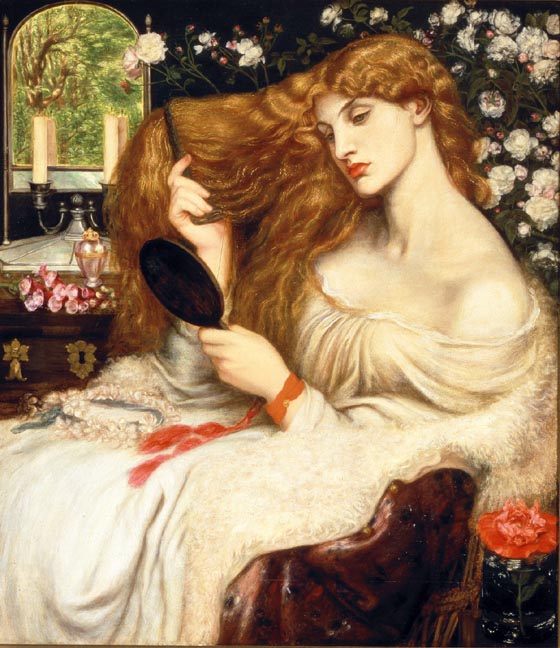
| Lilith | Rossetti | 212 | |
| Algernon Charles Swinburne. | |||
| Adoration of the Magi | Dürer | 215 | |
| Moriz Thausing. | |||
| Marriage A-la-Mode | Hogarth | 218 | |
| Austin Dobson. | |||
| The Madonna of the Rocks | Leonardo da Vinci | 234 | |
| Théophile Gautier. | |||
| Beatrice Cenci | Guido Reni | 239 | |
| Percy Bysshe Shelley. | |||
| The Transfiguration | Raphael | 249 | |
| Mrs. Jameson. | |||
| The Bull | Paul Potter | 256 | |
| Eugène Fromentin. | |||
| Corésus and Callirhoé | Fragonard | 262 | |
| Edmond and Jules de Goncourt. | |||
| The Market-Cart | Gainsborough | 268 | |
| Richard and Samuel Redgrave. | |||
| Bacchus and Ariadne | Tintoret | 273 | |
| Hippolyte Adolphe Taine. | |||
| Bacchus and Ariadne | 278 | ||
| Anonymous. | |||
| La Cruche Cassée | Greuze | 280 | |
| Théophile Gautier. | |||
| Portrait of Lady Cockburn and Her Children | Reynolds | 282 | |
| Frederic G. Stephens. | |||
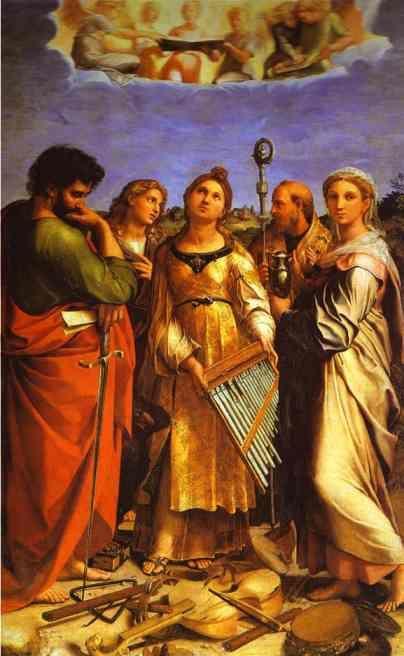
| St. Cecilia | Raphael | 287 | |
| Percy Bysshe Shelley. | |||
| The Last Supper | Leonardo da Vinci | 289 | |
| Johann Wolfgang von Goethe. | |||
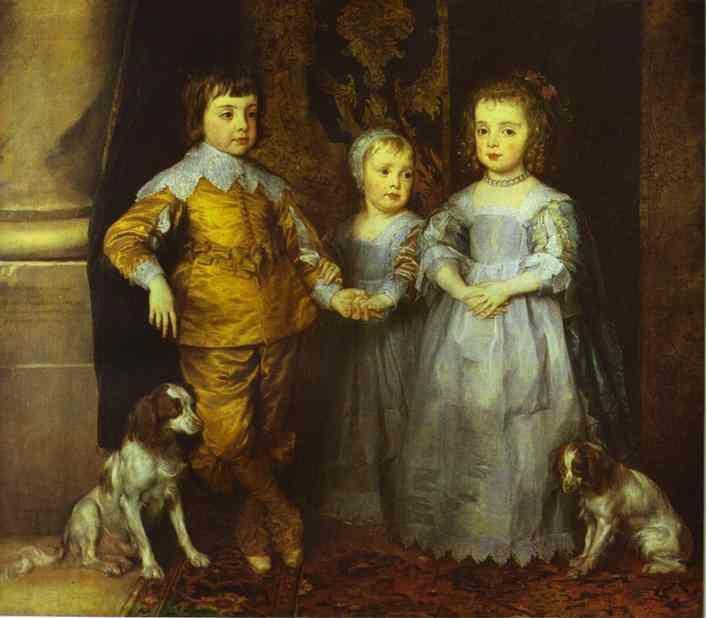
| The Children of Charles I. | Van dyck | 300 | |
| Jules Guiffrey. | |||
| The Fighting Téméraire Tugged to Her Last Berth to be Broken Up, 1838 | Turner | 306 | |
| John Ruskin. | |||
| Spring | Botticelli | 313 | |
| Marcel Reymond. | |||
Illustrations
| Bordone | Fisherman presenting the Ring to the Doge Gradenigo | Venice | Frontispiece |
| FACING PAGE | |||
| Botticelli | The Birth of Venus | Florence | 6 |
| Veronese | The Queen of Sheba | Turin | 16 |
| Michael Angelo | The Last Judgment | Rome | 18 |
| Correggio | Magdalen | Dresden | 28 |
| Van der Helst | The Banquet of the Arquebusiers | Amsterdam | 34 |
| Watteau | L’Embarquement pour l’Île de Cythère | Paris | 38 |
| Raphael | The Sistine Madonna | Dresden | 46 |
| Carpaccio | The Dream of St. Ursula | Venice | 58 |
| Rubens | The Descent from the Cross | Antwerp | 62 |
| Titian | Bacchus and Ariadne | London | 72 |
| Fra Angelico | The Coronation of the Virgin | Paris | 78 |
| Botticelli | Judith | Florence | 80 |
| Hobbema | The Avenue of Middelharnais | London | 88 |
| Andrea del Sarto | The Dance of the Daughter of Herodias | Florence | 94 |
| Fabriano | The Adoration of the Magi | Florence | 98 |
| Holbein | Portrait of Georg Gisze | Berlin | 102 |
| Tintoret | Paradise | Venice | 106 |
| Guido Reni | Aurora | Rome | 114 |
| Titian | The Assumption of the Virgin | Venice | 120 |
| xivRembrandt | The Night Watch | Amsterdam | 124 |
| Gozzoli | The Rape of Helen | London | 138 |
| L. da Vinci | Monna Lisa | Paris | 142 |
| Van Eyck | The Adoration of the Lamb | Ghent | 154 |
| Piero di Cosimo | The Death of Procris | London | 168 |
| Tintoret | The Marriage in Cana | Venice | 172 |
| De la Tour | Portrait of Madame de Pompadour | Paris | 178 |
| Constable | The Hay Wain | London | 184 |
| Velasquez | The Surrender of Breda | Madrid | 192 |
| Murillo | The Immaculate Conception | Paris | 196 |
| Giotto | St. Frances before the Soldan | Florence | 202 |
| Rossetti | Lilith | Rockford, Del. | 212 |
| Dürer | The Adoration of the Magi | Florence | 216 |
| Hogarth | The Marriage A-la-Mode | London | 218 |
| L. da Vinci | The Madonna of the Rocks | Paris | 234 |
| Guido Reni | Portrait of Beatrice Cenci | Rome | 240 |
| Raphael | The Transfiguration | Rome | 250 |
| Paul Potter | The Bull | The Hague | 256 |
| Fragonard | Corésus and Callirhoé | Paris | 262 |
| Gainsborough | The Market-Cart | London | 268 |
| Tintoret | Bacchus and Ariadne | Venice | 274 |
| Greuze | La Cruche Cassée | Paris | 280 |
| Reynolds | Portrait of Lady Cockburn and her Children | London | 282 |
| Raphael | St. Cecilia | Naples | 288 |
| L. da Vinci | The Last Supper | Milan | 290 |
| Van Dyck | Portrait of the Children of Charles I. | Turin | 300 |
| Turner | The Fighting Téméraire | London | 306 |
| Botticelli | Spring | Florence | 314 |
GREAT PICTURES
DESCRIBED BY GREAT WRITERS
THE FISHERMAN PRESENTING THE RING
TO THE DOGE GRADENIGO
(BORDONE)
THÉOPHILE GAUTIER
This picture, which represents a gondolier returning
the ring of Saint Mark to the Doge, treats of
a legend, an episode of which Giorgione, as we shall see in
the next hall, has also painted in a somewhat singular manner.
Here is the story in a few words: One night while
the gondolier was sleeping in his gondola, waiting for
custom along the canal of S. Giorgio Maggiore, three mysterious
individuals jumped into his boat and bade him take
them to the Lido; one of the three persons, as well as he
could be distinguished in the darkness, appeared to have the
beard of an apostle and the figure of a high dignitary of the
Church; the two others, by a certain sound as of armour
rubbing beneath their mantles, revealed themselves as men-at-arms.
The gondolier turned his prow towards the Lido
and began to row; but the lagoon, so tranquil at their
departure, began to chop and swell strangely: the waves2
gleamed with sinster lights; monstrous apparitions were outlined
menacingly around the barque to the great terror of
the gondolier; and hideous spirits of evil and devils half
man half fish seemed to be swimming from the Lido
towards Venice, making the waves emit thousands of sparks
and exciting the tempest with whistling and fiendish
laughter in the storm; but the appearance of the shining
swords of the two knights and the extended hand of the
saintly personage made them recoil and vanish in sulphurous
explosions.
The battle lasted for a long time; new demons constantly
succeeded the others; however, the victory remained
with the personages in the boat, who had themselves taken
back to the landing of the Piazzetta. The gondolier
scarcely knew what to think of their strange conduct;
until, as they were about to separate, the oldest of the
group, suddenly causing his nimbus to shine out again, said
to the gondolier: “I am Saint Mark, the patron of Venice.
I learned to-night that the devils assembled in convention
at the Lido in the cemetery of the Jews, had formed the
resolution of exciting a frightful tempest and overthrowing
my beloved city, under the pretext that many excesses are
committed there which give the evil spirits power over her
inhabitants; but as Venice is a good Catholic and will confess
her sins in the beautiful cathedral which she has raised
to me, I resolved to defend her from this peril of which
she was ignorant, by the aid of these two brave companions,
Saint George and Saint Theodore, and I have borrowed thy
boat; now, as all trouble merits reward, and as thou hast
passed a boisterous night, here is my ring; carry it to the3
Doge and tell him what thou hast seen. He will fill thy
cap with golden sequins.”
So saying, the Saint resumed his position on the top of
the porch of Saint Mark’s, Saint Theodore climbed to the
top of his column, where his crocodile was grumbling with
ill-humour, and Saint George went to squat in the depths
of his columned niche in the great window of the Ducal
Palace.
The gondolier, rather astonished, and he had reason
enough, would have believed that he had been dreaming
after drinking during that evening several glasses too many
of the wine of Samos, if the large and heavy golden ring
studded with precious stones which he held in his hand had
not prevented his doubting the reality of the events of the
night.
Therefore, he went to find the Doge, who was presiding
over the Senate in his cap of office, and, respectfully
kneeling before him, he related the story of the battle
between the devils and the patron saints of Venice. At
first this story seemed incredible; but the return of the ring,
which was in very sooth that of Saint Mark, and the
absence of which from the church treasury was established,
proved the gondolier’s veracity. This ring, locked up under
triple keys in a carefully-guarded treasury, the bolts of
which showed no trace of disturbance, could only have been
removed by supernatural means. They filled the gondolier’s
cap with gold and celebrated a mass of thanksgiving
for the peril they had escaped. This did not prevent the
Venetians from continuing their dissolute course of life,
from spending their nights in the haunts of play, at gay4
suppers, and in love-making; in masking for intrigues, and
in prolonging the long orgy of their carnival for six months
in the year. The Venetians counted upon the protection
of Saint Mark to go to paradise and they took no other care
of their salvation. That was Saint Mark’s affair; they had
built him a fine church for that, and the Saint was still
under obligations to them.
The moment selected by Paris Bordone is that when the
gondolier falls on his knees before the Doge. The composition
of the scene is very picturesque; you see in perspective
a long row of the brown or grey heads of senators
of the most magisterial character. Curious spectators are
on the steps, forming happily-contrasted groups: the beautiful
Venetian costume is displayed here in all its splendour.
Here, as in all the canvases of this school, an important
place is given to architecture. The background is occupied
by fine porticos in the style of Palladio, animated with
people coming and going. This picture possesses the
merit, sufficiently rare in the Italian school, which is almost
exclusively occupied with the reproduction of religious or
mythological subjects, of representing a popular legend, a
scene of manners, in a word, a romantic subject such as
Delacroix or Louis Boulanger might have chosen and
treated according to his own special talent; and this gives
it a character of its own and an individual charm.
Voyage en Italie (Paris, new ed., 1884).
THE BIRTH OF VENUS
(BOTTICELLI)
WALTER PATER
In Leonardo’s treatise on painting only one contemporary
is mentioned by name—Sandro Botticelli.
This pre-eminence may be due to chance only, but to some
will rather appear a result of deliberate judgment; for
people have begun to find out the charm of Botticelli’s
work, and his name, little known in the last century, is
quietly becoming important. In the middle of the Fifteenth
Century he had already anticipated much of that
meditative subtlety which is sometimes supposed peculiar
to the great imaginative workmen of its close. Leaving
the simple religion which had occupied the followers of
Giotto for a century, and the simple naturalism which had
grown out of it, a thing of birds and flowers only, he
sought inspiration in what to him were works of the
modern world, the writings of Dante and Boccaccio, and
in new readings of his own of classical stories; or if he
painted religious subjects, painted them with an undercurrent
of original sentiment which touches you as the
real matter of the picture through the veil of its ostensible
subject. What is the peculiar sensation, what is the
peculiar quality of pleasure which his work has the property6
of exciting in us, and which we cannot get elsewhere?
For this, especially when he has to speak of a
comparatively unknown artist, is always the chief question
which a critic has to answer.
In an age when the lives of artists were full of adventure,
his life is almost colourless. Criticism indeed has
cleared away much of the gossip which Vasari accumulated,
has touched the legend of Lippo and Lucrezia, and
rehabilitated the character of Andrea del Castagno; but in
Botticelli’s case there is no legend to dissipate. He did
not even go by his true name: Sandro is a nickname, and
his true name is Filipepi, Botticelli being only the name of
the goldsmith who first taught him art. Only two things
happened to him, two things which he shared with other
artists—he was invited to Rome to paint in the Sistine
Chapel, and he fell in later life under the influence of
Savonarola, passing apparently almost out of men’s sight
in a sort of religious melancholy which lasted till his death
in 1515, according to the received date. Vasari says that
he plunged into the study of Dante, and even wrote a
comment on the Divine Comedy. But it seems strange
that he should have lived on inactive so long; and one
almost wishes that some document might come to light
which, fixing the date of his death earlier, might relieve
one, in thinking of him, of his dejected old age.

The Birth of Venus.
Botticelli.
He is before all things a poetical painter, blending the
charm of story and sentiment, the medium of the art of
poetry, with the charm of line and colour, the medium of
abstract painting. So he becomes the illustrator of Dante.
In a few rare examples of the edition of 1481, the blank7
spaces left at the beginning of every canto for the hand
of the illuminator have been filled as far as the nineteenth
canto of the Inferno, with impressions of engraved plates,
seemingly by way of experiment, for in the copy in the
Bodleian Library, one of the three impressions it contains
has been printed upside down and much awry in the midst
of the luxurious printed page. Giotto, and the followers
of Giotto, with their almost childish religious aim, had not
learned to put that weight of meaning into outward things,
light, colour, every-day gesture, which the poetry of the
Divine Comedy involves, and before the Fifteenth Century
Dante could hardly have found an illustrator. Botticelli’s
illustrations are crowded with incident, blending with a
naïve carelessness of pictorial propriety three phases of the
same scene into one plate. The grotesques, so often a
stumbling-block to painters who forget that the words of
a poet, which only feebly present an image to the mind,
must be lowered in key when translated into form, make
one regret that he has not rather chosen for illustration
the more subdued imagery of the Purgatorio. Yet in the
scene of those who go down quick into hell there is an
invention about the fire taking hold on the up-turned soles
of the feet, which proves that the design is no mere translation
of Dante’s words, but a true painter’s vision; while
the scene of the Centaurs wins one at once, for, forgetful
of the actual circumstances of their appearance, Botticelli
has gone off with delight on the thought of the Centaurs
themselves, bright small creatures of the woodland, with
arch baby faces and mignon forms, drawing tiny bows.
Botticelli lived in a generation of naturalists, and he8
might have been a mere naturalist among them. There
are traces enough in his work of that alert sense of outward
things which, in the pictures of that period, fills the
lawns with delicate living creatures, and the hill-sides with
pools of water, and the pools of water with flowering reeds.
But this was not enough for him; he is a visionary
painter, and in his visionariness he resembles Dante.
Giotto, the tried companion of Dante, Masaccio, Ghirlandaio
even, do but transcribe with more or less refining
the outward image; they are dramatic, not visionary
painters; they are almost impassive spectators of the
action before them. But the genius of which Botticelli
is the type usurps the data before it as the exponents
of ideas, moods, visions of its own; with this interest it
plays fast and loose with those data, rejecting some and
isolating others, and always combining them anew. To
him, as to Dante, the scene, the colour, the outward image
or gesture, comes with all its incisive and importunate
reality; but awakes in him, moreover, by some subtle
structure of his own, a mood which it awakes in no one
else, of which it is the double or repetition, and which it
clothes, that all may share it, with sensuous circumstances.
But he is far enough from accepting the conventional
orthodoxy of Dante which, referring all human action to
the easy formula of purgatory, heaven, and hell, leaves an
insoluble element of prose in the depths of Dante’s poetry.
One picture of his, with the portrait of the donor, Matteo
Palmieri, below, had the credit or discredit of attracting
some shadow of ecclesiastical censure. This Matteo Palmieri—two
dim figures move under that name in contemporary9
history—was the reputed author of a poem,
still unedited, La Città Divina, which represented the
human race as an incarnation of those angels who, in the
revolt of Lucifer, were neither for God nor for his enemies,
a fantasy of that earlier Alexandrian philosophy, about
which the Florentine intellect in that century was so
curious. Botticelli’s picture may have been only one of
those familiar compositions in which religious reverie has
recorded its impressions of the various forms of beatified
existence—Glorias, as they were called, like that in which
Giotto painted the portrait of Dante; but somehow it was
suspected of embodying in a picture the wayward dream of
Palmieri, and the chapel where it hung was closed. Artists
so entire as Botticelli are usually careless about philosophical
theories, even when the philosopher is a Florentine of the
Fifteenth Century, and his work a poem in terza rima.
But Botticelli, who wrote a commentary on Dante and
became the disciple of Savonarola, may well have let such
theories come and go across him. True or false, the story
interprets much of the peculiar sentiment with which he
infuses his profane and sacred persons, comely, and in a
certain sense like angels, but with a sense of displacement
or loss about them—the wistfulness of exiles conscious of
a passion and energy greater than any known issue of them
explains, which runs through all his varied work with a
sentiment of ineffable melancholy.
So just what Dante scorns as unworthy alike of heaven
and hell, Botticelli accepts, that middle world in which
men take no side in great conflicts, and decide no great
causes, and make great refusals. He thus sets for himself10
the limits within which art, undisturbed by any moral
ambition, does its most sincere and surest work. His
interest is neither in the untempered goodness of Angelico’s
saints, nor the untempered evil of Orcagna’s Inferno; but
with men and women in their mixed and uncertain condition,
always attractive, clothed sometimes by passion with
a character of loveliness and energy, but saddened perpetually
by the shadow upon them of the great things from
which they shrink. His morality is all sympathy; and it
is this sympathy, conveying into his work somewhat more
than is usual of the true complexion of humanity, which
makes him, visionary as he is, so forcible a realist.
It is this which gives to his Madonnas their unique
expression and charm. He has worked out in them a
distinct and peculiar type, definite enough in his own mind,
for he has painted it over and over again, sometimes one
might think almost mechanically, as a pastime during that
dark period when his thoughts were so heavy upon him.
Hardly any collection of note is without one of these circular
pictures, into which the attendant angels depress their
heads so naïvely. Perhaps you have sometimes wondered
why those peevish-looking Madonnas, conformed to no
acknowledged or obvious type of beauty, attract you more
and more, and often come back to you when the Sistine
Madonna and the virgins of Fra Angelico are forgotten.
At first, contrasting them with those, you may have thought
that there was even something in them mean or abject, for
the abstract lines of the face have little nobleness and the
colour is wan. For with Botticelli she too, though she
holds in her hands the “Desire of all nations,” is one of11
those who are neither for God nor for his enemies; and
her choice is on her face. The white light on it is cast up
hard and cheerless from below, as when snow lies upon the
ground, and the children look up with surprise at the
strange whiteness of the ceiling. Her trouble is in the very
caress of the mysterious child, whose gaze is always far
from her, and who has already that sweet look of devotion
which men have never been able altogether to love, and
which still makes the born saint an object almost of suspicion
to his earthly brethren. Once, indeed, he guides
her hand to transcribe in a book the words of her exaltation,
the Ave and the Magnificat, and the Gaude Maria,
and the young angels, glad to rouse her for a moment from
her dejection, are eager to hold the inkhorn and support
the book; but the pen almost drops from her hand, and
the high cold words have no meaning for her, and her true
children are those others, in the midst of whom, in her
rude home, the intolerable honour came to her, with that
look of wistful inquiry on their irregular faces which you
see in startled animals—gipsy children, such as those who,
in Apennine villages, still hold out their long brown arms
to beg of you, but on Sundays become enfants du chœur
with their thick black hair nicely combed and fair white
linen on their sunburnt throats.
What is strangest is that he carries this sentiment into
classical subjects, its most complete expression being a picture
in the Uffizi, of Venus rising from the sea, in which
the grotesque emblems of the middle age, and a landscape
full of its peculiar feeling, and even its strange draperies
powdered all over in the Gothic manner with a quaint conceit12
of daisies, frame a figure that reminds you of the
faultless nude studies of Ingres. At first, perhaps, you are
attracted only by a quaintness of design, which seems to
recall all at once whatever you have read of Florence in the
Fifteenth Century; afterwards you may think that this
quaintness must be incongruous with the subject, and that
the colour is cadaverous, or at least cold. And yet the
more you come to understand what imaginative colouring
really is, that all colour is no mere delightful quality of
natural things, but a spirit upon them by which they become
expressive to the spirit, the better you will like this peculiar
quality of colour; and you will find that quaint design of
Botticelli’s a more direct inlet into the Greek temper than
the works of the Greeks themselves even of the finest
period. Of the Greeks as they really were, of their difference
from ourselves, of the aspects of their outward life, we
know far more than Botticelli, or his most learned contemporaries;
but for us, long familiarity has taken off the edge
of the lesson, and we are hardly conscious of what we owe
to the Hellenic spirit. But in pictures like this of Botticelli’s
you have a record of the first impression made by it
on minds turned back towards it in almost painful aspiration
from a world in which it had been ignored so long;
and in the passion, the energy, the industry of realization,
with which Botticelli carries out his intention, is the exact
measure of the legitimate influence over the human mind
of the imaginative system of which this is the central
myth. The light is, indeed, cold—mere sunless dawn;
but a later painter would have cloyed you with sunshine;
and you can see the better for that quietness in the morning13
air each long promontory as it slopes down to the
water’s edge. Men go forth to their labours until the
evening; but she is awake before them, and you might
think that the sorrow in her face was at the thought of the
whole long day of love yet to come. An emblematical
figure of the wind blows hard across the grey water, moving
forward the dainty-lipped shell on which she sails, the
sea “showing his teeth” as it moves in thin lines of foam,
and sucking in one by one the falling roses, each severe in
outline, plucked off short at the stalk, but embrowned a
little, as Botticelli’s flowers always are. Botticelli meant
all that imagery to be altogether pleasurable; and it was
partly an incompleteness of resources, inseparable from the
art of that time, that subdued and chilled it; but his predilection
for minor tones counts also; and what is unmistakable
is the sadness with which he has conceived the
goddess of pleasure as the depository of a great power over
the lives of men.
I have said that the peculiar character of Botticelli is the
result of a blending in him of a sympathy for humanity in
its uncertain condition, its attractiveness, its investiture at
rarer moments in a character of loveliness and energy, with
his consciousness of the shadow upon it of the great things
from which it shrinks, and that this conveys into his work
somewhat more than painting usually attains of the true
complexion of humanity. He paints the story of the goddess
of pleasure in other episodes besides that of her birth
from the sea, but never without some shadow of death in
the grey flesh and wan flowers. He paints Madonnas, but
they shrink from the pressure of the divine child, and plead14
in unmistakable undertones for a warmer, lower humanity.
The same figure—tradition connects it with Simonetta, the
mistress of Giuliano de’ Medici—appears again as Judith
returning home across the hill country when the great
deed is over, and the moment of revulsion come, and the
olive branch in her hand is becoming a burthen; as Justice,
sitting on a throne, but with a fixed look of self-hatred
which makes the sword in her hand seem that of a suicide;
and again as Veritas in the allegorical picture of Calumnia,
where one may note in passing the suggestiveness of an
accident which identifies the image of Truth with the
person of Venus. We might trace the same sentiment
through his engravings; but his share in them is doubtful,
and the object of this fragment has been attained if I have
defined aright the temper in which he worked.
But, after all, it may be asked, is a painter like Botticelli,
a second-rate painter, a proper subject for general
criticism? There are a few great painters, like Michael
Angelo or Leonardo, whose work has become a force in
general culture, partly for this very reason that they have
absorbed into themselves all such workmen as Sandro
Botticelli; and, over and above mere technical or antiquarian
criticism, general criticism may be very well employed
in that sort of interpretation which adjusts the
position of these men to general culture, whereas smaller
men can be the proper subjects only of technical or antiquarian
treatment. But, besides those great men, there is
a certain number of artists who have a distinct faculty of
their own by which they convey to us a peculiar quality
of pleasure which we cannot get elsewhere, and these, too,15
have their place in general culture, and have to be interpreted
to it by those who have felt their charm strongly,
and are often the objects of a special diligence and a consideration
wholly affectionate, just because there is not
about them the stress of a great name and authority. Of
this select number Botticelli is one; he has the freshness,
the uncertain and diffident promise which belongs to the
earlier Renaissance itself, and makes it perhaps the most
interesting period in the history of the mind; in studying
his work one begins to understand to how great a place in
human culture the art of Italy had been called.
Studies in the History of the Renaissance (London, 1873).
THE QUEEN OF SHEBA
(VERONESE)
JOHN RUSKIN
This picture is at Turin, and is of quite inestimable
value. It is hung high; and the really principal
figure—the Solomon, being in the shade, can hardly be
seen, but is painted with Veronese’s utmost tenderness, in
the bloom of perfect youth, his hair golden, short, crisply
curled. He is seated high on his lion throne; two elders
on each side beneath him, the whole group forming a tower
of solemn shade. I have alluded, elsewhere, to the principle
on which all the best composers act, of supporting
these lofty groups by some vigorous mass of foundation.
This column of noble shade is curiously sustained. A
falconer leans forward from the left-hand side, bearing on
his wrist a snow-white falcon, its wings spread, and brilliantly
relieved against the purple robe of one of the elders.
It touches with its wings one of the golden lions of the
throne, on which the light also flashes strongly; thus forming,
together with it, the lion and eagle symbol, which
is the type of Christ, throughout mediæval work. In
order to show the meaning of this symbol, and that Solomon
is typically invested with the Christian royalty, one of the
elders by a bold anachronism, holds a jewel in his hand in
the shape of a cross, with which he (by accident of gesture)17
points to Solomon; his other hand is laid on an open
book.

The Queen of Sheba.
Veronese.
The group opposite, of which the Queen forms the
centre, is also painted with Veronese’s highest skill; but
contains no point of interest bearing on our present subject,
except its connection by a chain of descending emotion.
The Queen is wholly oppressed and subdued; kneeling, and
nearly fainting, she looks up to Solomon with tears in her
eyes; he, startled by fear for her, stoops forward from the
throne, opening his right hand, as if to support her, so as
almost to drop the sceptre. At her side her first maid of
honour is kneeling also, but does not care about Solomon;
and is gathering up her dress that it may not be crushed;
and looking back to encourage a negro girl, who, carrying
two toy-birds, made of enamel and jewels, for presentation
to the King, is frightened at seeing her Queen fainting,
and does not know what she ought to do; while lastly, the
Queen’s dog, another of the little fringy paws, is wholly
unabashed by Solomon’s presence, or anybody else’s; and
stands with his forelegs well apart, right in front of his
mistress, thinking everybody has lost their wits; and barking
violently at one of the attendants, who has set down a
golden vase disrespectfully near him.
Modern Painters (London, 1860).
THE LAST JUDGEMENT
(MICHAEL ANGELO)
ALEXANDRE DUMAS
While Michael Angelo worked upon his Moses,
Clement VII., following the example of Julius II.,
would not leave him alone for a moment. It was a trick
of all these Popes to exact from the poor artist something
different to what he was doing at the time. To obtain
some respite, he was forced to promise the Pope that he
would occupy himself at the same time with the cartoon of
The Last Judgment. But Clement VII. was not a man to
be put off with words; he supervised the work in person,
and Buonarroti was obliged to pass continually from the
chisel to the pencil and from the pen to the mallet. The
Last Judgment! Moses! these are two works of little
importance and easy to do off-hand! And yet he had to.
His Holiness would not listen to reason.
One day it was announced to Michael Angelo that he
would not receive his accustomed visit: Clement VII. was
dead. The artist breathed freely just during the Conclave.
The new Pope, Paul III., had nothing more pressing to
do than to present himself in Buonarroti’s studio, followed
pompously by ten cardinals. The newly-elected Pope was
easily recognized there!

The Last Judgment.
Michael Angelo.
“Ah!” said the Holy Father, in a tone of firm decision,
“I hope that henceforth the whole of your time will belong
to me, Maestro Buonarroti.”
“May your Holiness deign to excuse me,” replied
Michael Angelo, “but I have just signed an engagement
with the Duke of Urbino, which forces me to finish the
tomb of Pope Julius.”
“What!” exclaimed Paul III.: “for thirty years I have
had a certain wish and now that I am Pope I cannot
realize it!”
“But the contract, Holy Father, the contract!”
“Where is this contract? I will tear it up.”
“Ah!” exclaimed in his turn the Cardinal of Mantua,
who was one of the suite, “your Holiness should see the
Moses which Maestro Michael Angelo has just finished:
that statue alone would more than suffice to honour the
memory of Julius.”
“Cursed flatterer!” muttered Michael Angelo in a low
voice.
“Come, come, I will take charge of this matter myself,”
said the Pope. “You shall only make three statues with
your own hand: the rest shall be given to other sculptors,
and I will answer for the Duke of Urbino’s consent. And
now, Maestro, to the Sistine Chapel. A great empty wall
is waiting for you there.”
What could Michael Angelo reply to such an emphatic
wish expressed so distinctly? He finished in his best style
his two statues of Active Life and Contemplative Life—Dante’s
symbolical Rachel and Leah—and not wishing to
profit by this new arrangement to which he was forced to20
submit, he added fifteen hundred and twenty-four ducats to
the four thousand he had received, to pay with his own
gains for the works confided to the other artists.
Having thus terminated this unfortunate affair, which had
caused him so much worry and fatigue, Michael Angelo
was at last enabled to occupy himself exclusively with the
execution of his Last Judgment, to which he devoted
no less than eight to nine years.
This immense and unique picture, in which the human
figure is represented in all possible attitudes, where every
sentiment, every passion, every reflection of thought, and
every aspiration of the soul are rendered with inimitable
perfection, has never been equalled and never will be
equalled in the domain of Art.
This time the genius of Michael Angelo simply attacked
the infinite. The subject of this vast composition, the
manner in which it is conceived and executed, the admirable
variety and the learned disposition of the groups, the
inconceivable boldness and firmness of the outlines, the contrast
of light and shade, the difficulties, I might almost say
the impossibilities vanquished, as if it were all mere play,
and with a happiness that savours of prodigy, the unity of
the whole and the perfection of the details, make The Last
Judgment the most complete and the greatest picture in
existence. It is broad and magnificent in effect, and yet
each part of this prodigious painting gains infinitely when
seen and studied quite near; and we do not know of any
easel-picture worked upon with such patience and finished
with such devotion.
The painter could only choose one scene, several isolated21
groups, in this appalling drama which will be enacted on
the last day in the Valley of Jehoshaphat, where all the
generations of man shall be gathered together. And yet,
admire the omnipotence of genius! With nothing but a
single episode in a restricted space, and solely by the expression
of the human body, the artist has succeeded in
striking you with astonishment and terror, and in making
you really a spectator of the supreme catastrophe.
At the base of the picture, very nearly in the centre, you
perceive the boat of the Inferno, a fantastic reminiscence
borrowed from Pagan tradition, in accordance with which
first the poet and then the painter were pleased to clothe an
accursed being with the form and occupation of Charon.
“Charon with the eyes of burning embers gathering
together with a gesture all these souls, and striking with his
oar those who hesitate.”1
It is impossible to form an idea of the incredible science
displayed by Michael Angelo in the varied contortions of
the damned, heaped one upon the other in the fatal bark.
All the violent contractions, all the visible tortures, all the
frightful shrinkings that suffering, despair, and rage can
produce upon human muscles are rendered in this group
with a realism that would make the most callous shudder.
To the left of this bark you see the gaping mouth of a
cavern; this is the entrance to Purgatory, where several
demons are in despair because they have no more souls to
torment.
This first group, which very naturally attracts the spectator’s
attention, is that of the dead whom the piercing22
sound of the eternal trumpet has awakened in their tombs.
Some of them shake off their shrouds, others with great
difficulty open their eyelids made heavy by their long sleep.
Towards the angle of the picture there is a monk who is
pointing out the Divine Judge with his left hand; this
monk is the portrait of Michael Angelo.
The second group is formed of the resuscitated ones who
ascend of themselves to the Judgment. These figures,
many of which are sublime in expression, rise more or less
lightly into space, according to the burden of their sins, of
which they must render account.
The third group, also ascending to the right of Christ,
is that of the Blessed. Among all these saints, some of
whom show the instrument of their execution, others the
marks of their martyrdom, there is one head especially remarkable
for beauty and tenderness: it is that of a mother
who is protecting her daughter, turning her eyes, filled with
faith and hope, towards the Christ.
Above the host of saints, you see a fourth group of
angelic spirits, some bearing the Cross, others the Crown
of Thorns,—instruments and emblems of the Saviour’s
Passion.
The fifth group, parallel to the fourth which we have
just pointed out, is composed of angels; such, at least, they
seem to be by the splendour of their youth and the aërial
lightness of their movements; and these also bear, as if in
triumph, other emblems of the divine expiation—the
column, the ladder, and the sponge.
Above these angels, on the same plane as the saints and
to the left of Christ, is the choir of the just; the patriarchs,23
the prophets, the apostles, the martyrs, and the holy personages
form this sixth group.
The seventh is the most horrible of all and the one in
which the art of Michael Angelo has displayed itself in all
its terrific grandeur: it is composed of the rejected ones,
overwhelmed by the decree and led away to punishment by
the rebel angels. The very coldest spectator could not
remain unmoved by this spectacle. You believe yourself in
hell; you hear the cries of anguish and the gnashing of the
teeth of the wretched, who, according to the terrible
Dantesque expression, vainly desire a second death.
The eighth, ninth, and tenth groups, occupying the base
of the composition, are composed, as we have already said,
of the bark of Charon, the grotto of Purgatory, and the
Angels of Judgment, eight in number, blowing their brazen
trumpets with all their might to convoke the dead from the
four quarters of the earth.
Finally, in the eleventh group, in the centre, very near
the upper part of the picture, between the two companies
of the blessed, and seated upon the clouds, the sovereign
Judge with a terrible action hurls his malediction upon the
condemned: “Ite maledicti in ignem aeternum.” The Virgin
turns away her head and trembles. On Christ’s right is
Adam, and on his left, St. Peter. They have exactly the
same positions assigned to them by Dante in his Paradiso.
This immense work was exhibited to the public on
Christmas Day, 1541. It had cost eight years of work.
Michael Angelo was then sixty-seven years old.
Several anecdotes relating to this great picture have come
down to us.
It is related that the Pope, scandalized at the nudity of
certain figures, a nudity which Daniele da Volterra was
afterwards charged to clothe, sent word to Michael Angelo
that he must cover them.
Michael Angelo replied with his usual brusqueness:
“Tell the Pope that he must employ himself a little less
in correcting my pictures, which is very easy, and employ
himself a little more in reforming men, which is very
difficult.”
It is said that Maestro Biaggio, master of ceremonies to
Paul III., having accompanied the Pope on a visit that His
Holiness made to see Michael Angelo’s fresco when it was
about half finished, allowed himself to express his own
opinion upon The Last Judgment.
“Holy Father,” said the good Messer Biaggio, “if I dare
pronounce my judgment, this picture seems more appropriate
to figure in a tavern than in the chapel of a Pope.”
Unfortunately for the master of ceremonies, Michael
Angelo was behind him and did not lose a word of Messer
Biaggio’s compliment. The Pope had scarcely gone before
the irritated artist, wishing to make an example as a warning
for all future critics, placed this Messer Biaggio in his
hell, well and duly, under the scarcely flattering guise of
Minos. That was always Dante’s way when he wanted to
avenge himself upon an enemy.
I leave you to imagine the lamentations and complaints
of the poor master of ceremonies when he saw himself
damned in this manner. He threw himself at the Pope’s
feet, declaring that he would never arise unless His Holiness
would have him taken out of hell: that was the most25
important thing. As for the punishment, that the painter
deserved for this dreadful sacrilege, Messer Biaggio would
leave that entirely to the high impartiality of the Holy
Father.
“Messer Biaggio,” replied Paul III. with as much
seriousness as he could maintain, “you know that I have
received from God an absolute power in heaven and upon
the earth, but I can do nothing in hell; therefore you must
remain there.”
While Michael Angelo was working at his picture of
The Last Judgment, he fell from the scaffold and seriously
injured his leg. Soured by pain and seized with an attack
of misanthropy, the painter shut himself up in his house
and would not see any one.
But he reckoned without his physician; and the physician
this time was as stubborn as the invalid.
This excellent disciple of Æsculapius was named Baccio
Rontini. Having learned by chance of the accident that
had befallen the great artist, he presented himself before
his house and knocked in vain at the door.
No response.
He shouted, he flew into a passion, and he called the
neighbours and the servants in a loud voice.
Complete silence.
He goes to find a ladder, places it against the front of
the house, and tries to enter by the casements. The
windows are hermetically sealed and the shutters are
fast.
What is to be done? Any one else in the physician’s
place would have given up; but Rontini was not the man26
to be discouraged for so little. With much difficulty he
enters the cellar and with no less trouble he goes up into
Buonarroti’s room, and, partly by acquiescence and partly
by force, he triumphantly tends his friend’s leg.
It was quite time: exasperated by his sufferings, the
artist had resolved to let himself die.
Trois Maîtres (Paris, 1861).
FOOTNOTES:
1 Dante, Inferno III.
MAGDALEN IN THE DESERT
(CORREGGIO)
AIMÉ GIRON
Correggio was a painter and a poet at the same
time, interpreting Nature, flattering her, idealizing
her, and realizing her creations in their double æsthetic
expression, with undulating outlines and tender tones.
His drawing was modelled and supple, with a certain
vigour of line and a certain solidity of relief. He had a
charming imagination of conception and a voluptuous grace
in its accomplishment, which are requisites in the painting
of women and children. He therefore excelled in rendering
bambini. With a note-book in his hand, he studied
them everywhere. This explains why his Loves and his
Cherubs have such rare truth of mien, of flesh, and of life.
His knowledge of anatomy is great and he foreshortens
on canvas and ceiling astonishingly before the advent of
Michael Angelo. His enchanting colouring, impasted like
that of Giorgione, vivid as that of Titian, ran through the
most delicate gradations and melted into the most elusive
harmonies. Beneath his facile brush, soft and thick, the
transparencies of the skin and the morbidezza of the flesh
become ideal.
He was the first to apply himself to the choice of
fabrics, and one of the first in Italy to attend to the28
scientific distribution of light. But, in the famous chiaroscuro
he does not get his effects by contrasts, but by
analogies, superimposing shadow upon shadow and light
upon light, both being disposed in large masses and graduated
in progression. This process occurs at its fullest
in the Christmas Night, where the moon shines, and the
child glows with radiance, in a kind of symbolic struggle
between the natural light of this world and the supernatural
light of the other. The effect is such that the
spectator is forced instinctively to blink his eyes, as does
the Shepherdess herself entering the stable.
“When Correggio excels he is a painter worthy of
Athens,” wrote Diderot, whose art criticism had in it
more of sentiment than knowledge.
“With Correggio everything is large and graceful,” said
Louis Carrache, who gave Correggio a large place in his
eclecticism. But after studying and weighing everything,
from his somewhat excessive qualities it follows that
Correggio was more of an idealist than a mystic and
obeyed Art more than Faith, with a leaning towards the
apotheosis of form. He painted Io and Jupiter for Frederick
Gonzaga of Mantua. This picture having passed
to the son of the Regent, the two passionate heads so
strongly troubled his prudery that he cut them out and
burned them. Coypel then begged the Prince to spare
the rest and to give it to him. He obtained it on condition
that “he would make good use of it,” and on the death
of Coypel, M. Pasquier, député du Commerce de Rouen,
paid 16,500 livres for the mutilated remains, as I find in
a very old account.

Magdalen.
Correggio
All the great museums of the world possess Correggios,
and I will only mention the exquisite Saint Catherine and
the resplendent Antiope of the Louvre; the Danaë of the
Borghese Gallery, a chef-d’œuvre of grace and delicacy;
and, finally, in the Dresden Gallery, our Magdalen in the
Desert, that jewel so well-known and so often reproduced.
This Magdalen as a matter of fact holds the first place
among the small Correggios. There are two kinds of
Magdalens in art: I. the Repentant, emaciated, growing
ugly, disfigured by tears and penitence at the end of her
life, with a skull in her hand or before her eyes, not having
had even—like the one sculptured in the Cathedral of
Rouen—”for three times ten winters any other vesture
than her long hair,” according to Petrarch’s verse; II. the
Sinner, always young, always beautiful, always seductive,
who has not lost any of her charms nor even of her
coquetry, and with whom the Book of Life takes the place
of the Death’s Head.
Our Magdalen belongs to the latter class. In a solitary
spot, but attractive with its verdure and rocks, on a grassy
knoll the saint is stretched out at full length, with her
shoulder, her bosom, her arms, and her feet adorably bare.
A blue fabric drapes the rest of her body and forms a
coquettish hood for her head and neck. Her flesh has a
robust elegance of line. Leaning on her right elbow, her
hand, half hidden in her hair, supports a charming and
meditative head, while her other arm is slipped under an
open manuscript. Her hair, long and blonde, according
to legend—which she loves and still cares for because it
once wiped the feet of her Saviour—falls in thick curls,30
or strays at will with a premeditated abandon. On the
ground, to her right, stands the vase of perfumes of her
first adoration; to the left are the stones of her supreme
expiation.
What grace in her attitude! What beauty of form!
She is thrown in with a rare happiness and painted with an
exquisite delicacy of touch and tint. The blue drapery
upon the green landscape defines her sufficiently without
making her stand out too much, leaving the figure and the
landscape to mingle without disturbing each other in skilful
harmony. All of this is in most finished execution, a little
elaborate, perhaps, and the expression of the face reflects
the sweet, sad memory of the Beloved, whose Gospels
she is reading, just as one reads again tender letters of the
past.
This work was executed for the Dukes of Este, who
kept it in a silver frame studded with precious stones and
used it as an ornament for their bedrooms, and when they
travelled, they took it with them in a casket. When the
King of Poland became its possessor, he gave it a second
boxing of glass with lock and key. In 1788, this masterpiece
having been stolen, 1,000 ducats were promised for
its discovery, and, in consideration of that sum, the thief
denounced himself. Cristofano Allori, the greatest Florentine
painter of the Decadence, made a superb copy for the
Offices, I believe.
This Magdalen of Correggio’s, “the least converted of
sinners and the most adorable of penitents,” is she really,
historically and liturgically the Magdalen of the House of
Bethany, of the grotto de la Sainte-Baume in Provence?31
No. She recalls rather “cette dame de marque” who was
evoked in the Seventeenth Century by the Carmelite Father
Pierre de Saint-Louis in his sublime poem of accomplished
burlesque; and does not the following verse hum in your
ear:
while the sinner
This evidently is not at all the art of the Middle Ages,
nor its saints, whose vestment was sackcloth and whose
body was a mere lay figure for a soul devoted entirely to
purity, to simplicity, to mysticism, and to the other world.
In the Sixteenth Century, however, people took the sackcloth
from the saints and dressed them in flesh. Then
was produced a kind of revival of paganism, of naturalism,
of life; and religious art, in its flesh and colouring, no
longer created anything but an Olympus of beautiful
maidens, or, at least, noble goddesses. Correggio’s
Magdalen belongs to this artistic cycle and the painter
executed it in the noonday splendour of those qualities,
the dawn of which glows in Parma at St. Paul’s. Correggio
is not a mystic, he is a voluptuous naturalist, and
from him to the realist Caravaggio, “the grinder of flesh,”
and the exuberant Rubens, who gave much study to Correggio,
the distance is not very great and the decline is
fatal. But, in the meantime, where shall we find more
grace, or seductiveness—under this conversion complicated
with memories—than in Correggio’s Magdalen?
In hagiographal literature we find a work of similar tone
and charm: Marie Madeleine, by P. Lacordaire, an exquisite
little book written with tenderness and piety, which
deliciously calls up before us the Magdalen of repentance
and love, “the loving woman accustomed to the delights of
contemplation and needing only to see in her heart him
whom in other days she saw under the transparent veil of
mortal flesh.”
It must be confessed that Correggio was constantly preoccupied
with charm and with that skilful coquetry that
sports with every grace. This is a subtlety of purely
personal qualities; but let others beware of a systematic
affectation! In this way Correggio did not found a school,
but he had imitators, among whom was Parmigiano, who
by dint of study and in search for grace—the most natural
thing in the world—most often fell into affected and conventional
ways.
Jouin, Chefs-d’œuvre: Peinture, Sculpture, Architecture (Paris,
1895-7).
BANQUET OF THE ARQUEBUSIERS
(VAN DER HELST)
WILLIAM MAKEPEACE THACKERAY
The Night-Watch at Amsterdam is magnificent in
parts, but on the side to the spectator’s right,
smoky and dim. The Five Masters of the Drapers is
wonderful for depth, strength, brightness, massive power.
What words are these to express a picture! to describe
a description! I once saw a moon riding in the sky
serenely, attended by her sparkling maids of honour, and
a little lady said, with an air of great satisfaction, “I must
sketch it.” Ah, my dear lady, if with an H.B., a Bristol
board, and a bit of india-rubber, you can sketch the firmament
on high, and the moon in her glory, I make you my
compliment! I can’t sketch The Five Drapers with any
ink or pen at present at command—but can look with
all my eyes, and be thankful to have seen such a masterpiece.
They say he was a moody, ill-conditioned man, the old
tenant of the mill. What does he think of the “Van der
Helst” which hangs opposite his Night-Watch, and which
is one of the great pictures of the world? It is not painted
by so great a man as Rembrandt; but there it is—to see
it is an event of your life. Having beheld it you have34
lived in the year 1648, and celebrated the Treaty of
Münster. You have shaken the hands of the Dutch
Guardsmen, eaten from their platters, drunk their Rhenish,
heard their jokes, as they wagged their jolly beards. The
Amsterdam Catalogue discourses thus about it:—a model
catalogue: it gives you the prices paid, the signatures of the
painters, a succinct description of the work.
“This masterpiece represents a banquet of the Civic
Guard, which took place on the 18th of June, 1648, in
the great hall of the St. Joris Doele, on the Singel at
Amsterdam, to celebrate the conclusion of the Peace at
Münster. The thirty-five figures composing the picture
are all portraits.

The Banquet of the Arquebusiers.
Van der Helst.
“‘The Captain Witse’ is placed at the head of the table,
and attracts our attention first. He is dressed in black
velvet, his breast covered with a cuirass, on his head a
broad-brimmed black hat with white plumes. He is comfortably
seated on a chair of black oak, with a velvet
cushion, and holds in his left hand, supported on his knee,
a magnificent drinking-horn, surrounded by a St. George
destroying the dragon, and ornamented with olive-leaves.
The captain’s features express cordiality and good-humour;
he is grasping the hand of ‘Lieutenant Van Wavern’
seated near him in a habit of dark grey, with lace and
buttons of gold, lace-collar and wrist-bands, his feet crossed,
with boots of yellow leather, with large tops, and gold
spurs, on his head a black hat and dark-brown plumes.
Behind him, at the centre of the picture, is the standard-bearer,
‘Jacob Banning,’ in an easy martial attitude, hat in
hand, his right hand on his chair, his right leg on his left35
knee. He holds the flag of blue silk, in which the Virgin
is embroidered” (such a silk! such a flag! such a piece of
painting!), “emblematic of the town of Amsterdam. The
banner covers his shoulder, and he looks towards the spectator
frankly and complacently.
“The man behind him is probably one of the sergeants.
His head is bare. He wears a cuirass, and yellow gloves,
grey stockings, and boots with large tops, and knee-caps of
cloth. He has a napkin on his knees, and in his hand a
piece of ham, a slice of bread and a knife. The old man
behind is probably ‘William the Drummer.’ He has his hat
in his right hand, and in his left a gold-footed wineglass,
filled with white wine. He wears a red scarf, and a black
satin doublet, with little slashes of yellow silk. Behind
the drummer, two matchlock-men are seated at the end of
the table. One in a large black habit, a napkin on his
knee, a hausse-col of iron, and a linen scarf and collar. He
is eating with his knife. The other holds a long glass of
white wine. Four musketeers, with different shaped hats,
are behind these, one holding a glass, the three others with
their guns on their shoulders. Other guests are placed
between the personage who is giving the toast and the
standard-bearer. One with his hat off, and his hand uplifted,
is talking to another. The second is carving a fowl.
A third holds a silver plate; and another, in the background,
a silver flagon, from which he fills a cup. The
corner behind the captain is filled by two seated personages,
one of whom is peeling an orange. Two others are
standing, armed with halberts, of whom one holds a plumed
hat. Behind him are other three individuals, one of36
them holding a pewter pot on which the name ‘Poock,’ the
landlord of the ‘Hotel Doele,’ is engraved. At the back,
a maid-servant is coming in with a pasty, crowned with a
turkey. Most of the guests are listening to the captain.
From an open window in the distance, the façades of two
houses are seen, surmounted by stone figures of sheep.”
There, now you know all about it: now you can go
home and paint just such another. If you do, do pray remember
to paint the hands of the figures as they are here
depicted; they are as wonderful portraits as the faces.
None of your slim Van Dyck elegancies, which have done
duty at the cuffs of so many doublets; but each man with a
hand for himself, as with a face for himself. I blushed for
the coarseness of one of the chiefs in this great company,
that fellow behind “William the Drummer,” splendidly
attired, sitting full in the face of the public; and holding
a pork-bone in his hand. Suppose the Saturday Review
critic were to come suddenly on this picture? Ah! what
a shock it would give that noble nature! Why is that
knuckle of pork not painted out? at any rate, why is not a
little fringe of lace painted round it? or a cut pink paper?
or couldn’t a smelling-bottle be painted in instead, with a
crest and a gold top, or a cambric pocket-handkerchief in
lieu of the horrid pig, with a pink coronet in the corner? or
suppose you covered the man’s hand (which is very coarse
and strong), and gave him the decency of a kid glove? But
a piece of pork in a naked hand? O nerves and eau de
Cologne, hide it, hide it!
In spite of this lamentable coarseness, my noble sergeant,
give me thy hand as nature made it! A great, and famous,37
and noble handiwork I have seen here. Not the greatest
picture in the world—not a work of the highest genius—but
a performance so great, various, and admirable, so
shrewd of humour, so wise of observation, so honest and
complete of expression, that to have seen it has been a
delight, and to remember it will be a pleasure for days to
come. Well done, Bartholomeus Van der Helst! Brave,
meritorious, victorious, happy Bartholomew, to whom it has
been given to produce a masterpiece!
… Was it a dream? It seems like one. Have we been
to Holland? Have we heard the chimes at midnight at
Antwerp? Were we really away for a week, or have I been
sitting up in the room dozing, before this stale old desk?
Here’s the desk; yes. But if it has been a dream, how
could I have learned to hum that tune out of Dinorah?
Ah, is it that tune, or myself that I am humming? If it
was a dream how comes this yellow Notice des Tableaux
du Musée d’Amsterdam avec Fascimile des Monogrammes
before me, and this signature of the gallant
Bartholomeus van der Helst fecit; 1648.
Yes, indeed, it was a delightful little holiday; it lasted a
whole week.
Roundabout Papers (London, 1863).
L’EMBARQUEMENT POUR L’ÎLE DE
CYTHÈRE
(WATTEAU)
EDMOND AND JULES DE GONCOURT
Watteau is the great poet of the Eighteenth Century.
A creation, a whole creation of poetry and
dreams, emanated from his brain and filled his work with
the elegance of a supernatural life. From the fantasies of
his brain, from the caprice of his art, from his perfectly
original genius, not one but a thousand fairies took their
flight. From the enchanted visions of his imagination,
the painter has drawn an ideal world, and, superior to his
own time, he has created one of those Shakespearian realms,
one of those countries of love and light, one of those paradises
of gallantry that Polyphile built upon the cloud of
dreams for the delicate joy of poetic mortals.
Watteau revived grace. Grace with Watteau is not the
antique grace—a rigid and solid charm, the perfection of
the marble of a Galatea, the entirely plastic and the material
glory of a Venus. Grace with Watteau is grace. It is
that nothing that invests a woman with an attraction, a
coquetry, a more than physical beauty. It is that subtile
quality which seems the smile of a line, the soul of form,
the spiritual physiognomy of matter.

L’Embarquement pour l’Île de Cythère.
Watteau.
All the fascinations of a woman in repose: languor,
idleness, abandon, leaning back, reclining at full length,
39nonchalance, the cadences of pose, the pretty air of profiles
bending over the scales of love (gammes d’amour), the receding
curves of the bosom, the serpentine lines and undulations,
the suppleness of the female body, the play of
slender fingers on the handle of a fan and the indiscretions
of high heels beyond the skirts, and the happy fortune of
deportment, and the coquetry of actions, and the management
of the shoulders, and all that knowledge that was
taught to women by the mirrors of the last century,—the
mimicry of grace!—lives in Watteau with its blossom
and its accent, immortal and fixed in a more vital proof
than the bosom of the wife of Diomedes moulded by the
ashes of Pompeii. And if this grace is animated by Watteau,
if he looses it from repose and immobility, if he
renders it active and moving, it seems that it works with a
rhythm and that its measured pace is a dance led by some
harmony.
How decorative is the form of woman, and her grace!
O nature, wherein the painter’s poetic fancies wander! O
landscape! O stage fit for a desirable life! a helpful land,
gallant woods, meadows full of music, groves propitious to
the sports of Echo! cradling trees hung with baskets of
flowers! desert places far from the jealous world, touched
by the magic brush of a Servandoni, refreshed with fountains,
peopled with marbles and statues, and Naiads, that
spot the trembling shadow of the leaves! jets of water
suddenly springing up in the midst of farm-yards! an amiable
and radiant countryside! Suns of apotheosis, beautiful
lights sleeping on the lawns, penetrating and translucent
verdure without one shadow where the palette of Veronese,
40the riot of purple, and of blonde tresses may find sleep.
Rural delights! murmurous and gorgeous decorations!
gardens thick with brier and rose! French landscapes
planted with Italian pines! villages gay with weddings and
carriages, ceremonies, toilettes, and fêtes stunned with the
noise of violins and flutes leading the bridal of Nature and
the Opera to a Jesuit fane! Rustic scene on the green curtain,
on the flowery slope up which the Comédie Française
climbs and the Comédie Italienne gambols.
Quick! to array the spring in ball costume, Watteau’s
heavens and earth, quick. Gelosi! A bergomask laugh
shall be the laughter, animation, and action, and movement
of the piece. Look where Folly, capped and belled,
runs and wakes gaiety, zephyrs, and noise! Ruffs and
caps, belts and daggers, little vests and short mantles, go
and come. The band of buffoons comes running, bringing
beneath the shady boughs the carnival of human passions
and its rainbow-hued garb. Variegated family, clothed with
sunlight and brilliant silk! that masks with the night! that
patches and paints with the moon! Harlequin, as graceful
as a product of the pencil of Parmesan! Pierrot, with his
arms at his side, as straight as an I, and the Tartaglias, and
the Scapins, and the Cassandras, and the Doctors, and the
favourite Mezzetin “the big brown man with the laughing
face” always in the foreground with his cap on the back
of his head—striped all over like a zebra, proud as a god,
and drunk as a Silenus! It is the Comédie Italienne that
plays the guitar in all these landscapes….
Here is the new Olympus and the new mythology; the
Olympus of all the demi-gods forgotten by antiquity.41
Here is the deification of the ideas of the Eighteenth Century,
the soul of Watteau’s world and time led to the
Pantheon of human passions and fashions. These are the
new humours of aging humanity—Languor, Gallantry, and
Reverie, which Watteau incarnates as clothed allegories,
and which he rests upon the pulvinar of a divine nature;
these are the moral muses of our age out of which he has
created the women, or, we might say, the goddesses of
these divine pictures.
Love is the light of this world, it penetrates and fills it.
It is the youth and serenity of it; and amidst rivers and
mountains, promenades and gardens, lakes and fountains,
the Paradise of Watteau unfolds; it is Cythera. Under
a sky painted with the colours of summer, the galley of
Cleopatra swings at the bank. The waves are stilled.
The woods are hushed. From the grass to the firmament,
beating the motionless air with their butterfly wings, a host
of Cupids fly, fly, play and dance, here tying careless
couples with roses, and tying above a circlet of kisses that
has risen from earth to the sky. Here is the temple, here
is the end of this world: the painter’s L’Amour paisible,
Love disarmed, seated in the shadows, which the poet of
Theos wished to engrave upon a sweet cup of spring; a
smiling Arcadia; a Decameron of sentiment; a tender
meditation; attentions with vague glances; words that lull
the soul; a platonic gallantry, a leisure occupied by the
heart, an idleness of youthful company; a court of amorous
thoughts; the emotional and playful courtesy of the young
newly married leaning upon the offered arm; eyes without
fever, desire without appetite, voluptuousness without desire,
42audacious gestures regulated like the ballet for a spectacle,
and tranquil defences disdainful of haste through their
security; the romance of the body and the mind, soothed,
pacified, resuscitated, happy; an idleness of passion at which
the stone satyrs lurking in the green coulisses laugh with
their goat-laughter. Adieu to the bacchanales led by
Gillot, that last pagan of the Renaissance, born of the libations
of the Pleiad to the rustic gods of Arcueil! Adieu to
the Olympus of the Io Pæan, the hoarse pipe and the goat-footed
Gods, the laughter of the Cyclops of Euripides and
the Evohe of Ronsard, the licentious triumphs, the ivy-crowned
Joys;
These gods have gone, and Rubens, who lives again in
that palette of light and rosy flesh, wanders bewildered in
these fêtes, where the riot of the senses is stilled,—animated
caprices which seem to await the crack of a whip to
dissolve and disappear in the realm of fancy like a mid-summer
night’s dream! It is Cythera; but it is Watteau’s.
It is love, but it is a poetic love, a love that dreams and
thinks; modern love, with its aspirations and its crown of
melancholy.
Yes, at the heart of this work of Watteau’s, I do not
know what slow and vague harmony murmurs behind those
laughing words; I do not know what musical and sweetly
contagious sorrow is diffused throughout these gallant fêtes.
Like the fascination of Venice, I do not know what veiled
and sighing poetry in low tones holds here the charmed
spirit. The man has passed across his work; and this
43work you come to regard as the play and distraction of a
suffering thought, like the playthings of a sick child who
is now dead….
But let us speak of that masterpiece of French masterpieces,
that canvas which has held a distinguished place on
one of the walls of the salon carré for fifty years,
L’Embarquement de Cythère.
Observe all that ground lightly coated with a transparent
and golden varnish, all that ground covered with rapid strokes
of the brush lightly laid on with a delicate touch. Notice
that green of the trees shot through with red tones, penetrated
with quivering air, and the vaporous light of
autumn. Notice the delicate water-colour effect of thick
oil, the general smoothness of the canvas, the relief of this
pouch or hood; notice the full modelling of the little faces
with their glances in the confused outlines of the eye and
their smiles in the suggested outlines of the mouth. The
beautiful and flowing sweep of the brush over those décolletages,
the bare flesh glowing with voluptuous rose among
the shadows of the wood! The pretty crossings of the
brush to round a neck! The beautiful undulating folds
with soft breaks like those which the modeller makes in the
clay! And the spirit and the gallantry of touch of Watteau’s
brush in the feminine trifles and headdresses and
finger-tips,—and everything it approaches! And the
harmony of those sunlit distances, those mountains of rosy
snow, those waters of verdurous reflections; and again those
rays of sunlight falling upon robes of rose and yellow, mauve
petticoats, blue mantles, shot-coloured vests, and little white
dogs with fiery spots. For no painter has equalled Watteau
44in rendering beautifully coloured objects transfigured by a
ray of sunlight, their soft fading and that kind of diffused
blossoming of their brilliancy under the full light. Let your
eyes rest for a moment on that band of pilgrims of both
sexes hurrying, beneath the setting sun, towards the galley
of Love that is about to set sail: there is the joyousness of
the most adorable colours in the world surprised in a ray of
the sun, and all that haze and tender silk in the radiant
shower involuntarily remind you of those brilliant insects
that we find dead, but with still living colours, in the golden
glow of a piece of amber.
This picture, the Embarquement de Cythère, is the wonder
of wonders of this master.
L’Art du Dix-huitième Siècle (3d ed., Paris, 1880).
THE SISTINE MADONNA
(RAPHAEL)
F.A. GRUYER
Raphael seemed to have attained perfection in the
Virgin with the Fish; however, four or five years
later, he was to rise infinitely higher and display something
superior to art and inaccessible to science.
It was in 1518 that the Benedictines of the monastery of
St. Sixtus ordered this picture. They had required that the
Virgin and the Infant Jesus should be in the company of
St. Sixtus and St. Barbara. This is how Raphael entered
into their views.
Deep shadows were veiling from us the majesty of the
skies. Suddenly light succeeds the obscurity, and the Infant
Jesus and Mary appear surrounded by a brightness so
intense that the eyes can scarcely bear it. Between two
green curtains drawn to either side of the picture, amid an
aureole of innumerable cherubin, the Virgin is seen standing
upon the clouds, with her son in her arms, showing
him to the world as its Redeemer and Sovereign Judge.
Lower down, St. Sixtus and St. Barbara are kneeling on the
clouds on either side. Nothing is visible of the earth, but
it is divined by the gestures and glances of the two saints,
who are pointing to the multitude for whom they are
imploring the divine mercy. Two angels are leaning on a
46kind of balustrade whose horizontal line forms a solid plane
at the base of the composition. Nothing could be more
elementary than the idea of such a picture; the ancient
symmetry and the most rigid parallelism are scrupulously
observed. Raphael becomes almost archaic, and, while
returning to the simplicity of primitive traditions, by the
force of genius he confounds the scientific exaggeration
that is already so close to decadence. Doubtless he had
raised his eyes high every time he had taken antiquity as a
model, but he raised them much higher still by becoming
exclusively Christian again, and by comprehending that the
humblest way is not only the surest, but also the most sublime.
Why is such simple means so highly successful in
exalting our feelings? Why is it, when looking at this
picture, we have moments of divine oblivion in which we
fancy ourselves in Heaven? That is what we must try to
penetrate and comprehend.

The Sistine Madonna.
Raphael.
The principal figure of the picture is the Infant Jesus.
He is no longer the graceful Bambino that we have so often
seen in the arms of Raphael’s Madonnas, gentle and
encouraging to the eyes of mankind, or again he who, erewhile,
in the Virgin with the Fish, leaned towards the young
Tobit; it is the God himself, it is the God of Justice and
of the Last Day. In the most humble state of our flesh,
beneath the veil of infancy, we see the terrifying splendour
of infinite majesty in this picture. The divine Infant
leaves between himself and us a place for fear, and in
his presence we experience something of the fear of
God that Adam felt and that he transmitted to his race.
For attaining such heights of impression the means
47employed by Raphael are of an incomprehensible simplicity.
The Infant Jesus nestles familiarly in his mother’s arms.
Sitting on a fold of the white veil that the Virgin supports
with her left hand, he leans against the Madonna’s right
arm; his legs are crossed one above the other; the whole
of the left arm follows the bend of the body and the left
hand rests upon the right leg; at the same time, the right
shoulder being raised by Mary’s hand, the right arm is bent
at the elbow and the hand grasps the Virgin’s veil. This
attitude, so natural, so true, so unstudied, expresses grandeur
and sovereignty. Nothing can be more elementary nor
more powerful. The light rests calmly upon every part of
this beautiful body and all its members in such fine repose.
Humanity was never seen under such radiance. The Son
of God, in transporting to Heaven the terrestrial form of
his infancy, has made it divine for all eternity. Raphael
doubtless owed to antiquity something of the power that
enabled him spontaneously to create such a masterpiece;
but in this case he has far surpassed his models, and we
should search vainly in antique art for a more ideal and
grand figure than that of this marvellous infant. However,
hitherto we have only examined the body, what shall we
say about the head to give a true idea of it? In fact, that
is perhaps the most extraordinary and most indescribable
part of the whole picture. The Infant Jesus seems to
recoil from the spectacle of human shame; he lovingly
presses against the Virgin’s breast, softly rests his forehead
against his Mother’s cheek, and darts towards the world
one of those flaming and terrible glances at which, it is said,
everything in heaven, on earth, and in hell trembles. His
48disordered hair stands upright and quivers as in the breath
of the tempest, and sombre clouds pass across the widely
modelled forehead; the brows are frowning, the pupils dilate
and the flame is ready to dart forth; the eyes, profound
and terrible, are preparing to flash with lightning; they still
withhold it, but we feel that it may break forth, and we
tremble. This glance is truly splendid; it fascinates you,
attracts you, and, at the same time, fills you with terror.
The lips are quivering, and, from the point of view of line,
that is the great mystery, I think; the upper lip, visibly
lifted on the left side, assumes a strange accent of anger
and indignation. This deviation of a single feature is
materially a small matter, and yet it suffices to stamp the
whole countenance with irresistible action. The Infant
Jesus assumes a formidable aspect; we recognize in him the
Sovereign Judge; his power is infinite and one act of his
will be sufficient to condemn or absolve. The Virgin of
the Chair had given us a presentiment of this image in
1516; the Virgin of St. Sixtus shows it to us in 1518, in
its eternal grandeur and sublime reality. But the Word of
God would scarcely leave room for anything but fear, if the
Virgin did not immediately come to shed hope in the soul
terrified at the idea of justice.
In fact, the Virgin remains calm and serene beside her
enraged son, and reassures our heart also with her confidence.
If she presents the Son of God to the world under
a terrifying aspect, at the same time she presses him so
tenderly against her breast, and her features, under the
splendour of the divine radiance, shine with such purity that
we feel the flame that purifies all passing within ourselves.49
The Virgin appears here like the dawning light. She
advances from right to left, beautiful as the skies, light as
the cloud that bears her. Her gait, or rather her flight
through the air, is stamped with royal nobleness and dignity.
Her right hand, raised as high as the shoulder, holds the
body of Jesus under his right arm, and the Saviour lies back
against his Mother’s right arm, while Mary’s left arm is
placed under the Infant’s body to support and carry him.
The Virgin of St. Sixtus, like every Madonna, wears a red
robe and a white mantle; and Art has never done greater
things with drapery with such simple elements. The
mantle falls with a beautiful movement over the lower part
of the body and floats in wide folds, which, while sharply
defining the form and movement of the lower limbs, reveals
the bare feet which are of admirable form and colour. The
robe, ornamented only with a little gold embroidery on the
sleeve, is of a purple tint in the shadows and becomes rose
in the light; it is girdled below the breast like the antique
statues, and reveals the neck as well as the top of the
shoulders, which are surrounded by a veil of white gauze.
A long scarf of the same colour as the veil but tinted with
bistre, is placed on the crown of the head, and, distending
like a sail above the left shoulder, returns to the left hand to
serve as a support for the Infant, and runs along the body
of Jesus, who grasps it with his right hand. The Virgin’s
head appears in full illumination without any artifice, and
glows solely with its own beauty. It is three quarters left,
indeed almost full face, in a similar position but in opposition
to the Saviour’s head, which, as we have seen, is three
quarters right and almost full face also. The hair, a light
50chestnut, is arranged simply in smooth and flat bands
lightly waved above the brow, leaving the ears, cheeks, and
temples completely uncovered, and not interfering in any
way with the outlines of the face. The forehead, of a
medium height, presents a widely developed surface, in the
centre of which glows a light that is continued down the
bridge of the nose. The eyes, of irreproachable shape, are
full of brilliance, and their gaze sheds over all it illumines
an infinite softness mingled with an indefinable exaltation.
The mouth trembles with divine emotion and seems to
quiver with celestial bliss.
Another remarkable thing in this supreme manifestation
of genius is that in the Virgin and the Infant, of such
different, we might almost say such opposite expressions,
the same features are noticeably repeated. Raphael has
been faithful to the last to the system he adopted in almost
his earliest pictures, and to make this intentional resemblance
more noticeable here he has placed the two heads
close together, and shown them almost full face, so that
there shall be no distracting element; and has opposed them
to each other by turning them in different ways so that
they may complement each other and be reflected in one
another as in a mirror. Therefore, as the same glory
surrounds both Mother and Son at the same time, so the
same character of beauty is found faithfully reproduced in
each. The skulls of both have the same general conformation,
the same intelligence shines upon the two
brows, although the Saviour’s is dark and menacing whilst
the Virgin’s remains radiant and clear; the eyes have also
the same shape and are full of the same fire, though the
51glance of the one is terrible and of the other, reassuring;
the mouth has the same lines, the same nobility, and the
same quiver that has the power of alternately inspiring terror
and tranquillity; and the cleft in the chin is identical.
The colour also helps to make an almost perfect unity
of these two figures—we have the same white and
solid flesh tints, strong and delicate; the same warm and
always luminous shadows. Indeed, Jesus is confounded
with Mary, so to speak, so that the two forms together
make one and the same body, and, moreover, the Saviour
at need may get rid of his majestic nakedness beneath the
veil and in the mantle of Mary.
This Virgin, in which Raphael has surpassed himself,
was painted in a moment of veritable exaltation of genius.
It was not laboriously conceived; it was born of itself,
spontaneously complete, like the antique Minerva, with
its perfect form and beauty, and it was the recompense
for an entire life consecrated without intermission to
the search after nature and truth, to the study of the
masters and all the traditions, to the cult of the ideal and
especially of the Virgin.
After having produced so many rare masterpieces, his
love and faith were carried to such a pitch of power
and enthusiasm that he seemed to be borne up by them,
and, suddenly penetrating into a sphere superior to all he
had hitherto visited, he painted a Virgin incomparably more
beautiful than all the admirable Virgins he had painted
before. Not a single design, nor preparatory study, puts
us on the trace of any bringing forth of any of the parts
of this picture.
However, if the image of this Virgin was traced on the
canvas by a hand suddenly inspired, I think that at the
same time Raphael confronted his inspiration with nature,
and that, whilst resolutely springing towards the infinite, he
yet set himself face to face with reality. Perhaps, strictly,
he would have had no need of that; he had amassed so
much, his memory placed such numerous, varied, and exact
documents at the service of his will, that he had only to
remember in order almost immediately to produce an
accomplished whole. Moreover, he had the model he
wanted, possessing without dominating it; and without
losing sight of his ideal, it was to this model that he
applied himself for the embodiment of his idea. Thus,
in the Virgin of St. Sixtus, we recognize, not the image
of La Fornarina, but the transfiguration of her image.
None of her features are left and yet it is she, but so
purified that no trouble nor shadow comes to dim the
radiant and virginal brightness of the picture. In every
human creature there is a divine germ that cannot flourish
on earth and whose blossoming is only in the skies; this
is the flowering, the splendour of which is shown in the
Virgin of St. Sixtus. We care very little about Raphael’s
private life; we only affirm in the presence of his work
that as a painter he did not love for this life only, and that
from the beginning to the end of his career he had the
respect and the taste for eternal love. Since the day when
the Virgin appeared transfigured to the seer of the Apocalypse,
she had never revealed herself in such effulgence.
Before this picture, we lose every memory of earth and see
nothing but the Queen of Heaven and of the angels, the
53creature elect and blessed above all creatures. In thus
painting the Virgin, Raphael has almost reached the confines
of divinity.
But everything in this picture is food for admiration,
even the atmosphere that envelops it and those innumerable
and endless legions of cherubin that gravitate around
the Virgin and the Word of God. The aureole that
encircles the divine group shows nothing at first but
dazzling and golden light; then, as it recedes from the
centre, this light gradually pales and insensibly merges
from the most intense gold into the purest blue, and is
filled with those heads, chaste, innocent, and fervent, that
spring beneath the brush of Raphael like the flowers at
the breath of Spring. These aërial creatures throng to
contemplate the Virgin, and their forms recall those
radiances in the shape of crowns that fill the Dantesque
Paradise, making the name of Mary resound with their
praises. Our eyes and mind lose themselves in the
immense multitude of these happy spirits. “Number if
you can the sands of the sea or the stars in the sky, those
that are visible and invisible, and still believe that you have
not attained the number of the angels. It costs God
nothing to multiply the most excellent things, and it is
the most beautiful of which he is most prodigal.” We
cannot keep our eyes away from that sky; we gaze at it
and love to dazzle and weary our eyes with it.
On either side of the Virgin, kneel St. Sixtus and St.
Barbara. Placed also amid the clouds, but below the
Madonna, they are near the sovereign mediatrix, as
mediators also between the world and the Sovereign54
Judge. St. Sixtus is seen on the right in profile, his head
is raised towards the Infant Jesus, his left hand is placed
devoutly on his breast while his right is foreshortened and
points towards the spectator. He wears a white rochet
tied by a girdle with golden tassels, a white amice
around his neck, a magnificent pallium woven with gold
falling to his feet, and a long chasuble embroidered with
gold and lined with red enveloping his shoulders and arms,
the wide folds of which are lost amid the clouds. His
head is bare, and his white tiara, adorned with the triple
crown, is placed on the balustrade that runs horizontally
across the base of the picture. It is impossible to find a
representation of pontifical sovereignty of greater fervour,
grandeur, and truth. His cranium is bald and has only a
crown of grey hair remaining. His emaciated face is
full of ardour and power: his eyes penetrate straight
into the splendour of God; and his mouth, although
partially hidden by the grey beard that covers the lower
part of his face, is praying with extraordinary fervour.
His gesture, so resolute and respectful, is in itself an act
of love and charity, and his very hands, so true in drawing
and so bold in action, have their special eloquence. It
seems impossible that the divine justice will not allow
itself to be swayed by such intercession.
St. Barbara is opposite St. Sixtus. Her body is in left
profile, towards the Virgin, while her head, turned over her
left shoulder towards the spectator, appears almost in full
face. Only her left arm and hand are visible, pressed
against her breast. Her left knee, directly resting upon the
cloud, sustains the weight of her body; her right leg, which
55is raised, only touches the clouds with the foot. Her head
is as beautiful, youthful, and fresh as the action of her
whole figure is easy, elegant, and noble. Then where did
Raphael find this serenity if not in himself? The saint,
gently bending towards the earth, seems to want to receive
our hopes and vows to bear them to Heaven. She is one of
those virgins who are created in the image of the Virgin par
excellence. Nevertheless, here she affects certain worldly
appearances which, beside the severe simplicity of the Mother
of the Word, establish a hierarchy between the two figures
and a sort of line of demarcation that cannot be crossed. The
higher we soar the more is grandeur simplified in everything.
St. Barbara’s hair is arranged with a certain elegance; it
is very abundant, of an ash blonde, and forms thick waving
bands that are gathered off the temples and are crossed by
two white fillets, one of which crosses the top of the forehead
like a diadem. Her eyes, lowered towards the earth,
are perfectly beautiful; her mouth is calm and sweet; and
purity shines in all her features. Her shoulders are bare,
only covered with a veil of white gauze which falls down
her back, passes under her arm and returns to her breast
where her left hand holds it. Her robe of violet shading
into a neutral tint, is only visible where it covers her leg;
for a green mantle, thrown over it, envelops the body,
only revealing the arm, the sleeve of which is blue on the
upper arm, yellow, and slightly puffed at the shoulder, and
yellow also on the forearm. All this is of a grand air and
in exquisite taste. Thus draped, the figure has a charming
effect which, without detracting from the religious idea,
leaves room also for a more human sentiment.
Raphael, doubtless, had thought that the figures of the
Virgin, the Infant Jesus, St. Sixtus, and St. Barbara would
alone be sufficient for his picture; but the empty space
remaining beneath the feet of the Madonna was too considerable
to be filled up simply by clouds: and therefore he
added that rigid and horizontal supporting bar on which two
angels lean upon their elbows, contemplating the glory of
the Virgin with such rapture. In fact, these angels seem
to be painted as an afterthought, for, laid in with a light
brush, they scarcely cover the clouds, but allow the underlying
pigment to show through.
Little wings of vivid tint complete these aërial creatures,
always living around Raphael and always ready to come
from his brush. Although held to nature by the most intimate
ties, although perhaps too familiar in attitude and
manner, they are yet supernatural by the clearness of their
intelligence and by the power of their admiration. We are
enchanted with their candour and beauty. They are full
of zeal and enthusiasm; they possess the grace of the Pagan
Loves merged into Christian innocence and chastity. Their
faith is as beautiful as the sky, and in loving them it is
almost for God himself that we feel the love.
Such are the various parts of this work; their union
forms the most sublime harmony, and each in particular
brings a divine note to this celestial concert. By what
process was this picture produced? We can scarcely say,
so greatly does the inspiration predominate over the
technique.
Raphael aimed at the sublime; and the rest was given to
him as increase. The colour is just what it should be in
57such a subject; whilst keeping to a sweet, calm, and peaceful
scale, it is resplendent with light, and we ask ourselves
whether it is not the hand of an angel rather than that of
a man that has been able to realize such a marvel.
The Virgin of St. Sixtus is the most beautiful picture in
the world. To copy this Virgin is to attempt the impossible.
Study it a hundred times and a hundred times it will reveal
itself under a new aspect. It was before this picture, it is
said, that Correggio cried: “And I also, I am a painter.”
The Virgin of St. Sixtus was immediately placed where
it was meant to be; it was present in triumph every day
for two hundred and thirty-six years at the divine sacrament;
and never was a human work so worthy of that
signal honour.
In 1734 the degenerate monks of St. Sixtus preferred a
little gold to their inestimable masterpiece, and for a miserable
sum of a hundred and some thousands of francs (110,000
to 120,000), they sold their Virgin to Augustus III., Elector
of Saxony and King of Poland. That day the barbarians
were not those the Italians think….
At Dresden, the Madonna was received with great
pomp. Augustus III. had it brought in haste into the
reception hall of his palace; as the place of honour was
occupied by the throne, he, himself, seized the royal chair,
and relegating it to a less conspicuous station, he cried:
“Room for the great Raphael.” If this is historic, it does
honour to the prince; if legendary, it is to the glory of the
people whose sentiment it translates.
Les Vierges de Raphaël (Paris, 1869).
THE DREAM OF ST. URSULA
(CARPACCIO)
JOHN RUSKIN
In the year 1869, just before leaving Venice I had been
carefully looking at a picture by Victor Carpaccio,
representing the dream of a young princess. Carpaccio has
taken much pains to explain to us, as far as he can, the
kind of life she leads, by completely painting her little bedroom
in the light of dawn, so that you can see everything
in it. It is lighted by two doubly-arched windows, the
arches being painted crimson round their edges, and the
capitals of the shafts that bear them, gilded. They are
filled at the top with small round panes of glass; but beneath,
are open to the blue morning sky, with a low lattice
across them; and in the one at the back of the room are
set two beautiful white Greek vases with a plant in each;
one having rich dark and pointed green leaves, the other
crimson flowers, but not of any species known to me, each
at the end of a branch like a spray of heath.

The Dream of St. Ursula.
Carpaccio.
These flower-pots stand on a shelf which runs all round
the room, and beneath the window, at about the height of
the elbow, and serves to put things on anywhere: beneath
it, down to the floor, the walls are covered with green
cloth; but above are bare and white. The second window
is nearly opposite the bed, and in front of it is the princess’s
59reading-table, some two feet and a half square, covered by
a red cloth with a white border and dainty fringe; and beside
it her seat, not at all like a reading chair in Oxford,
but a very small three-legged stool like a music stool,
covered with crimson cloth. On the table are a book, set
up at a slope fittest for reading, and an hour-glass. Under
the shelf near the table so as to be easily reached by the
outstretched arm, is a press full of books. The door of
this has been left open, and the books, I am grieved to say,
are rather in disorder, having been pulled about before the
princess went to bed, and one left standing on its side.
Opposite this window, on the white wall, is a small
shrine or picture (I can’t see which, for it is in sharp retiring
perspective), with a lamp before it, and a silver
vessel hung from the lamp, looking like one for holding
incense.
The bed is a broad four-poster, the posts being beautifully
wrought golden or gilded rods, variously wreathed
and branched, carrying a canopy of warm red. The
princess’s shield is at the head of it, and the feet are raised
entirely above the floor of the room, on a dais which projects
at the lower end so as to form a seat, on which the
child has laid her crown. Her little blue slippers lie at the
side of the bed,—her white dog beside them, the coverlid
is scarlet, the white sheet folded half way back over it;
the young girl lies straight, bending neither at waist nor
knee, the sheet rising and falling over her in a narrow unbroken
wave, like the shape of the coverlid of the last
sleep, when the turf scarcely rises. She is some seventeen
or eighteen years old, her head is turned towards us on the
60pillow, the cheek resting on her hand, as if she were thinking,
yet utterly calm in sleep, and almost colourless. Her
hair is tied with a narrow riband, and divided into two
wreaths, which encircle her head like a double crown. The
white nightgown hides the arm raised on the pillow, down
to the wrist.
At the door of the room an angel enters; (the little dog,
though lying awake, vigilant, takes no notice.) He is a
very small angel, his head just rises a little above the shelf
round the room, and would only reach as high as the
princess’s chin, if she were standing up. He has soft
grey wings, lustreless; and his dress, of subdued blue, has
violet sleeves, open above the elbow, and showing white
sleeves below. He comes in without haste, his body, like
a mortal one, casting shadow from the light through the
door behind, his face perfectly quiet; a palm-branch in his
right hand—a scroll in his left.
So dreams the princess, with blessed eyes, that need no
earthly dawn. It is very pretty of Carpaccio to make her
dream out the angel’s dress so particularly, and notice the
slashed sleeves; and to dream so little an angel—very
nearly a doll angel,—bringing her the branch of palm,
and message. But the lovely characteristic of all is the
evident delight of her continual life. Royal power over
herself, and happiness in her flowers, her books, her sleeping
and waking, her prayers, her dreams, her earth, her
heaven….
“How do I know the princess is industrious?”
Partly by the trim state of her room,—by the hour-glass
on the table,—by the evident use of all the books
61she has, (well bound, every one of them, in stoutest leather
or velvet, and with no dog’s-ears,) but more distinctly
from another picture of her, not asleep. In that one a
prince of England has sent to ask her in marriage: and
her father, little liking to part with her, sends for her to
his room to ask her what she would do. He sits, moody
and sorrowful; she, standing before him in a plain house-wifely
dress, talks quietly, going on with her needlework
all the time.
A work-woman, friends, she, no less than a princess; and
princess most in being so. In like manner, is a picture by
a Florentine, whose mind I would fain have you know
somewhat, as well as Carpaccio’s—Sandro Botticelli—the
girl who is to be the wife of Moses, when he first sees
her at the desert well, has fruit in her left hand, but a
distaff in her right.2
“To do good work, whether you live or die,” it is the
entrance to all Princedoms; and if not done, the day will
come, and that infallibly, when you must labour for evil
instead of good.
Fors Clavigera (Sunnyside, Orpington, Kent, 1872).
FOOTNOTES:
2 More accurately a rod cloven into three at the top, and so holding
the wool. The fruit is a bunch of apples; she has golden sandals,
and a wreath of myrtle round her hair.
THE DESCENT FROM THE CROSS
(RUBENS)
EUGÈNE FROMENTIN
Many people say Antwerp; but many also say the
country of Rubens, and this mode of speech more
exactly expresses all the things that constitute the magic of
the place: a great city, a great personal destiny, a famous
school, and ultra-celebrated pictures. All this is imposing,
and our imagination becomes excited rather more than
usual when, in the centre of the Place Vert, we see the
statue of Rubens and, farther on, the old basilica where
are preserved the triptychs which, humanly speaking, have
consecrated it.
The statue is not a masterpiece; but it is he, in his own
home. Under the form of a man, who was nothing but a
painter, with the sole attributes of a painter, in perfect
truth it personifies the sole Flemish sovereignty which has
neither been contested nor menaced, and which certainly
never will be.

The Descent from the Cross.
Rubens.
At the end of the square is seen Notre Dame; it presents
itself in profile, being outlined by one of its lateral
faces, the darkest one, on account of the rains beating on
that side. It is made to look blacker and bigger by being
surrounded with light and low buildings. With its carved
stonework, its rusty tone, its blue and lustrous roof, its
63colossal tower where the golden disk and the golden
needles of its dial glitter in the stone discoloured by the
vapours from the Scheldt and by the winters, it assumes
monstrous proportions. When the sky is troubled, as it is
to-day, it adds all its own strange caprices to the grandeur
of the lines. Imagine then the invention of a Gothic
Piranesi, exaggerated by the fancy of the North, wildly
illuminated by a stormy day, and standing out in irregular
blotches against the scenic background of a sky entirely
black or entirely white, and full of tempest. A more
original or more striking preliminary stage-setting could not
be contrived. Thus it is vain for you to have come from
Mechlin or Brussels, to have seen the Magi and the Calvary,
to have formed an exact and measured idea of Rubens, or
even to have taken familiarities in examining him that have
set you at your ease with him, for you cannot enter Notre
Dame as you enter a museum.
It is three o’clock; the clock high up has just struck.
Scarcely even a sacristan makes a sound in the tranquil,
clean and clear naves, as Pieter Neefs has represented them,
with an inimitable feeling for their solitude and grandeur.
It is raining and the light is fading. Shadows and gleams
succeed each other upon the two triptychs in their thin
framing of brown wood fastened without any pomp to the
cold and smooth walls of the transepts, and this proud
painting only stands out the more amid the violent lights
and obscurities contending around it. German copyists have
placed their easels before the Descent from the Cross; there
is nobody before the Elevation to the Cross. This simple
fact expresses the world’s opinion as to these two works.
They are greatly admired, almost unreservedly so, and
the fact is rare in the case of Rubens, but the admiration is
divided. The chief renown has fallen upon the Descent
from the Cross. The Elevation to the Cross has the gift of
touching still more the impassioned, or more deeply convinced,
friends of Rubens. No two works, in fact, could
resemble each other less than these that were conceived at
an interval of two years, that were inspired by the same
effort of mind, and that, nevertheless, so plainly bear the
marks of two separate tendencies. The date of the Descent
from the Cross is 1612; that of the Elevation to the Cross is
1610. I insist upon the date, for it is important. Rubens
was returning to Antwerp, and it was on his disembarkation,
so to speak, that he painted them. His education was
finished. At that moment he had even an excess of studies
that were somewhat heavy for him and of which he was
going to make free use once for all and then get rid of
almost immediately. Of all the Italian masters he had
consulted, each one, be it understood, gave him advice of
a sufficiently exclusive nature. The hot-headed masters
authorized him to dare greatly; the severe masters recommended
him to keep himself under strong restraint.
His nature, character, and native faculties all tended to a
division. The task itself exacted that he should make two
parts of his beautiful gifts. He felt the expediency of this,
took advantage of it, treated of the subjects in accordance
with their spirit, and gave two contrary and two just ideas
of himself: on the one hand the most magnificent example
we possess of his wisdom, and on the other one of the most
astonishing visions of his fire and ardour. To the personal
65inspiration of the painter add a very marked Italian influence
and you will still better be able to explain to yourself the
extraordinary value that posterity attaches to pages which
may be regarded as his diploma works and which were the
first public acts of his life as the head of a school.
I will tell you how this influence manifests itself and by
what characteristics it may be recognized. But first it is
enough for me to remark that it exists, in order that
the physiognomy of the talent of Rubens may not lose
any of its features at the moment when we examine it.
This is not that he should be positively cramped in canonical
formulæ in which others would find themselves
imprisoned.
On the other hand, with what ease he moves among
these formulæ, with what freedom he makes use of them,
with what tact he disguises or confesses them, according as
he takes pleasure in revealing the well-informed man or
the novice. However, whatever he may do, we feel the
Romanist who has just spent some years on classic ground,
who has just arrived and has not yet changed his atmosphere.
There is some unknown quality remaining with
him that reveals travel, such as a foreign odour about his
clothes. It is certainly to this fine Italian scent that the
Descent from the Cross owes the extreme favour that it enjoys.
For those indeed who would like Rubens to be somewhat as
he is, but very much also as they imagine him, there is
here a seriousness in youth, a frank and studious flower
of maturity which is about to disappear and which is
unique.
I need not describe the composition. You could not
66mention a more popular composition as a work of art or as
an example of religious style. There is nobody who has
not in his mind the ordering and the effect of the picture,
its great central light cast against a dark background, its
grandiose masses, its distinct and massive divisions. We
know that Rubens got the first idea of it from Italy, and
that he made no attempt to conceal the loan. The scene
is powerful and grave. It acts on one from afar, it stands
out strikingly upon a wall: it is serious and enforces seriousness.
When we remember the carnage with which the
work of Rubens is crimsoned, the massacres, the executioners
torturing, martyring, and making their victims
howl, we recognize that here we have a noble execution.
Everything in it is restrained, concise, and laconic, as in a
page of Holy Writ.
There are neither gesticulations, cries, horrors, nor too
many tears. The Virgin hardly breaks into a single sob,
and the intense suffering of the drama is expressed by scarce
a gesture of inconsolable motherhood, a tearful face, or red
eyes. The Christ is one of the most elegant figures that
Rubens ever imagined for the painting of a God. It possesses
some peculiar extended, pliant, and almost tapering
grace, that gives it every natural delicacy and all the distinction
of a beautiful academic study. It is subtly proportioned
and in perfect taste: the drawing does not fall
far short of the sentiment.
You have not forgotten the effect of that large and
slightly hip-shot body, with its small, thin, and fine head
slightly fallen to one side, so livid and so perfectly limpid
in its pallor, neither shrivelled nor drawn, and from which
67all suffering has disappeared, as it descends with so much
beatitude to rest for a moment among the strange beauties
of the death of the just! Recollect how heavily it hangs
and how precious it is to support, in what a lifeless attitude
it glides along the sudarium, with what agonized affection
it is received by the outstretched hands and arms of the
women. Is there anything more touching? One of his
feet, livid and pierced, encounters at the foot of the Cross
the bare shoulder of Magdalen. It does not rest upon it,
but grazes it. The contact is scarcely noticeable, we
divine it rather than see it. It would have been profane
to insist upon it, it would have been cruel not to have
made us believe in it. All Rubens’s furtive sensitiveness is
in this imperceptible contact that says so many things,
respects them all, and makes them affecting.
The sinner is admirable. She is incontestably the best
piece of work in the picture, the most delicate, the most
personal, one of the best figures of women, moreover, that
Rubens ever executed in his career that was so fertile in
feminine creations. This delicious figure has its legend;
how should it not have, its very perfection having become
legendary! It is probable that this beautiful maiden with
the black eyes, with the firm glance, with the clear-cut
profile, is a portrait, and the portrait is that of Isabella Brandt,
whom he had married two years before, and who had also
sat for him for the Virgin in the wing of the Visitation.
However, while observing her ample figure, powdered hair,
and plump proportions, we reflect what must some day be
the splendid and individual charms of that beautiful Helen
Fourment whom he is to marry twenty years later.
From his earliest to his latest years, one tenacious type
seems to have taken up its abode in Rubens’s heart; one
fixed idea haunted his amorous and constant imagination.
He delights in it, he completes it, he achieves it; to some
extent he pursues it in his two marriages, just as he never
ceases to repeat it throughout his works. There is always
something both of Isabella and of Helen in the women
whom Rubens painted from either one of them. In the
first he puts a sort of preconceived trait of the second;
into the second glides a kind of ineffaceable memory of the
first. At the date of which we treat, he possesses the first
and is inspired by her; the other is not yet born, and still he
divines her. The future already mingles with the present;
the real with the ideal. As soon as the image appears it
has this double form. Not only is it exquisite, but not a
feature is wanting. Does it not seem as if in thus fixing it
from the first day, Rubens intended that neither he nor
anyone else should forget it?
As for the rest, this is the sole mundane grace with which
he has embellished this austere picture, slightly monkish, and
absolutely evangelical in character, if by that is meant the
gravity of sentiment and style, and if we remember the
rigours that such a spirit must impose upon itself. In that
case, you will understand, a great part of his reserve
is as much the result of his Italian education as of the
attention he gave to his subject.
The canvas is sombre, notwithstanding its high lights and
the extraordinary whiteness of the winding-sheet. In spite
of its reliefs, the painting is flat. It is a picture of blackish
grounds on which are disposed broad strong lights of no
69gradations. The colouring is not very rich: it is full, well-sustained,
and clearly calculated to be effective from a distance.
It makes the picture, frames it, expresses its weakness
and its strength, and makes no attempt to beautify it.
It is composed of an almost black green, an absolute black,
a rather heavy red, and a white. These four tones are placed
side by side as frankly as is possible with four notes of such
violence. The contact is brusque and yet they do not
suffer. In the great white, the corpse of Christ is drawn
with a delicate and supple line and modelled by its own
reliefs without any effort of nuances, thanks to deviations of
imperceptible values. No shining, no single division in the
lights, and scarcely a detail in the dark parts. All that is of
a singular breadth and rigidity. The outlines are narrow,
the half-tints limited except in the Christ, where the under
layer of ultramarine has worn through and to-day forms
blemishes. The pigment is smooth, compact, flowing
easily and thoughtfully.
At the distance from which we examine it, the work of
the hand disappears, but it is easy to guess that it is excellent
and directed with full confidence by a mind broken into
good habits, that conforms to them, applies itself, and
wishes to do well. Rubens remembers, observes, restrains
himself, possesses all his forces, subordinates them, and only
half makes use of them.
In spite of these drawbacks, this is a singularly original,
attractive, and strong work. Van Dyck will derive his
best religious inspirations from it. Philippe de Champagne
will not imitate it, I am afraid, except in its weak points,
and from it will compose his French style. Otto Van Veen
70should certainly applaud it. What should Van Oort think
of it? As for Jordaens, he is waiting for his fellow student
to become more distinctly and expressly Rubens before
following him in these new ways.
Les Maîtres d’ Autrefois (Paris, 1876).
BACCHUS AND ARIADNE
(TITIAN)
CHARLES LAMB
Hogarth excepted, can we produce any one
painter within the last fifty years, or since the
humour of exhibiting began, that has treated a story imaginatively?
By this we mean, upon whom has subject so acted
that it has seemed to direct him—not to be arranged by
him? Any upon whom its leading or collateral points
have impressed themselves so tyrannically, that he dared not
treat it otherwise, lest he should falsify a revelation? Any
that has imparted to his compositions, not merely so much
truth as is enough to convey a story with clearness, but that
individualizing property, which should keep the subject so
treated distinct in feature from every other subject, however
similar, and to common apprehensions almost identical; so
as that we might say this and this part could have found an
appropriate place in no other picture in the world but this?
Is there anything in modern art—we will not demand that
it should be equal—but in any way analogous to what Titian
has effected, in that wonderful bringing together of two times
in the Ariadne, in the National Gallery? Precipitous, with
his reeling Satyr rout about him, repeopling and re-illuming
suddenly the waste places, drunk with a new fury beyond
the grape, Bacchus, born in fire, fire-like flings himself at
72the Cretan. This is the time present. With this telling
of the story an artist, and no ordinary one, might remain
richly proud. Guido in his harmonious version of it, saw
no farther. But from the depths of the imaginative spirit
Titian has recalled past time, and laid it contributory with
the present to one simultaneous effect. With the desert all
ringing with the mad symbols of his followers, made lucid
with the presence and new offers of a god,—as if unconscious
of Bacchus, or but idly casting her eyes as upon
some unconcerning pageant—her soul undistracted from
Theseus—Ariadne is still pacing the solitary shore, in as
much heart-silence, and in almost the same local solitude,
with which she awoke at daybreak to catch the forlorn last
glances of the sail that bore away the Athenian.
Here are two points miraculously co-uniting; fierce
society, with the feeling of solitude still absolute; noon-day
revelations, with the accidents of the dull grey dawn
unquenched and lingering; the present Bacchus with the
past Ariadne; two stories, with double Time; separate,
and harmonizing. Had the artist made the woman one
shade less indifferent to the God; still more, had she
expressed a rapture at his advent, where would have been
the story of the mighty desolation of the heart previous?
merged in the insipid accident of a flattering offer met
with a welcome acceptance. The broken heart for
Theseus was not lightly to be pieced up by a God.
Lamb’s Complete Works, edited by R.H. Shepherd (London, 1875).

Bacchus and Ariadne.
Titian.
BACCHUS AND ARIADNE
(TITIAN)
EDWARD T. COOK
But though as yet half unconscious, Ariadne is
already under her fated star: for above is the
constellation of Ariadne’s crown—the crown with which
Bacchus presented his bride. And observe in connection
with the astronomical side of the allegory the figure
in Bacchus’s train with the serpent round him: this is the
serpent-bearer (Milton’s “Ophiuchus huge”) translated to
the skies with Bacchus and Ariadne. Notice too another
piece of poetry: the marriage of Bacchus and Ariadne
took place in the spring, Ariadne herself being the personification
of its return, and Bacchus of its gladness; hence
the flowers in the foreground which deck his path.
The picture is as full of the painter’s art as of the
poet’s. Note first the exquisite painting of the vine
leaves, and of these flowers in the foreground, as an
instance of the “constant habit of the great masters
to render every detail of their foreground with the most
laborious botanical fidelity.” “The foreground is occupied
with the common blue iris, the aquilegia, and the wild rose
(more correctly the Capparis Spinosa); every stamen of
which latter is given, while the blossoms and leaves of the
74columbine (a difficult flower to draw) have been studied
with the most exquisite accuracy.” But this detail is
sought not for its own sake, but only so far as is necessary
to mark the typical qualities of beauty in the object.
Thus “while every stamen of the rose is given because
this was necessary to mark the flower, and while the
curves and large characters of the leaves are rendered with
exquisite fidelity, there is no vestige of particular texture, of
moss, bloom, moisture, or any other accident, no dewdrops,
nor flies, nor trickeries of any kind: nothing beyond the
simple forms and hues of the flowers, even those hues themselves
being simplified and broadly rendered. The varieties
of aquilegia have in reality a greyish and uncertain tone of
colour, and never attain the purity of blue with which Titian
has gifted his flower. But the master does not aim at the
particular colour of individual blossoms; he seizes the
type of all, and gives it with the utmost purity and
simplicity of which colour is capable.” A second point
to be noticed is the way in which one kind of truth has
often to be sacrificed in order to gain another. Thus here
Titian sacrifices truth of aërial effect to richness of tone—tone
in the sense, that is, of that quality of colour which
makes us feel that the whole picture is in one climate,
under one kind of light, and in one kind of atmosphere.
“It is difficult to imagine anything more magnificently
impossible than the blue of the distant landscape; impossible,
not from its vividness, but because it is not faint
and aërial enough to account for its purity of colour; it is
too dark and blue at the same time; and there is indeed so
total a want of atmosphere in it, that, but for the difference
75of form, it would be impossible to tell the mountains intended
to be ten miles off, from the robe of Ariadne close
to the spectator. Yet make this blue faint, aërial, and
distant; make it in the slightest degree to resemble the
tint of nature’s colour; and all the tone of the picture, all
the intensity and splendour will vanish on the instant.”3
We may notice lastly what Sir Joshua Reynolds points
out (Discourse VIII.), that the harmony of the picture—that
wonderful bringing together of two times of which
Lamb speaks above, is assisted by the distribution of
colours. “To Ariadne is given (say the critics) a red
scarf to relieve the figure from the sea, which is behind
her. It is not for that reason alone, but for another of
much greater consequence; for the sake of the general
harmony and effect of the picture. The figure of Ariadne
is separated from the great group, and is dressed in blue,
which, added to the colour of the sea, makes that quantity
of cold colour which Titian thought necessary for the
support and brilliancy of the great group; which group is
composed, with very little exception, entirely of mellow
colours. But as the picture in this case would be divided
into two distinct parts, one half cold, and the other warm;
it was necessary to carry some of the mellow colours of
the great group into the cold part of the picture, and a
part of the cold into the great group; accordingly, Titian
gave Ariadne a red scarf, and to one of the Bacchante a
little blue drapery.”
It is interesting to know that this great picture took
Titian three years, off and on, to finish. It was a commission
from the Duke of Ferrara, who supplied canvas
and frame for it, and repeatedly wrote to press for its
delivery; it reached him in 1523.
A Popular Handbook to the National Gallery (London and New
York, 1888).
FOOTNOTES:
3 Modern Painters, Vols. I., XXVII., XXX. (Preface to Second
Edition), pt. i. sec. ii. ch. 1 § 5, pt. ii. sec. ii. ch. 1. § 15; Vol. III.
pt. iv. ch. ix. § 18; Vol. V. pt. ix. ch. iii. § 31; Arrows of the
Chace, I. 58.
THE CORONATION OF THE VIRGIN
(FRA ANGELICO)
THÉOPHILE GAUTIER
The Coronation of the Virgin, by
Fra Beato Angelico, seems to have been painted by
an angel rather than by a mortal. Time has not tarnished
the ideal freshness of this painting, delicate as a miniature
in a missal, and whose tints are borrowed from the whiteness
of the lily, the rose of the dawn, the blue of the sky, and
the gold of the stars. No muddy tones of earth dull these
seraphic beings composed of luminous vapours. Upon a
throne with marble steps, the varied colours of which are
symbolic, Christ is seated, holding a crown of rich workmanship
which he is about to place upon the head of his
divine mother, kneeling before him, with her head modestly
inclined and her hands crossed upon her breast. Around
the throne, throng a choir of angel-musicians, playing the
trumpet, the theorbo, the angelot, and the viola d’ amore. A
light flame flutters about their heads and their great wings
palpitate with joy at this glorious coronation which will
transform the humble handmaid of the Lord into the Lady
of Paradise. To the left, an angel kneels in prayer. In
the lower part of the painting with faces uplifted to the sky
78the hosts of the blessed, distributed in two groups, adore
and contemplate. On one side, are Moses, Saint John the
Baptist, the apostles, the bishops, and the founders of orders,
distinguished by some emblem, and for greater certainty
bearing their names inscribed around their nimbus, or upon
the embroideries of their vestments. Saint Dominick holds
a branch of lilies and a book. A sun forms the agrafe of
Saint Thomas Aquinas’s mantle; Charlemagne, “l’empereur
à la barbe fleurie,” is recognizable by his crown
of fleur-de-lis. Saint Nicholas, bishop of Myra, has by his
side the three balls of gold, symbolic of the three purses
which he gave to a poor gentleman to dower his three
daughters whose beauty exposed them to dangers. On the
other side, throng King David, apostles, martyrs, Saint
Peter the Dominican with his wounded head, Saint
Laurence holding his gridiron, Saint Stephen with a palm
in his hand, and Saint George armed from head to foot;
then, in the foreground of the picture, is the charming group
of saints of perfectly celestial grace: the kneeling Magdalen
offers her vase of perfumes; Saint Cæcilia advances,
crowned with roses; Saint Clara gleams through her veil,
constellated with crosses and golden stars; Saint Catherine
of Alexandria leans upon the wheel, the instrument of her
execution, as calmly and peacefully as if it were a spinning-wheel;
and Saint Agnes holds in her arms a little white
lamb, the symbol of innocent purity.

The Coronation of the Virgin.
Fra Angelico.
Fra Beato Angelico has given to these youthful saints a
celestial and ideal beauty, whose type exists not upon this
earth: they are visible souls, rather than bodies, they are
thoughts of human form enveloped in these chaste draperies
79of white, rose, and blue, sown with stars and embroidered,
clothed as might be the happy spirits who rejoice in the
eternal light of Paradise. If there be paintings in Heaven,
surely they must resemble those of Fra Angelico.
Guide de l’Amateur au Musée du Louvre (Paris, 1882).
JUDITH
(SANDRO BOTTICELLI)
MAURICE HEWLETT
In the days when it was verging on a question whether
a man could be at the same time a good Christian and
an artist the chosen subjects of painting were significant of
the approaching crisis—those glaring moral contrasts in
history which, for want of a happier term, we call dramatic.
Why this was so, whether Art took a hint from Politics, or
had withdrawn her more intimate manifestations to await
likelier times, is a question it were long to answer. The
subjects, at any rate, were such as the Greeks, with their
surer instincts and saving grace of sanity in matters of this
kind, either forbore to meddle with or treated as decoratively
as they treated acanthus-wreaths. To-day we call
them “effective” subjects; we find they produce shocks
and tremors; we think it braces us to shudder, and we
think that Art is a kind of emotional pill; we measure it
quantitatively, and say that we “know what we like.”
And doubtless there is something piquant in the quivering
produced, for example, by the sight of white innocence
fluttering helpless in a grey shadow of lust. So long as
the Bible remained a god that piquancy was found in a
Massacre of the Innocents; in our own time we find it in a
Faust and Gretchen, in the Doré Gallery, or in the Royal81
Academy. It was a like appreciation of the certain effect
of vivid contrasts as powerful didactic agents (coupled with,
or drowning, a something purer and more devout) which
had inspired those most beautiful and distinctive of all the
symbols of Catholicism, the Adoration of the Kings, the
Christ-child cycle, and which raised the Holy Child and
Maid-Mother to their place above the mystic tapers and the
Cross. Naturally the Old Testament, that garner of grim
tales, proved a sick wine: David and Golias, Susanna and
the Elders, the Sacrifice of Isaac, Jethro’s Daughter. But
the story of Judith did not come to be painted in Tuscan
sanctuaries until Donatello of Florence had first cast her
in bronze at the prayer of Cosimo pater patriæ. Her entry
was dramatic enough at least: Dame Fortune may well
have sniggered as she spun round the city on her ball.
Cosimo the patriot and his splendid grandson were no sooner
dead and their brood sent flying, than Donatello’s Judith
was set up in the Piazza as a fit emblem of rescue from
tyranny, with the vigorous motto, to make assurance double,
“exemplvm salvtis pvblicae cives posvere.” Savonarola,
who knew his Bible, saw here a keener application
of Judith’s pious sin. A few years later that same Judith
saw him burn. Thus, as an incarnate cynicism, she will
pass; as a work of art she is admittedly one of her great
creator’s failures. Her neighbour Perseus of the Loggia
makes this only too plain! For Cellini has seized the right
moment in a deed of horror, and Donatello, with all his
downrightness and grip of the fact, has hit upon the wrong.
It is fatal to freeze a moment of time into an eternity of
writing. His Judith will never strike: her arm is palsied
82where it swings. The Damoclean sword is a fine incident
for poetry; but Holofernes was no Damocles, and if he
had been, it were intolerable to cast his experience in
bronze. Donatello has essayed that thing impossible for
sculpture, to arrest a moment instead of denote a permanent
attribute. Art is adjectival, is it not, O Donatello? Her
business is to qualify facts, to say what things are, not to
state them, to affirm that they are. A sculptured Judith
was done not long afterwards, carved, as we shall see, with
a burin on a plate; and the man who so carved her was a
painter.

JUDITH.
Botticelli.
Meantime, pari passu, almost, a painter who was a poet
was trying his hand; a man who knew his Bible and his
mythology and was equally at home with either. Perhaps
it is not extravagant to say that you cannot be an artist
unless you are at home with mythology, unless mythology
is the swiftest and most direct expression of your being,
so that you can be measured by it as a man is known by
his books, or a woman by her clothes, her way of bowing,
her amusements, or her charities. For mythopœia is just
this, the incarnating the spirit of natural fact; and the
generic name of that power is Art. A kind of creation, a
clothing of essence in matter, an hypostatizing (if you
will have it) of an object of intuition within the folds of
an object of sense. Lessing did not dig so deep as his
Greek Voltaire (whose “dazzling antithesis,” after all,
touches the root of the matter), for he did not see that
rhythmic extension in time or space, as the case may be,
with all that that implies—colour, value, proportion, all
the convincing incidents of form—is simply the mode of
83all arts, the thing with which Art’s substance must be
interpenetrated, until the two form a whole, lovely, golden,
irresistible, and inevitable as Nature’s pieces are. This
substance, as I have said, is the spirit of natural fact.
And so mythology is Art at its simplest and barest (where
the bodily medium is neither word, nor texture of stone,
nor dye), the parent art from which all the others were,
so to speak, begotten by man’s need. This much of
explanation, I am sorry to say, is necessary, before we
turn to our mytho-poet of Florence, to see what he made
out of the story of Judith.
First of all, though, what has the story of Judith to do
with mythology? It is a legend, one of the finest of
Semitic legends; and between legend and myth there is as
great a gulf as between Jew and Greek. I believe there
are no myths proper to Israel—I do not see how such
magnificent egoists could contract to the necessary state
of awe—and I do not know that there are any legends
proper to Greece which are divorced from real myths.
For where a myth is the incarnation of the spirit of natural
fact, a legend is the embellishment of an historical event:
a very different thing. A natural fact is permanent and
elemental, an historical event is transient and superficial.
Take one instance out of a score. The rainbow links
heaven and earth. Iris, then, to the myth-making Greek,
was Jove’s messenger, intermediary between God and
Man. That is to incarnate a constant, natural fact. Plato
afterwards, making her a daughter of Thaumas, incarnated
a fact, psychological, but none the less constant, none the
less natural. But, to say, as the legend-loving Jew said,
84that Noah floated his ark over a drowning world and
secured for his posterity a standing covenant with God,
who then and once for all set his bow in the heavens; that
is to indicate, somewhere, in the dim backward and abysm
of time, an historical event. The rainbow is suffered as
the skirt of the robe of Noah, who was an ancestor of
Israel. So the Judith poem may be a decorated event,
or it may be the barest history in a splendid epical setting:
the point to remember is that it cannot be, as legend, a
subject for creative art. The artist, in the language of Neo-Platonism,
is a demiurge; he only of men can convert dead
things into life. And now we will go into the Uffizi.
Mr. Ruskin, in his petulant-playful way, has touched
upon the feeling of amaze most people have who look for
the first time at Botticelli’s Judith tripping smoothly and
lightly over the hill-country, her steadfast maid dogging
with intent patient eyes every step she takes. You say it
is flippant, affected, pedantic. For answer, I refer you to
the sage himself, who, from his point of view—that
painting may fairly deal with a chapter of history—is
perfectly right. The prevailing strain of the story is the
strength of weakness—ex dulci fortitudo, to invert the old
enigma. “O God, O my God, hear me also, a widow.
Break down their stateliness by the hand of a woman!”
It is the refrain that runs through the whole history
of Israel, that reasonable complacency of a little people in
their God-fraught destiny. And, withal, a streak of
savage spite: that the audacious oppressor shall be done
scornfully to death. There is the motive of Jael and
Sisera too. So “she smote twice upon his neck with all
85her might, and she took away his head from him, and
tumbled his body down from the bed.” Ho! what a fate
for the emissary of the Great King. Wherefore, once
more, the jubilant paradox, “The Lord hath smitten him
by the hand of a woman!” That is it: the amazing,
thrilling antithesis insisted on over and over again by the
old Hebrew bard. “Her sandals ravished his eyes, her
beauty took his mind prisoner, and the fauchion passed
through his neck.” That is the leit-motif: Sandro the
poet knew it perfectly well and taught it to the no small
comfort of Mr. Ruskin and his men. Giuditta, dainty,
blue-eyed, a girl still and three years a widow, flits homeward
through a spring landscape of grey and green and the
smile of a milky sky, being herself the dominant of the
chord, with her bough of slipt olive and her jagged scimitar,
with her pretty blue fal-lals smocked and puffed, and
her yellow curls floating over her shoulders. On her
slim feet are the sandals that ravished his eyes; all her
maiden bravery is dancing and fluttering like harebells in
the wind. Behind her plods the slave girl folded in an
orange scarf, bearing that shapeless, nameless burden of
hers, the head of the grim Lord Holofernes. Oh, for
that, it is the legend itself! For look at the girl’s eyes.
What does their dreamy solemnity mean if not, “the Lord
hath smitten him by the hand of a woman”? One other
delicate bit of symbolizing he has allowed himself, which I
may not omit. You are to see by whom this deed was
done: by a woman who has unsexed herself. Judith is
absorbed in her awful service; her robe trails on the
ground and clings about her knees; she is unconscious of
86the hindrance. The gates of Bethulia are in sight; the
Chaldean horsemen are abroad, but she has no anxiety to
escape. She is swift because her life just now courses
swiftly; but there is no haste. The maid, you shall mark,
picks up her skirts with careful hand, and steps out the
more lustily for it.
So far Botticelli the poet, and so far also Mr. Ruskin,
reader of pictures. What says Botticelli the painter? Had
he no instincts to tell him that his art could have little to
say to a legend? Or that a legend might be the subject
of an epic (here, indeed, was an epic ready made), might,
under conditions, be the subject of a drama; but could not,
under any conditions, be alone the subject of a picture? I
don’t for a moment suggest that he had, or that any artist
ever goes to work in this double-entry, methodical way, but
are we entitled to say that he was not influenced by his
predilections, his determinations as a draughtsman, when he
squared himself to illustrate the Bible? We say that the
subject of a picture is the spirit of natural fact. If
Botticelli was a painter, that is what he must have looked
for, and must have found, in every picture he painted.
Where, then, was he to get his natural facts in the story of
Judith? What is, in that story, the natural, essential (as
opposed to the historical, fleeting) fact? It is murder.
Judith’s deed was what the old Scots law incisively calls
slauchter. It may be glossed over as assassination or even
execution—in fact, in Florence, where Giuliano was soon
to be taken off, it did not fail to be so called: it remains,
however, just murder. Botticelli, not shirking the position
at all, judged murder to be a natural fact, and its spirit or
87essence swiftness and stealth. Chaucer, let us note, had
been of the same mind:
and so on, in lines not be matched for hasty and dreadful suggestion.
Swiftness and stealth, the ambush, the averted face
and the sudden stab, are the standing elements of murder:
pare off all the rest, you come down to that. Your staring
looks, your blood, your “chirking,” are accidentals. They
may be there (for each of us carries a carcase), but the
horror of sudden death is above them: a man may strangle
with his thoughts cleaner than with his pair of hands. And
as “matter” is but the stuff wherewith Nature works, and
she is only insulted, not defied, when we flout or mangle it, so
it is against the high dignity of Art to insist upon the carrion
she must use. She will press, here the terror, there the
radiance, of essential fact; she will leave to us, seeing it in
her face, to add mentally the poor stage properties we have
grown to trust. No blood, if you please. Therefore, in
Botticelli’s Judith, nothing but the essentials are insisted
on; the rest we instantly imagine, but it is not there to be
sensed. The panel is in a tremor. So swift and secret is
Judith, so furtive the maid, we need no hurrying horsemen
to remind us of her oath,—”Hear me, and I will do a
thing which shall go throughout all generations to the children
of our nation.” Sudden death in the air; nature has
been outraged. But there is no drop of blood—the thin
scarlet line along the sword-edge is a symbol if you will—the
pale head in the cloth is a mere “thing:” yet we all
know what has been done.
Earthwork out of Tuscany (London, 1895).
THE AVENUE OF MIDDELHARNAIS
(HOBBEMA)
PAUL LAFOND
Some small and slender trees, branchless almost to
their tops, border the two sides of a road, which
occupies the centre of the picture, and extend all the way
to a village which closes the horizon with several masts and
hulls of ships in profile against a sky where the sun is
veiled; to the right, a nursery-garden of shrubs and
rose-trees separated from the road by a wide ditch full of
water; then, in the middle distance, the buildings of a farm;
to the left, a clump of trees and another ditch, and further
back the spire of a church; a huntsman, with a gun on his
shoulder and preceded by his dog, is walking on the road,
and two peasants—a man and a woman—have stopped
to chat on the path that leads across to the farm; a horticulturist
is grafting the shrubs in the nursery-garden; and
this corner of a landscape has sufficed for Hobbema to produce
a masterpiece which the National Gallery of London
is justly proud to possess. This youngest of the great
European Museums is not the poorest and owns very considerable
works of every school.

The Avenue of Middelharnais.
Hobbema.
What is most admired in this picture of the Dutch Master?
The firmness of touch, the brilliancy of the key, the
ease and breadth of execution without the slightest sign of
89hesitation or alteration, or the extraordinary perfection with
which the perspective is rendered? We do not know.
Despite the complexity of the subject, the one defect of
which may be a slight lack of unity in the composition, the
general effect of the picture is simple and powerful, and the
gradation of colour harmonious and correct. It would be
impossible to go any farther than this artist has done in the
interpretation of this tranquil Dutch landscape. The deep
values of the trees, the yellowish greys of the road, and the
sluggish water of the ditches, together with the blue sky
flecked with little grey and white clouds produce an
ensemble of absolute calm. The little figures which give
life to this canvas are so fine and delicate in execution that
they leave nothing to be desired. Here, as very rarely
happens, the multiplication of details does not spoil the
effect of the whole.
This is a picture absolutely without a peer, and a page
by itself in Hobbema’s work. This is true in every sense,
even in the choice of subject; for most frequently the
painter borrows the motives for his pictures from a different
phase of nature. Ordinarily he interprets forest-clearings;
the skirts of a wood with poor huts hidden by great trees;
calm and fresh pools; and streams feeding humble mills.
Witness the one in the Louvre for which he showed so
great a predilection and which he reproduced under so
many varied aspects.
But whatever may be the subject he treats, he always
remains the happy interpreter of the calm scenery of his
own country of low and drowned horizons; the painter
attracted by the light which with him envelops everything
90it approaches—trees, cottages, ground, waters, and distances
bathed in delicious depths.
Nature, gentle and friendly to man, which he saw with
a simplicity and a clearness approached by no other painter,
attracted and charmed him above all else, in contrast to
his contemporary and friend, J. Ruysdael, who, led away by
heart-breaking melancholy, would never see any side of
her but the energetic and lugubrious, the sad and troubled.
In his forests, on the banks of his ponds and rivers, in
the neighbourhood of his huts and mills, Hobbema wants
to have company; so he has sown his landscapes with
figures, and they are constantly animated with people and
animals. Are these figures always his own? It would be
imprudent to affirm this, although they harmonize in most
cases so marvellously with the rest of the picture, and it
would therefore seem difficult for them to be by another
hand. However, if we must defer to his historian, von
Wurzbach, they are very frequently the work of Nicholaas
Berghem, Adriaen Van de Velde, Lingelbach, Philip
Wouwerman, Isack van Ostade, Pijnacker, etc., which
would prove, at least, that he knew how to select his
collaborators.
The painter of the Avenue of Middelharnais in the
National Gallery, of the Mill in our Louvre, and of many
other masterpieces was yet unknown, or rather despised,
not very long ago, and it is quite recently that his name
has emerged from the unjust neglect in which it was
buried. This great name of Hobbema had fallen into such
discredit that when one of his pictures fell by chance into
the hands of an amateur or merchant the signature would
91be effaced as quickly as possible and replaced by that of
J. Ruysdael, the sole painter worthy of entering into
competition with him.
Who then is this Meindert Hobbema? Where was he
born? Where did he live? What was his life? Alas,
we know very little concerning this impeccable master,
one of the greatest glories of Dutch painting. The principal
historians of the Netherland school are ignorant of him
or pass him by in silence. Houbraken, Descamps, and
d’Argenville are dumb regarding him. Those who, by
chance, treat of him, commit so many errors that it is best
to take no account of their words. Three cities, Amsterdam,
Koeverden, and a village, Middelharnais, in the
province of Guelder, which he has made famous by the
marvellous picture, the subject of our notice, dispute
the honour of being his birthplace. But, it seems,
although nothing can be affirmed with certainty, that he
first saw the light in Amsterdam in 1638. He was the
son of a sergeant in the Netherland army and spent his
early life in Koeverden, where he was baptized and where
his father was in garrison. At a later period he established
himself in Amsterdam, where he became the pupil and
soon the comrade and friend of J. Ruysdael, who served as
witness to his marriage with Eeltie Vinck, celebrated in
this same city, Oct. 2, 1668. From that time he scarcely
ever left Amsterdam, where he died, Dec. 14, 1709, five
years after his wife, in the sad Roosegraft, which had seen
Rembrandt expire thirty years before. He was sixty-seven
years of age. Have we any need to add that, like Rembrandt,
the painter of painters, he died poor?
That is all we know of Meindert Hobbema. It is
little enough, but quite sufficient. Have we not the
man complete in his work? What more could we
wish?
Jouin, Chefs-d’œuvre: Peinture, Sculpture, Architecture (Paris,
1895-97).
THE DANCE OF THE DAUGHTER OF
HERODIAS
(ANDREA DEL SARTO)
ALGERNON CHARLES SWINBURNE
With the majestic and tragic things of art we began,
at the landmarks set by Leonardo and Michael
Angelo; and are come now, not quite at random, to the
lyric and elegiac loveliness of Andrea del Sarto. To praise
him would need sweeter and purer speech than this of ours.
His art is to me as the Tuscan April in its temperate days,
fresh and tender and clear, but lulled and kindled by such
air and light as fills the life of the growing year with fire.
At Florence only can one trace and tell how great a painter
and how various he was. There only, but surely there, can
the influence and pressure of the things of time on his immortal
spirit be understood; how much of him was killed
or changed, how much of him could not be. There are
the first-fruits of his flowering manhood, when the bright
and buoyant genius in him had free play and large delight
in its handiwork; when the fresh interest of invention was
still his, and the dramatic sense, the pleasure in the play of
life, the power of motion and variety; before the old
strength of sight and of flight had passed from weary wing
and clouding eye, the old pride and energy of enjoyment
had gone out of hand and heart. How the change fell
94upon him, and how it wrought, any one may see who compares
his later with his earlier works, with the series, for
instance, of outlines representing the story of St. John
Baptist in the desolate little cloister of Lo Scalzo. In these
mural designs there is such exultation and exuberance of
young power, of fresh passion and imagination, that only
by the innate grace can one recognize the hand of the
master whom hitherto we know by the works of his after
life, when the gift of grace had survived the gift of invention.
This and all other gifts it did survive; all pleasure
of life and power of mind, all the conscience of the man, his
will, his character, his troubles, his triumphs, his sin and honour,
heart-break and shame. All these his charm of touch,
his sweetness of execution, his “Elysian beauty, melancholy
grace,” outlived, and blossomed in their dust. Turn from
that cloistral series to those later pictures, painted when he
was “faultless” and nothing more; and seeing all the
growth and all the gain, all the change and all the loss, one
to whom the second was unknown would feel and foreknow
his story and his sorrow. In the cloister, what life and
fullness of growing and strengthening genius, what joyous
sense of its growth and the fair field before it, what
dramatic delight in character and action! where St. John
preaches in the wilderness and the few first listeners are
gathered together at his feet, old people and poor, soul-stricken,
silent—women with worn still faces, and a spirit
in their tired aged eyes that feeds heartily and hungrily on
his words—all the haggard funereal group filled from the
fountain of his faith with gradual fire and white-heat of
soul; or where Salome dances before Herod, an incarnate
95figure of music, grave and graceful, light and glad, the song
of a bird made flesh, with perfect poise of her sweet slight
body from the maiden face to the melodious feet; no
tyrannous or treacherous goddess of deadly beauty, but a
simple virgin, with the cold charm of girlhood and the
mobile charm of childhood; as indifferent and innocent
when she stands before Herodias and when she receives the
severed head of John with her slender and steady hands; a
pure bright animal, knowing nothing of man, and of life
nothing but instinct and motion. In her mother’s mature
and conscious beauty there is visible the voluptuous will of a
harlot and a queen; but, for herself, she has neither malice
nor pity; her beauty is a maiden force of nature, capable
of bloodshed without bloodguiltiness; the King hangs upon
the music of her movement, the rhythm of leaping life in
her fair fleet limbs, as one who listens to a tune, subdued
by the rapture of sound, absorbed in purity of passion. I
know not where the subject has been touched with such
fine and keen imagination as here. The time came when
another than Salome was to dance before the eyes of the
painter; and she required of him the head of no man, but
his own soul; and he paid the forfeit into her hands. With
the coming of that time upon him came the change upon
his heart and hand; “the work of an imperious whorish
woman.” Those words, set by the prophet as a brand
upon the fallen forehead of the chosen bride, come back to
mind as one studies in her husband’s pictures the full calm
lineaments, the large and serene beauty of Lucrezia del
Fede; a predominant and placid beauty, placid and implacable,
not to be pleaded with or fought against. Voluptuous
96always and slothful, subtle at times no doubt and sweet beyond
measure, full of heavy beauty and warm, slow grace,
her features bear no sign of possible love or conscience.
Seen side by side with his clear sad face, hers tells more of
the story than any written record, even though two poets
of our age have taken it up. In the feverish and feeble
melodrama of Alfred de Musset there is no touch of tragedy,
hardly a shadow of passionate and piteous truth; in Mr.
Browning’s noblest poem—his noblest it seems to me—the
whole tragedy is distilled into the right words, the whole
man raised up and reclothed with flesh. One point only
is but lightly touched upon—missed it could not be by an
eye so sharp and skilful—the effect upon his art of the
poisonous solvent of love. How his life was corroded by
it and his soul burnt into dead ashes, we are shown in full;
but we are not shown in full what as a painter he was
before, what as a painter he might have been without it.
This is what I think the works of his youth and age, seen
near together as at Florence, make manifest to any loving
and studious eye. In those later works, the inevitable and
fatal figure of the woman recurs with little diversity or change.
She has grown into his art, and made it even as herself;
rich, monotonous in beauty, calm, complete, without heart
or spirit. But his has not been always “the low-pulsed
forthright craftsman’s hand” it was then. He had started
on his way towards another goal than that. Nothing now
is left him to live for but his faultless hand and her faultless
face—still and full, suggestive of no change in the steady
deep-lidded eyes and heavy lovely lips without love or
pudency or pity. Here among his sketches we find it
97again and ever the same, crowned and clothed only with
the glory and the joy and the majesty of the flesh. When
the luxurious and subtle sense which serves the woman for
a soul looks forth and speaks plainest from those eyes and
lips, she is sovereign and stately still; there is in her beauty
nothing common or unclean. We cannot but see her for
what she is; but her majestic face makes no appeal for
homage or forgiveness.
Essays and Studies (London, 1875).

The Dance of the Daughter of Herodias.
Andrea del Sarto.
ADORATION OF THE MAGI
(GENTILE DA FABRIANO)
F.A. GRUYER
At the beginning of the Fifteenth Century, Gentile da
Fabriano4 painted an Adoration of the Magi,5 in
which the faithful representation of contemporary scenes
is again found. The Virgin, completely enveloped in a
large blue cloak, is seated in front of the stable, with her
head piously inclined towards her Son whom she is regarding
with tender gaze. St. Joseph is at her side and behind
her are two young women who are holding and admiring
the gifts offered to the Saviour. The infant Jesus has laid
his hand on the head of the oldest of the Magi, who, prostrated,
kisses his feet with devotion. The two other Kings
are much younger than the first one. They are presenting
their offerings to the Son of God, and are about to lay their
crowns before him. Then follows the retinue of these
Magi; and in this throng, where may be counted at least
seventy figures on foot and on horseback, of all ranks, of
all ages, and of all sizes, it is easy to recognize a trace of
those popular festivals instituted in the preceding century.99
Despite some slight Oriental disguises, one may easily
recognize the bearing, the general features, and the costumes
of the Italy of the first years of the Fifteenth Century.
Gentile was also pleased to add to the “superb
chargers” mentioned by Lattuda, all kinds of animals,
especially the apes that the Milanese loved to include in their
pompous processions. Finally, in the background of this
picture he has painted the embattled walls of a Guelph city
with two massive gates; the one through which the Magi
have entered, the other through which they will take their
departure. Is there anything here, either in the foreground
or the background that suggests Jerusalem? Do
you not notice rather a resemblance to the fortifications
of Milan, with the Porta Romana and the Porta San-Lorenzo?

Adoration of the Magi.
Fabriano.
After having painted the frescoes of the Cathedral of
Orvieto, Gentile lived for a long time in the north of Italy,
particularly in Venice. It is very likely that while there,
closer to the Orient and more especially nearer to Milan,
he painted his Adoration of the Magi. We may then certainly
consider this as a faithful portrayal of one of those
public ceremonials, which without doubt he had witnessed,
and in which he had most likely participated. Only,
ignoring the passions and violence of the period, he left
everywhere in this painting the imprint of his own gentle
and tender nature. We know that Michael Angelo remarked
of Gentile that his name was in perfect harmony
with the tone of his works. None of them can more
thoroughly convince us of the justice of this observation
than this picture. From the Virgin herself to the most
100humble of the servants of the Magi, and indeed even to
the animals, that beautiful soul which had for its servant
a talent replete with delicacy and suavity may be traced.6
Les Vierges de Raphaël (Paris, 1869).
FOOTNOTES:
4 One of the founders of the Roman School.
5 This painting is in the gallery of the Accademia delle Belle Arti,
Florence. At its base on one side one may read: OPVS: GENTILIS,
DE: FABRIANO; and on the other side: MCCCC.X.X.III:
MENSIS: MAII.
6 In a predella below this picture may be seen The Adoration of
the Shepherds and The Flight into Egypt. Gentile da Fabriano also
painted an Adoration of the Magi at San-Domenico, Perugia. This
second picture is of less value than the one at the Accademia delle
Belle Arti in Florence.
PORTRAIT OF GEORG GISZE
(HOLBEIN)
ANTONY VALABRÈGUE
When Holbein returned to London towards the end
of 1531, leaving Basle, where he had worked for
nearly three years, he found himself immediately occupied
with several portraits of the merchants of the Hanseatic
League. During his first sojourn in England, he had
painted the chancellor, Sir Thomas More, his protector and
friend, and he had traced the features of several members
of the aristocracy. On his return, circumstances for his
gaining access to the court were less favourable. Henry
VIII. was obeying his own good pleasure and satisfying
all his caprices, and the chancellor was holding aloof, and
could not exert his influence. Holbein did not now possess
the title of Painter to the King, consequently he had to
consider himself happy in obtaining the favour of his compatriots.
The German merchants had formed themselves into a
powerful association; they found themselves united in a
kind of city, which went by the name of Stahlhof. There
they had their Guildhall, their Bourse, the place where
their affairs were managed and which contained their stores
102of merchandise, and their counting-houses. It was a
separate quarter, where each one could also have his own
dwelling.
The company was opulent; the industry of the members
of the Hanseatic League was chiefly in iron and the
precious metals; among them were armourers, watch-makers,
and goldsmiths. In the Stahlhof, called in English
the Steelyard, and which the founders themselves had designated
the Palace of Steel, was to be noted a certain opulence
and pursuit of comfort which is to be found in all ages.
After having finished their business, the merchants formed
a social circle of their own. They had a festival-hall of
their own, and they could walk about in spacious gardens
which extended along the banks of the Thames.
Among these representatives of high finance a painter
might find a choice clientèle that would never care about
the price of an order. We know that Holbein painted
the portraits of many of these rich merchants, for to-day
we find these canvases, whose authenticity has been
established, in Museums and important collections. We
may therefore suppose that the German merchants appreciated
Holbein at his true value; doubtless they disputed
the honour of having their features reproduced by a master
of such remarkable talent.
The portrait of Georg Gisze, which is before our
readers, is certainly the finest work of this series. When
we saw this masterly work in the Museum of Berlin, to
which it belongs, it left an indelible impression upon us
which we still feel at this distance. It is incontestably a
masterpiece from every point of view; in the Gallery there
103is but one other picture of the same kind which may
be compared to it, a painting which suggests a parallel
in a single detail,—The Man with the Pinks, by Van
Eyck.

Portrait of Georg Gisze.
Holbein.
Holbein has represented Georg Gisze in his mercantile
office, at a table, holding a letter which he is about to
open, and surrounded by small objects, articles for which
he has use in his business and in his every-day life. This
man appears before us in a marvellous pose, among these
material surroundings and in this professional scene. Observe
his calm attitude and his almost placid physiognomy:
we notice, however, the firm and decided air of a wealthy
and elegant merchant. And, at the same time, we are
sure that the type represented here is not of sudden growth:
everything about him reveals intelligence.
Georg Gisze is young; the painter has told us his name
and his age in an inscription on the wall: he is thirty-four.
We do not lack information about him. We like him
under that air of youthful seriousness; we see upon his
face that dawning gravity in which the blossom of feeling
already exists, but its plenitude and maturity are still to
come. And in attentively examining our personage we are
struck with his reflective and searching glance. We seem
to have a glimpse in him of an undefined melancholy.
This expression surprises us in this man, who ought to be
happy at living and who lacks no pleasures that Fortune
can procure.
This is a state of mind which is indicated to us, moreover,
by a motto traced above his name on one of the walls
of his office: Nulla sine mærore voluptas. Why this
104thought? Is it purely emblematic, or does it contain an
allusion to some private matter? We are led to believe
that it is intended as a complementary explanation, that it
was placed upon the picture because it was in sympathy
with a train of ideas special to the model. Perhaps it
recalls some domestic sorrow, the lively grief left by an
absent one, or by some eternal separation. A moral
mystery, which seems to us very attractive, hovers around
Georg Gisze.
He has long fair hair confined beneath a black cap; his
smooth-shaven face is rather thin. He wears a rich costume,
a pourpoint of cerise silk with puffed sleeves, and, over
this pourpoint, a cloak of black wool lined with fur. The
table on which he is leaning is covered with a Persian rug,
and, beside the various objects scattered upon it, you notice
a bunch of carnations in an artistically wrought Venetian
glass. These carnations, like the motto, awake in us an
image, a poetical reminiscence. Sentiment, Germanic in
its essence, mingled with dreams and vague ideals, is
introduced into this merchant’s office.
The master has fully displayed with supreme power, and
with all the resources of his art, the colours of the costume,
the paleness of the face, and the freshness of the
flesh standing out from the background of green panels.
He has played with all the various tones of the accessories,
book and registers, inkstand, watch, and scales for weighing
the gold. Every detail, with no link missing, contributes
to form the perfect harmony of the whole.
We cannot too greatly admire the singular clearness and
extraordinary precision with which the artist has placed in
105relief every detail that can make a figure live and render a
work essentially eloquent.7
People have tried to make out that Georg Gisze was a
merchant of Basle. He would then have been of the race
connected most closely with the Master’s life. This
opinion has been discussed by Woltmann, Holbein’s historian.
The superscriptions on the sufficiently numerous
letters, which are reproduced in this painting, must be
especially noticed; they are written in an ancient dialect
which seems rather to be that of central Germany.8
Jouin, Chefs-d’œuvre: Peinture, Sculpture, Architecture (Paris,
1895-97).
FOOTNOTES:
In one corner of the picture is found this inscription with its
Latin distich:
8 We read on one of these letters: Dem erszamen Jergen Gisze to
Lunden in Engelant, mynem broder to handen.
PARADISE
(TINTORET)
JOHN RUSKIN
The chief reason why we all know the Last Judgment
of Michael Angelo, and not the Paradise of Tintoret,
is the same love of sensation which makes us read
the Inferno of Dante, and not his Paradise; and the choice,
believe me, is our fault, not his; some farther evil influence
is due to the fact that Michael Angelo had invested all his
figures with picturesque and palpable elements of effect,
while Tintoret has only made them lovely in themselves
and has been content that they should deserve, not demand,
your attention.
You are accustomed to think the figures of Michael
Angelo sublime—because they are dark, and colossal,
and involved, and mysterious—because, in a word, they
look sometimes like shadows, and sometimes like mountains,
and sometimes like spectres, but never like human beings.
Believe me, yet once more, in what I told you long since—man
can invent nothing nobler than humanity. He
cannot raise his form into anything better than God made
it, by giving it either the flight of birds or strength of
beasts, by enveloping it in mist, or heaping it into multitude.
Your pilgrim must look like a pilgrim in a straw hat, or
you will not make him into one with cockle and nimbus;
107an angel must look like an angel on the ground, as well as
in the air; and the much-denounced pre-Raphaelite faith
that a saint cannot look saintly unless he has thin legs, is
not more absurd than Michael Angelo’s, that a Sibyl cannot
look Sibylline unless she has thick ones.

Paradise.
Tintoret.
All that shadowing, storming, and coiling of his, when
you look into it, is mere stage decoration, and that of a
vulgar kind. Light is, in reality, more awful than darkness—modesty
more majestic than strength; and there is
truer sublimity in the sweet joy of a child, or the sweet
virtue of a maiden, than in the strength of Antæus, or
thunder-clouds of Ætna.
Now, though in nearly all his greater pictures, Tintoret
is entirely carried away by his sympathy with Michael
Angelo, and conquers him in his own field;—outflies him
in motion, outnumbers him in multitude, outwits him in
fancy, and outflames him in rage,—he can be just as
gentle as he is strong: and that Paradise, though it is the
largest picture in the world, without any question, is also
the thoughtfullest, and most precious.
The Thoughtfullest!—it would be saying but little, as
far as Michael Angelo is concerned.
For consider it of yourselves. You have heard, from your
youth up (and all educated persons have heard for three
centuries), of this Last Judgment of his, as the most sublime
picture in existence.
The subject of it is one which should certainly be interesting
to you in one of two ways.
If you never expect to be judged for any of your own
doings, and the tradition of the coming of Christ is to you
108as an idle tale—still, think what a wonderful tale it would
be, were it well told. You are at liberty, disbelieving it, to
range the fields—Elysian and Tartarean, of all imagination.
You may play with it, since it is false; and what a
play would it not be, well written? Do you think the
tragedy, or the miracle play, or the infinitely Divina Commedia
of the Judgment of the astonished living who were
dead;—the undeceiving of the sight of every human soul,
understanding in an instant all the shallow and depth of
past life and future,—face to face with both,—and with
God:—this apocalypse to all intellect, and completion to
all passion, this minute and individual drama of the perfected
history of separate spirits, and of their finally accomplished
affections!—think you, I say, all this was well told
by mere heaps of dark bodies curled and convulsed in space,
and fall as of a crowd from a scaffolding, in writhed concretions
of muscular pain?
But take it the other way. Suppose you believe, be it
never so dimly or feebly, in some kind of Judgment that is
to be;—that you admit even the faint contingency of retribution,
and can imagine, with vivacity enough to fear,
that in this life, at all events, if not in another—there may
be for you a Visitation of God, and a questioning—What
hast thou done? The picture, if it is a good one, should
have a deeper interest, surely on this postulate? Thrilling
enough, as a mere imagination of what is never to be—now,
as a conjecture of what is to be, held the best that in
eighteen centuries of Christianity has for men’s eyes been
made;—Think of it so!
And then, tell me, whether you yourselves, or any one
109you have known, did ever at any time receive from this
picture any, the smallest vital thought, warning, quickening,
or help? It may have appalled, or impressed you for a
time, as a thunder-cloud might: but has it ever taught you
anything—chastised in you anything—confirmed a purpose—fortified
a resistance—purified a passion? I know
that for you, it has done none of these things; and I know
also that, for others, it has done very different things. In
every vain and proud designer who has since lived, that
dark carnality of Michael Angelo’s has fostered insolent
science, and fleshly imagination. Daubers and blockheads
think themselves painters, and are received by the public as
such, if they know how to foreshorten bones and decipher
entrails; and men with capacity of art either shrink away
(the best of them always do) into petty felicities and innocencies
of genre painting—landscapes, cattle, family breakfasts,
village schoolings, and the like; or else, if they have
the full sensuous art-faculty that would have made true
painters of them, being taught from their youth up, to look
for and learn the body instead of the spirit, have learned it
and taught it to such purpose, that at this hour, when I
speak to you, the rooms of the Royal Academy of England,
receiving also what of best can be sent there by the masters
of France, contain not one picture honourable to the arts of
their age; and contain many which are shameful in their
record of its manners.
Of that, hereafter. I will close to-day by giving you some
brief account of the scheme of Tintoret’s Paradise, in justification
that it is the thoughtfullest as well as mightiest
picture in the world.
In the highest centre is Christ, leaning on the globe of
the earth, which is of dark crystal. Christ is crowned with
a glory as of the sun, and all the picture is lighted by that
glory, descending through circle beneath circle of cloud,
and of flying or throned spirits.
The Madonna, beneath Christ, and at some interval from
Him, kneels to Him. She is crowned with the Seven stars,
and kneels on a cloud of angels, whose wings change into
ruby fire where they are near her.
The three great Archangels, meeting from three sides, fly
towards Christ. Michael delivers up his scales and sword.
He is followed by the Thrones and Principalities of the
Earth; so inscribed—Throni—Principatus. The Spirits
of the Thrones bear scales in their hands; and of the Princedoms,
shining globes: beneath the wings of the last of
these are the four great teachers and lawgivers, St. Ambrose,
St. Jerome, St. Gregory, St. Augustine, and behind St.
Augustine stands his mother, watching him, her chief joy
in Paradise.
Under the Thrones are set the Apostles, St. Paul separated
a little from the rest, and put lowest, yet principal;
under St. Paul, is St. Christopher, bearing a massive globe,
with a cross upon it: but to mark him as the Christ-bearer,
since here in Paradise he cannot have the child on his
shoulders, Tintoret has thrown on the globe a flashing
stellar reflection of the sun round the head of Christ.
All this side of the picture is kept in glowing colour—the
four Doctors of the church have golden mitres and
mantles; except the Cardinal, St. Jerome, who is in burning
scarlet, his naked breast glowing, warm with noble life,—the
111darker red of his robe relieved against a white
glory.
Opposite to Michael, Gabriel flies towards the Madonna,
having in his hand the Annunciation lily, large and triple-blossomed.
Above him, and above Michael equally,
extends a cloud of white angels, inscribed “Serafini;” but
the group following Gabriel, and corresponding to the
Throni following Michael, is inscribed “Cherubini.”
Under these are the great prophets, and singers, and foretellers
of the happiness or of the sorrow of time. David,
and Solomon, and Isaiah, and Amos of the herdsmen.
David has a colossal golden psaltery laid horizontally across
his knees;—two angels behind him dictate to him as he
sings, looking up towards Christ; but one strong angel
sweeps down to Solomon from among the cherubs, and
opens a book, resting it on the head of Solomon, who looks
down earnestly, unconscious of it;—to the left of David,
separate from the group of prophets, as Paul from the
apostles, is Moses, dark-robed;—in the full light, withdrawn
far behind him, Abraham, embracing Isaac with his
left arm, and near him, pale St. Agnes. In front, nearer,
dark and colossal, stands the glorious figure of Santa
Giustina of Padua; then a little subordinate to her, St.
Catharine, and, far on the left, and high, Saint Barbara
leaning on her tower. In front, nearer, flies Raphael; and
under him is the four-square group of the Evangelists.
Beneath them, on the left, Noah; on the right, Adam and
Eve, both floating unsupported by cloud or angel; Noah
buoyed by the Ark, which he holds above him, and it is this
into which Solomon gazes down, so earnestly. Eve’s face
112is, perhaps, the most beautiful ever painted by Tintoret—full
in light, but dark-eyed. Adam floats beside her, his
figure fading into a winged gloom, edged in the outline of
fig-leaves. Far down, under these, central in the lowest
part of the picture, rises the Angel of the Sea, praying for
Venice; for Tintoret conceives his Paradise as existing
now, not as in the future. I at first mistook this soft
Angel of the Sea for Magdalene, for he is sustained by
other three angels on either side, as the Magdalen is, in
designs of earlier time, because of the verse, “There is joy
in the presence of the angels over one sinner that repenteth.”
But the Magdalen is on the right, behind St.
Monica; and on the same side, but lowest of all, Rachel,
among the angels of her children gathered now again to
her for ever.
I have no hesitation in asserting this picture to be by
far the most precious work of art of any kind whatsoever,
now existing in the world; and it is, I believe, on the eve
of final destruction; for it is said that the angle of the great
council-chamber is soon to be rebuilt; and that process
will involve the destruction of the picture by removal, and,
far more, by repainting. I had thought of making some
effort to save it by an appeal in London to persons generally
interested in the arts; but the recent desolation of
Paris has familiarized us with destruction, and I have no
doubt the answer to me would be, that Venice must take
care of her own. But remember, at least, that I have
borne witness to you to-day of the treasures that we
forget, while we amuse ourselves with the poor toys, and
the petty, or vile, arts, of our own time.
The years of that time have perhaps come, when we are
to be taught to look no more to the dreams of painters,
either for knowledge of Judgment, or of Paradise. The
anger of Heaven will not longer, I think, be mocked for
our amusement; and perhaps its love may not always be
despised by our pride. Believe me, all the arts, and all
the treasures of men, are fulfilled and preserved to them
only, so far as they have chosen first, with their hearts, not
the curse of God, but His blessing. Our Earth is now encumbered
with ruin, our Heaven is clouded by Death.
May we not wisely judge ourselves in some things now,
instead of amusing ourselves with the painting of judgments
to come?
The Relation Between Michael Angelo and Tintoret (London, 1872).
AURORA
(GUIDO RENI)
CHARLOTTE A. EATON
On the roof of the summer-house of the Palazzo
Rospigliosi, is painted the celebrated fresco of
Guido’s Aurora. Its colouring is clear, harmonious, airy,
brilliant—unfaded by time; and the enthusiastic admirer
of Guido’s genius may be permitted to hope that this, his
noblest work, will be immortal as his fame.

Aurora.
Guido Reni.
Morghen’s fine engraving may give you some idea of
the design and composition of this beautiful painting; but
it cannot convey the soft harmony of the tints, the living
touches, the brilliant forms, the realized dream of the
imagination, that bursts, with all its magic, upon your
enraptured sight in the matchless original. It is embodied
poetry. The Hours, that hand-in-hand encircle the car of
Phœbus, advance with rapid pace. The paler, milder
forms of those gentler sisters who rule over declining
day, and the glowing glance of those who bask in the
meridian blaze, resplendent in the hues of heaven,—are
of no mortal grace and beauty; but they are eclipsed by
Aurora herself, who sails on the golden clouds before them,
shedding “showers of shadowing roses” on the rejoicing
earth; her celestial presence diffusing gladness, and light,
115and beauty around. Above the heads of the heavenly
coursers, hovers the morning star, in the form of a youthful
cherub, bearing his flaming torch. Nothing is more
admirable in this beautiful composition, than the motion
given to the whole. The smooth and rapid step of the
circling Hours as they tread on the fleecy clouds; the
fiery steeds; the whirling wheels of the car; the torch of
Lucifer, blown back by the velocity of his advance; and
the form of Aurora, borne through the ambient air, till you
almost fear she should float from your sight; all realize
the illusion. You seem admitted into the world of fancy,
and revel in its brightest creations.
In the midst of such youth and loveliness, the dusky
figure of Phœbus appears to great disadvantage. It is not
happily conceived. Yet his air is noble and godlike, and
his free commanding action, and conscious ease, as he carelessly
guides, with one hand, the fiery steeds that are
harnessed to his flaming car, may, perhaps, compensate in
some degree for his want of beauty; for he certainly is
not handsome; and I looked in vain for the youthful
majesty of the god of day, and thought on Apollo Belvedere.
Had Guido thought of it too, he never could have
made this head, which is, I think, the great and only defect
of this exquisite painting; and what makes it of more
importance, is, that Apollo, not Aurora, is the principal
figure—the first that catches the eye, and which, in spite
of our dissatisfaction, we are to the last obliged to contemplate.
The defects of his Apollo are a new proof of
what I have very frequently observed, that Guido succeeded
far better in feminine than in masculine beauty.116
His female forms, in their loveliness, their delicacy, their
grace and sweetness are faultless; and the beauty and
innocence of his infants have seldom been equalled; but
he rarely gave to manly beauty and vigour a character that
was noble.
From the Aurora of Guido, we must turn to the rival
Aurora of Guercino, in the Villa Ludovisi. In spite of
Guido’s bad head of Apollo, and in spite of Guercino’s
magic chiaroscuro, I confess myself disposed to give the
preference to Guido. In the first place, there is not the
same unity of composition in Guercino’s. It is very fine
in all its parts; but still it is in parts. It is not so fine a
whole, nor is it so perfect a composition, nor has it the
same charm as Guido’s. Neither is there the same ideal
beauty in the Aurora. Guercino’s is a mortal—Guido’s a
truly ethereal being. Guercino’s Aurora is in her car,
drawn by two heavenly steeds, and the shades of night
seem to dissipate at her approach. Old Tithonus, whom
she has left behind her seems half awake; and the morning
star, under the figure of a winged genius bearing his
kindled torch, follows her course. In a separate compartment,
Night, in the form of a woman, is sitting musing, or
slumbering, over a book. She has much of the character
of a Sibyl. Her dark cave is broken open, and the blue
sky and the coming light break beautifully in upon her and
her companions, the sullen owl and flapping bat, which
shrink from its unwelcome ray. The Hours are represented
under the figure of children, fluttering about before
the goddess, and extinguishing the stars of night—a beautiful
idea; but one, perhaps, better adapted to poetry than
117painting. The Hours of Guercino are, however, infinitely
less poetic and less beautiful than the bright female forms
which encircle the car of day in Guido’s Aurora. Yet it
is a masterpiece of painting; and but for the Aurora of
Guido, we could have conceived nothing beyond the Aurora
of Guercino.
Rome in the Nineteenth Century (5th edition, London, 1852).
AURORA
(GUIDO RENI)
JOHN CONSTABLE
Although no distinct landscape is known by the
hand of Guido, yet in a history of this particular
branch it may not be improper to notice its immense
importance as an accessory in his picture of Aurora. It is
the finest instance I know of the beauty of natural landscape
brought to aid a mythological story, and to be sensible
of its value we have only to imagine a plain background
in its stead. But though Guido has placed us in the
heavens, we are looking towards the earth, where seas and
mountain-tops are receiving the first beams of the morning
sun. The chariot of Apollo is borne on the clouds,
attended by the Hours and preceded by Aurora, who
scatters flowers, and the landscape, instead of diminishing
the illusion, is the chief means of producing it, and is
indeed most essential to the story.
Leslie, Life and Letters of John Constable, R.A. (London, new
ed., 1896).
THE ASSUMPTION OF THE VIRGIN
(TITIAN)
THÉOPHILE GAUTIER
The pearl of the Museum at Madrid is a Raphael;
that of Venice is a Titian, a marvellous canvas,
forgotten and afterwards recovered, which has its legend
also. For many long years Venice possessed this masterpiece
without knowing it. Relegated to an old and seldom
frequented church it had disappeared under a slow coating
of dust and behind a network of spider-webs. The subject
could scarcely be made out. One day, Count Cicognora,
a great connoisseur, noticing that these rusty figures
had a certain air, and scenting the master under this livery
of neglect and misery, wetted his finger and rubbed the
canvas, an action which is not one of exquisite propriety,
but which an expert on pictures cannot help doing when
he is face to face with a dirty canvas, be he twenty times a
count and a thousand times a dandy. The noble picture,
preserved intact under this layer of dust, like Pompeii
under its mantle of ashes, appeared so young and fresh that
the count never doubted but that he had discovered the
canvas of a great master, an unknown chef-d’œuvre. He
had the strength of mind to control his excitement, and proposed
to the curé to exchange this great dilapidated painting
for a beautiful picture, quite new, perfectly clean, very
120brilliant, and well framed, which would do honour to the
church and give pleasure to the faithful. The curé joyfully
accepted it, smiling to himself at the eccentricity of the count,
who gave new for old and demanded nothing in return.
When relieved of its dirt and stains, Titian’s Assunta
appeared radiant as the sun when it bursts through the
clouds. Parisian readers may form an idea of the importance
of this discovery by going to see the beautiful copy,
recently made by Serrur and placed in the Beaux Arts.
The Assunta is one of Titian’s greatest works, the one in
which he attains his highest flight: the composition is
balanced and distributed with infinite art. The upper
portion, which is arched, represents Paradise, Glory, as
the Spanish say in their ascetic language: garlands of angels
floating and submerged in a wave of light of uncalculable
depth, stars scintillating in the flame, and brighter glints of
the everlasting light form the aureole of the Father, who
arrives from the depths of the infinite with the action of a
hovering eagle, accompanied by an archangel and a seraph
whose hands support the crown and the nimbus.
This Jehovah, like a divine bird appearing head-foremost
and with body horizontally foreshortened beneath a wave
of drapery flying open like wings, astonishes us by its
sublime boldness; if it is possible for the brush of a human
being to give a countenance to divinity, certainly Titian
has succeeded. Unlimited power and imperishable youth
radiate from that white-bearded face that need only nod for
the snows of eternity to fall: not since the Olympian Jove
of Phidias has the lord of heaven and earth been represented
more worthily.

The Assumption of the Virgin.
Titian.
The centre of the picture is occupied by the Virgin
Mary, who is lifted up, or rather who is surrounded by a
wreath of angels and souls of the blessed: for she has no
need of any aid to mount to Heaven; she rises by the
springing upward of her robust faith, by the purity of
her soul, which is lighter than the most luminous ether.
Truly there is in this figure an unheard-of force of ascension,
and in order to obtain this effect Titian has not had
recourse to slender forms, diaphanous draperies, and transparent
colours. His Madonna is a very true, very living,
and very real woman, with a beauty as solid as that of the
Venus de Milo, or the sleeping woman in the Tribune of
Florence. Large, full drapery flows about her in numerous
folds; her flanks are wide enough to have contained a God,
and, if she was not on a cloud, the Marquis du Guast might
have put his hand on her beautiful bosom, as in the picture
in our Museum. Yet nothing is of more celestial beauty
than this great and strong figure in its rose-coloured tunic
and azure mantle; notwithstanding the powerful voluptuousness
of the body, the radiant glance is of the purest virginity.
At the base of the picture, the apostles are grouped in
happily-contrasted attitudes of rapture and surprise. Two
or three little angels, who link them to the intermediary
zone of the composition, seem to be explaining to them the
miracle that is taking place. The heads of the apostles,
who are of various ages and characters, are painted with a
surprising force of vitality and reality. The draperies are
of that fullness and abundant flow that characterize Titian as
the richest and at the same time the simplest of all painters.
In studying this Virgin and mentally comparing her with
other Virgins of different masters, we reflected what a
marvellous and ever new thing is art. What Catholic
painting has embroidered with variations upon this theme
of the Madonna, without ever exhausting it, astonishes and
confuses the imagination; but, in reflecting, we comprehend
that under the conventional type each painter conveyed
secretly, at the same time, his dream of love and the
personification of his talent.
The Madonna of Albrecht Dürer in her sad and somewhat
constrained gracefulness, with her tired features,
interesting rather than beautiful, her air of a matron rather
than a Virgin, her German and bourgeoise frankness, her
tight garments and her symmetrically broken folds, almost
always accompanied by a rabbit, an owl, or an ape, through
some vague memory of Germanic pantheism, may she not
be the woman whom he would have loved and preferred to
all others, and does she not also exceedingly well represent
the very genius of the artist? As she is his Madonna, she
might easily be his Muse.
The same resemblance exists in Raphael. The type of
his Madonna, in whom, mingled with old memories, the
features of the Fornarina are always found, sometimes
suggested, sometimes copied, most frequently idealized, is
she not the most perfect symbol of his talent,—elegant,
graceful, and penetrated throughout with a chaste voluptuousness?
The Christian nourished on Plato and Greek
Art, the friend of Leo X., the dilettante Pope, the artist
who died of love while painting the Transfiguration, did he
not live entirely in these modest Venuses holding on their
123knees a child who is Love? If we wished to symbolize
the genius of every painter in an allegorical picture, would it
be any other than the angel of Urbino?
The Virgin of the Assunta, big, strong, highly-coloured,
with her robust and beautiful grace, her fine bearing, and
her simple and natural beauty,—is she not Titian’s
painting with all its qualities? We might carry our
researches still further; but we have said enough as a
suggestion.
Thanks to the dusty shroud which covered it for so long,
the Assunta glows with a quite youthful brilliancy; the
centuries have not elapsed for it, and we enjoy the supreme
pleasure of seeing a picture of Titian’s just it came fresh
from the palette.
Voyage en Italie (new ed., Paris, 1884).
THE NIGHT WATCH
(REMBRANDT)
EUGÈNE FROMENTIN
We know how the Night Watch is hung. It faces
the Banquet of Arquebusiers by Van der Helst, and,
no matter what has been said, the two pictures do not hurt
each other. They oppose each other like day and night,
like the transfiguration of things and their literal imitation,
slightly vulgar and clever. Admit that they are as perfect
as they are celebrated and you will have before your eyes a
unique antithesis, what La Bruyère calls “opposition truths
that illuminate one another.”
I shall not astonish anyone in saying that the Night
Watch possesses no charm, and the fact is without example
among the fine works of pictorial art. It is amazing, it is
disconcerting, it is imposing, but it absolutely lacks that
insinuating quality that convinces us, and it almost always
fails to please us at first. In the first place, it shocks our
logical sense and that habitual visual rectitude that loves
clear forms, lucid ideas, and clearly formulated boldness;
something warns us that our imagination as well as our
reason will be only half satisfied and that even the mind
that is most easily won over will not submit till the last and
will not surrender without dispute. This is due to various
causes that do not all arise from the picture,—the light is
125detestable; the frame of dark wood in which the painting
is drowned spoils its middle values, and its bronze scale of
colour, and its force, and makes it look much more smoked
than it is; and, lastly and above all, the exigencies of the
place prevent the picture from being hung at the proper
height, and, against all the laws of the most elementary
perspective, oblige you to look at it from the same level.

The Night Watch.
Rembrandt.
You are aware that the Night Watch, rightly or wrongly,
passes for an almost incomprehensible work, and that constitutes
its chief prestige. Perhaps it would have made far
less noise in the world, if for two centuries people had not
kept up the habit of trying to find out its meaning instead
of examining its merits, and persisted in the mania of
regarding it as a picture enigmatical above all.
Taking it literally, what we know of the subject seems
to me sufficient. In the first place, we know the names
and quality of the personages, thanks to the care with
which the painter has inscribed them on a plate at the
bottom of the picture; which proves that if the painter’s
fancy has transfigured many things, the chief idea at least
deals with the customs of local life. It is true that we
cannot tell for what purpose these men are going out
armed, whether they are going to practise shooting, or on
parade, or what; but, as there is no matter here for the
deeper mysteries, I am persuaded that if Rembrandt has
failed to be more explicit it is because either he did not
wish or he did not know how to be, and there is a whole
series of hypotheses that might be very simply explained by
some such matter as inability or intentional reticence. As
for the time of day (the most vexed question of all and the
126only one, moreover, that could have been settled when first
it arose), for fixing that we have no need to discover that
the Captain’s outstretched arm casts a shadow upon the
skirt of his coat. It suffices to remember that Rembrandt
never treated light otherwise; that nocturnal obscurity is
his habit; that shadow is the ordinary form of his poetic
feeling and his usual means of dramatic expression; and
that in his portraits, in his interiors, in his legends, in his
anecdotes, in his landscapes, and in his etchings, as in his
paintings, it is generally with night that he makes day.
It is agreed that the composition does not constitute
the principal merit of the picture. The subject had not
been selected by the painter, and the manner in which
he intended to treat it did not allow of its first sketch
being very spontaneous, nor very lucid. Therefore the
scene is indecisive, the action almost null, and, consequently,
the interest is greatly divided. From the very beginning is
betrayed an inherent vice in the first idea, and a kind of
irresolution in the manner of conceiving, distributing, and
placing it. Some men marching, others standing still, one
priming his musket, another loading his, another firing, a
drummer who poses for the head while beating his instrument,
a somewhat theatrical standard-bearer, and, finally, a
crowd of figures fixed in the requisite immobility of portraits,—so
far as action is concerned, these, if I am not mistaken,
are the sole picturesque features of the painting.
Is this indeed sufficient to give it the facial, anecdotal,
and local feeling that we expect from Rembrandt when he
paints the places, things, and men of his time? If Van der
Helst instead of seating his arquebusiers had made them
127move in any manner whatever, do not doubt that he would
have given us the truest if not the finest indications of their
ways. And as for Frans Hals, you may imagine with
what clearness and order, and how naturally he would have
disposed the scene; how piquant, lively, ingenious, abundant,
and magnificent he would have been. The idea conceived
by Rembrandt then is one of the most ordinary, and
I would venture to say that the majority of his contemporaries
considered it poor in resources; some because its
abstract line is uncertain, scanty, symmetrical, meagre, and
singularly incoherent; others, the colourists, because this
composition, so full of gaps and ill-occupied spaces, did not
lend itself to that broad and generous employment of
colours which is usual with able palettes….
Thus there is no truth and very little pictorial invention
in the general disposition. Is there more in the individual
figures?
What immediately strikes us is that they are unreasonably
disproportioned and that many of them have
shortcomings and so to speak an embarrassment of
characterization that nothing can justify. The captain is
too big and the lieutenant too small, not only by the side
of Captain Kock, whose stature crushes him, but also
beside accessory figures whose height or breadth gives this
somewhat plain young man the air of a youth who has
grown a moustache too soon. Regarding the two as portraits,
they are scarcely successful ones of doubtful likeness
and thankless physiognomy, which is surprising in a
portrait-painter who had made his mark in 1642, and which
affords some excuse for Captain Kock’s having a little later
128applied to the infallible Van der Helst. Is the guard loading
his musket rendered any better? Moreover, what do
you think of his right-hand neighbour, and of the drummer?
One might say that all these portraits lack hands, so
vaguely are they sketched and so insignificant is their
action. It follows that what they hold is also ill rendered:
muskets, halberds, drum-sticks, canes, lances, and flag-pole;
and that the gesture of an arm is impotent when the hand
that ought to act does not do so clearly, quickly, or with
energy, precision, or intelligence. I will not speak of the
feet, which, in most cases, are lost in shadow. Such in
reality are the necessities of the system of envelopment
adopted by Rembrandt, and such is the imperious foregone
conclusion of his method, that one general dark cloud invades
the base of the picture and that the forms float in it
to the great detriment of their points of support.
Must we add that the clothes are very similar to the
likenesses, sometimes uncouth and unnatural, sometimes
rigid and rebellious to the lines of the body? One would
say that they are not worn properly. The helmets are
stupidly put on, the hats are outlandish and ungracefully
worn. The scarfs are in their place and yet they are
awkwardly tied. Here is none of that unique ease of
carriage, that natural elegance, that négligé dress, caught
and rendered to the life in which Frans Hals knows how
to attire every age, every stature, every stage of corpulence,
and, certainly also, every rank. We are not reassured on
this point more than on many others. We ask ourselves
whether there is not here a laborious fantasy, like an attempt
to be strange, which is not at all pleasing or striking.
Some of the heads are very handsome, I have mentioned
those that are not. The best, the only ones in which the
hand of the master and the feeling of a master are to be
recognized, are those which, from the depths of the canvas,
shoot their vague eyes and the fine spark of their mobile
glances at you; do not severely examine their construction,
nor their plan, nor their bony structure; accustom yourself
to the greyish pallor of their complexion, question them
from afar as they also look at you from a distance, and if
you want to know how they live, look at them as Rembrandt
wants us to look at his human effigies, attentively
and long, at their lips and eyes.
There remains an episodical figure which has hitherto
baffled all conjectures, because it seems by its traits, its
carriage, its odd splendour, and its inappropriateness, to
personify the magic, the romantic feeling, or, if you prefer,
the misrepresentation of the picture; I mean that little
witch-like personage, child-like and crone-like at the same
time, with her hair streaming and adorned with pearls,
gliding among the guards for no apparent reason, and who,
a not less inexplicable detail, has a white cock, that at need
might be taken for a purse, hanging from her girdle.
Whatever right she has to join the troop, this little
figure seems to have nothing human about her. She is
colourless and almost shapeless. Her figure is that of a
doll and her gait is automatic. She has the air of a beggar,
something like diamonds covers her whole body, and an
accoutrement resembling rays. You would say that she
came from some jewry, or old clothes market, or Bohemia,
and that, awaking from a dream, she had attired herself in
130the most singular of all worlds. She has the light, the
uncertainty, and the wavering of a pale fire. The more
we examine her, the less we can grasp the subtle lineaments
that serve as envelope for her uncorporeal existence.
We end by seeing in her nothing but a kind of extraordinarily
strange phosphorescence which is not the ordinary
light of things, nor yet the ordinary brilliance of a well-regulated
palette, and this adds more sorcery to the peculiarities
of her countenance. Notice that in the place she
occupies, one of the dark corners of the canvas, rather low
in the middle distance, between a man in deep red and the
captain dressed in black, this eccentric light has much greater
force than the most sudden contrast with a neighbouring
tint, and without extreme care this explosion of accidental
light would have sufficed to disorganize the whole picture.
What is the meaning of this little imaginary or real
being, who, however, is only a supernumerary while yet
holding, so to speak, the chief rôle? I shall not attempt
to tell you. Abler people than I have allowed themselves
to inquire what it was and what it was doing there, without
coming to any satisfactory conclusion.
But if to all these somewhat vain questions Rembrandt
replied: “This child is a caprice no less strange than and
quite as plausible as many others in my engraving or painting.
I have placed it as a narrow ray amid great masses
of shadow because its exiguity rendered it more vibrating
and it suited me to awaken with a ray one of the dark
corners of my picture. It also wears the usual costume of
my female figures, great or small, young or old, and in it
you will find the type frequently occurring in my works. I
131love what glitters, and that is why I have clothed her in
brilliant materials. As for those phosphorescent gleams
that astonish you here, whilst elsewhere they pass unnoticed,
it is only the light in its colourless splendour and
supernatural quality that I habitually give to my figures
when I illuminate them at all strongly.”—Do you not
think that such a reply ought to satisfy the most difficult,
and that finally, the rights of the stage-setter being reserved,
he need only render account of one point: the manner in
which he has treated the picture?
We know what to think of the effect produced by the
Night Watch when it appeared in 1642. This memorable
attempt was neither understood nor relished. It added noise
to Rembrandt’s glory, increased it in the eyes of his faithful
admirers, and compromised it in the eyes of those who had
only followed him with some effort and attended him to
this decisive point. It made him a painter more peculiar
and a master less sure. It heated and divided men of taste
according to the heat of their blood, or the stiffness of their
reason. In short, it was regarded as an absolutely new
but dangerous adventure which brought him applause and
some blame, and which at heart did not convince anybody.
If you know the judgment expressed on this subject by
Rembrandt’s contemporaries, his friends and his pupils, you
know that opinion has not sensibly varied for two centuries,
and that we repeat almost the same thing that this great
daring man might have heard during his lifetime….
Save one or two frank colours, two reds and a deep
violet, except one or two flashes of blue, you cannot perceive
anything in this colourless and violent canvas to
132recall the palette and ordinary method of any of the known
colourists. The heads have the appearance rather than the
colouring proper to life. They are red, purple, or pale,
without for all that having the true paleness Velasquez
gives to his faces, or those sanguine, yellowish, greyish, or
purplish shades that Frans Hals renders with such skill
when he desires to specify the temperaments of his personages.
In the clothes and hair and various parts of the
accoutrements, the colour is no more exact nor expressive
than is, as I have said, the form itself. When a red appears,
it is not of a delicate nature and it indistinctly expresses
silk, cloth, or satin. The guard loading his musket is
clothed in red from head to foot, from his hat to his boots.
Do you perceive that Rembrandt has occupied himself for
a moment with the varied physiognomy of this red, its
nature or substance, as a true colourist would not have
failed to do?…
I defy any one to tell me how the lieutenant is dressed
and in what colour. Is it white tinged with yellow? Is
it yellow faded to white? The truth is that this personage
having to express the central light of the picture,
Rembrandt has clothed him with light, very ably with
regard to brilliance and very negligently with regard to
colour.
Now, and it is here that Rembrandt begins to show himself,
for a colourist there is no light in the abstract. Light
of itself is nothing: it is the result of colours diversely
illumined and diversely radiating in accordance with the
nature of the ray that they transmit or absorb. One very
deep tint may be extraordinarily luminous; another very
133light one on the contrary may not be at all luminous.
There is not a student in the schools who does not know
that. With the colourists, then, the light depends exclusively
upon the choice of the colours employed to render it and is
so intimately connected with the tone that we may truthfully
say that with them light and colour are one. In the
Night Watch there is nothing of the kind. Tone disappears
in light as it does in shade. The shade is blackish,
the light whitish. Everything is brilliant or dull, radiant
or obscure, by an alternative effacement of the colouring
principle. Here we have different values rather than contrasted
tones. And this is so true that a fine engraving,
a good drawing, a Mouilleron lithograph, or a photograph
will give an exact idea of the picture in its important
effects, and a copy simply in gradations from light to dark
would destroy none of its arabesque.
What is his execution in the picture before us? Does
he treat a stuff well? No. Does he express it ingeniously,
or with liveliness, with its seams, folds, breaks, and tissue.
Assuredly not. When he places a feather at the brim of a
hat, does he give it the lightness and floating grace that we
see in Van Dyck, or Hals, or Velasquez? Does he indicate
by a little gloss on a dead ground, in their form, or
feeling of the body, the human physiognomy of a well
adjusted coat, rubbed by a movement or worn with use?
Can he, with a few masterly touches and taking no more
trouble than things are worth, indicate lace-work, or suggest
jewellery, or rich embroidery?
In the Night Watch we have swords, muskets, partisans,
polished casques, damascened cuirasses, high boots, tied
134shoes, a halberd with its fluttering blue silk, a drum, and
lances. Imagine with what ease, with what carelessness,
and with what a nimble way of making us believe in things
without insisting upon them, Rubens, Veronese, Van Dyck,
Titian himself, and lastly Frans Hals, that matchless workman,
would have summarily indicated and superbly carried
off all these accessories. Do you maintain in good faith
that Rembrandt in the Night Watch excels in treating
them thus? I pray you, look at the halberd that the little
lieutenant Ruijtenberg holds at the end of his stiff arm;
look at the foreshortened steel, look especially at the floating
silk, and tell me if an artist of that value has ever
allowed himself more pitifully to express an object that
ought to spring forth beneath his brush without his being
aware of it. Look at the slashed sleeves that have been
so highly praised, the ruffles, the gloves; examine the
hands! Consider well how in their affected or unaffected
negligence their form is accentuated and their foreshortening
is expressed. The touch is thick, embarrassed, awkward,
and blundering. We might truly say that it goes
astray, and that applied crosswise when it should be
applied lengthwise, made flat when any other than he would
have rounded it, it confuses instead of determining the
form….
At length I come to the incontestable interest of the
picture, to Rembrandt’s great effort in a new field: I am
going to speak of the application on a large scale of that
way of looking at things which is proper to him and which
is called chiaroscuro.
No mistake is possible here. What people attribute to135
Rembrandt is really his. Without any doubt chiaroscuro
is the native and necessary form of his impressions and
ideas. Others have made use of it; but nobody has
employed it so constantly and ingeniously as he. It is the
supremely mysterious form, the most enveloped, the most
elliptic, and the richest in hidden meanings and surprises
that exists in the pictorial language of the painter. In this
sense it is more than any other the form of intimate feelings
or ideas. It is light, vaporous, veiled, discreet; it
lends its charm to hidden things, invites curiosity, adds an
attraction to moral beauties, and gives a grace to the speculations
of conscience. In short, it partakes of sentiment,
emotion, uncertainty, indefiniteness, and infinity; of dreams
and of the ideal. And this is why it is, as it ought to be,
the poetic and natural atmosphere in which Rembrandt’s
genius never ceased to dwell.
In very ordinary language and in its action common to
all schools, chiaroscuro is the art of rendering the atmosphere
visible, and painting an object enveloped with air. Its
aim is to render all the picturesque accidents of shadow, of
half-tints, of light, of relief, and of distance; and to give
in consequence more variety, more unity of effect, more
caprice and more relative truth either to forms or to
colours. The contrary is a more ingenuous and more
abstract acceptation, by virtue of which objects are shown
as they are, viewed close at hand, the atmosphere being
suppressed, and consequently without any other than linear
perspective, which results from the diminishing of objects
and from their relation to the horizon. When we speak of
aërial perspective, we already presuppose a little chiaroscuro.
Any other than Rembrandt, in the Dutch school, might
sometimes make us forget that he was obeying the fixed
laws of chiaroscuro; with him this forgetfulness is impossible:
he has so to speak framed, co-ordinated and promulgated
its code, and if we might believe him a doctrinaire
at this moment of his career, when instinct swayed him
much more than reflection, the Night Watch would have a
redoubled interest, for it would assume the character and the
authority of a manifesto.
To envelop and immerse everything in a bath of shadow;
to plunge light itself into it only to withdraw it afterwards
to make it appear more distant and radiant; to make dark
waves revolve around illuminated centres, grading them,
sounding them, thickening them; to make the obscurity
nevertheless transparent, the half gloom easy to pierce,
and finally to give a kind of permeability to the strongest
colours that prevents their becoming blackness,—this is
the prime condition, and these also are the difficulties of
this very special art. It goes without saying, that if anyone
ever excelled in this, it was Rembrandt. He did not invent,
he perfected everything; and the method that he used
oftener and better than anyone else bears his name.
When explained according to this tendency of the painter
to express a subject only by the brilliance and obscurity of
objects, the Night Watch has, so to speak, no more secrets
for us. Everything that might have made us hesitate is
made clear. Its qualities have their raison d’être; and we
even come to comprehend its errors. The embarrassment
of the practitioner as he executes, of the designer as he
constructs, of the painter as he colours, of the costumer as
137he attires, the inconsistency of the tone, the amphibology of
the effect, the uncertainty of the time of day, the strangeness
of the figures, their flashing apparition in deep shadow,—all
this results here by chance from an effect conceived
contrary to probability, and pursued in spite of all logic, not
at all necessary, and with the following purpose: to illuminate
a real scene with unreal light, that is to say, to clothe
a fact with the ideal character of a vision. Do not seek for
anything beyond this audacious project that mocked the
painter’s aims, clashed with received ideas, set up a system
in opposition to customs, and boldness of spirit in opposition
to manual dexterity; and the temerity of which certainly
did not cease to spur him on until the day when I believe
insurmountable difficulties revealed themselves, for, if
Rembrandt resolved some of them, there are many that he
could not resolve.
Maîtres d’Autrefois (Paris, 1876).
THE RAPE OF HELEN
(BENOZZO GOZZOLI)
COSMO MONKHOUSE
Though the patronage of art had shifted partly from
the Church to the great magnates, especially the
great commercial princes like the Medici at Florence, her
influence was still paramount, and though secular subjects
were not uncommon, the vast majority of paintings executed
for patrons, whether clerical or lay, were still
religious in subject. It is not therefore, surprising that
among the artists of the Fifteenth Century, many of whom
were monks and all Church painters, we find a distinct
cleavage dividing artists whose aim was to break away
from all traditions—realists—classicists—in a word, reformers,
from artists who clung tenaciously to the old ideals,
and whose main aim was still the perfection of devotional
expression.

The Rape of Helen.
Gozzoli.
It was to the former class that Benozzo Gozzoli belonged,
pupil though he was of Fra Angelico. Although
his special quality may be partly discerned in the altar-piece
that hangs above his master’s predella, in the strongly marked
character of the saints, and perhaps more in the carefully
studied goldfinches, there was little scope in such a subject
for the exercise of his imagination or the display of his
individuality. It is different with the little panel opposite,139
The Rape of Helen (No. 591), in which he has depicted
with great liveliness and gusto a scene from a classical
legend. Possibly, to Fra Angelico, who regarded painting
only as a means of edification, its employment on such
a subject may have seemed little less than sacrilege, not
unlike the use of a chancel for the stabling of horses.
Such views can scarcely be said to be extinct now, and this
is the more remarkable as no one has the same feeling with
regard to the other arts, such as sculpture or poetry. To
a young man like Benozzo, and many others of his day,
not monks, nor specially devout in disposition, it must,
nevertheless, have been a change which was welcome.
To paint the Virgin enthroned with Saints over and over
again, must have been a little wearisome to men conscious
of a fancy to which they could give no scope except
by putting S. Jerome’s hat in a new place, or introducing a
couple of goldfinches. One likes to think of the pleasure
with which Gozzoli received his commission one morning,
perhaps from Cosimo de’ Medici himself, for whom his
master was adorning a cell in the Convent of San Marco,
recently rebuilt at the great man’s expense. Did he know
the legend of Helen of Troy, or had he to seek the advice
of some scholar like Nicolli or Poggio for the right tradition?
He seems, indeed, to have been rather mixed in his
ideas on the subject. Did he consult Brunellesco in the
construction of his Greek Temple, or Donatello or Ghiberti
for the statue inside? Whence came that wonderful
landscape with its mountains and cypress trees and strange-shaped
ships? From his imagination, or from some old
missal or choir-book illumination? At all events, pleasure
140evidently went to the making of it, for his fancy had full
scope. His costumes he adopted frankly from those of his
day, adding some features in the way of strange headgear,
much like those in Fra Angelico’s Adoration (in which
he possibly had a hand), to give an Eastern colour to the
group of boyish heroes on the left; not knowing or considering
that the robes in which he was accustomed
to drape his angels were much nearer to, were indeed
derived from, the costume of the Greeks. For his ideal
of female beauty he seems to have been satisfied with his
own taste. One can scarcely imagine a face or figure
much less classical than that of the blonde with the retroussé
nose (presumably Helen herself), who is riding so complacently
on the neck of the long-legged Italian in the centre.
The figures in the Temple are of a finer type, and the lady
in the sweeping robe, with the long sleeves, who turns her
back to us, has a simple dignity which reminds one less of
Gozzoli’s master than of Lippo Lippi or Masaccio, whose
frescoes in the Carmine he, in common with all other
artists, had doubtless studied. There is nothing so classical
or so natural in the picture as the beautiful little bare-legged
boy that is running away in the foreground. This
little bright panel—so gay, so naïve, so ignorant, and
withal so charming—is of importance in the history of art
as illustrated in the National Gallery. It is the first in
which the artist has given full play to his imagination, and
entered the romantic world of classic legend, and, with one
exception, the first which is purely secular in subject, and
was designed for a “secular” purpose. It probably once
formed part of a marriage-chest. The important share
141which the landscape has in the composition, and its serious
attempt at perspective, are also worthy of note. As an example
of the master himself, of the painter of the great
panoramic procession of the notables of his day, which
under the title of the Adoration of the Kings, covers the
walls of the chapel in the Medici Palace at Florence, of
the designs of the history of S. Agostino at San Gemignano,
and of the frescoes in Campo Santo at Pisa, it is of course
extremely inadequate, but it suffices to indicate many
paths which the young artist was to strike out from the
old track which sufficed for his saint-like master.
In the National Gallery (London, 1895).
MONNA LISA9
(LEONARDO DA VINCI)
WALTER PATER
In Vasari’s life of Leonardo da Vinci as we now read
it there are some variations from the first edition.
There, the painter who has fixed the outward type of
Christ for succeeding centuries was a bold speculator, holding
lightly by other men’s beliefs, setting philosophy above
Christianity. Words of his, trenchant enough to justify
this impression, are not recorded, and would have been out
of keeping with a genius of which one characteristic is the
tendency to lose itself in a refined and graceful mystery.
The suspicion was but the time-honoured form in which
the world stamps its appreciation of one who has thoughts
for himself alone, his high indifferentism, his intolerance of
the common forms of things; and in the second edition
the image was changed into something fainter and more
conventional. But it is still by a certain mystery in his
work, and something enigmatical beyond the usual measure
of great men, that he fascinates, or perhaps half repels.
His life is one of sudden revolts, with intervals in which
he works not at all, or apart from the main scope of his
work. By a strange fortune the works on which his more
popular fame rested disappeared early from the world, as
the Battle of the Standard; or are mixed obscurely with
143the work of meaner hands, as the Last Supper. His type
of beauty is so exotic that it fascinates a larger number
than it delights, and seems more than that of any other
artist to reflect ideas and views and some scheme of the
world within; so that he seemed to his contemporaries to
be the possessor of some unsanctified and secret wisdom;
as to Michelet and others to have anticipated modern ideas.
He trifles with his genius, and crowds all his chief work
into a few tormented years of later life; yet he is so
possessed by his genius that he passes unmoved through
the most tragic events, overwhelming his country and
friends, like one who comes across them by chance on
some secret errand….

Monna Lisa.
L. da Vinci.
His art, if it was to be something in the world, must be
weighted with more of the meaning of nature and purpose
of humanity. Nature was “the true mistress of higher intelligences.”
So he plunged into the study of nature.
And in doing this he followed the manner of the older
students; he brooded over the hidden virtues of plants and
crystals, the lines traced by stars as they moved in the sky,
over the correspondences which exist between the different
orders of living things, through which, to eyes opened,
they interpret each other; and for years he seemed to
those about him as one listening to a voice silent for other
men.
He learned here the art of going deep, of tracking the
sources of expression to their subtlest retreats, the power of
an intimate presence in the things he handled. He did not
at once or entirely desert his art; only he was no longer
the cheerful objective painter, through whose soul, as
144through clear glass, the bright figures of Florentine life,
only made a little mellower and more pensive by the
transit, passed on to the white wall. He wasted many
days in curious tricks of design, seeming to lose himself in
the spinning of intricate devices of lines and colours. He
was smitten with a love of the impossible—the perforation
of mountains, changing the course of rivers, raising
great buildings, such as the church of San Giovanni, in the
air; all those feats for the performance of which natural
magic professes to have the key. Later writers, indeed,
see in these efforts an anticipation of modern mechanics;
in him they were rather dreams, thrown off by the over-wrought
and labouring brain. Two ideas were especially
fixed in him, as reflexes of things that had touched his
brain in childhood beyond the measure of other impressions—the
smiling of women and the motion of great
waters….
The science of that age was all divination, clairvoyance,
unsubjected to our exact modern formulas, seeking in an
instant of vision to concentrate a thousand experiences.
Later writers, thinking only of the well-ordered treatise on
painting which a Frenchman, Raffaelle du Fresne, a hundred
years afterwards, compiled from Leonardo’s bewildered
manuscripts, written strangely as his manner was, from
right to left, have imagined a rigid order in his inquiries.
But this rigid order was little in accordance with the restlessness
of his character; and if we think of him as the
mere reasoner who subjects design to anatomy, and composition
to mathematical rules, we shall hardly have of him
that impression which those about him received from him.145
Poring over his crucibles, making experiments with colour,
trying by a strange variation of the alchemist’s dream to
discover the secret, not of an elixir to make man’s natural
life immortal, but rather giving immortality to the subtlest
and most delicate effects of painting, he seemed to them
rather the sorcerer or the magician, possessed of curious
secrets and a hidden knowledge, living in a world of which
he alone possessed the key. What his philosophy seems
to have been most like is that of Paracelsus or Cardan;
and much of the spirit of the older alchemy still hangs
about it, with its confidence in short cuts and odd byways
to knowledge. To him philosophy was to be something
giving strange swiftness and double sight, divining the
sources of springs beneath the earth or of expression
beneath the human countenance, clairvoyant of occult
gifts in common or uncommon things, in the reed at the
brook-side or the star which draws near to us but once in
a century. How in this way the clear purpose was overclouded,
the fine chaser’s head perplexed, we but dimly
see; the mystery which at no point quite lifts from
Leonardo’s life is deepest here. But it is certain that at
one period of his life he had almost ceased to be an artist.
The year 1483—the year of the birth of Raffaelle and
the thirty-first of Leonardo’s life—is fixed as the date of
his visit to Milan by the letter in which he recommends
himself to Ludovico Sforza, and offers to tell him for a
price strange secrets in the art of war. It was that Sforza
who murdered his young nephew by slow poison, yet was
so susceptible to religious impressions that he turned his
worst passions into a kind of religious cultus, and who took
146for his device the mulberry tree—symbol, in its long delay
and sudden yielding of flowers and fruit together, of a
wisdom which economizes all forces for an opportunity of
sudden and sure effect. The fame of Leonardo had gone
before him, and he was to model a colossal statue of
Francesco, the first duke. As for Leonardo himself he
came not as an artist at all, or careful of the fame of one;
but as a player on the harp, a strange harp of silver of his
own construction, shaped in some curious likeness to a
horse’s skull. The capricious spirit of Ludovico was susceptible
to the charm of music, and Leonardo’s nature had
a kind of spell in it. Fascination is always the word
descriptive of him. No portrait of his youth remains; but
all tends to make us believe that up to this time some charm
of voice and aspect, strong enough to balance the disadvantage
of his birth, had played about him. His physical
strength was great; it was said that he could bend a horseshoe
like a coil of lead.
The Duomo, the work of artists from beyond the Alps,
so fantastic to a Florentine used to the mellow unbroken
surfaces of Giotto and Arnolfo, was then in all its
freshness; and below, in the streets of Milan, moved a
people as fantastic, changeful, and dreamlike. To Leonardo
least of all men could there be anything poisonous in
the exotic flowers of sentiment which grew there. It was
a life of exquisite amusements, (Leonardo became a celebrated
designer of pageants,) and brilliant sins; and it
suited the quality of his genius, composed in almost equal
parts of curiosity and the desire of beauty, to take things
as they came.
Curiosity and the desire of beauty—these are the two
elementary forces in Leonardo’s genius; curiosity often in
conflict with the desire of beauty, but generating, in union
with it, a type of subtle and curious grace.
The movement of the Fifteenth Century was two-fold:
partly the Renaissance, partly also the coming of what is
called the “modern spirit,” with its realism, its appeal to
experience; it comprehended a return to antiquity, and a
return to nature. Raffaelle represents the return to antiquity,
and Leonardo the return to nature. In this return
to nature he was seeking to satisfy a boundless curiosity by
her perpetual surprises, a microscopic sense of finish by her
finesse, or delicacy of operation, that subtilitas naturæ which
Bacon notices. So we find him often in intimate relations
with men of science, with Fra Luca Paccioli the mathematician,
and the anatomist Marc Antonio della Torre. His
observations and experiments fill thirteen volumes of manuscript;
and those who can judge describe him as anticipating
long before, by rapid intuition, the later ideas of science. He
explained the obscure light of the unilluminated part of the
moon, knew that the sea had once covered the mountains
which contain shells, and the gatherings of the equatorial
waters above the polar.
He who thus penetrated into the most secret parts of
nature preferred always the more to the less remote, what,
seeming exceptional, was an instance of law more refined,
the construction about things of a peculiar atmosphere and
mixed lights. He paints flowers with such curious fidelity
that different writers have attributed to him a fondness for
particular flowers, as Clement the cyclamen, and Rio the
148jasmine; while at Venice there is a stray leaf from his
portfolio dotted all over with studies of violets and the
wild rose. In him first, appears the taste for what is
bizarre or recherché in landscape: hollow places full of the
green shadow of bituminous rocks, ridged reefs of trap-rock
which cut the water into quaint sheets of light—their
exact antitype is in our own western seas; all solemn
effects of moving water; you may follow it springing from
its distant source among the rocks on the heath of the
Madonna of the Balances, passing as a little fall into the
treacherous calm of the Madonna of the Lake, next, as a
goodly river below the cliffs of the Madonna of the Rocks,
washing the white walls of its distant villages, stealing out
in a network of divided streams in La Gioconda, to the sea-shore
of the Saint Anne—that delicate place, where the
wind passes like the hand of some fine etcher over the
surface, and the untorn shells lie thick upon the sand, and
the tops of the rocks, to which the waves never rise, are
green with grass grown fine as hair. It is the landscape,
not of dreams or fancy, but of places far withdrawn, and
hours selected from a thousand with a miracle of finesse.
Through his strange veil of sight things reach him so; in
no ordinary night or day, but as in faint light of eclipse, or
in some brief interval of falling rain at daybreak, or through
deep water.
And not into nature only; but he plunged also into
human personality, and became above all a painter of
portraits; faces of a modelling more skilful than has been
seen before or since, embodied with a reality which almost
amounts to illusion on dark air. To take a character as it
149was, and delicately sound its stops, suited one so curious in
observation, curious in invention. So he painted the portraits
of Ludovico’s mistresses, Lucretia Crivelli and Cecilia
Galerani the poetess, of Ludovico himself, and the Duchess
Beatrice. The portrait of Cecilia Galerani is lost, but
that of Lucretia Crivelli has been identified with La Belle
Ferronnière of the Louvre, and Ludovico’s pale, anxious face
still remains in the Ambrosian. Opposite is the portrait
of Beatrice d’Este, in whom Leonardo seems to have caught
some presentiment of early death, painting her precise and
grave, full of the refinement of the dead, in sad earth-coloured
raiment, set with pale stones….
The Last Supper was finished in 1497; in 1498 the
French entered Milan, and whether or not the Gascon
bowmen used it as a mark for their arrows, the model of
Francesco Sforza certainly did not survive. Ludovico
became a prisoner, and the remaining years of Leonardo’s
life are more or less years of wandering. From his brilliant
life at court he had saved nothing, and he returned to
Florence a poor man. Perhaps necessity kept his spirit
excited: the next four years are one prolonged rapture
or ecstasy of invention. He painted the pictures of the
Louvre, his most authentic works, which came there
straight from the cabinet of Francis the First, at Fontainebleau.
One picture of his, the Saint Anne—not the
Saint Anne of the Louvre, but a mere cartoon now in
London—revived for a moment a sort of appreciation
more common in an earlier time, when good pictures had
still seemed miraculous; and for two days a crowd of
people of all qualities passed in naïve excitement through
150the chamber where it hung, and gave Leonardo a taste of
Cimabue’s triumph. But his work was less with the
saints than with the living women of Florence; for he
lived still in the polished society that he loved, and in the
houses of Florence, left perhaps a little subject to light
thoughts by the death of Savonarola (the latest gossip is of
an undraped Monna Lisa, found in some out-of-the-way
corner of the late Orleans collection), he saw Ginevra di
Benci, and Lisa, the young third wife of Francesco del
Giocondo. As we have seen him using incidents of the
sacred legend, not for their own sake, or as mere subjects
for pictorial realisation, but as a symbolical language for
fancies all his own, so now he found a vent for his thoughts
in taking one of those languid women, and raising her, as
Leda or Pomona, Modesty or Vanity, to the seventh heaven
of symbolical expression.
La Gioconda is, in the truest sense, Leonardo’s masterpiece,
the revealing instance of his mode of thought and
work. In suggestiveness, only the Melancholia of Dürer is
comparable to it; and no crude symbolism disturbs the
effect of its subdued and graceful mystery. We all know
the face and hands of the figure, set in the marble chair, in
that cirque of fantastic rocks, as in some faint light under
sea. Perhaps of all ancient pictures time has chilled it
least.10 As often happens with works in which invention
seems to reach its limit, there is an element in it given to,
not invented by, the master. In that inestimable folio of
drawings, once in the possession of Vasari, were certain
151designs by Verrocchio, faces of such impressive beauty that
Leonardo in his boyhood copied them many times. It is
hard not to connect with these designs of the elder by-past
master, as with its germinal principle, the unfathomable
smile, always with a touch of something sinister in it, which
plays over all Leonardo’s work. Besides, the picture is a
portrait. From childhood we see this image defining itself
on the fabric of his dreams; and but for express historical
testimony, we might fancy that this was but his ideal lady,
embodied and beheld at last. What was the relationship
of a living Florentine to this creature of his thought? By
what strange affinities had she and the dream grown thus
apart, yet so closely together? Present from the first,
incorporeal in Leonardo’s thought, dimly traced in the
designs of Verrocchio, she is found present at last in Il
Giocondo’s house. That there is much of mere portraiture
in the picture is attested by the legend that by artificial means,
the presence of mimes and flute players, that subtle expression
was protracted on the face. Again, was it in four years and
by renewed labour never really completed, or in four months
and as by stroke of magic, that the image was projected?
The presence that thus so strangely rose beside the
waters is expressive of what in the ways of a thousand
years man had come to desire. Hers is the head upon
which all “the ends of the world are come,” and the eyelids
are a little weary. It is a beauty wrought out from
within upon the flesh, the deposit, little cell by cell, of
strange thoughts and fantastic reveries and exquisite passions.
Set it for a moment beside one of those white Greek goddesses
or beautiful women of antiquity, and how would
152they be troubled by this beauty into which the soul with
all its maladies has passed? All the thoughts and experience
of the world have etched and moulded there in
that which they have of power to refine and make expressive
the outward form, the animalism of Greece, the
lust of Rome, the reverie of the middle age with its
spiritual ambition and imaginative loves, the return of the
Pagan world, the sins of the Borgias. She is older than
the rocks among which she sits; like the vampire, she has
been dead many times, and learned the secrets of the
grave; and has been a diver in deep seas, and keeps
their fallen day about her; and trafficked for strange webs
with Eastern merchants; and, as Leda, was mother of
Helen of Troy, and as Saint Anne, the mother of Mary;
and all this has been to her but as the sound of lyres and
flutes, and lives only in the delicacy with which it has
moulded the changing lineaments and tinged the eyelids
and the hands. The fancy of a perpetual life, sweeping
together ten thousand experiences, is an old one; and
modern thought has conceived the idea of humanity as
wrought upon by, and summing up in itself, all modes of
thought and life. Certainly Lady Lisa might stand as the
embodiment of the old fancy, the symbol of the modern idea.
During these years at Florence Leonardo’s history is the
history of his art; he himself is lost in the bright cloud of
it. The outward history begins again in 1502, with a wild
journey through central Italy, which he makes as the chief
engineer of Cæsar Borgia. The biographer, putting
together the stray jottings of his manuscripts, may follow
him through every day of it, up the strange tower of153
Sienna, which looks towards Rome, elastic like a bent bow,
down to the sea-shore at Piombino, each place appearing as
fitfully as in a fevered dream…. We catch a glimpse
of him again at Rome in 1514, surrounded by his mirrors
and vials and furnaces, making strange toys that seemed
alive of wax and quicksilver. The hesitation which had
haunted him all through life, and made like one under a
spell, was upon him now with double force. No one had
ever carried political indifferentism farther; it had always
been his philosophy to “fly before the storm;” he is for
the Sforzas or against them, as the tide of their fortune
turns. Yet now he was suspected by the anti-Gallian
society at Rome of French tendencies. It paralyzed him
to find himself among enemies; and he turned wholly to
France, which had long courted him.
France was about to become an Italy more Italian than
Italy itself. Francis the First, like Lewis the Twelfth before
him, was attracted by the finesse of Leonardo’s work;
La Gioconda was already in his cabinet, and he offered
Leonardo the little Château de Clou, with its vineyards and
meadows, in the soft valley of the Masse, and not too far
from the great outer sea. M. Arsène Houssaye has succeeded
in giving a pensive local colour to this part of his
subject, with which, as a Frenchman, he could best deal.
“A Monsieur Lyonard, peinteur du Roy pour Amboyse,”—so
the letter of Francis the First is headed. It opens a
prospect, one of the most attractive in the history of art,
where, under a strange mixture of lights, Italian art dies
away as a French exotic.
Studies in the History of the Renaissance (London, 1873).]
FOOTNOTES:
9 The spelling commonly used is “Mona Lisa.” The editor has thought best,
however, to keep the form of spelling used by Walter Pater.
10 Yet for Vasari there was some further magic of crimson in the
lips and cheeks, lost for us.
THE ADORATION OF THE LAMB
(VAN EYCK)
KUGLER
Hubert van Eyck was born, according to the
common acceptation, in 1366. John van Eyck
was his junior by some unknown number of years. Chroniclers
of the Sixteenth Century vaguely suggest that the two
brothers settled at Ghent in 1410. There is every reason
to believe that all these dates are incorrect; that Hubert
was born after 1366, and that the date of his migration to
Ghent must be placed later in the century. It is credible
that both the brothers were court painters to Philip of
Charolois, heir apparent to the throne of Burgundy, who
lived with his wife Michelle de France at Ghent between
1418 and 1421. In the service of the prince, painters
were free from the constraint of their guild, but on the
withdrawal of the court the privilege would cease; and
this explains how the names of the Van Eycks were not
recorded in the register of the corporation of St. Luke till
1421, when, on the death of the Countess Michelle, and as
a tribute to her memory, they were registered as masters
without a fee. John van Eyck soon found employment in
the court atmosphere, which seemed congenial to him,
whilst Hubert remained at Ghent, received commissions
from the municipality (1424), and became acquainted with155
Jodocus Vydts, for whom he composed the vast altar-piece
known as the Adoration of the Lamb. It was not fated
that he should finish the great work which he was then
induced to begin. He probably sketched the subjects that
were to adorn the panels, and completed some of the more
important of them. At his death in 1426 he was buried
in the chapel, the decoration of which had been the last
occupation of his life. We may sum up the qualities
which distinguished him, and the services which he rendered
to the art of his country, in the following sentences:—

The Adoration of the Lamb.
Van Eyck.
He carried the realistic tendency, already existing in the
Flemish masters, to an extraordinary pitch of excellence,
whilst in many essential respects he adhered to the more
ideal feeling of the previous period, imparting to this, by
the means of his far richer powers of representation, greater
distinctness, truth of nature, and variety of expression.
Throughout his works he displayed an elevated and highly
energetic conception of the stern import of his labours in
the service of the Church. The prevailing arrangement of
his subject is symmetrical, holding fast the early architectonic
rules which had hitherto presided over ecclesiastic
art. The later mode of arrangement, in which a freer and
more dramatic and picturesque feeling was introduced, is
only seen in Hubert van Eyck’s works in subjection to
these rules. Thus his heads exhibit the aim at beauty and
dignity belonging to the earlier period, only combined with
more truth of nature. His draperies unite its pure taste
and softness of folds with greater breadth; the realistic
principle being apparent in that greater attention to detail
156which a delicate indication of the material necessitates.
Nude figures are studied from nature with the utmost
fidelity; undraped portions are also given with much truth,
especially the hands; only the feet remain feeble. That,
however, which is almost the principal quality of his art, is
the hitherto unprecedented power, depth, transparency, and
harmony of his colouring. To attain this he availed himself
of a mode of painting in oil which he and his brother had
perfected. Oil painting, it is true, had long been in use,
but only in a very undeveloped form, and for inferior purposes.
According to the most recent and thorough investigations,
the improvement introduced by the Van Eycks, and
which they doubtless only very gradually worked out, were
the following. First, they removed the chief impediment
which had hitherto obstructed the application of oil-paint to
pictures properly so called. For, in order to accelerate the
slow drying of the oil colours, it had been necessary to add
a varnish to them, which consisted of oil boiled with a resin.
Owing to the dark colour of this varnish, in which amber,
or more frequently sandarac, was used, this plan, from its
darkening effect on most colours, had hitherto proved unsuccessful.
The Van Eycks, however, succeeded in preparing
so colourless a varnish that they could apply it
without disadvantage, to all colours. In painting a picture
they proceeded on the following system. The outline was
drawn on a gesso ground, so strongly sized that no oil could
penetrate the surface. The under painting was then executed
in a generally warm brownish glazing colour, and so
thinly that the light ground was clearly seen through it.
They then laid on the local colours, thinner in the lights,
157and, from the quantity of vehicle used, more thickly in the
shadows; in the latter availing themselves often of the
under painting as a foil. In all other parts they so nicely
preserved the balance between the solid and the glazing
colours as to attain that union of body and transparency
which is their great excellence. Finally, in the use of the
brush they obtained that perfect freedom which the new
vehicle permitted; either leaving the touch of the brush
distinct, or fusing the touches tenderly together, as the
object before them required. Of all the works which are
now attributed to Hubert, but one is genuine and historically
authenticated. This noble work is certified by an
inscription. It is a large altar picture, consisting of two
rows of separate panels, once in the Cathedral of St. Bavon
at Ghent. It was painted, as before remarked, for Jodocus
Vydts, Seigneur of Pamele, and Burgomaster of Ghent, and
his wife Elizabeth, of the then distinguished family of Burlunt,
for their mortuary chapel in that cathedral.11 When the
wings were opened, which occurred only on festivals, the
subject of the upper centre picture was seen, consisting of
three panels, on which were the Triune God—the King
of heaven and earth—and at his side the Holy Virgin and
the Baptist; on the inside of the wings were angels, who
with songs and sacred music celebrate the praises of the
Most High: at the two extremities, each inside the half-shutters
which covered the figure of God the Father, were
Adam and Eve, the representatives of fallen man. The
lower central picture shows the Lamb of the Revelation,
whose blood flows into a cup; over it is the dove of the158
Holy Spirit; angels, who hold the instruments of the
Passion, worship the Lamb, and four groups, each consisting
of many persons, advance from the sides: they comprise
the holy martyrs, male and female, with priests and lay-men;
in the foreground is the fountain of life; in the distance
the towers of the heavenly Jerusalem. On the wing
pictures, other groups are coming up to adore the Lamb;
on the left, those who have laboured for the kingdom of
the Lord by worldly deeds—the soldiers of Christ, and the
righteous judges; on the right, those who, through self-denial
and renunciation of earthly good, have served Him
in the spirit—holy hermits and pilgrims; a picture underneath,
which represented hell, finished the whole.
This work is now dispersed: the centre pictures and the
panels of Adam and Eve only being in Ghent.12 The
lower picture of hell was early injured and lost, and
the others form some of the greatest ornaments of the
gallery of the Berlin Museum.13
159The three figures of the upper centre picture are designed
with all the dignity of statue-like repose belonging to the
early style; they are painted, too, on a ground of gold and
tapestry, as was constantly the practice in earlier times:
but united with the traditional type we already find a successful
representation of life and nature in all their truth.
They stand on the frontier of two different styles, and, from
the excellence of both, form a wonderful and most impressive
whole. In all the solemnity of antique dignity the
Heavenly Father sits directly fronting the spectator—his
right hand raised to give the benediction to the Lamb, and
to all the figures below; in his left is a crystal sceptre; on
his head the triple crown, the emblem of the Trinity. The
features are such as are ascribed to Christ by the traditions
of the Church, but noble and well-proportioned; the expression
is forcible, though passionless. The tunic of this
figure, ungirt, is of a deep red, as well as the mantle, which
last is fastened over the breast by a rich clasp, and, falling
down equally from both shoulders, is thrown in beautiful
folds over the feet. Behind the figure, and as high as the
head, is a hanging of green tapestry adorned with a golden
pelican (a well-known symbol of the Redeemer); behind the
head the ground is gold, and on it, in a semicircle, are
three inscriptions, which again describe the Trinity, as all-mighty,
all-good, and all-bountiful. The two other figures
160of this picture display equal majesty; both are reading holy
books and are turned towards the centre figure. The
countenance of John expresses ascetic seriousness, but in
the Virgin’s we find a serene grace, and a purity of form,
which approach very nearly to the happier efforts of Italian
art.
On the wing next to the Virgin stand eight angels
singing before a music-desk. They are represented as
choristers in splendid vestments and crowns. The brilliancy
of the stuffs and precious stones is given with the
hand of a master, the music-desk is richly ornamented with
Gothic carved work and figures, and the countenances are
full of expression and life; but in the effort to imitate
nature with the utmost truth, so as even to enable us to
distinguish with certainty the different voices of the double
quartet, the spirit of a holier influence has already passed
away. On the opposite wing, St. Cecilia sits at an organ,
the keys of which she touches with an expression of deep
meditation: other angels stand behind the organ with
different stringed instruments. The expression of these
heads shows far more feeling, and is more gentle; the
execution of the stuffs and accessories is equally masterly.
The two extreme wings of the upper series, the subjects
of which are Adam and Eve, are now in the Museum at
Brussels. The attempt to paint the nude figure of the
size of life, with the most careful attention to minute
detail, is eminently successful, with the exception of
a certain degree of hardness in the drawing. Eve holds
in her right hand the forbidden fruit. In the filling
up, which the shape of the altar-piece made necessary over
161these panels, there are small subjects in chiaroscuro: over
Adam, the sacrifice of Cain and Abel; over Eve, the death
of Abel—death, therefore, as the immediate consequence
of original sin.
The arrangement of the lower middle picture, the
worship of the Lamb, is strictly symmetrical, as the mystic
nature of the allegorical subject demanded, but there is
such beauty in the landscape, in the pure atmosphere, in
the bright green of the grass, in the masses of trees and
flowers, even in the single figures which stand out from the
four great groups, that we no longer perceive either hardness
or severity in this symmetry. The wing picture on the right,
representing the holy pilgrims, is, in the figures, less striking
than the others. Here St. Christopher, who wandered
through the world seeking the most mighty Lord, strides
before all, a giant in stature, whilst a host of smaller
pilgrims, of various ages, follow him. A fruitful valley,
with many details, showing a surprising observation of
nature, is seen through the slender trees. The cast of
the folds in the ample red drapery of St. Christopher, as in
the upper picture, reminds us still of the earlier style. The
whimsical and singular expression in the countenances of
the pilgrims is also very remarkable. The picture next to
the last described is more pleasing; it represents the troop
of holy anchorites passing out of a rocky defile. In front
are St. Paul the Hermit and St. Anthony, the two who set
the first example of retirement from the world; and the
procession closes with the two holy women who also passed
the greater part of their lives in the wilderness, Mary
Magdalen and St. Mary of Egypt. The heads are full of
162character, with great variety of expression: on every
countenance may be traced the history of its life. Grave
old men stand before us, each one differing from the other;
one is firm and strong, another more feeble; one cheerful
and single-minded, another less open. Some inspired
fanatics wildly raise their heads, whilst others with a simple
and almost humorous expression walk by their side, and
others again are still struggling with their earthly nature.
It is a remarkable picture, and leads us deep into the
secrets of the human heart—a picture which in all times
must be ranked amongst the master-works of art, and
which to be intelligible needs no previous inquiry into the
relative period and circumstances of the artists who created
it. The landscape background, the rocky defile, the
wooded declivity, and the trees laden with fruit, are all
eminently beautiful. The eye would almost lose itself in
this rich sense of still life if it were not constantly led back
to the interest of the foreground.
The opposite wing pictures differ essentially in conception
from those just described. Their subject did not
in itself admit such varied interest, and it is rather the
common expression of a tranquil harmony of mind, and of
the consciousness of a resolute will, which attracts the
spectator, combined at the same time with a skilful representation
of earthly splendour and magnificence. Inside
the wing to the right we see the soldiers of the Lord on
fine chargers, simple and noble figures in bright armour,
with surcoats of varied form and colour. The three foremost
with the waving banners appear to be St. Sebastian,
St. George, and St. Michael, the patron saints of the old163
Flemish guilds, which accompanied their earls to the
Crusades. In the head of St. George, the painter has
strikingly succeeded in rendering the spirit of the chivalry
of the Middle Ages—that true heroic feeling and sense of
power which humbles itself before the higher sense of the
Divinity. Emperors and kings follow after him. The
landscape is extremely beautiful and highly finished, with
rich and finely-formed mountain ridges, and the fleecy
clouds of spring floating lightly across. The second picture
(the last to the left) represents the righteous judges;
they also are on horseback, and are fine and dignified
figures. In front, on a splendidly caparisoned grey horse,
rides a mild benevolent old man, in blue velvet trimmed
with fur. This is the likeness of Hubert, to whom his
brother has thus dedicated a beautiful memorial. Rather
deeper in the group is John himself, clothed in black, with
his shrewd, sharp countenance turned to the spectator. We
are indebted to tradition for the knowledge of these
portraits.
Both these wing pictures have the special interest of
showing us, by means of armour, rich costumes, and caparisons,
a true and particular representation of the Court of
Burgundy in the time of Philip the Good—when it was
confessedly the most superb court in Europe.
The upper wings, when closed, represented the Annunciation,
and this was so arranged that on the outer and
wider ones (the backs of the two pictures of angels singing
and playing) were the figures of the Virgin and the Angel
Gabriel,—on the inner narrower ones (that is, on the back
of the Adam and Eve), a continuation of the Virgin’s
164chamber. Here, as was often the case in the outside
pictures of large altar-pieces, the colouring was kept down
to a more uniform tone, in order that the full splendour
might be reserved to adorn with greater effect the principal
subject within. The angel and the Holy Virgin are
clothed in flowing white drapery, but the wings of the
angel glitter with a play of soft and brilliant colour, imitating
those of the green parrot. The heads are noble and
well painted; the furniture of the room is executed with
great truth, as well as the view through the arcade which
forms the background of the Virgin’s chamber, into the streets
of a town, one of which we recognize as a street in Ghent.
In the semicircles which close these panels above, on
the right and left, are the prophets Micah and Zechariah,
whose heads have great dignity, but are somewhat stiff and
unsatisfactory in their attitudes. In the centre (corresponding
with the figures in chiaroscuro over Adam and
Eve) are two kneeling female figures represented as
sibyls.
The exterior portion of the lower wings contains the
statues of the two St. Johns. These display a heavy
style of drapery, and there is something peculiarly angular
in the breaks of the folds, imitated perhaps from the
sculpture of the day, which had also already abandoned the
older Northern mould. This peculiarity by degrees impressed
itself more and more on the style of painting of
the Fifteenth Century, and the drapery of the figures in
the Annunciation already betrays a tendency towards it.
The heads exhibit a feeling for beauty of form which is
rare in this school. John the Baptist, who is pointing
165with his right hand to the Lamb on his left, is appropriately
represented, as the last of the Prophets, as a man of earnest
mien and dignified features, with much hair and beard.
John the Evangelist, on the other hand, appears as a tender
youth with delicate features, looking very composedly at
the monster with four snakes which, at his benediction,
rises from the chalice in his hand.
The likenesses of the donors are given with inimitable life
and fidelity. They show the careful hand of Jan van
Eyck, but already approach that limit within which the
imitation of the accidental and insignificant in the human
countenance should be confined. The whole, however, is
in admirable keeping, and the care of the artist can hardly
be considered too anxiously minute, since feeling and
character are as fully expressed as the mere bodily form.
The aged Jodocus Vydts, to whose liberality posterity is
indebted for this great work of art, is dressed in a simple
red garment trimmed with fur; he kneels with his hands
folded, and his eyes directed upwards. His countenance,
however, is not attractive; the forehead is low and narrow,
and the eye without power. The mouth alone shows
a certain benevolence, and the whole expression of the
features denotes a character capable of managing worldly
affairs. The idea of originating so great a work as this
picture is to be found in the noble, intellectual, and expressive
features of his wife, who kneels opposite to him in
the same attitude, and in still plainer attire.
At Hubert van Eyck’s death, on the 16th of September,
1426, Jodocus Vydts engaged Jan van Eyck, the younger
brother and scholar of Hubert, to finish the picture in the
166incomplete parts.14 A close comparison of all the panels of
this altar-piece with the authentic works of Jan van Eyck
shows that the following portions differ in drawing, colouring,
cast of drapery, and treatment, from his style, and may
therefore with certainty be attributed to the hand of
Hubert:—of the inner side of the upper series, the
Almighty, the Virgin, St. John the Baptist, St. Cecilia
with the angels playing on musical instruments, and Adam
and Eve; of the inner side of the lower series, the side of
the centre picture with the apostles and saints, and the
wings with the hermits and pilgrims, though with the exception
of the landscapes. On the other hand, of the inner
side of the upper series, the wing picture with the singing
angels is by Jan van Eyck; of the inner side of the lower
series, the side of the centre picture of the Adoration of the
Lamb, containing the patriarchs and prophets, etc., and the
entire landscape; the wing with the soldiers of Christ and
the Righteous Judges, and the landscapes to the wing with
the hermits and pilgrims; finally, the entire outer sides of
the wings, comprising the portraits of the founders, and
167the Annunciation. The Prophet Zechariah and the two
sibyls alone show a feebler hand.15
About one hundred years after the completion of this
altar-piece an excellent copy of it was made by Michael
Coxis for Philip II. of Spain. The panels of this work,
like those of the original, are dispersed; some are in the
Berlin Museum, some in the possession of the King of
Bavaria, and others in the remains of the King of Holland’s
collection at the Hague. A second copy, which comprises
the inside pictures of this great work, from the chapel of
the Town-house at Ghent, is in the Antwerp Museum.
Handbook of Painting: the German, Flemish, and Dutch Schools,
based on the handbook of Kugler remodelled by Dr. Waagen and
revised by J.A. Crowe (London, 1874).
FOOTNOTES:
11 Carton, Les Trois Frères van Eyck, p. 36.
12 Marc van Vaernewijck in a MS. of 1566-8, describing the
Ghent troubles, states that on the 19th of August, two days before
the iconoclasts plundered St. Bavon, the picture of the Mystic Lamb
was removed from the Vijdts chapel and concealed in one of the
towers. See the MS., Van die Beroerlicke Tijden in die Nederlanden,
recently printed at Ghent (1872), p. 146. On the same page in which
Vaernewijck relates this story he says that he refers his readers, for
the lives of the Van Eycks to his book, Mijn leecken Philosophie int
xxe bouck. This book, which probably still exists on the shelves of
some library, has not as yet been discovered.
13 “The pictures here exhibited as the works of Hemmelinck,
Messis, Lucas of Holland, A. Dürer, and even Holbein, are inferior
to those ascribed to Eyck in colour, execution, and taste. The
draperies of the three on a gold ground, especially that of the middle figure,
could not be improved in simplicity, or elegance, by the
taste of Raphael himself. The three heads of God the Father, the
Virgin, and St. John the Baptist, are not inferior in roundness,
force, or sweetness to the heads of L. da Vinci, and possess a more
positive principle of colour.”—Life of Fuseli, i. p. 267. This is a
very remarkable opinion for the period when it was written.
This appears from the following inscription of the time, on the
frame of the outer wing:—
[The last verse gives the date of May 6, 1432.] The discovery of
this inscription, under a coating of green paint, was made in Berlin in
1824, when the first word and a half of the third line, which were missing,
were [imperfectly] supplied [with “frater perfectus”] by an
old copy of this inscription, found by M. de Bast, the Belgian
connoisseur.
15 [Dr. Waagen did not always hold decided opinions as to what
portions of the altar-piece of Ghent are by Hubert and John van Eyck,
respectively. There is no doubt that some of “the sublime earnestness”
which Schlegel notes in the Eternal, the Virgin, and John the
Baptist, and much of the stern realism which characterizes those figures,
is to be found in the patriarchs and prophets, and in the hermits and pilgrims,
and in the Adam and Eve; but it is too much to say that these
wing pictures can “with certainty be assigned to Hubert,” and it is
not to be forgotten that John van Eyck worked in this picture on the
lines laid down by his elder brother, and must have caught some of
the spirit of his great master.]
THE DEATH OF PROCRIS
(PIERO DI COSIMO)
EDWARD T. COOK
A very characteristic work by Piero, called di
Cosimo, after his godfather and master, Cosimo
Rosselli. Piero’s peculiarities are well known to all readers
of George Eliot’s Romola, where everything told us about
him by Vasari is carefully worked up. The first impression
left by this picture—its quaintness—is precisely
typical of the man. He shut himself off from the world,
and stopped his ears; lived in the untidiest of rooms, and
would not have his garden tended, “preferring to see all
things wild and savage about him.” He took his meals at
times and in ways that no other man did, and Romola used
to coax him with sweets and hard-boiled eggs. His fondness
for quaint landscape (“he would sometimes stand
beside a wall,” says Vasari, “and image forth the most
extraordinary landscapes that ever were”) may be seen in
this picture: so also may his love of animals, in which, says
Vasari, he took “indescribable pleasure.”

The Death of Procris.
Piero di Cosimo.
The subjects of his pictures were generally allegorical.
In Romola he paints Tito and Romola as Bacchus and
Ariadne; here he shows the death of Procris, the story in
which the ancients embodied the folly of jealousy. For
Procris being told that Cephalus was unfaithful, straight-way
169believed the report and secretly followed him to the
woods, for he was a great hunter. And Cephalus called
upon “aura,” the Latin for breeze, for Cephalus was hot
after the chase: “Sweet air, O come,” and echo answered,
“Come, sweet air.” But Procris, thinking that he was
calling after his mistress, turned to see, and as she moved
she made a rustling in the leaves, which Cephalus mistook
for the motion of some beast of the forest, and let fly his
unerring dart, which Procris once had given him.
Austin Dobson: Old World Lyrics.
A Popular Handbook to the National Gallery (London and New
York, 1888).
THE DEATH OF PROCRIS
(PIERO DI COSIMO)
JOHN ADDINGTON SYMONDS
The point that connects him with Botticelli is the
romantic treatment of his classical mythology, best
exemplified in his pictures of the tale of Perseus and
Andromeda.16 Piero was by nature and employment a
decorative painter; the construction of cars for pageants,
and the adornment of dwelling rooms and marriage chests,
affected his whole style, rendering it less independent and
more quaint than that of Botticelli. Landscape occupies
the main part of his compositions, made up by a strange
amalgam of the most eccentric details—rocks toppling
over blue bays, sea-caverns and fantastic mountain ranges.
Groups of little figures upon these spaces tell the story, and
the best invention of the artist is lavished on the form of
monstrous creatures like the dragon slain by Perseus.
There is no attempt to treat the classic subject in a classic
spirit: to do that and to fail in doing it, remained for
Cellini….17 The same criticism applies to Piero’s picture
of the murdered Procris watched by a Satyr of the
woodland.18 In creating his Satyr the painter has not
171had recourse to any antique bas-relief, but has imagined
for himself a being half human, half bestial, and yet wholly
real; nor has he portrayed in Procris a nymph of Greek
form, but a girl of Florence. The strange animals and
gaudy flowers introduced into the landscape background
further remove the subject from the sphere of classic treatment.
Florentine realism and quaint fancy being thus
curiously blended, the artistic result may be profitably
studied for the light it throws upon the so-called Paganism
of the earlier Renaissance. Fancy at that moment was
more free than when superior knowledge of antiquity had
created a demand for reproductive art, and when the
painters thought less of the meaning of the fable for themselves
than of its capability of being used as a machine for
the display of erudition.
The Renaissance in Italy (London, 1877).
FOOTNOTES:
16 Uffizi Gallery.
17 See the bas-relief upon the pedestal of his ‘Perseus’ in the
Loggia de’ Lanzi.
18 In the National Gallery.
THE MARRIAGE IN CANA
(TINTORET)
JOHN RUSKIN
The Church of the Salute is farther assisted by the
beautiful flight of steps in front of it down to the
canal; and its façade is rich and beautiful of its kind, and
was chosen by Turner for the principal object in his well
known view of the Grand Canal. The principal faults of
the building are the meagre windows in the sides of the
cupola, and the ridiculous disguise of the buttresses under
the form of colossal scrolls; the buttresses themselves
being originally a hypocrisy, for the cupola is stated by
Lazari to be of timber, and therefore needs none. The
sacristy contains several precious pictures: the three on its
roof by Titian, much vaunted, are indeed as feeble as they
are monstrous; but the small Titian, St. Mark with Sts.
Cosmo and Damian, was, when I first saw it, to my judgment,
by far the first work of Titian’s in Venice. It
has since been restored by the Academy, and it seemed to
me entirely destroyed, but I had not time to examine it
carefully.

The Marriage in Cana.
Tintoret
At the end of the larger sacristy is the lunette which
once decorated the tomb of the Doge Francesco Dandolo,
and, at the side of it, one of the most highly finished
Tintoret’s in Venice, namely: The Marriage in Cana. An
173immense picture, some twenty-five feet long by fifteen
high, and said by Lazari to be one of the few which
Tintoret signed with his name. I am not surprised at his
having done so in this case. Evidently the work has been
a favourite with him, and he has taken as much pains as it
was ever necessary for his colossal strength to take with
anything. The subject is not one which admits of much
singularity or energy in composition. It was always a
favourite one with Veronese, because it gave dramatic
interest to figures in gay costumes and of cheerful countenances;
but one is surprised to find Tintoret, whose
tone of mind was always grave, and who did not like to
make a picture out of brocades and diadems, throwing his
whole strength into the conception of a marriage feast;
but so it is, and there are assuredly no female heads in any
of his pictures in Venice elaborated so far as those which
here form the central light. Neither is it often that the
works of this mighty master conform themselves to any of
the rules acted upon by ordinary painters; but in this
instance the popular laws have been observed, and an
academy student would be delighted to see with what
severity the principal light is arranged in a central mass,
which is divided and made more brilliant by a vigorous
piece of shadow thrust into the midst of it, and which dies
away in lesser fragments and sparkling towards the extremities
of the picture. This mass of light is as interesting
by its composition as by its intensity. The cicerone
who escorts the stranger round the sacristy in the course of
five minutes and allows him some forty seconds for the
contemplation of a picture which the study of six months
174would not entirely fathom, directs his attention very carefully
to the “bell’ effetto di prospettivo,” the whole merit
of the picture being, in the eyes of the intelligent public,
that there is a long table in it, one end of which looks
further off than the other; but there is more in the “bell’
effetto di prospettivo” than the observance of the common
law of optics. The table is set in a spacious chamber, of
which the windows at the end let in the light from the
horizon, and those in the side wall the intense blue of an
Eastern sky. The spectator looks all along the table, at
the farther end of which are seated Christ and the Madonna,
the marriage guests on each side of it,—on one side men,
on the other women; the men are set with their backs to
the light, which passing over their heads and glancing
slightly on the table-cloth, falls in full length along the line
of young Venetian women, who thus fill the whole centre
of the picture with one broad sunbeam, made up of fair
faces and golden hair. Close to the spectator a woman has
risen in amazement, and stretches across the table to show
the wine in her cup to those opposite; her dark red
dress intercepts and enhances the mass of gathered light.
It is rather curious, considering the subject of the picture,
that one cannot distinguish either the bride or the bride-groom;
but the fourth figure from the Madonna in the line
of women, who wears a white head-dress of lace and rich
chains of pearls in her hair, may well be accepted for the
former, and I think that between her and the woman on
the Madonna’s left hand the unity of the line of women is
intercepted by a male figure: be this as it may, this fourth
female face is the most beautiful, as far as I recollect, that
175occurs in the works of the painter, with the exception only
of the Madonna in the Flight into Egypt. It is an ideal which
occurs indeed elsewhere in many of his works, a face at
once dark and delicate, the Italian cast of feature moulded
with the softness and childishness of English beauty some
half a century ago; but I have never seen the ideal so completely
worked out by the master. The face may best be
described as one of the purest and softest of Stothard’s conceptions,
executed with all the strength of Tintoret. The
other women are all made inferior to this one, but there are
beautiful profiles and bendings of breasts and necks along
the whole line. The men are all subordinate, though
there are interesting portraits among them; perhaps the
only fault of the picture being that the faces are a little too
conspicuous, seen like balls of light among the crowd of
minor figures which fill the background of the picture.
The tone of the whole is sober and majestic in the highest
degree; the dresses are all broad masses of colour, and the
only parts of the picture which lay claim to the expression
of wealth or splendour are the head-dresses of the women.
In this respect the conception of the scene differs widely
from that of Veronese, and approaches more nearly to the
probable truth. Still the marriage is not an important one;
an immense crowd, filling the background, forming superbly
rich mosaic of colour against the distant sky. Taken as a
whole the picture is perhaps the most perfect example
which human art has produced of the utmost possible force
and sharpness of shadow united with richness of local
colour. In all the other works of Tintoret, and much
more of other colourists, either the light and shade or the
176local colour is predominant; in the one case the picture
has a tendency to look as if painted by candle-light, in the
other it becomes daringly conventional, and approaches the
conditions of glass-painting. This picture unites colour as
rich as Titian’s with light and shade as forcible as Rembrandt’s,
and far more decisive.
There are one or two other interesting pictures of the
early Venetian school in this sacristy, and several important
tombs in the adjoining cloister; among which that of
Francesco Dandolo, transported here from the Church of
the Frari, deserves especial attention.
Stones of Venice (London, 1853).
MADAME DE POMPADOUR
(DE LA TOUR)
CHARLES-AUGUSTIN SAINTE-BEUVE
Madame de Pompadour was not exactly a
grisette, as her enemies affected to say and as Voltaire
has said in a malicious moment: she was a bourgeoise, a blossom
of finance, the most lovely woman in Paris, witty, elegant,
adorned with a thousand gifts and a thousand talents, but with
a way of feeling that did not have the grandeur and coldness
of an aristocratic ambition. She loved the King for his own
sake, as the handsomest man in his realm, as the one who
had seemed the most amiable to her; she loved him sincerely,
sentimentally, if not with a profound passion. On her
arrival at court, her ideal would have been to amuse him
with a thousand entertainments borrowed from the arts, or
even from matters of the intellect, to make him happy and
constant in a circle of varied enchantments and pleasures.
A Watteau landscape, sports, comedies, pastorals in the
shade, a continual Embarkation for Cythera, that would
have been the round she would have preferred. But once
transported into the slippery enclosure of the court, she
could realize her ideal very imperfectly. Kind and obliging
by nature, she had to take up arms to defend herself
against enmity and perfidy and to take the offensive to
avoid being overthrown; necessity led her into politics
and induced her to make herself Minister of State.
She loved the arts and intellectual things far above
the comprehension of any of the ladies of quality. On
her arrival at her eminent and dishonourable post—much
more dishonourable than she thought—she at first only
thought of herself as destined to aid, to call to her side,
and to encourage struggling merit and men of talent of all
kinds. This is her sole glory, her best title, and her
best excuse. She did her best to advance Voltaire and to
make him agreeable to Louis XV., whom the petulant poet
so strongly repelled by the vivacity and even the familiarity
of his praises. She thought she had found a genius in Crébillon
and honoured him accordingly. She showed favour
to Gresset; she protected Marmontel; she welcomed
Duclos; she admired Montesquieu and plainly showed it.
She would have liked to serve Jean-Jacques Rousseau.
When the King of Prussia ostentatiously gave d’Alembert
a modest pension and Louis XV. was scoffing in her
presence at the amount (1200 livres), in comparison with
the term sublime genius, for which it was given, she advised
him to forbid the philosopher to accept it and to double
it himself; which Louis XV. did not dare to do; his religious
principles would not permit it on account of the
Encyclopédie. It was not her fault that we cannot say the
century of Louis XV., as we say the century of Louis XIV.

Portrait of Madame de Pompadour.
De la Tour.
There are then in the career and power of Madame de
Pompadour two distinct periods: the first, the most brilliant
and most greatly favoured, was that following the peace of
Aix-la-Chapelle (1748): in this, she completely played
her rôle of a youthful favourite, fond of peace, the arts,
the pleasures of the mind, and advising and protecting all
179things happily. There was a second period, greatly
checkered, but more frequently disastrous and fatal;
this was the whole period of the Seven Years’ War, the
attempted assassination by Damiens, the defeat of Rosbach,
and the insults of the victorious Frederick. These were
harsh years which prematurely aged this weak and graceful
woman, who was drawn into a struggle beyond her
strength…. However, my impression is that things
might have been worse, and that, with the aid of M. de
Choiseul, by means of the Family Compact she again
covered her own mistakes and the humiliation of the
French monarchy with a certain amount of prestige.
It seems that the nation itself felt this and felt more
especially that after this brilliant favourite there would
be a greater fall; for when she died at Versailles, April 15,
1764, the regret of the Parisian populace, which some
years before would have stoned her, was universal….
The one who seemed to regret her the least was Louis
XV.; it is related that seeing from a window the hearse
on its way from Versailles to Paris, the weather being
dreadful, he only said:
“The Marquise will not have very fine weather for
her journey.”
All the masters of the French school of her time painted
a portrait of Madame de Pompadour: we have one by
Boucher, and another by Drouais which Grimm preferred
to all others; but the most admirable of all is certainly
La Tour’s pastel owned by the Louvre. To this we go
in order to see la marquise before we allow ourselves to
judge of her, or to form the least idea of her personality.
She is represented as seated in an arm-chair, holding in
one hand a book of music, and with her left arm resting
on a marble table on which are placed a globe and several
volumes. The largest one of these books, which is next
to the globe, is Volume IV. of the Encyclopédie; next to it
in a row are the volumes of L’Esprit des Lois, La
Henriade, and Pastor Fido, indicative of the tastes at once
serious and sentimental of the queen of this spot. Upon
the table also and at the base of the globe is seen a blue
book upside down, its cover is inscribed: Pierres gravées;
this is her work. Underneath it and hanging down over
the table is a print representing an engraver of precious
stones at work with these words: Pompadour sculpsit. On
the floor, by the foot of the table, is a portfolio marked
with her arms and containing engravings and drawings;
we have here a complete trophy. In the background,
between the feet of the consol-table, is seen a vase of
Japanese porcelain: why not of Sèvres? Behind her
arm-chair and on the side of the room opposite the table
is another arm-chair, or an ottoman, on which lies a
guitar. But it is the person herself who is in every
respect marvellous in her extreme delicacy, gracious dignity,
and exquisite beauty. Holding her music-book in
her hand lightly and carelessly, her attention is suddenly
called away from it; she seems to have heard a noise and
turns her head. Is it indeed the King who has arrived
and is about to enter? She seems to be expecting him
with certainty and to be listening with a smile. Her
head, thus turned aside, reveals the outline of the neck
in all its grace, and her very short but deliciously-waved
181hair is arranged in rows of little curls, the blonde tint of
which may be divined beneath the slight covering of powder.
The head stands out against a light-blue background,
which in general dominates the whole picture. Everything
satisfies and delights the eye; it is a melody, perhaps,
rather than a harmony. A bluish light, sifting downwards,
falls across every object. There is nothing in this
enchanted boudoir which does not seem to pay court to
the goddess,—nothing, not even L’Esprit des Lois and
L’Encyclopédie. The flowered satin robe makes way along
the undulations of the breast for several rows of those
bows, which were called, I believe, parfaits contentements,
and which are of a very pale lilac. Her own flesh-tints
and complexion are of a white lilac, delicately azured.
That breast, those ribbons, and that robe—all blend
together harmoniously, or rather lovingly. Beauty shines
in all its brilliance and in full bloom. The face is still
young; the temples have preserved their youth and freshness;
the lips are also still fresh and have not yet withered
as they are said to have become from having been too
frequently puckered or bitten in repressing anger and
insults. Everything in the countenance and in the attitude
expresses grace, supreme taste, and affability and
amenity rather than sweetness, a queenly air which she
had to assume but which sits naturally upon her and is
sustained without too much effort. I might continue and
describe many lovely details, but I prefer to stop and send
the curious to the model itself: there they will find a
thousand things that I scarcely dare to touch upon.
Such in her best days was this ravishing, ambitious,
182frail, but sincere woman, who in her elevation remained
good, faithful (I love to believe) in her sin, obliging,
so far as she could be, but vindictive when driven to it;
who was quite one of her own sex after all, and, finally,
whose intimate life her lady-in-waiting has been able to
show us without being too heavy or crushing a witness
against her.
In spite of everything, she was exactly the mistress to
suit this reign, the only one who could have succeeded in
turning it to account in the sense of opinion, the only one
who could lessen the crying discord between the least literary
of kings and the most literary of epochs. If the
Abbé Galiani, in a curious page, loudly preferring the
age of Louis XV. to that of Louis XIV., has been able
to say of this age of the human mind so fertile in results:
“Such another reign will not be met with anywhere for a
long time,” Mme. de Pompadour certainly contributed to
this to some extent. This graceful woman rejuvenated
the court by bringing into it the vivacity of her thoroughly
French tastes, tastes that were Parisian. As mistress and
friend of the Prince, as protectress of the arts, her mind
found itself entirely on a level with her rôle and her rank:
as a politician, she bent, she did ill, but perhaps not worse
than any other favourite in her place would have done at
that period when a real statesman was wanting among us.
When she found herself dying after a reign of nineteen
years; when at the age of forty-two years she had to leave
these palaces, these riches, these marvels of art she had
amassed, this power so envied and disputed, but which she
kept entirely in her own hands to her last day, she did not
183say with a sigh, like Mazarin, “So I must leave all this!”
She faced death with a firm glance, and as the curé of the
Madeleine, who had come to visit her at Versailles, was
about to depart, she said: “Wait a moment, Monsieur le
Curé, we will go together.”
Madame de Pompadour may be considered the last in
date of the Kings’ mistresses who were worthy of the
name: after her it would be impossible to descend and
enter with any decency into the history of the Du Barry.
The kings and emperors who have succeeded in France,
from that day to this, have been either too virtuous, or too
despotic, or too gouty, or too repentant, or too much the
paterfamilias, to allow themselves such useless luxuries:
at the utmost, only a few vestiges have been observable.
The race of Kings’ mistresses, therefore, may be said to
be greatly interrupted, even if not ended, and Mme. de
Pompadour stands before our eyes in history as the last as
well as the most brilliant of all.19
Causeries de Lundi (Paris, 1851-57), Vol. II.
FOOTNOTES:
19 Here is an exact statement of the civil register of the State relating
to Mme. de Pompadour: Jeanne-Antoinette Poisson, marquise de
Pompadour, born in Paris, Dec. 29, 1721 (Saint-Eustache);—married
March 9, 1741, to Charles-Guillaume Lenormant, seigneur
d’Étioles (Saint-Eustache); died April 15, 1764; interred on the
17th at the Capucines de la place Vendôme. Her parish in Paris was
la Madeleine; her hôtel, in the Faubourg Saint-Honoré, now l’Élysée.
M. Le Roi, librarian of Versailles, has published, after an authentic
manuscript the Relevé des dépenses de Mme. de Pompadour depuis
la première année de sa faveur jusqu’à sa mort. This statement,
which mentions the sums and their uses, presents a complete picture of
the marquise’s varied tastes, and does not try too much to dishonour
her memory.
THE HAY WAIN
(CONSTABLE)
C.L. BURNS
A little strip of country on the borders of Essex
and Suffolk, not ten miles in length, and but two
or three in breadth, presenting to the casual observer few
features more striking than are to be seen in many other
parts of England, but hailed with delight by painters for its
simple charm, has exercised a wider influence upon modern
landscape painting than all the noble scenery of Switzerland
or the glories of Italy; for here was nurtured that last and
greatest master of that school of English landscape painting,
which made the Eastern Counties famous in the annals of
art. He was so essentially English, it might be said local,
in his feeling, that he never left his country, and produced
his greatest works within the narrow limits of his native
valley; in whom love of locality was indeed the very basis
of his art.

The Hay Wain.
Constable, for it was he, like Rembrandt, was the son
of a miller, and was born at a time when the winds and
flowing waters were powers in the land, bearing a golden
harvest on their health-giving and invisible currents, turning
sails upon countless hill-tops, and wheels in every river—before
the supplanter, steam, was even dreamed of.
His earliest recollections were mingled with the busy clatter
185of wheels, and the whirr of sails, as they sped round before
the wind, was the music of his boyhood. His father, good
man of the world as he was, holding a high opinion of the
solid comforts gained by following his own profitable calling,
placed his son, at the age of seventeen, in charge of a
windmill, hoping thereby to curb his rising enthusiasm for
the more glorious but less substantial pursuit of art. Alas!
how little can we predict the effect of our actions. This
one, framed to divert his purpose in life, was the very
means of leading him to study more closely the ever-varying
beauties of the sky, with its matchless combinations of
form and colour, and all the subtle differences of atmosphere,
which in after-life formed a distinctive feature in his
work; and, for a landscape-painter, perhaps no early training
could have been better. His daily occupation by
bringing him continually face to face with Nature, and
necessitating a constant observance of all her changing
phenomena, trained his heart and eye to discover her
secrets, hidden from the careless, but revealed to all true
lovers of her wisdom.
The effect upon a temperament so artistic as Constable’s
was as permanent as it was quickly apparent. In less than
a year we find his father reluctantly converted to his son’s
views in the choice of a career, and consenting to his
sojourn in London, to learn the principles and technicalities
of his profession, which he soon strove to forget and
subsequently set at defiance. Two years of studio work
was sufficient to convince him that his school was the open
air; and in his own country, amid the scenes of his boyhood,
he could shake off the chains of fashion, which
186bound the landscape-painter of that day, and go straight to
nature for his inspiration. Concerning this he writes:
“For the last two years I have been running after pictures,
and seeing truth at second-hand. I have not endeavoured
to represent nature with the same elevation of mind with
which I set out, but have rather tried to make my performances
look like the work of other men; I shall return
to Bergholt, where I shall get a pure and unaffected manner
of representing the scenes which may employ me—there
is room for a natural painter;” a prediction which was
hardly fulfilled in his lifetime, for, with the majority of even
intelligent lovers of art, his works were rarely understood
and never popular, though the appreciative sympathy of an
enlightened few kept him from despair. But, appreciated
or not, he had found his life’s work, and henceforth his
mission was to depict the scenes around his old home, and
to express the love he felt so keenly for “every stile and
stump, and every lane in dear Bergholt.”
“Painting,” he writes, “is with me but another word for
feeling, and I associate my careless boyhood with all that
lies on the banks of the Stour—those scenes made me a
painter, and I am grateful.”
How lovingly he repaid this debt of gratitude to his
native valley will be seen by the tender care he bestowed
in depicting its beauties; indeed, the strongest impression
produced after visiting Constable’s country and again turning
to a study of his works, is the marvellous sense of
locality he has embodied in them. You seem to breathe
the very air of Suffolk and hear again the “sound of water
escaping from mill-dams,” and see once more “the willows,
187the old rotten planks, the slimy posts, and brickwork,” he
delighted in. In spite of the fifty years which have elapsed
since he laid aside his brush for ever, with all the accidents
of time and season, the subjects he painted are still to be
easily found, and clearly distinguished by anyone at all
acquainted with his works. The only exception is in the
original of the famous Cornfield, now in the National
Gallery. Here the enemy has been busy, and by the aid
of his children Growth and Decay, has succeeded in transforming
the subject out of all recognition, tearing down the
trees on the left, enlarging the group on the right, shutting
out the view of Stratford Church, and choking up the brook
from which the boy is drinking. Nor has Time been idle
with this same boy, who six years ago, was carried to
his last resting-place in Bergholt Churchyard, aged sixty-five….
It is not, however, in Bergholt village that we must seek
for the scenes which made Constable a painter, but down in
the quiet hollow a mile and a half to the eastward on the
banks of his much-loved Stour, and around the paternal
mill of Flatford, not improved as is the one at Dedham
into hideousness, but remaining much as it was in the
artist’s day. Both mills were the property of Golding
Constable, witnessed thereto in the latter, the initials G.C.,
carved in irregular characters deep in the huge mill scales,
still legible beneath the dust of a century, as enduring
almost as the memory of his gifted son.
A low uneven structure is Flatford Mill, with many
gables and queer outbuildings; standing on an island, the
millhouse backing the main stream and facing a pool
188formed by the mill-tail, which, flowing through the mill,
rejoins the main stream a hundred yards below. To this
spot came Constable many a hundred times, we may be
sure, fishing in the stream, or sketching with his close ally,
John Dunthorne, the village plumber, and a lover of
nature; their performances with the brush doubtless puzzling
old Willy Lott—whose farmhouse occupies the
opposite side of the pool; but though his judgment might
not have been so technically sound upon art matters as
upon the merits of those hornless Suffolk cattle, said to
have been unconsciously introduced by Constable into pictures
painted in far distant countries, yet his criticisms
would have been worth hearing by virtue of their originality.
Willy cared but little for the outer world and its
mode of thinking, any curiosity he may have ever had concerning
it being amply satisfied by the experiences of four
nights, separated by long intervals, spent away from his
ancestral roof in four-score years. That this house of his
possessed a peculiar fascination for Constable is evident
from its forming an important feature in two of his best
known works, the Hay Wain and the Valley Farm, besides
appearing in numerous sketches.
Every foot of ground round the old mill seems to have
imparted a yearning in him to paint it. The lock in the
main stream, with its tide of life passing through, busier
then than in these days of railways; the bridge above, with
the picturesque cottages still standing, all were lingered
over, studied, and painted with an affection inspired by the
recollection of those golden hours of his boyhood. Here,
doubtless, was the scene of those stolen interviews with
189his future wife, following the ecclesiastical ban placed on
his suit by the lady’s grandfather, Dr. Rhudde, the Rector,
whose belief in the preordination of marriage was tempered
in this case by a wise discretion on the subject of settlements.
To the young painter’s inability to satisfy this
scruple may be attributed the Doctor’s discouragement of
any practical application of the theory. The marriage
duly took place despite the old gentleman, who, although
not apparently reconciled during the remainder of his life,
pleasantly surprised the young couple by leaving his granddaughter
four thousand pounds when he died.
The mill-tail is used as a thoroughfare, up which the
hay is carted, from the meadows on the opposite bank of
the river, a shallow and stony bedded back-water meeting
it at its junction with the main stream. Down this back-water
in July the heavy cart-horses drag the sweet-scented
haywains knee deep and axle deep in water, leaving feathery
wisps of hay hanging from the willows, and clinging to the
tall rushes upon either hand, the waggoner bravely astride
the leader, while haymakers and children are seated on top
of the load, not a little nervous in mid-stream, and clinging
tightly when the horses are struggling up the deep ascent
into the stack-yard.
A contrast, indeed, is the bustle of the hay-making with
the splash of the teams and the merry voices of the children
to the solitude which reigns supreme in this silent, currentless
backwater during the rest of the year. Winding
between the long flat meadows away from the traffic of the
river it becomes in early summer a veritable museum of
aquatic plants: lilies choke its passage, and the ancient
190gates, giving access to the adjoining fields, lie lost in creamy
meadow-sweet, their sodden and decaying posts wreathed
in sweet forget-me-nots, while sword-like rushes rear their
points till they part the grey-green willow leaves above.
The silence would become oppressive were it not for an
indistinct murmur from the working world, which forms
a fitful background to the prevailing stillness; the distant
roar of a train as it rushes on its journey to the palpitating
heart of London, the faint sound of a mowing machine in
the meadows, or the crack of a whip up the tow-path as
a barge moves up to the primitive lock, add a touch of
human interest without disturbing the sense of restfulness
from the eager hurry of Nineteenth Century existence….
Constable’s country may be said to extend along the
Stour valley, anywhere within walking distance of his home,
Neyland, Stoke, Langham, Stratford, and in the opposite
direction, Harwich, all having furnished material for his
fruitful pencil. But, despite much admirable work done
in each of these places, it was to the few acres of river and
meadow round the old mill at Flatford that he owed his
first awakening to the wonders of nature around him.
To these, his first and truest masters, his memory was
ever turning for inspiration; and during the life-long battle
he waged with all that was untrue, he was certain of finding
there encouragement to victory and solace in disappointment.
Magazine of Art (1891).
THE SURRENDER OF BREDA
(VELASQUEZ)
THÉOPHILE GAUTIER
The Surrender of Breda, better known
under the name of Las Lanzas, mingles in the most
exact proportion realism and grandeur. Truth pushed to
the point of portraiture does not diminish in the slightest
degree the dignity of the historical style.
A vast and spacious sky full of light and vapour, richly
laid in with pure ultramarine, mingles its azure with the
blue distances of an immense landscape where sheets of
water gleam with silver. Here and there incendiary smoke
ascends from the ground in fantastic wreaths and joins the
clouds of the sky. In the foreground on each side, a
numerous group is massed: here the Flemish troops,
there the Spanish troops, leaving for the interview between
the vanquished and victorious generals an open space which
Velasquez has made a luminous opening with a glimpse
of the distance where the glitter of the regiments and
standards is indicated by a few masterly touches.
The Marquis of Spinola, bareheaded with hat and staff
of command in hand, in his black armour damascened with
gold, welcomes with a chivalrous courtesy that is affable
and almost affectionate, as is customary between enemies
who are generous and worthy of mutual esteem, the192
Governor of Breda, who is bowing and offering him the
keys of the city in an attitude of noble humiliation.

The Surrender of Breda.
Velasquez.
Flags quartered with white and blue, their folds agitated
by the wind, break in the happiest manner the straight
lines of the lances held upright by the Spaniards. The
horse of the Marquis, represented almost foreshortened
from the rear and with its head turned, is a skilful invention
to tone down military symmetry, so unfavourable to
painting.
It would not be easy to convey in words the chivalric
pride and the Spanish grandeur which distinguish the heads
of the officers forming the General’s staff. They express
the calm joy of triumph, tranquil pride of race, and familiarity
with great events. These personages would have no
need to bring proofs for their admittance into the orders of
Santiago and Calatrava. Their bearing would admit them,
so unmistakably are they hidalgos. Their long hair, their
turned-up moustaches, their pointed beards, their steel
gorgets, their corselets or their buff doublets render them in
advance ancestral portraits to hang up, with their arms
blazoned on the corner of the canvas, in the galleries of
old castles. No one has known so well as Velasquez how
to paint the gentleman with such superb familiarity, and,
so to speak, as equal to equal. He is by no means a poor,
embarrassed artist who only sees his models while they are
posing and has never lived with them. He follows them in
the privacy of the royal apartments, on great hunting-parties,
and in ceremonies of pomp. He knows their bearing, their
gestures, their attitudes, and their physiognomy; he himself
is one of the King’s favourites (privados del rey). Like
193themselves, and even more than they, he has les grandes et
les petites entrées.20 The nobility of Spain having Velasquez
for a portrait-painter could not say, like the lion of the
fable: “Ah! if the lions only knew how to paint.”
Velasquez takes his place naturally between Titian and
Van Dyck as a painter of portraits. His colour is solidly
and profoundly harmonious, without any false luxury and
with no need of glitter. His magnificence is that of
ancient hereditary fortunes. It has tranquillity, equality,
and intimacy. We find no violent reds, greens, nor blues,
no upstart glitter, no brilliant gew-gaws. All is restrained
and subdued, but with a warm tone like that of old gold, or
with a grey tone like the dead sheen of family silver.
Gaudy and loud things will do for upstarts, but Don
Diego Velasquez de Silva is too true a gentleman to make
himself an object of remark in that manner, and, let us say,
too good a painter also. Although a realist, he brings to his
art a lofty grandeur, a disdain of useless detail, and an
intentional sacrifice that plainly reveal the sovereign master.
These sacrifices were not always those that another painter
would have made. Velasquez chose to put in evidence
what, it sometimes seems, should have been left in shadow.
He extinguishes and he illuminates with apparent caprice,
but the effect always justifies him.
The correctness of his eye was such that while he only
pretended to be copying, he brought the soul to the surface
and painted the inner and the outer man at the same time.
His portraits relate the secret Mémoires of the Spanish
court better than all the chroniclers. Let him represent
194them in gala dress, riding their genets, in hunting-costume,
an arquebuse in their hand, a greyhound at their feet, and
we recognize in these wan figures of kings, queens, and
infantas, with pale faces, red lips, and massive chins the
degeneracy of Charles V. and the falling away of exhausted
dynasties. Although a court-painter, he has not flattered
his royal models. However, despite the brainlessness of
the type, the quality of these high personages would never
be doubted. It is not that he did not know how to paint
genius; the portrait of the Count-Duke of Olivares, so
noble, so imperious, and so full of authority, unanswerably
proves that, unable to lend any fire to these sad lords, he
gives them a cold majesty, a wearied dignity, a gesture and
pose of etiquette, and then envelops all with his magnificent
colour; that was full payment for the protection of his
crowned friend. M. Paul de Saint-Victor has somewhere
called Victor Hugo “The Spanish Grandee of poetry;”
may we not be permitted to call Velasquez “The Spanish
Grandee of painting”? No qualification would suit him
better.
As we have said, Velasquez was Court Chamberlain, and
it was he who was charged with the preparation of the
lodgings of the King in the trip that Philip IV. made to
Irun to deliver the Infanta Doña Maria-Teresa to the King
of France. It was he who had decorated and ornamented
the pavilion where the interview of the two kings took
place in the Île des Faisans. Velasquez was distinguished
among the crowd of courtiers by his personal dignity, the
elegance, the richness, and the good taste of his costumes
on which he arranged with art the diamonds and jewels,—gifts
195of the sovereigns; but on his return to Madrid, he fell
ill with fatigue and died on the 7th of August, 1660. His
widow, Doña Juana Pacheco, only survived him seven days
and was interred near him in the parish of San Juan. The
funeral of Velasquez was splendid; great personages,
knights of the military orders, the King’s household, and
the artists were present sad and pensive, as if they felt that
with Velasquez they were interring Spanish art.
Guide de l’Amateur au Musée du Louvre (Paris, 1882).
FOOTNOTES:
20 Private audiences of the King.
THE IMMACULATE CONCEPTION
(MURILLO)
AIMÉ GIRON
After her 3,700 battles with the Moors and the
conquest of Granada, Spain had a splendid outburst
of literary and artistic glory. In painting, the four schools
of Valencia, Toledo, Madrid, and Seville suddenly shone
forth with that conception of the real and that care for
sharp relief which they owed to the brilliancy of their sunshine,
while amid the fogs of the North the outline is more
wavering and the vision less clear. Under the influence of
this original realism, their works instinctively reproduced
that two-fold character which the land of Spain, smiling in
her valleys and savage in her mountains, shows in sharp
contrast. But the Spaniards are, in truth, much more
realistic in their execution than in their inspiration.
The school of Seville, founded by Luis de Vargas,
counted among its illustrious masters the greatest painter
of that sunlit and passionate Andalusia, Murillo (Bartolomé-Estéban),
1617-1682, Spain’s most popular painter,
“the painter of the Conceptions,” as she called him.

The Immaculate Conception.
Murillo.
His uncle, Juan del Castillo, a mediocre artist but a
good teacher, initiated him into his dry, stiff, and hard
manner,—that of the old Florentine school. In his studio
young Estéban Murillo had young Pedro de Moya as a
197fellow-student. One day the former took a fancy to go to
Cadiz, where, miserable enough, he painted on pieces of
serge some Madonnas for traffic in the West Indies, while
the latter went to London to work in Van Dyck’s studio.
On his return Pedro de Moya brought several studies of
the Flemish master, and Murillo, suddenly revolutionized
and suddenly illuminated, no longer dreamed of anything
but of going to Flanders or Italy, passing—happily—through
Madrid. In Madrid, the Velasquez of the Court
of Charles II. stopped him on the way, gave him admission
to the royal collections, where he copied Titian,
Veronese, and Rubens, and then opened his purse to him,
and, lastly, revealed the secrets of his mighty art.
Thus taught and thus inspired, Murillo returned to
Seville, where he settled once for all, immuring himself in
his studio, where—modest, timid, and gentle—he lived
with that single love for his art which soon enriched him,
two years later adding to it the adoration of his wife, a
noble lady of Pilas. It was from this studio that almost all
of his laborious, numerous, and superb works issued, sometimes
scarcely signed. From the very beginning, Murillo
possessed all the qualities of a great master, and henceforth
we have only to separate his own personality and
originality.
Murillo had three periods, as he also had three styles
according to the nature of the subjects he had to treat: the
first period, under the influence of the Florentine formulas
of Juan del Castillo, was somewhat that of happy and
masterly imitations; the second, under the memories of
Van Dyck, brought back by Pedro de Moya and of the
198copies painted at Madrid, belongs to the Flemish school.
But, at thirty-five, in full possession of his genius, he reveals
himself, with his superb colouring, his consummate ease, his
great science, his rich and inexhaustible imagination, his
exquisite and tender sentiment, and his harmony, often produced
with feminine delicacy and childish grace, with his
vigour, his trivialities, and his mysticism.
The genius of Murillo, in fact, obeyed a double current,
which carried him forward, on the one hand towards the
sky, and on the other towards the earth, towards the
Catholic ideal or towards vulgar realities, gentle Madonnas
alternately with knavish beggars. Very sincerely and
observantly religious, with the contemplative soul of the
land of great men and great mysteries, Saint John of the
Cross and Saint Theresa, this chaste artist, who never
painted a nude woman, has the exalted sentiment of faith
of the Spanish artists, a sentiment which is somewhat ennobled
by their realism of nature.
“Why don’t you finish that Christ?” asked one of his
friends.
“I am waiting until he comes to speak to me,” replied
Murillo.
With these works he enriched the chapter-house of the
Seville Cathedral, the Hospital de la Caridad, that of the
Hospital de los Venerables, the convents of the Capuchins,
the Augustines, etc.
I have said that Murillo had three styles, almost three
pencils, not like the pencils of gold, of silver, and of iron
that the Venetians attributed to the unequal genius of Tintoret,
but in sympathy with the subjects he had to treat. The199
Spaniards have distinguished and qualified these
styles as follows: Frio, calido y vaporoso, cold, warm, and
vaporous.
In the cold style he painted broadly, boldly, and frankly
his beggars and his muchachos, so true to life and in strong
relief, with a certain brutality almost approaching triviality.
A very well-known work of this kind is the Pouilleux in
the Museum of the Louvre, and a masterpiece in the Pinacothek
of Munich, the Grandmother and Infant. He
sought these types in some old Moorish dwelling, on the
deck of a ship from Tunis or Tripoli anchored in a
Spanish harbour, or in among a band of wandering Gitanos
on the banks of the Guadalquivir.
In the vaporous manner, which he used in rendering
the ecstasies of the saints, he painted (under indescribable
transparencies of light and atmospheric shade which is really
only extinguished light), Saint Francis in Ecstasy, The Angel
Kitchen (Miracle of San Diego) running through several
scales of tones in a marvellous chord and softening all
the outlines “dulcemente perdidos,” as Céan Bermudez
says.
In his warm style, come his Annunciations, Conceptions,
and all those gentle and graceful Madonnas, sweet and
poetic young mothers rather than divine Virgins “whom
Jews might kiss and Infidels adore,” as Pope says,
and which remind us of Correggio’s effeminacy, unknown
to Murillo, and in which he plays with ease with harmonies,
contrasts, and reflections of colour.
The Immaculate Conception, in the National Museum of
the Louvre, is of this style. Certainly it is not more beautiful
200than the Conception in Madrid, of such extraordinary
brilliance, and of such a virginal expression of innocence,
piety, and melancholy; and above all not more beautiful
than that of Seville—The Great Conception, or the Pearl of
Conceptions, making the Virgin Mother’s face into a beautiful
and intense face of an archangel. That had its day of
resounding triumph.
Every one knows that Marshal Soult accepted this work
in Spain for the pardon of two monks condemned to be
hanged as spies. On the 29th of May, 1852, this canvas
was sold at auction. Around it the greatest nations were
represented with their rival gold, and loud applause accompanied
each royal bid. When, for the sum of 615,300
francs, it was knocked down—”To France, gentlemen!”
cried the Count de Nieuwerkerke—then broke forth the
delirium of a battle won.
In a diaphanous atmosphere gilded with an invisible
clearness as of Paradise, the winged heads and bodies of
little angels are moving: the former gracefully grouped, the
latter boldly and skilfully disposed. The celestial infants
have followed all the way to the earth the rays of celestial
light in its elusive gradations of colour under its imperceptible
glazing. In the centre, in the act of ascent, the Virgin
rises in ecstasy. One corner of a cloud, the crescent
moon, and a masterly group of little angels, naked and
enraptured, bear the Immaculate aloft. Gracefully and
statuesquely posed, and broadly draped in a white robe with
sober folds enriched by an ample scarf of light blue, she
modestly hides her feet under the drapery and chastely
crosses her hands over the breast in which she feels the
201conception of the Son of God operating. Her head under
its dishevelled waves of black hair, a little turned back and
bending slightly to one side, is raised to heaven with
uplifted eyes and open mouth, as if to receive in every
sense the flow of the spirit. The face, in the exquisite
sweetness of a surrender to piety, reflects the bliss of Faith,
of mystical voluptuousness, and divine ecstasy. The
expression is religious, but the Virgin is human, and full of
life in the firmness of her lines and the warmth of her
flesh-tints. Beneath the suppleness of the drawing and the
soft touches we recognize in Mary the Immaculate, the
woman and even the Andalusian.
The whole work is a most harmonious and well-balanced
composition, of the greatest opulence of colour, solidly
laid in, and here and there lightly glazed over in the Venetian
manner; a superb work this, in which Murillo has
found the right point where his idealism and his materialism
meet and mingle.
If I remember rightly, we know one hundred and thirty
canvases of Murillo, to any one of which our admiration
hesitates to award the pre-eminence,—and if the crown of
laurels which a Pope laid upon the funeral couch of
Raphael is the consecration of the sovereignty of the
painter of Urbino for History, the universally popular
name of Murillo has also sanctified the incontestable genius
of the painter of Seville.
Jouin, Chefs-d’œuvre: Peinture, Sculpture Architecture (Paris,
1895-97).
ST. FRANCIS BEFORE THE SOLDAN
(GIOTTO)
JOHN RUSKIN
It is a characteristic—(as far as I know, quite a universal
one)—of the great masters, that they never
expect you to look at them;—seem always rather surprised
if you want to; and not overpleased. Tell them
you are going to hang their picture at the upper end of the
table at the next great City dinner, and that Mr. So-and-So
will make a speech about it;—you produce no impression
upon them whatever, or an unfavourable one. The
chances are ten to one they send you the most rubbishy
thing they can find in their lumber-room. But send for
one of them in a hurry, and tell him the rats have gnawed
a nasty hole behind the parlour door, and you want it
plastered and painted over;—and he does you a masterpiece
which the world will peep behind your door to look
at for ever.
I have no time to tell you why this is so; nor do I
know why, altogether, but so it is.
Giotto, then, is sent for, to paint this high chapel: I am
not sure if he chose his own subjects from the life of St.
Francis: I think so,—but of course can’t reason on the
guess securely. At all events, he would have much of his
own way in the matter.

St. Francis before the Soldan.
Giotto.
Now you must observe that painting a Gothic chapel
rightly is just the same thing as painting a Greek vase
rightly. The chapel is merely the vase turned upside-down,
and outside-in. The principles of decoration are
exactly the same. Your decoration is to be proportioned
to the size of your vase; to be together delightful when
you look at the cup, or chapel, as a whole; to be various
and entertaining when you turn the cup round; (you turn
yourself round in the chapel;) and to bend its heads and
necks of figures about, as best it can, over the hollows,
and ins and outs, so that anyhow, whether too long or too
short—possible or impossible—they may be living, and
full of grace. You will also please take it on my word to-day—in
another morning walk you shall have proof of it—that
Giotto was a pure Etruscan-Greek of the Thirteenth
Century: converted indeed to worship St. Francis instead
of Heracles; but as far as vase-painting goes, precisely the
Etruscan he was before. This is nothing else than a large,
beautiful, coloured Etruscan vase you have got, inverted
over your heads like a diving-bell. The roof has the
symbols of the three virtues of labour—Poverty, Chastity,
Obedience.
A. Highest on the left side, looking to the window. The
life of St. Francis begins in his renunciation of the world.
B. Highest on the right side. His new life is approved
and ordained by the authority of the church.
C. Central on the left side. He preaches to his own
disciples.
D. Central on the right side. He preaches to the
heathen.
E. Lowest on the left side. His burial.
F. Lowest on the right side. His power after death.
Besides these six subjects, there are, on the sides of the
window, the four great Franciscan saints, St. Louis of
France, St. Louis of Toulouse, St. Clare, and St. Elizabeth
of Hungary. The Soldan, with an ordinary opera-glass,
you may see clearly enough; and I think it will be
first well to notice some technical points in it.
If the little virgin on the stairs of the temple reminded
you of one composition of Titian’s, this Soldan should, I
think, remind you of all that is greatest in Titian; so forcibly,
indeed, that for my own part, if I had been told that
a careful early fresco by Titian had been recovered in Santa
Croce, I could have believed both report and my own eyes,
more quickly than I have been able to admit that this is
indeed by Giotto. It is so great that—had its principles
been understood—there was in reality nothing more to be
taught of art in Italy; nothing to be invented afterwards
except Dutch effects of light.
That there is “no effect of light” here arrived at, I beg
you at once to observe as a most important lesson. The
subject is St. Francis challenging the Soldan’s Magi,—fire-worshippers—to
pass with him through the fire, which is
blazing red at his feet. It is so hot that the two Magi on
the other side of the throne shield their faces. But it is
represented simply as a red mass of writhing forms of
flame; and casts no firelight whatever. There is no ruling
colour on anybody’s nose; there are no black shadows
under anybody’s chin; there are no Rembrandtesque gradations
of gloom, or glitterings of sword-hilt and armour.
Is this ignorance, think you, in Giotto, and pure artlessness?
He was now a man in middle life, having passed
all his days in painting, and professedly, and almost contentiously,
painting things as he saw them. Do you suppose
he never saw fire cast firelight?—and he the friend
of Dante! who of all poets is the most subtle in his sense
of every kind of effect of light—though he has been
thought by the public to know that of fire only. Again
and again, his ghosts wonder that there is no shadow cast
by Dante’s body; and is the poet’s friend because a painter,
likely, therefore, not to have known that mortal substance
casts shadow, and terrestrial flame, light? Nay, the passage
in the Purgatorio where the shadows from the morning
sunshine make the flames redder, reaches the accuracy
of Newtonian science, and does Giotto, think you, all the
while, see nothing of the sort?
The fact was, he saw light so intensely that he never for an
instant thought of painting it. He knew that to paint the
sun was as impossible as to stop it; and he was no trickster,
trying to find out ways of seeming to do what he did
not. I can paint a rose,—yes; and I will. I can’t paint
a red-hot coal; and I won’t try to, nor seem to. This
was just as natural and certain a process of thinking with
him, as the honesty of it, and true science, were impossible
to the false painters of the Sixteenth Century.
Nevertheless, what his art can honestly do to make you
feel as much as he wants you to feel, about this fire, he
will do; and that studiously. That the fire be luminous
or not, is no matter just now. But that the fire is hot, he
would have you to know. Now, will you notice what
206colours he has used in the whole picture. First, the blue
background, necessary to unite it with the other three
subjects, is reduced to the smallest possible space. St.
Francis must be in grey, for that is his dress; also the
attendant of one of the Magi is in grey; but so warm, that,
if you saw it by itself, you would call it brown. The
shadow behind the throne, which Giotto knows he can
paint, and therefore does, is grey also. The rest of the
picture21 in at least six-sevenths of its area—is either
crimson, gold, orange, purple, or white, all as warm as
Giotto could paint them; and set off by minute spaces
only of intense black,—the Soldan’s fillet at the shoulders,
his eyes, beard, and the points necessary in the golden
pattern behind. And the whole picture is one glow.
A single glance round at the other subjects will convince
you of the special character in this; but you will recognize
also that the four upper subjects in which St. Francis’s life
and zeal are shown, are all in comparatively warm colours,
while the two lower ones—of the death, and the visions
after it—have been kept as definitely sad and cold.
Necessarily, you might think, being full of monks’
dresses. Not so. Was there any need for Giotto to have
put the priest at the foot of the dead body, with the black
banner stooped over it in the shape of a grave? Might he
not, had he chosen, in either fresco, have made the
celestial visions brighter? Might not St. Francis have
appeared in the centre of a celestial glory to the dreaming
Pope, or his soul been seen of the poor monk, rising
207through more radiant clouds? Look, however, how
radiant, in the small space allowed out of the blue, they
are in reality. You cannot anywhere see a lovelier piece
of Giottesque colour, though here you have to mourn over
the smallness of the piece, and its isolation. For the face
of St. Francis himself is repainted, and all the blue
sky; but the clouds and four sustaining angels are
hardly retouched at all, and their iridescent and exquisitely
graceful wings are left with really very tender and delicate
care by the restorer of the sky. And no one but Giotto
or Turner could have painted them.
For in all his use of opalescent and warm colour, Giotto
is exactly like Turner, as, in his swift expressional power,
he is like Gainsborough. All the other Italian religious
painters work out their expression with toil; he only can
give it with a touch. All the other great Italian colourists
see only the beauty of colour, but Giotto also its brightness.
And none of the others, except Tintoret, understood
to the full its symbolic power; but with those—Giotto
and Tintoret—there is always, not only a colour
harmony, but a colour secret. It is not merely to make
the picture glow, but to remind you that St. Francis
preaches to a fire-worshipping king, that Giotto covers the
wall with purple and scarlet;—and above, in the dispute
at Assisi, the angry father is dressed in red, varying like
passion; and the robe with which his protector embraces
St. Francis, blue, symbolizing the peace of Heaven. Of
course certain conventional colours were traditionally
employed by all painters; but only Giotto and Tintoret
invent a symbolism of their own for every picture. Thus
208in Tintoret’s picture of the fall of the manna, the figure of
God the Father is entirely robed in white, contrary to all
received custom; in that of Moses striking the rock, it is
surrounded by a rainbow. Of Giotto’s symbolism in
colour at Assisi I have given account elsewhere.22
You are not to think, therefore, the difference between
the colour of the upper and lower frescos unintentional.
The life of St. Francis was always full of joy and triumph.
His death, in great suffering, weariness, and extreme humility.
The tradition of him reverses that of Elijah: living,
he is seen in the chariot of fire; dying, he submits to more
than the common sorrow of death.
There is, however, much more than a difference in
colour between the upper and lower frescos. There is a
difference in manner which I cannot account for; and
above all, a very singular difference in skill,—indicating, it
seems to me, that the two lower were done long before the
others, and afterwards united and harmonized with them.
It is of no interest to the general reader to pursue this question;
but one point he can notice quickly, that the lower
frescos depend much on a mere black or brown outline of
the features, while the faces above are evenly and completely
painted in the most accomplished Venetian manner:—and
another, respecting the management of the draperies, contains
much interest for us.
Giotto never succeeded, to the very end of his days, in
representing a figure lying down, and at ease. It is one of
the most curious points in all his character. Just the thing
which he could study from nature without the smallest
209hindrance, is the thing he never can paint; while subtleties
of form and gesture, which depend absolutely on their
momentariness, and actions in which no model can stay
for an instant he seizes with infallible accuracy.
Not only has the sleeping Pope, in the right hand lower
fresco, his head laid uncomfortably on his pillow, but all
the clothes on him are in awkward angles, even Giotto’s
instinct for lines of drapery failing him altogether when he
has to lay it on a reposing figure. But look at the folds
of the Soldan’s robe over his knees. None could be more
beautiful or right; and it is to me wholly inconceivable
that the two paintings should be within even twenty years
of each other in date—the skill in the upper one is so
supremely greater. We shall find, however, more than
mere truth in its casts of drapery, if we examine them.
They are so simply right, in the figure of the Soldan, that
we do not think of them;—we see him only, not his dress.
But we see dress first, in the figures of the discomfited Magi.
Very fully draped personages these, indeed,—with trains,
it appears four yards long, and bearers of them.
The one nearest the Soldan has done his devoir as
bravely as he could; would fain go up to the fire, but cannot;
is forced to shield his face, though he has not turned
back. Giotto gives him full sweeping breadth of fold;
what dignity he can;—a man faithful to his profession, at
all events.
The next one has no such courage. Collapsed altogether,
he has nothing more to say for himself or his creed. Giotto
hangs the cloak upon him in Ghirlandajo’s fashion, as from
a peg, but with ludicrous narrowness of fold. Literally, he
210is a “shut-up” Magus—closed like a fan. He turns his
head away, hopelessly. And the last Magus shows nothing
but his back, disappearing through the door.
Opposed to them, in a modern work, you would have
had a St. Francis standing as high as he could in his sandals,
contemptuous, denunciatory; magnificently showing the
Magi the door. No such thing, says Giotto. A somewhat
mean man; disappointing even in presence—even
in feature; I do not understand his gesture, pointing to his
forehead—perhaps meaning, “my life, or my head, upon
the truth of this.” The attendant monk behind him is
terror-struck; but will follow his master. The dark
Moorish servants of the Magi show no emotion—will
arrange their masters’ trains as usual, and decorously sustain
their retreat.
Lastly, for the Soldan himself. In a modern work, you
would assuredly have had him staring at St. Francis with
his eyebrows up, or frowning thunderously at the Magi, with
them bent as far down as they would go. Neither of these
aspects does he bear according to Giotto. A perfect gentleman
and king, he looks on his Magi with quiet eyes of
decision; he is much the noblest person in the room—though
an infidel, the true hero of the scene, far more so
than St. Francis. It is evidently the Soldan whom Giotto
wants you to think of mainly, in this picture of Christian
missionary work.
He does not altogether take the view of the Heathen
which you would get in an Exeter Hall meeting. Does
not expatiate on their ignorance, their blackness, or their
nakedness. Does not at all think of the Florentine Islington
211and Pentonville, as inhabited by persons in every respect
superior to the Kings of the East; nor does he imagine
every other religion but his own to be log-worship.
Probably the people who really worship logs—whether in
Persia or Pentonville—will be left to worship logs to their
hearts’ content, thinks Giotto. But to those who worship
God, and who have obeyed the laws of heaven written in
their hearts, and numbered the stars of it visible to them,—to
these, a nearer star may rise; and a higher God be
revealed.
You are to note, therefore, that Giotto’s Soldan is the
type of all noblest religion and law, in countries where the
name of Christ has not been preached. There was no
doubt what king or people should be chosen: the country
of the three Magi had already been indicated by the miracle
of Bethlehem; and the religion and morality of Zoroaster
were the purest, and in spirit the oldest, in the heathen
world. Therefore, when Dante in the nineteenth and twentieth
books of the Paradise, gives his final interpretation of
the law of human and divine justice in relation to the gospel
of Christ—the lower and enslaved body of the heathen
being represented by St. Philip’s convert (“Christians like
these the Ethiop shall condemn”)—the noblest state
of heathenism is at once chosen, as by Giotto: “What
may the Persians say unto your kings?” Compare also
Milton,—
Mornings in Florence (Sunnyside, Orpington, Kent, 1875).
FOOTNOTES:
21 The floor has been repainted; but though its grey is now heavy
and cold, it cannot kill the splendour of the rest.
22 Fors Clavigera for September, 1874.
LILITH
(ROSSETTI)
ALGERNON CHARLES SWINBURNE

Lilith.
Rossetti.
It is well-known that the painter of whom I now propose
to speak has never suffered exclusion or acceptance
at the hand of any academy. To such acceptance or
such rejection all other men of any note have been and
may be liable. It is not less well known that his work
must always hold its place as second in significance and
value to no work done by any painter of his time. Among
the many great works of Mr. D.G. Rossetti, I know of
none greater than his two latest. These are types of
213sensual beauty and spiritual, the siren and the sibyl. The
one is a woman of the type of Adam’s first wife; she is a
living Lilith with ample splendour of redundant hair;
Clothed in soft white garments, she draws out through a
comb the heavy mass of hair like thick spun gold to fullest
length; her head leans back half sleepily, superb and satiate
with its own beauty; the eyes are languid, without love in
them or hate; the sweet luxurious mouth has the patience
of pleasure fulfilled and complete, the warm repose of
passion sure of its delight. Outside, as seen in the glimmering
mirror, there is full summer; the deep and glowing
leaves have drunk in the whole strength of the sun. The
sleepy splendour of the picture is a fit raiment for the idea
incarnate of faultless fleshly beauty and peril of pleasure
unavoidable. For this serene and sublime sorceress there
is no life but of the body; with spirit (if spirit there be)
she can dispense. Were it worth her while for any word
to divide those terrible tender lips, she too might say with
the hero of the most perfect and exquisite book of modern
times—Mademoiselle de Maupin—”Je trouve la terre aussi
belle que le ciel, et je pense que la correction de la forme est la
vertu.” Of evil desire or evil impulse she has nothing;
and nothing of good. She is indifferent, equable, magnetic;
she charms and draws down the souls of men by pure force
of absorption, in no wise wilful or malignant; outside herself
she cannot live, she cannot even see: and because of
214this she attracts and subdues all men at once in body and
in spirit. Beyond the mirror she cares not to look, and
could not.
So, rapt in no spiritual contemplation, she will sit to all
time, passive and perfect: the outer light of a sweet spring
day flooding and filling the massive gold of her hair. By
the reflection in a deep mirror of fervent foliage from without,
the chief chord of stronger colour is touched in this
picture; next in brilliance and force of relief is the heap
of curling and tumbling hair on which the sunshine strikes;
the face and head of the siren are withdrawn from the full
stroke of the light.
Essays and Studies (London, 1875).
ADORATION OF THE MAGI
(DÜRER)
MORIZ THAUSING
Italy, that beautiful enchantress, whose irresistible
charms have caused many of Germany’s greatest men
to forget their native land, and array themselves beneath
her colours, did not fail to exercise over Dürer, in the
course of the year and more that he spent beyond the Alps,
that subtle influence which elevates the understanding and
expands the mind. He thought, as did Goethe after him,
with a sort of shudder, of his return to cloudy skies, and of
the less easy nature of the life which awaited him at home.
But, though he enjoyed himself very much at Venice, and
gave in willingly in many external things to the prevailing
taste there, the essential nature of his art remained untouched
by foreign influences, and he returned to Nuremberg
unitalianized, and true to his original principles. The
fame which his works enjoyed in Italy only encouraged him
to continue in the path he had already chosen. Perhaps
the exuberance of life displayed in Venetian painting
inspired him, even under the altered circumstances of his
home life, with the determination to devote all his energies
to large easel pictures. To the Adoration of the Magi in
1504, and the Feast of the Rosary in 1506, succeeded the216
Adam and Eve in 1507, the Martyrdom of the Ten Thousand
Saints in 1508, the Assumption of the Virgin in 1509, and
the All Saints picture or Adoration of the Trinity of 1511.
Dürer was at the height of his power when he created these
masterpieces, small, indeed, in number, but remarkable for
their conception, composition, and entire execution by his
own hand. To complete a large picture to his satisfaction,
Dürer required the same time as Schiller did for a tragedy,
viz., a whole year….

Adoration of the Magi.
Dürer.
It was in the year 1504 that Dürer finished the first great
picture, which, from its excellent state of preservation, must
have been entirely executed with the greatest care by his own
hand, even to the most minute detail. This picture is the
Adoration of the Magi, now in the Tribune of the Uffizi at
Florence. Mary sits on the left, looking like the happiest
of German mothers, with the enchantingly naïve Infant on
her knees; the three Wise Men from the East, in magnificent
dresses glittering with gold, approach, deeply moved,
and with various emotions depicted on their countenances,
while the whole creation around seems to share their joyous
greeting, even to the flowers and herbs, and to the great
stag-beetle and two white butterflies, which are introduced
after the manner of Wolgemut. The sunny green on
copse and mountain throws up the group better than the
conventional nimbus could have done. The fair-haired
Virgin, draped entirely in blue with a white veil, recalls
vividly the same figure in the Paumgärtner altarpiece. Aërial
and linear perspective are still imperfect, but the technical
treatment of the figures is as finished as in Dürer’s best
pictures of the later period. The outlines are sharp, the
217colours very liquid, laid on without doubt in tempera, and
covered with oil glazes; the whole tone exceedingly fresh,
clear, and brilliant. If it was Barbari’s fine work which incited
Dürer to this delicate and careful method of execution,
he has certainly far surpassed the Venetian, not only in form
and ideas, but also in the solidity of his technique. This
technique is undoubtedly of Northern origin, as is also the
harmony of colour, which Dürer here realizes, and does
not soon again abandon. It must not be forgotten, however,
that the difference between this technique and that practised
by Giovanni Bellini is one of degree and not of principle;
judging at least by the unfinished painting of Giovanni’s
in the Uffizi, in which the design is sketched either with
the pencil or brush, and the colours then laid on in tempera,
and afterwards repeatedly covered with oil glazes. Dürer
appears to have owed the opportunity of producing this his
first masterpiece in painting to a commission from the
Elector Frederick of Saxony. Christian II. presented it to
the Emperor Rudolph II. in 1603, and in the last century
it was sent from the imperial gallery, in exchange for the
Presentation in the Temple, by Fra Bartolomeo, to Florence,
where it now shines as a gem of German art amongst the
renowned pictures in the Tribune of the Uffizi.
The Life and Works of Albert Dürer, translated from the German
and edited by Fred. A. Eaton (London, 1882).
MARRIAGE A-LA-MODE
(HOGARTH)
AUSTIN DOBSON
Nevertheless, if the main circumstances of the
painter’s career should still remain unaltered, there
must always be a side of his work which will continue to
need interpretation. In addition to painting the faults and
follies of his time, he was pre-eminently the pictorial
chronicler of its fashions and its furniture. The follies
endure; but the fashions pass away. In our day—a day
which has witnessed the demolition of Northumberland
House, the disappearance of Temple Bar, and the removal
of we know not what other time-honoured and venerated
landmarks—much in Hogarth’s plates must seem as
obscure as the cartouches on Cleopatra’s Needle. Much
more is speedily becoming so; and without some guidance
the student will scarcely venture into that dark and doubtful
rookery of tortuous streets and unnumbered houses—the
London of the Eighteenth Century.

Marriage A-la-Mode.
Hogarth.
Were it not beyond the reasonable compass of a methodical
memoir, it would be a pleasant task to loiter for a while
in that vanished London of Hogarth, of Fielding, of Garrick;—that
London of Rocque’s famous map of 1746,
when “cits” had their country-boxes and “gazebos” at
Islington and Hackney, and fine gentlemen their villas at219
Marybone and Chelsey; when duels were fought in the
“fields” behind the British Museum, and there was a
windmill at the bottom of Rathbone Place. We should
find the Thames swarming with noisy watermen, and the
streets with thick-calved Irish chairmen; we should see
the old dusky oil-lamps lighted feebly with the oil that
dribbled on the Rake when he went to Court; and the
great creaking sign-boards that obscured the sky, and
occasionally toppled on the heads of his Majesty’s lieges
beneath. We should note the sluggish kennels and the
ill-paved streets; and rejoice in the additional facilities
afforded for foot-passengers at the “new Buildings near
Hanover Square.” We might watch King George II.
yawning in his Chapel Royal of St. James’s, or follow
Queen Caroline of Anspach in her walk on Constitution
Hill. Or we might turn into the Mall, which is filled on
summer evenings with a Beau-Monde of cinnamon-coloured
coats and pink négligés. But the tour of Covent Garden
(with its column and dial in the centre) would take at least
a chapter, and the pilgrimage of Leicester Fields another.
We should certainly assist at the Lord Mayor’s Show; and
we might, like better folks before us, be hopelessly engulfed
in that westward-faring crowd, which, after due
warning from the belfry of St. Sepulchre’s, swept down
the old Tyburn Road on “Execution Day” to see the
last of Laurence Shirley, Earl Ferrers, or the highwayman
James M’Lean. It is well, perhaps, that our limits are
definitely restricted.
Moreover, much that we could do imperfectly with the
pen, Hogarth has done imperishably with the graver.220
Essentially metropolitan in his tastes, there is little notable
in the London of his day of which he has not left us some
pictorial idea. He has painted the Green Park, the Mall,
and Rosamond’s Pond. He has shown us Covent Garden
and St. James’s Street; Cheapside and Charing Cross;
Tottenham-Court Road and Hog-Lane, St. Giles. He has
shown us Bridewell, Bedlam, and the Fleet Prison. Through
a window in one print we see the houses on old London
Bridge; in another it is Temple Bar, surmounted by the
blackened and ghastly relics of Jacobite traitors. He takes
us to a cock-fight in Bird Cage Walk, to a dissection in
Surgeons’ Hall. He gives us reception-rooms in Arlington
Street, counting-houses in St. Mary Axe, sky-parlours in
Porridge Island, and night-cellars in Blood-Bowl Alley.
He reproduces the decorations of the Rose Tavern or of
the Turk’s Head Bagnio as scrupulously as the monsters at
Dr. Misaubin’s museum in St. Martin’s Lane, or the cobweb
over the poor-box in Mary-le-bone Old Church. The
pictures on the walls, the Chinese nondescripts on the
shelves, the tables and chairs, the pipes and punch-bowls,
nay, the very tobacco and snuff, have all their distinctive
physiognomy and prototypes. He gives us, unromanced
and unidealized, “the form and pressure,” the absolute
details and accessories, the actual mise-en-scène, of the time
in which he lived.23
But he has done much more than this. He has peopled
his canvas with its dramatis personæ,—with vivid portraits
of the more strongly-marked actors in that cynical and
sensual, brave and boastful, corrupt and patriotic age. Not,
be it understood, with its Wolfes and Johnsons,—he was
a humourist and a satirist, and goodness was no game for
his pencil,—rather with its Lovats and Chartres, its Sarah
Malcolms and its Shebbeares. He was a moralist after the
manner of eighteenth-century morality, not savage like
Swift, not ironical like Fielding, not tender-hearted at times
like Johnson and Goldsmith; but unrelenting, uncompromising,
uncompassionate. He drew vice and its consequences
in a thoroughly literal and business-like way,
neither sparing nor extenuating its details, wholly insensible
to its seductions, incapable of flattering it even for
a moment, preoccupied simply with catching its precise
contortion of pleasure or of pain. In all his delineations,
as in that famous design of Prud’hon’s, we see Justice and
Vengeance following hard upon the criminal….
A hint of the new series had already been given in the
Battle of the Pictures, where the second scene, still inoffensively
reposing upon the easel, is wantonly assaulted by a
copy of the Aldobrandini Marriage. In April following
the set of engravings was issued, the subscription ticket
being the etching of heads known as Characters and Caricaturas.
Plates I. and VI. were engraved by Scotin, Plates
II. and III. by Baron, and Plates IV. and V. by Ravenet.
Exactly two years earlier, Hogarth had heralded them by
the following notification in the London Daily Post, and
General Advertiser of April 2nd, 1743:
“Mr. Hogarth intends to publish by Subscription, six
prints from Copper-Plates, engrav’d by the best Masters in
Paris, after his own Paintings; representing a Variety of
Modern Occurrences in High-Life, and called Marriage A-la-Mode.
Particular Care will be taken, that there may
not be the least Objection to the Decency or Elegancy of
the whole Work, and that none of the Characters represented
shall be personal.” Then follow the terms of subscription.
The last quoted lines are probably a bark at some forgotten
detraction, and if not actually ironical, doubtless about as
sincere as Fielding’s promise, in the Prologue to his first
comedy, not to offend the ladies. Those who had found
inelegancy and indecency in the previous productions of
the painter, would still discover the same defects in the
masterpiece he now submitted to the public. And although
it may be said that the “characters” represented are not
“personal” in a satirical sense, his precautions, as he himself
tells us, “did not prevent a likeness being found for each
head, for a general character will always bear some resemblance
to a particular one.”
But what, no doubt, interested his critical contemporaries
even more than these preliminary protestations, was
the painter’s promise to represent, in his new work, “a
variety of modern occurrences in high-life.” Here, it may
be admitted, was a proposition which certainly savoured of
temerity. What could one whose pencil had scarcely
travelled beyond the limits of St. Giles’s, know of the inner
secrets of St. James’s? A Hervey or a Beauclerk, or even
a Fielding, might have sufficed; but a Hogarth of Leicester
Fields, whose only pretence to distinction (as High Life
223conceives it) was that he had run away with Thornhill’s
handsome daughter,—what special title had he to depict
that charmed region of cards and folly, ringed with its
long-resounding knockers, and flambeau-carrying footmen!
This was, however, to reckon without genius, which over-leaps
loftier barriers than these. It is true that the English
Novel of Manners, which has since stimulated so many
artists, had only just made its appearance; and Pamela and
Joseph Andrews but falteringly foreshadowed Clarissa and
Tom Jones. Yet there is nothing in the story of Marriage
A-la-Mode which was beyond the powers of a spectator ab
extra, always provided he were fairly acquainted with the
Modelys and Wildairs of the stage, and the satires of
Johnson and Pope. The plot, like that of all masterpieces,
is extremely simple. An impoverished nobleman who
marries his son to a rich citizen’s daughter; a husband
who, pursuing his own equivocal pleasures, resigns his wife
to the temptations of opportunity; a foregone sequel and
a tragic issue:—this material is of the oldest, and could
make but slender claim to originality. Submitted to Colman
or Garrick as the scenario of a play for Yates and
Mrs. Woffington, it would probably have been rejected
as pitifully threadbare. Yet combined and developed under
the brush of Hogarth, set in an atmosphere that makes it
as vivid as nature itself, decorated with surprising fidelity,
and enlivened by all the resources of the keenest humour,
it passes out of the line of mere transcripts of life, and,
retaining the merits of the specific and particular, becomes
a representative and typical work, as articulate to-day, as
direct and unhesitating in its teaching, as it was when it
was first offered to the world.
How well-preserved, even now, these wonderful pictures
are! It would almost seem as if Time, unreasoning in
his anger, had determined to ignore in every way the audacious
artist who treated him with such persistent indignity.
Look at them in the National Gallery. Look, too, at the
cracks and fissures in the Wilkies, the soiled rainbows of
Turner,—the bituminous riding-habit of Lady Douro in Sir
Edwin’s Story of Waterloo. But these paintings of William
Hogarth are well-nigh as fresh to-day as when, new from
the easel, they found their fortunate purchaser in Mr. Lane
of Hillingdon. They are not worked like a Denner, it is
true, and the artist is often less solicitous about his method
than about the result of it; yet they are soundly, straight-forwardly,
and skilfully executed. Lady Bingley’s red
hair, Carestini’s nostril, are shown in the simplest and
directest manner. Everywhere the desired effect is exactly
produced, and without effort. Take, as an illustration, the
inkstand in the first scene, with its bell and sand-caster.
In these days it would be a patient trompe-l’œil, probably
better done than the figures using it. Here it is merely
indicated, not elaborated; it holds its exact place as a piece
of furniture, and nothing more. And at this point it may
be observed that if in the ensuing descriptions we should
speak of colour, the reader will remember we are describing,
not the performances of Messrs. Ravenet and the rest,
but Hogarth’s original pictures at Trafalgar Square. It is
the more necessary to bear this in mind, because, besides
being reversed, the paintings frequently differ in detail from
the engravings.
The first of the series represents the signing of the marriage
225contract. The scene, as the artist is careful to signify
by the ostentatious coronets on the furniture and
accessories (they are to be discerned even on the crutches),
is laid in the house of an earl, who, with his gouty foot
swathed in flannels, seems with a superb—if somewhat
stiff-jointed—dignity to be addressing certain pompous
observations respecting himself and his pedigree (dating
from William the Conqueror) to a sober-looking personage
opposite, who, horn-spectacles on nose, is peering at the
endorsement of the “Marriage Settlem^t of the R^t Hon^ble.
Lord Vincent [Squanderfield].”24 This second figure, which
is that of a London merchant, with its turned-in toes, the
point of the sword-sheath between the legs, and the awkward
constraint of its attitude, forms an admirable contrast
to the other. A massive gold chain denotes the wearer to
be an alderman. Between the two is a third person, perhaps
the merchant’s confidential clerk or cashier, who
holds out a “Mortgage” to the Earl. Gold and notes lie
upon the table, where are also an inkstand, sealing-wax, and
a lighted candle in which a “thief” is conspicuous. At
the back of this trio is the betrothed couple—the earl’s son
and the alderman’s daughter. It is, in fact, an alliance of sacs
et parchemins, in which the young people are involved rather
than interested. The lady, who looks young and pretty
in her bridal-dress, wears a mingled expression of mauvaise
honte and distaste for her position, and trifles with the ring,
which she has strung upon her handkerchief, while a brisk
and well-built young lawyer, who trims a pen, bends
towards her with a whispered compliment. Meantime the226
Viscount—a frail, effeminate-looking figure, holding an
open snuff-box, from which he affectedly lifts a pinch—turns
from his fiancée with a smirk of complacent foppery
towards a pier-glass at his side. His wide-cuffed coat
is light blue, his vest is loaded with embroidery. He wears
an enormous solitaire, and has high red heels to his shoes.
Before him, in happy parody of the ill-matched pair, are
two dogs in coupling-links:—the bitch sits up, alert and
curious, her companion is lying down. The only other
figure is that of an old lawyer, who, with a plan in his
hand, and a gesture of contempt or wonder, looks through
an open window at an ill-designed and partly-erected
building, in front of which several idle servants are lounging
or sitting. Like Pope’s “Visto,” the Earl has “a
taste,” and his taste, interrupted for the moment by lack
of funds, is the ruinous one of bricks and mortar.
The pictures on the wall exemplify and satirize the
fashion of the time. The largest is a portrait in the French
style of one of the earl’s ancestors, who traverses the
canvas triumphantly. A cannon explodes below him, a
comet is seen above; and in his right hand, notwithstanding
his cuirass and voluminous Queen-Anne peruke,
he brandishes the thunderbolt of Jupiter. Judith and Holofernes,
St. Sebastian, The Murder of Abel, David and Goliath,
The Martyrdom of St. Laurence, are some of the rest, all
of which, it is perhaps needless to note, belong to those
“dismal dark subjects, neither entertaining nor ornamental,”
against which we have already heard the painter inveigh.
Upon the ceiling, with a nice sense of decorative fitness, is
Pharaoh in the Red Sea. From a sconce at the side,
227a Gorgon surveys the proceedings with astonishment.
Hogarth has used a similar idea in the Strolling Actresses,
where the same mask seems horrified at the airy freedom
of the lightly-clad lady who there enacts the part of
Diana.
In the picture of the Contract, the young people and
“Counsellor Silvertongue,” as he has been christened by
the artist, are placed in close proximity. These are the
real actors in the drama. Building immemor sepulcri, the
old earl had but few years to live. Henceforth he is seen
no more; and the alderman reappears only at the end of
the story….
We have only dealt briefly with these concluding pictures,
the decorations and accessories of which are to the
full as minute and effective as those of the one that precede
them. The furniture of the bagnio, with its portrait of
Moll Flanders humorously continued by the sturdy legs
of a Jewish soldier in the tapestry Judgment of Solomon
behind, the half-burned candle flaring in the draught of
the open door and window, the reflection of the lantern on
the ceiling and the shadow of the tongs on the floor, the
horror-stricken look on the mask of the lady and the satanic
grin on that of her paramour, all deserve notice. So
do the gross Dutch pictures in the alderman’s house, the
sordid pewter plates and the sumptuous silver goblet, the
stained table-cloth, the egg in rice, and the pig’s head
which the half-starved and ravenous dog is stealing.
There is no defect of invention, no superfluity of detail, no
purposeless stroke in this “owre true tale.” From first
to last it progresses steadily to its catastrophe by a forward
228march of skilfully linked and fully developed incidents. It
is like a novel of Fielding on canvas; and it seems inconceivable
that, with this magnificent work en évidence, the
critics of that age should have been contented to re-echo
the opinion of Walpole that “as a painter Hogarth had but
slender merit,” and to cackle the foot-rule criticisms of the
Rev. William Gilpin as to his ignorance of composition.
But so it was. Not until that exhibition of his works at
the British Institution in 1814, was it thoroughly understood
how excellent and individual both as a designer and
a colourist was this native artist, whom “Picture-dealers,
Picture-cleaners, Picture-frame-makers, and other Connoisseurs”—to
use his own graphically ironical words—had
been allowed to rank below the third-rate copyists of third-rate
foreigners.
Beyond the remark that the “jaded morning countenance”
of the Viscount in Scene II. “lectures on the
vanity of pleasure as audibly as anything in Ecclesiastics,”
Lamb’s incomparable essay in The Reflector makes no
material reference to Marriage A-la-Mode. His comments,
besides, are confined to the engravings. But Hazlitt, who
saw the pictures in the above-mentioned exhibition in
1814, devotes much of his criticism to the tragedy of the
Squanderfields, chiefly, it would seem, because Lamb had
left the subject untouched. Hazlitt’s own studies as an
artist, his keen insight and his quick enthusiasm, made him
a memorable critic of Hogarth, whose general characteristics
he defines with admirable exactitude. Much quotation
has made his description of the young Lord and Counsellor
Silvertongue sufficiently familiar. But he is equally good
229in his vignette of the younger woman in the episode at the
Quack Doctor’s, a creation which he rightly regards as
one of Hogarth’s most successful efforts. “Nothing,” he
says, “can be more striking than the contrast between the
extreme softness of her person and the hardened indifference
of her character. The vacant stillness, the docility
to vice, the premature suppression of youthful sensibility,
the doll-like mechanism of the whole figure, which seems
to have no other feeling but a sickly sense of pain—show
the deepest insight into human nature, and into the effects
of those refinements in depravity, by which it has been
good-naturedly asserted that ‘vice loses half its evil in
losing all its grossness.'” In the death of the Countess,
again, he speaks thus of two of the subordinate characters:—”We
would particularly refer to the captious, petulant
self-sufficiency of the apothecary, whose face and figure
are constructed on exact physiognomical principles, and
to the fine example of passive obedience, and non-resistance
in the servant, whom he is taking to task, and whose coat
of green and yellow livery is as long and melancholy as his
face. The disconsolate look, the haggard eyes, the open
mouth, the comb sticking in the hair, the broken gapped
teeth, which, as it were, hitch in an answer—everything
about him denotes the utmost perplexity and dismay.”
Some other of Hazlitt’s comments are more fanciful, as,
for example, when he compares Lady Squanderfield’s curl
papers (in the “Toilet Scene”) to a “wreath of half-blown
flowers,” and those of the macaroni-amateur to “a chevaux-de-frise
of horns, which adorn and fortify the lack-lustre
expression and mild resignation of the face beneath.”230
With his condemnation of the attitude of the husband, in
the scene at the “Turk’s Head Bagnio,” as “one in
which it would be impossible for him to stand, or even
fall,” it is difficult to coincide; and it is an illustration of
the contradictions of criticism that this very figure should
have been selected for especial praise, with particular reference
to the charges made against the painter of defective
drawing, by another critic who was not only as keenly
sympathetic as Hazlitt, but was probably a better anatomist—the
author of Rab and his Friends.
To Hazlitt’s general estimate of Hogarth we shall not
now refer. But his comparison of Hogarth and Wilkie
may fairly be summarized in this place, because it contains
so much excellent discrimination of the former. Wilkie,
Hazlitt contends, is a simple realist; Hogarth is a comic
painter. While one is a “serious, prosaic, literal narrator
of facts,” the other is a moral satirist, “exposing vice and
folly in their most ludicrous points of view, and, with
a profound insight into the weak sides of character and
manners in all their tendencies, combinations, and contrasts….
He is carried away by a passion for the ridiculous.
His object is not so much ‘to hold the mirror up
to nature’ as ‘to show vice her own feature, scorn her
own image.’ He is so far from contenting himself with
still-life that he is always on the verge of caricature, though
without ever falling into it. He does not represent folly
or vice in its incipient, or dormant, or grub state; but full-grown,
with wings, pampered into all sorts of affectation,
airy, ostentatious, and extravagant…. There is a perpetual
collision of eccentricities—a tilt and tournament of
231absurdities; the prejudices and caprices of mankind are let
loose, and set together by the ears, as in a bear-garden.
Hogarth paints nothing but comedy or tragi-comedy.
Wilkie paints neither one nor the other. Hogarth never
looks at any object but to find out a moral or a ludicrous
effect. Wilkie never looks at any object but to see that
it is there…. In looking at Hogarth, you are ready to
burst your sides with laughing at the unaccountable jumble
of odd things which are brought together; you look at
Wilkie’s pictures with a mingled feeling of curiosity and
admiration at the accuracy of the representation.” The
distinction thus drawn is, in the main, a just one. Yet, at
certain points, Wilkie comes nearer to Hogarth than any
other English artist; and that elegant amateur, Sir George
Howland Beaumont, reasoned rightly when he judged the
painter of The Village Politicians to be, in his day, the only
fit recipient of Hogarth’s mahl-stick.
To return to Marriage A-la-Mode. Notwithstanding
that the pictures were, as stated at the beginning of this
chapter, announced for sale in 1745, it was five years
before they actually found a purchaser, although, in the
interval, they seem to have been freely exhibited both at
the “Golden Head” and at Cock’s Auction Rooms. In
1750, however, they were at last disposed of by another of
those unfortunate schemes devised by Hogarth for disposing
of his works. The bidding, said the announcement in
the Daily Advertiser, was to be by written notes; no
dealers in pictures were to be admitted as bidders; and the
highest bidder at noon on the 6th June was to be the
purchaser.
Whether this mode of sale, coupled with the characteristic
manner of its notification, “disobliged the Town” or
not, it is impossible to say; but it is certain that when Mr.
Lane, “of Hillingdon, near Uxbridge,” who was to become
the lucky proprietor of the pictures, arrived on the date
appointed at the “Golden Head,” he found he was the
only bidder who had put in an appearance.25 In fact, there
was no one in the room but the painter himself and his
friend Dr. Parsons, Secretary to the Royal Society. The
highest written offer having been declared to be £120, Mr.
Lane, shortly before twelve, said he would “make the
pounds guineas,” but subsequently much to his credit,
offered the artist a delay of some hours to find a better purchaser.
An hour passed, and as, up to that time, no one
had appeared, Hogarth, much mortified, surrendered the
pictures to Mr. Lane, who thus became the owner of the
artist’s best work, and the finest pictorial satire of the century,
for the modest sum of £126, which included Carlo
Marratti frames that had cost Hogarth four guineas a-piece.
Mr. Lane, who readily promised not to sell or clean the
pictures without the knowledge of the painter, left them at
233his death to his nephew, Colonel J.F. Cawthorne, by
whom they were put up to auction in March, 1792, but
were bought in again for 910 guineas. In 1797 they were
sold at Christie’s for £1,381 to Mr. John Julius Angerstein,
with the rest of whose collection they were acquired
in 1824 for the National Gallery.
William Hogarth (New York and London, 1891).
FOOTNOTES:
23 “It was reserved to Hogarth to write a scene of furniture. The
rake’s levee-room, the nobleman’s dining-room, the apartments of the
husband and wife in Marriage A-la-Mode, the alderman’s parlour, the
poet’s bed-chamber, and many others, are the history of the manners
of the age.” So says Horace Walpole (Anecdotes, etc., 1771, p.
74), and in this, at least, he was an unimpeachable authority.
24 The name is added in the print.
25 Not the “sole bidder,” as Allan Cunningham and others have
inferred. If this were so, in “making the pounds guineas,” Mr.
Lane would be bidding against himself, a thing which occasionally
occurs at auctions, but is not recommended. We have failed to find
any other account of this transaction than that supplied to Nichols for
his second edition of 1782, pp. 225-7, by Mr. Lane himself, which is
summarized above. Cunningham seems to have derived his information
from the same source; but he strangely transforms it. We can
but surmise that he followed Ireland’s transcript, in which the highest
bid is given as £110, instead of £120—a rather unfortunate mistake,
for it appears to have misled a good many people.
THE MADONNA OF THE ROCKS
(LEONARDO DA VINCI)
THÉOPHILE GAUTIER
The engraving has popularized the Vierge aux Rochers,26
that composition that exhales the strange and
mysterious grace of the master. In a strange spot, a kind
of grotto bristling with stalactites and sharply pointed rocks,
the holy Virgin presents the little Saint John to the Infant
Jesus, who blesses him with uplifted finger. An angel
with a proud and charming face,—a celestial hermaphrodite
having something of the young maiden and the youth
but superior to either in his ideal beauty,—accompanies
and supports the little Jesus like a page of the great household
who watches over the child of the king with mingled
respect and protection. Hair of a thousand crisp curls
frames that face so aristocratic and distinguished. Certainly
235this angel occupies a very high rank in the hierarchy
of the sky; he should, at least, possess a throne, a dominion,
or a principality. The Infant Jesus draws himself up in a
pose that shows great knowledge of foreshortening, and is a
marvel of roundness and fine modelling. The Virgin is of
that charming Lombard type in which under chaste innocence
appears that malicious playfulness which da Vinci
excels in rendering. The colour of this majestic picture
has blackened, particularly in the shadows, but it has lost
nothing of its harmony, and perhaps it is more ideally
poetic than if it had kept its original freshness and the
natural tones of life. Doubts have been raised regarding
this picture. Some critics have wished to see here merely a
composition by Leonardo executed by a strange hand, or even
simply the copy of another canvas painted for the chapel of
the Conception of the church of the Franciscans in Milan.
But none other than Leonardo could have drawn such firm
and pure contours or carried this model through those
learned grades that give to the body the roundness of sculpture
with all the softness of skin, or rendered his favourite
types so superbly and delicately….

The Madonna of the Rocks.
L. da Vinci.
The Madonna of the Rocks, the engraving of which is so
well known, belongs to and may be considered the type of
Leonardo’s second manner. The modelling is pursued
with a care not found in those painters who are not familiar
with the engraving chisel. The roundness of the bodies
obtained by gradation of tints, the exactness of the shadows
and the parsimonious reserve in the light in this unparalleled
picture betray the habits of a sculptor. We know that
Leonardo was one, and he often said: “It is only in
236modelling that the painter can find the science of shadow.”
For a long time earthen figures which he made use of in
his work were preserved.
The appearance of the Madonna of the Rocks is singular,
mysterious, and charming. A kind of basaltic grotto shelters
the divine group placed on the bank of a spring which
shows the stones of its bed through its limpid waters.
Through the arched grotto we see a rocky landscape dotted
with slender trees and traversed by a stream, on the banks
of which is a village; the colour of all this is as indefinable
as those chimerical countries that we pass through in
dreams and is marvellously appropriate to set off the
figures.
What an adorable type is the Madonna! It is quite
peculiar to Leonardo, and does not in the least recall the
virgins of Perugino nor those of Raphael: the upper part
of the head is spherical, the forehead well developed; the
oval of the cheeks sweeps down to a delicately curved
chin; the eyes with lowered lids are circled with shadow;
the nose, although fine, is not in a straight line with the
forehead, like those of the Greek statues; the nostrils seem
to quiver as if palpitating with respiration. The mouth,
rather large, has that vague, enigmatical and delicious smile
which da Vinci gives to all the faces of his women; faint
malice mingles there with the expression of purity and
kindness. The hair, long, fine, and silky, falls in waving
locks upon cheeks bathed in shadows and half-tints, framing
them with incomparable grace.
It is Lombard beauty idealized with an admirable execution
whose only fault is perhaps too absolute a perfection.
And what hands! especially the one stretched out with
the fingers foreshortened. M. Ingres alone has succeeded
in repeating this tour de force in his figure of La Musique
couronnant Cherubini. The arrangement of the draperies is
of that exquisite and precious taste that characterizes da
Vinci. An agrafe in the form of a medallion fastens on
the breast the ends of a mantle lifted up by the arms which
thus produce folds full of nobility and elegance.
The angel who is pointing out the Infant Jesus to the
little Saint John has the sweetest, the finest, and the proudest
head that brush ever fixed upon canvas. He belongs, if
we may so express it, to the highest celestial aristocracy.
One might say he was a page of high birth accustomed to
place his foot on the steps of a throne.
Hair in waves and ringlets abounds upon his head, so
pure and delicate in design that it surpasses feminine beauty
and gives the idea of a type superior to all that man can
dream of; his eyes are not turned towards the group that
he is pointing at, for he has no need to look in order to see,
and even if he did not have wings on his shoulders, we
should not be deceived regarding his nature. A divine
indifference is depicted upon his charming face, and almost
a smile lurks in the corners of his lips. He accomplishes
the commission given him by the Eternal with an impassible
serenity.
Assuredly no virgin, no woman, ever had a more beautiful
face; but the most manly spirit and the most dominating
intelligence shine in those dark eyes, fixed vaguely upon
the spectator who seeks to penetrate their mystery.
We know how difficult it is to paint children. The
238scarcely settled forms of the earliest age lend themselves
awkwardly to art expression. In the little Saint John of
the Madonna of the Rocks, Leonardo da Vinci has solved
this problem with his accustomed superiority. The drawn-up
position of the child, who presents several portions of
his body foreshortened, is full of grace, a grace sought-for
and rare, like everything else that the sublime artist ever did,
but natural, nevertheless. It is impossible to find anything
more finely modelled than this head with its chubby dimpled
cheeks, than those plump little round arms, than the body
crossed with rolls of fat, and those legs half folded in
the sod. The shadow advances towards the light by
gradations of infinite delicacy and gives an extraordinary
relief to the figure.
Half enveloped in transparent gauze, the divine Bambino
kneels, joining his hands as if he were already conscious of
his mission and understood the gesture which the little
Saint John repeats after the angel.
With regard to the colour, if in becoming smoked it has
lost its proper value, it has retained a harmony preferred by
delicate minds for the freshness and brilliancy of its shadows.
The tones have deadened in such perfect sympathy that
the result is a kind of neutral, abstract, ideal, and mysterious
tint which clothes the forms like a celestial veil and
sets them apart from terrestrial realities.
Guide de l’Amateur au Musée du Louvre (Paris, 1882).
FOOTNOTES:
26 The National Gallery and the Louvre each claims that it possesses
the original of this celebrated picture and that its rival is a replica. The
former was purchased in Milan, in 1796 by Gavin Hamilton, who sold
it to Lord Suffolk, in whose collection at Charlton Park it was long an
ornament. It was purchased from him in 1880 for £9,000. The
Louvre picture is first mentioned as belonging to Francis I. Designs
for it are in Turin and Windsor, and in these the outstretched hand of
the angel appears. This does not occur in the London Madonna of
the Rocks, which differs in several details; for example, there are halos
above the heads of the figures and John the Baptist carries a cross.—E.S.
BEATRICE CENCI
(GUIDO RENI)
PERCY BYSSHE SHELLEY
On my arrival at Rome I found that the story of the
Cenci was a subject not to be mentioned in Italian
society without awakening a deep and breathless interest:
and that the feelings of the company never failed to incline
to a romantic pity for the wrongs, and a passionate exculpation
of the horrible deed to which they urged her who has
been mingled two centuries with the common dust. All
ranks of people knew the outlines of this history, and participated
in the overwhelming interest which it seems to
have the magic of exciting in the human heart. I had a
copy of Guido’s picture of Beatrice, which is preserved in
the Colonna Palace, and my servant instantly recognized it
as the portrait of La Cenci….
The portrait of Beatrice at the Colonna Palace is most
admirable as a work of art: it was taken by Guido during
her confinement in prison. But it is most interesting as a
just representation of one of the loveliest specimens of the
workmanship of Nature. There is a fixed and pale composure
upon the features; she seems sad and stricken-down
in spirit, yet the despair thus expressed is lightened by the
patience of gentleness. Her head is bound with folds of
240white drapery, from which the yellow strings of her golden
hair escape, and fall about her neck. The moulding of her
face is exquisitely delicate; the eyebrows are distinct and
arched; the lips have that permanent meaning of imagination
and sensibility which suffering has not repressed, and
which it seems as if death scarcely could extinguish. Her
forehead is large and clear; her eyes, which we are told
were remarkable for their vivacity, are swollen with weeping,
and lustreless, but beautifully tender and serene. In
the whole mien there is a simplicity and dignity which,
united with her exquisite loveliness and deep sorrow, are
inexpressibly pathetic. Beatrice Cenci appears to have
been one of those rare persons in whom energy and gentleness
dwell together without destroying one another: her
nature was simple and profound. The crimes and miseries
in which she was an actor and a sufferer are as the mask
and mantle in which circumstances clothed her for her
impersonation on the scene of the world.

Portrait of Beatrice Cenci.
Guido Reni.
The Cenci Palace is of great extent; and, though in
part modernized, there yet remains a vast and gloomy pile
of feudal architecture in the same state as during the dreadful
scenes which are the subject of this tragedy. The
palace is situated in an obscure corner of Rome, near the
quarter of the Jews; and from the upper windows you see
the immense ruins of Mount Palatine, half hidden under
their profuse overgrowth of trees. There is a court in one
part of the palace (perhaps that in which Cenci built the
chapel to St. Thomas) supported by granite columns, and
adorned with antique friezes of fine workmanship, and
built up, according to the ancient Italian fashion, with balcony
241over balcony of open work. One of the gateways
of the palace, formed of immense stones, and leading
through a passage dark and lofty, and opening into gloomy
subterranean chambers, struck me particularly….
The most wicked life which the Roman nobleman,
Francesco Cenci, led in this world not only occasioned his
own ruin and death, but also that of many others and brought
down the destruction of his house. Concerning his religion,
it is sufficient to state that he never frequented any church;
and, although he caused a small chapel, dedicated to the
Apostle St. Thomas, to be built in the court of his palace,
his intention in so doing was to bury there all his children,
whom he cruelly hated. He cursed [his sons] and often
also struck and ill-treated his daughters. The eldest of
these, being unable any longer to support the cruelty of her
father, exposed her miserable condition to the Pope and
supplicated him either to marry her according to his choice,
or shut her up in a monastery, that by any means she
might be liberated from the cruel oppression of her parent.
Her prayer was heard, and the Pope, in pity to her unhappiness,
bestowed her in marriage to Signore Carlo
Gabrielli, one of the first gentlemen of the city of Gubbio,
and obliged Francesco to give her a fitting dowry of some
thousand crowns.
Francesco, fearing that his youngest daughter would,
when she grew up, follow the example of her sister, bethought
himself how to hinder this design, and for that
purpose shut her up alone in an apartment of the palace,
where he himself brought her food, so that no one
might approach her; and imprisoned her in this manner
242for several months, often inflicting on her blows with a stick.
In the meantime ensued the death of his two sons,
Rocco and Cristoforo—one being assassinated by a surgeon,
and the other by Paolo Corso, while he was attending
mass. The inhuman father showed every sign of joy
on hearing this news; saying that nothing would exceed
his pleasure if all his children died, and that, when the grave
should receive the last, he would, as a demonstration of joy,
make a bonfire of all that he possessed. And on the
present occasion, as a further sign of his hatred, he refused
to pay the slightest sum towards the funeral expenses of
his murdered sons….
Beatrice, finding it impossible to continue to live in so
miserable a manner, followed the example of her sister;
she sent a well-written supplication to the Pope, imploring
him to exercise his authority in withdrawing her from the
violence and cruelty of her father. But this petition, which
might, if listened to, have saved the unfortunate girl from
an early death, produced not the least effect.
Francesco, having discovered this attempt on the part of
his daughter, became more enraged, and redoubled his
tyranny; confining with vigour not only Beatrice, but also
his wife. At length, these unhappy women, finding themselves
without hope of relief, driven to desperation, resolved
to plan his death…. Beatrice communicated the design
to her eldest brother, Giacomo, without whose concurrence
it was impossible that they should succeed. This latter
was easily drawn into consent, since he was utterly disgusted
with his father, who ill-treated him, and refused to
243allow him a sufficient support for his wife and children….
Giacomo, with the understanding of his sister and mother-in-law,
held various consultations and finally resolved to
commit the murder of Francesco to two of his vassals, who
had become his inveterate enemies; one called Marzio,
and the other Olimpio: the latter, by means of Francesco,
had been deprived of his post as castellan of the Rock of
Petrella…. He [Francesco] received an honourable
burial; and his family returned to Rome to enjoy the
fruits of their crime. They passed some time there in
tranquillity. But Divine Justice, which would not allow
so atrocious a wickedness to remain hid and unpunished,
so ordered it that the Court of Naples, to which the
account of the death of Cenci was forwarded, began to
entertain doubts concerning the mode by which he came by
it, and sent a commissary to examine the body and to take
informations….
The Pope, after having seen all the examinations and
the entire confessions, ordered that the delinquents should
be drawn through the streets at the tails of horses and
afterward decapitated.
Many cardinals and priests interested themselves, and
entreated that at least they might be allowed to draw up
their defence. The Pope at first refused to comply, replying
with severity, and asking these intercessors what defence
had been allowed to Francesco when he had been so
barbarously murdered in his sleep….
The sentence was executed the morning of Saturday the
11th of May. The messengers charged with the communication
of the sentence, and the Brothers of the Consorteria,
244were sent to the several prisons at five the preceding
night; and at six the sentence of death was communicated
to the unhappy brothers while they were placidly sleeping.
Beatrice, on hearing it broke into a piercing lamentation,
and into passionate gesture, exclaiming, “How is it possible,
O my God, that I must so suddenly die?” Lucretia,
as prepared and already resigned to her fate, listened without
terror to the reading of this terrible sentence, and with
gentle exhortations induced her daughter-in-law to enter
the chapel with her; and the latter, whatever excess she
might have indulged in on the first intimation of a speedy
death, so much the more now courageously supported herself,
and gave every one certain proofs of a humble resignation.
Having requested that a notary might be allowed to come
to her, and her request being granted, she made her will, in
which she left 15,000 crowns to the Fraternity of the
Sacre Stimmate, and willed that all her dowry should be
employed in portioning for marriage fifty maidens; and
Lucretia, imitating the example of her daughter-in-law,
ordered that she should be buried in the church of S.
Gregorio at Monte Celio, with 32,000 crowns for charitable
uses, and made other legacies; after which they passed
some time in the Consorteria, reciting psalms and litanies
and other prayers with so much fervour that it well appeared
that they were assisted by the peculiar grace of God. At
eight o’clock they confessed, heard mass, and received the
holy communion. Beatrice, considering that it was not
decorous to appear before the judges and on the scaffold
with their splendid dresses, ordered two dresses, one for
herself and the other for her mother-in-law, made in the
245manner of the nuns—gathered up, and with long sleeves
of black cotton for Lucretia, and of common silk for herself,
with a large cord girdle. When these dresses came,
Beatrice rose, and, turning to Lucretia—”Mother,” said
she, “the hour of our departure is drawing near; let us dress
therefore in these clothes, and let us mutually aid one
another in this last office.” Lucretia readily complied with
this invitation, and they dressed, each helping the other,
showing the same indifference and pleasure as if they were
dressing for a feast….
The funereal procession passed through the Via dell’ Orso,
by the Apollinara, thence through the Piazza Navona;
from the church of S. Pantalio to the Piazza Pollarolla,
through the Campo di Fiori, S. Carlo a Catinari, to the
Arco de’ Conti Cenci; proceeding, it stopped under the
Palace Cenci, and then finally rested at the Corte Savilla,
to take the two ladies. When these arrived, Lucretia
remained last, dressed in black, as has been described, with
a veil of the same colour, which covered her as far as her
girdle. Beatrice was beside her, also covered with a veil.
They wore velvet slippers, with silk roses and gold fastenings;
and, instead of manacles, their wrists were bound by
a silk cord, which was fastened to their girdles in such a
manner as to give them almost the free use of their hands.
Each had in her left hand the holy sign of benediction,
and in the right hand a handkerchief, with which Lucretia
wiped her tears, and Beatrice the perspiration from her
forehead. Being arrived at the place of punishment, Bernardo
was left on the scaffold, and the others were conducted
to the chapel. During this dreadful separation,
246this unfortunate youth, reflecting that he was soon going
to behold the decapitation of his nearest relatives, fell down
in a dreadful swoon, from which, however, he was at last
recovered, and seated opposite the block….
While the scaffold was being arranged for Beatrice, and
whilst the Brotherhood returned to the chapel for her, the
balcony of a shop filled with spectators fell, and five of
those underneath were wounded, so that two died a few
days after. Beatrice, hearing the noise, asked the executioner
if her mother had died well, and, being replied that
she had, she knelt before the crucifix, and spoke thus:
“Be thou everlastingly thanked, O my most gracious
Saviour, since, by the good death of my mother, thou hast
given me assurance of thy mercy towards me.” Then,
rising, she courageously and devoutly walked towards
the scaffold, repeating by the way several prayers with so
much fervour of spirit that all who heard her shed tears of
compassion. Ascending the scaffold, while she arranged
herself, she also turned her eyes to Heaven, and thus
prayed: “Most beloved Jesus, who, relinquishing thy
divinity, becamest a man, and didst through love purge my
sinful soul also of its original sin with thy precious blood;
deign, I beseech thee, to accept that which I am about to
shed, at thy most merciful tribunal, as a penalty which
may cancel my many crimes, and spare me a part of that
punishment justly due to me.” Then she placed her head
under the axe, which, at one blow, was divided from her
body as she was repeating the second verse of the psalm
De profundis, at the words fiant aures tuæ. The blow gave
a violent motion to her body, and discomposed her dress.247
The executioner raised the head to the view of the people;
and in placing it in the coffin placed underneath, the cord
by which it was suspended slipped from its hold, and the
head fell to the ground, shedding a great deal of blood,
which was wiped up with water and sponges…. The
bodies of Lucretia and Beatrice were left at the end of
the bridge until the evening, illuminated by two torches,
and surrounded by so great a concourse of people that it
was impossible to cross the bridge. An hour after dark,
the body of Beatrice was placed in a coffin, covered by a
black velvet pall richly adorned with gold: garlands of
flowers were placed, one at her head, and another at her
feet; and the body was strewed with flowers. It was
accompanied to the church of S. Peter in Montorio by the
Brotherhood of the Order of Mercy, and followed by many
Franciscan monks, with great pomp and innumerable
torches. She was there buried before the high altar, after
the customary ceremony had been performed. By reason
of the distance of the church from the bridge, it was four
hours after dark before the ceremony was finished. Afterwards,
the body of Lucretia, accompanied in the same
manner, was carried to the church of S. Gregorio upon the
Celian hill; where, after the ceremony, it was honourably
buried.
Beatrice was rather tall, of a fair complexion, and she
had a dimple on each cheek, which, especially when she
smiled, added a grace to her lovely countenance that transported
every one who beheld her. Her hair appeared like
threads of gold; and, because they were extremely long,
she used to tie it up, and when afterwards she loosened
248it, the splendid ringlets dazzled the eyes of the spectator.
Her eyes were of a deep blue, pleasing, and full of fire.
To all these beauties she added, both in words and action,
a spirit and a majestic vivacity that captivated every one.
She was twenty years of age when she died.
The Cenci: Poetical Works of Percy Bysshe Shelley, edited by
William M. Rossetti (London 1878).
THE TRANSFIGURATION
(RAPHAEL)
MRS. JAMESON
The Transfiguration is an early subject in Christian
Art, and has gone through different phases. It is
given in the mosaics of S. Apollinare in Classe, at Ravenna
(Sixth Century), in that reticence of form and emblematical
character significant of classic Art. By the uninitiated
the subject would not be readily deciphered. In the centre
of the domed apse is a large jewelled cross, in the middle
of which is the head of Christ. This represents the Lord.
On each side are bust-lengths of Moses and Elijah, while
below are three sheep, emblems of the three disciples.
Another form is seen in early miniatures—for instance,
in a magnificent Evangelium preserved in the Cathedral at
Aix-la-Chapelle. Here Christ is seen with three rays
above Him; at His side are the full-length figures of
Moses and Elijah; below are the three disciples—two
crouching low in terror, while Peter raises himself, saying
“Lord, it is good for us to be here,” etc.
The next form is that given by early Byzantine artists,
of a very formal and conventional character. Christ is in
the mandorla, from which five rays of glory proceed.
These five rays touch the prophets at His side, and the
250disciples, all three crouching low at His feet. We see
Giotto scarcely emerging from this convention in his
series in the Accademia.

The Transfiguration.
Raphael.
Fra Angelico has a more fanciful representation. The
Christ has his arms extended, as a type of the death He
was to suffer on the Cross. The disciples retain the traditional
Byzantine positions. At the sides are the mere
heads of the prophets, while the painter’s adoration of the
Virgin, and his homage toward St. Domenic, the founder
of his order, are shown by their attendant figures.
It must be allowed that there could be no more daring
or more difficult undertaking in Art than to represent by
any human medium this transcendent manifestation of the
superhuman character of the Redeemer. It has been
attempted but seldom, and of course, however reverent and
poetical the spirit in which the attempt has been made, it
has proved, in regard to the height of the theme, only a
miserable failure. I should observe, however, that the
early artists hardly seem to have aimed at anything beyond
a mere indication of an incident too important to be wholly
omitted. In all these examples the representation of a
visible fact has been predominant, the aim in the mind of
the artist being to comply with some established conventional
or theological rule.
Only in one instance has the vision of heavenly beatitude
been used to convey the sublimest lesson to humanity,
and thus the inevitable failure has been redeemed nobly, or,
we might rather say, converted into a glorious success.
When Raphael, in the last year of his life, was commissioned
by the Cardinal de’ Medici to paint an altar-piece
251for the Cathedral of Narbonne, he selected for his
subject the Transfiguration of our Lord.
Every one knows that this picture has a world-wide
fame; it has, indeed, been styled the “greatest picture in
the world;” it has also been criticised as if Raphael,
the greatest artist who ever lived, had been here unmindful
of the rules of Art. But it is clear that of those who
have enthusiastically praised or daringly censured, few have
interpreted its real significance. Some have erred in ignorantly
applying the rules of Art where they were in no
respect applicable. Others, not claiming to know anything,
or care anything about rules of Art, insisting on their right
to judge what is or is not intelligible to them, have given
what I must needs call very absurd opinions about what
they do not understand. It has been objected by one set
of critics that there is a want of unity, that the picture is
divided in two, and that these two parts not only do not
harmonize, but “mutually hurt each other.” Others say
that the spiritual beatitude above, and the contortions of
the afflicted boy below, present a shocking contrast.
Others sneer at the little hillock or platform which they
suppose is to stand for Mount Tabor, think the group
above profane, and the group below horrible. Such as
these, with a courage quite superior to all artistic criticism,
and undazzled by the accumulated fame of five centuries,
venture on a fiat which reminds one of nothing so much
as Voltaire’s ridicule of Hamlet, and his denunciation of
that barbare, that imbécile de Shakespeare, who would not
write so as to be appreciated by a French critic.
Now, in looking at the Transfiguration (and I hope the
252reader, if the original be far off, will at least have a good
print before him while going over these following remarks),
we must bear in mind that it is not an historical but a
devotional picture—that the intention of the painter was
not to represent a scene, but to excite religious feelings by
expressing, so far as painting might do it, a very sublime
idea, which it belongs to us to interpret.
I can best accomplish this, perhaps, by putting down
naturally my own impressions, when I last had the opportunity
of studying this divine picture.
If we remove to a certain distance from it, so that the
forms shall become vague, indistinct, and only the masses
of colour and the light and shade perfectly distinguishable,
we shall see that the picture is indeed divided as if horizontally,
the upper half being all light, and the lower half
comparatively all dark. As we approach nearer, step by
step, we behold above, the radiant figure of the Saviour
floating in mid air, with arms outspread, garments of transparent
light, glorified visage upturned as in rapture, and
the hair uplifted and scattered as I have seen it in persons
under the influence of electricity. On the right, Moses;
on the left, Elijah; representing, respectively, the old law
and the old prophecies, which both testified of Him. The
three disciples lie on the ground, terror-struck, dazzled.
There is a sort of eminence or platform, but no perspective,
no attempt at real locality, for the scene is revealed
as in a vision, and the same soft transparent light envelops
the whole. This is the spiritual life, raised far above the
earth, but not yet in heaven. Below is seen the earthly
life, poor humanity struggling helplessly with pain, infirmity,
253and death. The father brings his son, the possessed,
or, as we should now say, the epileptic boy, who ofttimes
falls into the water or into the fire, or lies grovelling on the
earth, foaming and gnashing his teeth; the boy struggles
in his arms—the rolling eyes, the distorted features, the
spasmodic limbs are at once terrible and pitiful to look on.
Such is the profound, the heart-moving significance of
this wonderful picture. It is, in truth, a fearful approximation
of the most opposite things; the mournful helplessness,
suffering, and degradation of human nature, the
unavailing pity, are placed in immediate contrast with
spiritual light, life, hope—nay, the very fruition of
heavenly rapture.
It has been asked, who are the two figures, the two
saintly deacons, who stand on each side of the upper group,
and what have they to do with the mystery above, or the
sorrow below? Their presence shows that the whole
was conceived as a vision, or a poem. The two saints are
St. Lawrence and St. Julian, placed there at the request of
the Cardinal de’ Medici, for whom the picture was painted,
to be offered by him as an act of devotion as well as munificence
to his new bishopric; and these two figures commemorate
in a poetical way, not unusual at the time, his
father, Lorenzo, and his uncle, Giuliano de’ Medici. They
would be better away; but Raphael, in consenting to the
wish of his patron that they should be introduced, left no
doubt of the significance of the whole composition—that
it is placed before worshippers as a revelation of the double
life of earthly suffering and spiritual faith, as an excitement
to religious contemplation and religious hope.
In the Gospel, the Transfiguration of our Lord is first
described, then the gathering of the people and the appeal
of the father in behalf of his afflicted son. They appear
to have been simultaneous; but painting only could have
placed them before our eyes, at the same moment, in all
their suggestive contrast. It will be said that in the brief
record of the Evangelist, this contrast is nowhere indicated,
but the painter found it there and was right to use it—just
the same as if a man should choose a text from which to
preach a sermon, and, in doing so, should evolve from the
inspired words many teachings, many deep reasonings,
besides the one most obvious and apparent.
But, after we have prepared ourselves to understand and
to take into our heads all that this wonderful picture can
suggest, considered as an emanation of the mind, we find
that it has other interests for us, considered merely as a
work of Art. It was the last picture which came from
Raphael’s hand; he was painting on it when seized with
his last illness. He had completed all the upper part of
the composition, all the ethereal vision, but the lower part
of it was still unfinished, and in this state the picture was
hung over his bier, when, after his death, he was laid out
in his painting-room, and all his pupils and his friends, and
the people of Rome, came to look upon him for the last
time; and when those who stood round raised their eyes
to the Transfiguration, and then bent them on the lifeless
form extended beneath it, “every heart was like to burst
with grief” (faceva scoppiare l’ anima di dolore a ognuno che
quivi guardava), as, indeed, well it might.
Two-thirds of the price of the picture, 655 duccati 255
di camera, had already been paid by the Cardinal de’
Medici; and, in the following year, that part of the
picture which Raphael had left unfinished was completed
by his pupil Giulio Romano, a powerful and gifted but
not a refined or elevated genius. He supplied what was
wanting in the colour and chiaroscuro according to
Raphael’s design, but not certainly as Raphael would himself
have done it. The sum which Giulio received he
bestowed as a dowry on his sister, when he gave her
in marriage to Lorenzetto the sculptor, who had also
been a pupil and friend of Raphael. The Cardinal
did not send the picture to Narbonne, but, unwilling to
deprive Rome of such a masterpiece, he presented it to the
Church of San Pietro in Montorio, and sent in its stead
the Raising of Lazarus, by Sebastian del Piombo, now in
our National Gallery. The French carried off the Transfiguration
to Paris in 1797, and, when restored, it was
placed in the Vatican, where it now is. The Communion
of St. Jerome, by Domenichino, is opposite to it, and it is
a sort of fashion to compare them, and with some to give
the preference to the admirable picture by Domenichino;
but the two are so different in aim and conception, the
merits of each are so different in kind, that I do not see
how any comparison can exist between them.
The History of Our Lord, as exemplified in Works of Art, continued
and completed by Lady Eastlake (2nd ed., London, 1865).
THE BULL
(PAUL POTTER)
EUGÈNE FROMENTIN
The Lesson in Anatomy, The Night Watch, and Paul
Potter’s Bull are the most celebrated things in Holland.
To the latter the Museum at The Hague owes a
great part of the interest it inspires. It is not the largest
of Paul Potter’s canvases; but it is, at least, the only one
of his great pictures that merits serious attention. The
Bear Hunt in the Museum of Amsterdam (supposing it to
be authentic), even by ridding it of the retouches which
disfigure it, has never been anything else save the extravagance
of a young man, the greatest mistake he committed.
The Bull is not priced. Estimating it according to the
present value of Paul Potter’s other works, nobody doubts
that in a European auction it would fetch a fabulous sum.
Then is it a beautiful picture? By no means. Does it
deserve the importance attached to it? Incontestably.
Then is Paul Potter a very great painter? Very great.
Does it follow that he really does paint as well as is commonly
supposed? Not exactly. That is a misapprehension
that it will be well to dissipate.

The Bull.
Paul Potter.
On the day when this suppositious auction of which I
speak opened, and consequently when every one had the
right freely to discuss the merits of this famous work, if
257anyone dared to let the truth be heard, he would speak very
nearly as follows:
“The reputation of the picture is very much exaggerated
and at the same time very legitimate; it is contradictory.
It is considered as an incomparable specimen of
painting, and that is a mistake. People think it is an
example to be followed, a model to be copied, one in which
ignorant generations may learn the technical secrets of
their art. In that again they deceive themselves entirely.
The work is ugly and very ill-conceived, and the painting
is monotonous, thick, heavy, dull, and dry. The arrangement
is of the poorest. Unity is lacking in this picture,
which begins one knows not where, does not end anywhere,
receives light without being illuminated, and distributes
it at random, escapes on every side and runs out of
the frame, so exactly like flowered linen prints does it seem
to be painted. The space is too crowded without being
occupied. Neither the lines, nor the colour, nor the distribution
of the effects, give it even those first conditions of
existence which are essential to any fairly well-ordered
work. The animals are ridiculous in their size. The
painting of the fawn cow with the white head is very
hard. The ewe and the ram are modelled in plaster. As
for the shepherd, no one would think of defending him.
Only two portions of this picture seem to be intended
for our notice, the great sky and the enormous bull. The
cloud is well in place: it is lighted up where it should be,
and it is also properly tinted according to the demands of
the principal object, its purpose being to accompany or
serve as a relief to the latter. With a wise understanding
258of the law of contrasts, the painter has beautifully graded
the strong tints and the dark shading of the animal. The
darkest part is opposed to the light portion of the sky, and
the most energetic and ingrained characteristic of the bull
is opposite to all that is most limpid in the atmosphere.
But this is hardly a merit, considering the simplicity of the
problem. The rest is simply a surplus that we might cut
away without regret, to the great advantage of the picture.”
That would be a brutal criticism, but an exact one.
And yet public opinion, less punctilious or more clear-sighted,
would say that the signature was well worth the
price.
Public opinion never goes entirely astray. By uncertain
roads, often by those not most happily chosen, it arrives
definitely at the expression of a true sentiment. The
motives that lead it to acclaim any one are not always of
the best, but there are always other good reasons that
justify this expression. It is deceived regarding titles,
sometimes it mistakes faults for excellencies, it estimates a
man for his manner, and that is the least of all his merits;
it believes that a painter paints well when he paints badly
and because he paints minutely. What is astonishing in
Paul Potter is the imitation of objects carried to the point
of eccentricity. People do not know, or do not notice,
that in such a case the soul of the painter is of more worth
than the work, and that his manner of feeling is of infinitely
greater importance than the result.
When he painted The Bull in 1647, Paul Potter was
not twenty-three years of age. He was a very young
man; and according to the usual run of young men of
259twenty-three years, he was a child. To what school
did he belong? To none. Had he any masters? We
do not know of any other teachers than his father Pieter
Simonsz Potter, an obscure painter, and Jacob de Wet (of
Haarlem), who had no force to influence a pupil either for
good or evil. Paul Potter then found around his cradle
and afterwards in the studio of his second master nothing
but simple advice and no doctrines; very strange to say,
the pupil did not need anything more. Until 1647 Paul
Potter divided his time between Amsterdam and Haarlem,
that is to say, between Frans Hals and Rembrandt in the
focus of the most active, the most inspiring and the richest
art of celebrated masters that the world had ever known
except during the preceding century in Italy. Professors
were not lacking, the choice was only too embarrassing.
Wynants was forty-six; Cuyp, forty-two; Terburg, thirty-nine;
Ostade, thirty-seven; Metzu, thirty-two; Wouwerman,
twenty-seven; and Berghem, about his own age,
was twenty-three years of age. Many of the youngest
even were members of the Guild of St. Luke. Finally, the
greatest of all, the most illustrious, Rembrandt, had already
produced the Night Watch, and he was a master to tempt
one.
What became of Paul Potter? How did he isolate
himself in the heart of this rich and swarming school,
where practical ability was extreme, talent universal, style
somewhat similar, and, nevertheless—a beautiful thing at
that happy time—the methods of feeling were very individual?
Had he any fellow-pupils? We do not see
them. His friends are unknown. He was born,—it is the
260utmost we can do to be sure of the exact year. He
reveals himself early, signing a charming etching at fourteen;
at twenty-two he is ignorant on many points, but on
others his maturity is unexampled. He laboured and produced
work upon work; doing some things admirably.
He accumulated them in a few years in haste and abundance,
as if death were at his heels, and yet with an appreciation
and a patience which render this prodigious labour
miraculous. He married, young, for any one else but very
late for him, for it was on July 3, 1650; and on August
4, 1654, four years afterwards, death seized him in the
height of his glory, but before he had learned his whole
ground. What could be simpler, shorter, and more fully
accomplished? Genius and no lessons, ardent study, an
ingenuous and able product, attentive observation and
reflection; add to this great natural charm, the gentleness
of a meditative mind, the appreciation of a conscience filled
with scruples, the sadness inseparable from solitary labour,
and, perhaps, the natural melancholy belonging to sickly
beings, and you very nearly have all Paul Potter.
To this extent, if we except its charm, The Bull at The
Hague represents him wonderfully well. It is a great study,
too great from the common-sense point of view, not too
great for the research of which it was the object, nor for
the instruction that the painter drew from it.
Reflect that Paul Potter, compared with his brilliant contemporaries,
was ignorant of all the skill of the handicraft:
I do not speak of the tricks of which his frankness can
never be suspected. He especially studied forms and
aspects in their absolute simplicity. The least artifice was
261an embarrassment which would have spoiled him, because
it would have altered his clear view of things. A great bull
in a vast plain, an immense sky, and no horizon, so to
speak,—what better opportunity is there for a student to
learn once for all a host of very difficult things, and to know
them, as they say, by rule and compass. The action is
very simple; he did not fail with it; the movement is true,
and the head admirably full of life. The beast has his age,
his type, his character, his disposition, his length, his height,
his joints, his bones, his muscles, his hair rough or smooth,
in flocks or curls, his hide loose or stretched,—all is perfection.
The head, the eye, the neck and shoulders, the
chest, from the point of view of a naïve and powerful
observation, form a very rare specimen, perhaps, really
without an equal. I do not say that the pigment is beautiful,
nor that the colour is well chosen; pigment and colour
are here subordinated too visibly to preoccupations of form
for us to exact much on that head, when the designer has
given all, or nearly all, under another. Moreover, the
work in that field accomplished with such force results in
rendering nature exactly as she is, in her reliefs, her
nuances, and her power, and almost in her mysteries. It
is not possible to aim at a more circumscribed but more
formal result and attain it with more success. People say
Paul Potter’s Bull, and that is not enough, I assure you:
they might say The Bull, and, in my opinion, that would
be the greatest eulogy that could be bestowed upon this
work, so mediocre in its weak parts and yet so decisive.
Les Maîtres d’Autrefois (Paris, 1876)
CORÉSUS AND CALLIRHOÉ
(FRAGONARD)
EDMOND AND JULES DE GONCOURT
Poets were lacking in the last century. I do not say
rhymers, versifiers and mechanical arrangers of
words; I say poets. Poetry, taking the expression in the
truth and height of its meaning; poetry, which is an elevation
or an enchantment of the imagination, the contribution
of an ideal of reverie or gaiety to human thought; poetry,
which carries away and suspends above the world the soul
of a period and the spirit of a people, was unknown to the
France of the Eighteenth Century, and her two only poets
were two painters: Watteau and Fragonard.

Corésus and Callirhoé.
Fragonard.
Watteau, the man of the North, the child of Flanders,
the great poet of Love! the master of sweet serenity and
tender Paradises, whose work may be likened to the Elysian
Field of Passion! Watteau, the melancholy enchanter
who has made nature sigh so heavily in his autumn woods,
full of regret around dreamful pleasure! Watteau, the
Pensieroso of the Regency; Fragonard, the little poet of
the Art of Love of the time.
Have you noticed in L’Embarquement de Cythère all those
naked little forms of saucy and knavish Loves half lost in
the heights of the sky? Where are they going? They
263are going to play at Fragonard’s and to put on his palette
the hues of their butterfly wings.
Fragonard is the bold narrator, the gallant amoroso, the
rogue with Gallic malice, nearly Italian in genius but
French in spirit; the man of foreshortened mythology and
roguish undress, of skies made rosy by the flesh of goddesses
and alcoves lighted with female nudity.
Upon a table beside a bunch of roses let us allow the
leaves of his work to be ruffled by the wind of a lovely day:
from landscapes where robes of satin are escaping in
coquettish flight, our glance skips to meadows guarded by
Annettes of fifteen years, to granges where the somersaults
of love upset the painter’s easel, to pastures where the
milk-maid of the milk-jug reveals her bare legs and weeps
like a nymph over her broken urn, for her sheep, her
flocks, and her vanished dream. Upon another page a
maiden in love is writing a beloved name on the bark of a
tree on a lovely summer evening. The breeze is always
turning them over: now a shepherd and shepherdess are
embracing before a sun-dial which little Cupids make into
a pleasure-dial. It keeps on turning them; and now we
have the beautiful dream of a pilgrim sleeping with his staff
and gourd beside him, and to whom appears a host of young
fays skimming a huge pot. Does it not seem that your
eye is upon a vision of a fête by Boucher, shown by his
pupil in Tasso’s garden? Adorable magic lantern! where
Clorinde follows Fiammette, where the gleams of an epic
poem mingle with the smiles of the novellieri! Tales of the
fay Urgèle, little comic jests, rays of gayety and sunshine
which one might say were thrown upon the cloth upon
264which Béroalde de Verville made his cherry-gatherer walk.
Tasso, Cervantes, Boccaccio, Ariosto (Ariosto as he has
drawn him, inspired by Love and Folly), it recalls all his
genii of happiness. It laughs with the liberties of La
Fontaine. It goes from Properce to Grécourt, from
Longus to Favart, from Gentil-Bernard to André Chénier.
It has, so to speak, the heart of a lover and the hand of a
charming rascal. In it the breath of a sigh passes into a
kiss and it is young with immortal youth: it is the poem
of Desire, a divine poem!
It is enough to have written it like Fragonard for him to
remain what he will always be: the Cherubino of erotic painting….
He leaped into success and fame at one bound, with his
picture of Callirhoé, that painting of universal approbation,
which caused him to be received into the Académie by
acclamation; that painting which aroused public enthusiasm
at the Salon in the month of August, and which had the
honour of a Royal command for its reproduction upon
Gobelin tapestry.
Imagine a large picture nine feet high by twelve feet
long, where the human figures are of natural size, the
architecture in its proper proportion and the crowd and sky
have their own space. Between two columns of a shining
marble with its iris-coloured reflections, above the heavy
purple of a tapestry with golden fringe spread out and
broken by the ridge of two steps, opens the scene of an
antique drama which seems to be under the curtain of a
theatre. On this tapestry, on this pagan altar-cloth, stands
a copper crater near an urn of black marble half veiled with
265white linen. A column cuts in half a large candelabra
smoking with incense and ornamented with goats’ heads, a
superb bronze which must have been taken from the lava
of Herculaneum. A young priest has thrown himself on
his knees against this candelabra and embraces its pedestal;
in terror he has allowed his censer to fall to the earth.
Standing by his side is Corésus, the high priest, crowned
with ivy, enveloped in draperies, and seemingly floating in
the sacerdotal whiteness of his vestments; a beardless
priest, of doubtful sex, of androgynous grace, an enervated
Adonis, the shadow of a man. With a backward turn of
one hand he plunges the knife in his breast; with the other
he has the appearance of casting his life into the heavens,
whilst across his effeminate face pass the weakness of the
agony and grief of violent death. Opposite the dying high-priest
is the living though fainting victim, nearly dead at
the belief that she is about to die. With her head resting
on her shoulder, she has glided before the smoking altar.
Her body has lost all rigidity on her bending legs, her arms
hang down at her side; her glance is distracted; she has
lost all volition in the use of her limbs; and she is there,
sinking motionless, her throat scarcely distending with a
breath, turning white under her crown of roses, which the
painter’s brush has made to pale in sympathy. Between
her body and the altar a young priest is leaning in horrified
curiosity. Another, upon one knee, perfectly terrified,
with fixed gaze and parted lips, holds before the young girl
the basin used to receive the blood of the victims. In the
background are visible figures of old grey-bearded priests,
aghast at the horrible spectacle. Above them the smoke
266of the temple, the flames, the perfumes, and the incense
of the altar mingle with the cloudy sky, a sky of a
night of miracles and hell, wild and rolling, a sky of fiery
and sombre whirlwind, in which a genie brandishing a
torch and dagger bears Love away in sombre flight
enveloped in a black mantle. From that shadow, let
us go to the shadow at the base of the picture: two
women, writhing with fear, shrink back veiling their faces;
a little boy clings about their knees and holds fast to them,
and a ray of sunlight, falling across the arm of one of the
women, illumines the hair and the little rosy hands of the
child.
Such is Fragonard’s great composition, that striking unexpected
production, for which he must have taken the
idea, and, perhaps, even the effect from one of the revivals
of Callirhoé by the poet Roy;27 a painting of the opera, and
demanding from the opera its soul and its light. But what
a magnificent illusion this picture presents! It must be
seen in the Louvre so that the eyes may feast upon the
clear and warm splendour of the canvas, the milky radiance
of all those white priestly robes, the virginal light inundating
the centre of the scene, palpitating and dying away on
Callirhoé, enveloping her fainting body like the fading of
day, and caressing that failing throat. The rays of light
and the smoke all melt into one another; the temple
smokes and the mists of incense ascend everywhere. Night
is rolling above the day. The sun falls into the gloom and
casts a reflected glare. The gleams of sulphur flames
illuminate the faces and the throng. Fragonard lavishly
267threw the lights of fairyland upon his masterpiece: it is
Rembrandt combined with Ruggieri.
And what movement, what action are in this agitated
and convulsive painting! The clouds and the garments
whirl, the gestures are rapid, the attitudes are despairing,
horror shudders in every pose and on every lip, and a great
mute cry seems to rise throughout this entire temple and
throughout this entire lyrical composition.
This cry of a picture, so new for the Eighteenth Century,
is Passion. Fragonard introduces it into his time in
this picture so full of tragic tenderness where we might
fancy the entombment of Iphigenia. The phantasmagoria
raises his art to the level of the emotion of the Alceste of
Euripides; it reveals a future for French painting: pathos.
L’Art du Dix-Huitième Siècle (3d ed., Paris, 1882).
FOOTNOTES:
27 Callirhoé by Pierre-Charles Roy, was written in 1712.—E.S.
THE MARKET-CART
(GAINSBOROUGH)
RICHARD AND SAMUEL REDGRAVE
It is said that Sir Joshua at an Academy dinner gave
“the health of Mr. Gainsborough, the greatest landscape
painter of the day,” to which Wilson, in his blunt,
grumbling way, retorted, “Ay, and the greatest portrait
painter, too.” In Gainsborough’s own time, the world of
Art patrons seem to have employed his talents as a portrait
painter, but to have disregarded his landscape art. Beechey
said that “in Gainsborough’s house in Pall Mall the landscapes
stood ranged in long lines from his hall to his painting-room,
and that those who came to sit to him for his
portraits, on which he was chiefly occupied, rarely deigned
to honour them with a look as they passed them.” After
his death, however, and the eulogium Reynolds had pronounced
on his landscapes and rustic children, these came
to be considered his finest works, and it is usual now to
speak of him as a landscape rather than as a portrait painter.
But it is more than doubtful whether Wilson did not judge
more truly of his talent than Sir Joshua; and without wishing
to place him above Reynolds in that painter’s peculiar
branch, it is certain that Gainsborough, in his finest portraits,
formed a style equally original, and produced works
that are every way worthy to take rank with those of the
269great President. They contrast with the latter in being
more silvery and pure, and in the absence of that impasto
and richness in which Reynolds indulged, but his figures
are surrounded by air and light, and his portraits generally
are easy and graceful without affectation….

The Market-Cart.
Gainsborough
Reynolds says: “It is difficult to determine whether
Gainsborough’s portraits were most admirable for exact
truth of resemblance, or his landscapes for a portrait-like
representation of Nature,”—a strange judgment, written
more with a view to a well-rounded period than to any
true criticism on his rival’s landscape art. It is certainly
true that Gainsborough put aside altogether the early
foundation of Dutch landscape on which he had begun to
build, and took an entirely original view of Nature, both as
to treatment and handling. Yet in the sense in which the
artists of our day paint “portrait-like representations of
Nature,” Gainsborough’s art was anything but portrait-like.
It has been objected to the great Italian landscape painters
that they did not discriminate between one tree and another,
but indulged in a “painter’s tree.” There is far more
variety in those of our native artist, yet it would puzzle a
critic to say what his trees really are, and to point out in
his landscapes the distinctive differences between oak and
beech, and elm. The weeds, too, in his foregrounds, have
neither form nor species. On the margins of his brooks or
pools a few sword-shaped dashes tell of reeds and rushes;
on the banks of his road-side some broad-leaved forms
catch the straggling sun-ray, but he cared little to go into
botanical minutiæ, or to enable us to tell their kind. His
rocks are certainly not truly stratified or geologically correct—how
270should they be?—he studied them, perhaps, in his
painting-room from broken stones and bits of coal. The
truth is, however, that he gave us more of Nature than any
merely imitative rendering could do. As the great portrait
painter looks beyond the features of his sitter to give the
mind and character of the man, often thereby laying himself
open to complaint as to his mere likeness painting; so
the great landscape painter will at all times sink individual
imitation in seeking to fill us with the greater truths of his
art. It may be the golden sunset or the breezy noon, the
solemn breadth of twilight, or the silvery freshness of morn—the
something of colour, of form, of light and shade,
floating rapidly away, that makes the meanest and most
commonplace view at times startle us with wonder at its
beauty, when treated by the true artist.
And did he study such merely from broken stones and
pieces of coal, from twigs and weeds in his painting-room?
Vain idea! these were but the memoria technica, that served
to call up in his mind the thoughts he had fed on in many
a lonely walk and leisure moment, when they of common
clay plodded on and saw nothing—brooded on with a
nature tuned to the harmonies of colour and of form,
organized in a high degree to receive and retain impressions
of beauty; and gifted with the power to place vividly
before us by his art objects which had so delighted and
pleased himself. Does any one think otherwise—let him
try what can be got out of stones and coals; let him try
how his memory will aid him, with such feeble helps as
broken twigs and dry mosses, and then he may be able to
appreciate, in a degree, how this man had won the mastery
271of paint and canvas and turned their dross into the fine gold
of true Art.
But in the history of British Art, the great merit of
Gainsborough is, to have broken us entirely loose from old
conventions. Wilson had turned aside from Dutch art to
ennoble landscape by selecting from the higher qualities of
Italian art; but Gainsborough early discarded all he had
learned from the bygone schools, and gave himself up
wholly to Nature; he was capable of delicate handling and
minute execution, but he resolutely cast them aside lest any
idol should interfere between him and his new religion.
There may be traced a lingering likeness in his landscapes
to those of Rubens; but this arose more from his generalization
of details, his sinking the parts in the whole, than to
any imitation of the great Fleming. It is like the recollection
of some sweet melody which the musician weaves into
his theme, all unconscious that it is a memory and not a
child of his own creation.
The pictures of Gainsborough, on the whole, stand better
far than those by Reynolds. “Landscape with Cattle,” a
picture belonging to the Marquis of Lansdowne, is lovely
for colour and freshness; it has been lined and repaired,
but evidently had parted widely in the lights. Could any
closeness of individual imitation give the truth, beauty of
colour, and luminous sunlight of this picture? It somewhat
reminds one of Zuccarelli, but how completely has
Gainsborough sucked the honey and left the comb of the
master! Viewed near, this picture is somewhat loose in
texture, and hesitating in execution; the colour obtained by
semi-transparents, as yellow-ochre, terra-verte, and ultramarine;
272while viewed at a proper distance, it is in perfect
harmony.
In examining the landscapes of this painter, much must,
however, be allowed for the present state of some of his
works. Many are covered with a dark-brown varnish,
obscuring the silvery freshness of their first state. This
has cracked up in the darks and quite changed them. The
Market-Cart and the Watering-Place, as well as others
in the National collection, are in a very different condition
to that in which they left the easel. The world, however,
has become so conservative, and has such belief in the
picture-vamper’s “golden tones,” that so they must remain.
It would be most impolitic to touch them until
they have become too dark to be seen at all.
A Century of Painters of the English School (London, 1866).
BACCHUS AND ARIADNE
(TINTORET)
HIPPOLYTE ADOLPHE TAINE
It is more difficult for me to speak to you of the Venetian
painters than of any others. Before their pictures
one has no desire to analyze or reason; if one does this, it
is by compulsion. The eyes enjoy, and that is all: they
enjoy as the Venetians enjoyed in the Sixteenth Century;
for Venice was not at all a literary or critical city like
Florence; there painting was nothing more than the complement
of the environing pleasure, the decoration of a
banqueting-hall or of an architectural alcove. In order to
understand this you must place yourself at a distance, shut
your eyes and wait until your sensations are dulled; then
your mind performs its work….
There are certain families of plants, the species of which
are so closely allied that they resemble more than they
differ from each other: such are the Venetian painters,
not only the four celebrities, Giorgione, Titian, Tintoret,
and Veronese, but others less illustrious, Palma “il vecchio,”
Bonifazio, Paris Bordone, Pordenone, and that host
enumerated by Ridolfi in his Lives, contemporaries, relatives,
and successors of the great men, Andrea Vicentino,
Palma “il giovine,” Zelotti, Bazzaco, Padovinano, Bassano,
Schiavone, Moretto, and many others. What first
appeals to the eye is the general and common type; the
274individual and personal traits remain for a time in shadow.
They have worked together and by turns in the Ducal
Palace, but by the involuntary concord of their talents their
pictures make an harmonious whole.

Bacchus and Ariadne.
Tintoret.
At first our eyes are astonished; with the exception of
three or four halls, the apartments are low and small. The
Hall of Council of the Ten and those surrounding it28
are gilded habitations, insufficient for the figures that dwell
therein; but after a moment one forgets the habitation
and sees only the figures. Power and voluptuousness blaze
there, unbridled and superb. In the angles nude men,
painted caryatides, jut out in such high relief that at the
first glance one takes them for statues; a colossal breath
swells their chests; their thighs and their shoulders writhe.
On the ceiling a Mercury, entirely nude, is almost a figure
by Rubens, but of a more gross sensuality. A gigantic
Neptune urges before him his sea-horses which plash
through the waves; his foot presses the edge of his chariot;
his enormous and ruddy body is turned backwards; he
raises his conch with the joy of a bestial god; the salt
wind blows through his scarf, his hair, and his beard; one
could never imagine, without seeing it, such a furious élan,
such an overflowing of animal spirit, such a joy of pagan
flesh, such a triumph of free and shameless life in the open
air and broad sunlight. What an injustice to limit the
Venetians to the painting of merely happy scenes and to
the art of simply pleasing the eye! They have also painted
grandeur and heroism; the mere energetic and active body
275has attracted them; like the Flemings, they have their
colossi also. Their drawing, even without colour, is
capable by itself of expressing all the solidity and all the
vitality of the human structure. Look in this same hall at
the four grisailles by Veronese—five or six women veiled
or half-nude, all so strong and of such a frame that their
thighs and arms would stifle a warrior in their embrace,
and, nevertheless, their physiognomy is so simple or so
proud that, despite their smile, they are virgins like
Raphael’s Venuses and Psyches.
The more we consider the ideal figures of Venetian art,
the more we feel the breath of an heroic age behind us.
Those great draped old men with the bald foreheads are
the patrician kings of the Archipelago, Barbaresque sultans
who, trailing their silken simars, receive tribute and order
executions. The superb women in sweeping robes, bedizened
and creased, are empress-daughters of the Republic,
like that Catherina Cornaro from whom Venice received
Cyprus. There are the muscles of fighters in the bronzed
breasts of the sailors and captains; their bodies, reddened
by the sun and wind, have dashed against the athletic bodies
of janizaries; their turbans, their pelisses, their furs, their
sword-hilts constellated with precious stones,—all the
magnificence of Asia is mingled on their bodies with the
floating draperies of antiquity and with the nudities of
Pagan tradition. Their straight gaze is still tranquil and
savage, and the pride and the tragic grandeur of their
expression announce the presence of a life in which man
was concentrated in a few simple passions, having no other
thought than that of being master so that he should not
276be a slave, and to kill so that he should not be killed. Such
is the spirit of a picture by Veronese which, in the Hall of
the Council of the Ten, represents an old warrior and a
young woman; it is an allegory, but we do not trouble
ourselves about the subject. The man is seated and leans
forward, his chin upon his hand, with a savage air; his
colossal shoulders, his arm, and his bare leg encircled with
a cnemis of lions’ heads protrudes from his ample drapery;
with his turban, his white beard, his thoughtful brow, and
his traits of a wearied lion, he has the appearance of a
Pacha who is tired of everything. She, with downcast eyes,
places her hands upon her soft breast; her magnificent
hair is caught up with pearls; she seems a captive awaiting
the will of her master, and her neck and bowed face are
strongly empurpled in the shadow that encircles them.
Nearly all the other halls are empty; the paintings have
been taken into an interior room. We go to find the
curator of the Museum; we tell him in bad Italian that
we have no letters of introduction, nor titles, nor any
rights whatsoever to be admitted to see them. Thereupon
he has the kindness to conduct us into the reserved hall,
to lift up the canvases, one after the other, and to lose two
hours in showing them to us.
I have never had greater pleasure in Italy; these canvases
are now standing before our eyes; we can look at
them as near as we please, at our ease, and we are alone.
There are some browned giants by Tintoret, with their
skin wrinkled by the play of the muscles, Saint Andrew
and Saint Mark, real colossi like those of Rubens. There
is a Saint Christopher by Titian, a kind of bronzed and
277bowed Atlas with his four limbs straining to bear the
weight of a world, and on his neck by an extraordinary
contrast, the tiny, soft, and laughing bambino, whose infantine
flesh has the delicacy and grace of a flower. Above
all, there are a dozen mythological and allegorical paintings
by Tintoret and Veronese, of such brilliancy and such
intoxicating fascination that a veil seems to fall from our
eyes and we discover an unknown world, a paradise of
delights situated beyond all imagination and all dreams.
When the Old Man of the Mountain transported into his
harem his sleeping youths to render them capable of
extreme devotion, doubtless it was such a spectacle that
he furnished.
Upon the coast at the margin of the infinite sea, serious
Ariadne receives the ring of Bacchus, and Venus, with a
crown of gold, has come through the air to celebrate their
marriage. Here is the sublime beauty of bare flesh, such
as it appears coming out of the water, vivified by the sun
and touched with shadows. The goddess is floating in
liquid light and her twisted back, her flanks and her curves
are palpitating, half enveloped in a white, diaphanous veil.
With what words can we paint the beauty of an attitude,
a tone, or an outline? Who will describe the healthy and
roseate flesh under the amber transparency of gauze?
How shall we represent the soft plenitude of a living form
and the curves of limbs which flow into the leaning body?
Truly she is swimming in the light like a fish in its lake,
and the air, filled with vague reflections, embraces and
caresses her.
Voyage en Italie (Paris, 1866).
FOOTNOTES:
28 Painted by Veronese and by Zelotti and Bazzaco under his direction.
BACCHUS AND ARIADNE
ANONYMOUS
Titian’s magnificent pictures in the Ducal Palace
were, all but one, destroyed by fire the year after
his death; but his impetuous rival, Tintoretto, is abundantly
represented there. With regard to him, as usual,
our admiration for frequent manifestations of extraordinary
power is but too commonly checked and chilled by coarse,
heavy painting, and the unexpressive wholly uninteresting
character of many of his allegorical or celestial groups,
which seem introduced merely as exercises or exhibitions of
technical skill, rather than as appeals to our imagination or
finer feelings…. On the whole you are again tempted
to be somewhat out of conceit with Tintoretto, till you
pause in the Ante Collegio, or guard-room, before a picture
of his so poetically conceived and admirably wrought,
indeed so pleasing in all respects, that you wonder still
more at the dull, uninteresting character of so many of the
others. Yes, here Il Furioso Tintoretto, leaving ostentatious,
barren displays of technical power, has once again had
the gentleness and patience to make himself thoroughly
agreeable. Ariadne, a beautiful and noble figure, is seated
undraped on a rock, and Bacchus, profusely crowned with
ivy, advances from the sea, and offers her the nuptial ring;
whilst above, Venus, her back towards you, lying horizontally
279in the pale blue air, as if the blue air were her
natural couch, spreads or rather kindles, a chaplet or circlet
of stars round Ariadne’s head. Here, those who luxuriate
in what is typical, may tell us, and probably not without
truth, that Tintoretto wished to convey a graceful hint of
Venice crowned by beauty and blessed with joy and
abundance. Bacchus arising from the sea well signifies
these latter gifts, and the watery path by which they come
to her; and the lonely island nymph to whom he presents
the wedding-ring, may be intended to refer to the situation
and original forlornness of Venice herself, when she sat in
solitude amidst the sandy isles of the lagune, aloof from
her parental shores, ravaged by the Hun or the Lombard.
The pale yellow sunshine on these nude figures and their
light transparent shadows, and the mild temperate blue of
the calm sea and air, almost completing the most simple
arrangement of the colouring of the picture, are still beautiful,
and no doubt were far more so before its lamentable
fading, occasioned, it seems, by too much exposure to
light; you feel quite out of doors, all on the airy cliffs, as
you look on it, and almost taste the very freshness of the
sea-breeze.
The Art Journal (London, 1857).
LA CRUCHE CASSÉE
(GREUZE)
THÉOPHILE GAUTIER
One might say of Greuze, as of Hogarth, that the
moral scenes which he represents appear to have
been posed for and acted by excellent actors rather than
copied directly from nature. This is the truth, but seen,
however, through an interpretation and under a travesty of
rusticity. All is reasoned out, full of purpose, and leading
to an end. There is in every stroke what the littérateurs
call ideas when they talk about painting. Thus Diderot
has celebrated Greuze in the most lyric strain. Greuze,
however, is not a mediocre artist: he invented a genre
unknown before his time, and he possesses veritable qualities
of a painter. He has colour, he has touch, and his
heads, modelled by square plans and, so to speak, by facets,
have relief and life. His draperies, or rather his rumpled
linen, torn and treated grossly in a systematic fashion
to give full value to the delicacy of the flesh, reveal in
their very negligence an easy brush. La Malédiction Paternelle
and Le Fils Maudit are homilies that are well painted
and of a practical moral, but we prefer L’Accordée du
Village, on account of the adorable head of the fiancée; it
is impossible to find anything younger, fresher, more innocent
281and more coquettishly virginal, if these two words
may be connected. Greuze, and this is the cause of the
renown which he enjoys now after the eclipse of his glory
caused by the intervention of David and his school, has a
very individual talent for painting woman in her first bloom,
when the bud is about to burst into the rose and the child
is about to become a maiden. As in the Eighteenth Century
all the world was somewhat libertine, even the moralists,
Greuze, when he painted an Innocence, always took
pains to open the gauze and give a glimpse of the curve of
the swelling bosom; he puts into the eyes a fiery lustre and
upon the lips a dewy smile that suggests the idea that Innocence
might very easily become Voluptuousness.

La Cruche Cassée.
Greuze.
La Cruche Cassée is the model of this genre. The head
has still the innocence of childhood, but the fichu is disarranged,
the rose at the corsage is dropping its leaves, the
flowers are only half held in the fold of the gown and the
jug allows the water to escape through its fissure.
Guide de l’Amateur au Musée du Louvre (Paris, 1882).
PORTRAIT OF LADY COCKBURN AND
HER CHILDREN
(REYNOLDS)
FREDERIC G. STEPHENS
The number of Reynolds’s portraits of ladies has never
been given, probably it cannot be ascertained with
precision; it is beyond all question marvellous, but not less
so is the variety of the attitudes in which he placed the
sitters, that of the ideas he expressed, and of the accessories
with which they are surrounded; to this end, and to show
how successfully he fitted things together, background and
figure, compare the portrait of Elizabeth Hamilton, Countess
of Derby splendidly engraved by W. Dickinson, with
that of Lady Betty Delmé. It is the same everywhere.
We believe that Reynolds, of that English school of
portrait-painters of which he was the founder, was the happiest
in introducing backgrounds to his works; to him we
are for the most part indebted for that aptitude of one to
the other which has so great an effect in putting the eye
and mind of the observer into harmonious relationship with
what may be called the motive of the portrait, which, indeed,
elevates a mere likeness to the character of a picture,
and affords a charming field for the display of art in pathos,
which is too often neglected, if not utterly ignored, by
Reynolds’s successors. We think he exhibited more of
283this valuable characteristic than any other contemporary
artist. Lawrence aimed at it, but with effect only commensurate
to his success in painting. Of old, as before
the Seventeenth Century in Germany and Italy, the art of
landscape-painting per se was inefficiently cultivated, at
least expressed with irregularity, although occasionally with
force enough to show that the pathos as well as the beauty
of nature were by no means unappreciated or neglected to
anything like the extent which has been commonly represented
by writers on Art. Reynolds probably took the
hint, as he did many others of the kind, from Vandyck, and
gave apt backgrounds to his figures: between these painters
no one did much, or even well in the pathetic part of the
achievement. Since Reynolds, none have approached him
in success. It will be understood that the object of these
remarks is not to suggest for the reader’s consideration who
painted the best landscape backgrounds as landscapes, but
who most happily adapted them to his more important
themes. We believe Reynolds did so, and will conclude
our remarks by another example. The landscape in the
distance of The Age of Innocence is as thoroughly in keeping
with the subject as it can be: thus here are fields easy to
traverse, a few village elms, and just seen above their tops
the summits of habitations,—the hint is thus given that
the child, all innocent as she is, has not gone far from
home, or out of sight of the household to which she
belongs….

Portrait of Lady Cockburn and her Children.
Reynolds.
It has been alleged that Reynolds never, or rarely
painted the landscape backgrounds to his pictures, and that
they were the work of Peter Toms, R.A., one of his
284ablest assistants, or of others who were more potent with
that branch of Art than the President himself…. It is
hard to deny to the mind which conceived the ruling idea
of such pictures that honour which is assuredly due to some
one, and to whom more probably than to the painter of
the faces and designer of the attitudes, which are in such perfect
harmony with the subordinate elements about them as
to be completed only when the alliance is made. Without
this alliance, this harmony of parts, half the significance of
many of Reynolds’s pictures is obscured. When we have
noted this the result is at least instructive, if not convincing,
that one mind designed, if one hand did not invariably
execute, the whole of any important portrait by our
subject.
Our own belief is, that whenever the landscapes or
other accessories of his productions are essential to the idea
expressed by the work as a whole, then undoubtedly
Reynolds wrought these minor parts almost wholly, if not
entirely, with his own brushes.
Few, if any, of Reynolds’s family groups equals in beauty,
variety, and spirit, the famous Cornelia and her Children, or
rather Lady Cockburn and her three Infants,—a work so
charming, that we can well conceive the feelings of the
Royal Academicians of 1774, that long-past time, when
it was brought to be hung in the Exhibition, and received
with clapping of hands, as men applaud a successful musical
performance, or the fine reading of a poem. Every
Royal Academician then present—the scene must have
been a very curious one—stepped forward, and in this
manner saluted the work of the President; they did so,
285not because it was his, but on account of its charming
qualities. Conceive the painters, each in his swallow-tailed
coat, his ruffles and broad cuffs, his knee-breeches,
buckles, long waistcoat, and the rest of his garments of
those days, thus uniting in one acclaim. The reader may
judge whether or not such applause was deserved by the
picture, which tells its own story. The parrot in the
background was occasionally used by Reynolds; see the
portrait of Elizabeth, Countess of Derby, and the engraving
from it by W. Dickinson.29 It has been said that the
only example of Reynolds’s practice in signing pictures on
the border of the robes of his sitters appears in Mrs. Siddons
as the Tragic Muse; nevertheless, this picture of Cornelia
shows at least one exception to that asserted rule. The
border of Lady Cockburn’s dress in the original is inscribed
in a similar manner thus:—”1775, Reynolds pinxit.” The
picture was begun in 1773, and is now in the possession
of Sir James Hamilton, of Portman Square, who married
the daughter of General Sir James Cockburn, one of the
boys in the picture. It is noteworthy that all these children
successively inherited the baronetcy; one of them—the
boy who looks over his mother’s shoulder—was
Admiral Sir George Cockburn, Bart., on board whose
ship, the Northumberland, Napoleon was conveyed to St.
Helena. Sir James, the eldest brother, was afterwards
seventh baronet; Sir William, the third brother, was
eighth baronet of the name, was Dean of York, and
286married a daughter of Sir R. Peel. The lady was
Augusta Anne, daughter of the Rev. Frances Ascough,
D.D., Dean of Bristol, married in 1769, the second wife
of Sir James Cockburn, sixth baronet of Langton, in the
county of Berwick, M.P. She was niece of Lord Lyttleton.
For this picture in March, 1774, Reynolds received
£183 15s. This was probably the whole price, and for
a work of no great size, but wealthy in matter, the amount
was small indeed. It includes four portraits. After comparison
of the facts that the engravings, by C.W. Wilkin,
in stipple, and by S.W. Reynolds, mezzotint, are dated,
on the robe as aforesaid, “1775,” and its exhibition in
1774, the year in which it was paid for, we may guess
that the signature and date were added by the painter after
exhibiting it, and probably while he worked on it, with the
advantage of having compared the painting with others in
the Royal Academy. The landscape recalls that glimpse
of halcyon country of which we caught sight in The Infant
Academy—its trees, its glowing sky, are equally adaptable
to both subjects. The picture was exhibited at the British
Institution in 1843, and was then the property of Sir
James Cockburn, Bart., whose portrait it contains.
English Children as painted by Sir Joshua Reynolds (London,
1867).
FOOTNOTES:
29 Rather we should say, see the engraving only. The picture
is one of the very few prime works by Reynolds which has disappeared
without records of its loss.
ST. CECILIA
(RAPHAEL)
PERCY BYSSHE SHELLEY
I have seen a quantity of things here—churches,
palaces, statues, fountains, and pictures; and my brain
is at this moment like a portfolio of an architect, or a
print-shop, or a common-place book. I will try to recollect
something of what I have seen; for indeed it requires, if
it will obey, an act of volition. First, we went to the
Cathedral, which contains nothing remarkable, except a
kind of shrine, or rather a marble canopy, loaded with
sculptures, and supported on four marble columns. We
went then to a palace—I am sure I forget the name of
it—where we saw a large gallery of pictures. Of course,
in a picture gallery you see three hundred pictures you
forget, for one you remember. I remember, however, an
interesting picture by Guido, of the Rape of Proserpine, in
which Proserpine casts back her languid and half-unwilling
eyes, as it were, to the flowers she had left ungathered in
the fields of Enna.
We saw besides one picture of Raphael—St. Cecilia;
this is in another and higher style; you forget that it is a
picture as you look at it; and yet it is most unlike any of
those things which we call reality. It is of the inspired
and ideal kind, and seems to have been conceived and
288executed in a similar state of feeling to that which produced
among the ancients those perfect specimens of
poetry and sculpture which are the baffling models of succeeding
generations. There is a unity and a perfection in
it of an incommunicable kind. The central figure, St.
Cecilia, seems rapt in such inspiration as produced her
image in the painter’s mind; her deep, dark, eloquent eyes
lifted up; her chestnut hair flung back from her forehead—she
holds an organ in her hands—her countenance, as
it were, calmed by the depth of its passion and rapture,
and penetrated throughout with the warm and radiant light
of life. She is listening to the music of heaven, and, as I
imagine, has just ceased to sing, for the four figures that
surround her evidently point, by their attitudes, towards
her; particularly St. John, who, with a tender yet impassioned
gesture, bends his countenance towards her, languid
with the depth of his emotion. At her feet lie various instruments
of music, broken and unstrung. Of the colouring
I do not speak; it eclipses nature, yet has all her truth
and softness.
Letters from Italy. The Prose Works of Percy Bysshe Shelley,
edited by Harry Buxton Forman (London, 1880).

St. Cecilia.
Raphael.
THE LAST SUPPER
(LEONARDO DA VINCI)
JOHANN WOLFGANG VON GOETHE
We will now turn to The Last Supper, which was
painted on the wall of the refectory of St. Maria
delle Gratie in Milan.
The place where this picture is painted must first be considered:
for here the knowledge of this artist is focussed.
Could anything more appropriate, or noble, be devised for
a refectory than a parting meal which the whole world
will reverence for ever?
Several years ago when travelling we beheld this dining-room
still undestroyed. Opposite the entrance on the
narrow end on the floor of the hall stands the prior’s table
with a table for the monks on either side, all three raised
a step above the ground, and now when the visitor turns
around he sees painted on the wall, above the not very
high doors, a fourth table, at which are seated Christ and
His disciples, as if they also belonged to this company. It
must have been an impressive sight at meal times when
the tables of Christ and the prior looked upon each other
like two pictures, and the monks found themselves enclosed
between them. And, for this very reason, the artist’s
judgment selected the tables of the monks for a model.
Also the table-cloth, with its creased folds, embroidered
290stripes, and tied corners, was taken from the linen-room
of the monastery, while the dishes, plates, drinking-vessels,
and other utensils are similarly copied from those used by
the monks.

The Last Supper.
L. da Vinci.
Here, also, no attempt was made to depict an uncertain
and antiquated custom. It would have been extremely
unsuitable in this place to permit the holy company to
recline upon cushions. No! it should be made contemporary.
Christ should take His Last Supper with the Dominicans
in Milan.
In many other respects also the picture must have produced
a great effect. About ten feet above the floor the
thirteen figures, each one half larger than life-size, occupy
a space twenty-eight Parisian feet long. Only two of
these can be seen at full length at the opposite ends of the
table, the others are half-figures, and here, too, the artist
found great advantage in the conditions. Every moral expression
belongs solely to the upper part of the body, and
the feet, in such cases, are always in the way; the artist
has created here eleven half-figures, whose laps and knees
are hidden by the table and table-cloth under which the
feet in the deep shadow are scarcely visible.
Now, let us transport ourselves to this place and room,
imagine the extreme moral repose which reigns in such a
monastic dining-hall, and marvel at the strong emotion and
impassioned action that the painter has put into his picture
whilst he has kept his work of art close to nature, bringing
it immediately in contrast with the neighbouring actual
scene.
The exciting means which the artist employed to agitate
291the tranquil and holy Supper-Table are the Master’s words:
“There is one amongst you that betrays me.” The words
are spoken, and the entire company falls into consternation;
but He inclines His head with downcast looks; the whole
attitude, the motion of the arms, the hands, and everything
repeat with heavenly resignation which the silence itself
confirms, “Verily, verily, there is one amongst you that
betrays Me.”
Before going any farther we must point out a great
expedient, by means of which Leonardo principally animated
this picture: it is the motion of the hands; only an
Italian would have discovered this. With his nation the
whole body is expressive, all the limbs take part in describing
an emotion, not only passion but also thought. By
various gestures he can express: “What do I care?”—”Come
here!”—”This is a rascal, beware of him!”
“He shall not live long!” “This is a main point. Take
heed of this, my hearers!” To such a national trait,
Leonardo, who observed every characteristic with the
greatest attention, must have turned his searching eye;
in this the present picture is unique and one cannot observe
it too much. The expression of every face and every
gesture is in perfect harmony, and yet a single glance can
take in the unity and the contrast of the limbs rendered so
admirably.
The figures on both sides of our Lord may be considered
in groups of three, and each group may be regarded as
a unit, placed in relation and still held in connection with
its neighbours. On Christ’s immediate right are John,
Judas, and Peter.
Peter, the farthest, on hearing the words of our Lord,
rises suddenly, in conformity with his vehement character,
behind Judas, who, looking up with terrified countenance,
leans over the table, tightly clutching the purse with his
right hand, whilst with the left he makes an involuntary
nervous motion as if to say: “What may this mean?
What is to happen?” Peter, meanwhile, with his left
hand has seized the right shoulder of John, who is bending
towards him, and points to Christ, at the same time urging
the beloved disciple to ask: “Who is the traitor?” He
accidentally touches Judas’s side with the handle of a knife
held in his right hand, which occasions the terrified forward
movement upsetting the salt-cellar, so happily brought out.
This group may be considered as the one first thought of
by the artist; it is the most perfect.
While now on the right hand of the Lord a certain
degree of emotion seems to threaten immediate revenge, on
the left, the liveliest horror and detestation of the treachery
manifest themselves. James the Elder starts back in terror,
and with outspread arms gazes transfixed with bowed head,
like one who imagines that he already beholds with his eyes
what his ears have heard. Thomas appears behind his
shoulder, and approaching the Saviour raises the forefinger
of his right hand to his forehead. Philip, the third of this
group, rounds it off in the most pleasing manner; he has
risen, he bends forward towards the Master, lays his hands
upon his breast, and says with the greatest clearness: “It
is not I, Lord, Thou knowest it! Thou knowest my
pure heart, it is not I.”
And now the three last figures on this side give us new
293material for reflection. They are discussing the terrible
news. Matthew turns his face eagerly to his two companions
on the left, hastily stretching out his hands towards
the Master, and thus, by an admirable contrivance of the
artist, he is made to connect his own group with the preceding
one. Thaddæus shows the utmost surprise, doubt,
and suspicion; his left hand rests upon the table, while he
has raised the right as if he intended to strike his left hand
with the back of his right, a very common action with
simple people when some unexpected occurrence leads
them to say: “Did I not tell you so? Did I not always
suspect it?”—Simon sits at the end of the table with
great dignity, and we see his whole figure; he is the oldest
of all and wears a garment with rich folds, his face and
gesture show that he is troubled and thoughtful but not
excited, indeed, scarcely moved.
If we now turn our eyes to the opposite end of the table,
we see Bartholomew, who rests on his right foot with the
left crossed over it, supporting his inclined body by firmly
resting his hands upon the table. He is probably trying
to hear what John will ask of the Lord: this whole side
appears to be inciting the favourite disciple. James the
Younger, standing near and behind Bartholomew, lays his
left hand on Peter’s shoulder, just as Peter lays his on
John’s shoulder, but James mildly requests the explanation
whilst Peter already threatens vengeance.
And as Peter behind Judas, so James the Younger
stretches out his hand behind Andrew, who, as one of the
most prominent figures expresses, with his half-raised arms
and his hands stretched out directly in front, the fixed horror
294that has seized him, an attitude occurring but once in this
picture, while in other works of less genius and less reflection,
it is too often repeated….
It is sad to reflect that unfortunately even when the
picture was painted, its ruin might have been predicted
from the character and situation of the building. Duke
Louis, out of malice or caprice, compelled the monks to
renovate their decaying monastery in this unfavourable location,
wherefore it was ill-built and as if by forced feudal
labour. In the old galleries we see miserable meanly-wrought
columns, great arches with small ill-assorted
bricks, the materials from old pulled-down buildings.
If then what is visible on the exterior is so bad, it is
also to be feared that the inner walls, which were plastered
over, were constructed still worse. This is saying nothing
of weather-beaten bricks and other minerals saturated with
hurtful salts which absorbed the dampness of the locality
and destructively exhaled it again. Farther away stood
the unfortunate walls to which such a great treasure was
entrusted, towards the north, and, moreover in the vicinity
of the kitchen, the pantry, and the scullery; and how sad,
that so careful an artist, who could not select and refine
his colours and clear his glaze and varnish too carefully, was
compelled by the circumstances, or rather by the place and
situation in which the picture had to stand, to overlook the
chief point upon which everything depended, or not to
take it sufficiently to heart!
However, despite all this, if the monastery had stood
upon high ground, the evil would not have been so great.
It lies so low, and the Refectory lower than the rest of the
295building, that in the year 1800, during a long rain, the
water stood to a depth of three palms, which leads us also
to believe that the frightful floods of 1500 also extended
to this place. It is to be remembered that the monks did
their best to dry out this room, but unfortunately there
remained enough humidity to penetrate it through and
through; and they were even sensible of this in Leonardo’s
time.
About ten years after the completion of the picture, a
terrible plague overran the good city, and how could we
expect that the afflicted monks, forsaken by all the world
and in fear of death, should think of the picture in their
dining-room?
War and numerous other misfortunes which overtook
Lombardy in the first half of the Sixteenth Century were
the cause of the complete neglect of such works as the one
we are speaking of; the white-washed wall being especially
unfavourable: perhaps, indeed, the very style of painting
lent itself to speedy destruction. In the second half of the
Sixteenth Century a traveller says that the picture is half
spoiled; another sees in it only a tarnished blot; people
complain that the picture is already lost, assuredly it can
scarcely be seen; another calls it perfectly useless, and so
speak all the later authors of this period.
But the picture was still there, even if it was the shadow
of its former self. Now, however, from time to time fear
arises lest it be lost entirely; the cracks are increasing and
run into one another, and the great and precious surface is
splitting into numberless small flakes and threatening to
fall piece by piece. Touched by this state of affairs, Cardinal296
Frederick Borromeo had a copy of it made in 1612,
and we are grateful for his forethought.
Not only did it suffer by the lapse of time, in connection
with the above-mentioned circumstances, but the
owners, themselves, who should have kept and preserved it,
wrought its greatest ruin and therefore have covered their
memory with eternal shame. It seemed to them necessary
to have doors that they might pass in and out of the
Refectory; so these were cut symmetrically through the
wall upon which the picture stood. They desired an impressive
entrance into the room which was so precious to them.
A door much larger than was necessary was broken
through the middle, and, without any feeling of reverence
either for the painter or the holy company, they ruined the
feet of several apostles, indeed, even of Christ. And from
this, the ruin of the picture really dates. Now, in order
to build an arch, a much larger opening had to be made in
the wall than even for the door; and not only was a large
portion of the picture lost, but the blows of hammers shook
the picture in its own field, and in many places the crust
was loosened and some pieces were fastened on again with
nails.
At a later period, by a new form of bad taste, the picture
was obscured, inasmuch as a national escutcheon was fastened
under the ceiling, almost touching the forehead of
Christ; thus by the door from below, so now from above
also, the Lord’s presence was cramped and degraded. From
this time forward the restoration was again spoken of
which was undertaken at a later period. But what real
297artist would care to undertake such a responsibility?
Unfortunately, in the year 1726, Bellotti presented himself,
poor in art, but at the same time, as is usual, with an
abundant supply of presumption. He, like a charlatan,
boasted of a secret process with which he could restore
the picture to its original state. By means of a small
sample of his work he deluded the ignorant monks who
yielded to his discretion this treasure, which he immediately
surrounded with scaffolding, and, hidden behind it,
he painted over the entire picture with a hand shaming to
art. The little monks wondered at the secret, which he
communicated in a common varnish to delude them, and
gave them to understand that with this they would be able
to save it from spoiling for ever.
Whether, on the clouding of the picture after a short
time, the monks made use of this costly remedy or not, is
unknown, but it certainly was freshened up several times,
and indeed with water-colours in certain parts.
Meanwhile the picture had become constantly more decayed,
and again the question arose how far it could still
be preserved, but not without much contention among
artists and directors. De Giorgi, a modest man of moderate
talent, but intelligent and zealous and with a knowledge
of true art, steadfastly refused to set his hand forward
where Leonardo had withheld his own.
At last, in 1770, on a well-meaning order but one void
of discretion, through the indulgence of a courtly prior, the
work was transferred to a certain Mazza, who botched it
in a masterly manner. The few old original spots remaining,
although twice muddied by a foreign hand, were
298an impediment to his free brush; so he scraped them with
iron and prepared bare places for the free play of his own
impudent daubing, indeed, several heads were handled in
this way.
Friends of art were now aroused against that in Milan,
and patrons and clients were openly blamed. Enthusiasm
fed the fire and the fermentation became general. Mazza,
who had begun to paint on the right of the Saviour, had by
this arrived at the left, and only the heads of Matthew,
Thaddæus, and Simon remained untouched. He thought
to cover Bellotti’s work and to vie with him in the name
of a hero. But Fate willed otherwise, for the pliant prior
having been transferred, his successor, a friend of art, did
not delay to dismiss Mazza forthwith; through which step
three heads were so far saved that we can accordingly judge
of Bellotti. And, indeed, this circumstance probably gave
rise to the saying: “There are still three heads of the
genuine original remaining.”
In 1796, the French host crossed the Alps triumphantly,
led by General Bonaparte. Young, crowned with fame
and seeking fame, he was drawn by the name of Leonardo
to the place that has now held us so long.
He immediately gave orders that no encampment should
be made here lest other damage should happen, and signed
the order on his knee before he mounted his horse. Shortly
afterwards another general disregarded these orders, had the
doors broken in, and turned the hall into a stable.
Mazza’s coating had already lost some of its freshness
and the horse steam which was worse than the steam from
viands on monkish sideboards lastingly impregnated the
299walls, and added new mould to the picture; indeed, dampness
collected so heavily that it ran down leaving white
streaks. Later, this room was used for storing hay, and
sometimes for other purposes connected with the military,
by whom it was abused.
Finally the Administration succeeded in closing the place,
and even walling it in, so that for a long time those who
wished to see The Last Supper were obliged to climb a
ladder leading to the pulpit from which the Reader discoursed
at meal times.
In the year 1800, a great flood produced still more dampness.
In 1801, on the recommendation of Vossi, who took
it upon himself to assume the Secretaryship of the Academy,
a door was built and the board of governors promised
more care in the future. Finally, in 1807, the Viceroy
of Italy gave orders that the place should be renovated and
duly honoured. Windows were put in and scaffolding was
erected in some parts to examine if there was anything
more that could be done. The door was transferred to
the side, and since then no considerable changes have been
noticed, although to the minute observer its dullness varies
according to the state of the atmosphere. Although the
work itself is as good as lost, may it yet leave some slight
trace to the sad but pious memory of future generations!
Werke (Stuttgart and Tübingen, 1831), Vol. XXXIX.
THE CHILDREN OF CHARLES I.
(VAN DYCK)
JULES GUIFFREY
Upon his arrival [in England] Anthonius was temporarily
lodged at the house of Edward Norgate, a
protégé of the Earl of Arundel, charged by the King to provide
for all the needs of his guest. Another such installation
could not be repeated. The sovereign himself took
pains to find a suitable establishment for his painter. Mr.
Carpenter cites a very curious note on this subject.
Charles I. wrote with his own hand,—”To speak with
Inigo Jones concerning a house for Vandike.” This
house demanded the combination of certain conditions
very difficult to meet with. It was necessary that the
artist should be comfortably established; and, on the other
hand, the King wished him not to be too far from the
palace. The architect was able to satisfy all these requirements.
A winter residence was found for Van Dyck
in Blackfriars on the right bank of the Thames. From
his palace in Whitehall, Charles I., crossing the river
in his barge, could conveniently reach the studio of his
favourite painter. He took great pleasure in watching
him at work and loved to forget himself during the long
hours charmed by the wit and innate distinction of his
entertainer. During the summer season, Van Dyck lived
301at Eltham in the county of Kent. He probably occupied
an apartment or some dependency of one of the palaces of
the Crown. An annual pension of two hundred pounds
sterling was assigned to him, first of all to enable him to
support a household worthy of the title bestowed upon
him,—”Principal Painter in Ordinary.” The portraits
commanded by the King were paid for independently.
The remuneration for his works finally provided the artist
with that brilliant and gorgeous life which had been his
ambition for so long and which an assiduous industry had
not been able to procure for him in Flanders. He had
no less than six servants and several horses; at all periods,
as we know, he always bestowed much care and refinement
upon his toilet. Frequenting an elegant and frivolous court
could not but develop this natural disposition for all the
quests of luxury.

Portrait of the Children of Charles I.
Van Dyck.
Three months after his arrival, Van Dyck was included
in a creation of knights made on July 5, 1632. Charles I.
added still more to this favour by the gift of a chain of gold
bearing a miniature of himself enriched with diamonds.
In many of his portraits the artist is represented with this
mark of royal munificence.
It now devolved upon him to justify the high position
to which he found himself so rapidly elevated. An act of
the Privy Seal pointed out by Mr. Carpenter shows us
that Van Dyck lost no time in satisfying the impatience of
his royal protector. On August 8, 1632, the sum of
£224 was allowed him from the royal treasury for various
works of painting. The enumeration of these pictures
furnishes precious details for the price of the artist’s works.302
It seems that from the very beginning, a kind of tariff was
adopted with common accord, according to the size of each
portrait. The price of a whole length portrait was £25;
other canvases only fetched £20; that refers probably to
personages at half length. Finally, a large family picture,
representing the King, the Queen, and their two children
attained the sum of £100. At a later period, these figures
were increased and the price of a full length portrait was
raised to £40.
But how many of these works, in which, however, very
great qualities shine, pale before a canvas of the Master
preserved in the Museum of Turin! We mean the picture
in which the three young children of Charles I. are
grouped—the Prince of Wales, the Princess Henrietta
Maria who became the Duchess of Orleans, and the Duke
of York. All three are still in long dresses, therefore the
eldest was about five or six years old at most; all three are
standing up, and for that reason we cannot give the youngest
less than eighteen months or two years. This circumstance
dates the picture—it was painted in 1635.
We know the various portraits of the children of Charles
I. disseminated in the museums and palaces of Europe;
we have seen and admired the picture in Dresden, those
at Windsor, the sketch in the Louvre, and the canvas in
Berlin, a copy of the great composition which belongs to
the Queen of England. Very well! there is not the
slightest hesitation possible—not one of these pictures is
comparable to that in Turin. Nowhere does there exist a
work of Van Dyck’s so delicate, so well preserved, and so
perfect in all its points. With what care and worship this
303picture is surrounded no one can imagine. The most
watchful precautions and the most respectful regard are at
its service. We have been told that the directors of the
Museum constantly refuse to move it for the convenience
of photographers. A little detail hardly worth mentioning,
one would say! We do not think so. We consider that
the authorities of the Museum are right a thousand times,
when they possess such a chef-d’œuvre, not to neglect any
precaution, however insignificant it may appear, to assure
it a longer duration.
A fine engraving of this incomparable jewel gives a very
exact idea of the arrangement and dominating qualities of
the picture; but how can we translate in black and white
the shimmering of material, the delicacy of tone, the colouring
of those robes, rose, blue, and white, of exquisite harmony
and incomparable finesse.
What shall we say of the physiognomy, of the grace,
and also the penetrating charm of those three child figures?
Such a work would alone suffice for the glory of a museum,
above all when it has kept its freshness like the flowering
of genius.
Every moment of the painter was consecrated to the
various members of the royal family. That was natural
enough. Charles I. never desisted from watching his
clever protégé at work, and spending his leisure in his studio,—the
habitual rendez-vous of the young gentlemen and the
beauties of fashion. The establishment of the artist permitted
him to receive such guests becomingly. Hired
musicians were instructed to divert his aristocratic models
during the hours of work. Thus he was enabled to attract
304and hold at his home the very best society in London.
Every day at his table sat numerous guests chosen from
the élite of the artists and littérateurs mingled with the
greatest personages. Carried into the whirlwind of this
light world so full of entertainment, Van Dyck hastened
to enjoy all the pleasures and exhaust all the delights, without
considering his strength, or hoarding his health….
The King would never let him stop painting the pictures
of his children. On his side, Van Dyck brought to this
task all his art, we might say all his heart. Doubtless, he
derived from Rubens and also from Van Balen that very
lively intelligence for the graces of childhood. Also, when
he occupied himself in rendering those delicious faces of
rosy and chubby babies, in the midst of glimmering stuffs,
he found colours of incomparable freshness….
Every artist of high degree carries within himself the
ideal type whose expression he pursues without pause.
This search imprints upon each of his works the characteristic
mark of genius: originality. Thus we recognize at
the first glance the giants that sprang from the brain of
Michael Angelo, the enigmatical sirens of da Vinci, and
those superhuman figures with which Raphael has peopled
his immortal compositions. Titian lived in a world of
kings and magnificent princes. Correggio’s individuality is
grace of form and charm of colour; his portion is not to
be scorned. The exuberant nature of Rubens betrays itself
in his least important canvases. The personages of his
innumerable pictures share in common the affinities of race
and family which make them recognizable everywhere.
Anthonius Van Dyck obeys, likewise, the common law. Each
305of his works is marked by that sign of originality,
which in him consists of the incessant pursuit of elegance
and distinction. Distinction,—that is the gift par excellence,
the dominating quality of this artist, that which
constitutes his individuality, that which marks with an indelible
imprint all his glorious works, from the first gropings
of the pupil of Rubens to those immortal images of
Charles I., his family, and his court.
Whether he belongs to the highest spheres of society or
whether he comes from the simple bourgeoisie of Antwerp,
the model receives from Van Dyck’s brush the most aristocratic
mien. One would insist that the painter spent his
life only in a world of gentlemen and patricians. Never
does he surprise even the men that he knows the best, his
most intimate friends, in the familiar carelessness of their
daily occupations. Rarely, very rarely, does it come into
his mind to group them in some intimate interior scene.
Everybody is made to pose before posterity; each sitter
has the smile to give his or her descendants the most
exalted idea of his or her station and manners. Not one
is vulgar, not one dares to show himself in his ordinary
work, or in the careless good nature of daily life. Nothing
alters their immutable serenity; nothing troubles the unalterable
placidity of their physiognomy. Let others paint
the people of taverns, the world of kermesses and peasants!
Van Dyck wished to be and to live for ever the painter of
aristocracy.
Antoine Van Dyck—sa vie et sonnœuvre. (Paris, 1882).
THE FIGHTING TÉMÉRAIRE TUGGED
TO HER LAST BERTH TO BE
BROKEN UP, 1838
(TURNER)
JOHN RUSKIN
Exhibited at the Academy in 1839, with the
above lines cited in the Catalogue. Of all Turner’s
pictures in the National Gallery this is perhaps the most
notable. For, first it is the last picture he ever painted
with perfect power—the last in which his execution is as
firm and faultless as in middle life; the last in which lines
requiring exquisite precision, such as those of the masts and
yards of shipping, are drawn rightly at once. When he
painted the Téméraire Turner could, if he liked, have painted
the Shipwreck or the Ulysses over again; but when he
painted the Sun of Venice, though he was able to do different,
and in some sort more beautiful things, he could not
have done those again. His period of central power thus
begins with the Ulysses and closes with the Téméraire.
The one picture, it will be observed, is of sunrise, the
other of sunset. The one of a ship entering on its voyage,
and the other of a ship closing its course for ever. The
one, in all the circumstance of the subject, unconsciously
307illustrative of his own life in its triumph, the other, in all
the circumstances of its subject, unconsciously illustrative
of his own life in its decline. Accurately as the first sets
forth his escape to the wild brightness of nature, to reign
amidst all her happy spirits, so does the last set forth his
returning to die by the shore of the Thames. And besides
having been painted in Turner’s full power, the
Téméraire is of all his large pictures the best preserved.
Secondly, the subject of the picture is, both particularly and
generally, the noblest that in an English National Gallery
could be. The Téméraire was the second ship in Nelson’s
line at the Battle of Trafalgar; and this picture is the last
of the group which Turner painted to illustrate that central
struggle in our national history. The part played by the
Téméraire in the battle will be found detailed below.
And, generally, she is a type of one of England’s chief
glories. It will be always said of us, with unabated
reverence, “They built ships of the line.” Take it all in
all, a Ship of the Line is the most honourable thing that
man as a gregarious animal, has ever produced. By himself,
unhelped, he can do better things than ships of the
line; he can make poems and pictures, and other such
concentrations of what is best in him. But as a being
living in flocks, and hammering out, with alternate strokes
and mutual agreement, what is necessary for him in those
flocks, to get or produce, the ship of the line is his first
work. And as the subject was the noblest Turner could
have chosen so also was his treatment of it. Of all
pictures of subjects not visibly involving human pain, this
is, I believe, the most pathetic that was ever painted. The
308utmost pensiveness which can ordinarily be given to a
landscape depends on adjuncts of ruin; but no ruin was
ever so affecting as this gliding of the vessel to her grave.
A ruin cannot be so, for whatever memories may be
connected with it, and whatever witness it may have borne
to the courage and glory of men, it never seems to have
offered itself to their danger, and associated itself with their
acts, as a ship of battle can. The mere facts of motion,
and obedience to human guidance, double the interest of
the vessel: nor less her organized perfectness, giving her
the look, and partly the character of a living creature, that
may indeed be maimed in limb or decrepit in frame, but
must either live or die, and cannot be added to nor
diminished from—heaped up and dragged down—as a
building can. And this particular ship, crowned in the
Trafalgar hour of trial with chief victory—prevailing
over the fatal vessel that had given Nelson death—surely,
if ever anything without a soul deserved honour or affection,
we owed them here. Those sails that strained so full
bent into the battle—that broad bow that struck the surf
aside, enlarging silently in steadfast haste full front to the
shot—resistless and without reply—those triple ports
whose choirs of flame rang forth in their courses, into the
fierce revenging monotone, which, when it died away, left
no answering voice to rise any more upon the sea against
the strength of England—those sides that were wet with
the long runlets of English life-blood, like press planks at
vintage, gleaming goodly crimson down to the cast and
clash of the washing foam—those pale masts that stayed
themselves up against the war-ruin, shaking out their ensigns
309through the thunder, till sail and ensign drooped—steeped
in the death-stilled pause of Andalusian air, burning
with its witness-clouds of human souls at rest,—surely,
for these some sacred care might have been left in our
thoughts, some quiet space amidst the lapse of English
waters? Nay, not so. We have stern keepers to trust
her glory to—the fire and the worm. Never more shall
sunset lay golden robe on her, nor starlight tremble on the
waves that part at her gliding. Perhaps, where the low
gate opens to some cottage-garden, the tired traveller may
ask, idly, why the moss grows so green on its rugged wood;
and even the sailor’s child may not answer, nor know, that
the night-dew lies deep in the war-rents of the wood of the
old Téméraire. And, lastly, the pathos of the picture—the
contrast of the old ship’s past glory with her present
end; and the spectacle of the “old order” of the ship of
the line whose flag had braved the battle and the breeze,
yielding place to the new, in the little steam-tug—these
pathetic contrasts are repeated and enforced by a technical
tour de force in the treatment of the colours which is without
a parallel in art. And the picture itself thus combines
the evidences of Turner’s supremacy alike in imagination
and in skill. The old masters, content with one simple
tone, sacrificed to its unity all the exquisite gradations and
varied touches of relief and change by which nature unites
her hours with each other. They gave the warmth of the
sinking sun, overwhelming all things in its gold, but they
did not give those gray passages about the horizon, where,
seen through its dying light, the cool and the gloom of
night gather themselves for their victory…. But in
310this picture, under the blazing veil of vaulted fire, which
lights the vessel on her last path, there is a blue, deep,
desolate hollow of darkness out of which you can hear the
voice of the night wind, and the dull boom of the disturbed
sea; the cold deadly shadows of the twilight are gathering
through every sunbeam, and moment by moment, as you
look, you will fancy some new film and faintness of the
night has risen over the vastness of the departing form.
(Compiled from Modern Painters, Vol. I. pt. ii. Sec. I. ch.
vii. § 46 n., Sec. II. ch i. § 21; Harbours of England, p.
12; and Notes on the Turner Gallery, pp. 75-80.)

The Fighting Téméraire.
Turner.
Finally a few words about the history of the picture
itself may be interesting. The subject of it was suggested
to Turner by Clarkson Stanfield (who himself, it will be
remembered, had painted a Battle of Trafalgar). They
were going down the river by boat, to dine, perhaps, at
Greenwich, when the old ship, being tugged to her last
berth at Deptford, came in sight. “There’s a fine subject,
Turner,” said Stanfield. This was in 1838. Next
year the picture was exhibited at the Academy, but no
price was put upon it. A would-be purchaser offered
Turner 300 guineas for it. He replied that it was his
“200 guinea size” only, and offered to take a commission
at that price for any subject of the same size, but with the
Téméraire itself he would not part. Another offer was
subsequently made from America, which again Turner declined.
He had already mentally included the picture, it
would seem, amongst those to be bequeathed to the nation;
and in one of the codicils to his will, in which he left each
of his executors a picture to be chosen by them in turn,
311the Téméraire was specially excepted from the pictures
they might choose.30
Edward T. Cook, A Popular Handbook to the National Gallery.
FOOTNOTES:
30 Mr. W. Hale White recently drew up for Mr. Ruskin, from
official records, the following history of the Téméraire. To him and
to Mr. Ruskin I am indebted for permission to insert the history here.
It will be seen that Turner was right in calling his picture the Fighting
Téméraire and the critic who induced him to change the title in
the engraving to the Old Téméraire wrong:—
“The Téméraire, second-rate, ninety-eight guns, was begun at
Chatham, July, 1793, and launched on the 11th September, 1798.
She was named after an older Téméraire taken by Admiral Boscawen
from the French in 1759, and sold in June, 1784. The Chatham
Téméraire was fitted at Plymouth for a prison ship in 1812, and in
1819 she became a receiving ship and was sent to Sheerness. She
was sold on the 16th August, 1838, to Mr. J. Beatson for £5,530.
The Téméraire was at the Battle of Trafalgar on the 21st October,
1805. She was next to the Victory, and followed Nelson into action;
commanded by Captain Elias Harvey, with Thomas Kennedy as
first lieutenant. Her maintopmast, the head of her mizzenmast, her
foreyard, her starboard, cathead and bumpkin, and her fore and main
topsail yards were shot away; her fore and main masts so wounded
as to render them unfit to carry sail, and her bowsprit shot through in
several places. Her rigging of every sort was cut to pieces; the head
of her rudder was taken off by the fire of the Redoutable; eight feet
of the starboard side of the lower deck abreast of the mainmast were
stove in, and the whole of her quarter-galleries on both sides carried
away. Forty-six men on board of her were killed, and seventy-six
wounded…. The Téméraire was built with a beakhead, or, in other
words, her upper works were cut off across the catheads; a peculiarity
which can be observed in Turner’s picture. It was found by experience
in the early part of the French war that this mode of construction
exposed the men working the guns to the enemy’s fire, and it was
afterwards abandoned. It has been objected,” adds Mr. White,
“that the masts and yards in the picture are too light for a ninety-eight
gun ship; but the truth is that when the vessel was sold she
was juryrigged as a receiving ship, and Turner, therefore, was strictly
accurate. He might have seemed more accurate by putting heavier
masts and yards in her; but he painted her as he saw her. This is
very important, as it gets rid of the difficulty which I myself have felt
and expressed, that it was very improbable that she was sold all
standing in sea-going trim, as I imagined Turner intended us to
believe she was sold, and answers also the criticism just mentioned
as to the disproportion between the weight of the masts and yards
and the size of the hull.” Part of the Téméraire, Mr. White tells
me, is still in existence. Messrs. Castle, the shipbuilders of Millbank,
have the two figures of Atlas which supported the sterngallery.
SPRING
(BOTTICELLI)
MARCEL REYMOND
Of all the ancient Italian painters, Botticelli has, for
several years, been the master most in fashion.
Why? The first reason should be sought in that reaction
against the pseudo-classic style of the Renaissance which
has seemed to be the dominant tendency of art in the
Nineteenth Century. But this explanation does not suffice
to tell us for what reasons the favour of the public has
specially fallen upon Botticelli. Why select Botticelli
rather than any other artist of the Fourteenth or Fifteenth
Century? Why Botticelli and not Giotto, or Fra Angelico,
or, to cite none but his contemporaries, why not
Signorelli, or Ghirlandajo? It is because Fra Angelico’s
art is too religious for our century and Giotto’s art too
philosophical, or, at least, it is because our century no
longer thinks of demanding from its artists, as in the time
of Giotto and Fra Angelico, the expression of the moral
questions with which it is occupied. And if we seem to-day
somewhat indifferent to the art of Ghirlandajo, or
Signorelli, it is because their thought is too grave and
because we desire before all else that art shall bring smiles
into our laborious life; we demand that it shall give repose
to our tired brains by charming us with the vision of all
terrestrial beauties, without exacting any labour or any effort
from our minds.
In this quest of beauty, our curious minds, which know
so many things and which have been able to compare the
works of the most diverse civilizations, are perpetually
seeking novelty, eager for rare forms, and inimical to
everything banal and to everything that ordinary life brings
before our eyes. And in our fin de siècle we have been so
much the more prone to subtle pursuits because for some
time our French art has seemed to take delight in the forms
of a gross realism.
This refinement of art, this intimate analysis of form
and thought, this love of sensual beauty, had appeared at
the court of the Medici by the same causes that prompt
us to seek them; they are the fruit of a society that has
attained the highest degree of well-being, wealth and
knowledge.
This kind of art lasted only for a moment in Florence.
It is correct to say that Florentine art did not seem destined
to speak the charms of feminine beauty. From its
beginning, this school had been stamped by Giotto with
the philosophic impress, and for two centuries its artists
had been before everything else, thinkers, occupied more
with moral ideas than with the beauty of form.
The first in Florence to be enthralled by the charm of
beautiful eyes was the poor Filippo Lippi. It was he who
created that new form of art which was to continue with
Botticelli, his pupil, and which attained its perfection under
the hands of Leonardo. If, to the Lucrezia Buti of Filippo
Lippi, we join Botticelli’s Simonetta and Leonardo’s Monna
Lisa, we should have the poem of love sung by Florentine
genius under its most exquisite form.

Spring.
Botticelli.
What Botticelli was, Spring will tell us; and this work
is so significant, its essence expresses the thought of the
master so clearly that it has preserved all its charm for us,
although its particular meaning is not known to us. We
call it Spring, but if one of the figures in the picture really
represents Spring, it is only an accessory figure; and,
moreover, this name given to the picture is entirety
modern. Vasari says that it represents Venus surrounded by
the Graces, but if we find the three Graces in the picture,
it is not likely that the principal figure represents Venus.
In my opinion, it is that principal figure that is the key to
the picture; it is for this figure that everything has been
done, and this it is, above all, that we must interrogate if
we wish to know Botticelli’s meaning. Evidently it is
neither Venus, nor Spring; and the precision of the features,
and the fidelity of the smallest details of the costume
make us believe that we are in the presence of a veritable
portrait…. Around her, Nature adorns herself with
flowers; Spring and the Graces surround her like a train
of Fays. Here is one of the familiar poetical forms of the
Fifteenth Century; and, doubtless, by attentively reading
the Florentine poets, we should discover the meaning of all
the allegorical figures that Botticelli has united in his work
and which we do not understand.31
But whatever may be the particular meaning of each of
316these figures, it is certain that here we have to do with love
and beauty, and that perhaps in no other work may we
find the charm of woman described in more passionate
accents.
In this world of feminine fascination Botticelli loved
everything. He knows the attraction of the toilet and of
jewels, but he knows above all that no gem and no invention
of man can rival the beauty of the female form. He
was the first to understand the exquisite charm of silhouettes,
the first to linger in expressing the joining of the
arm and body, the flexibility of the hips, the roundness of
the shoulders, the elegance of the leg, the little shadow
that marks the springing of the neck, and, above all, the
exquisite carving of the hand. But, even more, he understood
“le prestige insolent des grands yeux,”—large eyes,
full, restless, and sad, because they are filled with love.
Look at these young maidens of Botticelli’s. What a
heavenly vision! Did Alfred de Musset know these
veiled forms that seem to float over the meadow and did
he think of them in the sleeplessness of his nights of May?
Did he think of that young girl whose arm rises supple as
the stem of a flower, of that young Grace so charming in
the frame of her fair hair confined by strings of pearls, or,
indeed, of that Primavera, who advances so imperiously
beautiful, in her long robe of brocade, scattering handfuls
of flowers that she makes blossom, or of that young mother
more charming still in her modest grace, with her beautiful
eyes full of infinite tenderness.
And around this scene, what a beautiful frame of verdure
and flowers! Nature has donned her richest festal
317robes; the inanimate things, like the human beings, all
speak of love and happiness, and tell us that the master of
this world is that little child with bandaged eyes, who
amuses himself by shooting his arrows of fire.
To say a word about the technique of this work, we
should remark that Botticelli always painted in fresco or
distemper, and that he did not seek the supple modelling
that painting in oil affords; and, on the other hand, he
submitted profoundly to the influence of Pollaiolo; he
observed Nature with the eyes of a goldsmith; and he
painted his works as if, working a niello or enamel, he
had to set each figure in gold-wire.
Finally, is it necessary to speak of the date of the
Primavera? This would occasion a long discussion if the
space were accorded me. Let it suffice to say that the
biography written by Vasari merits no credence, that it has
been unfortunately accepted by the majority of historians,
and that we have not yet a good chronology of Botticelli’s
works, nor even a simple catalogue. As for the chronology,
most historians, relying upon Vasari, place nearly
all of Botticelli’s works before his trip to Rome in 1481.
I think, on the contrary, and I will prove it elsewhere,
that the great productive period of Botticelli belongs to
the ten last years of the century and that the Primavera
should be classed in this period. The Primavera represents,
with The Birth of Venus and The Adoration of the
Magi, the culminating point of Botticelli’s art.
Jouin, Chefs-d’œuvre; Peinture, Sculpture, Architecture (Paris,
1895-97).
FOOTNOTES:
See notably the Stanze of Politian, where one will find nearly all
the details of Botticelli’s picture; the shady grove, the flowery meadow,
even the attitudes and the garments of the personages. Is it not a figure
of Botticelli’s which is thus described:
Transcriber’s Notes:
{a} Possible typo for sinister?
{b} Van die Beroerlicke Tijden in die Nederlanden.
Tijden appears in text as Tij den. Other sources give
Tyden as another spelling.
Most of the illustrations in this book have links to colored images on other sites on the internet.
If the links don’t work, try the “Web Gallery of Art” at http://www.wga.hu/
Then search for the artist or painting of interest.