

MORE ENGLISH FAIRY TALES
Collected and Edited by
JOSEPH JACOBS
Illustrated by
JOHN D. BATTEN

New York and London
BOOK
Door,
side.
quiet, you will hear
the grating
will find at the
it has J.J.
Keyhole, which
door, and
Preface
This volume will come, I fancy, as a surprise both to my brother
folk-lorists and to the public in general. It might naturally have
been thought that my former volume (English Fairy Tales) had
almost exhausted the scanty remains of the traditional folk-tales of
England. Yet I shall be much disappointed if the present collection is
not found to surpass the former in interest and vivacity, while for
the most part it goes over hitherto untrodden ground, the majority of
the tales in this book have either never appeared before, or have
never been brought between the same boards.
In putting these tales together, I have acted on the same
principles as in the preceding volume, which has already, I am happy
to say, established itself as a kind of English Grimm. I have taken
English tales wherever I could find them, one from the United States,
some from the Lowland Scotch, and a few have been adapted from
ballads, while I have left a couple in their original metrical form. I
have rewritten most of them, and in doing so have adopted the
traditional English style of folk-telling, with its “Wells” and
“Lawkamercy” and archaic touches, which are known nowadays as
vulgarisms. From former experience, I find that each of these
principles has met with some dissent from critics who have written
from the high and lofty standpoint of folk-lore, or from the lowlier
vantage of “mere literature.” I take this occasion to soften their
ire, or perhaps give them further cause for reviling.
My folk-lore friends look on with sadness while they view me laying
profane hands on the sacred text of my originals. I have actually at
times introduced or deleted whole incidents, have given another turn
to a tale, or finished off one that was incomplete, while I have had
no scruple in prosing a ballad or softening down over-abundant
dialect. This is rank sacrilege in the eyes of the rigid orthodox in
matters folk-lorical. My defence might be that I had a cause at heart
as sacred as our science of folk-lore—the filling of our
children’s imaginations with bright trains of images. But even on the
lofty heights of folk-lore science I am not entirely defenceless. Do
my friendly critics believe that even Campbell’s materials had not
been modified by the various narrators before they reached the great
J.F.? Why may I not have the same privilege as any other story-teller,
especially when I know the ways of story-telling as she is told in
English, at least as well as a Devonshire or Lancashire peasant?
And—conclusive argument—wilt thou, oh orthodox brother
folk-lorist, still continue to use Grimm and Asbjörnsen? Well,
they did the same as I.
Then as to using tales in Lowland Scotch, whereat a Saturday
Reviewer, whose identity and fatherland were not difficult to guess,
was so shocked. Scots a dialect of English! Scots tales the same as
English! Horror and Philistinism! was the Reviewer’s outcry. Matter of
fact is my reply, which will only confirm him, I fear, in his
convictions. Yet I appeal to him, why make a difference between tales
told on different sides of the Border? A tale told in Durham or
Cumberland in a dialect which only Dr. Murray could distinguish from
Lowland Scotch, would on all hands be allowed to be “English.” The
same tale told a few miles farther North, why should we refuse it the
same qualification? A tale in Henderson is English: why not a tale in
Chambers, the majority of whose tales are to be found also south of
the Tweed?
The truth is, my folk-lore friends and my Saturday Reviewer differ
with me on the important problem of the origin of folk-tales. They
think that a tale probably originated where it was found. They
therefore attribute more importance than I to the exact form in which
it is found and restrict it to the locality of birth. I consider the
probability to lie in an origin elsewhere: I think it more likely than
not that any tale found in a place was rather brought there than born
there. I have discussed this matter elsewhere[1]
with all the solemnity its importance deserves, and cannot attempt
further to defend my position here. But even the reader innocent of
folk-lore can see that, holding these views, I do not attribute much
anthropological value to tales whose origin is probably foreign, and
am certainly not likely to make a hard-and-fast division between tales
of the North Countrie and those told across the Border.
As to how English folk-tales should be told authorities also
differ. I am inclined to follow the tradition of my old nurse, who was
not bred at Girton and who scorned at times the rules of Lindley
Murray and the diction of smart society. I have been recommended to
adopt a diction not too remote from that of the Authorised Version.
Well, quite apart from memories of my old nurse, we have a certain
number of tales actually taken down from the mouths of the people, and
these are by no means in Authorised form; they even trench on the
“vulgar”—i.e., the archaic. Now there is just a touch of
snobbery in objecting to these archaisms and calling them “vulgar.”
These tales have been told, if not from time immemorial, at least for
several generations, in a special form which includes dialect and
“vulgar” words. Why desert that form for one which the children cannot
so easily follow with “thous” and “werts” and all the artificialities
of pseudo-Elizabethan? Children are not likely to say “darter” for
“daughter,” or to ejaculate “Lawkamercyme” because they come across
these forms in their folk-tales. They recognise the unusual forms
while enjoying the fun of them. I have accordingly retained the
archaisms and the old-world formulæ which go so well with the
folk-tale.
In compiling the present collection I have drawn on the store of
140 tales with which I originally started; some of the best of these I
reserved for this when making up the former one. That had necessarily
to contain the old favourites Jack the Giant Killer, Dick
Whittington, and the rest, which are often not so interesting or
so well told as the less familiar ones buried in periodicals or
folk-lore collections. But since the publication of English Fairy
Tales, I have been specially fortunate in obtaining access to
tales entirely new and exceptionally well told, which have been either
published during the past three years or have been kindly placed at my
disposal by folk-lore friends. Among these, the tales reported by Mrs.
Balfour, with a thorough knowledge of the peasants’ mind and mode of
speech, are a veritable acquisition. I only regret that I have had to
tone down so much of dialect in her versions. She has added to my
indebtedness to her by sending me several tales which are entirely new
and inedited. Mrs. Gomme comes only second in rank among my creditors
for thanks which I can scarcely pay without becoming bankrupt in
gratitude. Other friends have been equally kind, especially Mr. Alfred
Nutt, who has helped by adapting some of the book versions, and by
reading the proofs, while to the Councils of the American and English
Folk-Lore Societies I have again to repeat my thanks for permission to
use materials which first appeared in their publications. Finally, I
have had Mr. Batten with me once again—what should I or other
English children do without him?
JOSEPH JACOBS.
See “The Science of Folk Tales and the Problem of Diffusion” in
Transactions of the International Folk-Lore Congress, 1891.
Mr. Lang has honoured me with a rejoinder, which I regard as a
palinode, in his Preface to Miss Roalfe Cox’s volume of variants of
Cinderella (Folk-Lore Society, 1892).
Contents
THE KING OF
ENGLAND AND HIS THREE SONS
KING JOHN AND THE
ABBOT OF CANTERBURY
Full Page Illustrations
MORE ENGLISH FAIRY TALES
The Pied Piper
Newtown, or Franchville, as ‘t was called of old, is a sleepy
little town, as you all may know, upon the Solent shore. Sleepy as it
is now, it was once noisy enough, and what made the noise
was—rats. The place was so infested with them as to be scarce
worth living in. There wasn’t a barn or a corn-rick, a store-room or a
cupboard, but they ate their way into it. Not a cheese but they gnawed
it hollow, not a sugar puncheon but they cleared out. Why the very
mead and beer in the barrels was not safe from them. They’d gnaw a
hole in the top of the tun, and down would go one master rat’s tail,
and when he brought it up round would crowd all the friends and
cousins, and each would have a suck at the tail.
Had they stopped here it might have been borne. But the squeaking
and shrieking, the hurrying and scurrying, so that you could neither
hear yourself speak nor get a wink of good honest sleep the live-long
night! Not to mention that, Mamma must needs sit up, and keep watch
and ward over baby’s cradle, or there’d have been a big ugly rat
running across the poor little fellow’s face, and doing who knows what
mischief.
Why didn’t the good people of the town have cats? Well they did,
and there was a fair stand-up fight, but in the end the rats were too
many, and the pussies were regularly driven from the field. Poison, I
hear you say? Why, they poisoned so many that it fairly bred a plague.
Ratcatchers! Why there wasn’t a ratcatcher from John o’ Groat’s house
to the Land’s End that hadn’t tried his luck. But do what they might,
cats or poison, terrier or traps, there seemed to be more rats than
ever, and every day a fresh rat was cocking his tail or pricking his
whiskers.
The Mayor and the town council were at their wits’ end. As they
were sitting one day in the town hall racking their poor brains, and
bewailing their hard fate, who should run in but the town beadle.
“Please your Honour,” says he, “here is a very queer fellow come to
town. I don’t rightly know what to make of him.” “Show him in,” said
the Mayor, and in he stepped. A queer fellow, truly. For there wasn’t
a colour of the rainbow but you might find it in some corner of his
dress, and he was tall and thin, and had keen piercing eyes.
“I’m called the Pied Piper,” he began. “And pray what might you be
willing to pay me, if I rid you of every single rat in
Franchville?”
Well, much as they feared the rats, they feared parting with their
money more, and fain would they have higgled and haggled. But the
Piper was not a man to stand nonsense, and the upshot was that fifty
pounds were promised him (and it meant a lot of money in those old
days) as soon as not a rat was left to squeak or scurry in
Franchville.
Out of the hall stepped the Piper, and as he stepped he laid his
pipe to his lips and a shrill keen tune sounded through street and
house. And as each note pierced the air you might have seen a strange
sight. For out of every hole the rats came tumbling. There were none
too old and none too young, none too big and none too little to crowd
at the Piper’s heels and with eager feet and upturned noses to patter
after him as he paced the streets. Nor was the Piper unmindful of the
little toddling ones, for every fifty yards he’d stop and give an
extra flourish on his pipe just to give them time to keep up with the
older and stronger of the band.
Up Silver Street he went, and down Gold Street, and at the end of
Gold Street is the harbour and the broad Solent beyond. And as he
paced along, slowly and gravely, the townsfolk flocked to door and
window, and many a blessing they called down upon his head.
As for getting near him there were too many rats. And now that he
was at the water’s edge he stepped into a boat, and not a rat, as he
shoved off into deep water, piping shrilly all the while, but followed
him, plashing, paddling, and wagging their tails with delight. On and
on he played and played until the tide went down, and each master rat
sank deeper and deeper in the slimy ooze of the harbour, until every
mother’s son of them was dead and smothered.

The tide rose again, and the Piper stepped on shore, but never a
rat followed. You may fancy the townsfolk had been throwing up their
caps and hurrahing and stopping up rat holes and setting the church
bells a-ringing. But when the Piper stepped ashore and not so much as
a single squeak was to be heard, the Mayor and the Council, and the
townsfolk generally, began to hum and to ha and to shake their
heads.
For the town money chest had been sadly emptied of late, and where
was the fifty pounds to come from? Such an easy job, too! Just getting
into a boat and playing a pipe! Why the Mayor himself could have done
that if only he had thought of it.
So he hummed and ha’ad and at last, “Come, my good man,” said he,
“you see what poor folk we are; how can we manage to pay you fifty
pounds? Will you not take twenty? When all is said and done, ‘t will
be good pay for the trouble you’ve taken.”
“Fifty pounds was what I bargained for,” said the piper shortly;
“and if I were you I’d pay it quickly. For I can pipe many kinds of
tunes, as folk sometimes find to their cost.”
“Would you threaten us, you strolling vagabond?” shrieked the
Mayor, and at the same time he winked to the Council; “the rats are
all dead and drowned,” muttered he; and so “You may do your worst, my
good man,” and with that he turned short upon his heel.
“Very well,” said the Piper, and he smiled a quiet smile. With that
he laid his pipe to his lips afresh, but now there came forth no
shrill notes, as it were, of scraping and gnawing, and squeaking and
scurrying, but the tune was joyous and resonant, full of happy
laughter and merry play. And as he paced down the streets the elders
mocked, but from school-room and play-room, from nursery and workshop,
not a child but ran out with eager glee and shout following gaily at
the Piper’s call. Dancing, laughing, joining hands and tripping feet,
the bright throng moved along up Gold Street and down Silver Street,
and beyond Silver Street lay the cool green forest full of old oaks
and wide-spreading beeches. In and out among the oak-trees you might
catch glimpses of the Piper’s many-coloured coat. You might hear the
laughter of the children break and fade and die away as deeper and
deeper into the lone green wood the stranger went and the children
followed.
All the while, the elders watched and waited. They mocked no longer
now. And watch and wait as they might, never did they set their eyes
again upon the Piper in his parti-coloured coat. Never were their
hearts gladdened by the song and dance of the children issuing forth
from amongst the ancient oaks of the forest.
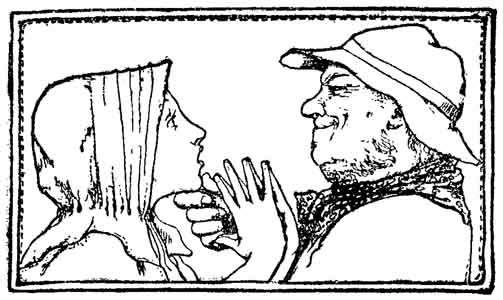
Hereafterthis
Once upon a time there was a farmer called Jan, and he lived all
alone by himself in a little farmhouse.
By-and-by he thought that he would like to have a wife to keep it
all vitty for him.
So he went a-courting a fine maid, and he said to her: “Will you
marry me?”
“That I will, to be sure,” said she.
So they went to church, and were wed. After the wedding was over,
she got up on his horse behind him, and he brought her home. And they
lived as happy as the day was long.
One day, Jan said to his wife, “Wife can you milk-y?”
“Oh, yes, Jan, I can milk-y. Mother used to milk-y, when I lived
home.”
So he went to market and bought her ten red cows. All went well
till one day when she had driven them to the pond to drink, she
thought they did not drink fast enough. So she drove them right into
the pond to make them drink faster, and they were all drowned.
When Jan came home, she up and told him what she had done, and he
said, “Oh, well, there, never mind, my dear, better luck next
time.”
So they went on for a bit, and then, one day, Jan said to his wife,
“Wife can you serve pigs?”
“Oh, yes, Jan, I can serve pigs. Mother used to serve pigs when I
lived home.”
So Jan went to market and bought her some pigs. All went well till
one day, when she had put their food into the trough she thought they
did not eat fast enough, and she pushed their heads into the trough to
make them eat faster, and they were all choked.
When Jan came home, she up and told him what she had done, and he
said, “Oh, well, there, never mind, my dear, better luck next
time.”
So they went on for a bit, and then, one day, Jan said to his wife,
“Wife can you bake-y?”
“Oh, yes, Jan, I can bake-y. Mother used to bake-y when I lived
home.”
So he bought everything for his wife so that she could bake bread.
All went well for a bit, till one day, she thought she would bake
white bread for a treat for Jan. So she carried her meal to the top of
a high hill, and let the wind blow on it, for she thought to herself
that the wind would blow out all the bran. But the wind blew away meal
and bran and all—so there was an end of it.
When Jan came home, she up and told him what she had done, and he
said, “Oh, well, there, never mind, my dear, better luck next
time.”
So they went on for a bit, and then, one day, Jan said to his wife,
“Wife can you brew-y?”
“Oh, yes, Jan, I can brew-y. Mother used to brew-y when I lived
home.”
So he bought everything proper for his wife to brew ale with. All
went well for a bit, till one day when she had brewed her ale and put
it in the barrel, a big black dog came in and looked up in her face.
She drove him out of the house, but he stayed outside the door and
still looked up in her face. And she got so angry that she pulled out
the plug of the barrel, threw it at the dog, and said, “What dost look
at me for? I be Jan’s wife.” Then the dog ran down the road, and she
ran after him to chase him right away. When she came back again, she
found that the ale had all run out of the barrel, and so there was an
end of it.
When Jan came home, she up and told him what she had done, and he
said, “Oh well, there, never mind, my dear, better luck next
time.”
So they went on for a bit, and then, one day, she thought to
herself, “‘T is time to clean up my house.” When she was taking down
her big bed she found a bag of groats on the tester. So when Jan came
home, she up and said to him, “Jan, what is that bag of groats on the
tester for?”
“That is for Hereafterthis, my dear.”
Now, there was a robber outside the window, and he heard what Jan
said. Next day, he waited till Jan had gone to market, and then he
came and knocked at the door. “What do you please to want?” said
Mally.
“I am Hereafterthis,” said the robber, “I have come for the bag of
groats.”
Now the robber was dressed like a fine gentleman, so she thought to
herself it was very kind of so fine a man to come for the bag of
groats, so she ran upstairs and fetched the bag of groats, and gave it
to the robber and he went away with it.
When Jan came home, she said to him, “Jan, Hereafterthis has been
for the bag of groats.”
“What do you mean, wife?” said Jan.
So she up and told him, and he said, “Then I’m a ruined man, for
that money was to pay our rent with. The only thing we can do is to
roam the world over till we find the bag of groats.” Then Jan took the
house-door off its hinges, “That’s all we shall have to lie on,” he
said. So Jan put the door on his back, and they both set out to look
for Hereafterthis. Many a long day they went, and in the night Jan
used to put the door on the branches of a tree, and they would sleep
on it. One night they came to a big hill, and there was a high tree at
the foot. So Jan put the door up in it, and they got up in the tree
and went to sleep. By-and-by Jan’s wife heard a noise, and she looked
to see what it was. It was an opening of a door in the side of the
hill. Out came two gentlemen with a long table, and behind them fine
ladies and gentlemen, each carrying a bag, and one of them was
Hereafterthis with the bag of groats. They sat round the table, and
began to drink and talk and count up all the money in the bags. So
then Jan’s wife woke him up, and asked what they should do.
“Now’s our time,” said Jan, and he pushed the door off the
branches, and it fell right in the very middle of the table, and
frightened the robbers so that they all ran away. Then Jan and his
wife got down from the tree, took as many money-bags as they could
carry on the door, and went straight home. And Jan bought his wife
more cows, and more pigs, and they lived happy ever after.

The Golden Ball
There were two lasses, daughters of one mother, and as they came
from the fair, they saw a right bonny young man stand at the
house-door before them. They never saw such a bonny man before. He had
gold on his cap, gold on his finger, gold on his neck, a red gold
watch-chain—eh! but he had brass. He had a golden ball in each
hand. He gave a ball to each lass, and she was to keep it, and if she
lost it, she was to be hanged. One of the lasses, ‘t was the youngest,
lost her ball. I’ll tell thee how. She was by a park-paling, and she
was tossing her ball, and it went up, and up, and up, till it went
fair over the paling; and when she climbed up to look, the ball ran
along the green grass, and it went right forward to the door of the
house, and the ball went in and she saw it no more.
So she was taken away to be hanged by the neck till she was dead
because she’d lost her ball.
But she had a sweetheart, and he said he would go and get the ball.
So he went to the park-gate, but ‘t was shut; so he climbed the hedge,
and when he got to the top of the hedge, an old woman rose up out of
the dyke before him, and said, if he wanted to get the ball, he must
sleep three nights in the house. He said he would.
Then he went into the house, and looked for the ball, but could not
find it. Night came on and he heard bogles move in the courtyard; so
he looked out o’ the window, and the yard was full of them.
Presently he heard steps coming upstairs. He hid behind the door,
and was as still as a mouse. Then in came a big giant five times as
tall as he, and the giant looked round but did not see the lad, so he
went to the window and bowed to look out; and as he bowed on his
elbows to see the bogles in the yard, the lad stepped behind him, and
with one blow of his sword he cut him in twain, so that the top part
of him fell in the yard, and the bottom part stood looking out of the
window.
There was a great cry from the bogles when they saw half the giant
come tumbling down to them, and they called out, “There comes half our
master, give us the other half.”
So the lad said, “It’s no use of thee, thou pair of legs, standing
alone at the window, as thou hast no eye to see with, so go join thy
brother;” and he cast the lower part of the giant after the top part.
Now when the bogles had gotten all the giant they were quiet.
Next night the lad was at the house again, and now a second giant
came in at the door, and as he came in the lad cut him in twain, but
the legs walked on to the chimney and went up them. “Go, get thee
after thy legs,” said the lad to the head, and he cast the head up the
chimney too.
The third night the lad got into bed, and he heard the bogles
striving under the bed, and they had the ball there, and they were
casting it to and fro.
Now one of them has his leg thrust out from under the bed, so the
lad brings his sword down and cuts it off. Then another thrusts his
arm out at other side of the bed, and the lad cuts that off. So at
last he had maimed them all, and they all went crying and wailing off,
and forgot the ball, but he took it from under the bed, and went to
seek his true-love.
Now the lass was taken to York to be hanged; she was brought out on
the scaffold, and the hangman said, “Now, lass, thou must hang by the
neck till thou be’st dead.” But she cried out:
coming!
ball
free?”
ball
free,
hung
gallows-tree.”
Then the hangman said, “Now, lass, say thy prayers for thou must
die.” But she said:
coming!
ball
free?”
ball
free,
hung
gallows-tree.”
Then the hangman said, “Hast thee done thy prayers? Now, lass, put
thy head into the noose.”
But she answered, “Stop, stop, I think I see my brother coming!”
And again she sang, and then she thought she saw her sister coming,
then her uncle, then her aunt, then her cousin; but after this the
hangman said, “I will stop no longer, thou ‘rt making game of me. Thou
must be hung at once.”
But now she saw her sweetheart coming through the crowd, and he
held over his head in the air her own golden ball; so she said:
coming!
ball
free?”
ball
free,
hung
gallows-tree.”
And he took her home, and they lived happy ever after.
My Own Self
In a tiny house in the North Countrie, far away from any town or
village, there lived not long ago, a poor widow all alone with her
little son, a six-year-old boy.
The house-door opened straight on to the hill-side and all round
about were moorlands and huge stones, and swampy hollows; never a
house nor a sign of life wherever you might look, for their nearest
neighbours were the “ferlies” in the glen below, and the
“will-o’-the-wisps” in the long grass along the pathside.
And many a tale she could tell of the “good folk” calling to each
other in the oak-trees, and the twinkling lights hopping on to the
very window sill, on dark nights; but in spite of the loneliness, she
lived on from year to year in the little house, perhaps because she
was never asked to pay any rent for it.
But she did not care to sit up late, when the fire burnt low, and
no one knew what might be about; so, when they had had their supper
she would make up a good fire and go off to bed, so that if anything
terrible did happen, she could always hide her head under the
bed-clothes.
This, however, was far too early to please her little son; so when
she called him to bed, he would go on playing beside the fire, as if
he did not hear her.
He had always been bad to do with since the day he was born, and
his mother did not often care to cross him; indeed, the more she tried
to make him obey her, the less heed he paid to anything she said, so
it usually ended by his taking his own way.
But one night, just at the fore-end of winter, the widow could not
make up her mind to go off to bed, and leave him playing by the
fireside; for the wind was tugging at the door, and rattling the
window-panes, and well she knew that on such a night, fairies and such
like were bound to be out and about, and bent on mischief. So she
tried to coax the boy into going at once to bed:
“The safest bed to bide in, such a night as this!” she said: but
no, he wouldn’t.
Then she threatened to “give him the stick,” but it was no use.
The more she begged and scolded, the more he shook his head; and
when at last she lost patience and cried that the fairies would surely
come and fetch him away, he only laughed and said he wished they
would, for he would like one to play with.
At that his mother burst into tears, and went off to bed in
despair, certain that after such words something dreadful would
happen; while her naughty little son sat on his stool by the fire, not
at all put out by her crying.
But he had not long been sitting there alone, when he heard a
fluttering sound near him in the chimney and presently down by his
side dropped the tiniest wee girl you could think of; she was not a
span high, and had hair like spun silver, eyes as green as grass, and
cheeks red as June roses. The little boy looked at her with
surprise.

“Oh!” said he; “what do they call ye?”
“My own self,” she said in a shrill but sweet little voice, and she
looked at him too. “And what do they call ye?”
“Just my own self too!” he answered cautiously; and with that they
began to play together.
She certainly showed him some fine games. She made animals out of
the ashes that looked and moved like life; and trees with green leaves
waving over tiny houses, with men and women an inch high in them, who,
when she breathed on them, fell to walking and talking quite
properly.
But the fire was getting low, and the light dim, and presently the
little boy stirred the coals with a stick to make them blaze; when out
jumped a red-hot cinder, and where should it fall, but on the fairy
child’s tiny foot.
Thereupon she set up such a squeal, that the boy dropped the stick,
and clapped his hands to his ears but it grew to so shrill a screech,
that it was like all the wind in the world whistling through one tiny
keyhole.
There was a sound in the chimney again, but this time the little
boy did not wait to see what it was, but bolted off to bed, where he
hid under the blankets and listened in fear and trembling to what went
on.

A voice came from the chimney speaking sharply:
“Who’s there, and what’s wrong?” it said.
“It’s my own self,” sobbed the fairy-child; “and my foot’s burnt
sore. O-o-h!”
“Who did it?” said the voice angrily; this time it sounded nearer,
and the boy, peeping from under the clothes, could see a white face
looking out from the chimney-opening.
“Just my own self too!” said the fairy-child again.
“Then if ye did it your own self,” cried the elf-mother shrilly,
“what’s the use o’ making all this fash about it?”—and with that
she stretched out a long thin arm, and caught the creature by its ear,
and, shaking it roughly, pulled it after her, out of sight up the
chimney.
The little boy lay awake a long time, listening, in case the
fairy-mother should come back after all; and next evening after
supper, his mother was surprised to find that he was willing to go to
bed whenever she liked.
“He’s taking a turn for the better at last!” she said to herself;
but he was thinking just then that, when next a fairy came to play
with him, he might not get off quite so easily as he had done this
time.

Black Bull of Norroway
In Norroway, long time ago, there lived a certain lady, and she had
three daughters: The oldest of them said to her mother: “Mother, bake
me a bannock, and roast me a collop, for I’m going away to seek my
fortune.” Her mother did so; and the daughter went away to an old
witch washerwife and told her purpose. The old wife bade her stay that
day, and look out of her back-door, and see what she could see. She
saw nought the first day. The second day she did the same, and saw
nought. On the third day she looked again, and saw a coach-and-six
coming along the road. She ran in and told the old wife what she saw.
“Well,” quoth the old woman, “yon’s for you.” So they took her into
the coach and galloped off.
The second daughter next says to her mother: “Mother, bake me a
bannock, and roast me a collop, for I’m going away to seek my
fortune.” Her mother did so; and away she went to the old wife, as her
sister had done. On the third day she looked out of the back-door, and
saw a coach-and-four coming along the road. “Well,” quoth the old
woman, “yon’s for you.” So they took her in, and off they set.
The third daughter says to her mother: “Mother, bake me a bannock,
and roast me a collop, for I’m going away to seek my fortune.” Her
mother did so; and away she went to the old witch. She bade her look
out of her back-door, and see what she could see She did so; and when
she came back, said she saw nought. The second day she did the same,
and saw nought. The third day she looked again, and on coming back
said to the old wife she saw nought but a great Black Bull coming
crooning along the road. “Well,” quoth the old witch, “yon’s for you.”
On hearing this she was next to distracted with grief and terror; but
she was lifted up and set on his back, and away they went.
Aye they travelled, and on they travelled, till the lady grew faint
with hunger. “Eat out of my right ear,” says the Black Bull, “and
drink out of my left ear, and set by your leaving.” So she did as he
said, and was wonderfully refreshed. And long they rode, and hard they
rode, till they came in sight of a very big and bonny castle. “Yonder
we must be this night,” quoth the Bull; “for my elder brother lives
yonder;” and presently they were at the place. They lifted her off his
back, and took her in, and sent him away to a park for the night. In
the morning, when they brought the Bull home, they took the lady into
a fine shining parlour, and gave her a beautiful apple, telling her
not to break it till she was in the greatest strait ever mortal was in
the world, and that would bring her out of it. Again she was lifted on
the Bull’s back, and after she had ridden far, and farther than I can
tell, they came in sight of a far bonnier castle, and far farther away
than the last. Says the Bull to her: “Yonder we must be this night,
for my second brother lives yonder;” and they were at the place
directly. They lifted her down and took her in, and sent the Bull to
the field for the night. In the morning they took the lady into a fine
and rich room, and gave her the finest pear she had ever seen, bidding
her not to break it till she was in the greatest strait ever mortal
could be in, and that would get her out of it. Again she was lifted
and set on his back, and away they went. And long they rode, and hard
they rode, till they came in sight of the far biggest castle and far
farthest off, they had yet seen. “We must be yonder to-night,” says
the Bull, “for my young brother lives yonder;” and they were there
directly. They lifted her down, took her in, and sent the Bull to the
field for the night. In the morning they took her into a room, the
finest of all, and gave her a plum, telling her not to break it till
she was in the greatest strait mortal could be in, and that would get
her out of it. Presently they brought home the Bull, set the lady on
his back, and away they went.
And aye they rode, and on they rode, till they came to a dark and
ugsome glen, where they stopped, and the lady lighted down. Says the
Bull to her: “Here you must stay till I go and fight the Old One. You
must seat yourself on that stone, and move neither hand nor foot till
I come back, else I’ll never find you again. And if everything round
about you turns blue, I have beaten the Old One; but should all things
turn red, he’ll have conquered me.” She set herself down on the stone,
and by-and-by all round her turned blue. Overcome with joy, she lifted
one of her feet, and crossed it over the other, so glad was she that
her companion was victorious. The Bull returned and sought for her,
but never could find her.
Long she sat, and aye she wept, till she wearied. At last she rose
and went away, she didn’t know where. On she wandered, till she came
to a great hill of glass, that she tried all she could to climb, but
wasn’t able. Round the bottom of the hill she went, sobbing and
seeking a passage over, till at last she came to a smith’s house; and
the smith promised, if she would serve him seven years, he would make
her iron shoon, wherewith she could climb over the glassy hill. At
seven years’ end she got her iron shoon, clomb the glassy hill, and
chanced to come to the old washerwife’s habitation. There she was told
of a gallant young knight that had given in some clothes all over
blood to wash, and whoever washed them was to be his wife. The old
wife had washed till she was tired, and then she set her daughter at
it, and both washed, and they washed, and they washed, in hopes of
getting the young knight; but for all they could do they couldn’t
bring out a stain. At length they set the stranger damsel to work; and
whenever she began, the stains came out pure and clean, and the old
wife made the knight believe it was her daughter had washed the
clothes. So the knight and the eldest daughter were to be married, and
the stranger damsel was distracted at the thought of it, for she was
deeply in love with him. So she bethought her of her apple and
breaking it, found it filled with gold and precious jewellery, the
richest she had ever seen. “All these,” she said to the eldest
daughter, “I will give you, on condition that you put off your
marriage for one day and allow me to go into his room alone at night.”
The lady consented; but meanwhile the old wife had prepared a sleeping
drink, and given it to the knight who drank it, and never wakened till
next morning. The live-long night the damsel sobbed and sang:
thee,
thee,
thee;
me?”

Next day she knew not what to do for grief. Then she broke the
pear, and found it filled with jewellery far richer than the contents
of the apple. With these jewels she bargained for permission to be a
second night in the young knight’s chamber; but the old wife gave him
another sleeping drink, and again he slept till morning. All night she
kept sighing and singing as before:
thee,
thee,
thee;
me?”
Still he slept, and she nearly lost hope altogether, But that day,
when he was out hunting, somebody asked him what noise and moaning was
that they heard all last night in his bedchamber. He said: “I have
heard no noise.” But they assured him there was; and he resolved to
keep waking that night to try what he could hear. That being the third
night and the damsel being between hope and despair, she broke her
plum, and it held far the richest jewellery of the three. She
bargained as before; and the old wife, as before, took in the sleeping
drink to the young knight’s chamber; but he told her he couldn’t drink
it that night without sweetening. And when she went away for some
honey to sweeten it with, he poured out the drink, and so made the old
wife think he had drunk it. They all went to bed again, and the damsel
began, as before, singing:
thee,
thee,
thee;
me?”
He heard, and turned to her. And she told him all that had befallen
her, and he told her all that had happened to him. And he caused the
old washerwife and her daughter to be burnt. And they were married,
and he and she are living happy to this day for aught I know.
Yallery Brown
Once upon a time, and a very good time it was, though it wasn’t in
my time, nor in your time, nor any one else’s time, there was a young
lad of eighteen or so named Tom Tiver working on the Hall Farm. One
Sunday he was walking across the west field, ‘t was a beautiful July
night, warm and still and the air was full of little sounds as though
the trees and grass were chattering to themselves. And all at once
there came a bit ahead of him the pitifullest greetings ever he heard,
sob, sobbing, like a bairn spent with fear, and nigh heartbroken;
breaking off into a moan and then rising again in a long whimpering
wailing that made him feel sick to hark to it. He began to look
everywhere for the poor creature. “It must be Sally Bratton’s child,”
he thought to himself; “she was always a flighty thing, and never
looked after it. Like as not, she’s flaunting about the lanes, and has
clean forgot the babby.” But though he looked and looked, he could see
nought. And presently the whimpering got louder and stronger in the
quietness, and he thought he could make out words of some sort. He
hearkened with all his ears, and the sorry thing was saying words all
mixed up with sobbing—
“Ooh! the stone, the great big stone! ooh! the stones on top!”
Naturally he wondered where the stone might be, and he looked
again, and there by the hedge bottom was a great flat stone, nigh
buried in the mools, and hid in the cotted grass and weeds. One of the
stones was called the “Strangers’ Table.” However, down he fell on his
knee-bones by that stone, and hearkened again. Clearer than ever, but
tired and spent with greeting came the little sobbing
voice—”Ooh! ooh! the stone, the stone on top.” He was gey, and
mis-liking to meddle with the thing, but he couldn’t stand the
whimpering babby, and he tore like mad at the stone, till he felt it
lifting from the mools, and all at once it came with a sough out o’
the damp earth and the tangled grass and growing things. And there in
the hole lay a tiddy thing on its back, blinking up at the moon and at
him. ‘T was no bigger than a year-old baby, but it had long cotted
hair and beard, twisted round and round its body so that you couldn’t
see its clothes; and the hair was all yaller and shining and silky,
like a bairn’s; but the face of it was old and as if ‘t were hundreds
of years since ‘t was young and smooth. Just a heap of wrinkles, and
two bright black eyne in the midst, set in a lot of shining yaller
hair; and the skin was the colour of the fresh turned earth in the
spring—brown as brown could be, and its bare hands and feet were
brown like the face of it. The greeting had stopped, but the tears
were standing on its cheek, and the tiddy thing looked mazed like in
the moonshine and the night air.
The creature’s eyne got used like to the moonlight, and presently
he looked up in Tom’s face as bold as ever was; “Tom,” says he, “thou
‘rt a good lad!” as cool as thou can think, says he, “Tom, thou ‘rt a
good lad!” and his voice was soft and high and piping like a little
bird twittering.

Tom touched his hat, and began to think what he ought to say.
“Houts!” says the thing again, “thou needn’t be feared o’ me; thou ‘st
done me a better turn than thou know’st, my lad, and I’ll do as much
for thee.” Tom couldn’t speak yet, but he thought; “Lord! for sure ‘t
is a bogle!”
“No!” says he as quick as quick, “I am no bogle, but ye ‘d best not
ask me what I be; anyways I be a good friend o’ thine.” Tom’s very
knee-bones struck, for certainly an ordinary body couldn’t have known
what he’d been thinking to himself, but he looked so kind like, and
spoke so fair, that he made bold to get out, a bit quavery
like—
“Might I be axing to know your honour’s name?”
“H’m,” says he, pulling his beard; “as for that”—and he
thought a bit—”ay so,” he went on at last, “Yallery Brown thou
mayst call me, Yallery Brown; ‘t is my nature seest thou, and as for a
name ‘t will do as any other. Yallery Brown, Tom, Yallery Brown’s thy
friend, my lad.”
“Thankee, master,” says Tom, quite meek like.
“And now,” he says, “I’m in a hurry to-night, but tell me quick,
what’ll I do for thee? Wilt have a wife? I can give thee the finest
lass in the town. Wilt be rich? I’ll give thee gold as much as thou
can carry. Or wilt have help wi’ thy work? Only say the word.”
Tom scratched his head. “Well, as for a wife, I have no hankering
after such; they’re but bothersome bodies, and I have women folk at
home as ‘ll mend my clouts; and for gold that’s as may be, but for
work, there, I can’t abide work, and if thou ‘lt give me a helpin’
hand in it I’ll thank—”
“Stop,” says he, quick as lightning, “I’ll help thee and welcome,
but if ever thou sayest that to me—if ever thou thankest me,
see’st thou, thou ‘lt never see me more. Mind that now; I want no
thanks, I’ll have no thanks;” and he stampt his tiddy foot on the
earth and looked as wicked as a raging bull.
“Mind that now, great lump that thou be,” he went on, calming down
a bit, “and if ever thou need’st help, or get’st into trouble, call on
me and just say, ‘Yallery Brown, come from the mools, I want thee!’
and I’ll be wi’ thee at once; and now,” says he, picking a dandelion
puff, “good-night to thee,” and he blowed it up, and it all came into
Tom’s eyne and ears. Soon as Tom could see again the tiddy creature
was gone, and but for the stone on end and the hole at his feet, he’d
have thought he’d been dreaming.
Well, Tom went home and to bed; and by the morning he’d nigh forgot
all about it. But when he went to the work, there was none to do! all
was done already, the horses seen to, the stables cleaned out,
everything in its proper place, and he’d nothing to do but sit with
his hands in his pockets. And so it went on day after day, all the
work done by Yallery Brown, and better done, too, than he could have
done it himself. And if the master gave him more work, he sat down,
and the work did itself, the singeing irons, or the broom, or what
not, set to, and with ne’er a hand put to it would get through in no
time. For he never saw Yallery Brown in daylight; only in the darklins
he saw him hopping about, like a Will-o-th’-wyke without his
lanthorn.
At first ‘t was mighty fine for Tom; he’d nought to do and good pay
for it; but by-and-by things began to grow vicey-varsy. If the work
was done for Tom, ‘t was undone for the other lads; if his buckets
were filled, theirs were upset; if his tools were sharpened, theirs
were blunted and spoiled; if his horses were clean as daisies, theirs
were splashed with muck, and so on; day in and day out, ‘t was the
same. And the lads saw Yallery Brown flitting about o’ nights, and
they saw the things working without hands o’ days, and they saw that
Tom’s work was done for him, and theirs undone for them; and naturally
they begun to look shy on him, and they wouldn’t speak or come nigh
him, and they carried tales to the master and so things went from bad
to worse.
For Tom could do nothing himself; the brooms wouldn’t stay in his
hand, the plough ran away from him, the hoe kept out of his grip. He
thought that he’d do his own work after all, so that Yallery Brown
would leave him and his neighbours alone. But he couldn’t—true
as death he couldn’t. He could only sit by and look on, and have the
cold shoulder turned on him, while the unnatural thing was meddling
with the others, and working for him.
At last, things got so bad that the master gave Tom the sack, and
if he hadn’t, all the rest of the lads would have sacked him, for they
swore they’d not stay on the same garth with Tom. Well, naturally Tom
felt bad; ‘t was a very good place, and good pay too; and he was fair
mad with Yallery Brown, as ‘d got him into such a trouble. So Tom
shook his fist in the air and called out as loud as he could, “Yallery
Brown, come from the mools; thou scamp, I want thee!”
You’ll scarce believe it, but he’d hardly brought out the words but
he felt something tweaking his leg behind, while he jumped with the
smart of it; and soon as he looked down, there was the tiddy thing,
with his shining hair, and wrinkled face, and wicked glinting black
eyne.
Tom was in a fine rage, and he would have liked to have kicked him,
but ‘t was no good, there wasn’t enough of it to get his boot against;
but he said, “Look here, master, I’ll thank thee to leave me alone
after this, dost hear? I want none of thy help, and I’ll have nought
more to do with thee—see now.”
The horrid thing broke into a screeching laugh, and pointed its
brown finger at Tom. “Ho, ho, Tom!” says he. “Thou ‘st thanked me, my
lad, and I told thee not, I told thee not!”
“I don’t want thy help, I tell thee,” Tom yelled at him—”I
only want never to see thee again, and to have nought more to do with
‘ee—thou can go.”
The thing only laughed and screeched and mocked, as long as Tom
went on swearing, but so soon as his breath gave out—
“Tom, my lad,” he said with a grin, “I’ll tell ‘ee summat, Tom.
True’s true I’ll never help thee again, and call as thou wilt, thou
‘lt never see me after to-day; but I never said that I’d leave thee
alone, Tom, and I never will, my lad! I was nice and safe under the
stone, Tom, and could do no harm; but thou let me out thyself, and
thou can’t put me back again! I would have been thy friend and worked
for thee if thou had been wise; but since thou bee’st no more than a
born fool I’ll give ‘ee no more than a born fool’s luck; and when all
goes vicey-varsy, and everything agee—thou ‘lt mind that it’s
Yallery Brown’s doing though m’appen thou doesn’t see him. Mark my
words, will ‘ee?”
And he began to sing, dancing round Tom, like a bairn with his
yellow hair, but looking older than ever with his grinning wrinkled
bit of a face:
grist;
Brown
the stone.”
Tom could never rightly mind what he said next. ‘T was all cussing
and calling down misfortune on him; but he was so mazed in fright that
he could only stand there shaking all over, and staring down at the
horrid thing; and if he’d gone on long, Tom would have tumbled down in
a fit. But by-and-by, his yaller shining hair rose up in the air, and
wrapt itself round him till he looked for all the world like a great
dandelion puff; and it floated away on the wind over the wall and out
o’ sight, with a parting skirl of wicked voice and sneering laugh.
And did it come true, sayst thou? My word! but it did, sure as
death! He worked here and he worked there, and turned his hand to this
and to that, but it always went agee, and ‘t was all Yallery Brown’s
doing. And the children died, and the crops rotted—the beasts
never fatted, and nothing ever did well with him; and till he was dead
and buried, and m’appen even afterwards, there was no end to Yallery
Brown’s spite at him; day in and day out he used to hear him
saying—
well;
grist;
Brown
the stone.”
Three Feathers
Once upon a time there was a girl who was married to a husband that
she never saw. And the way this was, was that he was only at home at
night, and would never have any light in the house. The girl thought
that was funny, and all her friends told her there must be something
wrong with her husband, some great deformity that made him want not to
be seen.
Well, one night when he came home she suddenly lit a candle and saw
him. He was handsome enough to make all the women of the world fall in
love with him. But scarcely had she seen him when he began to change
into a bird, and then he said: “Now you have seen me, you shall see me
no more, unless you are willing to serve seven years and a day for me,
so that I may become a man once more.” Then he told her to take three
feathers from under his side, and whatever she wished through them
would come to pass. Then he left her at a great house to be
laundry-maid for seven years and a day.
And the girl used to take the feathers and say:
“By virtue of my three feathers may the copper be lit, and the
clothes washed, and mangled, and folded, and put away to the missus’s
satisfaction.”
And then she had no more care about it. The feathers did the rest,
and the lady set great store by her for a better laundress she had
never had. Well, one day the butler, who had a notion to have the
pretty laundry-maid for his wife, said to her, he should have spoken
before but he did not want to vex her. “Why should it when I am but a
fellow-servant?” the girl said. And then he felt free to go on, and
explain he had £70 laid by with the master, and how would she
like him for a husband.
And the girl told him to fetch her the money, and he asked his
master for it, and brought it to her. But as they were going
up-stairs, she cried, “O John, I must go back, sure I’ve left my
shutters undone, and they’ll be slashing and banging all night.”
The butler said, “Never you trouble, I’ll put them right.” and he
ran back, while she took her feathers, and said: “By virtue of my
three feathers may the shutters slash and bang till morning, and John
not be able to fasten them nor yet to get his fingers free from
them.”
And so it was. Try as he might the butler could not leave hold, nor
yet keep the shutters from blowing open as he closed them. And he
was angry, but could not help himself, and he did not care to
tell of it and get the laugh on him, so no one knew.
Then after a bit the coachman began to notice her, and she found he
had some £40 with the master, and he said she might have it if
she would take him with it.
So after the laundry-maid had his money in her apron as they went
merrily along, she stopt, exclaiming: “My clothes are left outside, I
must run back and bring them in.” “Stop for me while I go; it is a
cold frost night,” said William, “you’d be catching your death.” So
the girl waited long enough to take her feathers out and say, “By
virtue of my three feathers may the clothes slash and blow about till
morning, and may William not be able to take his hand from them nor
yet to gather them up.” And then she was away to bed and to sleep.

The coachman did not want to be every one’s jest, and he said
nothing. So after a bit the footman comes to her and said he: “I have
been with my master for years and have saved up a good bit, and you
have been three years here, and must have saved up as well. Let us put
it together, and make us a home or else stay on at service as pleases
you.” Well, she got him to bring the savings to her as the others had,
and then she pretended she was faint, and said to him: “James, I feel
so queer, run down cellar for me, that’s a dear, and fetch me up a
drop of brandy.” Now no sooner had he started than she said: “By
virtue of my three feathers may there be slashing and spilling, and
James not be able to pour the brandy straight nor yet to take his hand
from it until morning.”
And so it was. Try as he might James could not get his glass
filled, and there was slashing and spilling, and right on it all, down
came the master to know what it meant!
So James told him he could not make it out, but he could not get
the drop of brandy the laundry-maid had asked for, and his hand would
shake and spill everything, and yet come away he could not.
This got him in for a regular scrape, and the master when he got
back to his wife said: “What has come over the men, they were all
right until that laundry-maid of yours came. Something is up now
though. They have all drawn out their pay, and yet they don’t leave,
and what can it be anyway?”
But his wife said she could not hear of the laundry-maid being
blamed, for she was the best servant she had and worth all the rest
put together.
So it went on until one day as the girl stood in the hall door, the
coachman happened to say to the footman: “Do you know how that girl
served me, James?” And then William told about the clothes. The butler
put in, “That was nothing to what she served me,” and he told of the
shutters clapping all night.
Just then the master came through the hall, and the girl said: “By
virtue of my three feathers may there be slashing and striving between
master and men, and may all get splashed in the pond.”
And so it was, the men fell to disputing which had suffered the
most by her, and when the master came up all would be heard at once
and none listened to him, and it came to blows all round, and the
first they knew they had shoved one another into the pond.
When the girl thought they had had enough she took the spell off,
and the master asked her what had begun the row, for he had not heard
in the confusion.
And the girl said: “They were ready to fall on any one; they’d have
beat me if you had not come by.”
So it blew over for that time, and through her feathers she made
the best laundress ever known. But to make a long story short, when
the seven years and a day were up, the bird-husband, who had known her
doings all along, came after her, restored to his own shape again. And
he told her mistress he had come to take her from being a servant, and
that she should have servants under her. But he did not tell of the
feathers.
And then he bade her give the men back their savings.
“That was a rare game you had with them,” said he, “but now you are
going where there is plenty, leave them each their own.” So she did;
and they drove off to their castle, where they lived happy ever
after.

Sir Gammer Vans
Last Sunday morning at six o’clock in the evening as I was sailing
over the tops of the mountains in my little boat, I met two men on
horseback riding on one mare: So I asked them, “Could they tell me
whether the little old woman was dead yet who was hanged last Saturday
week for drowning herself in a shower of feathers?” They said they
could not positively inform me, but if I went to Sir Gammer Vans he
could tell me all about it. “But how am I to know the house?” said I.
“Ho, ‘t is easy enough,” said they, “for ‘t is a brick house, built
entirely of flints, standing alone by itself in the middle of sixty or
seventy others just like it.”
“Oh, nothing in the world is easier,” said I.
“Nothing can be easier,” said they: so I went on my way.
Now this Sir G. Vans was a giant, and a bottle-maker. And as all
giants who are bottle-makers usually pop out of a little
thumb-bottle from behind the door, so did Sir G. Vans.
“How d’ye do?” says he.
“Very well, I thank you,” says I.
“Have some breakfast with me?”
“With all my heart,” says I.
So he gave me a slice of beer, and a cup of cold veal; and there
was a little dog under the table that picked up all the crumbs.
“Hang him,” says I.
“No, don’t hang him,” says he; “for he killed a hare yesterday. And
if you don’t believe me, I’ll show you the hare alive in a
basket.”
So he took me into his garden to show me the curiosities. In one
corner there was a fox hatching eagle’s eggs; in another there was an
iron apple tree, entirely covered with pears and lead; in the third
there was the hare which the dog killed yesterday alive in the basket;
and in the fourth there were twenty-four hipper switches
threshing tobacco, and at the sight of me they threshed so hard that
they drove the plug through the wall, and through a little dog that
was passing by on the other side. I, hearing the dog howl, jumped over
the wall; and turned it as neatly inside out as possible, when it ran
away as if it had not an hour to live. Then he took me into the park
to show me his deer: and I remembered that I had a warrant in my
pocket to shoot venison for his majesty’s dinner. So I set fire to my
bow, poised my arrow, and shot amongst them. I broke seventeen ribs on
one side, and twenty-one and a half on the other; but my arrow passed
clean through without ever touching it, and the worst was I lost my
arrow: however, I found it again in the hollow of a tree. I felt it;
it felt clammy. I smelt it; it smelt honey. “Oh, ho,” said I, “here’s
a bee’s nest,” when out sprang a covey of partridges. I shot at them;
some say I killed eighteen; but I am sure I killed thirty-six, besides
a dead salmon which was flying over the bridge, of which I made the
best apple-pie I ever tasted.

Tom Hickathrift
Before the days of William the Conqueror there dwelt a man in the
marsh of the Isle of Ely whose name was Thomas Hickathrift, a poor day
labourer, but so stout that he could do two days’ work in one. His one
son he called by his own name, Thomas Hickathrift, and he put him to
good learning, but the lad was none of the wisest, and indeed seemed
to be somewhat soft, so he got no good at all from his teaching.
Tom’s father died, and his mother being tender of him, kept him as
well as she could. The slothful fellow would do nothing but sit in the
chimney-corner, and eat as much at a time as would serve four or five
ordinary men. And so much did he grow that when but ten years old he
was already eight feet high, and his hand like a shoulder of
mutton.
One day his mother went to a rich farmer’s house to beg a bottle of
straw for herself and Tom. “Take what you will,” said the farmer, an
honest charitable man. So when she got home she told Tom to fetch the
straw, but he wouldn’t and, beg as she might, he wouldn’t till she
borrowed him a cart rope. So off he went, and when he came to the
farmer’s, master and men were all a-trashing in the barn.
“I’m come for the straw,” said Tom.
“Take as much as thou canst carry,” said the farmer.
So Tom laid down his rope and began to make his bottle.
“Your rope is too short,” said the farmer by way of a joke; but the
joke was on Tom’s side, for when he had made up his load there was
some twenty hundred-weight of straw, and though they called him a fool
for thinking he could carry the tithe of it, he flung it over his
shoulder as if it had been a hundred-weight, to the great admiration
of master and men.
Tom’s strength being thus made known there was no longer any
basking by the fire for him; every one would be hiring him to work,
and telling him ‘t was a shame to live such a lazy life. So Tom seeing
them wait on him as they did, went to work first with one, then with
another. And one day a woodman desired his help to bring home a tree.
Off went Tom and four men besides, and when they came to the tree they
began to draw it into the cart with pulleys. At last Tom, seeing them
unable to lift it, “Stand away, you fools,” said he, and taking the
tree, set it on one end and laid it in the cart. “Now,” said he, “see
what a man can do.” “Marry, ‘t is true,” said they, and the woodman
asked what reward he’d take. “Oh, a stick for my mother’s fire,” said
Tom; and espying a tree bigger than was in the cart, he laid it on his
shoulders and went home with it as fast as the cart and six horses
could draw it.
Tom now saw that he had more strength than twenty men, and began to
be very merry, taking delight in company, in going to fairs and
meetings, in seeing sports and pastimes. And at cudgels, wrestling, or
throwing the hammer, not a man could stand against him, so that at
last none durst go into the ring to wrestle with him, and his fame was
spread more and more in the country.
Far and near he would go to any meetings, as football play or the
like. And one day in a part of the country where he was a stranger,
and none knew him, he stopped to watch the company at football play;
rare sport it was; but Tom spoiled it all, for meeting the ball he
took it such a kick that away it flew none could tell whither. They
were angry with Tom as you may fancy, but got nothing by that as Tom
took hold of a big spar, and laid about with a will, so that though
the whole country-side was up in arms against him, he cleared his way
wherever he came.
It was late in the evening ere he could turn homeward, and on the
road there met him four lusty rogues that had been robbing passengers
all day. They thought they had a good prize in Tom, who was all alone,
and made cocksure of his money.
“Stand and deliver!” said they.
“What should I deliver?” said Tom.
“Your money, sirrah,” said they.
“You shall give me better words for it first,” said Tom.
“Come, come, no more prating; money we want, and money we’ll have
before you stir.”
“Is it so?” said Tom, “nay, then come and take it.”
The long and the short of it was that Tom killed two of the rogues
and grieviously wounded the other two, and took all their money, which
was as much as two hundred pounds. And when he came home he made his
old mother laugh with the story of how he served the football players
and the four thieves.
But you shall see that Tom sometimes met his match. In wandering
one day in the forest he met a lusty tinker that had a good staff on
his shoulder, and a great dog to carry his bag and tools.
“Whence come you and whither are you going?” said Tom, “this is no
highway.”
“What’s that to you?” said the tinker; “fools must needs be
meddling.”
“I’ll make you know,” said Tom, “before you and I part, what it is
to me.”
“Well,” said the tinker, “I’m ready for a bout with any man, and I
hear there is one Tom Hickathrift in the country of whom great things
are told. I’d fain see him to have a turn with him.”
“Ay,” said Tom, “methinks he might be master with you. Anyhow, I am
the man; what have you to say to me?”
“Why, verily, I’m glad we are so happily met.”
“Sure, you do but jest,” said Tom.
“Marry, I’m in earnest,” said the tinker. “A match?” “‘T is done.”
“Let me first get a twig,” said Tom. “Ay,” said the tinker, “hang him
that would fight a man unarmed.”
So Tom took a gate-rail for his staff, and at it they fell, the
tinker at Tom, and Tom at the tinker, like two giants they laid on at
each other. The tinker had a leathern coat on, and at every blow Tom
gave the tinker his coat roared again, yet the tinker did not give way
one inch. At last Tom gave him a blow on the side of his head which
felled him.
“Now tinker where are you?” said Tom.
But the tinker being a nimble fellow, leapt up again, gave Tom a
blow that made him reel again, and followed his blow with one on the
other side that made Tom’s neck crack again. So Tom flung down his
weapon and yielded the tinker the better on it, took him home to his
house, where they nursed their bruises and from that day forth there
was no stauncher pair of friends than they two.
Tom’s fame was thus spread abroad till at length a brewer at Lynn,
wanting a good lusty man to carry his beer to Wisbeach went to hire
Tom, and promised him a new suit of clothes from top to toe, and that
he should eat and drink of the best, so Tom yielded to be his man and
his master told him what way he should go, for you must understand
there was a monstrous giant who kept part of the marsh-land, so that
none durst go that way.
So Tom went every day to Wisbeach a good twenty miles by the road.
‘T was a wearisome journey thought Tom and he soon found that the way
kept by the giant was nearer by half. Now Tom had got more strength
than ever, being well kept as he was and drinking so much strong ale
as he did. One day, then, as he was going to Wisbeach, without saying
anything to his master or any of his fellow servants, he resolved to
take the nearest road or to lose his life; as they say, to win horse
or lose saddle. Thus resolved, he took the near road, flinging open
the gates for his cart and horses to go through. At last the giant
spied him, and came up speedily, intending to take his beer for a
prize.
He met Tom like a lion as though he would have swallowed him. “Who
gave you authority to come this way?” roared he. “I’ll make you an
example for all rogues under the sun. See how many heads hang on
yonder tree. Yours shall hang higher than all the rest for a
warning.”
But Tom made him answer, “A fig in your teeth you shall not find me
like one of them, traitorly rogue that you are.”
The giant took these words in high disdain, and ran into his cave
to fetch his great club, intending to dash out Tom’s brains at the
first blow.
Tom knew not what to do for a weapon; his whip would be but little
good against a monstrous beast twelve foot in length and six foot
about the waist. But whilst the giant went for his club, bethinking
him of a very good weapon, he made no more ado, but took his cart,
turned it upside down, and took axle-tree and wheel for shield and
buckler. And very good weapons they were found!
Out came the giant and began to stare at Tom. “You are like to do
great service with those weapons,” roared he. “I have here a twig that
will beat you and your wheel to the ground.” Now this twig was as
thick as some mileposts are, but Tom was not daunted for all that,
though the giant made at him with such force that the wheel cracked
again. But Tom gave as good as he got, taking the giant such a weighty
blow on the side of the head that he reeled again. “What,” said Tom,
“are you drunk with my strong beer already?”
So at it they went, Tom laying such huge blows at the giant, down
whose face sweat and blood ran together, so that, being fat and foggy
and tired with the long fighting, he asked Tom would he let him drink
a little? “Nay, nay,” said Tom, “my mother did not teach me such wit;
who’d be a fool then?” And seeing the giant beginning to weary and fail
in his blows, Tom thought best to make hay whilst the sun shone, and,
laying on as fast as though he had been mad, he brought the giant to
the ground. In vain were the giant’s roars and prayers and promises to
yield himself and be Tom’s servant. Tom laid at him till he was dead,
and then, cutting off his head, he went into the cave, and found a
great store of silver and gold, which made his heart to leap. So he
loaded his cart, and after delivering his beer at Wisbeach, he came
home and told his master what had befallen him. And on the morrow he
and his master and more of the towns-folk of Lynn set out for the
giant’s cave. Tom showed them the head, and what silver and gold there
was in the cave, and not a man but leapt for joy, for the giant was a
great enemy to all the country.
The news was spread all up and down the country-side how Tom
Hickathrift had killed the giant. And well was he that could run to
see the cave; all the folk made bonfires for joy, and if Tom was
respected before, he was much more so now. With common consent he took
possession of the cave and every one said, had it been twice as much,
he would have deserved it. So Tom pulled down the cave, and built
himself a brave house. The ground that the giant kept by force for
himself, Tom gave part to the poor for their common land, and part he
turned into good wheat-land to keep himself and his old mother, Jane
Hickathrift. And now he was become the chiefest man in the
country-side; ‘t was no longer plain Tom, but Mr. Hickathrift, and he
was held in due respect I promise you. He kept men and maids and lived
most bravely; made him a park to keep deer, and time passed with him
happily in his great house till the end of his days.

The Hedley Kow
There was once an old woman, who earned a poor living by going
errands and such like, for the farmers’ wives round about the village
where she lived. It wasn’t much she earned by it; but with a plate of
meat at one house, and a cup of tea at another, she made shift to get
on somehow, and always looked as cheerful as if she hadn’t a want in
the world.
Well, one summer evening as she was trotting away homewards, she
came upon a big black pot lying at the side of the road.
“Now that,” said she, stopping to look at it, “would be just
the very thing for me if I had anything to put into it! But who can
have left it here?” and she looked round about, as if the person it
belonged to must be not far off. But she could see no one.
“Maybe it’ll have a hole in it,” she said thoughtfully:—
“Ay, that’ll be how they’ve left it lying, hinny. But then it ‘d do
fine to put a flower in for the window; I’m thinking I’ll just take it
home, anyways.” And she bent her stiff old back, and lifted the lid to
look inside.
“Mercy me!” she cried, and jumped back to the other side of the
road; “if it is fit brim full o’ gold PIECES!!”
For a while she could do nothing but walk round and round her
treasure, admiring the yellow gold and wondering at her good luck, and
saying to herself about every two minutes, “Well, I do be
feeling rich and grand!” But presently she began to think how she
could best take it home with her; and she couldn’t see any other way
than by fastening one end of her shawl to it, and so dragging it after
her along the road.
“It’ll certainly be soon dark,” she said to herself, “and folk’ll
not see what I’m bringing home with me, and so I’ll have all the night
to myself to think what I’ll do with it. I could buy a grand house and
all, and live like the Queen herself, and not do a stroke of work all
day, but just sit by the fire with a cup of tea; or maybe I’ll give it
to the priest to keep for me, and get a piece as I’m wanting; or maybe
I’ll just bury it in a hole at the garden-foot, and put a bit on the
chimney, between the chiney teapot and the spoons—for ornament
like. Ah! I feel so grand, I don’t know myself rightly!”
And by this time, being already rather tired with dragging such a
heavy weight after her, she stopped to rest for a minute, turning to
make sure that her treasure was safe.
But when she looked at it, it wasn’t a pot of gold at all, but a
great lump of shining silver!
She stared at it, and rubbed her eyes and stared at it again; but
she couldn’t make it look like anything but a great lump of silver.
“I’d have sworn it was a pot of gold,” she said at last, “but I reckon
I must have been dreaming. Ay, now, that’s a change for the better;
it’ll be far less trouble to look after, and none so easy stolen; yon
gold pieces would have been a sight of bother to keep ’em safe. Ay,
I’m well quit of them; and with my bonny lump I’m as rich as
rich—!”
And she set off homewards again, cheerfully planning all the grand
things she was going to do with her money. It wasn’t very long,
however, before she got tired again and stopped once more to rest for
a minute or two.
Again she turned to look at her treasure, and as soon as she set
eyes on it she cried out in astonishment. “Oh, my!” said she; “now
it’s a lump o’ iron! Well, that beats all; and it’s just real
convenient! I can sell it as easy as easy, and get a lot
o’ penny pieces for it. Ay, hinny, an’ it’s much handier than a lot o’
yer gold and silver as ‘d have kept me from sleeping o’ nights
thinking the neighbours were robbing me—an’ it’s a real good
thing to have by you in a house, ye niver can tell what ye mightn’t
use it for, an’ it’ll sell—ay, for a real lot. Rich? I’ll be
just rolling!“
And on she trotted again chuckling to herself on her good luck,
till presently she glanced over her shoulder, “just to make sure it
was there still,” as she said to herself.
“Eh, my!” she cried as soon as she saw it; “if it hasn’t gone and
turned itself into a great stone this time! Now, how could it have
known that I was just terrible wanting something to hold my
door open with? Ay, if that isn’t a good change! Hinny, it’s a fine
thing to have such good luck.”
And, all in a hurry to see how the stone would look in its corner
by her door, she trotted off down the hill, and stopped at the foot,
beside her own little gate.
When she had unlatched it, she turned to unfasten her shawl from
the stone, which this time seemed to lie unchanged and peaceably on
the path beside her, There was still plenty of light, and she could
see the stone quite plainly as she bent her stiff back over it, to
untie the shawl end; when, all of a sudden, it seemed to give a jump
and a squeal, and grew in a moment as big as a great horse; then it
threw down four lanky legs, and shook out two long ears, flourished a
tail, and went off kicking its feet into the and laughing like a
naughty mocking boy.
The old woman stared after it, till it was fairly out of sight.
“WELL!” she said at last, “I do be the luckiest body
hereabouts! Fancy me seeing the Hedley Kow all to myself, and making
so free with it too! I can tell you, I do feel that
GRAND—”
And she went into her cottage, and sat down by the fire to think
over her good luck.
Gobborn Seer
Once there was a man Gobborn Seer, and he had a son called
Jack.
One day he sent him out to sell a sheep skin, and Gobborn said,
“You must bring me back the skin and the value of it as well.”
So Jack started, but he could not find any who would leave him the
skin and give him its price too. So he came home discouraged.
But Gobborn Seer said, “Never mind, you must take another turn at
it to-morrow.”
So he tried again, and nobody wished to buy the skin on those
terms.
When he came home his father said, “You must go and try your luck
to-morrow,” and the third day it seemed as if it would be the same
thing over again. And he had half a mind not to go back at all, his
father would be so vexed. As he came to a bridge, like the Creek Road
one yonder, he leaned on the parapet thinking of his trouble, and that
perhaps it would be foolish to run away from home, but he could not
tell which to do; when he saw a girl washing her clothes on the bank
below. She looked up and said:
“If it may be no offence asking, what is it you feel so badly
about?”
“My father has given me this skin, and I am to fetch it back and
the price of it beside.”
“Is that all? Give it here, and it’s easy done.”
So the girl washed the skin in the stream, took the wool from it,
and paid him the value of it, and gave him the skin to carry back.
His father was well pleased, and said to Jack, “That was a witty
woman; she would make you a good wife. Do you think you could tell her
again?”
Jack thought he could, so his father told him to go by-and-by to
the bridge, and see if she was there, and if so bid her come home to
take tea with them.
And sure enough Jack spied her and told her how his old father had
a wish to meet her, and would she be pleased to drink tea with
them.
The girl thanked him kindly, and said she could come the next day;
she was too busy at the moment.
“All the better,” said Jack, “I’ll have time to make ready.”
So when she came Gobborn Seer could see she was a witty woman, and
he asked her if she would marry his Jack. She said “Yes,” and they
were married.
Not long after, Jack’s father told him he must come with him and
build the finest castle that ever was seen, for a king who wished to
outdo all others by his wonderful castle.
And as they went to lay the foundation-stone, Gobborn Seer said to
Jack, “Can’t you shorten the way for me?”
But Jack looked ahead and there was a long road before them, and he
said, “I don’t see, father, how I could break a bit off.”
“You’re no good to me, then, and had best be off home.”
So poor Jack turned back, and when he came in his wife said, “Why,
how’s this you’ve come alone?” and he told her what his father had
said and his answer.
“You stupid,” said his witty wife, “if you had told a tale you
would have shortened the road! Now listen till I tell you a story, and
then catch up with Gobborn Seer and begin it at once. He will like
hearing it, and by the time you are done you will have reached the
foundation-stone.”
So Jack sweated and overtook his father. Gobborn Seer said never a
word, but Jack began his story, and the road was shortened as his wife
had said.
When they came to the end of their journey, they started building
of this castle which was to outshine all others. Now the wife had
advised them to be intimate with the servants, and so they did as she
said, and it was “Good-morning” and “Good-day to you” as they passed
in and out.
Now, at the end of a twelvemonth, Gobborn, the wise man, had built
such a castle thousands were gathered to admire it.
And the king said: “The castle is done. I shall return to-morrow
and pay you all.”
“I have just a ceiling to finish in an upper lobby,” said Gobborn,
“and then it wants nothing.”
But after the king was gone off, the housekeeper sent for Gobborn
and Jack, and told them that she had watched for a chance to warn
them, for the king was so afraid they should carry their art away and
build some other king as fine a castle, he meant to take their lives
on the morrow. Gobborn told Jack to keep a good heart, and they would
come off all right.
When the king had come back Gobborn told him he had been unable to
complete the job for lack of a tool left at home, and he should like
to send Jack after it.
“No, no,” said the king, “cannot one of the men do the errand?”
“No, they could not make themselves understood,” said the Seer,
“but Jack could do the errand.”
“You and your son are to stop here. But how will it do if I send my
own son?”
“That will do.”
So Gobborn sent by him a message to Jack’s wife. “Give him
Crooked and Straight!”
Now there was a little hole in the wall rather high up, and Jack’s
wife tried to reach up into a chest there after “crooked and
straight,” but at last she asked the king’s son to help her, because
his arms were longest.
But when he was leaning over the chest she caught him by the two
heels, and threw him into the chest, and fastened it down. So there he
was, both “crooked and straight!”
Then he begged for pen and ink, which she brought him, but he was
not allowed out, and holes were bored that he might breathe.
When his letter came, telling the king, his father, he was to be
let free when Gobborn and Jack were safe home, the king saw he must
settle for the building, and let them come away.
As they left Gobborn told him: Now that Jack was done with this
work, he should soon build a castle for his witty wife far superior to
the king’s, which he did, and they lived there happily ever after.

Lawkamercyme
heard tell.
to sell;
market-day,
highway.
was Stout,
about;
knees,
and freeze.
wake,
to shake;
to cry—
I!”
be,
he’ll know me;
tail,
bark and wail.”
the dark;
to bark;
cry—
I!”

Tattercoats
In a great Palace by the sea there once dwelt a very rich old lord,
who had neither wife nor children living, only one little
granddaughter, whose face he had never seen in all her life. He hated
her bitterly, because at her birth his favourite daughter died; and
when the old nurse brought him the baby, he swore, that it might live
or die as it liked, but he would never look on its face as long as it
lived.
So he turned his back, and sat by his window looking out over the
sea, and weeping great tears for his lost daughter, till his white
hair and beard grew down over his shoulders and twined round his chair
and crept into the chinks of the floor, and his tears, dropping on to
the window-ledge, wore a channel through the stone, and ran away in a
little river to the great sea. And, meanwhile, his granddaughter grew
up with no one to care for her, or clothe her; only the old nurse,
when no one was by, would sometimes give her a dish of scraps from the
kitchen, or a torn petticoat from the rag-bag; while the other
servants of the Palace would drive her from the house with blows and
mocking words, calling her “Tattercoats,” and pointing at her bare
feet and shoulders, till she ran away crying, to hide among the
bushes.
And so she grew up, with little to eat or wear, spending her days
in the fields and lanes, with only the gooseherd for a companion, who
would play to her so merrily on his little pipe, when she was hungry,
or cold, or tired, that she forgot all her troubles, and fell to
dancing, with his flock of noisy geese for partners.
But, one day, people told each other that the King was travelling
through the land, and in the town near by was to give a great ball, to
all the lords and ladies of the country, when the Prince, his only
son, was to choose a wife.
One of the royal invitations was brought to the Palace by the sea,
and the servants carried it up to the old lord who still sat by his
window, wrapped in his long white hair and weeping into the little
river that was fed by his tears.
But when he heard the King’s command, he dried his eyes and bade
them bring shears to cut him loose, for his hair had bound him a fast
prisoner and he could not move. And then he sent them for rich
clothes, and jewels, which he put on; and he ordered them to saddle
the white horse, with gold and silk, that he might ride to meet the
King.
Meanwhile Tattercoats had heard of the great doings in the town,
and she sat by the kitchen-door weeping because she could not go to
see them. And when the old nurse heard her crying she went to the Lord
of the Palace, and begged him to take his granddaughter with him to
the King’s ball.
But he only frowned and told her to be silent, while the servants
laughed and said: “Tattercoats is happy in her rags, playing with the
gooseherd, let her be—it is all she is fit for.”
A second, and then a third time, the old nurse begged him to let
the girl go with him, but she was answered only by black looks and
fierce words, till she was driven from the room by the jeering
servants, with blows and mocking words.
Weeping over her ill-success, the old nurse went to look for
Tattercoats; but the girl had been turned from the door by the cook,
and had run away to tell her friend the gooseherd, how unhappy she was
because she could not go to the King’s ball.
But when the gooseherd had listened to her story, he bade her cheer
up, and proposed that they should go together into the town to see the
King, and all the fine things; and when she looked sorrowfully down at
her rags and bare feet, he played a note or two upon his pipe, so gay
and merry, that she forgot all about her tears and her troubles, and
before she well knew, the herdboy had taken her by the hand, and she,
and he, and the geese before them, were dancing down the road towards
the town.
Before they had gone very far, a handsome young man, splendidly
dressed, rode up and stopped to ask the way to the castle where the
King was staying; and when he found that they too were going thither,
he got off his horse and walked beside them along the road.
The herdboy pulled out his pipe and played a low sweet tune, and
the stranger looked again and again at Tattercoats’ lovely face till
he fell deeply in love with her, and begged her to marry him.
But she only laughed, and shook her golden head.
“You would be finely put to shame if you had a goosegirl for your
wife!” said she; “go and ask one of the great ladies you will see
to-night at the King’s ball, and do not flout poor Tattercoats.”
But the more she refused him the sweeter the pipe played, and the
deeper the young man fell in love; till at last he begged her, as a
proof of his sincerity, to come that night at twelve to the King’s
ball, just as she was, with the herdboy and his geese, and in her torn
petticoat and bare feet, and he would dance with her before the King
and the lords and ladies, and present her to them all, as his dear and
honoured bride.
So when night came, and the hall in the castle was full of light
and music, and the lords and ladies were dancing before the King, just
as the clock struck twelve, Tattercoats and the herdboy, followed by
his flock of noisy geese, entered at the great doors, and walked
straight up the ball-room, while on either side the ladies whispered,
the lords laughed, and the King seated at the far end stared in
amazement.
But as they came in front of the throne, Tattercoats’ lover rose
from beside the King, and came to meet her. Taking her by the hand, he
kissed her thrice before them all, and turned to the King.

TATTERCOATS.
“Father!” he said, for it was the Prince himself, “I have made my
choice, and here is my bride, the loveliest girl in all the land, and
the sweetest as well!”
Before he had finished speaking, the herdboy put his pipe to his
lips and played a few low notes that sounded like a bird singing far
off in the woods; and as he played, Tattercoats’ rags were changed to
shining robes sewn with glittering jewels, a golden crown lay upon her
golden hair, and the flock of geese behind her, became a crowd of
dainty pages, bearing her long train.
And as the King rose to greet her as his daughter, the trumpets
sounded loudly in honour of the new Princess, and the people outside
in the street said to each other:
“Ah! now the Prince has chosen for his wife the loveliest girl in
all the land!”
But the gooseherd was never seen again, and no one knew what became
of him; while the old lord went home once more to his Palace by the
sea, for he could not stay at Court, when he had sworn never to look
on his granddaughter’s face.
So there he still sits by his window, if you could only see him, as
you some day may, weeping more bitterly than ever, as he looks out
over the sea.
The Wee Bannock
“Grannie, grannie, come tell us the story of the wee
bannock.”
“Hout, childer, ye’ve heard it a hundred times afore. I
needn’t tell it over again.”
“Ah! but, grannie, it’s such a fine one. You must tell it.
Just once.”
“Well, well, if ye’ll all promise to be good, I’ll tell it ye
again.”
There lived an old man and an old woman at the side of a burn. They
had two cows, five hens, and a cock, a cat and two kittens. The old
man looked after the cows, and the old wife span on the distaff. The
kittens oft gripped at the old wife’s spindle, as it tussled over the
hearthstone. “Sho, sho,” she would say, “go away;” and so it tussled
about.
One day, after breakfast, she thought she would have a bannock. So
she baked two oatmeal bannocks, and set them on to the fire to harden.
After a while, the old man came in, and sat down beside the fire, and
takes one of the bannocks, and snaps it through the middle. When the
other one sees this, it runs off as fast as it could, and the old wife
after it, with the spindle in the one hand, and the distaff in the
other. But the wee bannock ran away and out of sight, and ran till it
came to a pretty large thatched house, and it ran boldly up inside to
the fireside; and there were three tailors sitting on a big bench.
When they saw the wee bannock come in, they jumped up, and got behind
the goodwife, that was carding tow by the fire. “Hout,” quoth she, “be
no afeard; it’s but a wee bannock. Grip it, and I’ll give ye a sup of
milk with it.” Up she gets with the tow-cards and the tailor with the
goose, and the two ‘prentices, the one with the big shears, and the
other with the lawbrod; but it dodged them, and ran round about the
fire; and one of the ‘prentices, thinking to snap it with the shears,
fell into the ashes. The tailor cast the goose, and the goodwife the
tow-cards; but it wouldn’t do. The bannock ran away, and ran till it
came to a wee house at the roadside; and in it runs and there was a
weaver sitting at the loom, and the wife winding a clue of yarn.

“Tibby,” quoth he, “what’s that?”
“Oh,” quoth she, “it’s a wee bannock.”
“It’s well come,” quoth he, “for our porrage were but thin to-day.
Grip it, my woman; grip it.”
“Ay,” quoth she; “what recks! That’s a clever bannock. Catch it,
Willie; catch it, man.”
“Hout,” quoth Willie, “cast the clue at it.”
But the bannock dodged round about, and off it went, and over the
hill, like a new-tarred sheep or a mad cow. And forward it runs to the
neat-house, to the fireside; and there was the goodwife churning.
“Come away, wee bannock,” quoth she; “I’ll have cream and bread
to-day.” But the wee bannock dodged round about the churn, and the
wife after it, and in the hurry she had near-hand overturned the
churn. And before she got it set right again, the wee bannock was off
and down the brae to the mill; and in it ran.
The miller was sifting meal in the trough; but, looking up: “Ay,”
quoth he, “it’s a sign of plenty when ye’re running about, and nobody
to look after ye. But I like a bannock and cheese. Come your way
hither, and I’ll give ye a night’s quarters.” But the bannock wouldn’t
trust itself with the miller and his cheese. So it turned and ran its
way out; but the miller didn’t fash his head with it.
So it toddled away and ran till it came to the smithy; and in it
runs, and up to the anvil. The smith was making horse-nails. Quoth he:
“I like a glass of good ale and a well-toasted bannock. Come your way
in by here.” But the bannock was frightened when it heard about the
ale, and turned and was off as hard as it could, and the smith after
it, and cast the hammer. But it missed, and the bannock was out of
sight in a crack, and ran till it came to a farmhouse with a good
peat-stack at the end of it. Inside it runs to the fireside. The
goodman was cloving lint, and the goodwife heckling. “O Janet,” quoth
he, “there’s a wee bannock; I’ll have the half of it.”
“Well, John, I’ll have the other half. Hit it over the back with
the clove.” But the bannock played dodgings. “Hout, tout,” quoth the
wife, and made the heckle flee at it. But it was too clever for
her.
And off and up the burn it ran to the next house, and rolled its
way to the fireside. The goodwife was stirring the soup, and the
goodman plaiting sprit-binnings for the cows. “Ho, Jock,” quoth the
goodwife, “here come. You’re always crying about a wee bannock. Here’s
one. Come in, haste ye, and I’ll help ye to grip it.”
“Ay, mother, where is it?”
“See there. Run over on that side.”
But the bannock ran in behind the goodman’s chair. Jock fell among
the sprits. The goodman cast a binning, and the goodwife the spurtle.
But it was too clever for Jock and her both. It was off and out of
sight in a crack, and through among the whins, and down the road to
the next house, and in and snug by the fireside. The folk were just
sitting down to their soup, and the goodwife scraping the pot. “Look,”
quoth she, “there’s a wee bannock come in to warm itself at our
fireside.”
“Shut the door,” quoth the goodman, “and we’ll try to get a grip of
it.”
When the bannock heard that, it ran out of the house and they after
it with their spoons, and the goodman shied his hat. But it rolled
away and ran, and ran, till it came to another house; and when it went
in the folk were just going to their beds. The goodman was taking off
his breeches, and the goodwife raking the fire.
“What’s that?” quoth he.
“Oh,” quoth she, “it’s a wee bannock.”
Quoth he, “I could eat the half of it.”
“Grip it,” quoth the wife, “and I’ll have a bit too.”
“Cast your breeches at it!” The goodman shied his breeches, and had
nearly smothered it. But it wriggled out and ran, and the goodman
after it without his breeches; and there was a clean chase over the
craft park, and in among the whins; and the goodman lost it, and had
to come away, trotting home half naked. But now it was grown dark, and
the wee bannock couldn’t see; but it went into the side of a big whin
bush, and into a fox’s hole. The fox had had no meat for two days. “O
welcome, welcome,” quoth the fox, and snapped it in two in the middle.
And that was the end of the wee bannock.
Johnny Gloke
Johnny Gloke was a tailor by trade, but like a man of spirit he
grew tired of his tailoring, and wished to follow some other path that
would lead to honour and fame. But he did not know what to do at first
to gain fame and fortune, so for a time he was fonder of basking idly
in the sun than in plying the needle and scissors. One warm day as he
was enjoying his ease, he was annoyed by the flies alighting on his
bare ankles. He brought his hand down on them with force and killed a
goodly number of them. On counting the victims of his valour, he was
overjoyed at his success; his heart rose to the doing of great deeds,
and he gave vent to his feelings in the saying:—
Gloke,
stroke.”
His resolution was now taken to cut out his path to fortune and
honour. So he took down from its resting-place a rusty old sword that
had belonged to some of his forebears, and set out in search of
adventures. After travelling a long way, he came to a country that was
much troubled by two giants, whom no one was bold enough to meet, and
strong enough to overcome. He was soon told of the giants, and learned
that the King of the country had offered a great reward and the hand
of his daughter in marriage to the man who should rid his land of this
scourge. John’s heart rose to the deed, and he offered himself for the
service. The great haunt of the giants was a wood, and John set out
with his old sword to perform his task. When he reached the wood, he
laid himself down to think what course he would follow, for he knew
how weak he was compared to those he had undertaken to kill. He had
not waited long, when he saw them coming with a waggon to fetch wood
for fuel. My! they were big ones, with huge heads and long tusks for
teeth. Johnny hid himself in the hollow of a tree, thinking only of
his own safety. Feeling himself safe, he peeped out of his
hiding-place, and watched the two at work. Thus watching he formed his
plan of action. He picked up a pebble, threw it with force at one of
them, and struck him a sharp blow on the head. The giant in his pain
turned at once on his companion, and blamed him in strong words for
hitting him. The other denied in anger that he had thrown the pebble.
John now saw himself on the high way to gain his reward and the hand
of the King’s daughter. He kept still, and carefully watched for an
opportunity of striking another blow. He soon found it, and right
against the giant’s head went another pebble. The injured giant fell
on his companion in fury, and the two belaboured each other till they
were utterly tired out. They sat down on a log to breathe, rest, and
recover themselves.

While sitting, one of them said, “Well, all the King’s army was not
able to take us, but I fear an old woman with a rope’s end would be
too much for us now.”
“If that be so,” said Johnny Gloke, as he sprang, bold as a lion,
from his hiding-place, “What do you say to Johnny Gloke with his old
roosty sword?” So saying he fell upon them, cut off their heads, and
returned in triumph. He received the King’s daughter in marriage and
for a time lived in peace and happiness. He never told the mode he
followed in his dealing with the giants.
Some time after a rebellion broke out among the subjects of his
father-in-law. John, on the strength of his former valiant deed, was
chosen to quell the rebellion. His heart sank within him, but he could
not refuse, and so lose his great name. He was mounted on the fiercest
horse that ever saw sun or wind, and set out on his desperate task. He
was not accustomed to ride on horseback, and he soon lost all control
of his steed. It galloped off at full speed, in the direction of the
rebel army. In its wild career it passed under the gallows that stood
by the wayside. The gallows was somewhat old and frail, and down it
fell on the horse’s neck. Still the horse made no stop, but always
forward at furious speed towards the rebels. On seeing this strange
sight approaching towards them at such a speed they were seized with
terror, and cried out to one another, “There comes Johnny Gloke that
killed the two giants with the gallows on his horse’s neck to hang us
all.” They broke their ranks, fled in dismay, and never stopped till
they reached their homes. Thus was Johnny Gloke a second time
victorious. So in due time he came to the throne and lived a long,
happy, and good life as king.
Coat o’ Clay
Once on a time, in the parts of Lindsey, there lived a wise woman.
Some said she was a witch, but they said it in a whisper, lest she
should overhear and do them a mischief, and truly it was not a thing
one could be sure of, for she was never known to hurt any one, which,
if she were a witch, she would have been sure to do. But she could
tell you what your sickness was, and how to cure it with herbs, and
she could mix rare possets that would drive the pain out of you in a
twinkling; and she could advise you what to do if your cows were ill,
or if you’d got into trouble, and tell the maids whether their
sweethearts were likely to be faithful.
But she was ill-pleased if folks questioned her too much or too
long, and she sore misliked fools. A many came to her asking foolish
things, as was their nature, and to them she never gave
counsel—at least of a kind that could aid them much.
Well, one day, as she sat at her door paring potatoes, over the
stile and up the path came a tall lad with a long nose and goggle eyes
and his hands in his pockets.
“That’s a fool, if ever was one, and a fool’s luck in his face,”
said the wise woman to herself with a nod of her head, and threw a
potato skin over her left shoulder to keep off ill-chance.
“Good-day, missis,” said the fool. “I be come to see thee.”
“So thou art,” said the wise woman; “I see that. How’s all in thy
folk this year?”
“Oh, fairly,” answered he. “But they say I be a fool.”
“Ay, so thou art,” nodded she, and threw away a bad potato. “I see
that too. But wouldst o’ me? I keep no brains for sale.”
“Well, see now. Mother says I’ll ne’er be wiser all my born days;
but folks tell us thou canst do everything. Can’t thee teach me a bit,
so they’ll think me a clever fellow at home?”
“Hout-tout!” said the wise woman; “thou ‘rt a bigger fool than I
thought. Nay, I can’t teach thee nought, lad; but I tell thee summat.
Thou ‘lt be a fool all thy days till thou gets a coat o’ clay; and
then thou ‘lt know more than me.”
“Hi, missis; what sort of a coat’s that?” said he.
“That’s none o’ my business,” answered she, “Thou ‘st got to find
out that.”
And she took up her potatoes and went into her house.
The fool took off his cap and scratched his head.
“It’s a queer kind of coat to look for, sure-ly,” said he,
“I never heard of a coat o’ clay. But then I be a fool, that’s
true.”
So he walked on till he came to the drain near by, with just a
pickle of water and a foot of mud in it.
“Here’s muck,” said the fool, much pleased, and he got in and
rolled in it spluttering. “Hi, yi!” said he—for he had his mouth
full—”I’ve got a coat o’ clay now to be sure. I’ll go home and
tell my mother I’m a wise man and not a fool any longer.” And he went
on home.
Presently he came to a cottage with a lass at the door.
“Morning, fool,” said she; “hast thou been ducked in the
horse-pond?”
“Fool yourself,” said he, “the wise woman says I’ll know more ‘n
she when I get a coat o’ clay, and here it is. Shall I marry thee,
lass?”
“Ay,” said she, for she thought she’d like a fool for a husband,
“when shall it be?”
“I’ll come and fetch thee when I’ve told my mother,” said the fool,
and he gave her his lucky penny and went on.
When he got home his mother was on the doorstep.
“Mother, I ‘ve got a coat o’ clay,” said he.
“Coat o’ muck,” said she; “and what of that?”
“Wise woman said I’d know more than she when I got a coat o’ clay,”
said he, “so I down in the drain and got one, and I’m not a fool any
longer.”
“Very good,” said his mother, “now thou canst get a wife.”
“Ay,” said he, “I’m going to marry so-an’-so.”
“What!” said his mother, “that lass? No, and that thou ‘lt
not. She’s nought but a brat, with ne’er a cow or a cabbage o’ her
own.”
“But I gave her my luck penny,” said the fool.
“Then thou ‘rt a bigger fool than ever, for all thy coat o’ clay!”
said his mother, and banged the door in his face.
“Dang it!” said the fool, and scratched his head, “that’s not the
right sort o’ clay sure-ly.”
So back he went to the highroad and sat down on the bank of the
river close by, looking at the water, which was cool and clear.
By-and-by he fell asleep, and before he knew what he was
about—plump—he rolled off into the river with a splash,
and scrambled out, dripping like a drowned rat.
“Dear, dear,” said he, “I’d better go and get dry in the sun.” So
up he went to the highroad, and lay down in the dust, rolling about so
that the sun should get at him all over.
Presently, when he sat up and looked down at himself, he found that
the dust had caked into a sort of skin over his wet clothes till you
could not see an inch of them, they were so well covered. “Hi, yi!”
said he, “here’s a coat o’ clay ready made, and a fine one. See now,
I’m a clever fellow this time sure-ly, for I’ve found what I
wanted without looking for it! Wow, but it’s a fine feeling to be so
smart!”
And he sat and scratched his head, and thought about his own
cleverness.
But all of a sudden, round the corner came the squire on horseback,
full gallop, as if the boggles were after him; but the fool had to
jump, even though the squire pulled his horse back on his
haunches.
“What the dickens,” said the squire, “do you mean by lying in the
middle of the road like that?”
“Well, master,” said the fool, “I fell into the water and got wet,
so I lay down in the road to get dry; and I lay down a fool an’ got up
a wise man.”
“How’s that?” said the squire.
So the fool told him about the wise woman and the coat o’ clay.
“Ah, ah!” laughed the squire, “whoever heard of a wise man lying in
the middle of the highroad to be ridden over? Lad, take my word for
it, you are a bigger fool than ever,” and he rode on laughing.
“Dang it!” said the fool, as he scratched his head. “I’ve not got
the right sort of coat yet, then.” And he choked and spluttered in the
dust that the squire’s horse had raised.
So on he went in a melancholy mood till he came to an inn, and the
landlord at his door smoking.
“Well, fool,” said he, “thou ‘rt fine and dirty.”
“Ay,” said the fool, “I be dirty outside an’ dusty in, but it’s not
the right thing yet.”
And he told the landlord all about the wise woman and the coat o’
clay.
“Hout-tout!” said the landlord, with a wink. “I know what’s wrong.
Thou ‘st got a skin o’ dirt outside and all dry dust inside. Thou must
moisten it, lad, with a good drink, and then thou ‘lt have a real
all-over coat o’ clay.”
“Hi,” said the fool, “that’s a good word.”
So down he sat and began to drink. But it was wonderful how much
liquor it took to moisten so much dust; and each time he got to the
bottom of the pot he found he was still dry. At last he began to feel
very merry and pleased with himself.
“Hi, yi!” said he. “I’ve got a real coat o’ clay now outside and
in—what a difference it do make, to be sure. I feel another man
now—so smart.”
And he told the landlord he was certainly a wise man now, though he
couldn’t speak over-distinctly after drinking so much. So up he got,
and thought he would go home and tell his mother she hadn’t a fool for
a son any more.
But just as he was trying to get through the inn-door which would
scarcely keep still long enough for him to find it, up came the
landlord and caught him by the sleeve.

“See here, master,” said he, “thou hasn’t paid for thy
score—where’s thy money?”
“Haven’t any!” said the fool, and pulled out his pockets to show
they were empty.
“What!” said the landlord, and swore; “thou ‘st drunk all my liquor
and haven’t got nought to pay for it with!”
“Hi!” said the fool. “You told me to drink so as to get a coat o’
clay; but as I’m a wise man now I don’t mind helping thee along in the
world a bit, for though I’m a smart fellow I’m not too proud to my
friends.”
“Wise man! smart fellow!” said the landlord, “and help me along,
wilt thee? Dang it! thou ‘rt the biggest fool I ever saw, and it’s
I’ll help thee first—out o’ this!”
And he kicked him out of the door into the road and swore at
him.
“Hum,” said the fool, as he lay in the dust, “I’m not so wise as I
thought. I guess I’ll go back to the wise woman and tell her there’s a
screw loose somewhere.”
So up he got and went along to her house, and found her sitting at
the door.
“So thou ‘rt come back,” said she, with a nod. “What dost thou want
with me now?”
So he sat down and told her how he’d tried to get a coat o’ clay,
and he wasn’t any wiser for all of it.
“No,” said the wise woman, “thou ‘rt a bigger fool than ever, my
lad.”
“So they all say,” sighed the fool; “but where can I get the right
sort of coat o’ clay, then, missis?”
“When thou ‘rt done with this world, and thy folk put thee in the
ground,” said the wise woman. “That’s the only coat o’ clay as ‘ll
make such as thee wise, lad. Born a fool, die a fool, and be a
fool thy life long, and that’s the truth!”
And she went into the house and shut the door.
“Dang it,” said the fool. “I must tell my mother she was right
after all, and that she’ll never have a wise man for a son!”
And he went off home.
The Three Cows
There was a farmer, and he had three cows, fine fat beauties they
were. One was called Facey, the other Diamond, and the third Beauty.
One morning he went into his cowshed, and there he found Facey so thin
that the wind would have blown her away. Her skin hung loose about
her, all her flesh was gone, and she stared out of her great eyes as
though she’d seen a ghost; and what was more, the fireplace in the
kitchen was one great pile of wood-ash. Well, he was bothered with it;
he could not see how all this had come about.
Next morning his wife went out to the shed, and see! Diamond was
for all the world as wisht a looking creature as Facey—nothing
but a bag of bones, all the flesh gone, and half a rick of wood was
gone too; but the fireplace was piled up three feet high with white
wood-ashes. The farmer determined to watch the third night; so he hid
in a closet which opened out of the parlour, and he left the door just
ajar, that he might see what passed.
Tick, tick, went the clock, and the farmer was nearly tired of
waiting; he had to bite his little finger to keep himself awake, when
suddenly the door of his house flew open, and in rushed maybe a
thousand pixies, laughing and dancing and dragging at Beauty’s halter
till they had brought the cow into the middle of the room. The farmer
really thought he should have died with fright, and so perhaps he
would had not curiosity kept him alive.
Tick, tick, went the clock, but he did not hear it now. He was too
intent staring at the pixies and his last beautiful cow. He saw them
throw her down, fall on her, and kill her; then with their knives they
ripped her open, and flayed her as clean as a whistle. Then out ran
some of the little people and brought in firewood and made a roaring
blaze on the hearth, and there they cooked the flesh of the
cow—they baked and they boiled, they stewed and they fried.
“Take care,” cried one, who seemed to be the king, “let no bone be
broken.”
Well, when they had all eaten, and had devoured every scrap of beef
on the cow, they began playing games with the bones, tossing them one
to another. One little leg-bone fell close to the closet door, and the
farmer was so afraid lest the pixies should come there and find him in
their search for the bone, that he put out his hand and drew it in to
him. Then he saw the king stand on the table and say, “Gather the
bones!”

Round and round flew the imps, picking up the bones. “Arrange
them,” said the king; and they placed them all in their proper
positions in the hide of the cow. Then they folded the skin over them,
and the king struck the heap of bone and skin with his rod. Whisht! up
sprang the cow and lowed dismally. It was alive again; but, alas! as
the pixies dragged it back to its stall, it halted in the off
forefoot, for a bone was missing.
and the farmer crept trembling to bed.
The Blinded Giant
At Dalton, near Thirsk, in Yorkshire, there is a mill. It has quite
recently been rebuilt; but when I was at Dalton, six years ago, the
old building stood. In front of the house was a long mound which went
by the name of “the giant’s grave,” and in the mill you can see a long
blade of iron something like a scythe-blade, but not curved, which was
called “the giant’s knife,” because of a very curious story which is
told of this knife. Would you like to hear it? Well, it isn’t very
long.
There once lived a giant at this mill who had only one eye in the
middle of his forehead, and he ground men’s bones to make his bread.
One day he captured on Pilmoor a lad named Jack, and instead of
grinding him in the mill he kept him grinding as his servant, and
never let him get away. Jack served the giant seven years, and never
was allowed a holiday the whole time. At last he could bear it no
longer. Topcliffe fair was coming on, and Jack begged that he might be
allowed to go there.
“No, no,” said the giant, “stop at home and mind your
grinding.”
“I’ve been grinding and grinding these seven years,” said Jack,
“and not a holiday have I had. I’ll have one now, whatever you
say.”
“We’ll see about that,” said the giant.
Well, the day was hot, and after dinner the giant lay down in the
mill with his head on a sack and dozed. He had been eating in the
mill, and had laid down a great loaf of bone bread by his side, and
the knife I told you about was in his hand, but his fingers relaxed
their hold of it in sleep. Jack seized the knife, and holding it with
both his hands drove the blade into the single eye of the giant, who
woke with a howl of agony, and starting up, barred the door. Jack was
again in difficulties, for he couldn’t get out, but he soon found a
way out of them. The giant had a favourite dog, which had also been
sleeping when his master was blinded. So Jack killed the dog, skinned
it, and threw the hide over his back.
“Bow, wow,” says Jack.
“At him, Truncheon,” said the giant; “at the little wretch that
I’ve fed these seven years, and now has blinded me.”
“Bow, wow,” says Jack, and ran between the giant’s legs on
all-fours, barking till he got to the door. He unlatched it and was
off, and never more was seen at Dalton Mill.
Scrapefoot
Once upon a time, there were three Bears who lived in a castle in a
great wood. One of them was a great big Bear, and one was a middling
Bear, and one was a little Bear. And in the same wood there was a Fox
who lived all alone, his name was Scrapefoot. Scrapefoot was very much
afraid of the Bears, but for all that he wanted very much to know all
about them. And one day as he went through the wood he found himself
near the Bears’ Castle, and he wondered whether he could get into the
castle. He looked all about him everywhere, and he could not see any
one. So he came up very quietly, till at last he came up to the door
of the castle, and he tried whether he could open it. Yes! the door
was not locked, and he opened it just a little way, and put his nose
in and looked, and he could not see any one. So then he opened it a
little way farther, and put one paw in, and then another paw, and
another and another, and then he was all in the Bears’ Castle. He
found he was in a great hall with three chairs in it—one big,
one middling, and one little chair; and he thought he would like to
sit down and rest and look about him; so he sat down on the big chair.
But he found it so hard and uncomfortable that it made his bones ache,
and he jumped down at once and got into the middling chair, and he
turned round and round in it, but he couldn’t make himself
comfortable. So then he went to the little chair and sat down in it,
and it was so soft and warm and comfortable that Scrapefoot was quite
happy; but all at once it broke to pieces under him and he couldn’t
put it together again! So he got up and began to look about him again,
and on one table he saw three saucers, of which one was very big, one
was middling, one was quite a little saucer. Scrapefoot was very
thirsty, and he began to drink out of the big saucer. But he only just
tasted the milk in the big saucer, which was so sour and so nasty that
he would not taste another drop of it. Then he tried the middling
saucer, and he drank a little of that. He tried two or three
mouthfuls, but it was not nice, and then he left it and went to the
little saucer, and the milk in the little saucer was so sweet and so
nice that he went on drinking it till it was all gone.
Then Scrapefoot thought he would like to go upstairs; and he
listened and he could not hear any one. So upstairs he went, and he
found a great room with three beds in it; one was a big bed, and one
was a middling bed, and one was a little white bed; and he climbed up
into the big bed, but it was so hard and lumpy and uncomfortable that
he jumped down again at once, and tried the middling bed. That was
rather better, but he could not get comfortably in it, so after
turning about a little while he got up and went to the little bed; and
that was so soft and so warm and so nice that he fell fast asleep at
once.
And after a time the Bears came home, and when they got into the
hall the big Bear went to his chair and said, “WHO’S BEEN SITTING IN
MY CHAIR?” and the middling Bear said, “WHO’S BEEN SITTING IN MY
CHAIR?” and the little Bear said, “Who’s been sitting in my chair
and has broken it all to pieces?” And then they went to have their
milk, and the big Bear said, “WHO’S BEEN DRINKING MY MILK?” and the
middling Bear said, “WHO’S BEEN DRINKING MY MILK?” and the little Bear
said, “Who’s been drinking my milk and has drunk it all up?”
Then they went upstairs and into the bedroom, and the big Bear said,
“WHO’S BEEN SLEEPING IN MY BED?” and the middling Bear said, “WHO’S
BEEN SLEEPING IN MY BED?” and the little Bear said, “Who’s been
sleeping in my bed?—and see here he is!” So then the Bears
came and wondered what they should do with him; and the big Bear said,
“Let’s hang him!” and then the middling Bear said, “Let’s drown him!”
and then the little Bear said, “Let’s throw him out of the window.”
And then the Bears took him to the window, and the big Bear took two
legs on one side and the middling Bear took two legs on the other
side, and they swung him backwards and forwards, backwards and
forwards, and out of the window. Poor Scrapefoot was so frightened,
and he thought every bone in his body must be broken. But he got up
and first shook one leg—no, that was not broken; and then
another, and that was not broken; and another and another, and then he
wagged his tail and found there were no bones broken. So then he
galloped off home as fast as he could go, and never went near the
Bears’ Castle again.


The Pedlar of Swaffham
In the old days when London Bridge was lined with shops from one
end to the other, and salmon swam under the arches, there lived at
Swaffham, in Norfolk, a poor pedlar. He’d much ado to make his living,
trudging about with his pack at his back and his dog at his heels, and
at the close of the day’s labour was but too glad to sit down and
sleep. Now it fell out that one night he dreamed a dream, and therein
he saw the great bridge of London town, and it sounded in his ears
that if he went there he should hear joyful news. He made little count
of the dream, but on the following night it come back to him, and
again on the third night.
Then he said within himself, “I must needs try the issue of it,”
and so he trudged up to London town. Long was the way and right glad
was he when he stood on the great bridge and saw the tall houses on
right hand and left, and had glimpses of the water running and the
ships sailing by. All day long he paced to and fro, but he heard
nothing that might yield him comfort. And again on the morrow he stood
and he gazed—he paced afresh the length of London Bridge, but
naught did he see and naught did he hear.
Now the third day being come as he still stood and gazed, a
shopkeeper hard by spoke to him.
“Friend,” said he, “I wonder much at your fruitless standing. Have
you no wares to sell?”
“No, indeed,” quoth the pedlar.
“And you do not beg for alms.”
“Not so long as I can keep myself.”
“Then what, I pray thee, dost thou want here, and what may thy
business be?”
“Well, kind sir, to tell the truth, I dreamed that if I came
hither, I should hear good news.”
Right heartily did the shopkeeper laugh.
“Nay, thou must be a fool to take a journey on such a silly errand.
I’ll tell thee, poor silly country fellow, that I myself dream too o’
nights, and that last night I dreamt myself to be in Swaffham, a place
clean unknown to me, but in Norfolk if I mistake not, and methought I
was in an orchard behind a pedlar’s house, and in that orchard was a
great oak-tree. Then meseemed that if I digged I should find beneath
that tree a great treasure. But think you I’m such a fool as to take
on me a long and wearisome journey and all for a silly dream. No, my
good fellow, learn wit from a wiser man than thyself. Get thee home,
and mind thy business.”
When the pedlar heard this he spoke no word, but was exceeding glad
in himself, and returning home speedily, digged underneath the great
oak-tree, and found a prodigious great treasure. He grew exceeding
rich, but he did not forget his duty in the pride of his riches. For
he built up again the church at Swaffham, and when he died they put a
statue of him therein all in stone with his pack at his back and his
dog at his heels. And there it stands to this day to witness if I
lie.
The Old Witch
Once upon a time there were two girls who lived with their mother
and father. Their father had no work, and the girls wanted to go away
and seek their fortunes. Now one girl wanted to go to service, and her
mother said she might if she could find a place. So she started for
the town. Well, she went all about the town, but no one wanted a girl
like her. So she went on farther into the country, and she came to the
place where there was an oven where there was lots of bread baking.
And the bread said, “Little girl, little girl, take us out, take us
out. We have been baking seven years, and no one has come to take us
out.” So the girl took out the bread, laid it on the ground, and went
on her way. Then she met a cow, and the cow said, “Little girl, little
girl, milk me, milk me! Seven years have I been waiting, and no one
has come to milk me.” The girl milked the cow into the pails that
stood by. As she was thirsty she drank some, and left the rest in the
pails by the cow. Then she went on a little bit farther, and came to
an apple tree, so loaded with fruit that its branches were breaking
down, and the tree said, “Little girl, little girl, help me shake my
fruit. My branches are breaking, it is so heavy.” And the girl said,
“Of course I will, you poor tree.” So she shook the fruit all off,
propped up the branches, and left the fruit on the ground under the
tree. Then she went on again till she came to a house. Now in this
house there lived a witch, and this witch took girls into her house as
servants. And when she heard that this girl had left her home to seek
service, she said that she would try her, and give her good wages. The
witch told the girl what work she was to do. “You must keep the house
clean and tidy, sweep the floor and the fireplace; but there is one
thing you must never do. You must never look up the chimney, or
something bad will befall you.”
So the girl promised to do as she was told, but one morning as she
was cleaning, and the witch was out, she forgot what the witch said,
and looked up the chimney. When she did this a great bag of money fell
down in her lap. This happened again and again. So the girl started to
go off home.
When she had gone some way she heard the witch coming after her. So
she ran to the apple tree and cried:
me,
me;
bones,
stones.”
So the apple-tree hid her. When the witch came up she said:

Have you seen a girl
With a willy-willy wag, and a long-tailed bag,
Who stole my money, all I had?”
mine,
long-tailed bag,
had?”
And the apple-tree said, “No, mother; not for seven year.”
When the witch had gone down another way, the girl went on again,
and just as she got to the cow heard the witch coming after her again,
so she ran to the cow and cried:
me;
bones,
stones.”
So the cow hid her.
When the old witch came up, she looked about and said to the
cow:
mine,
long-tailed bag,
had?”
And the cow said, “No, mother, not for seven year.”
When the witch had gone off another way, the little girl went on
again, and when she was near the oven she heard the witch coming after
her again, so she ran to the oven and cried:
me;
bones,
stones.”
And the oven said, “I’ve no room, ask the baker,” and the baker hid
her behind the oven.
When the witch came up she looked here and there and everywhere,
and then said to the baker:
mine,
long-tailed bag,
had?”
So the baker said, “Look in the oven.” The old witch went to look,
and the oven said, “Get in and look in the furthest corner.” The witch
did so, and when she was inside the oven shut her door, and the witch
was kept there for a very long time.
The girl then went off again, and reached her home with her money
bags, married a rich man, and lived happy ever afterwards.
The other sister then thought she would go and do the same. And she
went the same way. But when she reached the oven, and the bread said,
“Little girl, little girl, take us out. Seven years have we been
baking, and no one has come to take us out,” the girl said, “No, I
don’t want to burn my fingers.” So she went on till she met the cow,
and the cow said, “Little girl, little girl, milk me, milk me, do.
Seven years have I been waiting, and no one has come to milk me.” But
the girl said, “No, I can’t milk you, I’m in a hurry,” and went on
faster. Then she came to the apple-tree, and the apple-tree asked her
to help shake the fruit. “No, I can’t; another day p’raps I may,” and
went on till she came to the witch’s house. Well, it happened to her
just the same as to the other girl—she forgot what she was told,
and one day when the witch was out, looked up the chimney, and down
fell a bag of money. Well, she thought she would be off at once. When
she reached the apple-tree, she heard the witch coming after her, and
she cried:
me,
me;
bones,
stones.”
But the tree didn’t answer, and she ran on further. Presently the
witch came up and said:
mine,
long-tailed bag,
had?”
The tree said, “Yes, mother; she’s gone down that way.”
So the old witch went after her and caught her, she took all the
money away from her, beat her, and sent her off home just as she
was.

The Three Wishes
Once upon a time, and be sure ‘t was a long time ago, there lived a
poor woodman in a great forest, and every day of his life he went out
to fell timber. So one day he started out, and the goodwife filled his
wallet and slung his bottle on his back, that he might have meat and
drink in the forest. He had marked out a huge old oak, which, thought
he, would furnish many and many a good plank. And when he was come to
it, he took his axe in his hand and swung it round his head as though
he were minded to fell the tree at one stroke. But he hadn’t given one
blow, when what should he hear but the pitifullest entreating, and
there stood before him a fairy who prayed and beseeched him to spare
the tree. He was dazed, as you may fancy, with wonderment and
affright, and he couldn’t open his mouth to utter a word. But he found
his tongue at last, and, “Well,” said he, “I’ll e’en do as thou
wishest.”
“You’ve done better for yourself than you know,” answered the
fairy, “and to show I’m not ungrateful, I’ll grant you your next three
wishes, be they what they may.” And therewith the fairy was no more to
be seen, and the woodman slung his wallet over his shoulder and his
bottle at his side, and off he started home.
But the way was long, and the poor man was regularly dazed with the
wonderful thing that had befallen him, and when he got home there was
nothing in his noddle but the wish to sit down and rest. Maybe, too,
‘t was a trick of the fairy’s. Who can tell? Anyhow down he sat by the
blazing fire, and as he sat he waxed hungry, though it was a long way
off supper-time yet.
“Hasn’t thou naught for supper, dame?” said he to his wife.
“Nay, not for a couple of hours yet,” said she.
“Ah!” groaned the woodman, “I wish I’d a good link of black pudding
here before me.”
No sooner had he said the word, when clatter, clatter, rustle,
rustle, what should come down the chimney but a link of the finest
black pudding the heart of man could wish for.
If the woodman stared, the goodwife stared three times as much.
“What’s all this?” says she.
Then all the morning’s work came back to the woodman, and he told
his tale right out, from beginning to end, and as he told it the
goodwife glowered and glowered, and when he had made an end of it she
burst out, “Thou bee’st but a fool, Jan, thou bee’st but a fool; and I
wish the pudding were at thy nose, I do indeed.”
And before you could say Jack Robinson, there the goodman sat and
his nose was the longer for a noble link of black pudding.
He gave a pull but it stuck, and she gave a pull but it stuck, and
they both pulled till they had nigh pulled the nose off, but it stuck
and stuck.
“What’s to be done now?” said he.
“‘T isn’t so very unsightly,” said she, looking hard at him.
Then the woodman saw that if he wished, he must need wish in a
hurry; and wish he did, that the black pudding might come off his
nose. Well! there it lay in a dish on the table, and if the goodman
and goodwife didn’t ride in a golden coach, or dress in silk and
satin, why, they had at least as fine a black pudding for their supper
as the heart of man could desire.
The Buried Moon
Long ago, in my grandmother’s time, the Carland was all in bogs,
great pools of black water, and creeping trickles of green water, and
squishy mools which squirted when you stepped on them.
Well, granny used to say how long before her time the Moon herself
was once dead and buried in the marshes, and as she used to tell me,
I’ll tell you all about it.
The Moon up yonder shone and shone, just as she does now, and when
she shone she lighted up the bog-pools, so that one could walk about
almost as safe as in the day.
But when she didn’t shine, out came the Things that dwelt in the
darkness and went about seeking to do evil and harm; Bogles and
Crawling Horrors, all came out when the Moon didn’t shine.
Well, the Moon heard of this, and being kind and good—as she
surely is, shining for us in the night instead of taking her natural
rest—she was main troubled. “I’ll see for myself, I will,” said
she, “maybe it’s not so bad as folks make out.”
Sure enough, at the month’s end down she stept, wrapped up in a
black cloak, and a black hood over her yellow shining hair. Straight
she went to the bog edge and looked about her. Water here and water
there; waving tussocks and trembling mools, and great black snags all
twisted and bent. Before her all was dark—dark but for the
glimmer of the stars in the pools, and the light that came from her
own white feet, stealing out of her black cloak.
The Moon drew her cloak faster about and trembled, but she wouldn’t
go back without seeing all there was to be seen; so on she went,
stepping as light as the wind in summer from tuft to tuft between the
greedy gurgling water holes. Just as she came near a big black pool
her foot slipped and she was nigh tumbling in. She grabbed with both
hands at a snag near by to steady herself with, but as she touched it,
it twined itself round her wrists, like a pair of handcuffs, and gript
her so that she couldn’t move. She pulled and twisted and fought, but
it was no good. She was fast, and must stay fast.
Presently as she stood trembling in the dark, wondering if help
would come, she heard something calling in the distance, calling,
calling, and then dying away with a sob, till the marshes were full of
this pitiful crying sound; then she heard steps floundering along,
squishing in the mud and slipping on the tufts, and through the
darkness she saw a white face with great feared eyes.
‘T was a man strayed in the bogs. Mazed with fear he struggled on
toward the flickering light that looked like help and safety. And when
the poor Moon saw that he was coming nigher and nigher to the deep
hole, further and further from the path, she was so mad and so sorry
that she struggled and fought and pulled harder than ever. And though
she couldn’t get loose, she twisted and turned, till her black hood
fell back off her shining yellow hair, and the beautiful light that
came from it drove away the darkness.

Oh, but the man cried with joy to see the light again. And at once
all evil things fled back into the dark corners, for they cannot abide
the light. So he could see where he was, and where the path was, and
how he could get out of the marsh. And he was in such haste to get
away from the Quicks, and Bogles, and Things that dwelt there, that he
scarce looked at the brave light that came from the beautiful shining
yellow hair, streaming out over the black cloak and falling to the
water at his feet. And the Moon herself was so taken up with saving
him, and with rejoicing that he was back on the right path, that she
clean forgot that she needed help herself, and that she was held fast
by the Black Snag.
So off he went; spent and gasping, and stumbling and sobbing with
joy, flying for his life out of the terrible bogs. Then it came over
the Moon, she would main like to go with him. So she pulled and fought
as if she were mad, till she fell on her knees, spent with tugging, at
the foot of the snag. And as she lay there, gasping for breath, the
black hood fell forward over her head. So out went the blessed light
and back came the darkness, with all its Evil Things, with a screech
and a howl. They came crowding round her, mocking and snatching and
beating; shrieking with rage and spite, and swearing and snarling, for
they knew her for their old enemy, that drove them back into the
corners, and kept them from working their wicked wills.
“Drat thee!” yelled the witch-bodies, “thou ‘st spoiled our spells
this year agone!”
“And us thou sent’st to brood in the corners!” howled the
Bogles.
And all the Things joined in with a great “Ho, ho!” till the very
tussocks shook and the water gurgled. And they began again.
“We’ll poison her—poison her!” shrieked the witches.
And “Ho, ho!” howled the Things again.
“We’ll smother her—smother her!” whispered the Crawling
Horrors, and twined themselves round her knees.
And “Ho, ho!” mocked the rest of them.
And again they all shouted with spite and ill-will. And the poor
Moon crouched down, and wished she was dead and done with.
And they fought and squabbled what they should do with her, till a
pale grey light began to come in the sky; and it drew nigh the
dawning. And when they saw that, they were feared lest they shouldn’t
have time to work their will; and they caught hold of her, with horrid
bony fingers, and laid her deep in the water at the foot of the snag.
And the Bogles fetched a strange big stone and rolled it on top of
her, to keep her from rising. And they told two of the
Will-o-the-wykes to take turns in watching on the black snag, to see
that she lay safe and still, and couldn’t get out to spoil their
sport.
And there lay the poor Moon, dead and buried in the bog, till some
one would set her loose; and who’d know where to look for her.
Well, the days passed, and ‘t was the time for the new moon’s
coming, and the folk put pennies in their pockets and straws in their
caps so as to be ready for her, and looked about, for the Moon was a
good friend to the marsh folk, and they were main glad when the dark
time was gone, and the paths were safe again, and the Evil Things were
driven back by the blessed Light into the darkness and the
waterholes.
But days and days passed, and the new Moon never came, and the
nights were aye dark, and the Evil Things were worse than ever. And
still the days went on, and the new Moon never came. Naturally the
poor folk were strangely feared and mazed, and a lot of them went to
the Wise Woman who dwelt in the old mill, and asked if so be she could
find out where the Moon was gone.
“Well,” said she, after looking in the brewpot, and in the mirror,
and in the Book, “it be main queer, but I can’t rightly tell ye what’s
happened to her. If ye hear of aught, come and tell me.”
So they went their ways; and as days went by, and never a Moon
came, naturally they talked—my word! I reckon they did
talk! their tongues wagged at home, and at the inn, and in the garth.
But so came one day, as they sat on the great settle in the Inn, a man
from the far end of the bog lands was smoking and listening, when all
at once he sat up and slapped his knee. “My faicks!” says he, “I’d
clean forgot, but I reckon I kens where the Moon be!” and he told them
of how he was lost in the bogs, and how, when he was nigh dead with
fright, the light shone out, and he found the path and got home
safe.
So off they all went to the Wise Woman, and told her about it, and
she looked long in the pot and the Book again, and then she nodded her
head.
“It’s dark still, childer, dark!” says she, “and I can’t rightly
see, but do as I tell ye, and ye ‘ll find out for yourselves. Go all
of ye, just afore the night gathers, put a stone in your mouth, and
take a hazel-twig in your hands, and say never a word till you’re safe
home again. Then walk on and fear not, far into the midst of the
marsh, till ye find a coffin, a candle, and a cross. Then ye’ll not be
far from your Moon; look, and m’appen ye ‘ll find her.”
So came the next night in the darklings, out they went all
together, every man with a stone in his mouth, and a hazel-twig in his
hand, and feeling, thou may’st reckon, main feared and creepy. And
they stumbled and stottered along the paths into the midst of the
bogs; they saw nought, though they heard sighings and flutterings in
their ears, and felt cold wet fingers touching them; but all at once,
looking around for the coffin, the candle, and the cross, while they
came nigh to the pool beside the great snag, where the Moon lay
buried. And all at once they stopped, quaking and mazed and skeery,
for there was the great stone, half in, half out of the water, for all
the world like a strange big coffin; and at the head was the black
snag, stretching out its two arms in a dark gruesome cross, and on it
a tiddy light flickered, like a dying candle. And they all knelt down
in the mud, and said, “Our Lord, first forward, because of the cross,
and then backward, to keep off the Bogles; but without speaking out,
for they knew that the Evil Things would catch them, if they didn’t do
as the Wise Woman told them.”
Then they went nigher, and took hold of the big stone, and shoved
it up, and afterwards they said that for one tiddy minute they saw a
strange and beautiful face looking up at them glad-like out of the
black water; but the Light came so quick and so white and shining,
that they stept back mazed with it, and the very next minute, when
they could see again, there was the full Moon in the sky, bright and
beautiful and kind as ever, shining and smiling down at them, and
making the bogs and the paths as clear as day, and stealing into the
very corners, as though she’d have driven the darkness and the Bogles
clean away if she could.
A Son of Adam
A man was one day working. It was very hot, and he was digging.
By-and-by he stopped to rest and wipe his face; and he was very angry
to think he had to work so hard only because of Adam’s sin. So he
complained bitterly, and said some very hard words about Adam.
It happened that his master heard him, and he asked, “Why do you
blame Adam? You’d ha’ done just like Adam, if you’d a-been in his
place.”
“No, I shouldn’t,” said the man; “I should ha’ know’d better.”
“Well, I’ll try you,” says his master; “come to me at
dinner-time.”
So come dinner-time, the man came, and his master took him into a
room where the table was a-set with good things of all sorts. And he
said: “Now, you can eat as much as ever you like from any of the
dishes on the table; but don’t touch the covered dish in the middle
till I come back.” And with that the master went out of the room and
left the man there all by himself.
So the man sat down and helped himself, and ate some o’ this dish
and some o’ that, and enjoyed himself finely. But after awhile, as his
master didn’t come back, he began to look at the covered dish, and to
wonder whatever was in it. And he wondered more and more, and he says
to himself, “It must be something very nice. Why shouldn’t I just look
at it? I won’t touch it. There can’t be any harm in just peeping.” So
at last he could hold back no longer, and he lifted up the cover a
tiny bit; but he couldn’t see anything. Then he lifted it up a bit
more, and out popped a mouse. The man tried to catch it; but it ran
away and jumped off the table and he ran after it. It ran first into
one corner, and then, just as he thought he’d got it, into another,
and under the table, and all about the room. And the man made such a
clatter, jumping and banging and running round after the mouse,
a-trying to catch it, that at last his master came in.
“Ah!” he said; “never you blame Adam again, my man!”
The Children in the Wood
dear,
write;
hear,
light.
account,
late,
surmount
estate.
die,
save;
lie,
grave.
lost,
kind;
died,
behind.
boy
old,
he,
mould.
son,
come,
year;
Jane
gold,
marriage-day,
controlled.
die
come,
wealth;
run.
man,
dear;
girl,
here;
recommend
day;
have
stay.
both,
them
gone.”
dear:
she,
babes
carefully,
reward;
deal,
regard.”
stone,
small:
dear!”
fall.
spake
there:
ones,
fear;
mine,
have,
dear
grave!”
gone,
takes,
house
makes.
babes
day,
devise
away.
strong,
mood,
children young,
wood.
tale
send
town
friend.

babes,
tide,
mind
ride.
pleasantly,
way,
be
decay:
had
relent;
deed
repent.
heart,
charge,
him
large.
thereto,
strife;
fight
life;
mood
there,
wood;
fear!
hand,
eye,
him,
cry;
on,
complain:
you bread,
again.”
hand,
down;
man
town.
blackberries
dyed;
night,
cried.
innocents,
grief;
died,
pair
piously
leaves.
God
house,
hell:
consumed,
made,
field,
stayed.
Portugal
die;
brought
land
about.
act
out,
hand
kill,
die,
will:
truth,
displayed:
jail,
laid.
made,
fatherless,
meek,
thing,
right,
misery
requite.
The Hobyahs
Once there was an old man and woman and a little girl, and they all
lived in a house made of hempstalks. Now the old man had a little dog
named Turpie; and one night the Hobyahs came and said, “Hobyah!
Hobyah! Hobyah! Tear down the hempstalks, eat up the old man and
woman, and carry off the little girl!” But little dog Turpie barked so
that the Hobyahs ran off; and the old man said, “Little dog Turpie
barks so that I cannot sleep nor slumber, and if I live till morning I
will cut off his tail.” So in the morning the old man cut off little
dog Turpie’s tail.

The next night the Hobyahs came again, and said, “Hobyah! Hobyah!
Hobyah! Tear down the hempstalks, eat up the old man and woman, and
carry off the little girl!” But little dog Turpie barked so that the
Hobyahs ran off; and the old man said, “Little dog Turpie barks so
that I cannot sleep nor slumber, and if I live till morning I will cut
off one of his legs.” So in the morning the old man cut off one of
little dog Turpie’s legs.

The next night the Hobyahs came again, and said, “Hobyah! Hobyah!
Hobyah! Tear down the hempstalks, eat up the old man and woman, and
carry off the little girl!” But little dog Turpie barked so that the
Hobyahs ran off; and the old man said, “Little dog Turpie barks so
that I cannot sleep nor slumber, and if I live till morning I will cut
off another of his legs.” So in the morning the old man cut off
another of little dog Turpie’s legs.
The next night the Hobyahs came again, and said, “Hobyah! Hobyah!
Hobyah! Tear down the hempstalks, eat up the old man and woman, and
carry off the little girl!” But little dog Turpie barked so that the
Hobyahs ran off; and the old man said, “Little dog Turpie barks so
that I cannot sleep nor slumber, and if I live till morning I will cut
off another of his legs.” So in the morning the old man cut off
another of little dog Turpie’s legs.
The next night the Hobyahs came again, and said, “Hobyah! Hobyah!
Hobyah! Tear down the hempstalks, eat up the old man and woman, and
carry off the little girl!” But little dog Turpie barked so that the
Hobyahs ran off; and the old man said, “Little dog Turpie barks so
that I cannot sleep nor slumber, and if I live till morning I will cut
off another of his legs.” So in the morning the old man cut off
another of little dog Turpie’s legs.
The next night the Hobyahs came again, and said, “Hobyah! Hobyah!
Hobyah! Tear down the hempstalks, eat up the old man and woman, and
carry off the little girl!” But little dog Turpie barked so that the
Hobyahs ran off; and the old man said, “Little dog Turpie barks so
that I cannot sleep nor slumber, and if I live till morning I will cut
off little dog Turpie’s head.” So in the morning the old man cut off
little dog Turpie’s head.
The next night the Hobyahs came again, and said, “Hobyah! Hobyah!
Hobyah! Tear down the hempstalks, eat up the old man and woman, and
carry off the little girl!” And when the Hobyahs found that little dog
Turpie’s head was off they tore down the hempstalks, ate up the old
man and woman, and carried the little girl off in a bag.

And when the Hobyahs came to their home they hung up the bag with
the little girl in it, and every Hobyah knocked on the top of the bag
and said, “Look me! look me!” And then they went to sleep until the
next night, for the Hobyahs slept in the daytime.

The little girl cried a great deal, and a man with a big dog came
that way and heard her crying. When he asked her how she came there
and she told him, he put the dog in the bag and took the little girl
to his home.

The next night the Hobyahs took down the bag and knocked on the top
of it, and said “Look me! look me!” and when they opened the
bag—

 | the big dog jumped out and ate them all up; so there are no |  |
A Pottle o’ Brains
Once in these parts, and not so long gone neither, there was a fool
that wanted to buy a pottle o’ brains, for he was ever getting into
scrapes through his foolishness, and being laughed at by every one.
Folk told him that he could get everything he liked from the wise
woman that lived on the top o’ the hill, and dealt in potions and
herbs and spells and things, and could tell thee! all as ‘d come to
thee or thy folk. So he told his mother, and asked her if he could
seek the wise woman and buy a pottle o’ brains.
“That ye should,” says she; “thou ‘st sore need o’ them, my son:
and if I should die, who’d take care o’ a poor fool such ‘s thou, no
more fit to look after thyself than an unborn baby? but mind thy
manners, and speak her pretty, my lad; for they wise folk are gey and
light mispleased.”
So off he went after his tea, and there she was, sitting by the
fire, and stirring a big pot.

“Good e’en, missis,” says he, “it’s a fine night.”
“Aye,” says she, and went on stirring.
“It’ll maybe rain,” says he, and fidgeted from one foot to t’
other.
“Maybe,” says she.
“And m’appen it won’t,” says he, and looked out o’ the window.
“M’appen,” says she.
And he scratched his head and twisted his hat.
“Well,” says he, “I can’t mind nothing else about the weather, but
let me see; the crops are getting on fine.”
“Fine,” says she.
“And—and—the beasts is fattening,” says he.
“They are,” says she.
“And—and—” says he, and comes to a stop—”I reckon
we’ll tackle business now, having done the polite like. Have you any
brains for to sell?”
“That depends,” says she, “if thou wants king’s brains, or
soldier’s brains, or schoolmaster’s brains, I dinna keep ’em.”
“Hout no,” says he, “jist ordinary brains—fit for any
fool—same as every one has about here; something clean
common-like.”
“Aye so,” says the wise woman, “I might manage that, if so be thou
‘lt help thyself.”
“How’s that for, missis?” says he.
“Jest so,” says she, looking in the pot; “bring me the heart of the
thing thou likest best of all, and I’ll tell thee where to get thy
pottle o’ brains.”
“But,” says he, scratching his head, “how can I do that?”
“That’s no for me to say,” says she, “find out for thyself, my lad!
if thou doesn’t want to be a fool all thy days. But thou ‘ll have to
read me a riddle so as I can see thou ‘st brought the right thing, and
if thy brains is about thee. And I’ve something else to see to,” says
she, “so gode’en to thee,” and she carried the pot away with her into
the back place.
So off went the fool to his mother, and told her what the wise
woman said.
“And I reckon I’ll have to kill that pig,” says he, “for I like fat
bacon better than anything.”
“Then do it, my lad,” said his mother, “for certain ‘t will be a
strange and good thing fur thee, if thou canst buy a pottle o’ brains,
and be able to look after thy own self.”
So he killed his pig, and next day off he went to the wise woman’s
cottage, and there she sat, reading in a great book.
“Gode’en, missis,” says he, “I’ve brought thee the heart o’ the
thing I like the best of all; and I put it hapt in paper on the
table.”
“Aye so?” says she, and looked at him through her spectacles. “Tell
me this then, what runs without feet?”
He scratched his head, and thought, and thought, but he couldn’t
tell.
“Go thy ways,” says she, “thou ‘st not fetched me the right thing
yet. I’ve no brains for thee to-day.” And she clapt the book together,
and turned her back.
So off the fool went to tell his mother. But as he got nigh the
house, out came folk running to tell him that his mother was
dying.
And when he got in, his mother only looked at him and smiled as if
to say she could leave him with a quiet mind since he had got brains
enough now to look after himself—and then she died.
So down he sat and the more he thought about it the badder he felt.
He minded how she’d nursed him when he was a tiddy brat, and helped
him with his lessons, and cooked his dinners, and mended his clouts,
and bore with his foolishness; and he felt sorrier and sorrier, while
he began to sob and greet.
“Oh, mother, mother!” says he, “who’ll take care of me now? Thou
shouldn’t have left me alone, for I liked thee better than
everything!”
And as he said that, he thought of the words of the wise woman.
“Hi, yi!” says he, “must I take mother’s heart to her?”
“No! I can’t do that,” says he. “What’ll I do? what’ll I do to get
that pottle o’ brains, now I’m alone in the world?” So he thought and
thought and thought, and next day he went and borrowed a sack, and
bundled his mother in, and carried it on his shoulder up to the wise
woman’s cottage.
“Gode’en, missis,” says he, “I reckon I’ve fetched thee the right
thing this time, surely,” and he plumped the sack down kerflap! in the
doorsill.
“Maybe,” says the wise woman, “but read me this, now, what’s yellow
and shining but isn’t gold?”
And he scratched his head, and thought and thought, but he couldn’t
tell.
“Thou ‘st not hit the right thing, my lad,” says she. “I doubt thou
‘rt a bigger fool than I thought!” and shut the door in his face.
“See there!” says he, and set down by the road side and greets.
“I’ve lost the only two things as I cared for, and what else can I
find to buy a pottle o’ brains with!” and he fair howled, till the
tears ran down into his mouth. And up came a lass that lived near at
hand, and looked at him.
“What’s up with thee, fool?” says she.
“Oo, I’ve killed my pig, and lost my mother and I’m nobbut a fool
myself,” says he, sobbing.
“That’s bad,” says she; “and haven’t thee anybody to look after
thee?”
“No,” says he, “and I canna buy my pottle o’ brains, for there’s
nothing I like best left!”
“What art talking about?” says she.
And down she sets by him, and he told her all about the wise woman
and the pig, and his mother and the riddles, and that he was alone in
the world.
“Well,” says she, “I wouldn’t mind looking after thee myself.”
“Could thee do it?” says he.
“Ou, ay!” says she; “folks say as fools make good husbands, and I
reckon I’ll have thee, if thou ‘rt willing.”
“Can’st cook?” says he.
“Ay, I can,” says she.
“And scrub?” says he.
“Surely,” says she.
“And mend my clouts?” says he.
“I can that,” says she.
“I reckon thou ‘lt do then as well as anybody,” says he; “but
what’ll I do about this wise woman?”
“Oh, wait a bit,” says she, “something may turn up, and it’ll not
matter if thou ‘rt a fool, so long’st thou ‘st got me to look after
thee.”
“That’s true,” says he, and off they went and got married. And she
kept his house so clean and neat, and cooked his dinner so fine, that
one night he says to her: “Lass, I’m thinking I like thee best of
everything after all.”
“That’s good hearing,” says she, “and what then?”
“Have I got to kill thee, dost think, and take thy heart up to the
wise woman for that pottle o’ brains?”
“Law, no!” says she, looking skeered, “I winna have that. But see
here; thou didn’t cut out thy mother’s heart, did thou?”
“No; but if I had, maybe I’d have got my pottle o’ brains,” says
he.
“Not a bit of it,” says she; “just thou take me as I be, heart and
all, and I’ll wager I’ll help thee read the riddles.”
“Can thee so?” says he, doubtful like; “I reckon they’re too hard
for women folk.”
“Well,” says she, “let’s see now. Tell me the first”
“What runs without feet?” says he.
“Why, water!” says she.
“It do,” says he, and scratched his head.
“And what’s yellow and shining but isn’t gold?”
“Why, the sun!” says she.
“Faith, it be!” says he. “Come, we’ll go up to the wise woman at
once,” and off they went. And as they came up the pad, she was sitting
at the door, twining straws.

“Gode’en, missis,” says he.
“Gode’en, fool,” says she.
“I reckon I’ve fetched thee the right thing at last,” says he.
The wise woman looked at them both, and wiped her spectacles.
“Canst tell me what that is as has first no legs, and then two
legs, and ends with four legs?”
And the fool scratched his head and thought and thought, but he
couldn’t tell.
And the lass whispered in his ear:
“It’s a tadpole.”
“M’appen,” says he then, “it may be a tadpole, missis.”
The wise woman nodded her head.
“That’s right,” says she, “and thou ‘st got thy pottle o’ brains
already.”
“Where be they?” says he, looking about and feeling in his
pockets.
“In thy wife’s head,” says she. “The only cure for a fool is a good
wife to look after him, and that thou ‘st got, so gode’en to thee!”
And with that she nodded to them, and up and into the house.
So they went home together, and he never wanted to buy a pottle o’
brains again, for his wife had enough for both.
The King of England and His Three Sons
Once upon a time there was an old king who had three sons; and the
old king fell very sick one time and there was nothing at all could
make him well but some golden apples from a far country. So the three
brothers went on horseback to look for some of these apples. They set
off together, and when they came to cross-roads they halted and
refreshed themselves a bit; and then they agreed to meet on a certain
time, and not one was to go home before the other. So Valentine took
the right, and Oliver went straight on, and poor Jack took the
left.
To make my long story short, I shall follow poor Jack, and let the
other two take their chance, for I don’t think there was much good in
them. Off poor Jack rides over hills, dales, valleys, and mountains,
through woolly woods and sheepwalks, where the old chap never sounded
his hollow bugle-horn, farther than I can tell you to-night or ever
intend to tell you.
At last he came to an old house, near a great forest, and there was
an old man sitting out by the door, and his look was enough to
frighten you or any one else; and the old man said to him:
“Good morning, my king’s son.”
“Good morning to you, old gentleman,” was the young prince’s
answer; frightened out of his wits though he was, he didn’t like to
give in.
The old gentleman told him to dismount and to go in to have some
refreshment, and to put his horse in the stable, such as it was. Jack
soon felt much better after having something to eat, and began to ask
the old gentleman how he knew he was a king’s son.
“Oh dear!” said the old man, “I knew that you were a king’s son,
and I know what is your business better than what you do yourself. So
you will have to stay here to-night; and when you are in bed you
mustn’t be frightened whatever you may hear. There will come all
manner of frogs and snakes, and some will try to get into your eyes
and your mouth, but mind, don’t stir the least bit or you will turn
into one of those things yourself.”
Poor Jack didn’t know what to make of this, but, however, he
ventured to go to bed. Just as he thought to have a bit of sleep,
round and over and under him they came, but he never stirred an inch
all night.
“Well, my young son, how are you this morning?”
“Oh, I am very well, thank you, but I didn’t have much rest.”
“Well, never mind that; you have got on very well so far, but you
have a great deal to go through before you can have the golden apples
to go to your father. You’d better come and have some breakfast before
you start on your way to my other brother’s house. You will have to
leave your own horse here with me until you come back again, and tell
me everything about how you get on.”
After that out came a fresh horse for the young prince, and the old
man gave him a ball of yarn, and he flung it between the horse’s two
ears.
Off he went as fast as the wind, which the wind behind could not
catch the wind before, until he came to the second oldest brother’s
house. When he rode up to the door he had the same salute as from the
first old man, but this one was even uglier than the first one. He had
long grey hair, and his teeth were curling out of his mouth, and his
finger- and toe-nails had not been cut for many thousand years. He put
the horse into a much better stable, and called Jack in, and gave him
plenty to eat and drink, and they had a bit of a chat before they went
to bed.
“Well, my young son,” said the old man, “I suppose you are one of
the king’s children come to look for the golden apples to bring him
back to health.”
“Yes, I am the youngest of the three brothers, and I should like to
get them to go back with.”
“Well, don’t mind, my young son. Before you go to bed to-night I
will send to my eldest brother, and will tell him what you want, and
he won’t have much trouble in sending you on to the place where you
must get the apples. But mind not to stir to-night no matter how you
get bitten and stung, or else you will work great mischief to
yourself.”
The young man went to bed and bore all, as he did the first night,
and got up the next morning well and hearty. After a good breakfast
out comes a fresh horse, and a ball of yarn to throw between his ears.
The old man told him to jump up quick, and said that he had made it
all right with his eldest brother, not to delay for anything whatever,
“For,” said he, “you have a good deal to go through with in a very
short and quick time.”
He flung the ball, and off he goes as quick as lightning, and comes
to the eldest brother’s house. The old man receives him very kindly
and told him he long wished to see him, and that he would go through
his work like a man and come back safe and sound. “To-night,” said he,
“I will give you rest; there shall nothing come to disturb you, so
that you may not feel sleepy for to-morrow. And you must mind to get
up middling early, for you’ve got to go and come all in the same day;
there will be no place for you to rest within thousands of miles of
that place; and if there was, you would stand in great danger never to
come from there in your own form. Now, my young prince, mind what I
tell you. To-morrow, when you come in sight of a very large castle,
which will be surrounded with black water, the first thing you will do
you will tie your horse to a tree, and you will see three beautiful
swans in sight, and you will say, ‘Swan, swan, carry me over in the
name of the Griffin of the Greenwood,’ and the swans will swim you
over to the earth. There will be three great entrances, the first
guarded by four great giants with drawn swords in their hands, the
second by lions, the other by fiery serpents and dragons. You will
have to be there exactly at one o’clock; and mind and leave there
precisely at two and not a moment later. When the swans carry you over
to the castle, you will pass all these things, all fast asleep, but
you must not notice any of them.
“When you go in, you will turn up to the right; you will see some
grand rooms, then you will go downstairs through the cooking kitchen,
and through; a door on your left you go into a garden, where you will
find the apples you want for your father to get well. After you fill
your wallet, you make all speed you possibly can, and call out for the
swans to carry you over the same as before. After you get on your
horse, should you hear anything shouting or making any noise after
you, be sure not to look back, as they will follow you for thousands
of miles; but when the time is up and you get near my place, it will
be all over. Well now, my young man, I have told you all you have to
do to-morrow; and mind, whatever you do, don’t look about you when you
see all those frightful things asleep. Keep a good heart, and make
haste from there, and come back to me with all the speed you can. I
should like to know how my two brothers were when you left them, and
what they said to you about me.”


Swan Swan, Carry me over, In the name
of the Griffin of Greenwood.
“Well, to tell the truth, before I left London my father was sick,
and said I was to come here to look for the golden apples, for they
were the only things that would do him good; and when I came to your
youngest brother, he told me many things I had to do before I came
here. And I thought once that your youngest brother put me in the
wrong bed, when he put all those snakes to bite me all night long,
until your second brother told me ‘So it was to be,’ and said, ‘It is
the same here,’ but said you had none in your beds.”
“Well, let’s go to bed. You need not fear. There are no snakes
here.”
The young man went to bed, and had a good night’s rest, and got up
the next morning as fresh as newly caught trout. Breakfast being over,
out comes the other horse, and, while saddling and fettling, the old
man began to laugh, and told the young gentleman that if he saw a
pretty young lady, not to stay with her too long, because she might
waken, and then he would have to stay with her or to be turned into
one of those unearthly monsters, like those he would have to pass by
going into the castle.
“Ha! ha! ha! you make me laugh so that I can scarcely buckle the
saddle-straps. I think I shall make it all right, my uncle, if I see a
young lady there, you may depend.”
“Well, my boy, I shall see how you will get on.”
So he mounts his Arab steed, and off he goes like a shot out of a
gun. At last he comes in sight of the castle. He ties his horse safe
to a tree, and pulls out his watch. It was then a quarter to one, when
he called out, “Swan, swan, carry me over, for the name of the old
Griffin of the Greenwood.” No sooner said than done. A swan under each
side, and one in front, took him over in a crack. He got on his legs,
and walked quietly by all those giants, lions, fiery serpents, and all
manner of other frightful things too numerous to mention, while they
were fast asleep, and that only for the space of one hour, when into
the castle he goes neck or nothing. Turning to the right, upstairs he
runs, and enters into a very grand bedroom, and sees a beautiful
Princess lying full stretch on a gold bedstead, fast asleep. He gazed
on her beautiful form with admiration, and he takes her garter off,
and buckles it on his own leg, and he buckles his on hers; he also
takes her gold watch and pocket-handkerchief, and exchanges his for
hers; after that he ventures to give her a kiss, when she very nearly
opened her eyes. Seeing the time short, off he runs downstairs, and
passing through the kitchen to go into the garden for the apples, he
could see the cook all-fours on her back on the middle of the floor,
with the knife in one hand and the fork in the other. He found the
apples, and filled the wallet; and on passing through the kitchen the
cook near wakened, but he was obliged to make all the speed he
possibly could, as the time was nearly up. He called out for the
swans, and they managed to take him over; but they found that he was a
little heavier than before. No sooner than he had mounted his horse he
could hear a tremendous noise, the enchantment was broke, and they
tried to follow him, but all to no purpose. He was not long before he
came to the oldest brother’s house; and glad enough he was to see it,
for the sight and the noise of all those things that were after him
nearly frightened him to death.
“Welcome, my boy; I am proud to see you. Dismount and put the horse
in the stable, and come in and have some refreshments; I know you are
hungry after all you have gone through in that castle. And tell me all
you did, and all you saw there. Other kings’ sons went by here to go
to that castle, but they never came back alive, and you are the only
one that ever broke the spell. And now you must come with me, with a
sword in your hand, and must cut my head off, and must throw it in
that well.”
The young Prince dismounts, and puts his horse in the stable, and
they go in to have some refreshments, for I can assure you he wanted
some; and after telling everything that passed, which the old
gentleman was very pleased to hear, they both went for a walk
together, the young Prince looking around and seeing the place looking
dreadful, as did the old man. He could scarcely walk from his
toe-nails curling up like ram’s horns that had not been cut for many
hundred years, and big long hair. They come to a well, and the old man
gives the Prince a sword, and tells him to cut his head off, and throw
it in that well. The young man has to do it against his wish, but has
to do it.
No sooner has he flung the head in the well, than up springs one of
the finest young gentlemen you would wish to see; and instead of the
old house and the frightful-looking place, it was changed into a
beautiful hall and grounds. And they went back and enjoyed themselves
well, and had a good laugh about the castle.
The young Prince leaves this young gentleman in all his glory, and
he tells the young Prince before leaving that he will see him again
before long. They have a jolly shake-hands, and off he goes to the
next oldest brother; and, to make my long story short, he has to serve
the other two brothers the same as the first.
Now the youngest brother began to ask him how things went on. “Did
you see my two brothers?”
“Yes.”
“How did they look?”
“Oh! they looked very well. I liked them much. They told me many
things what to do.”
“Well, did you go to the castle?”
“Yes, my uncle.”
“And will you tell me what you see in there? Did you see the young
lady?”
“Yes, I saw her, and plenty of other frightful things.”
“Did you hear any snake biting you in my oldest brother’s bed?”
“No, there were none there; I slept well.”
“You won’t have to sleep in the same bed to-night. You will have to
cut my head off in the morning.”
The young Prince had a good night’s rest, and changed all the
appearance of the place by cutting his friend’s head off before he
started in the morning. A jolly shake-hands, and the uncle tells him
it’s very probable he shall see him again soon when he is not aware of
it. This one’s mansion was very pretty, and the country around it
beautiful, after his head was cut off. Off Jack goes, over hills,
dales, valleys, and mountains, and very near losing his apples
again.
At last he arrives at the cross-roads, where he has to meet his
brothers on the very day appointed. Coming up to the place, he sees no
tracks of horses, and, being very tired, he lays himself down to
sleep, by tying the horse to his leg, and putting the apples under his
head. Presently up come the other brothers the same time to the
minute, and found him fast asleep; and they would not waken him, but
said one to another, “Let us see what sort of apples he has got under
his head.” So they took and tasted them, and found they were different
to theirs. They took and changed his apples for theirs, and off to
London as fast as they could, and left the poor fellow sleeping.
After a while he awoke, and, seeing the tracks of other horses, he
mounted and off with him, not thinking anything about the apples being
changed. He had still a long way to go, and by the time he got near
London he could hear all the bells in the town ringing, but did not
know what was the matter till he rode up to the palace, when he came
to know that his father was recovered by his brothers’ apples. When he
got there his two brothers were off to some sports for a while; and
the King was glad to see his youngest son, and very anxious to taste
his apples. But when he found out that they were not good, and thought
that they were more for poisoning him, he sent immediately for the
headsman to behead his youngest son, who was taken away there and then
in a carriage. But instead of the headsman taking his head off, he
took him to a forest not far from the town, because he had pity on
him, and there left him to take his chance, when presently up comes a
big hairy bear, limping upon three legs. The Prince, poor fellow,
climbed up a tree, frightened of him, but the bear told him to come
down, that it was no use of him to stop there. With hard persuasion
poor Jack comes down, and the bear speaks to him and bids him “Come
here to me; I will not do you any harm. It’s better for you to come
with me and have some refreshments; I know that you are hungry all
this time.”
The poor young Prince says, “No, I am not hungry; but I was very
frightened when I saw you coming to me first, as I had no place to run
away from you.”
The bear said, “I was also afraid of you when I saw that gentleman
setting you down from the carriage. I thought you would have guns with
you, and that you would not mind killing me if you saw me; but when I
saw the gentleman going away with the carriage, and leaving you behind
by yourself, I made bold to come to you, to see who you were, and now
I know who you are very well. Are you not the king’s youngest son? I
have seen you and your brothers and lots of other gentlemen in this
wood many times. Now before we go from here, I must tell you that I am
in disguise; and I shall take you where we are stopping.”
The young Prince tells him everything from first to last, how he
started in search of the apples, and about the three old men, and
about the castle, and how he was served at last by his father after he
came home; and instead of the headsman taking his head off, he was
kind enough to leave him his life, “and here I am now, under your
protection.”
The bear tells him, “Come on, my brother; there shall no harm come
to you as long as you are with me.”
So he takes him up to the tents; and when they see ’em coming, the
girls begin to laugh, and say, “Here is our Jubal coming with a young
gentleman.” When he advanced nearer the tents, they all knew that he
was the young Prince that had passed by that way many times before;
and when Jubal went to change himself, he called most of them together
into one tent, and told them all about him, and to be kind to him. And
so they were, for there was nothing that he desired but what he had,
the same as if he was in the palace with his father and mother. Jubal,
after he pulled off his hairy coat, was one of the finest young men
amongst them, and he was the young Prince’s closest companion. The
young Prince was always very sociable and merry, only when he thought
of the gold watch he had from the young Princess in the castle, and
which he had lost he knew not where.
He passed off many happy days in the forest; but one day he and
poor Jubal were strolling through the trees, when they came to the
very spot where they first met, and, accidentally looking up, he could
see his watch hanging in the tree which he had to climb when he first
saw poor Jubal coming to him in the form of a bear; and he cries out,
“Jubal, Jubal, I can see my watch up in that tree.”
“Well, I am sure, how lucky!” exclaimed poor Jubal; “shall I go and
get it down?”
“No, I’d rather go myself,” said the young Prince.
Now whilst all this was going on, the young Princess in that
castle, seeing that one of the King of England’s sons had been there
by the changing of the watch and other things, got herself ready with
a large army, and sailed off for England. She left her army a little
out of the town, and she went with her guards straight up to the
palace to see the King, and also demanded to see his sons. They had a
long conversation together about different things. At last she demands
one of the sons to come before her; and the oldest comes, when she
asks him, “Have you ever been at the Castle of Melvales?” and he
answers, “Yes.” She throws down a pocket handkerchief and bids him to
walk over it without stumbling. He goes to walk over it, and no sooner
did he put his foot on it, than he fell down and broke his leg. He was
taken off immediately and made a prisoner of by her own guards. The
other was called upon, and was asked the same questions, and I had to
go through the same performance, and he also was made a prisoner of.
Now she says, “Have you not another son?” when the King began so to
shiver and shake and knock his two knees together that he could
scarcely stand upon his legs, and did not know what to say to her, he
was so much frightened. At last a thought came to him to send for his
headsman, and inquire of him particularly, Did he behead his son, or
was he alive?
“He is saved, O King.”
“Then bring him here immediately, or else I shall be done for.”
Two of the fastest horses they had were put in the carriage, to go
and look for the poor Prince; and when they got to the very spot where
they left him, it was the time when the Prince was up the tree,
getting his watch down, and poor Jubal standing a distance off. They
cried out to him, Had he seen another young man in this wood? Jubal,
seeing such a nice carriage, thought something, and did not like to
say No, and said Yes, and pointed up the tree; and they told him to
come down immediately, as there was a young lady in search of him.
“Ha! ha! ha! Jubal, did you ever hear such a thing in all your
life, my brother?”
“Do you call him your brother?”
“Well, he has been better to me than my brothers.”
“Well, for his kindness he shall accompany you to the palace, and
see how things turn out.”
After they go to the palace, the Prince has a good wash, and
appears before the Princess, when she asks him, Had he ever been at
the Castle of Melvales? With a smile upon his face, he gives a
graceful bow. And says my Lady, “Walk over that handkerchief without
stumbling.” He walks over it many times, and dances upon it, and
nothing happened to him. She said, with a proud and smiling air, “That
is the young man;” and out come the objects exchanged by both of them.
Presently she orders a very large box to be brought in and to be
opened, and out come some of the most costly uniforms that were ever
worn on an emperor’s back; and when he dressed himself up, the King
could scarcely look upon him from the dazzling of the gold and
diamonds on his coat. He orders his two brothers to be in confinement
for a period of time; and before the Princess asks him to go with her
to her own country, she pays a visit to the bear’s camp, and she makes
some very handsome presents for their kindness to the young Prince.
And she gives Jubal an invitation to go with them, which he accepts;
wishes them a hearty farewell for a while, promising to see them all
again in some little time.
They go back to the King and bid farewell, and tell him not to be
so hasty another time to order people to be beheaded before having a
proper cause for it. Off they go with all their army with them; but
while the soldiers were striking their tents, the Prince bethought
himself of his Welsh harp, and had it sent for immediately to take
with him in a beautiful wooden case. They called to see each of those
three brothers whom the Prince had to stay with when he was on his way
to the Castle of Melvales; and I can assure you, when they all got
together, they had a very merry time of it. And there we will leave
them.
King John and the Abbot of Canterbury
In the reign of King John there lived an Abbot of Canterbury who
kept up grand state in his Abbey. A hundred of the Abbot’s men dined
each day with him in his refectory, and fifty knights in velvet coats
and gold chains waited upon him daily. Well, King John, as you know,
was a very bad king, and he couldn’t brook the idea of any one in his
kingdom, however holy he might be, being honoured more than he. So he
summoned the Abbot of Canterbury to his presence.
The Abbot came with a goodly retinue, with his fifty
knights-at-arms in velvet cloaks and gold chains. The King went to
meet him, and said to him, “How now, father Abbot? I hear it of thee,
thou keepest far greater state than I. This becomes not our royal
dignity, and savours of treason in thee.”
“My liege,” quoth the Abbot, bending low, “I beg to say that all I
spend has been freely given to the Abbey out of the piety of the folk.
I trust your Grace will not take it ill that I spend for the Abbey’s
sake what is the Abbey’s.”
“Nay, proud prelate,” answered the King, “all that is in this fair
realm of England is our own, and thou hast no right to put me to shame
by holding such state. However, of my clemency I will spare thee thy
life and thy property if you can answer me but three questions.”
“I will do so, my liege,” said the Abbot, “so far as my poor wit
can extend.”
“Well, then,” said the King, “tell me where is the centre of all
the world round; then let me know how soon can I ride the whole world
about; and, lastly, tell me what I think.”
“Your Majesty jesteth,” stammered the Abbot.
“Thou wilt find it no jest,” said the King. “Unless thou canst
answer me these questions three before a week is out, thy head will
leave thy body;” and he turned away.
Well, the Abbot rode off in fear and trembling, and first he went
to Oxford to see if any learned doctor could tell him the answer to
those questions three; but none could help him, and he took his way to
Canterbury, sad and sorrowful, to take leave of his monks. But on his
way he met his shepherd as he was going to the fold.
“Welcome home, Lord Abbot,” quoth the shepherd; “what news from
good King John?”
“Sad news, sad news, my shepherd,” said the Abbot, and told him all
that had happened.
“Now, cheer up, Sir Abbot,” said the shepherd. “A fool may perhaps
answer what a wise man knows not. I will go to London in your stead;
grant me only your apparel and your retinue of knights. At the least I
can die in your place.”
“Nay, shepherd, not so,” said the Abbot; “I must meet the danger in
my own person. And to that, thou canst not pass for me.”
“But I can and I will, Sir Abbot. In a cowl, who will know me for
what I am?”
So at last the Abbot consented, and sent him to London in his most
splendid array, and he approached King John with all his retinue as
before, but dressed in his simple monk’s dress and his cowl over his
face.

“Now welcome, Sir Abbot,” said King John; “thou art prepared for
thy doom, I see.”
“I am ready to answer your Majesty,” said he.
“Well, then, question first—where is the centre of the round
earth?” said the King.
“Here,” said the shepherd Abbot, planting his crozier in the
ground; “an’ your Majesty believe me not, go measure it and see.”
“By St. Botolph,” said the King, “a merry answer and a shrewd; so
to question the second. How soon may I ride this round world
about?”
“If your Majesty will graciously rise with the sun, and ride along
with him until the next morning he rise, your Grace will surely have
ridden it round.”
“By St. John,” laughed King John, “I did not think it could be done
so soon. But let that pass, and tell me question third and last, and
that is—What do I think?”
“That is easy, your Grace,” said he. “Your Majesty thinks I am my
lord the Abbot of Canterbury; but as you may see,” and here he raised
his cowl, “I am but his poor shepherd, that am come to ask your pardon
for him and for me.”
Loud laughed the King. “Well caught. Thou hast more wit than thy
lord, and thou shalt be Abbot in his place.”
“Nay, that cannot be,” quoth the shepherd; “I know not to write nor
to read.”
“Well, then, four nobles a week thou shalt have for the ready wit.
And tell the Abbot from me that he has my pardon.” And with that King
John sent away the shepherd with a right royal present, besides his
pension.

Rushen Coatie
There was once a king and a queen, as many a one has been; few have
we seen, and as few may we see. But the queen died, leaving only one
bonny girl, and she told her on her death-bed: “My dear, after I am
gone, there will come to you a little red calf, and whenever you want
anything, speak to it, and it will give it you.”
Now, after a while, the king married again an ill-natured wife,
with three ugly daughters of her own. And they hated the king’s
daughter because she was so bonny. So they took all her fine clothes
away from her, and gave her only a coat made of rushes. So they called
her Rushen Coatie, and made her sit in the kitchen nook, amid the
ashes. And when dinner-time came, the nasty stepmother sent her out a
thimbleful of broth, a grain of barley, a thread of meat, and a crumb
of bread. But when she had eaten all this, she was just as hungry as
before, so she said to herself: “Oh! how I wish I had something to
eat.” Just then, who should come in but a little red calf, and said to
her: “Put your finger into my left ear.” She did so, and found some
nice bread. Then the calf told her to put her finger into its right
ear, and she found there some cheese, and made a right good meal of
the bread and cheese. And so it went on from day to day.
Now the king’s wife thought Rushen Coatie would soon die from the
scanty food she got, and she was surprised to see her as lively and
healthy as ever. So she set one of her ugly daughters on the watch at
meal times to find out how Rushen Coatie got enough to live on. The
daughter soon found out that the red calf gave food to Rushen Coatie,
and told her mother. So her mother went to the king and told him she
was longing to have a sweetbread from a red calf. Then the king sent
for his butcher, and had the little red calf killed. And when Rushen
Coatie heard of it, she sate down and wept by its side, but the dead
calf said:
bone,
stone;
want
grant.”
So she did so, but could not find the shank-bone of the calf.
Now the very next Sunday was Yuletide, and all the folk were going
to church in their best clothes, so Rushen Coatie said: “Oh! I should
like to go to church, too,” but the three ugly sisters said: “What
would you do at the church, you nasty thing? You must bide at home and
make the dinner.” And the king’s wife said: “And this is what you must
make the soup of, a thimbleful of water, a grain of barley, and a
crumb of bread.”
When they all went to church, Rushen Coatie sat down and wept, but
looking up, who should she see coming in limping, lamping, with a
shank wanting, but the dear red calf? And the red calf said to her:
“Do not sit there weeping, but go, put on these clothes, and above
all, put on this pair of glass slippers, and go your way to
church.”
“But what will become of the dinner?” said Rushen Coatie.
“Oh, do not fash about that,” said the red calf, “all you have to
do is to say to the fire:
burn,
turn,
play,
Yuleday,’
and be off to church with you. But mind you come home first.”
So Rushen Coatie said this, and went off to church, and she was the
grandest and finest lady there. There happened to be a young prince
there, and he fell at once in love with her. But she came away before
service was over, and was home before the rest, and had off her fine
clothes and on with her rushen coatie, and she found the calf had
covered the table, and the dinner was ready, and everything was in
good order when the rest came home. The three sisters said to Rushen
Coatie: “Eh, lassie, if you had seen the bonny fine lady in church
to-day, that the young prince fell in love with!” Then she said: “Oh!
I wish you would let me go with you to the church to-morrow,” for they
used to go three days together to church at Yuletide.
But they said: “What should the like of you do at church, nasty
thing? The kitchen nook is good enough for you.”
So the next day they all went to church, and Rushen Coatie was left
behind, to make dinner out of a thimbleful of water, a grain of
barley, a crumb of bread, and a thread of meat. But the red calf came
to her help again, gave her finer clothes than before, and she went to
church, where all the world was looking at her, and wondering where
such a grand lady came from, and the prince fell more in love with her
than ever, and tried to find out where she went to. But she was too
quick for him, and got home long before the rest, and the red calf had
the dinner all ready.
The next day the calf dressed her in even grander clothes than
before, and she went to the church. And the young prince was there
again, and this time he put a guard at the door to keep her, but she
took a hop and a run and jumped over their heads, and as she did so,
down fell one of her glass slippers. She didn’t wait to pick it up,
you may be sure, but off she ran home, as fast as she could go, on
with the rushen coatie, and the calf had all things ready.
Then the young prince put out a proclamation that whoever could put
on the glass slipper should be his bride. All the ladies of his court
went and tried to put on the slipper. And they tried and tried and
tried, but it was too small for them all. Then he ordered one of his
ambassadors to mount a fleet horse and ride through the kingdom and
find an owner for the glass shoe. He rode and he rode to town and
castle, and made all the ladies try to put on the shoe. Many a one
tried to get it on that she might be the prince’s bride. But no, it
wouldn’t do, and many a one wept, I warrant, because she couldn’t get
on the bonny glass shoe. The ambassador rode on and on till he came at
the very last to the house where there were the three ugly sisters.
The first two tried it and it wouldn’t do, and the queen, mad with
spite, hacked off the toes and heels of the third sister, and she
could then put the slipper on, and the prince was brought to marry
her, for he had to keep his promise. The ugly sister was dressed all
in her best and was put up behind the prince on horseback, and off
they rode in great gallantry. But ye all know, pride must have a fall,
for as they rode along a raven sang out of a bush—
Pinchèd Toes
rides,
Feet
bides.”
“What’s that the birdie sings?” said the young prince.
“Nasty, lying thing,” said the step-sister, “never mind what it
says.”
But the prince looked down and saw the slipper dripping with blood,
so he rode back and put her down. Then he said, “There must be some
one that the slipper has not been tried on.”
“Oh, no,” said they, “there’s none but a dirty thing that sits in
the kitchen nook and wears a rushen coatie.”
But the prince was determined to try it on Rushen Coatie, but she
ran away to the grey stone, where the red calf dressed her in her
bravest dress, and she went to the prince and the slipper jumped out
of his pocket on to her foot, fitting her without any chipping or
paring. So the prince married her that very day, and they lived happy
ever after.
The King o’ the Cats
One winter’s evening the sexton’s wife was sitting by the fireside
with her big black cat, Old Tom, on the other side, both half asleep
and waiting for the master to come home. They waited and they waited,
but still he didn’t come, till at last he came rushing in, calling
out, “Who’s Tommy Tildrum?” in such a wild way that both his wife and
his cat stared at him to know what was the matter.
“Why, what’s the matter?” said his wife, “and why do you want to
know who Tommy Tildrum is?”
“Oh, I’ve had such an adventure. I was digging away at old Mr.
Fordyce’s grave when I suppose I must have dropped asleep, and only
woke up by hearing a cat’s Miaou.”
“Miaou!” said Old Tom in answer.
“Yes, just like that! So I looked over the edge of the grave, and
what do you think I saw?”
“Now, how can I tell?” said the sexton’s wife.
“Why, nine black cats all like our friend Tom here, all with a
white spot on their chestesses. And what do you think they were
carrying? Why, a small coffin covered with a black velvet pall, and on
the pall was a small coronet all of gold, and at every third step they
took they cried all together, Miaou—”
“Miaou!” said Old Tom again.
“Yes, just like that!” said the Sexton; “and as they came nearer
and nearer to me I could see them more distinctly, because their eyes
shone out with a sort of green light. Well, they all came towards me,
eight of them carrying the coffin, and the biggest cat of all walking
in front for all the world like—but look at our Tom, how he’s
looking at me. You’d think he knew all I was saying.”
“Go on, go on,” said his wife; “never mind Old Tom.”
“Well, as I was a-saying, they came towards me slowly and solemnly,
and at every third step crying all together, Miaou!—”
“Miaou!” said Old Tom again.
“Yes, just like that, till they came and stood right opposite Mr.
Fordyce’s grave, where I was, when they all stood still and looked
straight at me. I did feel queer, that I did! But look at Old Tom;
he’s looking at me just like they did.”
“Go on, go on,” said his wife; “never mind Old Tom.”
“Where was I? Oh, they all stood still looking at me, when the one
that wasn’t carrying the coffin came forward and, staring straight at
me, said to me—yes, I tell ‘ee, said to me, with a
squeaky voice, ‘Tell Tom Tildrum that Tim Toldrum’s dead,’ and that’s
why I asked you if you knew who Tom Tildrum was, for how can I tell
Tom Tildrum Tim Toldrum’s dead if I don’t know who Tom Tildrum
is?”
“Look at Old Tom, look at Old Tom!” screamed his wife.
And well he might look, for Tom was swelling and Tom was staring,
and at last Tom shrieked out, “What—old Tim dead! then I’m the
King o’ the Cats!” and rushed up the chimney and was never more
seen.

Tamlane
Young Tamlane was son of Earl Murray, and Burd Janet was daughter
of Dunbar, Earl of March. And when they were young they loved one
another and plighted their troth. But when the time came near for
their marrying, Tamlane disappeared, and none knew what had become of
him.
Many, many days after he had disappeared, Burd Janet was wandering
in Carterhaugh Wood, though she had been warned not to go there. And
as she wandered she plucked the flowers from the bushes. She came at
last to a bush of broom and began plucking it. She had not taken more
than three flowerets when by her side up started young Tamlane.
“Where come ye from, Tamlane, Tamlane?” Burd Janet said; “and why
have you been away so long?”
“From Elfland I come,” said young Tamlane. “The Queen of Elfland
has made me her knight.”
“But how did you get there, Tamlane?” said Burd Janet.
“I was hunting one day, and as I rode widershins round yon hill, a
deep drowsiness fell upon me, and when I awoke, behold! I was in
Elfland. Fair is that land and gay, and fain would I stop but for thee
and one other thing. Every seven years the Elves pay their tithe to
the Nether world, and for all the Queen makes much of me, I fear it is
myself that will be the tithe.”
“Oh can you not be saved? Tell me if aught I can do will save you,
Tamlane?”
“One only thing is there for my safety. To-morrow night is
Hallowe’en, and the fairy court will then ride through England and
Scotland, and if you would borrow me from Elfland you must take your
stand by Miles Cross between twelve and one o’ the night, and with
holy water in your hand you must cast a compass all around you.”
“But how shall I know you, Tamlane?” quoth Burd Janet, “amid so
many knights I’ve ne’er seen before?”

“The first court of Elves that come by let pass. The next court you
shall pay reverence to, but do naught nor say aught. But the third
court that comes by is the chief court of them, and at the head rides
the Queen of all Elfland. And I shall ride by her side upon a
milk-white steed with a star in my crown; they give me this honour as
being a christened knight. Watch my hands, Janet, the right one will
be gloved but the left one will be bare, and by that token you will
know me.”
“But how to save you, Tamlane?” quoth Burd Janet.
“You must spring upon me suddenly, and I will fall to the ground.
Then seize me quick, and whatever change befall me, for they will
exercise all their magic on me, cling hold to me till they turn me
into red-hot iron. Then cast me into this pool and I will be turned
back into a mother-naked man. Cast then your green mantle over me, and
I shall be yours, and be of the world again.”
So Burd Janet promised to do all for Tamlane, and next night at
midnight she took her stand by Miles Cross and cast a compass round
her with holy water.
Soon there came riding by the Elfin court, first over the mound
went a troop on black steeds, and then another troop on brown. But in
the third court, all on milk-white steeds, she saw the Queen of
Elfland, and by her side a knight with a star in his crown, with right
hand gloved and the left bare. Then she knew this was her own Tamlane,
and springing forward she seized the bridle of the milk-white steed
and pulled its rider down. And as soon as he had touched the ground
she let go the bridle and seized him in her arms.
“He’s won, he’s won amongst us all,” shrieked out the eldritch
crew, and all came around her and tried their spells on young
Tamlane.
First they turned him in Janet’s arms like frozen ice, then into a
huge flame of roaring fire. Then, again, the fire vanished and an
adder was skipping through her arms, but still she held on; and then
they turned him into a snake that reared up as if to bite her, and yet
she held on. Then suddenly a dove was struggling in her arms, and
almost flew away. Then they turned him into a swan, but all was in
vain, till at last he was turned into a red-hot glaive, and this she
cast into a well of water and then he turned back into a mother-naked
man. She quickly cast her green mantle over him, and young Tamlane was
Burd Janet’s for ever.
Then sang the Queen of Elfland as the court turned away and began
to resume its march:
Tamlane
groom,
knight,
room.
Tamlane,
thee,
eyne,
tree.
Tamlane,
home,
flesh,
stone.
yestreen
to-day,
teind
away.”
And then the Elfin court rode away, and Burd Janet and young
Tamlane went their way homewards and were soon after married after
young Tamlane had again been sained by the holy water and made
Christian once more.
The Stars in the Sky
Once on a time and twice on a time, and all times together as ever
I heard tell of, there was a tiny lassie who would weep all day to
have the stars in the sky to play with; she wouldn’t have this, and
she wouldn’t have that, but it was always the stars she would have. So
one fine day off she went to find them. And she walked and she walked
and she walked, till by-and-by she came to a mill-dam.
“Goode’en to ye,” says she, “I’m seeking the stars in the sky to
play with. Have you seen any?”
“Oh, yes, my bonnie lassie,” said the mill-dam. “They shine in my
own face o’ nights till I can’t sleep for them. Jump in and perhaps
you’ll find one.”
So she jumped in, and swam about and swam about and swam about, but
ne’er a one could she see. So she went on till she came to a
brooklet.
“Goode’en to ye, Brooklet, Brooklet,” says she; “I’m seeking the
stars in the sky to play with. Have you seen any?”
“Yes, indeed, my bonny lassie,” said the Brooklet. “They glint on
my banks at night. Paddle about, and maybe you’ll find one.”
So she paddled and she paddled and she paddled, but ne’er a one did
she find. So on she went till she came to the Good Folk.
“Goode’en to ye, Good Folk,” says she; “I’m looking for the stars
in the sky to play with. Have ye seen e’er a one?”
“Why, yes, my bonny lassie,” said the Good Folk. “They shine on the
grass here o’ night. Dance with us, and maybe you’ll find one.”
And she danced and she danced and she danced, but ne’er a one did
she see. So down she sate; I suppose she wept.
“Oh dearie me, oh dearie me,” says she, “I’ve swam and I’ve paddled
and I’ve danced, and if ye’ll not help me I shall never find the stars
in the sky to play with.”
But the Good Folk whispered together, and one of them came up to
her and took her by the hand and said, “If you won’t go home to your
mother, go forward, go forward; mind you take the right road. Ask Four
Feet to carry you to No Feet at all, and tell No Feet at all to carry
you to the stairs without steps, and if you can climb that—”
“Oh, shall I be among the stars in the sky then?” cried the
lassie.
“If you’ll not be, then you’ll be elsewhere,” said the Good Folk,
and set to dancing again.
So on she went again with a light heart, and by-and-by she came to
a saddled horse, tied to a tree.
“Goode’en to ye, Beast,” said she; “I’m seeking the stars in the
sky to play with. Will you give me a lift, for all my bones are
an-aching.”
“Nay,” said the horse, “I know nought of the stars in the sky, and
I’m here to do the bidding of the Good Folk, and not my own will.”
“Well,” said she, “it’s from the Good Folk I come, and they bade me
tell Four Feet to carry me to No Feet at all.”
“That’s another story,” said he; “jump up and ride with me.”
So they rode and they rode and they rode, till they got out of the
forest and found themselves at the edge of the sea. And on the water
in front of them was a wide glistening path running straight out
towards a beautiful thing that rose out of the water and went up into
the sky, and was all the colours in the world, blue and red and green,
and wonderful to look at.
“Now get you down,” said the horse; “I’ve brought ye to the end of
the land, and that’s as much as Four Feet can do. I must away home to
my own folk.”
“But,” said the lassie, “where’s No Feet at all, and where’s the
stair without steps?”
“I know not,” said the horse, “it’s none of my business neither. So
goode’en to ye, my bonny lassie;” and off he went.
So the lassie stood still and looked at the water, till a strange
kind of fish came swimming up to her feet.
“Goode’en to ye, big Fish,” says she, “I’m looking for the stars in
the sky, and for the stairs that climb up to them. Will ye show me the
way?”
“Nay,” said the Fish, “I can’t unless you bring me word from the
Good Folk.”
“Yes, indeed,” said she. “They said Four Feet would bring me to No
Feet at all, and No Feet at all would carry me to the stairs without
steps.”

“Ah, well,” said the Fish; “that’s all right then. Get on my back
and hold fast.”
And off he went—Kerplash!—into the water, along the
silver path, towards the bright arch. And the nearer they came the
brighter the sheen of it, till she had to shade her eyes from the
light of it.
And as they came to the foot of it, she saw it was a broad bright
road, sloping up and away into the sky, and at the far, far end of it
she could see wee shining things dancing about.
“Now,” said the Fish, “here you are, and yon’s the stair; climb up,
if you can, but hold on fast. I’ll warrant you find the stair easier
at home than by such a way; ‘t was ne’er meant for lassies’ feet to
travel;” and off he splashed through the water.
So she clomb and she clomb and she clomb, but ne’er a step higher
did she get: the light was before her and around her, and the water
behind her, and the more she struggled the more she was forced down
into the dark and the cold, and the more she clomb the deeper she
fell.
But she clomb and she clomb, till she got dizzy in the light and
shivered with the cold, and dazed with the fear; but still she clomb,
till at last, quite dazed and silly-like, she let clean go, and sank
down—down—down.
And bang she came on to the hard boards, and found herself sitting,
weeping and wailing, by the bedside at home all alone.
News!
MR. G. Ha! Steward, how are you, my old boy? How do things go on at
home?
STEWARD. Bad enough, your honour; the magpie’s dead!
MR. G. Poor mag! so he’s gone. How came he to die?
STEWARD. Over-ate himself, Sir.
MR. G. Did he indeed? a greedy dog. Why, what did he get that he
liked so well?
STEWARD. Horseflesh; he died of eating horseflesh.
MR. G. How came he to get so much horseflesh?
STEWARD. All your father’s horses, Sir.
MR. G. What! are they dead too?
STEWARD. Ay, Sir; they died of over-work.
MR. G. And why were they over-worked?
STEWARD. To carry water, Sir.
MR. G. To carry water, and what were they carrying water for?
STEWARD. Sure, Sir, to put out the fire.
MR. G. Fire! what fire?
STEWARD. Your father’s house is burned down to the ground.
MR. G. My father’s house burnt down! and how came it to be on
fire?
STEWARD. I think, Sir, it must have been the torches.
MR G. Torches! what torches?
STEWARD. At your mother’s funeral.
MR. G. My mother dead?
STEWARD. Ay, poor lady, she never looked up after it.
MR. G. After what?
STEWARD. The loss of your father.
MR. G. My father gone too?
STEWARD. Yes, poor gentleman, he took to his bed as soon as he
heard of it.
MR. G. Heard of what?
STEWARD. The bad news, an’ it please your honour.
MR. G. What? more miseries, more bad news!
STEWARD. Yes, Sir, your bank has failed, your credit is lost and
you’re not worth a shilling in the world. I make bold, Sir, to come
and wait on you about it; for I thought you would like to hear the
news.

Puddock, Mousie, and Ratton
well,
mill.
rid
side.
inn,
within?”
within,
spin.”
woo,
you.”
none
home.”
in
within.”
wall
small?
bride
side?
Sir Drake;
squeak.
cat
back:
lack?”
brook,
fluke.
down,
crown.
small,
wall;
all.”
The Little Bull-Calf
Centuries of years ago, when almost all this part of the country
was wilderness, there was a little boy, who lived in a poor bit of
property and his father gave him a little bull-calf, and with it he
gave him everything he wanted for it.
But soon after his father died, and his mother got married again to
a man that turned out to be a very vicious step-father, who couldn’t
abide the little boy. So at last the step-father said: “If you bring
that bull-calf into this house, I’ll kill it.” What a villain he was,
wasn’t he?
Now this little boy used to go out and feed his bull-calf every day
with barley bread, and when he did so this time, an old man came up to
him—we can guess who that was, eh?—and said to him: “You
and your bull-calf had better go away and seek your fortune.”
So he went on and he went on and he went on, as far as I could tell
you till to-morrow night, and he went up to a farmhouse and begged a
crust of bread, and when he got back he broke it in two and gave half
of it to the bull-calf. And he went to another house and begged a bit
of cheese crud, and when he went back he wanted to give half of it to
the bull-calf. “No,” says the bull-calf, “I’m going across the field,
into the wild-wood wilderness country, where there’ll be tigers,
leopards, wolves, monkeys, and a fiery dragon, and I’ll kill them all
except the fiery dragon, and he’ll kill me.”
The little boy did cry, and said: “Oh, no, my little bull-calf; I
hope he won’t kill you.”
“Yes, he will,” said the little bull-calf, “so you climb up that
tree, so that no one can come nigh you but the monkeys, and if they
come the cheese crud will save you. And when I’m killed, the dragon
will go away for a bit, then you must come down the tree and skin me,
and take out my bladder and blow it out, and it will kill everything
you hit with it. So when the fiery dragon comes back, you hit it with
my bladder and cut its tongue out.”
(We know there were fiery dragons in those days, like George and
his dragon in the legend; but, there! it’s not the same world
nowadays. The world is turned topsy-turvy since then, like as if you’d
turn it over with a spade!)
Of course, he did all the little bull-calf told him. He climbed up
the tree, and the monkeys climbed up the tree after him. But he held
the cheese crud in his hand, and said: “I’ll squeeze your heart like
the flint-stone.” So the monkey cocked his eye as much as to say: “If
you can squeeze a flint-stone to make the juice come out of it, you
can squeeze me.” But he didn’t say anything, for a monkey’s cunning,
but down he went. And all the while the little bull-calf was fighting
all the wild beasts on the ground, and the little lad was clapping his
hands up the tree, and calling out: “Go in, my little bull-calf! Well
fought, little bull-calf!” And he mastered everything except the fiery
dragon, but the fiery dragon killed the little bull-calf.
But the lad waited and waited till he saw the dragon go away, then
he came down and skinned the little bull-calf, and took out its
bladder and went after the dragon. And as he went on, what should he
see but a king’s daughter, staked down by the hair of her head, for
she had been put there for the dragon to destroy her.
So he went up and untied her hair, but she said: “My time has come
for the dragon to destroy me; go away, you can do no good.” But he
said: “No! I can master it, and I won’t go”; and for all her begging
and praying he would stop.
And soon he heard it coming, roaring and raging from afar off, and
at last it came near, spitting fire, and with a tongue like a great
spear, and you could hear it roaring for miles, and it was making for
the place where the king’s daughter was staked down. But when it came
up to them, the lad just hit it on the head with the bladder and the
dragon fell down dead, but before it died, it bit off the little boy’s
forefinger.


Then the lad cut out the dragon’s tongue and said to the king’s
daughter: “I’ve done all I can, I must leave you.” And sorry she was
he had to go, and before he went she tied a diamond ring in his hair,
and said good-bye to him.
By-and-by, who should come along but the old king, lamenting and
weeping, expecting to see nothing of his daughter but the prints of
the place where she had been. But he was surprised to find her there
alive and safe, and he said: “How came you to be saved?” So she told
him how she had been saved, and he took her home to his castle
again.
Well, he put it into all the papers to find out who saved his
daughter, and who had the dragon’s tongue and the princess’s diamond
ring, and was without his forefinger. Whoever could show these signs
should marry his daughter and have his kingdom after his death. Well,
any number of gentlemen came from all parts of England, with
forefingers cut off, and with diamond rings and all kinds of tongues,
wild beasts’ tongues and foreign tongues. But they couldn’t show any
dragons’ tongues, so they were turned away.
At last the little boy turned up, looking very ragged and desolated
like, and the king’s daughter cast her eye on him, till her father
grew very angry and ordered them to turn the little beggar boy away.
“Father,” says she; “I know something of that boy.”
Well, still the fine gentlemen came, bringing up their dragons’
tongues that weren’t dragons’ tongues, and at last the little boy came
up, dressed a little better. So the old king says: “I see you’ve got
an eye on that boy. If it has to be him it must be him.” But all the
others were fit to kill him, and cried out: “Pooh, pooh, turn that boy
out, it can’t be him.” But the king said: “Now, my boy, let’s see what
you have to show.” Well, he showed the diamond ring with her name on
it, and the fiery dragon’s tongue. How the others were thunderstruck
when he showed his proofs! But the king told him: “You shall have my
daughter and my estate.”
So he married the princess, and afterwards got the king’s estate.
Then his step-father came and wanted to own him, but the young king
didn’t know such a man.

The Wee, Wee Mannie
Once upon a time, when all big folks were wee ones and all lies
were true, there was a wee, wee Mannie that had a big, big Coo. And
out he went to milk her of a morning, and said—
hinny,
Coo,
dinner
doo.”
But the big, big Coo wouldn’t hold still. “Hout!” said the wee, wee
Mannie—
dearie,
milk,
contrairy
silk.”
But the big, big Coo wouldn’t hold still. “Look at that, now!” said
the wee, wee Mannie—
do,
Coo?”
So off he went to his mother at the house. “Mother,” said he, “Coo
won’t stand still, and wee, wee Mannie can’t milk big, big Coo.”
“Hout!” says his mother, “take stick and beat Coo.”
So off he went to get a stick from the tree, and said—
cake.”
But the stick wouldn’t break, so back he went to the house.
“Mother,” says he, “Coo won’t hold still, stick won’t break, wee, wee
Mannie can’t beat big, big Coo.”
“Hout!” says his mother, “go to the Butcher and bid him kill
Coo.”
So off he went to the Butcher, and said—
Coo,
noo.”
But the Butcher wouldn’t kill the Coo without a silver penny, so
back the Mannie went to the house. “Mother,” says he, “Coo won’t hold
still, stick won’t break, Butcher won’t kill without a silver penny,
and wee, wee Mannie can’t milk big, big Coo.”
“Well,” said his mother, “go to the Coo and tell her there’s a
weary, weary lady with long yellow hair weeping for a cup o’
milk.”
So off he went and told the Coo, but she wouldn’t hold still, so
back he went and told his mother.
“Well,” said she, “tell the Coo there’s a fine, fine laddie from
the wars sitting by the weary, weary lady with golden hair, and she
weeping for a sup o’ milk.”
So off he went and told the Coo, but she wouldn’t hold still, so
back he went and told his mother.
“Well,” said his mother, “tell the big, big Coo there’s a sharp,
sharp sword at the belt of the fine, fine laddie from the wars who
sits beside the weary, weary lady with the golden hair, and she
weeping for a sup o’ milk.”
And he told the big, big Coo, but she wouldn’t hold still.
Then said his mother, “Run quick and tell her that her head’s going
to be cut off by the sharp, sharp sword in the hands of the fine, fine
laddie, if she doesn’t give the sup o’ milk the weary, weary lady
weeps for.”
And wee, wee Mannie went off and told the big, big Coo.
And when Coo saw the glint of the sharp, sharp sword in the hand of
the fine, fine laddie come from the wars, and the weary, weary lady
weeping for a sup o’ milk, she reckoned she’d better hold still; so
wee, wee Mannie milked big, big Coo, and the weary, weary lady with
the golden hair hushed her weeping and got her sup o’ milk, and the
fine, fine laddie new come from the wars put by his sharp, sharp
sword, and all went well that didn’t go ill.
Habetrot and Scantlie Mab
A woman had one fair daughter, who loved play better than work,
wandering in the meadows and lanes better than the spinning-wheel and
distaff. The mother was heartily vexed at this, for in those days no
lassie had any chance of a good husband unless she was an industrious
spinster. So she coaxed, threatened, even beat her daughter, but all
to no purpose; the girl remained what her mother called her, “an idle
cuttie.”
At last, one spring morning, the gudewife gave her seven heads of
lint, saying she would take no excuse; they must be returned in three
days spun into yarn. The girl saw her mother was in earnest, so she
plied her distaff as well as she could; but her hands were all
untaught, and by the evening of the second day only a very small part
of her task was done. She cried herself to sleep that night, and in
the morning, throwing aside her work in despair, she strolled out into
the fields, all sparkling with dew. At last she reached a knoll, at
whose feet ran a little burn, shaded with woodbine and wild roses; and
there she sat down, burying her face in her hands. When she looked up,
she was surprised to see by the margin of the stream an old woman,
quite unknown to her, drawing out the thread as she basked in the sun.
There was nothing very remarkable in her appearance, except the length
and thickness of her lips, only she was seated on a self-bored stone.
The girl rose, went to the good dame, and gave her a friendly
greeting, but could not help inquiring “What makes you so long
lipped?”
“Spinning thread, my hinnie,” said the old woman, pleased with her.
“I wet my fingers with my lips, as I draw the thread from the
distaff.”
“Ah!” said the girl, “I should be spinning too, but it’s all to no
purpose. I shall ne’er do my task:” on which the old woman proposed to
do it for her. Overjoyed, the maiden ran to fetch her lint, and placed
it in her new friend’s hand, asking where she should call for the yarn
in the evening; but she received no reply; the old woman passed away
from her among the trees and bushes. The girl, much bewildered,
wandered about a little, sat down to rest, and finally fell asleep by
the little knoll.
When she awoke she was surprised to find that it was evening.
Causleen, the evening star, was beaming with silvery light, soon to be
lost in the moon’s splendour. While watching these changes, the maiden
was startled by the sound of an uncouth voice, which seemed to issue
from below the self-bored stone, close beside her. She laid her ear to
the stone and heard the words: “Hurry up, Scantlie Mab, for I’ve
promised the yarn and Habetrot always keeps her promise.” Then looking
down the hole saw her friend, the old dame, walking backwards and
forwards in a deep cavern among a group of spinsters all seated on
colludie stones, and busy with distaff and spindle. An ugly company
they were, with lips more or less disfigured, like old Habetrot’s.
Another of the sisterhood, who sat in a distant corner reeling the
yarn, was marked, in addition, by grey eyes, which seemed starting
from her head, and a long hooked nose.
While the girl was still watching, she heard Habetrot address this
dame by the name of Scantlie Mab, and say, “Bundle up the yarn, it is
time the young lassie should give it to her mother.” Delighted to hear
this, the girl got up and returned homewards. Habetrot soon overtook
her, and placed the yarn in her hands. “Oh, what can I do for ye in
return?” exclaimed she, in delight. “Nothing—nothing,” replied
the dame; “but dinna tell your mother who spun the yarn.”
Scarcely believing her eyes, the girl went home, where she found
her mother had been busy making sausters, and hanging them up in the
chimney to dry, and then, tired out, had retired to rest. Finding
herself very hungry after her long day on the knoll, the girl took
down pudding after pudding, fried and ate them, and at last went to
bed too. The mother was up first the next morning, and when she came
into the kitchen and found her sausters all gone, and the seven hanks
of yarn lying beautifully smooth and bright upon the table, she ran
out of the house wildly, crying out—
seven,
seven,
daylight.”
A laird who chanced to be riding by, heard the exclamation, but
could not understand it; so he rode up and asked the gudewife what was
the matter, on which she broke out again—
seven,
seven
before daylight; and if ye dinna believe me, why come in and see
it.” The laird, he alighted and went into the cottage, where he saw
the yarn, and admired it so much he begged to see the spinner.
The mother dragged in her girl. He vowed he was lonely without a
wife, and had long been in search of one who was a good spinner. So
their troth was plighted, and the wedding took place soon afterwards,
though the bride was in great fear that she should not prove so clever
at her spinning-wheel as he expected. But old Dame Habetrot came to
her aid. “Bring your bonny bridegroom to my cell,” said she to the
young bride soon after her marriage; “he shall see what comes o’
spinning, and never will he tie you to the spinning-wheel.”
Accordingly the bride led her husband the next day to the flowery
knoll, and bade him look through the self-bored stone. Great was his
surprise to behold Habetrot dancing and jumping over her rock, singing
all the time this ditty to her sisterhood, while they kept time with
their spindles:—
den,
see?
sun,
canopie:
lone
stone.
grey
away,
fair
air,
stone
alone.”

The song ended, Scantlie Mab asked Habetrot what she meant by the
last line, “Unseen by all but we alone.”
“There is one,” replied Habetrot, “whom I bid to come here at this
hour, and he has heard my song through the self-bored stone.” So
saying she rose, opened another door, which was concealed by the roots
of an old tree, and invited the pair to come in and see her
family.
The laird was astonished at the weird-looking company, as he well
might be, and inquired of one after another the cause of their strange
lips. In a different tone of voice, and with a different twist of the
mouth, each answered that it was occasioned by spinning. At least they
tried to say so, but one grunted out “Nakasind,” and another
“Owkasaänd,” while a third murmured “O-a-a-send.” All, however,
made the bridegroom understand what was the cause of their ugliness;
while Habetrot slily hinted that if his wife were allowed to spin, her
pretty lips would grow out of shape too, and her pretty face get an
ugsome look. So before he left the cave he vowed that his little wife
should never touch a spinning-wheel, and he kept his word. She used to
wander in the meadows by his side, or ride behind him over the hills,
but all the flax grown on his land was sent to old Habetrot to be
converted into yarn.
Old Mother Wiggle-Waggle
great strife,
whole life;
knife
e-ho!
night,
light,
night,
den-o!
stile,
a while!
short mile
e-ho!”
yard,
declared it was hard,
and their rest should be marred
Fox-o!
farmer’s gate,
drake;
sake,
e-ho!”
hay-stack,
very fat;
my back
e-ho!”
sleeve,
your leave
reprieve,
den-o!”
neck,
back,
quack, quack,”
down-o!
of bed,
old head;
goose is gone,
oh!”
cap,
a trap;
gave him the slip,
oh!
hill,
shrill,
sound
again,
nine, ten,
fine fat duck
down-o!”
hungry wife,
or knife,
their life,
bones-o!

Catskin
Well, there was once a gentleman who had fine lands and houses, and
he very much wanted to have a son to be heir to them. So when his wife
brought him a daughter, bonny as bonny could be, he cared nought for
her, and said, “Let me never see her face.”
So she grew up a bonny girl, though her father never set eyes on
her till she was fifteen years old and was ready to be married. But
her father said, “Let her marry the first that comes for her.” And
when this was known, who should be first but a nasty rough old man. So
she didn’t know what to do, and went to the henwife and asked her
advice. The henwife said, “Say you will not take him unless they give
you a coat of silver cloth.” Well, they gave her a coat of silver
cloth, but she wouldn’t take him for all that, but went again to the
henwife, who said, “Say you will not take him unless they give you a
coat of beaten gold.” Well, they gave her a coat of beaten gold, but
still she would not take him, but went to the henwife, who said, “Say
you will not take him unless they give you a coat made of the feathers
of all the birds of the air.” So they sent a man with a great heap of
pease; and the man cried to all the birds of the air, “Each bird take
a pea, and put down a feather.” So each bird took a pea and put down
one of its feathers: and they took all the feathers and made a coat of
them and gave it to her; but still she would not, but asked the
henwife once again, who said, “Say they must first make you a coat of
catskin.” So they made her a coat of catskin; and she put it on, and
tied up her other coats, and ran away into the woods.
So she went along and went along and went along, till she came to
the end of the wood, and saw a fine castle. So there she hid her fine
dresses, and went up to the castle gates, and asked for work. The lady
of the castle saw her, and told her, “I’m sorry I have no better
place, but if you like you may be our scullion.” So down she went into
the kitchen, and they called her Catskin, because of her dress. But
the cook was very cruel to her and led her a sad life.
Well, it happened soon after that the young lord of the castle was
coming home, and there was to be a grand ball in honour of the
occasion. And when they were speaking about it among the servants,
“Dear me, Mrs. Cook,” said Catskin, “how much I should like to
go.”
“What! you dirty impudent slut,” said the cook, “you go among all
the fine lords and ladies with your filthy catskin? a fine figure
you’d cut!” and with that she took a basin of water and dashed it into
Catskin’s face. But she only briskly shook her ears, and said
nothing.
When the day of the ball arrived, Catskin slipped out of the house
and went to the edge of the forest where she had hidden her dresses.
So she bathed herself in a crystal waterfall, and then put on her coat
of silver cloth, and hastened away to the ball. As soon as she entered
all were overcome by her beauty and grace, while the young lord at
once lost his heart to her. He asked her to be his partner for the
first dance, and he would dance with none other the live-long
night.
When it came to parting time, the young lord said, “Pray tell me,
fair maid, where you live.” But Catskin curtsied and said:
tell,
dwell.”
Then she flew from the castle and donned her catskin robe again,
and slipped into the scullery again, unbeknown to the cook.
The young lord went the very next day to his mother, the lady of
the castle, and declared he would wed none other but the lady of the
silver dress, and would never rest till he had found her. So another
ball was soon arranged for in hope that the beautiful maid would
appear again. So Catskin said to the cook, “Oh, how I should like to
go!” Whereupon the cook screamed out in a rage, “What, you, you dirty
impudent slut! you would cut a fine figure among all the fine lords
and ladies.” And with that she up with a ladle and broke it across
Catskin’s back. But she only shook her ears, and ran off to the
forest, where she first of all bathed, and then put on her coat of
beaten gold, and off she went to the ball-room.
As soon as she entered all eyes were upon her; and the young lord
soon recognised her as the lady of the “Basin of Water,” and claimed
her hand for the first dance, and did not leave her till the last.
When that came, he again asked her where she lived. But all that she
would say was:
tell,
dwell.”
and with that she curtsied, and flew from the ball, off with her
golden robe, on with her catskin, and into the scullery without the
cook’s knowing.
Next day when the young lord could not find where was the sign of
the “Basin of Water,” or of the “Broken Ladle,” he begged his mother
to have another grand ball, so that he might meet the beautiful maid
once more.
All happened as before. Catskin told the cook how much she would
like to go to the ball, the cook called her “a dirty slut,” and broke
the skimmer across her head. But she only shook her ears, and went off
to the forest, where she first bathed in the crystal spring, and then
donned her coat of feathers, and so off to the ball-room.
When she entered every one was surprised at so beautiful a face and
form dressed in so rich and rare a dress; but the young lord soon
recognised his beautiful sweetheart, and would dance with none but her
the whole evening. When the ball came to an end, he pressed her to
tell him where she lived, but all she would answer was:
tell,
dwell;”
and with that she curtsied, and was off to the forest. But this
time the young lord followed her, and watched her change her fine
dress of feathers for her catskin dress, and then he knew her for his
own scullery-maid.

Next day he went to his mother, the lady of the castle, and told
her that he wished to marry the scullery-maid, Catskin. “Never,” said
the lady, and rushed from the room. Well, the young lord was so
grieved at that, that he took to his bed and was very ill. The doctor
tried to cure him, but he would not take any medicine unless from the
hands of Catskin. So the doctor went to the lady of the castle, and
told her her son would die if she did not consent to his marriage with
Catskin. So she had to give way, and summoned Catskin to her. But she
put on her coat of beaten gold, and went to the lady, who soon was
glad to wed her son to so beautiful a maid.
Well, so they were married, and after a time a dear little son came
to them, and grew up a bonny lad; and one day, when he was four years
old, a beggar woman came to the door, so Lady Catskin gave some money
to the little lord and told him to go and give it to the beggar woman.
So he went and gave it, but put it into the hand of the woman’s child,
who leant forward and kissed the little lord. Now the wicked old
cook—why hadn’t she been sent away?—was looking on, so she
said, “Only see how beggars’ brats take to one another.” This insult
went to Catskin’s heart, so she went to her husband, the young lord,
and told him all about her father, and begged he would go and find out
what had become of her parents. So they set out in the lord’s grand
coach, and travelled through the forest till they came to Catskin’s
father’s house, and put up at an inn near, where Catskin stopped,
while her husband went to see if her father would own her.
Now her father had never had any other child, and his wife had
died; so he was all alone in the world and sate moping and miserable.
When the young lord came in he hardly looked up, till he saw a chair
close up to him, and asked him: “Pray, sir, had you not once a young
daughter whom you would never see or own?”
The old gentleman said: “It is true; I am a hardened sinner. But I
would give all my worldly goods if I could but see her once before I
die.” Then the young lord told him what had happened to Catskin, and
took him to the inn, and brought his father-in-law to his own castle,
where they lived happy ever afterwards.
Stupid’s Cries
There was once a little boy, and his mother sent him to buy a
sheep’s head and pluck; afraid he should forget it, the lad kept
saying all the way along:
pluck!
Trudging along, he came to a stile; but in getting over he fell and
hurt himself, and beginning to blubber, forgot what he was sent for.
So he stood a little while to consider: at last he thought he
recollected it, and began to repeat:
all!
all!”
Away he went again, and came to where a man had a pain in his
liver, bawling out:
all!
all!”
Whereon the man laid hold of him and beat him, bidding him say:
The youngster strode along, uttering these words, till he reached a
field where a hind was sowing wheat:
This was all his cry. So the sower began to thrash him, and charged
him to repeat:
more!
more!”
Off the child scampered with these words in his mouth till he
reached a churchyard and met a funeral, but he went on with his:
more!
more!”
The chief mourner seized and punished him, and bade him repeat:
heaven!
heaven!”
Away went the boy, and met a dog and a cat going to be hung, but
his cry rang out:
heaven!
heaven!”
The good folk nearly were furious, seized and struck him, charging
him to say:
hung!
hung!”
This the poor fellow did, till he overtook a man and a woman going
to be married. “Oh! oh!” he shouted:
hung!
hung!”
The man was enraged, as we may well think, gave him many a thump,
and ordered him to repeat:
This he did, jogging along, till he came to two labourers who had
fallen into a ditch. The lad kept bawling out:
This vexed one of the folk so sorely that he used all his strength,
scrambled out, beat the crier, and told him to say.
was!
was!”
On went young ‘un till he found a fellow with only one eye; but he
kept up his song:
was!
was!”
This was too much for Master One-eye, who grabbed him and chastised
him, bidding him call:
wish the other did!
the other did!”
So he did, to be sure, till he came to a house, one side of which
was on fire. The people here thought it was he who had set the place
a-blazing, and straightway put him in prison. The end was, the judge
put on his black cap, and condemned him to die.
The Lambton Worm
A wild young fellow was the heir of Lambton, the fine estate and
hall by the side of the swift-flowing Wear. Not a Mass would he hear
in Brugeford Chapel of a Sunday, but a-fishing he would go. And if he
did not haul in anything, his curses could be heard by the folk as
they went by to Brugeford.
Well, one Sunday morning he was fishing as usual, and not a salmon
had risen to him, his basket was bare of roach or dace. And the worse
his luck, the worse grew his language, till the passers-by were
horrified at his words as they went to listen to the Mass-priest.
At last young Lambton felt a mighty tug at his line. “At last,”
quoth he, “a bite worth having!” and he pulled and he pulled, till
what should appear above the water but a head like an elf’s, with nine
holes on each side of its mouth. But still he pulled till he had got
the thing to land, when it turned out to be a Worm of hideous shape.
If he had cursed before, his curses were enough to raise the hair on
your head.
“What ails thee, my son?” said a voice by his side, “and what hast
thou caught, that thou shouldst stain the Lord’s Day with such foul
language?”
Looking round, young Lambton saw a strange old man standing by
him.
“Why, truly,” he said, “I think I have caught the devil himself.
Look you and see if you know him.”
But the stranger shook his head, and said, “It bodes no good to
thee or thine to bring such a monster to shore. Yet cast him not back
into the Wear; thou has caught him, and thou must keep him,” and with
that away he turned, and was seen no more.
The young heir of Lambton took up the gruesome thing, and, taking
it off his hook, cast it into a well close by, and ever since that day
that well has gone by the name of the Worm Well.
For some time nothing more was seen or heard of the Worm, till one
day it had outgrown the size of the well, and came forth full-grown.
So it came forth from the well and betook itself to the Wear. And all
day long it would lie coiled round a rock in the middle of the stream,
while at night it came forth from the river and harried the country
side. It sucked the cows’ milk, devoured the lambs, worried the
cattle, and frightened all the women and girls of the district, and
then it would retire for the rest of the night to the hill, still
called the Worm Hill, on the north side of the Wear, about a mile and
a half from Lambton Hall.
This terrible visitation brought young Lambton, of Lambton Hall, to
his senses. He took upon himself the vows of the Cross, and departed
for the Holy Land, in the hope that the scourge he had brought upon
his district would disappear. But the grisly Worm took no heed, except
that it crossed the river and came right up to Lambton Hall itself
where the old lord lived on all alone, his only son having gone to the
Holy Land. What to do? The Worm was coming closer and closer to the
Hall; women were shrieking, men were gathering weapons, dogs were
barking and horses neighing with terror. At last the steward called
out to the dairy maids, “Bring all your milk hither,” and when they
did so, and had brought all the milk that the nine kye of the byre had
yielded, he poured it all into the long stone trough in front of the
Hall.
The Worm drew nearer and nearer, till at last it came up to the
trough. But when it sniffed the milk, it turned aside to the trough
and swallowed all the milk up, and then slowly turned round and
crossed the river Wear, and coiled its bulk three times round the Worm
Hill for the night.
Henceforth the Worm would cross the river every day, and woe betide
the Hall if the trough contained the milk of less than nine kye. The
Worm would hiss, and would rave, and lash its tail round the trees of
the park, and in its fury it would uproot the stoutest oaks and the
loftiest firs. So it went on for seven years. Many tried to destroy
the Worm, but all had failed, and many a knight had lost his life in
fighting with the monster, which slowly crushed the life out of all
that came near it.
At last the Childe of Lambton came home to his father’s Hall, after
seven long years spent in meditation and repentance on holy soil. Sad
and desolate he found his folk: the lands untilled, the farms
deserted, half the trees of the park uprooted, for none would stay to
tend the nine kye that the monster needed for his food each day.
The Childe sought his father, and begged his forgiveness for the
curse he had brought on the Hall.
“Thy sin is pardoned,” said his father; “but go thou to the Wise
Woman of Brugeford, and find if aught can free us from this
monster.”
To the Wise Woman went the Childe, and asked her advice.
“‘T is thy fault, O Childe, for which we suffer,” she said; “be it
thine to release us.”
“I would give my life,” said the Childe.
“Mayhap thou wilt do so,” said she. “But hear me, and mark me well.
Thou, and thou alone, canst kill the Worm. But, to this end, go thou
to the smithy and have thy armour studded with spear-heads. Then go to
the Worm’s Rock in the Wear, and station thyself there. Then, when the
Worm comes to the Rock at dawn of day, try thy prowess on him, and God
gi’e thee a good deliverance.”
“This I will do,” said Childe Lambton.
“But one thing more,” said the Wise Woman, going back to her cell.
“If thou slay the Worm, swear that thou wilt put to death the first
thing that meets thee as thou crossest again the threshold of Lambton
Hall. Do this, and all will be well with thee and thine. Fulfil not
thou vow, and none of the Lambtons, for generations three times three,
shall die in his bed. Swear, and fail not.”
The Childe swore as the Wise Woman bid, and went his way to the
smithy. There he had his armour studded with spear-heads all over.
Then he passed his vigils in Brugeford Chapel, and at dawn of day took
his post on the Worm’s Rock in the River Wear.
As dawn broke, the Worm uncoiled its snaky twine from around the
hill, and came to its rock in the river. When it perceived the Childe
waiting for it, it lashed the waters in its fury and wound its coils
round the Childe, and then attempted to crush him to death. But the
more it pressed, the deeper dug the spear-heads into its sides. Still
it pressed and pressed, till all the water around was crimsoned with
its blood. Then the Worm unwound itself, and left the Childe free to
use his sword. He raised it, brought it down, and cut the Worm in two.
One half fell into the river, and was carried swiftly away. Once more
the head and the remainder of the body encircled the Childe, but with
less force, and the spear-heads did their work. At last the Worm
uncoiled itself, snorted its last foam of blood and fire, and rolled
dying into the river, and was never seen more.


The Childe of Lambton swam ashore, and raising his bugle to his
lips, sounded its note thrice. This was the signal to the Hall, where
the servants and the old lord had shut themselves in to pray for the
Childe’s success. When the third sound of the bugle was heard, they
were to release Boris, the Childe’s favourite hound. But such was
their joy at learning of the Childe’s safety and the Worm’s defeat,
that they forgot orders, and when the Childe reached the threshold of
the Hall his old father rushed out to meet him, and would have clasped
him to his breast.
“The vow! the vow!” cried out the Childe of Lambton, and blew still
another blast upon his horn. This time the servants remembered, and
released Boris, who came bounding to his young master. The Childe
raised his shining sword, and severed the head of his faithful
hound.
But the vow was broken, and for nine generations of men none of the
Lambtons died in his bed. The last of the Lambtons died in his
carriage as he was crossing Brugeford Bridge, one hundred and thirty
years ago.

The Wise Men of Gotham
There were two men of Gotham, and one of them was going to market
to Nottingham to buy sheep, and the other came from the market, and
they both met together upon Nottingham bridge.
“Where are you going?” said the one who came from Nottingham.
“Marry,” said he that was going to Nottingham, “I am going to buy
sheep.”
“Buy sheep?” said the other, “and which way will you bring them
home?”
“Marry,” said the other, “I will bring them over this bridge.”
“By Robin Hood,” said he that came from Nottingham, “but thou shalt
not.”
“By Maid Marion,” said he that was going thither, “but I will.”
“You will not,” said the one.
“I will.”
Then they beat their staves against the ground one against the
other, as if there had been a hundred sheep between them.
“Hold in,” said one; “beware lest my sheep leap over the
bridge.”
“I care not,” said the other; “they shall not come this way.”
“But they shall,” said the other.
Then the other said: “If that thou make much to do, I will put my
fingers in thy mouth.”
“Will you?” said the other.
Now, as they were at their contention, another man of Gotham came
from the market with a sack of meal upon a horse, and seeing and
hearing his neighbours at strife about sheep, though there were none
between them, said:
“Ah, fools! will you ever learn wisdom? Help me, and lay my sack
upon my shoulders.”
They did so, and he went to the side of the bridge, unloosened the
mouth of the sack, and shook all his meal out into the river.
“Now, neighbours,” he said, “how much meal is there in my
sack?”
“Marry,” said they, “there is none at all.”
“Now, by my faith,” said he, “even as much wit as is in your two
heads to stir up strife about a thing you have not.”
Which was the wisest of these three persons, judge yourself.
Once upon a time the men of Gotham would have kept the Cuckoo so
that she might sing all the year, and in the midst of their town they
made a hedge round in compass and they got a Cuckoo, and put her into
it, and said, “Sing there all through the year, or thou shalt have
neither meat nor water.” The Cuckoo, as soon as she perceived herself
within the hedge, flew away. “A vengeance on her!” said they. “We did
not make our hedge high enough.”

There was a man of Gotham who went to the market at Nottingham to
sell cheese, and as he was going down the hill to Nottingham bridge,
one of his cheeses fell out of his wallet and rolled down the hill.
“Ah, gaffer,” said the fellow, “can you run to market alone? I will
send one after another after you.”
Then he laid down his wallet and took out the cheeses, and rolled
them down the hill. Some went into one bush; and some went into
another.
“I charge you all to meet me near the market-place;” and when the
fellow came to the market to meet his cheeses, he stayed there till
the market was nearly done. Then he went about to inquire of his
friends and neighbours, and other men, if they did see his cheeses
come to the market.
“Who should bring them?” said one of the market men.
“Marry, themselves,” said the fellow; “they know the way well
enough.”
He said, “A vengeance on them all. I did fear, to see them run so
fast, that they would run beyond the market. I am now fully persuaded
that they must be now almost at York.” Whereupon he forthwith hired a
horse to ride to York, to seek his cheeses where they were not, but to
this day no man can tell him of his cheeses.
When Good Friday came, the men of Gotham cast their heads together
what to do with their white herrings, their red herrings, their
sprats, and other salt fish. One consulted with the other, and agreed
that such fish should be cast into their pond (which was in the middle
of the town), that they might breed against the next year, and every
man that had salt fish left cast them into the pool.
“I have many white herrings,” said one.
“I have many sprats,” said another.
“I have many red herrings,” said the other.
“I have much salt fish. Let all go into the pond or pool, and we
shall fare like lords next year.”
At the beginning of next year following the men drew near the pond
to have their fish, and there was nothing but a great eel. “Ah,” said
they all, “a mischief on this eel, for he has eaten up all our
fish.”
“What shall we do to him?” said one to the others.
“Kill him,” said one.
“Chop him into pieces,” said another. “Not so,” said another; “let
us drown him.”
“Be it so,” said all. And they went to another pond, and cast the
eel into the pond. “Lie there and shift for yourself, for no help thou
shalt have from us;” and they left the eel to drown.
Once on a time the men of Gotham had forgotten to pay their
landlord. One said to the other, “To-morrow is our pay-day, and what
shall we find to send our money to our landlord?”
The one said, “This day I have caught a hare, and he shall carry
it, for he is light of foot.”
“Be it so,” said all; “he shall have a letter and a purse to put
our money in, and we shall direct him the right way.” So when the
letters were written and the money put in a purse, they tied it round
the hare’s neck, saying, “First you go to Lancaster, then thou must go
to Loughborough, and Newarke is our landlord, and commend us to him
and there is his dues.”

The hare, as soon as he was out of their hands, ran on along the
country way. Some cried, “Thou must go to Lancaster first.”
“Let the hare alone,” said another; “he can tell a nearer way than
the best of us all. Let him go.”
Another said, “It is a subtle hare, let her alone; she will not
keep the highway for fear of dogs.”
On a certain time there were twelve men of Gotham who went fishing,
and some went into the water and some on dry ground; and, as they were
coming back, one of them said, “We have ventured much this day wading;
I pray God that none of us that did come from home be drowned.”
“Marry,” said one, “let us see about that. Twelve of us came out,”
and every man did count eleven, and the twelfth man did never count
himself.
“Alas!” said one to another, “one of us is drowned.” They went back
to the brook where they had been fishing, and looked up and down for
him that was drowned, and made great lamentation. A courtier came
riding by, and he did ask what they were seeking, and why they were so
sorrowful. “Oh,” said they, “this day we came to fish in this brook,
and there were twelve of us, and one is drowned.”
“Why,” said the courtier, “count me how many of you there be,” and
one counted eleven and did not count himself. “Well,” said the
courtier, “what will you give me if I find the twelfth man?”
“Sir,” said they, “all the money we have.”
“Give me the money,” said the courtier; and he began with the
first, and gave him a whack over the shoulders that he groaned, and
said, “There is one,” and he served all of them that they groaned; but
when he came to the last he gave him a good blow, saying, “Here is the
twelfth man.”
“God bless you on your heart,” said all the company; “you have
found our neighbour.”
Princess of Canterbury
There lived formerly in the County of Cumberland a nobleman who had
three sons, two of whom were comely and clever youths, but the other a
natural fool, named Jack, who was generally engaged with the sheep: he
was dressed in a parti-coloured coat, and a steeple-crowned hat with a
tassel, as became his condition. Now the King of Canterbury had a
beautiful daughter, who was distinguished by her great ingenuity and
wit, and he issued a decree that whoever should answer three questions
put to him by the princess should have her in marriage, and be heir to
the crown at his decease. Shortly after this decree was published,
news of it reached the ears of the nobleman’s sons, and the two clever
ones determined to have a trial, but they were sadly at a loss to
prevent their idiot brother from going with them. They could not, by
any means, get rid of him, and were compelled at length to let Jack
accompany them. They had not gone far, before Jack shrieked with
laughter, saying, “I’ve found an egg.” “Put it in your pocket,” said
the brothers. A little while afterwards, he burst out into another fit
of laughter on finding a crooked hazel stick, which he also put in his
pocket; and a third time he again laughed extravagantly because he
found a nut. That also was put with his other treasures.
When they arrived at the palace, they were immediately admitted on
mentioning the nature of their business, and were ushered into a room
where the princess and her suite were sitting. Jack, who never stood
on ceremony, bawled out, “What a troop of fair ladies we’ve got
here!”
“Yes,” said the princess, “we are fair ladies, for we carry fire in
our bosoms.”
“Do you?” said Jack, “then roast me an egg,” pulling out the egg
from his pocket.
“How will you get it out again?” said the princess.
“With a crooked stick,” replied Jack, producing the hazel.
“Where did that come from?” said the princess.
“From a nut,” answered Jack, pulling out the nut from his pocket.
“I’ve answered the three questions, and now I’ll have the lady.” “No,
no,” said the king, “not so fast. You have still an ordeal to go
through. You must come here in a week’s time and watch for one whole
night with the princess, my daughter. If you can manage to keep awake
the whole night long you shall marry her next day.”
“But if I can’t?” said Jack.
“Then off goes your head,” said the king. “But you need not try
unless you like.”
Well, Jack went back home for a week, and thought over whether he
should try and win the princess. At last he made up his mind. “Well,”
said Jack, “I’ll try my vorton; zo now vor the king’s daughter, or a
headless shepherd!”
And taking his bottle and bag, he trudged to the court. In his way
thither, he was obliged to cross a river, and pulling off his shoes
and stockings, while he was passing over he observed several pretty
fish bobbing against his feet; so he caught some and put them into his
pocket. When he reached the palace he knocked at the gate loudly with
his crook, and having mentioned the object of his visit, he was
immediately conducted to the hall where the king’s daughter sat ready
prepared to see her lovers. He was placed in a luxurious chair, and
rich wines and spices were set before him, and all sorts of delicate
meats. Jack, unused to such fare, ate and drank plentifully, so that
he was nearly dozing before midnight.
“Oh, shepherd,” said the lady, “I have caught you napping!”
“Noa, sweet ally, I was busy a-feeshing.”
“A fishing,” said the princess in the utmost astonishment: “Nay,
shepherd, there is no fish-pond in the hall.”
“No matter vor that, I have been fishing in my pocket, and have
just caught one.”
“Oh me!” said she, “let me see it.”
The shepherd slyly drew the fish out of his pocket and pretending
to have caught it, showed it her, and she declared it was the finest
she ever saw.
About half an hour afterwards, she said, “Shepherd, do you think
you could get me one more?”
He replied, “Mayhap I may, when I have baited my hook;” and after a
little while he brought out another, which was finer than the first,
and the princess was so delighted that she gave him leave to go to
sleep, and promised to excuse him to her father.
In the morning the princess told the king, to his great
astonishment, that Jack must not be beheaded, for he had been fishing
in the hall all night; but when he heard how Jack had caught such
beautiful fish out of his pocket, he asked him to catch one in his
own.
Jack readily undertook the task, and bidding the king lie down, he
pretended to fish in his pocket, having another fish concealed ready
in his hand, and giving him a sly prick with a needle, he held up the
fish, and showed it to the king.
His majesty did not much relish the operation, but he assented to
the marvel of it, and the princess and Jack were united the same day,
and lived for many years in happiness and prosperity.


THE ENGLISH FAIRY TALES
ARE NOW CLOSED
LITTLE BOYS AND GIRLS
MUST NOT READ ANY FURTHER
Notes and References
For some general remarks on the English Folk-Tale and previous
collectors, I must refer to the introductory observations added to the
Notes and References of English Fairy Tales, in the third
edition. With the present instalment the tale of English Fairy Stories
that are likely to obtain currency among the young folk is complete. I
do not know of more than half-a-dozen “outsiders” that deserve to rank
with those included in my two volumes which, for the present, at any
rate, must serve as the best substitute that can be offered for an
English Grimm. I do not despair of the future. After what Miss Fison
(who, as I have recently learned, was the collector of Tom Tit
Tot and Cap o’ Rushes), Mrs. Balfour, and Mrs. Gomme have
done in the way of collecting among the folk, we may still hope for
substantial additions to our stock to be garnered by ladies from the
less frequented portions of English soil. And from the United States
we have every reason to expect a rich harvest to be gathered by Mr.
W.W. Newell, who is collecting the English folk-tales that still
remain current in New England. If his forthcoming book equals in
charm, scholarship, and thoroughness his delightful Games and Songs
of American Children, the Anglo-American folk-tale will be
enriched indeed. A further examination of English nursery rhymes may
result in some additions to our stock. I reserve these for separate
treatment in which I am especially interested, owing to the relations
which I surmise between the folk-tale and the cante-fable.
Meanwhile the eighty-seven tales (representing some hundred and
twenty variants) in my two volumes must represent the English
folk-tale as far as my diligence has been able to preserve it at this
end of the nineteenth century. There is every indication that they
form but a scanty survival of the whole corpus of such tales
which must have existed in this country. Of the seventy European
story-radicles which I have enumerated in the Folk-Lore Society’s
Handbook, pp. 117-35, only forty are represented in our
collection: I have little doubt that the majority of the remaining
thirty or so also existed in these isles, and especially in England.
If I had reckoned in the tales current in the English pale of Ireland,
as well as those in Lowland Scots, there would have been even less
missing. The result of my investigations confirms me in my impression
that the scope of the English folk-tale should include all those
current among the folk in English, no matter where spoken, in Ireland,
the Lowlands, New England, or Australia. Wherever there is community
of language, tales can spread, and it is more likely that tales should
be preserved in those parts where English is spoken with most of
dialect. Just as the Anglo-Irish Pale preserves more of the
pronunciation of Shakespeare’s time, so it is probable that
Anglo-Irish stories preserve best those current in Shakespeare’s time
in English. On the other hand, it is possible that some, nay many, of
the Anglo-Irish stories have been imported from the Celtic districts,
and are positively folk-translations from the Gaelic. Further research
is required to determine which is English and which Celtic among
Anglo-Irish folk-tales. Meanwhile my collection must stand for the
nucleus of the English folk-tale, and we can at any rate judge of its
general spirit and tendencies from the eighty-seven tales now before
the reader.
Of these, thirty-eight are märchen proper, i.e.,
tales with definite plot and evolution; ten are sagas or legends
locating romantic stories in definite localities; no less than
nineteen are drolls or comic anecdotes; four are cumulative stories:
six beast tales; while ten are merely ingenious nonsense tales put
together in such a form as to amuse children. The preponderance of the
comic element is marked, and it is clear that humour is a
characteristic of the English folk. The legends are not of a
very romantic kind, and the märchen are often humorous in
character. So that a certain air of unromance is given by such a
collection as that we are here considering. The English folk-muse
wears homespun and plods afoot, albeit with a cheerful smile and a
steady gaze.
Some of this effect is produced by the manner in which the tales
are told. The colloquial manner rarely rises to the dignified, and the
essence of the folk-tale manner in English is colloquial. The opening
formulæ are varied enough, but none of them has much play of
fancy. “Once upon a time and a very good time it was, though it wasn’t
in my time nor in your time nor in any one else’s time,” is effective
enough for a fairy epoch, and is common, according to Mayhew
(London Labour. iii.), among tramps. We have the rhyming
formula:
rhyme,
tobacco,
tough,
Oh!
on which I have variants not so refined. Some stories start off
without any preliminary formula, or with a simple “Well, there was
once a ——”. A Scotch formula reported by Mrs. Balfour
runs, “Once on a time when a’ muckle folk were wee and a’ lees were
true,” while Mr. Lang gives us “There was a king and a queen as mony
ane’s been, few have we seen and as few may we see.” Endings of
stories are even less varied. “So they married and lived happy ever
afterwards,” comes from folk-tales, not from novels. “All went well
that didn’t go ill,” is a somewhat cynical formula given by Mrs.
Balfour, while the Scotch have “they lived happy and died happy, and
never drank out of a dry cappie.”
In the course of the tale the chief thing to be noticed is the
occurrence of rhymes in the prose narrative, tending to give the
appearance of a cante-fable. I have enumerated those occurring
in English Fairy Tales in the notes to Childe Rowland
(No. xxi.). In the present volume, rhyme occurs in Nos. xlvi.,
xlviii., xlix., lviii., lx., lxiii. (see Note), lxiv., lxxiv., lxxxi.,
lxxxv., while lv., lxix., lxxiii., lxxvi., lxxxiii., lxxxiv., are
either in verse themselves or derived from verse versions. Altogether
one third of our collection gives evidence in favour of the
cante-fable theory which I adduced in my notes to Childe
Rowland. Another point of interest in English folk-narrative is
the repetition of verbs of motion, “So he went along and went along
and went along.” Still more curious is a frequent change of tense from
the English present to the past. “So he gets up and went along.” All
this helps to give the colloquial and familiar air to the English
fairy-tale not to mention the dialectal and archaic words and phrases
which occur in them.
But their very familiarity and colloquialism make them remarkably
effective with English-speaking little ones. The rhythmical phrases
stick in their memories; they can remember the exact phraseology of
the English tales much better, I find, than that of the Grimms’ tales,
or even of the Celtic stories. They certainly have the quality of
coming home to English children. Perhaps this may be partly due to the
fact that a larger proportion of the tales are of native manufacture.
If the researches contained in my Notes are to be trusted only i.-ix.,
xi., xvii., xxii., xxv., xxvi., xxvii., xliv., l., liv., lv., lviii.,
lxi., lxii., lxv., lxvii., lxxviii., lxxxiv., lxxxvii. were imported;
nearly all the remaining sixty are home produce, and have their roots
in the hearts of the English people which naturally respond to
them.
In the following Notes, I have continued my practice of giving (1)
Source where I obtained the various tales. (2)
Parallels, so far as possible, in full for the British Isles,
with bibliographical references when they can be found; for
occurrences abroad I generally refer to the list of incidents
contained in my paper read before the International Folk-Lore Congress
of 1891 and republished in the Transactions, 1892, pp. 87-98.
(3) Remarks where the tale seems to need them. I have mainly
been on the search for signs of diffusion rather than of “survivals”
of antiquarian interest, though I trust it will be found I have not
neglected these.
XLIV. THE PIED PIPER
Source.—Abraham Elder, Tales and Legends of the
Isle of Wight (London, 1839), pp. 157-164. Mr. Nutt, who has
abridged and partly rewritten the story from a copy of Elder’s book in
his possession, has introduced a couple of touches from Browning.
Parallels.—The well-known story of the Pied Piper of
Hameln (Hamelin), immortalised by Browning, will at once recur to
every reader’s mind. Before Browning, it had been told in English in
books as well known as Verstegan’s Restitution of Decayed
Intelligence, 1605; Howell’s Familiar Letters (see my
edition, p. 357, n.); and Wanley’s Wonders of the Little
World. Browning is said to have taken it from the last source
(Furnivall, Browning Bibliography, 158), though there are
touches which seem to me to come from Howell (see my note ad
loc.), while it is not impossible he may have come across Elder’s
book, which was illustrated by Cruikshank. The Grimms give the legend
in their Deutsche Sagen (ed. 1816, 330-33), and in its native
land it has given rise to an elaborate poem à la
Scheffel by Julius Wolff, which has in its turn been the occasion of
an opera by Victor Nessler. Mrs. Gutch, in an interesting study of the
myth in Folk-Lore iii., pp. 227-52, quotes a poem, The Sea
Piece, published by Dr. Kirkpatrick in 1750, as showing that a
similar legend was told of the Cave Hill, Belfast.
tells,
Spells
Bagpipe’s sounds
around.
Rear
swear!)
side to side,
and wide;
loud,
Crowd.
greedy Womb,
common Tomb.
Remarks.—Mr. Baring-Gould, in his Curious Myths of
the Middle Ages, has explained the Pied Piper as a wind myth. Mrs.
Gutch is inclined to think there may be a substratum of fact at the
root of the legend, basing her conclusions on a pamphlet of Dr.
Meinardus, Der historische Kern, which I have not seen. She
does not, however, give any well-authenticated historical event at
Hameln in the thirteenth century which could have plausibly given rise
to the legend, nor can I find any in the Urkundenbuch of Hameln
(Luneberg, 1883). The chief question of interest attaching to the
English form of the legend as given in 1839 by Elder, is whether it is
independent of the German myth. It does not occur in any of the local
histories of the Isle of Wight which I have been able to consult of a
date previous to Elder’s book—e.g., J. Hassel, Tour of
the Isle of Wight, 1790. Mr. Shore, in his History of
Hampshire, 1891, p. 185, refers to the legend, but evidently bases
his reference on Elder, and so with all the modern references I have
seen. Now Elder himself quotes Verstegan in his comments on the
legend, pp. 168-9 and note, and it is impossible to avoid conjecturing
that he adapted Verstegan to the locality. Newtown, when Hassel
visited it in 1790, had only six or seven houses (l.c., i.,
137-8), though it had the privilege of returning two members to
Parliament; it had been a populous town by the name of Franchville
before the French invasion of the island of temp. Ric. II. It
is just possible that there may have been a local legend to account
for the depopulation by an exodus of the children. But the expression
“pied piper” which Elder used clearly came from Verstegan, and until
evidence is shown to the contrary the whole of the legend was adapted
from him. It is not without significance that Elder was writing in the
days of the Ingoldsby Legends, and had possibly no more
foundation for the localisation of his stories than Barham.
There still remains the curious parallel from Belfast to which Mrs.
Gutch has drawn attention. Magic pipers are not unknown to English
folk-lore, as in the Percy ballad of The Frere and the Boy, or
in the nursery rhyme of Tom the Piper’s son in its more extended form.
But beguiling into a mountain is not known elsewhere except at Hameln,
which was made widely known in England by Verstegan’s and Howell’s
accounts, so that the Belfast variant is also probably to be traced to
the Rattenfänger. Here again, as in the case of
Beddgellert (Celtic Fairy Tales, No. xxi.), the Blinded Giant
and the Pedlar of Swaffham (infra, Nos. lxi., lxiii.), we have
an imported legend adapted to local conditions.
XLV. HEREAFTERTHIS
Source.—Sent me anonymously soon after the appearance
of English Fairy Tales. From a gloss in the MS. “vitty” =
Devonian for “decent,” I conclude the tale is current in Devon. I
should be obliged if the sender would communicate with me.
Parallels.—The latter part has a certain similarity
with “Jack Hannaford” (No. viii.). Halliwell’s story of the miser who
kept his money “for luck” (p. 153) is of the same type. Halliwell
remarks that the tale throws light on a passage in Ben Jonson:
so
God’s Blessing
busy.
The earlier part of the tale has resemblance with “Lazy Jack” (No.
xxvii), the European variants of which are given by M. Cosquin,
Contes de Lorraine, i., 241. Jan’s satisfaction with his wife’s
blunders is also European (Cosquin, l.c., i., 157). On minding
the door and dispersing robbers by its aid see “Mr. Vinegar” (No.
vi.).
Remarks.—”Hereafterthis” is thus a
mélange of droll incidents, yet has characteristic
folkish touches (“can you milk-y, bake-y,” “when I lived home”) which
give it much vivacity.
XLVI. THE GOLDEN BALL
Source.—Contributed to the first edition of
Henderson’s Folk-Lore of the Northern Counties, pp. 333-5, by
Rev. S. Baring-Gould.
Parallels.—Mr. Nutt gave a version in Folk-Lore
Journal, vi., 144. The man in instalments occurs in “The Strange
Visitor” (No. xxxii.). The latter part of the tale has been turned
into a game for English children, “Mary Brown,” given in Miss
Plunket’s Merry Games, but not included in Newell, Games and
Songs of American Children.
Remarks.—This story is especially interesting as
having given rise to a game. Capture and imprisonment are frequently
the gruesome motif of children’s games, as in “Prisoner’s
base.” Here it has been used with romantic effect.
XLVII. MY OWN SELF
Source.—Told to Mrs. Balfour by Mrs. W., a native of
North Sunderland, who had seen the cottage and heard the tale from
persons who had known the widow and her boy, and had got the story
direct from them. The title was “Me A’an Sel’,” which I have altered
to “My Own Self.”
Parallels.—Notwithstanding Mrs. Balfour’s informant,
the same tale is widely spread in the North Country. Hugh Miller
relates it, in his Scenes from my Childhood, as “Ainsel”; it is
given in Mr. Hartland’s English Folk and Fairy Tales; Mr. F.B.
Jevons has heard it in the neighbourhood of Durham; while a further
version appeared in Monthly Chronicle of North Country
Folk-Lore. Further parallels abroad are enumerated by Mr. Clouston
in his Book of Noodles, pp. 184-5, and by the late Prof.
Köhler in Orient und Occident, ii., 331. The expedient by
which Ulysses outwits Polyphemus in the Odyssey by calling himself
ουτις is clearly
of the same order.
Remarks.—The parallel with the Odyssey suggests the
possibility that this is the ultimate source of the legend, as other
parts of the epic have been adapted to local requirements in Great
Britain, as in the “Blinded Giant” (No. lxi.), or “Conall Yellowclaw”
(Celtic Fairy Tales, No. v.). The fact of Continental parallels
disposes of the possibility of its being a merely local legend. The
fairies might appear to be in a somewhat novel guise here as something
to be afraid of. But this is the usual attitude of the folk towards
the “Good People,” as indeed their euphemistic name really
implies.
XLVIII. THE BLACK BULL OF NORROWAY
Source.—Chambers’s Popular Rhymes of Scotland,
much Anglicised in language, but otherwise unaltered.
Parallels.—Chambers, l.c., gave a variant with
the title “The Red Bull o’ Norroway.” Kennedy, Legendary
Fictions, p. 87, gives a variant with the title “The Brown Bear of
Norway.” Mr. Stewart gave a Leitrim version, in which “Norroway”
becomes “Orange,” in Folk-Lore for June, 1893, which Miss
Peacock follows up with a Lincolnshire parallel (showing the same
corruption of name) in the September number. A reference to the “Black
Bull o’ Norroway” occurs in Sidney’s Arcadia, as also in the
Complaynt of Scotland, 1548. The “sale of bed” incident at the
end has been bibliographised by Miss Cox in her volume of variants of
Cinderella, p. 481. It probably existed in one of the versions
of Nix Nought Nothing (No. vii.).
Remarks.—The Black Bull is clearly a Beast who
ultimately wins a Beauty. But the tale as is told is clearly not
sufficiently motivated. Miss Peacock’s version renders it likely that
a fuller account may yet be recovered in England.
XLIX. YALLERY BROWN
Source.—Mrs. Balfour’s “Legends of the Lincolnshire
Fens,” in Folk-Lore, ii. It was told to Mrs. Balfour by a
labourer, who professed to be the hero of the story, and related it in
the first person. I have given him a name, and changed the narration
into the oblique narration, and toned down the dialect.
Parallels.—”Tiddy Mun,” the hero of another of Mrs.
Balfour’s legends (l.c., p. 151) was “none bigger ‘n a three
years old bairn,” and had no proper name.
Remarks.—One might almost suspect Mrs. Balfour of
being the victim of a piece of invention on the part of her
autobiographical informant. But the scrap of verse, especially in its
original dialect, has such a folkish ring that it is probable he was
only adapting a local legend to his own circumstances.
L. THE THREE FEATHERS
Source.—Collected by Mrs. Gomme from some hop-pickers
near Deptford.
Parallels.—The beginning is à la Cupid
and Psyche, on which Mr. Lang’s monograph in the Carabas series is the
classic authority. The remainder is an Eastern tale, the
peregrinations of which have been studied by Mr. Clouston in his
Pop. Tales and Fictions, ii., 289, seq. The Wright’s
Chaste Wife is the English fabliau on the subject. M.
Bédier, in his recent work on Les Fabliaux, pp. 411-13,
denies the Eastern origin of the fabliau, but in his
Indiaphobia M. Bédier is capable de tout. In the Indian
version the various messengers are sent by the king to test the
chastity of a peerless wife of whom he has heard. The incident occurs
in some versions of the “Battle of the Birds” story (Celtic Fairy
Tales, No. xxiv.), and considering the wide spread of this in the
British Isles, it was possibly from this source that it came to
Deptford.
LI. SIR GAMMER VANS
Source.—Halliwell’s Nursery Rhymes and
Tales.
Parallels.—There is a Yorkshire Lying Tale in
Henderson’s Folk-Lore, first edition, p. 337, a Suffolk one,
“Happy Borz’l,” in Suffolk Notes and Queries, while a similar
jingle of inconsequent absurdities, commencing “So he died, and she
unluckily married the barber, and a great bear coming up the street
popped his head into the window, saying, ‘Do you sell any soap’?” is
said to have been invented by Charles James Fox to test Sheridan’s
memory, who repeated it after one hearing. (Others attribute it to
Foote.) Similar Lugenmärchen are given by the Grimms, and
discussed by them in their Notes, Mrs. Hunt’s translation, ii., pp.
424, 435, 442, 450, 452, cf. Crane, Ital. Pop. Tales, p.
263.
Remarks.—The reference to venison warrants, and bows
and arrows seems to argue considerable antiquity for this piece of
nonsense. The honorific prefix “Sir” may in that case refer to clerkly
qualities rather than to knighthood.
LII. TOM HICKATHRIFT
Source.—From the Chap-book, c. 1660, in the
Pepysian Library, edited for the Villon Society by Mr. G.L. Gomme. Mr.
Nutt, who kindly abridged it for me, writes, “Nothing in the shape of
incident has been omitted, and there has been no rewriting beyond a
phrase here and there rendered necessary by the process of abridgment.
But I have in one case altered the sequence of events putting the
fight with the giant last.”
Parallels.—There are similar adventures of giants in
Hunt’s Cornish Drolls. Sir Francis Palgrave (Quart.
Rev., vol. xxi.), and after him, Mr. Gomme, have drawn attention
to certain similarities with the Grettir Saga, but they do not extend
beyond general resemblances of great strength. Mr. Gomme, however,
adds that the cartwheel “plays a not unimportant part in English
folk-lore as a representative of old runic faith” (Villon Soc.
edition, p. xv.).
Remarks.—Mr. Gomme, in his interesting Introduction,
points out several indications of considerable antiquity for the
legend, various expressions in the Pepysian Chap-book (“in the marsh
of the Isle of Ely,” “good ground”), indicating that it could trace
back to the sixteenth century. On the other hand, there is evidence of
local tradition persisting from that time onward till the present day
(Weaver, Funerall Monuments, 1631, pp. 866-7; Spelman,
Icenia, 1640, p. 138; Dugdale, Imbanking, 1662 (ed.
1772, p. 244); Blomefield, Norfolk, 1808, ix., pp. 79, 80).
These refer to a sepulchral monument in Tylney churchyard which had
figured on a stone coffin an axle-tree and cart-wheel. The name in
these versions of the legend is given as Hickifric, and he is there
represented as a village Hampden who withstood the tyranny of the
local lord of the manor. Mr. Gomme is inclined to believe, I
understand him, that there is a certain amount of evidence for Tom
Hickathrift being a historic personality round whom some of the
Scandinavian mythical exploits have gathered. I must refer to his
admirable Introduction for the ingenious line of reasoning on which he
bases these conclusions. Under any circumstances no English child’s
library of folk-tales can be considered complete that does not present
a version of Mr. Hickathrift’s exploits.
LIII. THE HEDLEY KOW
Source.—Told to Mrs. Balfour by Mrs. M. of S.
Northumberland. Mrs. M.’s mother told the tale as having happened to a
person she had known when young: she had herself seen the Hedley Kow
twice, once as a donkey and once as a wisp of straw. “Kow” must not be
confounded with the more prosaic animal with a “C.”
Parallels.—There is a short reference to the Hedley
Kow in Henderson, l.c., first edition, pp. 234-5. Our story is
shortly referred to thus: “He would present himself to some old dame
gathering sticks, in the form of a truss of straw, which she would be
sure to take up and carry away. Then it would become so heavy that she
would have to lay her burden down, on which the straw would become
‘quick,’ rise upright and shuffle away before her, till at last it
vanished from her sight with a laugh and shout.” Some of Robin
Goodfellow’s pranks are similar to those of the Hedley Kow. The old
woman’s content with the changes is similar to that of “Mr. Vinegar.”
An ascending scale of changes has been studied by Prof. Crane,
Italian Popular Tales, p. 373.
LIV. GOBBORN SEER
Source.—Collected by Mrs. Gomme from an old woman at
Deptford. It is to be remarked that “Gobborn Seer” is Irish (Goban
Saor = free carpenter), and is the Irish equivalent of Wayland Smith,
and occurs in several place names in Ireland.
Parallels.—The essence of the tale occurs in Kennedy,
l.c., p. 67, seq. Gobborn Seer’s daughter was clearly
the clever lass who is found in all parts of the Indo-European world.
An instance in my Indian Fairy Tales, “Why the Fish Laughed”
(No. xxiv.). She has been made a special study by Prof. Child,
English and Scotch Ballads, i., 485, while an elaborate
monograph by Prof. Benfey under the title “Die Kluge Dirne” (reprinted
in his Kleine Schriften, ii., 156, seq.), formed the
occasion for his first presentation of his now well-known hypothesis
of the derivation of all folk-tales from India.
Remarks.—But for the accident of the title being
preserved there would have been nothing to show that this tale had
been imported into England from Ireland, whither it had probably been
carried all the way from India.
LV. LAWKAMERCYME
Source.—Halliwell, Nursery Rhymes.
Parallels.—It is possible that this is an Eastern
“sell”: it occurs at any rate as the first episode in Fitzgerald’s
translation of Jami’s Salámán and Absál.
Jami, ob. 1492, introduces the story to illustrate the
perplexities of the problem of individuality in a pantheistic
system.
tale,
and THEE,
inspires me whence?
sensual impotence?
In other words, M. Bourget’s Cruelle Enigme. The Arab yokel
coming to Bagdad is fearful of losing his identity, and ties a pumpkin
to his leg before going to sleep. His companion transfers it to his
own leg. The yokel awaking is perplexed like the pantheist.
YOU?
WHO?
LVI. TATTERCOATS
Source.—Told to Mrs. Balfour by a little girl named
Sally Brown, when she lived in the Cars in Lincolnshire. Sally had got
it from her mother, who worked for Mrs. Balfour. It was originally
told in dialect, which Mrs. Balfour has omitted.
Parallels.—Miss Cox has included “Tattercoats” in her
exhaustive collection of parallels of Cinderella (Folk-Lore
Society Publications, 1892), No. 274 from the MS. which I had lent
her. Miss Cox rightly classes it as “Indeterminate,” and it has only
the Menial Heroine and Happy Marriage episodes in common
with stories of the Cinderella type.
Remarks.—Tattercoats is of interest chiefly as
being without any “fairy” or supernatural elements, unless the magic
pipe can be so considered; it certainly gives the tale a fairy-like
element. It is practically a prose variant of King Cophetua and the
Beggar Maid, and is thus an instance of the folk-novel pure and
simple, without any admixture of those unnatural incidents which
transform the folk-novel into the serious folk-tale as we are
accustomed to have it. Which is the prior, folk-novel or tale, it
would be hard to say.
LVII. THE WEE BANNOCK
Source.—Chambers’s Popular Rhymes of Scotland.
I have attempted an impossibility, I fear, in trying to anglicise, but
the fun of the original tempted me. There still remain several
technical trade terms requiring elucidation. I owe the following to
the kindness of the Rev. Mr. Todd Martin, of Belfast. Lawtrod =
lap board on which the tailor irons; tow cards, the comb with
which tow is carded; the clove, a heavy wooden knife for
breaking up the flax. Heckling is combing it with a
heckle or wooden comb; binnings are halters for cattle
made of sprit or rushes. Spurtle = spoon; whins =
gorse.
Parallels.—This is clearly a variant of
Johnny-cake = journey-cake, No. xxviii., where see Notes.
Remarks.—But here the interest is with the pursuers
rather than with the pursued. The subtle characterisation of the
various occupations reaches a high level of artistic merit. Mr. Barrie
himself could scarcely have succeeded better in a very difficult
task.
LVIII. JOHNNY GLOKE
Source.—Contributed by Mr. W. Gregor to Folk-Lore
Journal, vii. I have rechristened “Johnny Glaik” for the sake of
the rhyme, and anglicised the few Scotticisms.
Parallels.—This is clearly The Valiant Tailor
of the Grimms: “x at a blow” has been bibliographised. (See my
List of Incidents in Trans. Folk-Lore Congress, 1892, sub
voce.)
Remarks.—How The Valiant Tailor got to Aberdeen
one cannot tell, though the resemblance is close enough to suggest a
direct “lifting” from some English version of Grimm’s Goblins.
At the same time it must be remembered that Jack the Giant
Killer (see Notes on No. xix.) contains some of the incidents of
The Valiant Tailor.
LIX. COAT O CLAY
Source.—Contributed by Mrs. Balfour originally to
Longman’s Magazine, and thence to Folk-Lore, Sept.,
1890.
Remarks.—A rustic apologue, which is scarcely more
than a prolonged pun on “Coat o’ Clay.” Mrs. Balfour’s telling redeems
it from the usual dulness of folk-tales with a moral or a double
meaning.
LX. THE THREE COWS
Source.—Contributed to Henderson, l.c., pp.
321-2, by the Rev. S. Baring-Gould.
Parallels.—The incident “Bones together” occurs in
Rushen Coatie (infra, No. lxx.), and has been discussed
by the Grimms, i., 399, and by Prof. Köhler, Or. und Occ.,
ii., 680.
LXI. THE BLINDED GIANT
Source.—Henderson’s Folk-Lore of Northern
Counties. See also Folk-Lore.
Parallels.—Polyphemus in the Odyssey and the Celtic
parallels in Celtic Fairy Tales, No. v., “Conall Yellowclaw.”
The same incident occurs in one of Sindbad’s voyages.
Remarks.—Here we have another instance of the
localisation of a well-known myth. There can be little doubt that the
version is ultimately to be traced back to the Odyssey. The one-eyed
giant, the barred door, the escape through the blinded giant’s legs in
the skin of a slaughtered animal, are a series of incidents that could
not have arisen independently and casually. Yet till lately the mill
stood to prove if the narrator lied, and every circumstance of local
particularity seemed to vouch for the autochthonous character of the
myth. The incident is an instructive one, and I have therefore
included it in this volume, though it is little more than an anecdote
in its present shape.
LXII. SCRAPEFOOT
Source.—Collected by Mr. Batten from Mrs. H., who
heard it from her mother over forty years ago.
Parallels.—It is clearly a variant of Southey’s
Three Bears (No. xviii.).
Remarks.—This remarkable variant raises the question
whether Southey did anything more than transform Scrapefoot into his
naughty old woman, who in her turn has been transformed by popular
tradition into the naughty girl Silver-hair. Mr. Nutt ingeniously
suggests that Southey heard the story told of an old vixen, and
mistook the rustic name of a female fox for the metaphorical
application to women of fox-like temper. Mrs. H.’s version to my mind
has all the marks of priority. It is throughout an animal tale, the
touch at the end of the shaking the paws and the name Scrapefoot are
too volkstümlich to have been conscious variations on
Southey’s tale. In introducing the story in his Doctor, the
poet laureate did not claim to do more than repeat a popular tale. I
think that there can be little doubt that in Mrs. H.’s version we have
now recovered this in its original form. If this is so, we may here
have one more incident of the great Northern beast epic of bear and
fox, on which Prof. Krohn has written an instructive monograph,
Bär (Wolf.) und Fuchs (Helsingfors, 1889).
LXIII. THE PEDLAR OF SWAFFHAM
Source.—Diary of Abraham de la Pryme (Surtees
Soc.) under date 10th November, 1699, but rewritten by Mr. Nutt, who
has retained the few characteristic seventeenth century touches of
Pryme’s dull and colourless narration. There is a somewhat fuller
account in Blomefield’s History of Norfolk, vi., 211-13, from
Twysden’s Reminiscences, ed. Hearne, p. 299, in this there is a
double treasure; the first in an iron pot with a Latin inscription,
which the pedlar, whose name is John Chapman, does not understand.
Inquiring its meaning from a learned friend, he is told—
I.
He accordingly digs deeper and finds another pot of gold.
Parallels.—Blomefield refers to Fungerus,
Etymologicum Latino-Græcum, pp. 1110-11, where the same
story is told of a peasant of Dort, in Holland, who was similarly
directed to go to Kempen Bridge. Prof. E.B. Cowell, who gives the
passage from Fungerus in a special paper on the subject in the
Journal of Philology, vi., 189-95, points out that the same
story occurs in the Masnávi of the Persian port
Jalaluddin, whose floruit is 1260 A.D. Here a young spendthrift
of Bagdad is warned in a dream to repair to Cairo, with the usual
result of being referred back.
Remarks.—The artificial character of the incident is
sufficient to prevent its having occurred in reality or to more than
one inventive imagination. It must therefore have been brought to
Europe from the East and adapted to local conditions at Dort and
Swaffham. Prof. Cowell suggests that it was possibly adapted at the
latter place to account for the effigy of the pedlar and his dog.
LXIV. THE OLD WITCH
Source.—Collected by Mrs. Gomme at Deptford.
Parallels.—I have a dim memory of hearing a similar
tale in Australia in 1860. It is clearly parallel with the Grimms’
Frau Holle, where the good girl is rewarded and the bad
punished in a similar way. Perrault’s Toads and Diamonds is of
the same genus.
LXV. THE THREE WISHES
Source.—Steinberg’s Folk-Lore of
Northamptonshire, 1851, but entirely rewritten by Mr. Nutt, who
has introduced from other variants one touch at the close—viz.,
the readiness of the wife to allow her husband to remain
disfigured.
Parallels.—Perrault’s Trois Souhaits is the
same tale, and Mr. Lang has shown in his edition of Perrault (pp.
xlii.-li.) how widely spread is the theme throughout the climes and
the ages. I do not, however, understand him to grant that they are all
derived from one source—that represented in the Indian
Pantschatantra. In my Æsop, i., 140-1, I have
pointed out an earlier version in Phædrus where it occurs (as in
the prose versions) as the fable of Mercury and the two Women,
one of whom wishes to see her babe when it has a beard; the other,
that everything she touches which she would find useful in her
profession, may follow her. The babe becomes bearded, and the other
woman raising her hand to wipe her eyes finds her nose following her
hand—dénouement on which the scene closes. M.
Bédier, as usual, denies the Indian origin, Les
Fabliaux, pp. 177, seq.
Remarks.—I have endeavoured to show, l.c., that
the Phædrine form is ultimately to be derived from India, and
there can be little doubt that all the other variants, which are only
variations on one idea, and that an absurdly incongruous one, were
derived from India in the last resort. The case is strongest for
drolls of this kind.
LXVI. THE BURIED MOON
Source.—Mrs. Balfour’s “Legends of the Lincolnshire
Cars” in Folk-Lore, ii., somewhat abridged and the dialect
removed. The story was derived from a little girl named Bratton, who
declared she had heard it from her “grannie.” Mrs. Balfour thinks the
girl’s own weird imagination had much to do with framing the
details.
Remarks.—The tale is noteworthy as being distinctly
mythical in character, and yet collected within the last ten years
from one of the English peasantry. The conception of the moon as a
beneficent being, the natural enemy of the bogles and other dwellers
of the dark, is natural enough, but scarcely occurs, so far as I
recollect, in other mythological systems. There is, at any rate,
nothing analogous in the Grimms’ treatment of the moon in their
Teutonic Mythology, tr. Stallybrass, pp. 701-21.
LXVII. A SON OF ADAM
Source.—From memory, by Mr. E. Sidney Hartland, as
heard by him from his nurse in childhood.
Parallels.—Jacques de Vitry Exempla, ed. Prof.
Crane, No. xiii., and references given in notes, p. 139. It occurs in
Swift and in modern Italian folk-lore.
Remarks.—The Exempla were anecdotes, witty and
otherwise, used by the monks in their sermons to season their
discourse. Often they must have been derived from the folk of the
period, and at first sight it might seem that we had found still
extant among the folk the story that had been the original of Jacques
de Vitry’s Exemplum. But the theological basis of the story
shows clearly that it was originally a monkish invention and came
thence among the folk.
LXVIII. THE CHILDREN IN THE WOOD
Source.—Percy, Reliques. The ballad form of the
story has become such a nursery classic that I had not the heart to
“prose” it. As Mr. Allingham remarks, it is the best of the ballads of
the pedestrian order.
Parallels.—The second of R. Yarrington’s Two
Lamentable Tragedies, 1601, has the same plot as the ballad.
Several chap-books have been made out of it, some of them enumerated
by Halliwell’s Popular Histories (Percy Soc.) No. 18. From one
of these I am in the fortunate position of giving the names of the
dramatis personæ of this domestic tragedy. Androgus was
the wicked uncle, Pisaurus his brother who married Eugenia, and their
children in the wood were Cassander and little Kate. The ruffians were
appropriately named Rawbones and Woudkill. According to a writer in
3 Notes and Queries, ix., 144, the traditional burial-place of
the children is pointed out in Norfolk. The ballad was known before
Percy, as it is mentioned in the Spectator, Nos. 80 and
179.
Remarks.—The only “fairy” touch—but what a
touch!—the pall of leaves collected by the robins.
LXIX. THE HOBYAHS
Source.—American Folk-Lore Journal, iii., 173,
contributed by Mr. S.V. Proudfit as current in a family deriving from
Perth.
Remarks.—But for the assurance of the tale itself that
Hobyahs are no more, Mr. Batten’s portraits of them would have
convinced me that they were the bogles or spirits of the comma
bacillus. Mr. Proudfit remarks that the cry “Look me” was very
impressive.
LXX. A POTTLE O’ BRAINS
Source.—Contributed by Mrs. Balfour to
Folk-Lore, II.
Parallels.—The fool’s wife is clearly related to the
Clever Lass of “Gobborn Seer,” where see Notes.
Remarks.—The fool is obviously of the same family as
he of the “Coat o’ Clay” (No. lix.) if he is not actually identical
with him. His adventures might be regarded as a sequel to the former
ones. The Noodle family is strongly represented in English folk-tales,
which would seem to confirm Carlyle’s celebrated statistical
remark.
LXXI. THE KING OF ENGLAND
Source.—Mr. F. Hindes Groome, In Gypsy Tents,
told him by John Roberts, a Welsh gypsy, with a few slight changes and
omission of passages insisting upon the gypsy origin of the three
helpful brothers.
Parallels.—The king and his three sons are familiar
figures in European märchen. Slavonic parallels are
enumerated by Leskien Brugman in their Lithauische
Märchen, notes on No. 11, p. 542. The Sleeping Beauty is of
course found in Perrault.
Remarks.—The tale is scarcely a good example for Mr.
Hindes Groome’s contention (in Transactions Folk-Lore Congress)
for the diffusion of all folk-tales by means of gypsies as
colporteurs. This is merely a matter of evidence, and of
evidence there is singularly little, though it is indeed curious that
one of Campbell’s best equipped informants should turn out to be a
gypsy. Even this fact, however, is not too well substantiated.
LXXII. KING JOHN AND THE ABBOT
Source.—”Prosed” from the well-known ballad in Percy.
I have changed the first query: What am I worth? Answer: Twenty-nine
pence—one less, I ween, than the Lord. This would have sounded
somewhat bold in prose.
Parallels.—Vincent of Beauvais has the story, but the
English version comes from the German Joe Miller, Pauli’s Schimpf
und Ernst, No. lv., p. 46, ed. Oesterley, where see his notes. The
question I have omitted exists there, and cannot have “independently
arisen.” Pauli was a fifteenth century worthy or unworthy.
Remarks.—Riddles were once on a time serious things to
meddle with, as witness Samson and the Sphynx, and other instances
duly noted with his customary erudition by Prof. Child in his comments
on the ballad, English and Scotch Ballads, i, 403-14.
LXXIII. RUSHEN COATIE
Source.—I have concocted this English, or rather
Scotch, Cinderella from the various versions given in Miss Cox’s
remarkable collection of 345 variants of Cinderella (Folk-Lore
Society, 1892); see Parallels for an enumeration of those
occurring in the British Isles. I have used Nos. 1-3, 8-10. I give my
composite the title “Rushen Coatie,” to differentiate it from any of
the Scotch variants, and for the purposes of a folk-lore experiment.
If this book becomes generally used among English-speaking peoples, it
may possibly re-introduce this and other tales among the folk. We
should be able to trace this re-introduction by the variation in
titles. I have done the same with “Nix Nought Nothing,” “Molly
Whuppie,” and “Johnny Gloke.”
Parallels.—Miss Cox’s volume gives no less than 113
variants of the pure type of Cinderella—her type A. “Cinderella,
or the Fortunate Marriage of a Despised Scullery-maid by Aid of an
Animal God-mother through the Test of a Slipper”—such
might be the explanatory title of a chap-book dealing with the pure
type of Cinderella. This is represented in Miss Cox’s book, so far as
the British Isles are concerned, by no less than seven variants, as
follows: (1) Dr. Blind, in Archæological Review, iii.,
24-7, “Ashpitell” (from neighbourhood of Glasgow). (2) A. Lang, in
Revue Celtique, t. iii., reprinted in Folk-Lore,
September, 1890, “Rashin Coatie” (from Morayshire). (3) Mr. Gregor, in
Folk-Lore Journal, ii., 72-4 (from Aberdeenshire), “The Red
Calf”—all these in Lowland Scots. (4) Campbell, Popular
Tales, No. xliii., ii., 286 seq., “The Sharp Grey Sheep.”
(5) Mr. Sinclair, in Celtic Mag., xiii., 454-65, “Snow-white
Maiden.” (6) Mr. Macleod’s variant communicated through Mr. Nutt to
Miss Cox’s volume, p. 533; and (7) Curtin, Myths of Ireland,
pp. 78-92. “Fair, Brown, and Trembling”—these four in Gaelic,
the last in Erse. To these I would add (8, 9) Chambers’s two versions
in Pop. Rhymes of Scotland, pp. 66-8, “Rashie Coat,” though
Miss Cox assimilates them to Type B. Catskin; and (10) a variant of
Dr. Blind’s version, unknown to Miss Cox, but given in 7 Notes and
Queries, x., 463 (Dumbartonshire). Mr. Clouston has remarks on the
raven as omen-bird in his notes to Mrs. Saxby’s Birds of Omen in
Shetland (privately printed, 1893).
| GREGOR. | LANG. | CHAMBERS, I. and II. | BLIND. |
| Ill-treated heroine (by parents). | Calf given by dying mother. | Heroine dislikes husband. | Ill-treated heroine (by step-mother). |
| Helpful animal (red calf). | Ill-treated heroine (by stepmother and sisters). | Henwife aid. | Menial heroine. |
| Spy on heroine. | Heroine disguise (rashin coatie). | Countertasks. | Helpful animal (black sheep). |
| Slaying of helpful animal threatened. | Hearth abode. | Heroine disguise. | Ear cornucopia. |
| Heroine flight. | Helpful animal. | Heroine flight. | Spy on heroine. |
| Heroine disguise (rashin coatie). | Slaying of helpful animal. | Menial heroine. | Slaying of helpful animal. |
| Menial heroine. | Revivified bones. | (Fairy) aid. | Old woman advice. |
| Help at grave. | Revivified bones. | ||
| Dinner cooked (by helpful animal). | Task performing animal. | ||
| Magic dresses (given by calf). | Magic dresses. | Magic dresses. | Meeting-place (church). |
| Meeting-place (church). | Meeting-place (church). | Meeting-place (church). | Dresses (not magic). |
| Flight. | Flight threefold. | Flight threefold. | Flight twofold. |
| Lost shoe. | Lost shoe. | Lost shoe. | Lost shoe. |
| Shoe marriage test. | Shoe marriage test. | Shoe marriage test. | Shoe marriage test. |
| Mutilated foot (housewife’s daughter). | Mutilated foot. | Mutilated foot. | Mutilated foot |
| Bird witness. | False bride. | False bride. | False bride. |
| Happy marriage. | Bird witness. | Bird witness. | Bird witness (raven). |
| House for red calf. | Happy marriage. | Happy marriage. | Happy marriage. |
Remarks.—In going over these various versions, the
first and perhaps most striking thing that comes out is the
substantial agreement of the variants in each language. The
English—i.e., Scotch, variants go together; the Gaelic
ones agree to differ from the English. I can best display this
important agreement and difference by the accompanying two tables,
which give, in parallel columns, Miss Cox’s abstracts of her
tabulations, in which each incident is shortly given in technical
phraseology. It is practically impossible to use the long tabulations
for comparative purposes without some such shorthand.
| MACLEOD. | CAMPBELL. | SINCLAIR. | CURTIN. |
| Heroine, daughter of sheep, king’s wife. | Ill-treated heroine (by stepmother). | Ill-treated heroine (by stepmother and sisters). | Ill-treated heroine (by elder sisters). |
| Menial heroine. | Menial heroine. | Menial heroine. | |
| Helpful animal. | Helpful cantrips. | Henwife aid. | |
| Spy on heroine. | Spy on heroine. | Magic dresses (+ starlings on shoulders). | Magic dresses (honey-bird finger and stud). |
| Eye sleep threefold. | Eye sleep. | Meeting-place (church). | Meeting place (church). |
| Slaying of helpful animal mother. | Slaying of helpful animal. | Flight twofold. | Flight threefold. |
| Revivified bones. | Revivified bones. | Lost shoe. | Lost shoe. |
| Magic dresses. | Step-sister substitute. | Shoe marriage test. | Shoe marriage test. |
| Golden shoe gift (from hero). | Heroine under washtub. | Mutilated foot. | |
| Meeting-place (feast). | Meeting-place (sermon). | Happy marriage. | Happy marriage. |
| Flight threefold. | Flight threefold. | Substituted bride. | Substituted bride (eldest sister). |
| Lost shoe (golden). | Lost shoe. | Jonah heroine. | Jonah heroine. |
| Shoe marriage test. | Shoe marriage test. | Three reappearances. | Three reappearances. |
| Mutilated foot. | Mutilated foot. | Reunion. | Reunion. |
| False bride. | Villain Nemesis. | ||
| Bird witness. | Bird witness. | ||
| Happy marriage. | Happy marriage. |
Now, in the “English” versions there is practical unanimity in the
concluding portions of the tale. Magic dresses—Meeting-place
(Church)—Flight—Lost Shoe—Shoe
Marriage-test—Mutilated foot—False Bride—Bird
witness—Happy Marriage, follow one another with exemplary
regularity in all four (six) versions.[2] The
introductory incidents vary somewhat. Chambers has evidently a maimed
version of the introduction of Catskin (see No. lxxxiii.). The
remaining three enable us, however, to restore with some confidence
the Ur-Cinderella in English somewhat as follows: Helpful
animal given by dying mother—Ill-treated heroine—Menial
heroine—cornucopia—Spy on heroine—Slaying by helpful
animal—Tasks—Revivified bones. I have attempted in my
version to reconstruct the “English” Cinderella according to these
formulæ. It will be observed that the helpful animal is helpful
in two ways (a) in helping the heroine to perform tasks; (b) in
providing her with magic dresses. It is the same with the Grimms’
Aschenputtel and other Continental variants.
Turning to the Celtic variants, these divide into two sets.
Campbell’s and Macleod’s versions are practically at one with the
English formula, the latter with an important variation which will
concern us later. But the other two, Curtin’s and Sinclair’s, one
collected in Ireland and the other in Scotland, both continue the
formula with the conclusion of the Sea Maiden tale (on which see the
Notes of my Celtic Fairy Tales, No. xvii.). This is a
specifically Celtic formula, and would seem therefore to claim
Cinderella for the Celts. But the welding of the Sea Maiden ending on
to the Cinderella formula is clearly a later and inartistic junction,
and implies rather imperfect assimilation of the Cinderella formula.
To determine the question of origin we must turn to the purer type
given by the other two Celtic versions.
Campbell’s tale can clearly lay no claim to represent the original
type of Cinderella. The golden shoes are a gift of the hero to the
heroine which destroys the whole point of the Shoe marriage
test, and cannot have been in the original, wherever it
originated. Mr. Macleod’s version, however, contains an incident which
seems to bring us nearer to the original form than any version
contained in Miss Cox’s book. Throughout the variants it will be
observed what an important function is played by the helpful animal.
This in some of the versions is left as a legacy by the heroine’s
dying mother. But in Mr. Macleod’s version the helpful animal, a
sheep, is the heroine’s mother herself! This is indeed an archaic
touch, which seems to hark back to primitive times and totemistic
beliefs. And more important still, it is a touch which vitalises the
other variants in which the helpful animal is rather dragged in by the
horns. Mr. Nutt’s lucky find at the last moment seems to throw more
light on the origin of the tale than almost the whole of the remaining
collection.
But does this find necessarily prove an original Celtic origin for
Cinderella? Scarcely. It remains to be proved that this introductory
part of the story with helpful animal was necessarily part of the
original. Having regard to the feudal character underlying the whole
conception, it remains possible that the earlier part was ingeniously
dovetailed on to the latter from some pre-existing and more archaic
tale, perhaps that represented by the Grimms’ One Eyed, Two Eyes,
and Three Eyes. The possibility of the introduction of an archaic
formula which had become a convention of folk-telling cannot be left
out of account.
The “Youngest-best” formula which occurs in Cinderella, and on
which Mr. Lang laid much stress in his treatment of the subject in his
“Perrault” as a survival of the old tenure of “junior right,” does not
throw much light on the subject. Mr. Ralston, in the Nineteenth
Century, 1879, was equally unenlightening with his sun-myths.
Chamber’s II. consists entirely and solely of these
incidents.
LXXIV. KING O’ CATS
Source.—I have taken a point here and a point there
from the various English versions mentioned in the next section.
I have expanded the names, so as to make a jingle from the Dildrum
and Doldrum of Hartland.
Parallels.—Five variants of this quaint legend have
been collected in England: (1) Halliwell, Pop. Rhymes, 167,
“Molly Dixon”; (2) Choice Notes—Folk-Lore, p. 73, “Colman
Grey”; (3) Folk-Lore Journal, ii., 22, “King o’ the Cats”; (4)
Folk-Lore—England (Gibbings), “Johnny Reed’s Cat”; (5)
Hartland and Wilkinson, Lancashire Legends, p. 13, “Dildrum
Doldrum.” Sir F. Palgrave gives a Danish parallel; cf.
Halliwell, l.c.
Remarks.—An interesting example of the spread and
development of a simple anecdote throughout England. Here again we can
scarcely imagine more than a single origin for the tale which is, in
its way, as weird and fantastic as E.A. Poe.
LXXV. TAMLANE
Source.—From Scott’s Minstrelsy, with touches
from the other variants given by Prof. Child in his Eng. and Scotch
Ballads, i., 335-58.
Parallels.—Prof. Child gives no less than nine
versions in his masterly edition, l.c., besides another
fragment “Burd Ellen and Young Tamlane,” i., 258. He parallels the
marriage of Peleus and Thetis in Apollodorus III., xiii., 5, 6, which
still persists in modern Greece as a Cretan ballad.
Remarks.—Prof. Child remarks that dipping into water
or milk is necessary before transformation can take place, and gives
examples, l.c., 338, to which may be added that of Catskin (see
Notes infra). He gives as the reason why the Elf-queen would
have “ta’en out Tamlane’s two grey eyne,” so that henceforth he should
not be able to see the fairies. Was it not rather that he should not
henceforth see Burd Janet?—a subtle touch of jealousy. On
dwelling in fairyland Mr. Hartland has a monograph in his Science
of Fairy Tales, pp. 161-254.
LXXVI. THE STARS IN THE SKY
Source.—Mrs. Balfour’s old nurse, now in New Zealand.
The original is in broad Scots, which I have anglicised.
Parallels.—The tradition is widespread that at the
foot of the rainbow treasure is to be found; cf. Mr. John
Payne’s “Sir Edward’s Questing” in his Songs of Life and
Death.
Remarks.—The “sell” at the end is scarcely after the
manner of the folk, and various touches throughout indicate a
transmission through minds tainted with culture and introspection.
LXXVII. NEWS!
Source.—Bell’s Speaker.
Parallels.—Jacques de Vitry, Exempla, ed.
Crane, No. ccv., a servant being asked the news by his master returned
from a pilgrimage to Compostella, says the dog is lame, and goes on to
explain: “While the dog was running near the mule, the mule kicked him
and broke his own halter and ran through the house, scattering the
fire with his hoofs, and burning down your house with your wife.” It
occurs even earlier in Alfonsi’s Disciplina Clericalis, No.
xxx., at beginning of the twelfth century, among the Fabliaux,
and in Bebel, Werke, iii., 71, whence probably it was
reintroduced into England. See Prof. Crane’s note ad loc.
Remarks.—Almost all Alfonsi’s exempla are from
the East. It is characteristic that the German version finishes up
with a loss of honour, the English climax being loss of fortune.
LXXVIII. PUDDOCK, MOUSIE, AND RATTON
Source.—Kirkpatrick Sharpe’s Ballad Book, 1824,
slightly anglicised.
Parallels.—Mr. Bullen, in his Lyrics from
Elizabethan Song Books, p. 202, gives a version, “The Marriage of
the Frog and the Mouse,” from T. Ravenscroft’s Melismata, 1611.
The nursery rhyme of the frog who would a-wooing go is clearly a
variant of this, and has thus a sure pedigree of three hundred years;
cf. “Frog husband” in my List of Incidents, or notes to “The
Well of the World’s End” (No. xli.).
LXXIX. LITTLE BULL-CALF
Source.—Gypsy Lore Journal, iii., one of a
number of tales told “In a Tent” to Mr. John Sampson. I have respelt
and euphemised the bladder.
Parallels.—The Perseus and Andromeda incident is
frequent in folk-tales; see my List of Incidents sub voce
“Fight with Dragon.” “Cheese squeezing,” as a test of prowess, is also
common, as in “Jack the Giant Killer” and elsewhere (Köhler,
Jahrbuch, vii., 252).
LXXX. THE WEE WEE MANNIE
Source.—From Mrs. Balfour’s old nurse. I have again
anglicised.
Parallels.—This is one of the class of accumulative
stories like The Old Woman and her Pig (No. iv.). The class is
well represented in these isles.
LXXXI. HABETROT AND SCANTLIE MAB
Source.—Henderson’s Folk-Lore of Northern
Counties, pp. 258-62 of Folk-Lore Society’s edition. I have
abridged and to some extent rewritten.
Parallels.—This in its early part is a parallel to the
Tom Tit Tot, which see. The latter part is more novel, and is
best compared with the Grimms’ Spinners.
Remark.—Henderson makes out of Habetrot a goddess of
the spinning-wheel, but with very little authority as it seems to
me.
LXXXII. OLD MOTHER WIGGLE WAGGLE
Source.—I have inserted into Halliwell’s version one
current in Mr. Batten’s family, except that I have substituted
“Wiggle-Waggle” for “Slipper-Slopper.” The two versions supplement one
another.
Remarks.—This is a pure bit of animal satire, which
might have come from a rural Jefferies with somewhat more of wit than
the native writer.
LXXXIII. CATSKIN
Source.—From the chap-book reprinted in Halliwell I
have introduced the demand for magic dresses from Chambers’s Rashie
Coat, into which it had clearly been interpolated from some
version of Catskin.
Parallels.—Miss Cox’s admirable volume of variants of
Cinderella also contains seventy-three variants of
Catskin, besides thirteen “indeterminate” ones which
approximate to that type. Of these eighty-six, five exist in the
British Isles, two chap-books given in Halliwell and in Dixon’s
Songs of English Peasantry, two by Campbell, Nos. xiv. and
xiva, “The King who Wished to Marry his Daughter,” and one by
Kennedy’s Fireside Stories, “The Princess in the Catskins.”
Goldsmith knew the story by the name of “Catskin,” as he refers to it
in the Vicar. There is a fragment from Cornwall in
Folk-Lore, i., App. p. 149.
Remarks.—Catskin, or the Wandering Gentlewomen,
now exists in English only in two chap-book ballads. But Chambers’s
first variant of Rashie Coat begins with the Catskin formula in
a euphemised form. The full formula may be said to run in abbreviated
form—Death-bed promise—Deceased wife’s resemblance
marriage test—Unnatural father (desiring to marry his own
daughter)—Helpful animal—Counter tasks—Magic
dresses—Heroine flight—Heroine disguise—Menial
heroine—Meeting-place—Token objects named—Threefold
flight—Lovesick prince—Recognition ring—Happy
marriage. Of these the chap-book versions contain scarcely
anything of the opening motifs. Yet they existed in England,
for Miss Isabella Barclay, in a variant which Miss Cox has overlooked
(Folk-Lore, i., l.c.), remembers having heard the
Unnatural Father incident from a Cornish servant-girl. Campbell’s two
versions also contain the incident, from which one of them receives
its name. One wonders in what form Mr. Burchell knew Catskin, for “he
gave the [Primrose] children the Buck of Beverland,[3] with the history of Patient
Grissel, the adventures of Catskin and the Fair Rosamond’s Bower”
(Vicar of Wakefield, 1766, c. vi.). Pity that “Goldy” did not
tell the story himself, as he had probably heard it in Ireland, where
Kennedy gives a poor version in his Fireside Stories.
Yet, imperfect as the chap-book versions are, they yet retain not a
few archaic touches. It is clear from them, at any rate, that the
Heroine was at one time transformed into a Cat. For when the basin of
water is thrown in her face she “shakes her ears” just as a cat would.
Again, before putting on her magic dresses she bathes in a pellucid
pool. Now, Professor Child has pointed out in his notes on Tamlane and
elsewhere (English and Scotch Ballads, i., 338; ii., 505; iii.,
505) that dipping into water or milk is necessary before
transformation can take place. It is clear, therefore, that Catskin
was originally transformed into an animal by the spirit of her mother,
also transformed into an animal.
If I understand Mr. Nutt rightly (Folk-Lore, iv, 135,
seq.), he is inclined to think, from the evidence of the
hero-tales which have the unsavoury motif of the Unnatural
Father, that the original home of the story was England, where most of
the hero-tales locate the incident. I would merely remark on this that
there are only very slight traces of the story in these islands
nowadays, while it abounds in Italy, which possesses one almost
perfect version of the formula (Miss Cox, No. 142, from Sardinia).
Mr. Newell, on the other hand (American Folk-Lore Journal,
ii., 160), considers Catskin the earliest of the three types contained
in Miss Cox’s book, and considers that Cinderella was derived from
this as a softening of the original. His chief reason appears to be
the earlier appearance of Catskin in Straparola,[4]
1550, a hundred years earlier than Cinderella in Basile, 1636. This
appears to be a somewhat insufficient basis for such a conclusion. Nor
is there, after all, so close a relation between the two types in
their full development as to necessitate the derivation of one from
the other.
Who knows the Buck of Beverland nowadays?
It is practically in Des Perier’s
Récréations, 1544.
LXXXIV. STUPID’S CRIES
Source.—Folk-Lore Record, iii., 152-5, by the
veteran Prof. Stephens. I have changed “dog and bitch” of original to
“dog and cat,” and euphemised the liver and lights.
Parallels.—Prof. Stephens gives parallels from
Denmark. Germany (the Grimms’ Up Riesensohn) and Ireland
(Kennedy, Fireside Stories, p. 30).
LXXXV. THE LAMBTON WORM
Source.—Henderson’s Folk-Lore of Northern
Counties, pp. 287-9, I have rewritten, as the original was rather
high falutin’.
Parallels.—Worms or dragons form the subject of the
whole of the eighth chapter of Henderson. “The Laidly Worm of
Spindleston Heugh” (No. xxxiii.) also requires the milk of nine kye
for its daily rations, and cow’s milk is the ordinary provender of
such kittle cattle (Grimms’ Teut. Myth. 687), the mythological
explanation being that cows = the clouds and the dragon = the storm.
Jephtha vows are also frequent in folk-tales: Miss Cox gives many
examples in her Cinderella, p. 511.
Remarks.—Nine generations back from the last of the
Lambtons, Henry Lambton, M.P., ob. 1761, reaches Sir John Lambton,
Knight of Rhodes, and several instances of violent death occur in the
interim. Dragons are possibly survivals into historic times of
antedeluvian monsters, or reminiscences of classical legend (Perseus,
etc.). Who shall say which is which, as Mr. Lang would observe.
LXXXVI. WISE MEN OF GOTHAM
Source.—The chap-book contained in Mr. Hazlitt’s
Shaksperian Jest Book, vol. iii. I have selected the incidents
and modernised the spelling; otherwise the droll remains as it was
told in Elizabethan times.
Parallels.—Mr. Clouston’s Book of Noodles is
little else than a series of parallels to our droll. See my List of
Incidents under the titles, “One cheese after another,” “Hare
postman,” “Not counting self,” “Drowning eels.” In most cases Mr.
Clouston quotes Eastern analogies.
Remarks.—All countries have their special crop of
fools, Boeotians among the Greeks, the people of Hums among the
Persians (how appropriate!), the Schildburgers in Germany, and so on.
Gotham is the English representative, and as witticisms call to mind
well-known wits, so Gotham has had heaped on its head all the
stupidities of the Indo-European world. For there can be little doubt
that these drolls have spread from East to West. This “Not counting
self” is in the Gooroo Paramastan, the cheeses “one after
another” in M. Rivière’s collection of Kabyle tales, and so on.
It is indeed curious how little originality there is among mankind in
the matter of stupidity. Even such an inventive genius as the late Mr.
Sothern had considerable difficulty in inventing a new “sell.”
LXXXVII. PRINCESS OF CANTERBURY
Source.—I have inserted into the old chap-book version
of the Four Kings of Colchester, Canterbury, &c., an
incident entitled by Halliwell “The Three Questions.”
Parallels.—The “riddle bride wager” is a frequent
incident of folk-tales (see my List of Incidents); the sleeping tabu
of the latter part is not so common, though it occurs, e.g., in
the Grimms’ Twelve Princesses, who wear out their shoes with
dancing.