
IMPORTANT NEW BOOKS.
I.
By WILLIAM DEAN HOWELLS.
A
PRIL HOPES. A Novel. By William Dean Howells.
12mo, Cloth, $1 50.
Mr. Howells never wrote a more bewitching book. It is useless to deny the
rarity
and worth of the skill that can report so perfectly and with such exquisite
humor the
manifold emotions of the modern maiden and her lover.—Philadelphia Press.
M
ODERN ITALIAN POETS. Essays and Versions. By
William Dean Howells.
Author of “April Hopes,” &c. With Portraits.
12mo, Half Cloth, Uncut Edges and Gilt Tops, $2 00.
A portfolio of delightsome studies…. No acute and penetrating critic
surpasses
Mr. Howells in true insight, in polished irony, in effective and yet graceful
treatment of his theme, in that light and indescribable touch that fixes your
eye on the
true heart and soul of the theme.—Critic, N. Y.
II.
CONCLUSION OF KINGLAKE’S CRIMEAN WAR.
K
INGLAKE’S CRIMEAN WAR. The Invasion of the Crimea:
its Origin, and an account of its Progress down to the Death of Lord Raglan.
By Alexander William Kinglake. With Maps and Plans. Five Volumes
now ready. 12mo, Cloth, $2 00 per vol.
Vol. V. From the Morrow of Inkerman to the Fall of Canrobert; just
published.—Vol. VI. From the Rise of Pelissier to the Death of Lord
Raglan—completing the work—nearly ready.
The charm of Mr. Kinglake’s style, the wonderful beauty of his pictures,
the subtle irony of his reflections, have made him so long a favorite and companion, that
it is with unfeigned regret we read the word “farewell” with which these volumes
close.—Pall Mall Gazette, London.
III.
T. ADOLPHUS TROLLOPE’S AUTOBIOGRAPHY.
W
HAT I REMEMBER. By T. Adolphus Trollope.
With Portrait. 12mo, Cloth, $1 75.
The most delightful pot-pourri that we could desire of the time just anterior
to our
own…. Mr. Trollope preserves for us delightful, racy stories of his youth and
the youth of his century, and gives us glimpses of loved or worshipped faces
banished before our time. Hence the success of these written remembrances.—Academy,
London.
IV.
BY THE AUTHOR OF “SELF-HELP.”
L
IFE AND LABOR; or, Characteristics of Men of Industry,
Culture, and Genius. By Samuel Smiles, LL.D.,
Author of “Self-Help,” &c. 12mo, Cloth, $1 00.
Commends itself to the entire confidence of readers. Dr. Smiles writes
nothing that is not fresh, strong, and magnetically bracing. He is one of the most helpful
authors of the Victorian era…. This is just the book for young men.—N. Y. Journal
of Commerce.
V.
THOMAS W. HIGGINSON’S NEW BOOK.
W
OMEN AND MEN. By Thomas W. Higginson,
Author of “A Larger History of the United States,” &c. 16mo, Cloth, $1 00.
These essays are replete with common-sense ideas, expressed in well-chosen
language, and reflect on every page the humor, wit, wisdom of the author.—N. Y. Sun.
VI.
Plain, sensible, sturdy advice.—Chicago News.
B
IG WAGES, AND HOW TO EARN THEM. By A Foreman.
16mo, Cloth, 75 cents.
The views of an intelligent observer upon some of the foremost social topics
of the day. The style is simple, the logic cogent, and the tone moderate and
sensible.—N. Y.
Commercial Advertiser.
VII.
The standard authority upon the Inquisition.—Philadelphia Ledger.
H
ISTORY OF THE INQUISITION OF THE MIDDLE AGES.
By Henry Charles Lea. To be completed in Three Volumes. 8vo,
Cloth,
Uncut Edges and Gilt Tops, $3 00 per volume. Vols. I. and II. now ready.
Vol. III. nearly ready.
Characterized by the same astounding reach of historical scholarship as made
Mr. Lea’s “Sacerdotal Celibacy” the wonder of European scholars. But it seems even
to surpass his former works in judicial repose and in the mastery of materials….
Of Mr. Lea’s predecessors no one is so like him as Gibbon.—Sunday-School
Times, Philadelphia.
VIII.
THE NAVIES OF THE UNITED STATES AND OF EUROPE.
M
ODERN SHIPS OF WAR. By Sir Edward J. Reed, M.P.,
late Chief Constructor of the British Navy, and Edward Simpson,
Rear-Admiral
U.S.N., late President of the U.S. Naval Advisory Board. With
Supplementary Chapters and Notes by J. D. Jerrold Kelley, Lieutenant
U.S.N. Illustrated. Square 8vo, Cloth, Ornamental, $2 50.
This is the most valuable contribution yet made to the popular literature of
modern navies…. The whole country is indebted to the authors and to the publishers
for a book on men-of-war that both in matter and make-up is without an
equal.—N. Y. Herald.
IX.
Full, from beginning to end, with good stories.—Saturday Review, London.
M
Y AUTOBIOGRAPHY AND REMINISCENCES.
By W. P. Frith, R.A. Portrait. 12mo, Cloth, $1 50.
The whole round of English autobiography does not comprise a work more full
of character, more rich in anecdote, or more fruitful in entertainment for the
general reader. A delightful volume.—London Daily News.
X.
NEGRO TROOPS IN THE REBELLION.
H
ISTORY OF THE NEGRO TROOPS IN THE WAR OF THE REBELLION. 1861-1865.
By G. W. Williams, LL.D. Portrait. 8vo,
Cloth, Ornamental, $1 75.
Mr. Williams has written an excellent book. He was one of the gallant men
whose patriotic deeds he commemorates, and he has made a careful study of all the best
accessible records of their achievements. His people may well be proud of the
showing.—N. Y. Tribune.
XI.
$500 A YEAR FOR A FAMILY.
F
AMILY LIVING ON $500 A YEAR. A Daily Reference
Book for Young and Inexperienced Housewives. By Juliet Corson. 16mo,
Cloth, Extra, $1 25.
Miss Corson has rendered a valuable service by this book, in which she shows
conclusively
how for five hundred dollars a plentiful, appetizing and varied diet can be
furnished throughout the year to a family.—N. Y. Sun.
XII.
SOME RECENT FICTION.
C
APTAIN MACDONALD’S DAUGHTER. By Archibald Campbell.
16mo, Cloth, $1 00.
N
ARKA, THE NIHILIST. By Kathleen O’Meara.
16mo, Cloth, Extra, $1 00.
M
R. ABSALOM BILLINGSLEA, AND OTHER GEORGIAN FOLK.
By R. M. Johnston. Illustrated. 16mo, Cloth, Extra, $1 25.
A
MAGNIFICENT PLEBEIAN. By Julia Magruder.
16mo, Cloth, Extra, $1 00.
A
PRINCE OF THE BLOOD. By James Payn.
16mo, Cloth, 75 cents.
The above works are for sale by all booksellers, or will be sent by
Harper & Brothers, postpaid, to any part of the United States and
Canada on
receipt of price. Catalogue sent on receipt of Ten Cents in postage stamps.
Published by HARPER & BROTHERS, New York.
GARDEN AND FOREST:
An Illustrated Weekly Journal of Horticulture, Landscape
Art and Forestry.
GARDEN AND FOREST will be devoted to Horticulture in all its branches, Garden
Botany, Dendrology and Landscape Gardening,
and will discuss Plant Diseases and Insects injurious to vegetation.
Professor C. S. Sargent, of Harvard College, will have general
editorial control of GARDEN AND FOREST.
Professor Wm. G. Farlow, of Harvard College, will have editorial charge
of the Department of Cryptogamic Botany and Plant
Diseases.
Professor A. S. Packard, of Brown University, will have editorial
charge of the Department of Entomology.
Mr. Wm. A. Stiles will be the Managing Editor.
GARDEN AND FOREST will record all noteworthy discoveries and all progress in
science and practice within its field at home
and abroad. It will place scientific information clearly and simply before the
public, and make available for the instruction of all
persons interested in garden plants the conclusions reached by the most
trustworthy investigators. Arrangements have been made to
figure and describe new and little-known plants (especially North American) of
horticultural promise. A department will be devoted to
the history and description of ornamental trees and shrubs. New florists’
flowers, fruits and vegetables will be made known, and
experienced gardeners will describe practical methods of cultivation.
GARDEN AND FOREST will report the proceedings of the principal Horticultural
Societies of the United States and the
condition of the horticultural trade in the chief commercial centres of the
country.
GARDEN AND FOREST, in view of the growing taste for rural life, and of the
multiplication of country residences in all
parts of the United States, especially in the vicinity of the cities and of the
larger towns, will make a special feature of discussing the
planning and planting of private gardens and grounds, small and large, and will
endeavor to assist all who desire to make
their home surroundings attractive and artistic. It will be a medium of
instruction for all persons interested in preserving
and developing the beauty of natural scenery. It will co-operate with Village
Improvement Societies and every other organized
effort to secure the proper ordering and maintenance of parks and squares,
cemeteries, railroad stations, school grounds and
roadsides. It will treat of Landscape Gardening in all its phases; reviewing its
history and discussing its connection with architecture.
GARDEN AND FOREST will give special attention to scientific and practical
Forestry in their various departments, including
Forest Conservation and economic Tree Planting, and to all the important
questions which grow out of the intimate relation of the
forests of the country to its climate, soil, water supply and material
development.
Original information on all these subjects will be furnished by numerous
American and foreign correspondents.
Among those who have promised contributions to GARDEN AND FOREST are:
Mr. Sereno Watson, Curator of the Herbarium, Harvard
College.
Prof. Geo. L. Goodale, Harvard College.
“ Wolcott Gibbs, “
“ Wm. H. Brewer, Yale College.
“ D. G. Eaton, “
“ Wm. J. Beal, Agricultural College of Michigan.
“ L. H. Bailey, Jr., “
“
“
“ J. L. Budd, Agricultural College of Iowa.
“ B. D. Halsted, “ “ “
“ E. W. Hilgard, University of California.
“ J. T. Rothrock, University of Pennsylvania.
“ Chas. E. Bessey, University of Nebraska.
“ Wm. Trelease, Shaw School of Botany, St. Louis.
“ T. J. Burrill, University of Illinois.
“ W. W. Bailey, Brown University.
“ E. A. Popenoe, Agricultural College, Kansas.
“ Raphael Pumpelly. United States Geological
Survey.
“ James H. Gardiner, Director New York State
Survey.
“ Wm. R. Lazenby, Director of the Ohio Agricultural
Experiment Station.
“ W. W. Tracy, Detroit, Mich.
“ C. V. Riley, Washington, D. C.
Mr. Donald G. Mitchell, New Haven, Conn.
“ Frank J. Scott, Toledo, O.
Hon. Adolphe Leué, Secretary of the Ohio Forestry
Bureau.
“ B. G. Northrop, Clinton, Conn.
Mr. G. W. Hotchkiss, Secretary of the Lumber Manufacturers’
Association.
Dr. C. L. Anderson, Santa Cruz, Cal.
Mr. Frederick Law Olmsted, Brookline, Mass.
“ Francis Parkman, Boston.
Dr. C. C. Parry, San Francisco.
Mr. Prosper J. Berckmans, President of the American
Pomological Society.
“ Charles A. Dana, New York.
“ Burnet Landreth, Philadelphia.
“ Robert Ridgeway, Washington, D. C.
“ Calvert Vaux, New York.
“ J. B. Harrison, Franklin Falls, N. H.
Dr. Henry P. Walcott, President of the Massachusetts
Horticultural Society.
Mr. C. G. Pringle, Charlotte, Vt.
“ Robert Douglas, Waukegan, Ill.
“ H. W. S. Cleveland, Minneapolis, Minn.
“ Chas. W. Garfield, Secretary of the American
Pomological Society.
“ C. R. Orcutt, San Diego, Cal.
“ B. E. Fernow, Chief of the Forestry Division, Washington, D. C.
“ John Birkenbine, Secretary of the Pennsylvania
Forestry Association.
“ Josiah Hoopes, West Chester, Pa.
“ Peter Henderson, New York.
“ Wm. Falconer, Glen Cove, N. Y.
“ Jackson Dawson, Jamaica Plain, Mass.
“ Wm. H. Hall, State Engineer, Sacramento, Cal.
“ C. C. Crozier, Department of Agriculture, Washington, D. C.
The Rev. E. P. Roe, Cornwall, N. Y.
Dr. C. C. Abbott, Trenton, N. J.
Mrs. Schuyler van Rensselaer, New York.
“ Mary Treat, Vineland, N. J.
Dr. Karl Mohr, Mobile, Ala.
Hon. J. B. Walker, Forest Commissioner of New Hampshire.
Mr. Wm. Hamilton Gibson, Brooklyn, N. Y.
“ Edgar T. Ensign, Forest Commissioner of Colorado.
“ E. S. Carman, Editor of the Rural New Yorker.
“ Wm. M. Canby. Wilmington, Del.
“ John Robinson, Salem, Mass.
“ J. D. Lyman, Exeter, N. H.
“ Samuel Parsons, Jr., Superintendent of Central
Park, N. Y.
“ Wm. McMillan, Superintendent of Parks, Buffalo.
N. Y.
“ Sylvester Baxter, Boston.
“ Charles Eliot, Boston.
“ John Thorpe, Secretary of the New York Horticultural
Society.
“ Edwin Lonsdale, Secretary of the Philadelphia
Horticultural Society.
“ Robert Craig, President of the Philadelphia
Florists’ Club.
“ Samuel B. Parsons, Flushing, N. Y.
“ George Ellwanger, Rochester.
“ P. H. Barry, Rochester.
“ W. J. Stewart, Boston, Mass.
“ W. A. Manda, Botanic Gardens, Cambridge, Mass.
“ David Allan, Mount Vernon, Mass.
“ Wm. Robinson, North Easton, Mass.
“ A. H. Fewkes, Newton Highlands, Mass.
“ F. Goldring, Kenwood, N. Y.
“ C. M. Atkinson, Brookline, Mass.
Dr. Maxwell T. Masters, Editor of the Gardener’s Chronicle.
Mr. Geo. Nicholson, Curator of the Royal Gardens, Kew.
“ W. B. Hemsley, Herbarium, Royal Gardens, Kew.
“ Wm. Goldring, London.
Mr. Max Leichtlin, Baden Baden.
M. Edouard André, Editor of the Revue Horticole, Paris, France.
Dr. G. M. Dawson, Geological Survey of Canada.
Prof. John Macoun, “ “ “
M. Charles Naudin, Director of the Gardens of The Villa Thuret, Antibes.
Dr. Chas. Bolle, Berlin.
M. J. Allard, Angers, Maine & Loire, France.
Dr. H. Maye, University of Tokio, Japan.
Prof. D. P. Penhallow, Director of the Botanical Gardens, Montreal.
Mr. Wm. Saunders, Director of the Agricultural Experiment
Station, Ontario.
“ Wm. Little, Montreal.
Single numbers, 10 cents. Subscription price, Four Dollars a year, in advance.
THE GARDEN AND FOREST PUBLISHING CO., Limited,
D. A. MUNRO, Manager. Tribune Building, New York
GARDEN AND FOREST.
PUBLISHED WEEKLY BY
THE GARDEN AND FOREST PUBLISHING CO.
[LIMITED.]
Office: Tribune Building, New York.
Conducted by Professor C. S. Sargent.
ENTERED AS SECOND-CLASS MATTER AT THE POST OFFICE AT NEW YORK, N. Y.
NEW YORK, WEDNESDAY, FEBRUARY 29, 1888.
TABLE OF CONTENTS.
| PAGE. | |
| Editorial Articles:—Asa Gray. The Gardener’s Monthly. The White Pine in Europe | 1 |
| The Forests of the White Mountain | Francis Parkman. 2 |
| Landscape Gardening.—A Definition | Mrs. Schuyler Van Rensselaer. 2 |
| Floriculture in the United States | Peter Henderson. 2 |
| How to Make a Lawn | Professor W. J. Beal. 3 |
| Letter from London | W. Goldring. 4 |
| A New Departure in Chrysanthemums | A. H. Fewkes. 5 |
| New Plants from Afghanistan | Max Leichtlin. 6 |
| Iris Tenuis, with figure | Sereno Watson. 6 |
| Hardy Shrubs for Forcing | Wm. Falconer. 6 |
| Plant Notes | C. C. Pringle; Professor W. Trelease. 7 |
| Wire Netting for Tree Guards | A. A. Crozier. 7 |
| Artificial Water, with Illustration | 8 |
| Some New Roses | Edwin Lonsdale. 8 |
| Two Ferns and Their Treatment | F. Goldring. 9 |
| Timely Hints about Bulbs | John Thorpe. 9 |
| Entomology: | |
| Arsenical Poisons in the Orchard | Professor A. S. Packard. 9 |
| The Forest: | |
| The White Pine in Europe | Professor H. Mayr. 10 |
| European Larch in Massachusetts | 11 |
| Thinning Pine Plantations | B. E. Fernow. 11 |
| Book Reviews: | |
| Gray’s Elements of Botany | Professor G. L. Goodale. 11 |
| Kansas Forest Trees | Professor G. L. Goodale. 12 |
| Public Works:—The Falls of Minnehaha—A Park for Wilmington | 12 |
| Flower Markets:—New York—Philadelphia—Boston | 12 |

Asa Gray.
T
HE whole civilized world is mourning the death of
Asa Gray with a depth of feeling and appreciation
perhaps never accorded before to a scholar and man of
science.
To the editors of this Journal the loss at the very outset
of their labors is serious indeed. They lose a wise and
sympathetic adviser of great experience and mature judgment
to whom they could always have turned with entire
freedom and in perfect confidence; and they lose a contributor
whose vast stores of knowledge and graceful pen might,
it was reasonable to hope, have long enriched their columns.
The career of Asa Gray is interesting from many points
of view. It is the story of the life of a man born in humble
circumstances, without the advantages of early education,
without inherited genius—for there is no trace in his yeoman
ancestry of any germ of intellectual greatness—who
succeeded in gaining through native intelligence, industry
and force of character, a position in the very front rank of the
scientific men of his age. Among the naturalists who, since
Linnæus, have devoted their lives to the description and
classification of plants, four or five stand out prominently
in the character and importance of their work. In this
little group Asa Gray has fairly won for himself a lasting
position. But he was something more than a mere systematist.
He showed himself capable of drawing broad
philosophical conclusions from the dry facts he collected
and elaborated with such untiring industry and zeal. This
power of comprehensive generalization he showed in his
paper upon the “Characters of Certain New Species of Plants
Collected in Japan” by Charles Wright, published nearly
thirty years ago. Here he first pointed out the extraordinary
similarity between the Floras of Eastern North America
and Japan, and then explained the peculiar distribution of
plants through the northern hemisphere by tracing their
direct descent through geological eras from ancestors
which flourished in the arctic regions down to the latest
tertiary period. This paper was Professor Gray’s most
remarkable and interesting contribution to science. It
at once raised him to high rank among philosophical
naturalists and drew the attention of the whole scientific
world to the Cambridge botanist.
Asa Gray did not devote himself to abstract science
alone; he wrote as successfully for the student as for
the professional naturalist. His long list of educational
works have no equals in accuracy and in beauty and
compactness of expression. They have had a remarkable
influence upon the study of botany in this country during
the half century which has elapsed since the first of the
series appeared.
Botany, moreover, did not satisfy that wonderful intellect,
which hard work only stimulated but did not weary, and
one of Asa Gray’s chief claims to distinction is the prominent
and commanding position he took in the great intellectual
and scientific struggle of modern times, in which,
almost alone and single handed he bore in America the
brunt of the disbelief in the Darwinian theory shared by
most of the leading naturalists of the time.
But the crowning labor of Asa Gray’s life was the
preparation of a descriptive work upon the plants of North
America. This great undertaking occupied his attention
and much of his time during the last forty years of his life.
Less fortunate than his greatest botanical contemporary,
George Bentham, who turned from the last page of
corrected proof of his work upon the genera of plants to
the bed from which he was never to rise again, Asa Gray’s
great work is left unfinished. The two volumes of the
“Synoptical Flora of North America” will keep his
memory green, however, as long as the human race is
interested in the study of plants.
But his botanical writings and his scientific fame are not
the most valuable legacy which Asa Gray has left to the
American people. More precious to us is the example of
his life in this age of grasping materialism. It is a life that
teaches how industry and unselfish devotion to learning
can attain to the highest distinction and the most enduring
fame. Great as were his intellectual gifts, Asa Gray was
greatest in the simplicity of his character and in the beauty
of his pure and stainless life.
It is with genuine regret that we read the announcement
of the discontinuance of the Gardener’s Monthly. It is like
reading of the death of an old friend. Ever since we have
been interested in the cultivation of flowers we have
looked to the Monthly for inspiration and advice, and its
pages have rarely been turned without finding the assistance
we stood in need of. But, fortunately, the Gardener’s
Monthly, and its modest and accomplished editor, Mr.
Thomas Meehan, were one and the same thing. It is Mr.
Meehan’s long editorial experience, high character, great
learning and varied practical knowledge, which made the
Gardener’s Monthly what it was. These, we are happy to
know, are not to be lost to us, as Mr. Meehan will, in a somewhat
different field and with new associates, continue to
delight and instruct the horticultural public.
Americans who visit Europe cannot fail to remark that
in the parks and pleasure grounds of the Continent no
coniferous tree is more graceful when young or more dignified
at maturity than our White Pine. The notes of Dr.
Mayr, of the Bavarian Forest Academy, in another column,
testify that it holds a position of equal importance as a forest
tree for economic planting. It thrives from Northern Germany
to Lombardy, corresponding with a range of climate
in this country from New England to Northern Georgia. It
needs bright sunshine, however, and perhaps it is for lack of
this that so few good specimens are seen in England. It was
among the first of our trees to be introduced there, but it
has been universally pronounced an indifferent grower.
The Forests of the White Mountains.
N
EW Hampshire is not a peculiarly wealthy State,
but it has some resources scarcely equaled by
those of any of its sisters. The White Mountains, though
worth little to the farmer, are a piece of real estate which
yields a sure and abundant income by attracting tourists
and their money; and this revenue is certain to increase,
unless blind mismanagement interposes. The White
Mountains are at present unique objects of attraction;
but they may easily be spoiled, and the yearly tide of
tourists will thus be turned towards other points of interest
whose owners have had more sense and foresight.
These mountains owe three-fourths of their charms
to the primeval forest that still covers them. Speculators
have their eyes on it, and if they are permitted to work
their will the State will find a most productive piece of
property sadly fallen in value. If the mountains are robbed
of their forests they will become like some parts of the
Pyrenees, which, though much higher, are without interest,
because they have been stripped bare.
The forests of the White Mountains have a considerable
commercial value, and this value need not be sacrificed.
When lumber speculators get possession of forests they
generally cut down all the trees and strip the land at
once, with an eye to immediate profit. The more conservative,
and, in the end, the more profitable management,
consists in selecting and cutting out the valuable
timber when it has matured, leaving the younger growth
for future use. This process is not very harmful to the
landscape. It is practiced extensively in Maine, where the
art of managing forests with a view to profit is better understood
than elsewhere in this country. A fair amount
of good timber may thus be drawn from the White Mountains,
without impairing their value as the permanent
source of a vastly greater income from the attraction they
will offer to an increasing influx of tourists. At the same
time the streams flowing from them, and especially the
Pemigewasset, a main source of the Merrimac, will be
saved from the alternate droughts and freshets to which
all streams are exposed that take their rise in mountains
denuded of forests. The subject is one of the last importance
to the mill owners along these rivers.
Landscape Gardening.—A Definition.
S
OME of the Fine Arts appeal to the ear, others to the
eye. The latter are the Arts of Design, and they are
usually named as three—Architecture, Sculpture and Painting.
A man who practices one of these in any of its
branches is an artist; other men who work with forms and
colors are at the best but artisans. This is the popular belief.
But in fact there is a fourth art which has a right to be
rated with the others, which is as fine as the finest, and
which demands as much of its professors in the way of
creative power and executive skill as the most difficult.
This is the art whose purpose it is to create beautiful compositions
upon the surface of the ground.
The mere statement of its purpose is sufficient to establish
its rank. It is the effort to produce organic beauty—to
compose a beautiful whole with a number of related
parts—which makes a man an artist; neither the production
of a merely useful organism nor of a single beautiful
detail suffices. A clearly told story or a single beautiful
word is not a work of art—only a story told in beautifully
connected words. A solidly and conveniently built
house, if it is nothing more, is not a work of architecture,
nor is an isolated stone, however lovely in shape and surface.
A delightful tint, a graceful line, does not make a
picture; and though the painter may reproduce ugly
models he must put some kind of beauty into the reproduction
if it is to be esteemed above any other manufactured
article—if not beauty of form, then beauty of color or of
meaning or at least of execution. Similarly, when a man
disposes the surface of the soil with an eye to crops alone
he is an agriculturist; when he grows plants for their
beauty as isolated objects he is a horticulturist; but when
he disposes ground and plants together to produce
organic beauty of effect, he is an artist with the best.
Yet though all the fine arts are thus akin in general purpose
they differ each from each in many ways. And in
the radical differences which exist between the landscape-gardener’s
and all the others we find some reasons why
its affinity with them is so commonly ignored. One difference
is that it uses the same materials as nature herself.
In what is called “natural” gardening it uses them to produce
effects which under fortunate conditions nature might
produce without man’s aid. Then, the better the result,
the less likely it is to be recognized as an artificial—artistic—result.
The more perfectly the artist attains his aim,
the more likely we are to forget that he has been at work.
In “formal” gardening, on the other hand, nature’s materials
are disposed and treated in frankly unnatural ways;
and then—as a more or less intelligent love for natural
beauty is very common to-day, and an intelligent eye for
art is rare—the artist’s work is apt to be resented as an impertinence,
denied its right to its name, called a mere
contorting and disfiguring of his materials.
Again, the landscape-gardener’s art differs from all others
in the unstable character of its productions. When surfaces
are modeled and plants arranged, nature and the
artist must work a long time together before the true result
appears; and when once it has revealed itself, day to day
attention will be forever needed to preserve it from the deforming
effects of time. It is easy to see how often neglect
or interference must work havoc with the best intentions,
how often the passage of years must travesty or
destroy the best results, how rare must be the cases in
which a work of landscape art really does justice to its
creator.
Still another thing which affects popular recognition of
the art as such is our lack of clearly understood terms by
which to speak of it and of those who practice it. “Gardens”
once meant pleasure-grounds of every kind and
“gardener” then had an adequately artistic sound. But as
the significance of the one term has been gradually specialized,
so the other has gradually come to denote a mere
grower of plants. “Landscape gardener” was a title first
used by the artists of the eighteenth century to mark the
new tendency which they represented—the search for
“natural” as opposed to “formal” beauty; and it seemed
to them to need an apology as savoring, perhaps, of
grandiloquence or conceit. But as taste declined in England
it was assumed by men who had not the slightest
right, judged either by their aims or by their results, to be
considered artists; and to-day it is fallen into such disesteem
that it is often replaced by “landscape architect.”
This title has French usage to support it and is in many
respects a good one. But its correlative—“landscape
architecture”—is unsatisfactory; and so, on the other
hand, is “landscape artist,” though “landscape art” is an
excellent generic term. Perhaps the best we can do is to
keep to “landscape gardener,” and try to remember that it
ought always to mean an artist and an artist only.
Floriculture in the United States.
A
T the beginning of the present century, it is not probable
that there were 100 florists in the United
States, and their combined green-house structures could
not have exceeded 50,000 square feet of glass. There
are now more than 10,000 florists distributed through every
State and Territory in the Union and estimating 5,000
square feet of glass to each, the total area would be
50,000,000 feet, or about 1,000 acres of green-houses. The
value of the bare structures, with heating apparatus, at
60 cents per square foot would be $30,000,000, while the
stock of plants grown in them would not be less than
[page 3]
twice that sum. The present rate of growth in the business
is about 25% per annum, which proves that it is keeping
well abreast of our most flourishing industries.
The business, too, is conducted by a better class of men.
No longer than thirty years ago it was rare to find any other
than a foreigner engaged in commercial floriculture. These
men had usually been private gardeners, who were mostly
uneducated, and without business habits. But to-day, the
men of this calling compare favorably in intelligence and
business capacity with any mercantile class.
Floriculture has attained such importance that it has
taken its place as a regular branch of study in some of our
agricultural colleges. Of late years, too, scores of young
men in all parts of the country have been apprenticing
themselves to the large establishments near the cities, and
already some of these have achieved a high standing; for
the training so received by a lad from sixteen to twenty,
better fits him for the business here than ten years of
European experience, because much of what is learned
there would prove worse than useless here. The English
or German florist has here to contend with unfamiliar conditions
of climate and a manner of doing business that is
novel to him. Again he has been trained to more deliberate
methods of working, and when I told the story a few
years ago of a workman who had potted 10,000 cuttings in
two inch pots in ten consecutive hours, it was stigmatized
in nearly every horticultural magazine in Europe as a
piece of American bragging. As a matter of fact this same
workman two years later, potted 11,500 plants in ten hours,
and since then several other workmen have potted plants
at the rate of a thousand per hour all day long.
Old world conservatism is slow to adopt improvements.
The practice of heating by low pressure steam will save in
labor, coal and construction one-fifth of the expense by old
methods, and nearly all the large green-house establishments
in this country, whether private or commercial, have
been for some years furnished with the best apparatus.
But when visiting London, Edinburgh and Paris in 1885,
I neither saw nor heard of a single case where steam had
been used for green-house heating. The stress of competition
here has developed enterprise, encouraged invention
and driven us to rapid and prudent practice, so that while
labor costs at least twice as much as it does in Europe, our
prices both at wholesale and retail, are lower. And yet I
am not aware that American florists complain that their
profits compare unfavorably with those of their brethren
over the sea.
Commercial floriculture includes two distinct branches,
one for the production of flowers and the other for the production
of plants. During the past twenty years the growth
in the flower department of the business has outstripped
the growth of the plant department. The increase in the
sale of Rosebuds in winter is especially noteworthy. At the
present time it is safe to say that one-third of the entire
glass structures in the United States are used for this purpose;
many large growers having from two to three
acres in houses devoted to Roses alone, such erections costing
from $50,000 to $100,000 each, according to the style
in which they are built.
More cut flowers are used for decoration in the United
States than in any other country, and it is probable that
there are more flowers sold in New York than in London
with a population four times as great. In London and
Paris, however, nearly every door-yard and window of
city and suburb show the householder’s love for plants,
while with us, particularly in the vicinity of New York
(Philadelphia and Boston are better), the use of living
plants for home decoration is far less general.
There are fashions in flowers, and they continually
change. Thirty years ago thousands of Camellia flowers
were retailed in the holiday season for $1 each, while Rosebuds
would not bring a dime. Now, many of the fancy
Roses sell at $1 each, while Camellia flowers go begging
at ten cents. The Chrysanthemum is now rivaling the
Rose, as well it may, and no doubt every decade will see
the rise and fall of some floral favorite. But beneath these
flitting fancies is the substantial and unchanging love of
flowers that seems to be an original instinct in man, and
one that grows in strength with growing refinement.
Fashion may now and again condemn one flower or
another, but the fashion of neglecting flowers altogether
will never prevail, and we may safely look forward in the
expectation of an ever increasing interest and demand,
steady improvement in methods of cultivation, and to new
and attractive developments in form, color and fragrance.
How to Make a Lawn.
“A
SMOOTH, closely shaven surface of grass is by far
the most essential element of beauty on the grounds
of a suburban home.” This is the language of Mr. F. J. Scott,
and it is equally true of other than suburban grounds. A
good lawn then is worth working for, and if it have a substantial
foundation, it will endure for generations, and improve with
age.
We take it for granted that the drainage is thorough, for no
one would build a dwelling on water soaked land. No labor
should be spared in making the soil deep, rich and
fine in the full import of the words, as this is the stock from
which future dividends of joy and satisfaction are to be drawn.
Before grading, one should read that chapter of Downing’s
on “The Beauty in Ground.” This will warn against terracing
or leveling the whole surface, and insure a contour with
“gentle curves and undulations,” which is essential to the best
effects.
If the novice has read much of the conflicting advice in
books and catalogues, he is probably in a state of bewilderment
as to the kind of seed to sow. And when that point is
settled it is really a difficult task to secure pure and living seeds
of just such species as one orders. Rarely does either seller
or buyer know the grasses called for, especially the finer and
rarer sorts; and more rarely still does either know their seeds.
The only safe way is to have the seeds tested by an expert.
Mr. J. B. Olcott, in a racy article in the “Report of the
Connecticut Board of Agriculture for 1886,” says, “Fifteen
years ago nice people were often sowing timothy, red top and
clover for door-yards, and failing wretchedly with lawn-making,
while seedsmen and gardeners even disputed the identity
of our June grass and Kentucky blue-grass.”
We have passed beyond that stage of ignorance, however;
and to the question what shall we sow, Mr. Olcott replies:
“Rhode Island bent and Kentucky blue-grass are their foolish
trade names, for they belong no more to Kentucky or Rhode
Island than to other Northern States. Two sorts of fine
Agrostis are honestly sold under the trade name of Rhode
Island bent, and, as trade goes, we may consider ourselves
lucky if we get even the coarser one. The finest—a little the
finest—Agrostis canina—is a rather rare, valuable, and elegant
grass, which should be much better known by grass farmers,
as well as gardeners, than it is. These are both good lawn as
well as pasture grasses.” The grass usually sold as Rhode
Island bent is Agrostis vulgaris, the smaller red top of the
East and of Europe. This makes an excellent lawn. Agrostis
canina has a short, slender, projecting awn from one of the
glumes; Agrostis vulgaris lacks this projecting awn. In
neither case have we in mind what Michigan and New York
people call red top. This is a tall, coarse native grass often
quite abundant on low lands, botanically Agrostis alba.
Sow small red top or Rhode Island bent, and June grass
(Kentucky blue grass, if you prefer that name), Poa pratensis.
If in the chaff, sow in any proportion you fancy, and in any
quantity up to four bushels per acre. If evenly sown, less will
answer, but the thicker it is sown the sooner the ground will
be covered with fine green grass. We can add nothing else
that will improve this mixture, and either alone is about as
good as both. A little white clover or sweet vernal grass or
sheep’s fescue may be added, if you fancy them, but they will
not improve the appearance of the lawn. Roll the ground
after seeding. Sow the seeds in September or in March or
April, and under no circumstance yield to the advice to sow a
little oats or rye to “protect the young grass.” Instead of
protecting, they will rob the slender grasses of what they most
need.
Now wait a little. Do not be discouraged if some ugly weeds
get the start of the numerous green hairs which slowly follow.
As soon as there is any thing to be cut, of weeds or grass, mow
closely, and mow often, so that nothing need be raked from the
ground. As Olcott puts it, “Leave one crop where it belongs
[page 4]
for home consumption. The rains will wash the soluble
substance of the wilted grass into the earth to feed the growing
roots.” During succeeding summers as the years roll on, the
lawn should be perpetually enriched by the leaching of the
short leaves as they are often mown. Neither leave a
very short growth nor a very heavy growth for winter.
Experience alone must guide the owner. If cut too closely,
some of it may be killed or start too late in spring; if
left too high during winter, the dead long grass will be hard
to cut in spring and leave the stubble unsightly. After passing
through one winter the annual weeds will have perished and
leave the grass to take the lead. Perennial weeds should
be faithfully dug out or destroyed in some way.
Every year, add a top dressing of some commercial
fertilizer or a little finely pulverized compost which may be
brushed in. No one will disfigure his front yard with coarse
manure spread on the lawn for five months of the year.
If well made, a lawn will be a perpetual delight as long as
the proprietor lives, but if the soil is thin and poor, or if the
coarser grasses and clovers are sown instead of those named,
he will be much perplexed, and will very likely try some expensive
experiments, and at last plow up, properly fit the land and
begin over again. This will make the cost and annoyance
much greater than at first, because the trees and shrubs have
already filled many portions of the soil. A small piece, well
made and well kept, will give more satisfaction than a larger
plot of inferior turf.
Horticultural Exhibitions in London.
At a late meeting of the floral committee of the Royal Horticultural
Society at South Kensington among many novelties
was a group of seedling bulbous Calanthes from the garden of
Sir Trevor Lawrence, who has devoted much attention to
these plants and has raised some interesting hybrids. About
twenty kinds were shown, ranging in color from pure white to
deep crimson. The only one selected for a first-class certificate
was C. sanguinaria, with flowers similar in size and shape
to those of C. Veitchii, but of an intensely deep crimson. It is
the finest yet raised, surpassing C. Sedeni, hitherto unequaled
for richness of color. The pick of all these seedlings would
be C. sanguinaria, C. Veitchii splendens, C. lactea, C.
nivea,
and C. porphyrea. The adjectives well describe the different
tints of each, and they will be universally popular when once
they find their way into commerce.
Cypripedium Leeanum maculatum, also shown by Sir Trevor
Lawrence, is a novelty of sterling merit. The original C. Leeanum,
which is a cross between C. Spicerianum and C. insigne
Maulei, is very handsome, but this variety eclipses it, the dorsal
sepal of the flower being quite two and one-half inches broad,
almost entirely white, heavily and copiously spotted with purple.
It surpasses also C. Leeanum superbum, which commands
such high prices. I saw a small plant sold at auction lately for
fifteen guineas and the nursery price is much higher.
Lælia anceps Schrœderæ, is the latest addition to the now
very numerous list of varieties of the popular L. anceps. This
new form, to which the committee with one accord gave a first
class certificate, surpasses in my opinion all the colored
varieties, with the possible exception of the true old Barkeri.
The flowers are of the average size and ordinary form. The
sepals are rose pink, the broad sepals very light, almost white
in fact, while the labellum is of the deepest and richest velvety
crimson imaginable. The golden tipped crest is a veritable
beauty spot, and the pale petals act like a foil to show off the
splendor of the lip.
Two new Ferns of much promise received first class certificates.
One named Pteris Claphamensis is a chance seedling
and was found growing among a lot of other sporelings in
the garden of a London amateur. As it partakes of the characters
of both P. tremula and P. serrulata, old and well known
ferns, it is supposed to be a natural cross between these. The
new plant is of tufted growth, with a dense mass of fronds about
six inches long, elegantly cut and gracefully recurved on all
sides of the pot. It is looked upon by specialists as just the
sort of plant that will take in the market. The other certificated
fern, Adiantum Reginæ, is a good deal like A. Victoriæ
and is supposed to be a sport from it. But A. Reginæ, while it
has broad pinnæ of a rich emerald green like A. Victoriæ, has
fronds from nine to twelve inches long, giving it a lighter and
more elegant appearance. I don’t know that the Victoria
Maidenhair is grown in America yet, but I am sure those who
do floral decorating will welcome it as well as the newer A. Reginæ.
A third Maidenhair of a similar character is A. rhodophyllum
and these form a trio that will become the standard
kinds for decorating. The young fronds of all three are of a
beautiful coppery red tint, the contrast of which with the emerald
green of the mature fronds is quite charming. They are
warm green-house ferns and of easy culture, and are supposed
to be hybrid forms of the old A. scutum.
Nerine Mansellii, a new variety of the Guernsey Lily, was one
of the loveliest flowers at the show. From the common
Guernsey Lily it differs only in color of the flowers. These
have crimpled-edged petals of clear rose tints; and the umbel
of flowers is fully six inches across, borne on a stalk eighteen
inches high. These Guernsey Lilies have of recent years come
into prominence in English gardens since so many beautiful
varieties have been raised, and as they flower from September
onward to Christmas they are found to be indispensable for
the green-house, and indoor decoration. The old N. Fothergillii
major, with vivid scarlet-crimson flowers and crystalline
cells in the petals which sparkle in the sunlight like myriads
of tiny rubies, remains a favorite among amateurs. Baron
Schroeder, who has the finest collection in Europe, grows this
one only in quantity. An entire house is filled with them, and
when hundreds of spikes are in bloom at once, the display is
singularly brilliant.
A New Vegetable, a Japanese plant called Choro-Gi, belonging
to the Sage family, was exhibited. Its botanical name
is Stachys tuberifera and it was introduced first to Europe by
the Vilmorins of Paris under the name of Crosnes du Japon.
The edible part of the plant is the tubers, which are produced
in abundance on the tips of the wiry fibrous roots.
These are one and a half inches long, pointed at both ends,
and have prominent raised rings. When washed they are as
white as celery and when eaten raw taste somewhat like Jerusalem
artichokes, but when cooked are quite soft and possess
the distinct flavor of boiled chestnuts. A dish of these tubers
when cooked look like a mass of large caterpillars, but the Committee
pronounced them excellent, and no doubt this vegetable
will now receive attention from some of our enterprising seedsmen
and may become a fashionable vegetable because new
and unlike any common kind. The tubers were shown now
for the first time in this country by Sir Henry Thompson, the
eminent surgeon. The plant is herbaceous, dying down annually
leaving the tubers, which multiply very rapidly. They
can be dug at any time of the year, which is an advantage.
The plant is perfectly hardy here and would no doubt be so in
the United States, as it remains underground in winter. [A
figure of this plant with the tubers appeared in the Gardener’s
Chronicle, January 7th, 1888.—Ed.]
Phalænopsis F. L. Ames, a hybrid moth orchid, the result of
intercrossing P. grandiflora of Lindley with P. intermedia Portei
(itself a natural hybrid between the little P. rosea and P.
amabilis),
was shown at a later exhibition. The new hybrid is very
beautiful. It has the same purplish green leaves as P. amabalis,
but much narrower. The flower spikes are produced in the
same way as those of P. grandiflora, and the flowers in form
and size resemble those of that species, but the coloring of the
labellum is more like that of its other parent. The sepals
and petals are pure white, the latter being broadest at the lips.
The labellum resembles that of P. intermedia, being three-lobed,
the lateral lobes are erect, magenta purple in color and
freckled. The middle or triangular lobe is of the same color
as the lateral lobes, but pencilled with longitudinal lines of
crimson, flushed with orange, and with the terminal cirrhi of
a clear magenta. The column is pink, and the crest is adorned
with rosy speckles. The Floral Committee unanimously
awarded a first-class certificate of merit to the plant.
A New Lælia named L. Gouldiana has had an eventful history.
The representative of Messrs. Sander, of St. Albans,
the great orchid importers, while traveling in America saw it
blooming in New York, in the collection of Messrs. Siebrecht &
Wadley, and noting its distinctness and beauty bought the stock
of it. The same week another new Lælia flowered in England
and was sent up to one of the London auction rooms for sale.
As it so answered the description of the American novelty
which Messrs. Sander had just secured it was bought for the
St. Albans collection, and now it turns out that the English
novelty and the American novelty are one and the same thing,
and a comparison of dates shows that they flowered on the
same day, although in different hemispheres. As, however, it
was first discovered in the United States, it is intended to call it
an American orchid, and that is why Mr. Jay Gould has his name
attached to it, In bulb and leaf the novelty closely resembles L.
albida, and in flower both L. anceps and L. autumnalis. The
flowers are as large as those of an average form of L. anceps,
the sepals are rather narrow, the petals as broad as those of L.
[page 5]
anceps Dawsoni, and both petals and sepals are of a deep rose
pink, intensified at the tips as if the color had collected there
and was dripping out. The tip is in form between that of L.
anceps and L. autumnalis and has the prominent ridges of
the latter, while the color is a rich purple crimson. The black
viscid pubescence, always seen on the ovary of L. autumnalis,
is present on that of L. Gouldiana. The plants I saw in the orchid
nursery at St. Albans lately, bore several spikes, some
having three or four flowers. Those who have seen it are
puzzled about its origin, some considering it a hybrid between
L. anceps and L. autumnalis, others consider it a distinct
species and to the latter opinion I am inclined. Whatever its
origin may be, it is certain we have a charming addition to
midwinter flowering orchids.
London, February 1st.
A New Departure in Chrysanthemums.

Fig. 1.—Chrysanthemum—Mrs. Alpheus Hardy.
T
HE Chrysanthemum of which the figure gives a good representation
is one of a collection of some thirty varieties
lately sent from Japan to the lady for whom it has been named,
Mrs. Alpheus Hardy of Boston, by a young Japanese once a
protégé of hers, but now returned as a teacher to his native
country. As may be seen, it is quite distinct from any variety
known in this country or Europe, and the Japanese botanist
Miyabe, who saw it at Cambridge, pronounces it a radical departure
from any with which he is acquainted.
The photograph from which the engraving was made was
taken just as the petals had begun to fall back from the centre,
showing to good advantage the peculiarities of the variety.
The flower is of pure white, with the firm, long and broad
petals strongly incurved at the extremities. Upon the back or
[page 6]
outer surface of this incurved portion will be found, in the
form of quite prominent hairs, the peculiarity which makes
this variety unique.

Fig. 2.—Hair from Petal of
Chrysanthemum, much enlarged.
a—resin drop. b—epidermis
of petal with wavy cells.
These hairs upon close examination
are found to be a glandular outgrowth
of the epidermis of the petals, multi-cellular
in structure and with a minute
drop of a yellow resinous substance at
the tip. The cells at first conform to
the wavy character of those of the epidermis,
but gradually become prismatic
with straight walls, as shown in
the engraving of one of the hairs,
which was made from a drawing furnished
by Miss Grace Cooley, of the
Department of Botany at Wellesley
College, who made a microscopic investigation
of them.
This is one of those surprises that
occasionally make their appearance
from Japan. Possibly it is a chance
seedling; but since one or two other specimens in the collection
are striking in form, and others are distinguished for depth
and purity of color, it is more probable that the best of them
have been developed by careful selection.
This Chrysanthemum was exhibited at the Boston Chrysanthemum
Show last December by Edwin Fewkes & Son of
Newton Highlands, Mass.
New Plants from Afghanistan.
Arnebia cornuta.—This is a charming novelty, an annual,
native of Afghanistan. The little seedling with lancet-like hairy,
dark green leaves, becomes presently a widely branching
plant two feet in diameter and one and one-half feet high.
Each branch and branchlet is terminated by a lengthening
raceme of flowers. These are in form somewhat like those
of an autumnal Phlox, of a beautiful deep golden yellow color,
adorned and brightened up by five velvety black blotches.
These blotches soon become coffee brown and lose more and
more their color, until after three days they have entirely disappeared.
During several months the plant is very showy,
the fading flowers being constantly replaced by fresh expanding
ones. Sown in April in the open border, it needs no care
but to be thinned out and kept free from weeds. It must,
however, have some soil which does not contain fresh
manure.
Delphinium Zalil.—This, also, is a native of Afghanistan, but
its character, whether a biennial or perennial, is not yet ascertained.
The Afghans call it Zalil and the plant or root is used
for dyeing purposes. Some years ago we only knew blue,
white and purple larkspurs, and then California added two
species with scarlet flowers. The above is of a beautiful sulphur
yellow, and, all in all, it is a plant of remarkable beauty.
From a rosette of much and deeply divided leaves, rises a
branched flower stem to about two feet; each branch and
branchlet ending in a beautiful spike of flowers each of about
an inch across and the whole spike showing all its flowers open
at once. It is likely to become a first rate standard plant of
our gardens. To have it in flower the very first year it must
be sown very early, say in January, in seed pans, and transplanted
later, when it will flower from the end of May until
the end of July. Moreover, it can be sown during spring
and summer in the open air to flower the following year. It
is quite hardy here.
Baden-Baden.
Iris tenuis.*

Fig. 3.—Iris tenuis.
T
HIS pretty delicate species of Iris, Fig. 3, is a native of the Cascade
Mountains of Northern Oregon. Its long branching
rootstocks are scarcely more than a line in thickness, sending
up sterile leafy shoots and slender stems about a foot high.
The leaves are thin and pale green, rather taller than the stems,
sword-shaped and half an inch broad or more. The leaves of
the stem are bract-like and distant, the upper one or two subtending
slender peduncles. The spathes are short, very thin
and scarious, and enclose the bases of their rather small solitary
flowers, which are “white, lightly striped and blotched
with yellow and purple.” The sepals and petals are oblong-spatulate,
from a short tube, the sepals spreading, the shorter
petals erect and notched.
The peculiar habitat of this species doubtless accounts in
good measure for its slender habit and mode of growth. Mr.
L. F. Henderson, of Portland, Oregon, who discovered it in
1881, near a branch of the Clackamas River called Eagle Creek,
about thirty miles from Portland, reports it as growing in the
fir forests in broad mats, its very long rootstocks running
along near the surface of the ground, just covered by moss or
partly decayed fir-needles, with a light addition of soil. This
also would indicate the need of special care and treatment in
its cultivation. In May, 1884, Mr. Henderson took great pains
to procure roots for the Botanic Garden at Cambridge, which
were received in good order, but which did not survive the
next winter. If taken up, however, later in the season or very
early in the spring, it is probable that with due attention to
soil and shade there would be little trouble in cultivating it
successfully. The accompanying figure is from a drawing by
Mr. C. E. Faxon.
* TENUIS. Watson, Proc. Amer. Acad., xvii, 380. Rootstock elongated, very
slender (a line thick); leaves thin, ensiform, about equaling the stems, four to
eight lines broad; stems scarcely a foot high, 2 or 3-flowered, with two or three
bract-like leaves two or three inches long; lateral peduncles very slender, as long
as the bracts; spathes scarious, an inch long; pedicels solitary, very short; flowers
small, white marked with yellow and purple; tube two or three lines long;
segments oblong-spatulate, the sepals spreading, one and one-half inches long,
the petals shorter and emarginate; anthers as long as the filaments; styles with
narrow entire crests; capsule oblong-ovate, obtuse, nine lines long.]
Hardy Shrubs for Forcing.
S
HRUBS for forcing should consist of early blooming kinds
only. The plants should be stocky, young and healthy,
well-budded and well-ripened, and in order to have first-class
stock they should be grown expressly for forcing. For cut
flower purposes only, we can lift large plants of Lilacs, Snowballs,
Deutzias, Mock oranges and the like with all the ball of
roots we can get to them and plant at once in forcing-houses.
But this should not be done before New Year’s. We should
prepare for smaller plants some months ahead of forcing time.
say in the preceding April or August, by lifting them and planting
in small pots, tubs or boxes as can conveniently contain
their roots, and we should encourage them to root well before
winter sets in. Keep them out of doors and plunged till after
the leaves drop off; then either mulch them where they are or
bring them into a pit, shed or cool cellar, where there shall be
no fear of their getting dry, or of having the roots fastened in
by frost. Introduce them into the green-house in succession;
into a cool green-house at first for a few weeks, then as they
begin to start, into a warmer one. From the time they are
brought into the green-house till the flowers begin to open
give a sprinkling overhead twice a day with tepid water. When
they have done blooming, if worth keeping over for another
time, remove them to a cool house and thus gradually harden
them off, then plant them out in the garden in May, and give
them two years’ rest.
Shrubs to be forced for their cut flowers only should consist
of such kinds as have flowers that look well and keep
well after being cut. Among these are Deutzia gracilis, common
Lilacs of various colors, Staphyllea Colchica, Spiræa Cantonensis
(Reevesii) single and double, the Guelder Rose, the Japanese
Snowball and Azalea mollis. To these may be added some of
the lovely double-flowering and Chinese apples, whose snowy
or crimson-tinted buds and leafy twigs are very pretty. The
several double-flowered forms of Prunus triloba are also desirable,
but a healthy stock is hard to get. Andromeda floribunda
and A. Japonica set their flower buds the previous summer
for the next year’s flowers, and are, therefore, like the Laurestinus,
easily forced into bloom after New Year’s. Hardy and
half-hardy Rhododendrons with very little forcing may be had
in bloom from March.
In addition to the above, for conservatory decoration we
may introduce all manner of hardy shrubs. Double flowering
peach and cherry trees are easily forced and showy while they
last. Clumps of Pyrus arbutifolia can easily be had in bloom
in March, when their abundance of deep green leaves is an
additional charm to their profusion of hawthorn-like flowers.
The Chinese Xanthoceras is extremely copious and showy,
but of brief duration and ill-fitted for cutting. Bushes of yellow
Broom and double-flowering golden Furze can easily be
had after January. Jasminum nudiflorum may be had in
bloom from November till April, and Forsythia from January.
They look well when trained up to pillars. The early-flowering
Clematises may be used to capital advantage in the same
way, from February onward. Although the Mahonias flower
well, their foliage at blooming time is not always comely.
Out-of-doors the American Red-bud makes a handsomer tree
than does the Japanese one; but the latter is preferable for
green-house work, as the flowers are bright and the smallest
plants bloom. The Chinese Wistaria blooms as well in the
[page 7]
green-house as it does outside;
indeed, if we introduce some
branches of an out-door plant
into the green-house, we can
have it in bloom two months
ahead of the balance of the vine
still left out-of-doors. Hereabout
we grow Wistarias as
standards, and they bloom magnificently.
What a sight a big
standard wistaria in the green-house
in February would be!
Among other shrubs may be
mentioned Shadbush, African
Tamarix, Daphne of sorts and
Exochorda. We have also a
good many barely hardy plants
that may be wintered well in a
cellar or cold pit, and forced
into bloom in early spring.
Among these are Japanese
Privet, Pittosporum, Raphiolepis,
Hydrangeas and the like.
And for conservatory decoration
we can also use with excellent
advantage some of our fine-leaved
shrubs, for instance our
lovely Japanese Maples and
variegated Box Elder.
Glen Cove, N. Y.
Plant Notes.
A Half-hardy Begonia.—When
botanizing last September upon
the Cordilleras of North Mexico
some two hundred miles south
of the United States Boundary,
I found growing in black mould
of shaded ledges—even in the
thin humus of mossy rocks—at
an elevation of 7,000 to 8,000
feet, a plant of striking beauty,
which Mr. Sereno Watson identifies
as Begonia gracilis, HBK.,
var. Martiana, A. DC. From
a small tuberous root it sends
up to a height of one to two
feet a single crimson-tinted
stem, which terminates in a
long raceme of scarlet flowers,
large for the genus and long
enduring. The plant is still
further embellished by clusters
of Scarlet gemmæ in the axils of
its leaves. Mr. Watson writes:
“It was in cultivation fifty years
and more ago, but has probably
been long ago lost. It appears
to be the most northern species
of the genus, and should be the
most hardy.” Certainly the
earth freezes and snows fall in
the high region, where it is at
home.
Northern Limit of the Dahlia.—In
the same district, and at the
same elevation, I met with a
purple flowered variety of
Dahlia coccinea, Cav. It was
growing in patches under oaks
and pines in thin dry soil of
summits of hills. In such exposed
situations the roots must
be subjected to some frost, as
much certainly as under a light
covering of leaves in a northern
garden. The Dahlia has not
before been reported, as I believe,
from a latitude nearly so
high.
Ceanothus is a North American
genus, represented in the Eastern States by New Jersey
Tea, and Red Root (C. Americanus and C. ovalus), and in the
West and South-west by some
thirty additional species. Several
of these Pacific Coast
species are quite handsome
and well worthy of cultivation
where they will thrive. Some
of the more interesting of them
are figured in different volumes
of the Botanical Magazine, from
plants grown at Kew, and I
believe that the genus is held
in considerable repute by
French gardeners.
In a collection of plants
made in Southern Oregon, last
spring, by Mr. Thomas Howell,
several specimens of Ceanothus
occur which are pretty clearly
hybrids between C. cuneatus
and C. prostratus, two common
species of the region.
Some have the spreading habit
of the latter, their flowers
are of the bright blue color
characteristic of that species,
and borne on slender blue
pedicels, in an umbel-like cluster.
But while many of their
leaves have the abrupt three-toothed
apex of C. prostratus,
all gradations can be found
from this form to the spatulate,
toothless leaves of C. cuneatus.
Other specimens have the more
rigid habit of the latter species,
and their flowers are white or
nearly so, on shorter pale pedicels,
in usually smaller and
denser clusters. On these
plants the leaves are commonly
those of C. cuneatus, but they
pass into the truncated and
toothed form proper to C. prostratus.
According to Focke (Pflanzenmischlinge,
1881, p. 99), the
French cross one or more of
the blue-flowered Pacific Coast
species on the hardier New
Jersey Tea, a practice that may
perhaps be worthy of trial by
American gardeners. Have any
of the readers of Garden And
Forest ever met with spontaneous
hybrids?
Wire Netting for Tree Guards.—On
some of the street trees
of Washington heavy galvanized
wire netting is used to protect
the bark from injury by
horses. It is the same material
that is used for enclosing poultry
yards. It comes in strips
five or six feet wide, and may
be cut to any length required
by the size of the tree. The
edges are held in place by
bending together the cut ends
of the wires, and the whole is
sustained by staples over the
heavy wires at the top and
bottom. This guard appears
to be an effective protection
and is less unsightly than any
other of which I know, in fact
it can hardly be distinguished
at the distance of a few rods.
It is certainly an improvement
on the plan of white-washing
the trunks, which has been extensively practiced here since
the old guards were removed.
Artificial Water.
O
NE of the most difficult parts of a landscape gardener’s
work is the treatment of what our grandfathers called
“pieces of water” in scenes where a purely natural effect
is desired. The task is especially hard when the stream, pond
or lake has been artificially formed; for then Nature’s processes
must be simulated not only in the planting but in the
shaping of the shores. Our illustration partially reveals a successful
effort of this sort—a pond on a country-seat near Boston.
It was formed by excavating a piece of swamp and damming
a small stream which flowed through it. In the distance
towards the right the land lies low by the water and gradually
rises as it recedes. Opposite us it forms little wooded promontories
with grassy stretches between. Where we stand it is
higher, and beyond the limits of the picture to the left it forms
a high, steep bank rising to the lawn, on the further side of
which stands the house. The base of these elevated banks
and the promontories opposite are planted with thick masses
of rhododendrons, which flourish superbly in the moist, peaty
soil, protected, as they are, from drying winds by the trees and
high ground. Near the low meadow a long stretch of shore is
occupied by thickets of hardy azaleas. Beautiful at all seasons,
the pond is most beautiful in June, when the rhododendrons are
ablaze with crimson and purple and white, and when the yellow
of the azalea-beds—discreetly separated from the rhododendrons
by a great clump of low-growing willows—finds
delicate continuation in the buttercups which fringe the
daisied meadow. The lifted banks then afford particularly
fortunate points of view; for as we look down upon the rhododendrons,
we see the opposite shore and the water with its
rich reflected colors as over the edge of a splendid frame. No
accent of artificiality disturbs the eye despite the unwonted
profusion of bloom and variety of color. All the plants are
suited to their place and in harmony with each other; and all
the contours of the shore are gently modulated and softly connected
with the water by luxuriant growths of water plants.
The witness of the eye alone would persuade us that Nature
unassisted had achieved the whole result. But beauty of so
suave and perfect a sort as this is never a natural product.
Nature’s beauty is wilder if only because it includes traces
of mutation and decay which here are carefully effaced. Nature
suggests the ideal beauty, and the artist realizes it by faithfully
working out her suggestions.

A Piece of Artificial Water.
Some New Roses.
T
HE following list comprises most of the newer Roses that
have been on trial to any extent in and about Philadelphia
during the present winter:
Puritan (H. T.) is one of Mr. Henry Bennett’s seedlings, and
perhaps excites more interest than any other. It is a
cross between Mabel Morrison and Devoniensis, creamy
white in color and a perpetual bloomer. Its flowers have not
opened satisfactorily this winter. The general opinion seems
to be that it requires more heat than is needed for other forcing
varieties. Further trial will be required to establish its merit.
Meteor (H. T., Bennett.)—Some cultivators will not agree
with me in classing this among hybrid Teas. In its manner of
growth it resembles some Tea Roses, but its coloring and
scanty production of buds in winter are indications that there is
Hybrid Remontant blood in it. It retains its crimson color
after being cut longer than any Rose we have, and rarely shows
a tendency to become purple with age, as other varieties of
this color are apt to do. For summer blooming under glass
it will prove satisfactory. In winter its coloring is a rich
velvety crimson, but as the sun gets stronger it assumes a
more lively shade.
Mrs. John Laing (H. R., Bennett,) is a seedling from
Francois
Michelon, which it somewhat resembles in habit of growth
and color of flower. It is a free bloomer out-of-doors in summer
and forces readily in winter. Blooms of it have been
offered for sale in the stores here since the first week in December.
It is a soft shade of pink in color, with a delicate lilac
tint. It promises to become a general favorite, as in addition
to the qualities referred to, it is a free autumnal bloomer
outside. For forcing it will be tried extensively next winter.
Princess Beatrice (T., Bennett,) was distributed for the
first
time in this country last autumn, but has so far been a disappointment
in this city. But some lots arrived from Europe
too late and misfortunes befell others, so that the trial can
hardly be counted decisive, and we should not hastily condemn
it. Some have admired it for its resemblance, in form of
flower, to a Madame Cuisin, but its color is not just what we
need. In shade it somewhat resembles Sunset, but is not so
effective. It may, however, improve under cultivation, as
some other Roses have done; so far as I know it has not been
tried out-of-doors.
Papa Gontier (H. B., Nabonnaud.)—This, though not properly
a new rose, is on trial for the first time in this city. It has
become a great favorite with growers, retailers and purchasers.
In habit it is robust and free blooming, and in coloring, though
similar to Bon Silene, is much deeper or darker. There seems
to be a doubt in some quarters as to whether it blooms as
freely as Bon Silene; personally, I think there is not much
difference between the two. Gontier is a good Rose for outdoor
planting.
Two Ferns and their Treatment.
Adiantum Farleyense.—This beautiful Maidenhair is supposed
to be a subfertile, plumose form of A. tenerum, which much
resembles it, especially in a young state. For decorative purposes
it is almost unrivaled, whether used in pots or for trimming
baskets of flowers or bouquets. It prefers a warm,
moist house and delights in abundant water. We find it does best
when potted firmly in a compost of two parts loam to one of
peat, and with a good sprinkling of sifted coal ashes. In this compost
it grows very strong, the fronds attaining a deeper green
and lasting longer than when grown in peat. When the pots
are filled with roots give weak liquid manure occasionally.
This fern is propagated by dividing the roots and potting in
small pots, which should be placed in the warmest house,
where they soon make fine plants. Where it is grown
expressly for cut fronds the best plan is to plant it out on a
bench in about six inches of soil, taking care to give it plenty of
water and heat, and it will grow like a weed.
Actiniopteris radiata.—A charming little fern standing in a
genus by itself. In form it resembles a miniature fan palm,
growing about six inches in height. It is generally distributed
throughout the East Indies. In cultivation it is generally
looked upon as poor grower, but with us it grows as freely as
any fern we have. We grow a lot to mix in with Orchids, as
they do not crowd at all. We pot in a compost of equal parts
loam and peat with a few ashes to keep it open, and grow in
the warmest house, giving at all times abundance of water
both at root and overhead. It grows very freely from spores,
and will make good specimens in less than a year. It is an
excellent Fern for small baskets.
Timely Hints About Bulbs.
S
PRING flowering bulbs in-doors, such as the Dutch Hyacinths,
Tulips and the many varieties of Narcissus, should
now be coming rapidly into bloom. Some care is required to
get well developed specimens. When first brought in from
cold frames or wherever they have been stored to make roots,
do not expose them either to direct sunlight or excessive heat.
A temperature of not more than fifty-five degrees at night
is warm enough for the first ten days, and afterwards, if they
show signs of vigorous growth and are required for any particular
occasion, they may be kept ten degrees warmer. It is
more important that they be not exposed to too much light
than to too much heat.
Half the short stemmed Tulips, dumpy Hyacinths and blind
Narcissus we see in the green-houses and windows of amateurs
are the result of excessive light when first brought into warm
quarters. Where it is not possible to shade bulbs without interfering
with other plants a simple and effective plan is to
make funnels of paper large enough to stand inside each pot
and six inches high. These may be left on the pots night and
day from the time the plants are brought in until the flower
spike has grown above the foliage; indeed, some of the very
finest Hyacinths cannot be had in perfection without some
such treatment. Bulbous plants should never suffer for water
when growing rapidly, yet on the other hand, they are easily
ruined if allowed to become sodden.
When in flower a rather dry and cool temperature will
preserve them the longest.
Of bulbs which flower in the summer and fall, Gloxinias and
tuberous rooted Begonias are great favorites and easily managed.
For early summer a few of each should be started at
once—using sandy, friable soil. Six-inch pots, well drained, are
large enough for the very largest bulbs, while for smaller
even three-inch pots will answer. In a green-house there is
no difficulty in finding just the place to start them. It must be
snug, rather shady and not too warm. They can be well cared
for, however, in a hot-bed or even a window, but some
experience is necessary to make a success.
Lilies, in pots, whether L. candidum or L. longiflorum that
are desired to be in flower by Easter, should now receive every
attention—their condition should be that the flower buds can
be easily felt in the leaf heads. A temperature of fifty-five to
sixty-five at night should be maintained, giving abundance of
air on bright sunny days to keep them stocky. Green fly is
very troublesome at this stage, and nothing is more certain to
destroy this pest than to dip the plants in tobacco water which,
to be effective, should be the color of strong tea. Occasional
waterings of weak liquid manure will be of considerable help
if the pots are full of roots.
Entomology.
Arsenical Poisons in the Orchard.
A
S is well known, about fifty per cent. of the possible apple
crop in the Western states is sacrificed each year to the
codling moth, except in sections where orchardists combine
to apply bands of straw around the trunks. But as is equally
well known this is rather a troublesome remedy. At all events,
in Illinois, Professor Forbes, in a bulletin lately issued
from the office of the State Entomologist of Illinois, claims
that the farmers of that state suffer an annual loss from the
attacks of this single kind of insect of some two and three-quarters
millions of dollars.
As the results of two years’ experiments in spraying the
trees with a solution of Paris green, only once or twice in
early spring, before the young apples had drooped upon their
stems, there was a saving of about seventy-five per cent. of
the apples.
The Paris green mixture consisted of three-fourths of an
ounce of the powder by weight, of a strength to contain 15.4
per cent. of metallic arsenic, simply stirred up in two and a
half gallons of water. The tree was thoroughly sprayed with
a hand force-pump, and with the deflector spray and solid jet-hose
nozzle, manufactured in Lowell, Mass. The fluid was
thrown in a fine mist-like spray, applied until the leaves began
to drip.
The trees were sprayed in May and early in June while the
apples were still very small. It seems to be of little use to
employ this remedy later in the season, when later broods of
the moth appear, since the poison takes effect only in case it
reaches the surface of the apple between the lobes of the
calyx, and it can only reach this place when the apple is very
small and stands upright on its stem, It should be added that
spraying “after the apples have begun to hang downward is
unquestionably dangerous,” since even heavy winds and
violent rains are not sufficient to remove the poison from the
fruit at this season.
At the New York Experimental station last year a certain
number of trees were sprayed three times with Paris green
with the result that sixty-nine per cent. of the apples were
saved.
It also seems that last year about half the damage that might
have been done by the Plum weevil or curculio was prevented
by the use of Paris green, which should be sprayed on the
trees both early in the season, while the fruit is small, as well
as later.
The cost of this Paris green application, when made on a
large scale, with suitable apparatus, only once or twice a year,
must, says Mr. Forbes, fall below an average of ten cents a tree.
The use of solutions of Paris green or of London purple in
water, applied by spraying machines such as were invented
and described in the reports of the national Department of
Agriculture by the U. S. Entomologist and his assistants, have
effected a revolution in remedies against orchard and forest
insects. We expect to see them, in careful hands, tried with
equal success in shrubberies, lawns and flower gardens.
The Forest.
The White Pine in Europe.
T
HE White Pine was among the very first American
trees which came to Europe, being planted in the
year 1705 by Lord Weymouth on his grounds in Chelsea.
From that date, the tree has been cultivated in Europe
under the name of Weymouth Pine; in some mountain
districts of northern Bavaria, where it has become a real
forest tree, it is called Strobe, after the Latin name Pinus
strobus. After general cultivation as an ornamental tree
in parks this Pine began to be used in the forests on account
of its hardiness and rapid growth, and it is now not only
scattered through most of the forests of Europe, but covers
in Germany alone an area of some 300 acres in a dense,
pure forest. Some of these are groves 120 years old, and
they yield a large proportion of the seed demanded by the
increasing cultivation of the tree in Europe.
The White Pine has proved so valuable as a forest tree
that it has partly overcome the prejudices which every foreign
tree has to fight against. The tree is perfectly hardy, is
not injured by long and severe freezing in winter, nor by
untimely frosts in spring or autumn, which sometimes do
great harm to native trees in Europe. On account of the
softness of the leaves and the bark, it is much damaged by
the nibbling of deer, but it heals quickly and throws up a
new leader.
The young plant can endure being partly shaded by
other trees far better than any other Pine tree, and even
seems to enjoy being closely surrounded, a quality that
makes it valuable for filling up in young forests where
the native trees, on account of their slow growth, could
not be brought up at all.
The White Pine is not so easily broken by heavy snowfall
as the Scotch Pine, on account of the greater elasticity
of its wood. The great abundance of soft needles falling
from it every year better fits it for improving a worn-out
soil than any European Pine, therefore the tree has been
tried with success as a nurse for the ground in forest plantations
of Oak, when the latter begin to be thinned out by
nature, and grass is growing underneath them.
And finally, all observations agree that the White Pine is a
faster growing tree than any native Conifer in Europe,
except, perhaps, the Larch. The exact facts about that
point, taken from investigations on good soil in various
parts of Germany, are as follows:
| Years. | Height. | Annual Growth During Last Decade. | |
| The White Pine at | 20 reaches | 7.5 meters. | 37 centimeters |
| “ | 30 “ | 12.5 “ | 50 “ |
| “ | 40 “ | 18.5 “ | 60 “ |
| “ | 50 “ | 22.5 “ | 40 “ |
| “ | 60 “ | 26.5 “ | 40 “ |
| “ | 70 “ | 28.5 “ | 20 “ |
| “ | 80 “ | 30.0 “ | 15 “ |
| “ | 90 “ | 32.0 “ | 20 “ |
For comparison I add here the average growth on good
soil, of the Scotch Pine, one of the most valuable and
widely distributed timber trees of Europe.
| Years. | Height. | Annual Growth During Last Decade. | |
| The Scotch Pine at | 20 reaches | 7.3 meters. | 36.5 centimeters |
| “ | 30 “ | 11.6 “ | 43.0 “ |
| “ | 40 “ | 15.7 “ | 41.0 “ |
| “ | 50 “ | 19.4 “ | 37.0 “ |
| “ | 60 “ | 22.1 “ | 27.0 “ |
| “ | 70 “ | 24.0 “ | 22.0 “ |
| “ | 80 “ | 26.0 “ | 17.0 “ |
| “ | 90 “ | 27.5 “ | 15.0 “ |
| “ | 100 “ | 28.5 “ | 10.0 “ |
| “ | 120 “ | 30.0 “ | 7.5 “ |
That is, the White Pine is ahead of its relative during its
entire life and attains at 80 years a height which the
Scotch Pine only reaches in 120 years. It appears then
that the whole volume of wood formed within a certain
period by an acre of White Pine forest is greater than that
yielded by a forest of Scotch Pine within the same period.
As far as reliable researches show, a forest of White Pine
when seventy years old gives an annual increment of 3
cords of wood per acre. On the same area a forest of
Scotch Pine increases every year by 2.4 cords on the best
soil, 2 cords on medium soil, and 1.5 cords on poor soil.
But notwithstanding the splendid qualities which distinguish
the White Pine as a forest tree its wood has never been
looked upon with favor in Europe. Many of those who are
cultivating the White Pine for business seem to expect that
they will raise a heavy and durable wood. These are the
qualities prized in their own timber trees, and they seem to
think that the White Pine must be so highly prized at home for
the same qualities, when in fact it is the lightness and softness
of the wood which are considered in America. It would
seem also that some European planters believe that a Pine
tree exists which will yield more and at the same time
heavier wood than any other tree on the same area. It is
a general rule that the amount of woody substance annually
formed on the same soil does not vary in any great degree
with the different kinds of trees. For instance, if we have
good soil we may raise 2,200 lbs. per acre of woody substance
every year, from almost any kind of timber tree. If
we plant a tree forming a wood of low specific gravity, we
get a large volume of wood, and this is the case with the
White Pine. If we plant on the same ground an Oak tree,
we will get small volume of wood, but the weight of the
woody substance will be the same, that is, 2,200 pounds
of absolutely dried wood per acre.
It is remarkable that there is hardly any difference in the
specific gravity of the wood of the White Pine grown in
Europe and in its native country. I collected in Central Wisconsin
wood-sections of a tall tree and compared the
specific gravity with the wood of a full-grown tree of
White Pine from a Bavarian forest. The average specific
gravity of the Bavarian tree was 38.3. The average
specific gravity of the American tree was 38.9. In
both trees the specific gravity slightly increased from the
base to the top. Professor Sargent gives 38 as the result
of his numerous and careful investigations.
I was much surprised that the thickness of the sap-wood
varied much in favor of the Bavarian tree.
The sap-wood measured in thickness:
| Of the Bavarian tree. | Of the American tree. | |
| At the base | 2.7 centimeters | 9 centimeters. |
| In the middle | .4 “ | 6 “ |
| Within the crown | .3 “ | 4 “ |
I am inclined to believe that on account of the generally
drier climate of America a greater amount of water, and,
therefore, of water-conducting sap-wood, is necessary to
keep the balance between the evaporation and transportation
of the water. The wood of the White Pine is certainly
better fitted for many purposes than any tree with which
nature has provided Europe, and yet one can hardly
expect it to easily overcome fixed habits and prejudices.
It will devolve upon the more intelligent proprietors of
wood-land in Europe to begin with the plantation of the
White Pine on a large scale. No Conifer in Europe can be
cultivated with so little care and risk as the White Pine;
the frost does not injure the young plant, and the numerous
insects invading the European trees during their whole
life-time inflict but little harm. Subterranean parasites are
thinning out the plantations to some extent, but in no
dangerous way.
Tokio, Japan.
Abies amabilis.—Professor John Macoun detected this species
during the past summer upon many of the mountains of Vancouver’s
Island where with Tsuga Pattoniana it is common
above 3,000 feet over the sea level. The northern distribution
of this species as well as some other British Columbia trees
is still a matter of conjecture. It has not been noticed north
of the Fraser River, but it is not improbable that Abies
amabilis will be found to extend far to the north along some
of the mountain ranges of the north-west coast.
European Larch in Massachusetts.
I
N 1876 the Trustees of the Massachusetts Society for the
Promotion of Agriculture offered a premium for the
best plantations of not less than five acres of European
Larch. The conditions of the competition were that not less
than 2,700 trees should be planted to the acre, and that
only poor, worn-out land, or that unfit for agricultural purposes,
be used in these plantations.
The prize was to be awarded at the end of ten years.
The committee appointed to award the prize were C.
S. Sargent and John Lowell. The ten years having expired,
this Committee lately made the following report:
Mr. James Lawrence, of Groton, and Mr. J. D. W. French,
of North Andover, made plantations during the spring of 1877
in competition for this prize. Mr. Lawrence, however, at the
end of one year withdrew from the contest, and Mr. French is
the only competitor. Your Committee have visited his plantation
at different times during the past ten years, and have now
made their final inspection. The plantation occupies a steep
slope facing the South and covered with a thin coating of gravelly
loam largely mixed towards the bottom of the hill with
light sand. This field in 1877 was a fair sample of much of
the hillside pasture land of the eastern part of the State. It had
been early cleared, no doubt, of trees, and the light surface soil
practically exhausted by cultivation. It was then used as a
pasture, producing nothing but the scantiest growth of native
Grasses and Sedges with a few stunted Pitch Pines. Land of
this character has no value for tillage, and has practically little
value for pasturage. Upon five acres of this land Mr. French
planted fifteen thousand European Larch. The trees were
one foot high, and were set in the sod four feet apart each
way, except along the boundary of the field, where the plantation
was made somewhat thicker. The cost of the plantation,
as furnished by Mr. French, has been as follows:
| 15,000 Larch (imported), | $108 50 |
| Fencing, | 20 81 |
| Surveying, | 6 00 |
| Labor, | 104 69 |
| ——— | |
| Total, | $240 00 |
This, with compound interest at five per cent. for ten years,
makes the entire cost to date of the plantation of five acres,
$390.90.The Trees for several years grew slowly and not very satisfactorily.
Several lost their leaders, and in various parts of
the plantation small blocks failed entirely. The trees, however,
have greatly improved during the last four years, and
the entire surface of the ground is now, with one or two insignificant
exceptions, sufficiently covered. There appear to be
from 10,000 to 12,000 larch trees now growing on the five
acres. The largest tree measured is 25 feet high, with a
trunk 26 inches in circumference at the ground, There are
several specimens of this size at least, and it is believed that
all the trees, including many which have not yet commenced
to grow rapidly or which have been overcrowded and stunted
by their more vigorous neighbors, will average 12 feet in
height, with trunks 10 to 12 inches in circumference at the
ground. Many individuals have increased over four feet in
height during the present year. It is interesting to note as an
indication of what Massachusetts soil of poor quality is capable
of producing, that various native trees have appeared
spontaneously in the plantation since animals were excluded
from this field. Among these are White Pines 6 to 8 feet high,
Pitch Pines 14 feet high, a White Oak 15 feet high and a Gray
Birch 17 feet high. The Trustees offered this prize in the belief
that it would cause a plantation to be made capable of demonstrating
that unproductive lands in this State could be
cheaply covered with trees, and the result of Mr. French’s
experiment seems to be conclusive in this respect. It has
shown that the European Larch can be grown rapidly and
cheaply in this climate upon very poor soil, but it seems to us
to have failed to show that this tree has advantages for general
economic planting in this State which are not possessed
in an equal degree by some of our native trees. Land which
will produce a crop of Larch will produce in the same time at
least a crop of white pine. There can be no comparison in
the value of these two trees in Massachusetts. The White
Pine is more easily transplanted than the Larch, it grows with
equal and perhaps greater rapidity, and it produces material
for which there is an assured and increasing demand. The
White Pine, moreover, has so far escaped serious attacks of
insects and dangerous fungoid diseases which now threaten to
exterminate in different parts of Europe extensive plantations
of Larch.Your Committee find that Mr. French has complied with all
the requirements of the competition: they recommend that
the premium of one thousand dollars be paid to him.
Answers to Correspondents.
When the woods are cut clean in Southern New Hampshire
White Pine comes in very, very thickly. Is it best to thin out
the growth or allow the trees to crowd and shade the feebler
ones slowly to death?
It is better to thin such over-crowded seedlings early, if
serviceable timber is wanted in the shortest time. The statement
that close growth is needed to produce long, clean timber,
needs some limitation. No plant can develop satisfactorily
without sufficient light, air and feeding room. When
trees are too thickly crowded the vigor of every one is impaired,
and the process of establishing supremacy of individuals is
prolonged, to the detriment even of those which are ultimately
victorious. The length is drawn out disproportionately to
the diameter, and all the trees remain weak.
Experience has proved that plantations where space is given
for proper growth in their earlier years, yield more and better
wood than do Nature’s dense sowings. Two records are
added in confirmation of this statement, and many others
could be given:
1. A pine plantation of twelve acres was made, one half by
sowing, the other half by planting at proper distances. In
twenty-four years the first section had yielded, including the
material obtained in thinnings, 1,998 cubic feet, and the latter,
3,495 cubic feet of wood. The thinnings had been made,
when appearing necessary, at ten, fifteen and eighteen years
in the planted section, yielding altogether ten and three-quarter
cords of round firewood and seven cords of brush; and at
eight, ten and twenty years in the sowed section, with a yield
of only three and one-fifth cords of round firewood at the
last thinning and seven and four-fifths cords of brush wood.
2. A spruce growth seeded after thirty-three years was still
so dense as to be impenetrable, with scarcely any increase,
and the trees were covered with lichens. It was then thinned
out when thirty-five, and again when forty-two years old. The
appearance greatly improved, and the accretion in seven years
after thinning showed 160 per cent. increase, or more than
26 per cent. every year.
The density of growth which will give the best results in all
directions depends upon the kind of timber and soil conditions.
Washington, D. C.
Book Reviews.
Gray’s Elements of Botany.
F
IFTY-ONE
years ago, Asa Gray, then only twenty-six
years of age, published a treatise on botany adapted to
the use of schools and colleges. It was entitled “The Elements
of Botany.” Its method of arrangement was so admirably
adapted to its purpose, and the treatment of all the
subjects so mature and thorough, that the work served as a
model for a large work which soon followed,—the well-known
Botanical Text-book, and the same general plan has been followed
in all the editions of the latter treatise. About twenty-five
years after the appearance of the Elements, Dr. Gray prepared
a more elementary work for the use of schools, since
the Text-book had become rather too advanced and exhaustive
for convenient use. This work was the “Lessons in Botany,”
a book which has been a great aid throughout the country,
in introducing students to a knowledge of the principles of
the science. Without referring to other educational works
prepared by Dr. Gray, such as “How Plants Grow,” etc., it suffices
now to say that for two or three years, he had been convinced
that there was need of a hand-book, different in essential
particulars from any of its predecessors. When we remember
that all of these had been very successful from an
educational point of view, as well as from the more exacting
one of the publishers, we can understand how strong must
have been the motive which impelled the venerable but still
active botanist to give a portion of his fast-flying time to the
preparation of another elementary work. In answer to remonstrances
from those who believed that the remnant of his
days should be wholly given to the completion of the “Synoptical
Flora,” he was wont to say pleasantly, “Oh, I give only my
evenings to the ‘Elements.’” And, so, after a day’s work, in
which he had utilized every available moment of sunlight, he
[page 12]
would turn with the fresh alertness which has ever characterized
every motion and every thought, to the preparation of
what he called fondly, his “legacy” to young botanists. That
precious legacy we have now before us.
In form it is much like the Lessons, but more compact and
yet much more comprehensive. Its conciseness of expression
is a study in itself. To give it the highest praise, it may be
said to be French in its clearness and terseness. Not a word
is wasted: hence, the author has been able to touch lightly
and still with firmness every important line in this sketch of
the principles of botany. This work, in the words of its author,
“is intended to ground beginners in Structural Botany
and the principles of vegetable life, mainly as concerns Flowering
or Phanerogamous plants, with which botanical instruction
should always begin; also to be a companion and
interpreter to the Manuals and Floras by which the student
threads his flowery way to a clear knowledge of the surrounding
vegetable creation. Such a book, like a grammar,
must needs abound in technical words, which thus arrayed
may seem formidable; nevertheless, if rightly apprehended,
this treatise should teach that the study of botany is not the
learning of names and terms, but the acquisition of knowledge
and ideas. No effort should be made to commit technical
terms to memory. Any term used in describing a
plant or explaining its structure can be looked up when it is
wanted, and that should suffice. On the other hand, plans
of structure, types, adaptations, and modifications, once understood,
are not readily forgotten; and they give meaning
and interest to the technical terms used in explaining them.”
The specific directions given for collecting plants, for preparing
herbarium specimens, and for investigating the structure
of plants make this treatise of great use to those who are
obliged to study without a teacher. The very extensive glossary
makes the work of value not only to this class of students,
but to those, as well, whose pursuits are directed in our
schools. The work fills, in short, the very place which Dr.
Gray designed it should.
The Kansas Forest Trees Identified by Leaves and Fruit, by W.
A. Kellerman, Ph.D., and Mrs. W. A. Kellerman (Manhattan,
Kansas). This octavo pamphlet of only a dozen pages contains
a convenient artificial key for the rapid determination of
seventy-five species of trees. By the use of obvious characters
the authors have made the work of identification comparatively
easy in nearly every instance, and even in the few
doubtful cases, the student will not be allowed to go far astray.
The little hand-book ought to be found of use even beyond the
limits of the State for which it was designed.
Public Works.
The Falls of Minnehaha.—A tract of fifty acres, beautifully
located on the Mississippi, opposite the mouth of the Minnehaha,
has been acquired by the City of St. Paul, and land will
most probably be secured for a drive of several miles along
the river. The bank here is more than 100 feet high, often
precipitous, clothed with a rich growth of primeval forest,
shrubbery and vines. It is hoped that Minneapolis may secure
the land immediately opposite, including the Falls of Minnehaha
and the valley of the stream to the great river. In this
event a great park could be made between the two cities, easily
reached from the best part of both, with the Mississippi flowing
through it and the Falls as one of its features. This, in
connection with the park so beautifully situated on Lake
Como, three miles from St. Paul, and the neat parks of Minneapolis
and its superbly kept system of lake shore drives,
would soon be an object worthy of the civic pride of these enterprising
and friendly rivals.
A Park for Wilmington, Del.—After many delays and defeats
the people of this city have secured a tract of more than 100
acres, mostly of fine rocky woodland, with the classic Brandywine
flowing through it, and all within the city limits, together
with two smaller tracts, one a high wooded slope, the other lying
on tide water, and both convenient to those parts of the city
inhabited by workingmen and their families. A topographical
survey of these park lands is now in progress as preparation
for a general plan of improvement. Of the “Brandywine
Glen” Mr. Frederick Law Olmsted once wrote: “It is a passage
of natural scenery which, to a larger city, would be of
rare value—so rare and desirable that in a number of cities
several million dollars have been willingly spent to obtain results
of which the best that can said is, that they somewhat
distantly approach, in character and expression, such scenery
as the people of Wilmington have provided for them without
expense.”
Flower Market.
Retail Prices in the Flower Market.
New York, February 23d.
There is a glut of flowers, particularly of tea roses of an indifferent
quality. Bon Silene buds cost from 75 cts. to $1 a dozen, Perle des
Jardins, Niphetos, Souvenir d’un Ami, and Papa Gontiers bring $1.50
a dozen. C. Mermets are very fine and from 30 to 35 cts. each. Not
more than one in three La France roses is perfect; they bring from
25 cts. to 50 cts. each. Mde. Cuisin and Duke of Connaught are
25 cts. each, Bennets 20 cts. each and Brides 25 cts. each. American
Beauties are $1 to $1.50 each, according to the location where they are
sold. Puritans cost 75 cts. each, and Jacqueminots 50 cts. Magna
Chartas are the most popular of the hybrid roses at present. They,
Anna de Diesbach and Mad. Gabriel Luizet bring from $1 to $1.50
each.
Mignonette is very plentiful, well grown and of the spiral variety; it
brings 75 cts. a dozen spikes retail, very large spikes bring as high as
15 cts. each. Hyacinths, Lilies-of-the-Valley and Tulips bring $1 a
dozen. Lilacs cost 25 cts. for a spray of one or two tassels. Violets are
abundant, mostly of the Marie Louise variety, and bring $2 a hundred.
Fancy long stem red Carnations cost 75 cts. a dozen; short stem Carnations
are 50 cts. a dozen; the dyed Carnations, named “Emerald,”
are in brisk demand and sell for 15 cts. each. Daffodils are $1 a
dozen; those dyed bring 20 cts. each. Finely grown Forget-me-not
brought in small quantity to retail dealers sells for 10 cts. a spray.
Calla Lilies bring $2 and $3 a dozen, and Longiflorum Lilies $4 a
dozen.
Philadelphia, February 23d.
Heavy demands for flowers dropped off short on Ash Wednesday,
and decreased each day until Saturday, when the regular orders for
loose flowers caused the trade to pick up again. The demand for
Orchids is steadily growing; a fair quantity is used at balls and parties,
but nothing in comparison to Roses, Violets and Lily-of-the-Valley.
Violets have been in greater demand, so far, than for several years.
Large quantities of Tulips have been used recently for table
decorations, especially the pink varieties, the favorite color for dinners
and lunches. The American Beauty Rose, when cut with long stems,
and really first class in every other respect, has been in great demand,
at the best prices. Md. Gabrielle Luizet is scarce, the local growers
not having commenced to cut in quantity; it is frequently asked for.
Carnation plateaus in solid colors have been used freely. Lilacs are
considered choice and have been in good demand. Retail prices
rule as follows: Orchids, from 25 cts. to $1 each; La France, Mermet,
Bride and Bennet Roses, $3 per dozen; Jacques, $4 to $5; American
Beauty, $4 to $9; Puritan, $4; Anna de Diesbach, $5 to $7.50; Papa
Gontier, Sunset, Perle des Jardins and Mad. Cuisin, $1.50; Bon Silene,
$1.00; Niphetos, $1 to $1.50. Lily-of-the-Valley, and Roman Hyacinths,
bring $1 per dozen; Mignonette, 50 cts., and Freesia the same per
dozen; Heliotrope, Pansies, Carnations, and Forget-me-nots, 35 cts.
per dozen. Violets bring from $1 to $1.50 per hundred; Lilium
Harrisii, $3.00 per dozen; Callas $2 per dozen, and Lilacs $2 per bunch
of about eight sprays. Daffodils sell briskly at from $1 to $1.50 per
dozen.
Boston, February 23d.
The season of Lent is always looked forward to by the florists with
anxiety, for the rest from receptions, assemblies and balls cuts off one
of the chief outlets for the choicest flowers: a few warm days are
sufficient to overstock the market, and prices take a fall. Buyers are
learning, however, that at no period of the year can cut flowers be had
in such perfection and variety as during February and March, and
although not much required for party occasions they are bought for other
purposes in increasing quantities every year, so that the advent of Lent
does not now produce utter stagnation in the flower trade. In Roses
there is at present a large assortment offered. From the modest Bon
Silene, and its new competitor, Papa Gontier, up to the magnificent
American Beauty and Hybrid Perpetuals, may be found every gradation
of color, size and fragrance. Retail prices vary from 75 cts. per
dozen for Bon Silenes and $1.50 to $2 for Perles, Niphetos, etc., up to
$3 and $4 for the best Mermets, Niels and La France; Hybrids and
Jacques of best quality bring from $6 to $9 per dozen. In bulbous
flowers a large variety is shown. Lily-of-the-Valley sells for $1.50
per dozen sprays; Narcissus of various kinds, Hyacinths and Tulips
for $1 per dozen; Violets, 50 cts. per bunch; Pansies, Mignonette,
Heliotrope, Forget-me-not and Calendulas, 50 cts. per doz. Long
stemmed Carnations are to be had in great variety at 75 cts. per dozen;
Callas 25 cts. each, and Smilax 50 cts. a string. At this season Smilax
is at its best, being its time of flowering, and the flowers are
deliciously fragrant.
Publishers’ Note.
A photogravure of Mr. A. St. Gaudens’s bronze medallion of
the late Professor Asa Gray will be published as a supplement
to the second number of Garden and Forest.


For lawn and cemetery planting. These can
now be furnished in great variety, from our
extensive collection, at reduced prices.
We have now on hand a large supply of the
following rare Beeches, all of which have been
recently transplanted, and are in consequence
abundantly furnished with fine roots:—
PURPLE-LEAVED BEECH.
From 6 to 10 feet high; elegant specimens.
All were grafted from the beautiful
“Rivers’ variety,” so justly celebrated for
the intense blood-red color of its foliage.
WEEPING BEECH.
From 6 to 10 feet high, suitable for immediate
effect, and well supplied with
decidedly pendulous branches.
CRESTED and FERN-LEAVED BEECHES.
We offer a superb stock of these,
averaging in height from 5 or 6 to 10 feet,
all well rooted and nicely furnished.
In EVERGREENS
We have now in stock a large supply of
American, Siberian and Golden Arbor
Vitæs, Balsam Firs, Hemlocks and Norway
Spruce; good, young, healthy plants,
especially desirable for screens and hedges.
In SHRUBBERY
Our assortment is very complete, embracing
many rare and elegant species.
Our immense stock of some kinds enables
us to accept orders at very low rates.
HOOPES, BRO. & THOMAS,
Maple Avenue Nurseries,
WEST CHESTER, PA.
TUBEROUS BEGONIAS.
Awarded Four Gold Medals.
Gold Medal Collection, quite unrivaled. Tubers in
a dry state can be safely transmitted from England
until April.
Prices When Selection Is Left To Us:
| Per Doz. | ||
| A Collection, Named, our | best collection | 42s. |
| B “ “ | very choice selection | 36s. |
| C “ “ | choice selection | 30s. |
| D “ “ | very good selection | 24s. |
| E “ “ | good selection | 18s. |
| F “ “ | ordinary selection | 12s. |
| G “ Unnamed | best selections to color | 21s. |
| H “ “ | very choice selection | 18s. |
| J “ “ | best whites, distinct | 15s. |
| K “ “ | choice selection | 12s. |
| L “ “ | very good, selected to color for bedding | 9s. |
| M “ “ | good best do. per 100, 40s., | 6s. |
DOUBLE VARIETIES.
Prices (Our Selection):
| P Collection, Named, our | best collection, each 7s. 6d. and 13s. 6d. | |
| Per Doz. | ||
| R “ “ | very choice ditto | 63s. |
| S “ “ | choice ditto | 48s. |
| T “ “ | very good ditto | 42s. |
| W “ Unnamed | our very choice, selected, distinct | 30s. |
| X “ “ | choice, selected in 6 colors | 24s. |
| Z “ “ | mixed ditto | 18s. |
BEGONIA SEED.
Gold Medal strain from Prize Plants. New Crop.
Sealed packets. Choice mixed, from single varieties.
1s. and 2s. 6d. per packet; 5s. and 10s. extra large
packets; double varieties, 1s., 2s. 6d. and 5s. per
packet; large packets, 10s. Collections—12 named varieties,
single, separate, 5s. 6d.; 6 named varieties,
separate, 3s.
CALADIUM ROOTS.
The Finest Collection in the world. Best named
varieties, per doz., 30s., 36s., 42s., 48s. and 60s.
GLOXINIA ROOTS.
In dormant state till March. Our unequalled collection.
Self colors, and spotted. Best sorts to name, 12s., 18s.,
24s., 30s., 36s. and 42s. per doz. Unnamed, very choice,
6s., 9s. and 12s. per doz.
GLOXINIA SEED.
Saved from our Prize Plants; erect flowering, drooping,
mixed and spotted, separate, per packet, 1s., 2s.
6d. and 5s.
OTHER FLOWER SEEDS.
The choicest strains of Primula, Cineraria, Calceolaria,
Cyclamen, Hollyhock, Dahlia, Pansies, Asters,
Stocks, and every other sort.
All kinds of Plants, Roses, Fruit Trees, etc., that can
be imported from England, safely transmitted in Wardian
cases.

Remittances or London References must always
accompany orders. Flower Seeds by post. Orders
should reach us soon as possible.
CATALOGUES GRATIS AND POST FREE. 

BLÜCHER UNHORSED AT LIGNY.
Drawn by R. F. Zogbaum. Engraved by Peckwell.
THE CAMPAIGN OF WATERLOO. By
John C. Ropes. With illustrations by R. F.
Zogbaum, and drawings made by W. T. Smedley,
especially commissioned by this Magazine
to visit the field. A strikingly original history
of this greatest of military events. A concluding
article, beautifully illustrated, will
appear in April.
BEGGARS. The third of the series of charming
essays by Robert Louis Stevenson.
The New York Tribune says in referring to
this series:
“The matter is of itself enough to interest every
person in the least interested in literature, and the manner
of it is such as to make us ask again of him for the
hundredth time, as it was asked of Macaulay, ‘Where
did he get that style?’”
A SHELF OF OLD BOOKS.—LEIGH
HUNT. By Mrs. James T. Fields. Illustrated
with drawings, portraits and fac-similes. A
charming account of some of the literary
treasures owned by the late James T. Fields.
THE ELECTRIC MOTOR AND ITS
APPLICATIONS. By Franklin Leonard
Pope. With 14 illustrations. Mr. Pope describes
the great advances recently made by
which electricity takes the place of steam, or
supplements it in so many directions.
THE NIXIE. A Fantastic Story. By Mrs.
Robert Louis Stevenson.
MENDELSSOHN’S LETTERS TO MOSCHELES.
From the MSS. in the possession
of Felix Moscheles. By William F. Apthorp.
II. (Conclusion.) With portraits, reproductions
of drawings, musical scores, etc.
“The letters are full of interest, especially in their
frank observations on musical affairs of Mendelssohn’s
day.“—Boston Saturday Evening Gazette.
THE DAY OF THE CYCLONE. A stirring
Western story, founded on the Grinnell (Ia.)
tornado. By Octave Thanet.
FIRST HARVESTS.—Chapters VII-X. By
F. J. Stimson. (To be continued.)
NATURAL SELECTION—A Novelette in
Three Parts. By H. C. Bunner. (Conclusion.)
With Illustrations.
POEMS. By Thomas Nelson Page, C. P.
Cranch, Bessie Chandler, and Charles
Edwin Markham.
“In its one year of life Scribner’s Magazine has taken
not only an exalted and permanent place in periodical
literature but one that the world could in no sense
spare.”—Boston Traveller.
A year’s subscription, consisting of twelve
monthly numbers, gives more than 1,500 pages of
the best, most interesting, and valuable literature.
More than 700 illustrations from designs by
famous artists, reproduced by the best methods.
Price, 25 cents. $3.00 a year.

A Brilliant New Novel by the author of
“The Story of Margaret Kent.”
QUEEN MONEY.
1 vol., 12mo, $1.50.
“This is the strongest story that this author has yet
told. It is essentially a novel of character-painting,
more even than ‘Margaret Kent’ or ‘Sons and Daughters’.
It is superior to either of these. The merits of ‘Queen
Money’ are very great…. Interesting and valuable
and remarkably true to life. It is a book to be quoted,
to be thought about, to be talked about.”
LOOKING BACKWARD.
2000-1887. BY Edward Bellamy, author of
“Miss Ludington’s Sister.” $1.50.
“‘The Duchess Emilia’ and ‘She’ are not more
strange than this story.”
UNDER THE SOUTHERN CROSS.
By M. M. Ballou, author of “Due North,”
“Edge-Tools of Speech,” etc. $1.50.
A journey, in 1887, to Australia, Tasmania, Samoa,
New Zealand and other South-Sea Islands.
For sale by all booksellers, or will be sent, post free, on
receipt of price by
TICKNOR & CO., Boston.

The year 1888 promises to be a year of splendid
political development, one and all redounding to
the glory and triumph of a
UNITED DEMOCRACY.
In the Front Line will be found
THE SUN,
Fresh from its magnificent victory over the combined
foes of Democracy in its own State, true to its convictions,
truthful before all else, and fearless in the cause
of truth and right.
THE SUN has six, eight, twelve, and sixteen pages,
as occasion requires, and is ahead of all competition
in everything that makes a newspaper.
| Daily, | $6 00 |
| Daily and Sunday, | 7 50 |
| Sunday, 16 and 20 pages, | 1 50 |
| Weekly, | 1 00 |
Address THE SUN, New York.
is offering the very best accident
insurance at cost. $5,000 for
death by accident, $25 weekly
indemnity, and liberal indemnity
for loss of eye or limb. Costs
$13 to $15 per year.
Membership Fee, $5.
320 & 322 Broadway, New York.
Charles B. Peet,
President.
James R. Pitcher,
Secretary and Gen’l Manager.
For Spring Planting.
Azaleas,
Japanese Maples,
And all other hardy Ornamental Trees, Street Trees,
Evergreens, Shrubs, Roses and Vines of selected
quality, in quantity, at lowest rates; also, all the best
Fruits. Priced Catalogue on application.
FRED. W. KELSEY,
208 Broadway, NEW YORK.


and the best Botanical
series published,
COMPRISING:
|
Gray’s How Plants Grow, Gray’s How Plants Behave, Gray’s Lessons in Botany, Gray’s Field, Forest and Garden Botany, Gray’s School and Field Botany, Apgar’s Plant Analysis, Gray’s Manual of Botany, Gray’s Lessons and Manual, Gray’s Structural Botany, Goodale’s Physiological Botany, Gray’s Structural and Systematic Botany, Coulter’s Manual of the Rocky Mountains, The same, Tourist’s Edition, Gray and Coulter’s Manual of Western Botany, Gray’s Synoptical Flora—The Gamopetalæ, Chapman’s Flora of Southern U.S. |

Send for our new descriptive
pamphlet of Gray’s Botanies, containing
PORTRAIT AND BIOGRAPHICAL
SKETCH of the
Author.
Books for Introduction or examination
furnished on very favorable
terms.
IVISON, BLAKEMAN & CO.,
753-755 Broadway, New York,
AND
149 Wabash Ave., Chicago.

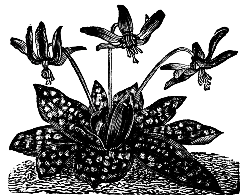
In presenting to our large and growing company
of patrons this, the fifth edition of our book,
our dominant feeling is one of extreme pleasure
at the generous welcome given our preceding
efforts. And we offer this edition in the belief and
hope that it may suggest ideas that may be of use,
and that may be practically carried out in the making
of gardens that must be a source of delight.
The wide-spread desire for better and more artistic
gardening is evidenced by the articles recently
published on the subject by the foremost
and ablest magazines. An excellent article on
“Old Garden Plants,” in Harper’s Monthly for
December, 1887, encourages us greatly in our efforts to popularize the Hardy
Flowers so
loved by our grandmothers, together with many fine plants of more recent
introduction.
As we were the first in this country to gather a fine collection of Hardy Plants
from all
quarters of the earth, and to offer them when there was but small demand for
such, we are
pleased indeed that so much attention is now being given to them, feeling that
our efforts in
behalf of the almost forgotten hardy plants, will tend to the creation of
gardens more permanent
and beautiful, and at much smaller outlay than any that can be made with tender
plants.
The fifth edition of our book is now ready. It is the largest and best work on
hardy plants published in this country, and contains many finely illustrated
articles, among
which are, “A Talk about Roses;” “Hardy Plants and Modes of Arranging Them;”
“The
Making of the Hardy Border;” “Some Beauties in their Native Wilds;”
“Rhododendrons,
Kalmias and Hardy Azaleas;” “Hardy Aquatic Plants;” “Tropical Garden Effects
with
Hardy Plants;” “A Garden Party;” etc., etc.
The book is finely printed on the best of paper, is of real merit and rare
beauty, and will be sent
post-paid, bound in durable flexible covers for 50 cents, or in leather for 75
cents, but the price
paid will be allowed on the first order for plants, making the book really free
to our customers.
Our descriptive catalogue, containing a complete descriptive list of the best
and largest
collection of Hardy Plants in America, sent on receipt of 10 cents in stamps.
Our special list of valuable, low-priced, well-grown plants mailed upon
application.
B. A. ELLIOTT CO., No. 56 Sixth Street, Pittsburgh, Pa.

CHRYSANTHEMUMS
A SPECIALTY.
Our catalogue for Spring of 1888, contains a select
list of New and Old Chrysanthemums, including:
“MRS. ALPHEUS HARDY,”
the beautiful variety figured in this paper.
Also a collection of Fine Flowering Cannas.
EDWIN FEWKES & SON,
NEWTON HIGHLANDS, MASS.

A REAL BONANZA IN SEEDS.—Being one
of the largest growers of Flower Seeds in
America, I want to induce extensive trial,
and for 65cts. will send, postpaid, 32 papers
Choice New Seeds, growth of ’81, 75 to 500
seeds & mixed colors in each. New Large
& Fancy Pansies, the finest ever offered,
(awarded Special Prize by Mass. Hort’l Society)
60 distinct sorts and an endless variety
of rich colors, all mixed; Double Asters;
Japan Pinks, 50 vars. mixed; Large A. D. Phlox;
Double Portulaca; New Godelias; New White Mignonette; New Nivaliana;
Everlastings; New Giant Candytuft; V. Stocks; New Marigolds;
Mottled, Striped and Fringed Petunias; Verbenas, 300 vars.
mixed; New Golden Chrysanthemums; Double Larkspurs; Velvet fl.;
New Yellow Mignonette; Double Gaillardia; New Double Dwarf Zinnias;
Double Salens; New Double White Aster, the finest white ever
offered; Butterfly fl.; Double Daisies & 8 other choice kinds, amounting
to $3.75 at regular rates, but to introduce will send the whole 32
papers for only 65 cts. This is an honest, square offer, but if you doubt
it, send 15 cts. or 5 letter stamps, and I will send you 7 sample papers,
my choice, but including Pansies, Asters and Improved Prize Sweet
Williams, 50 vars. mixed. Am sure a trial will prove all claims. New
Catalogue free. L. W. GOODELL, Pansy Park, Dwight P. O. Mass.

Edited by W. J. YOUMANS,
Is filled with scientific articles by well-known writers on subjects of popular
and practical interest. Its range of topics, which is widening with the advance of science, comprises:
Domestic and Social Economy.
Political Science, or the Functions of Government.
Psychology and Education.
Relations of Science and Religion.
Conditions of Health and Prevention of Disease.
Art and Architecture in Practical Life.
Race Development.
Agriculture and Food-Products.
Natural History; Exploration; Discovery, etc.
It contains Illustrated Articles, Portraits, Biographical Sketches; records the
advance made
in every branch of science; is not technical; and is intended for non-scientific
as well as
scientific readers.
No magazine in the world contains papers of a more instructive and at the same
time of a more interesting character.
Single number, 50 cents.
Yearly subscription, $5.00.
D. APPLETON & CO., Publishers, New York.
POINTS TO ADVERTISERS.
Nothing is sold without pushing, unless it has a monopoly.
No two articles can be pushed in exactly the same way.
In advertising you want to reach possible customers,
not merely people.
The best mediums for one line of goods may be the
worst for another.
Advertising should not be visionary, it should not be
attended to as a mere pastime.
Success means thought, the day of chance successes
is nearly over.
It costs no more to publish good matter than it does
poor.
The preparation of an advertisement is as important as
the publishing.
An advertiser needs an agent, as a client does a lawyer.
The agent, however, asks no retainer and saves his
customer money.
A merchant cannot study advertising all the time—a
good agent studies nothing else.
The customer’s interests are the agent’s. If the agent
is to succeed, the business done must be successful.
The undersigned want business, but not badly enough
to handle what is “questionable.“
They are honest and capable, their customers say, and
they give close personal attention to their business.
HERBERT BOOTH KING & BROTHER,
ADVERTISING AGENTS,
202 Broadway, N. Y.
(Copyright, 1887.)
Send for Circulars.
A VALUABLE WORK UPON
AMERICAN TREES,
Which should be in every Library
in the United States.
Fourth Edition, Just Ready. Price Reduced.
EMERSON’S TREES AND SHRUBS.
| THE |
TREES AND SHRUBS GROWING NATURALLY in the Forests of Massachusetts. By George B. Emerson. Fourth Edition. Superbly illustrated with nearly 150 plates (46 beautiful heliotypes and 100 lithographs), 2 vols. 8vo. Cloth. Price, $10.00 net; formerly $12.00 net. |
| THE |
SAME, with 36 of the plates beautifully colored. Price, $16.00 net; formerly $20.00 net. |
Though this work nominally treats of the trees and The illustrations of these volumes constitute one of Volume I. treats of the Pines, Oaks, Beeches, Chestnuts, Volume II. treats of the Elms, Ashes, Locusts, Maples, | |
LITTLE, BROWN, AND COMPANY, Publishers,
234 Washington Street, Boston.
HOUGHTON MIFFLIN & CO’S
Beautiful New Books.
BIOGRAPHY.
Memoir of Ralph Waldo Emerson.
By James Elliot Cabot. With a fine new steel
Portrait. 2 vols. 12mo, gilt top, $3.50.
Henry Clay.
Vols. XV. and XVI. in series of American Statesmen.
By Carl Schurz. 2 vols. 16mo, gilt
top, $2.50; half morocco, $5.00.
Patrick Henry.
Vol. XVII. of American Statesmen. By Moses
Coit Tyler. 16mo, gilt top, $1.25.
Benjamin Franklin.
Vol. X. of American Men of Letters. By John
Bach Mcmaster, author of “A History of the
People of the United States.“ With a steel
Portrait. 16mo, gilt top, $1.25.
NOVELS AND SHORT STORIES.
The Second Son.
By Mrs. M. O. W. Oliphant and Thomas Bailey
Aldrich. 12mo, $1.50.
The Gates Between.
By Elizabeth Stuart Phelps, author of “The
Gates Ajar,“ “Beyond the Gates,“ etc. $1.25.
Paul Patoff.
By F. Marion Crawford, author of “A Roman
Singer,“ etc. Crown 8vo, $1.50.
Jack the Fisherman.
A powerful and pathetic temperance story. By
Elizabeth Stuart Phelps. 50 cents.
Knitters in the Sun.
A book of excellent Short Stories. By Octave
Thanet. 16mo, $1.25.
A Princess of Java.
A novel of life, character and customs in Java.
By Mrs. S. J. Higginson, 12mo, $1.50.
The Story of Keedon Bluffs.
By Charles Egbert Craddock. A story for
Young Folks, and Older Ones. $1.00.
A New Book by Bret Harte.
“A Phyllis of the Sierras,” and “A Drift from
Redwood Camp,” $1.00.
*** For sale by all Booksellers. Sent by mail,
post-paid, on receipt of price by the Publishers,
HOUGHTON, MIFFLIN & CO., BOSTON.
11 EAST 17TH STREET, NEW YORK.
Shady Hill Nurseries, Cambridge, Mass.
THE SOURCE OF NOVELTIES IN ORNAMENTALS!
The New TREE LILAC (Syringa Japonica) was first grown commercially, and
first sold from Shady Hill Nurseries.
The Beautiful WEEPING LILAC (Syringa Ligustrina Pekinensis Pendula),
called by Mr. Samuel B. Parsons, at the American
Pomological Convention, at Boston (where it was first exhibited and received a
first-class Certificate of Merit from the Mass. Hort. Society),
“the most beautiful of all our small Weeping Trees.” This also will be sent out
in the autumn of this year.
Here also is grown, in large numbers, the lovely little flowering tree, called
the “TEA ROSE CRAB,” the most exquisite of all
our flowering trees. Ten thousand of this tree have been ordered by Messrs. V.
H. Hallock & Son.
Here originated the Hardy Perennial Gaillardia (G. Aristata Templeana of
Peter Henderson’s new catalogue), the most showy and
only hardy Gaillardia of this latitude.
A full descriptive catalogue, of all the things grown at Shady Hill, will be
issued in February, fully illustrated with engravings and containing
four full page lithographs, in eight colors, of the four new trees, viz.: “Tea
Rose Crab,” Tree Lilac, Weeping Lilac, and the Fastigiate-Maiden
Hair Tree. This will be sent free to all who will send address.
F. L. TEMPLE, Cambridge, Mass.
JOHN SAUL’S WASHINGTON NURSERIES.
Our Catalogue of new, rare and beautiful Plants for
1888 will be ready in February. It contains list of all
the most beautiful and rare Green-house and Hot-house
Plants in cultivation, as well as all novelties of merit.
Well grown and at very low prices. Every Plant lover
should have a copy.
ORCHIDS.—A very large stock of choice East
Indian, American, etc. Also, Catalogues of Roses,
Orchids, Seeds, Trees, etc. All free.
JOHN SAUL, Washington, D. C.
WESTERN N. C. ORNAMENTAL SHRUBS AND TREES.
Descriptive Price List sent on application. Detailed
description of the new Rhododendron Vaseyi, with each
List. Azalea arborescens is one of our specialties.
Correspondence solicited.
KELSEY BROS., Highlands Nursery, Highlands, N. C.
G
ARDENERS.
—Thorough, practical man, wants
situation to take charge of a good private place or
institution; 19 years’ experience in Europe and U. S.;
English, age 35, married, one of family; first-class reference.
Address J. S., care H. A. Dreer, 714 Chestnut
St. Philadelphia, Pa.
G
Strawberry, a New Berry of very
fine quality, now offered for the first time.
Also, Jewell, Jessie, Belmont, and other
varieties.
Address. P. M. Augur & Sons, Originators,
Middlefield, Conn.
N
EW PLANTS.
Our illustrated Floral Catalogue
of new, rare and beautiful Plants, Orchids, Palms,
Roses, Bulbs, Vines, Trees, Shrubs and Seeds, also,
all the Novelties of the season, now ready. Every
lover of plants should have a copy. Prices low. Send for
it; FREE to all. PAUL BUTZ & SON. New Castle, Pa.
Y
OU
are about to write for a catalogue. No doubt you want the best—the
truest descriptions, the clearest notes on plant culture, plainest type and
most beautiful illustrations. We have put forth every effort to make ours such.
Those who have seen it, say it is. It tells many reasons why you can buy
SEEDS and Plants—so many of which are grown on the Western prairies—better
and cheaper at CHICAGO than you can elsewhere. Then why not
do so? Our Chicago Parks Flowers and Plants; our Market Vegetables,
and our Gardening Implements make up a book that
TELLS THE WHOLE STORY,
and is a work of art which will please you. Send 15 cents and receive the
catalogue and a paper of the above seeds free.

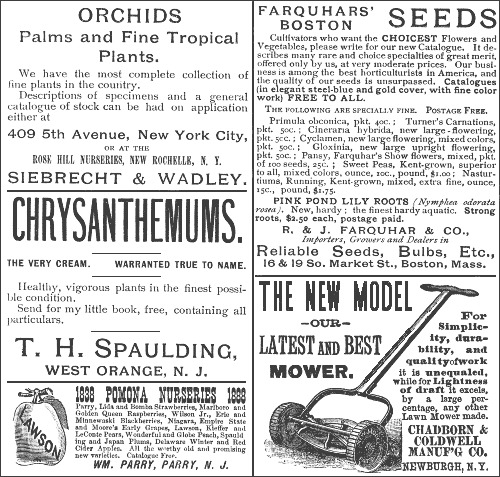
TRIED BY TIME

RACTICAL people
are well pleased with
the recent development
in horticultural
journalism by which
the young AMERICAN GARDEN
absorbed the old Gardener’s
Monthly, which included the Horticulturist,
started by Andrew
Jackson Downing, over forty-two
years ago.
I told our local society just what I really think the
other day, that you come the nearest my ideal of a
Horticultural Monthly for popular circulation of any of
the makers of such literature.—Chas. W. Garfield,
Sec’y Michigan Horticultural Society.
The magazine in now clearly the best horticultural
publication in America, and soon I trust I can say the
best extant.—Dr. E. Lewis Sturtevant.
As much as I regret the melting away of that old
landmark, the Gardener’s Monthly, of which I was a
reader since 1867, as glad I feel that the transfer has
been made into good hands.—R. Maitre. Florist, New
Orleans.
I have been a subscriber to the Gardener’s Monthly
from its first number. I feel sorry that the journal is
going away from Philadelphia, but am glad it has
gone into such good hands.—Chas. H. Miller. Landscape
Gardener, Fairmount Park.
Indispensable to the fruit growers, horticulturists,
gardeners and florists (both practical and amateur) of
this country.—Cyrus T. Fox, State Pomologist of Pennsylvania.
It is a lamentable failing of horticultural educators
in making the work intricate and apparently hard of
execution. Your new cover is in perfect accord with
the contents, viz.: It expresses and teaches horticulture
pure and simple.—Geo. R. Knapp, Rahway, N. J.
Adapted to the wants of Amateurs,
Country Dwellers, Practical
Gardeners and Fruit Growers,
The American Garden has
stood the test of Time, the great
leveler, and receives the endorsements
and support of all these
classes in every section and many
lands.
The equal in cost and value of many $2, and $4 publications,
this handsome and practical illustrated magazine
of horticulture costs only $1.00 a year. In Club
with Garden and Forest for $4.50. Address:
E. H. LIBBY, Publisher, 751 Broadway, N. Y.
The American Florist,
A SEMI-MONTHLY JOURNAL
For florists, and all who grow plants or flowers under
glass. It prints nothing but hard common-sense matter,
the experience of practical men who have been there
themselves and know what they are talking about.
Liberally Illustrated. Price, $1.00 a Year of 24 Numbers.
Sample Copy 6 Cents in Stamps.
American Florist Co., 54 La Salle St., Chicago.
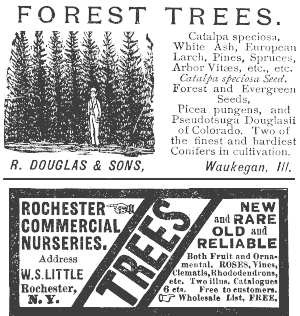
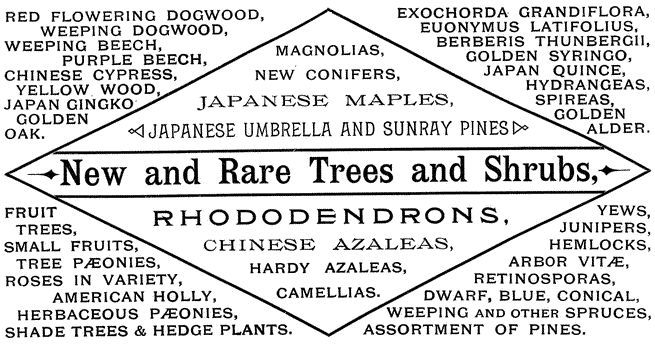
Seeds, Seeds, Seeds.
To our friends who have not
already received it, we are ready
to mail our
NEW CATALOGUE
OF
HIGH CLASS SEEDS
FOR 1888,
Containing all the Novelties of
the Season, both in VEGETABLE,
FLOWER and TREE Seeds.
J. M. Thorburn & Co.,
15 JOHN STREET,
NEW YORK.


OUR MANUAL OF EVERYTHING FOR THE GARDEN
is this season the grandest ever issued,
containing three colored plates and
superb illustrations of everything that is
new, useful and rare in Seeds and
Plants, together with plain directions
of “How to grow them,” by PETER HENDERSON.
This Manual, which is a book
of 140 pages, we mail to any address on
receipt of 25 cents (in stamps.) To all so
remitting 25 cents for the Manual, we will,
at the same time, send free by mail, in
addition, their choice of any one of the
the following novelties, the price of either of
which is 25 cents: One packet of the new
Green and Gold Watermelon or one
packet of new Succession Cabbage, or
one packet of new Zebra Zinnia, or one
packet of Butterfly Pansy (see illustration),
or one packet of new Mammoth
Verbena, or one plant of the beautiful
Moonflower, on the distinct understanding,
however, that those ordering
will state in what paper they saw this
advertisement.


furnished with fresh plants and flowers from the Southern Mountains,
including all the AZALEAS and RHODODENDRONS found east of
the Rockies, I can furnish Rhododendron Vastyi and Shortii galacifolia, and
other rare plants. Order
Shortii early, as it blooms in March and April.
T. G. HARBISON,
Principal of Highlands Academy, Highlands, N. C.
Transcriber’s Note:Missing and/or damaged punctuation has been repaired. Fig. 3, Iris tenuis, has been moved from p. 10 to p. 6 Errata: p. 3: (Floriculture) ‘county’ probably error for ‘country’. p. 4: (Lawn) ‘whch’ corrected to ‘which’ p. vi: (WESTERN N. C. ORNAMENTAL SHRUBS AND TREES). Corrections are also indicated by a dotted line underneath the correction. Scroll the mouse over the word and the original text will appear. |